


All JEE Mains 2024 Physics questions
31 chaptersShowing 151–200 of 593 questions
-
- (A) \(5\)
- (B) \(6\)
- (C) \(4\)
- (D) \(8\)
Show answer and solution
Correct Answer: (D)
\(I_{\max }=(\sqrt{\mathrm{I}}+\sqrt{4 \mathrm{I}})^2=9 \mathrm{I}\)\(\mathrm{I}_{\min }=(\sqrt{4 \mathrm{I}}-\sqrt{\mathrm{I}})^2=\mathrm{I}\)
\(\therefore \mathrm{I}_{\max }-\mathrm{I}_{\min }=8 \mathrm{I}\)
-
- (A) \(1\)
- (B) \(2\)
- (C) \(3\)
- (D) \(5\)
Show answer and solution
Correct Answer: (B)
\(\mathrm{d}=1 \mathrm{~mm}, \mathrm{D}=1 \mathrm{~m}, \lambda=500 \mathrm{~nm}\)\(10\left(\frac{\lambda \mathrm{D}}{\mathrm{d}}\right)=\frac{2 \lambda \mathrm{D}}{\mathrm{a}}\)
\(\mathrm{a}=\frac{\mathrm{d}}{5}\)
\(=\frac{10 \times 10^{-4} \mathrm{~m}}{5}\)
\(=2 \times 10^{-4}\)
-
- (A) \(5\)
- (B) \(8\)
- (C) \(9\)
- (D) \(10\)
Show answer and solution
Correct Answer: (C)
\(\mathrm{n}_2 \lambda_2=\mathrm{n}_1 \lambda_1\)\(\frac{\mathrm{n}_2}{\mathrm{n}_1}=\frac{\lambda_1}{\lambda_2}=\frac{450}{650}=\frac{9}{13}\)
\(\mathrm{n}_2=9\)
-
- (A) 11
- (B) 12
- (C) 13
- (D) 14
Show answer and solution
Correct Answer: (C)
For incoherent wave \(I_1=I_A+I_B \Rightarrow I_1=I_0+9 I_0\)
\(I_1=10 I_0\)
For coherent wave \(I_2=I_A+I_B+2 \sqrt{I_A I_B} \cos 60^{\circ}\)
\(I_2=I_0+9 I_0+2 \sqrt{9 I_0^2} \cdot \frac{1}{2}=13 I_0\)
\(\frac{I_1}{I_2}=\frac{10}{13}\) - 155. When a polaroid sheet is rotated between two crossed polaroids then the transmitted light intensity will be maximum for a rotation of : 2024 Hard
- (A) \(60^{\circ}\)
- (B) \(30^{\circ}\)
- (C) \(90^{\circ}\)
- (D) \(45^{\circ}\)
Show answer and solution
Correct Answer: (D)
Let \(I_0\) be intensity of unpolarised light incident on first polaroid.\(I_1=\) Intensity of light transmitted from \(1^{\text {st }}\) polaroid
\(=\frac{I_0}{2}\)
\(\theta\) be the angle between \(1^{\text {st }}\) and \(2^{\text {nd }}\) polaroid
\(\phi\) be the angle between \(2^{\text {nd }}\) and \(3^{\text {rd }}\) polaroid
\(\theta+\phi=90^{\circ}\) (as \(1^{\text {st }}\) and \(3^{\text {rd }}\) polaroid are crossed)
\(\phi=90^{\circ}-\theta\)
\(\mathrm{I}_2=\) Intensity from \(2^{\text {nd }}\) polaroid
\(I_2=I_1 \cos ^2 \theta=\frac{I_0}{2} \cos ^2 \theta\)
\(\mathrm{I}_3=\) Intensity from \(3^{\text {rd }}\) polaroid
\(\mathrm{I}_3=\mathrm{I}_2 \cos ^2 \phi\)
\(\mathrm{I}_3=\mathrm{I}_1 \cos ^2 \theta \cos ^2 \phi\)
\(\mathrm{I}_3=\frac{\mathrm{I}_0}{2} \cos ^2 \theta \cos ^2 \phi\)
\(\phi=90-\theta\)
\(I_3=\frac{I_0}{2} \cos ^2 \theta \sin ^2 \theta\)
\(I_3=\frac{I_0}{2}\left[\frac{2 \sin \theta \cos \theta}{2}\right]^2\)
\(I_3=\frac{I_0}{8} \sin ^2 2 \theta\)
\(\mathrm{I}_3\) will be maximum when \(\sin 2 \theta=1\)
\( 2 \theta=90^{\circ} \)
\( \theta=45^{\circ}\)
-
- (A) \(30^{\circ}\)
- (B) \(60^{\circ}\)
- (C) \(90^{\circ}\)
- (D) \(45^{\circ}\)
Show answer and solution
Correct Answer: (A)
At complete reflection refracted ray and reflected ray are perpendicular.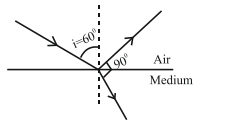
-
- (A) \(-16 \mathrm{~cm}\)
- (B) \(-160 \mathrm{~cm}\)
- (C) \(+160 \mathrm{~cm}\)
- (D) \(+16 \mathrm{~cm}\)
Show answer and solution
Correct Answer: (B)
\( \mu_1=1.5 \)\( \mu_{\mathrm{m}}=1.6 \)
\( \mathrm{f}_{\mathrm{a}}=20 \mathrm{~cm}\)
\( \text { As } \frac{f_m}{f_a}=\frac{\left(\mu_1-1\right) \mu_m}{\left(\mu_1-\mu_m\right)} \)
\( \frac{f_m}{20}=\frac{(1.5-1) 1.6}{(1.5-1.6)} \)
\( f_m=-160 \mathrm{~cm}\)
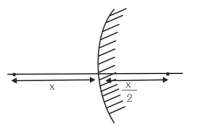
- 158. A convex mirror of radius of curvature \(30 \mathrm{~cm}\) forms an image that is half the size of the object. The object distance is : 2024 Hard
- (A) \(-15 \mathrm{~cm}\)
- (B) \(45 \mathrm{~cm}\)
- (C) \(-45 \mathrm{~cm}\)
- (D) \(15 \mathrm{~cm}\)
Show answer and solution
Correct Answer: (A)
\( \text { Given } R=30 \mathrm{~cm} \)\( \mathrm{f}=\mathrm{R} / 2=+15 \mathrm{~cm}\)
Magnification \((\mathrm{m})= \pm \frac{1}{2}\)
For convex mirror, virtual image is formed for real object.
Therefore, \(\mathrm{m}\) is +ve
\( \frac{1}{2}=\frac{f}{f-u} \)
\( u=-15 \mathrm{~cm}\)
-
- (A) \(1\)
- (B) \(2\)
- (C) \(3\)
- (D) \(4\)
Show answer and solution
Correct Answer: (B)
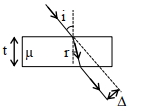
\(i=\theta_c\)\(\Rightarrow i=\sin ^{-1}\left(\frac{1}{\mu}\right)\)
\(\Rightarrow i=45^{\circ}\)
\(\text { and according to snell's law }\)
\(1 \sin 45^{\circ}=\sqrt{2} \sin r\)
\(\Rightarrow \mathrm{r}=30^{\circ}\)
\(\text { Lateral displacement } \Delta=\frac{\mathrm{t} \sin (\mathrm{i}-\mathrm{r})}{\cos \mathrm{r}}\)
\(\Rightarrow \Delta=\frac{4 \sqrt{3} \times \sin 15^{\circ}}{\cos 30^{\circ}}\)
\(\Rightarrow \Delta=2 \mathrm{~cm}\)
-
- (A) \(20 \mathrm{~cm}\)
- (B) \(50 \mathrm{~cm}\)
- (C) \(500 \mathrm{~cm}\)
- (D) \(25 \mathrm{~cm}\)
Show answer and solution
Correct Answer: (A)
\(\text { We know that } P_{e q}=\Sigma P_i\)\(\therefore \text { given all lenses are identical }\)
\(\therefore 5 P=25 D\)
\(\therefore P=5 D\)
\(\therefore \frac{1}{f}=5 \Rightarrow f=\frac{1}{5} \mathrm{~m}=20 \mathrm{~cm}\)
Hence option \((1)\)
-
- (A) \(\sqrt{2}: 1\)
- (B) \(1: 2\)
- (C) \(1: \sqrt{2}\)
- (D) \(2: 1\)
Show answer and solution
Correct Answer: (A)
\(\sin \theta_c=\frac{\mu_R}{\mu_d}=\frac{\mu_2}{\mu_1}\)\(\sin 45^{\circ}=\frac{\mu_2}{\mu_1}\)
\(\Rightarrow \frac{1}{\sqrt{2}}=\frac{\mu_2}{\mu_1}\)
\(\Rightarrow \frac{\mu_1}{\mu_2}=\frac{\sqrt{2}}{1}\)
-
- (A) \(1.2\)
- (B) \(1.4\)
- (C) \(1.5\)
- (D) \(1.8\)
Show answer and solution
Correct Answer: (C)
\(\frac{1}{\mathrm{f}}=\left(\frac{\mu_{\mathrm{ears}}}{\mu_{\mathrm{alr}}}-1\right)\left(\frac{1}{\mathrm{R}_1}-\frac{1}{\mathrm{R}_2}\right)\)\(\Rightarrow \frac{1}{+20}=\left(\frac{\mu}{1}-1\right)\left(\frac{1}{+15}-\frac{1}{(-30)}\right)\)
\(\Rightarrow \frac{1}{20}=(\mu-1)\left(\frac{3}{30}\right)\)
\(\Rightarrow \mu-1=\frac{1}{2}\)
\(\Rightarrow \mu=1+\frac{1}{2}=\frac{3}{2}=1 \cdot 5\)
-
- (A) Both Statement \(I\) and Statement \(II\) are true.
- (B) Statement \(I\) is true but Statement \(II\) is false.
- (C) Both Statement \(I\) and Statement \(II\) are false.
- (D) Statement \(I\) is false but Statement \(II\) is true.
Show answer and solution
Correct Answer: (A)
As \(\lambda_{\text {red }}>\lambda_{\text {yellow }}>\lambda_{\text {violet }}\)Light ray with longer wavelength bends less.
-
- (A) Both Statement I and Statement II are true
- (B) Both Statement I and Statement II are false
- (C) Statement I is true but Statement II is false
- (D) Statement I is false but Statement II is true
Show answer and solution
Correct Answer: (A)
Both Statement I and Statement II are true -
- (A) Both Statement \(I\) and Statement \(II\) are false.
- (B) Statement \(I\) is false but Statement \(II\) is true.
- (C) Statement \(I\) is true but Statement \(II\) is false.
- (D) Both Statement \(I\) and Statement \(II\) are true.
Show answer and solution
Correct Answer: (B)
Conceptual. -
- (A) Radius of curvature of concave surface
- (B) Specific rotation of liquids
- (C) Thickness of thin plates
- (D) Radius of curvature of convex surface
Show answer and solution
Correct Answer: (B)
Spherometer can be used to measure curvature of surface. -
- (A) \(15 \mathrm{~cm}\)
- (B) \(-12 \mathrm{~cm}\)
- (C) \(-10 \mathrm{~cm}\)
- (D) \(10 / 3 \mathrm{~cm}\)
Show answer and solution
Correct Answer: (C)
\( \mathrm{m}=2=\frac{-\mathrm{v}}{\mathrm{u}} \)
\( 2=\frac{-(15-\mathrm{u})}{-\mathrm{u}} \)
\( 2 \mathrm{u}=15-\mathrm{u} \)
\( 3 \mathrm{u}=15 \Rightarrow \mathrm{u}=5 \mathrm{~cm} \)
\( \mathrm{v}=15-\mathrm{u}=15-5=10 \mathrm{~cm} \)
\( \frac{1}{\mathrm{f}}=\frac{1}{\mathrm{v}}+\frac{1}{\mathrm{u}} \)
\( =\frac{1}{10}+\frac{1}{(-5)}=\frac{1-2}{10}=\frac{-1}{10} \)
\( \mathrm{f}=-10 \mathrm{~cm}\)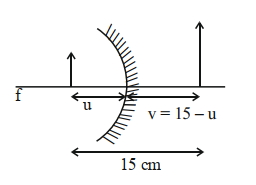
-
- (A) \(\pi-2 \mathrm{~A}\)
- (B) \(\frac{\pi}{2}-2 \mathrm{~A}\)
- (C) \(\pi-\mathrm{A}\)
- (D) \(\frac{\pi}{2}-\mathrm{A}\)
Show answer and solution
Correct Answer: (A)
\( \cot \frac{A}{2}=\frac{\sin \left(\frac{A+\delta_{\min }}{2}\right)}{\sin \frac{A}{2}} \)\( \Rightarrow \cos \frac{A}{2}=\sin \left(\frac{A+\delta_{\min }}{2}\right) \)
\( \frac{A+\delta_{\min }}{2}=\frac{\pi}{2}-\frac{A}{2} \)
\( \delta_{\min }=\pi-2 A\)
-
- (A) \(\frac{\Delta \mathrm{u}}{\mathrm{u}}+\frac{\Delta \mathrm{v}}{\mathrm{v}}\)
- (B) \(f^2\left[\frac{\Delta u}{u^2}+\frac{\Delta v}{v^2}\right]\)
- (C) \(2 \mathrm{f}\left[\frac{\Delta \mathrm{u}}{\mathrm{u}}+\frac{\Delta \mathrm{v}}{\mathrm{v}}\right]\)
- (D) \(f\left[\frac{\Delta u}{u}+\frac{\Delta v}{v}\right]\)
Show answer and solution
Correct Answer: (B)
\(f^{-1}=v^{-1}-u^{-1}\)\(-f^{-2} d f=-v^{-2} d v-u^{-2} d u\)
\(\frac{d f}{f^2}=\frac{d v}{v^2}+\frac{d u}{u^2}\)
\(d f=f^2\left[\frac{d v}{v^2}+\frac{d u}{u^2}\right]\)
-
- (A) \(50\)
- (B) \(40\)
- (C) \(30\)
- (D) \(20\)
Show answer and solution
Correct Answer: (D)
\(\frac{1}{f+20}-\frac{1}{-(f+20)}=\frac{1}{f}\)
\(\frac{2}{f+20}=\frac{1}{f} \quad f=20 \mathrm{~cm}\)
Or \(x_1 x_2=f^2\) gives \(f=20 \mathrm{~cm}\) -
- (A) \(100\)
- (B) \(200\)
- (C) \(300\)
- (D) \(400\)
Show answer and solution
Correct Answer: (B)
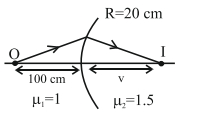
\(\frac{\mu_2}{\mathrm{v}}-\frac{\mu_1}{\mathrm{u}}=\frac{\mu_2-\mu_1}{\mathrm{R}}\)\(\frac{1.5}{\mathrm{v}}-\frac{1}{-100}=\frac{1.5-1}{20}\)
\(\mathrm{v}=100 \mathrm{~cm}\)
Distance from object
\(=100+100\)
\(=200 \mathrm{~cm}\)
-
- (A) \(10 \mathrm{~cm}\)
- (B) \(15 \mathrm{~cm}\)
- (C) \(25 \mathrm{~cm}\)
- (D) \(35 \mathrm{~cm}\)
Show answer and solution
Correct Answer: (C)
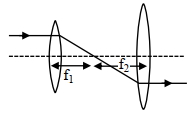
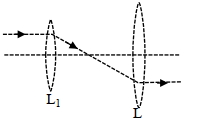
\(D=f_1+f_2=25 \mathrm{~cm}\)Paraxial parallel rays pass through focus and ray from focus of convex lens will become parallel
-
- (A) \(20\)
- (B) \(14\)
- (C) \(15\)
- (D) \(30\)
Show answer and solution
Correct Answer: (C)
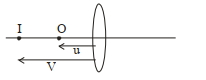
\(\mathrm{v}=3 \mathrm{u}\)\(\mathrm{v}-\mathrm{u}=20 \mathrm{~cm}\)
\(2 \mathrm{u}=20 \mathrm{~cm}\)
\(\mathrm{u}=10 \mathrm{~cm}\)
\(\frac{1}{(-30)}-\frac{1}{(-10)}=\frac{1}{\mathrm{f}}\)
\(\mathrm{f}=15 \mathrm{~cm}\)
-
- (A) \(10\)
- (B) \(4\)
- (C) \(13\)
- (D) \(85\)
Show answer and solution
Correct Answer: (A)
\( \frac{v}{u}=-2 \)\( v=-2 u \ldots(i) \)
\( v-u=45 \) \(...........(ii)\)
\( \Rightarrow u=-15 \mathrm{~cm} \)
\( v=30 \mathrm{~cm} \)
\( \frac{1}{f}=\frac{1}{v}-\frac{1}{u} \)
\( f=+10 \mathrm{~cm}\)
-
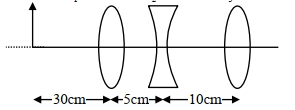
- (A) \(30 \mathrm{~cm}\) (right of third lens)
- (B) \(15 \mathrm{~cm}\) (left of second lens)
- (C) \(30 \mathrm{~cm}\) (left of third lens)
- (D) \(15 \mathrm{~cm}\) (right of second lens)
Show answer and solution
Correct Answer: (A)
For lens \(1: f_1=10, u=-30, v=\) ?\(v=\frac{u f}{u+f}=\frac{-30 \times 10}{-30+10}=15\)
For lens 2: \(f_1=-10, u=10, v=\) ?
\(\mathrm{v}=\frac{\mathrm{uf}}{\mathrm{u}+\mathrm{f}}=\frac{10 \times-10}{10-10}=\infty\)
For lens \(3: f=30, u=-\infty, v=\) ?
So v will be \(30\).
- 176. The refractive index of a prism with apex angle \(A\) is \(\cot A / 2\). The angle of minimum deviation is _______. 2024 Hard
- (A) \(\delta_{\mathrm{m}}=180^{\circ}-\mathrm{A}\)
- (B) \(\delta_m=180^{\circ}-3 \mathrm{~A}\)
- (C) \(\delta_m=180^{\circ}-4 \mathrm{~A}\)
- (D) \(\delta_{\mathrm{m}}=180^{\circ}-2 \mathrm{~A}\)
Show answer and solution
Correct Answer: (D)
\(\mu=\frac{\sin \left(\frac{A+\delta m}{2}\right)}{\sin \frac{A}{2}}\)\(\frac{\cos \frac{A}{2}}{\sin \frac{A}{2}}=\frac{\sin \left(\frac{A+\delta m}{2}\right)}{\sin \frac{A}{2}}\)
\(\sin \left(\frac{\pi}{2}-\frac{A}{2}\right)=\sin \left(\frac{A+\delta_m}{2}\right)\)
\(\frac{\pi}{2}-\frac{A}{2}=\frac{A}{2}+\frac{\delta m}{2}\)
\(\delta_m=\pi-2 A\)
-
- (A) \(60\)
- (B) \(70\)
- (C) \(75\)
- (D) \(80\)
Show answer and solution
Correct Answer: (A)
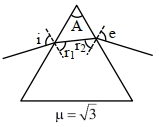
\(\text { For } \delta_{\min }\)\(\mathrm{i}=\mathrm{e}\)
\(\mathrm{r}_1=\mathrm{r}_2=\frac{\mathrm{A}}{2}\)
\(\frac{\delta_{\min }}{\mathrm{A}}=1\)
\(\frac{2 \mathrm{i}-\mathrm{A}}{\mathrm{A}}=1\)
\(2 \mathrm{i}=2 \mathrm{~A}\)
\(\mathrm{i}=\mathrm{A}\)
Snell's law
\(1 \times \sin i=\mu \sin r\)
\(\sin i=\mu \sin \left(\frac{A}{2}\right)\)
\(\sin A=\mu \sin \left(\frac{A}{2}\right)\)
\(2 \sin \frac{A}{2} \cos \frac{A}{2}=\sqrt{3} \sin \left(\frac{A}{2}\right)\)
\(\cos \left(\frac{A}{2}\right)=\frac{\sqrt{3}}{2}\)
\(\therefore \frac{A}{2}=30^{\circ}\)
\(\therefore A=60^{\circ}\)
-
- (A) \(64\)
- (B) \(85\)
- (C) \(65\)
- (D) \(31\)
Show answer and solution
Correct Answer: (D)
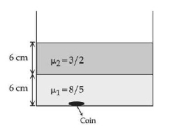
\(\mathrm{h}_{z p p}=\frac{\mathrm{h}_1}{\mu_1}+\frac{\mathrm{h}_2}{\mu_2}=\frac{6}{3 / 2}+\frac{6}{8 / 5}=4+\frac{15}{4}=\frac{31}{4} \mathrm{~cm}\) -
- (A) \(5\)
- (B) \(6\)
- (C) \(7\)
- (D) \(8\)
Show answer and solution
Correct Answer: (D)
\(I_{\text {rms }}=\sqrt{\frac{\int i^2 d t}{\int d t}}\)\(I_{\text {rms }}=\sqrt{(6)^2+\frac{(\sqrt{56})^2}{2}}\)
\(=\sqrt{36+28}\)
\(=\sqrt{64}\)
\(=8 \mathrm{~A}\)
-
- (A) increases
- (B) remains same
- (C) becomes zero
- (D) decreases
Show answer and solution
Correct Answer: (A)
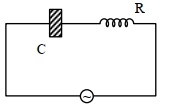
\(\mathrm{Z}=\sqrt{\mathrm{R}^2+\mathrm{X}_{\mathrm{C}}^2} \& \mathrm{X}_{\mathrm{C}}=\frac{1}{\mathrm{WC}}\)due to dielectric
\(\mathrm{C} \uparrow \Rightarrow \mathrm{X}_{\mathrm{c}} \downarrow \Rightarrow \mathrm{Z} \downarrow\)
So, current increases & thus bulb will glow more brighter.
-
- (A) \(3.2 \mathrm{~A}\)
- (B) \(1.5 \mathrm{~A}\)
- (C) \(2.0 \mathrm{~A}\)
- (D) \(1.2 \mathrm{~A}\)
Show answer and solution
Correct Answer: (B)
By energy conservation\( \frac{1}{2} \mathrm{CV}^2=\frac{1}{2} \mathrm{LI}_{\max }^2 \)
\( \mathrm{I}_{\max }=\sqrt{\frac{\mathrm{C}}{\mathrm{L}}} \mathrm{V} \)
\( =\sqrt{\frac{100 \times 10^{-6}}{6.4 \times 10^{-3}}} \times 12\)
\( =\frac{12}{8}=\frac{3}{2}=1.5 \mathrm{~A}\)
-
- (A) \(3\)
- (B) \(2\)
- (C) \(4\)
- (D) \(5\)
Show answer and solution
Correct Answer: (C)
\(\mathrm{Z}=\sqrt{\mathrm{R}^2+\mathrm{X}^2 \mathrm{~L}}\)
\(\mathrm{Z}=\sqrt{4^2+(4 \sqrt{3})^2}=8 \Omega\)
\(\mathrm{V}_{\mathrm{mms}}=\frac{\mathrm{V}}{\sqrt{2}}=\frac{8 \sqrt{2}}{\sqrt{2}}=(8 \mathrm{~V})\)
\(\mathrm{I}_{\mathrm{rms}}=\frac{\mathrm{V}_{\mathrm{rms}}}{\mathrm{z}}=\frac{8}{8}=1 \mathrm{~A}\)
Power dissipated \(=\mathrm{I}_{\mathrm{rms}}^2 \times \mathrm{R}=1 \times 4=(4 \mathrm{~W})\)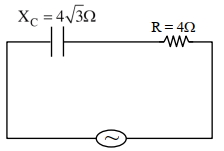
-
- (A) \(0.76 \mathrm{H}\)
- (B) \(2.86 \mathrm{H}\)
- (C) \(0.286 \mathrm{H}\)
- (D) \(0.91 \mathrm{H}\)
Show answer and solution
Correct Answer: (A)
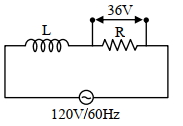
\(36=I_{\text {ms }} R\)\(36=\frac{120}{\sqrt{\mathrm{X}_{\mathrm{L}}^2+\mathrm{R}^2}} \times \mathrm{R}\)
\(\mathrm{R}=90 \Omega \Rightarrow 36=\frac{120 \times 90}{\sqrt{\mathrm{X}_{\mathrm{L}}^2+90^2}}\)
\(\sqrt{\mathrm{X}_{\mathrm{L}}^2+90^2}=300\)
\(\mathrm{X}_{\mathrm{L}}^2=81900\)
\(\mathrm{X}_{\mathrm{L}}=286.18\)
\(\omega \mathrm{L}=286.18\)
\(\mathrm{~L}=\frac{286.18}{376.8}\)
\(\mathrm{~L}=0.76 \mathrm{H}\)
-
- (A) \(1.38 \mu \mathrm{A}\) and \(1.38 \mu \mathrm{A}\)
- (B) \(14.3 \mu \mathrm{A}\) and \(143 \mu \mathrm{A}\)
- (C) \(13.8 \mu \mathrm{A}\) and \(138 \mu \mathrm{A}\)
- (D) \(13.8 \mu \mathrm{A}\) and \(13.8 \mu \mathrm{A}\)
Show answer and solution
Correct Answer: (D)
\(I=\frac{V}{X_C}=230 \times 300 \times 200 \times 10^{-12}=13.8 \mu \mathrm{A}\) -
- (A) \(5\)
- (B) \(1\)
- (C) \(45\)
- (D) \(43\)
Show answer and solution
Correct Answer: (B)
\( \mathrm{X}_{\mathrm{c}}=\frac{1}{\omega \mathrm{C}}=\frac{\pi}{2 \pi \times 50 \times 10^{-3}}=10\ \Omega \)\( \mathrm{x}_{\mathrm{L}}=\omega \mathrm{L}=2 \pi \times 50 \times \frac{100}{\pi} \times 10^{-3} \)
\( =10\ \Omega \)
\( \because \mathrm{x}_{\mathrm{C}}=\mathrm{x}_{\mathrm{L}}, \text { Hence, circuit is in resonance } \)
\( \therefore \text { power factor }=\frac{\mathrm{R}}{\mathrm{Z}}=\frac{\mathrm{R}}{\mathrm{R}}=1\)
-
- (A) \(68 \mathrm{~A}\)
- (B) \(63 \mathrm{~A}\)
- (C) \(10 \mathrm{~A}\)
- (D) \(10 \mathrm{~mA}\)
Show answer and solution
Correct Answer: (C)
Voltage across inductor \(\mathrm{V}_{\mathrm{L}}=\mathrm{IX}_{\mathrm{L}}\)\(31.4=\mathrm{I}[\mathrm{L} \omega]\)
\(31.4=\mathrm{I}[\mathrm{L}(2 \pi \mathrm{f})]\)
\(31.4=\mathrm{I}\left[10 \times 10^{-3}(2 \times 3.14) \times 50\right.\)
\(\Rightarrow \mathrm{I}=10 \mathrm{~A}\)
-
- (A) \(\frac{1}{\sqrt{2}}\)
- (B) \(\frac{1}{\sqrt{3}}\)
- (C) \(\frac{1}{\sqrt{5}}\)
- (D) \(\frac{1}{\sqrt{7}}\)
Show answer and solution
Correct Answer: (C)
\( E=25 \sin (1000 t) \)\( \cos \theta=\frac{1}{\sqrt{2}}\)
LR circuit
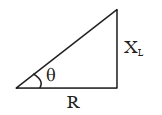
\( \text { Initially } \frac{R}{\omega_1 L}=\frac{1}{\tan \theta}=\frac{1}{\tan 45^{\circ}}= \)
\( X_L=\omega_1 L \)
\( \omega_2=2 \omega_1 \text {, given } \)
\( \tan \theta^{\prime}=\frac{\omega_2 L}{R}=\frac{2 \omega_1 L}{R} \)
\( \tan \theta^{\prime}=2 \)
\( \cos \theta^{\prime}=\frac{1}{\sqrt{5}}\)
-
- (A) \(22\)
- (B) \(20\)
- (C) \(25\)
- (D) \(30\)
Show answer and solution
Correct Answer: (A)
\(C=2 \mu f ; \quad E=110 \sqrt{2} \sin (100 \mathrm{t})\)\(\mathrm{X}_{\mathrm{C}}=\frac{1}{\omega c}=\frac{1}{100 \times 2 \times 10^6}\)
\(=\frac{10000}{2}=5000 \Omega\)
\(\mathrm{i}_0=\frac{110 \sqrt{2}}{5000}\)
\(\mathrm{i}_{\mathrm{rms}}=\frac{110 \sqrt{2}}{5000 \sqrt{2}}\)
\(=\frac{110}{5} \mathrm{~mA}\)
\(=22 \mathrm{~mA}\)
-
- (A) \(20\)
- (B) \(30\)
- (C) \(40\)
- (D) \(50\)
Show answer and solution
Correct Answer: (D)
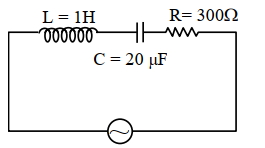
\(\mathrm{X}_{\mathrm{L}}=\omega \mathrm{L}=100 \times 1=100 \Omega\)
\(\mathrm{X}_{\mathrm{C}}=\frac{1}{\omega \mathrm{C}}=\frac{1}{100 \times 20 \times 10^{-6}}=500 \Omega\)
\(\mathrm{Z}=\sqrt{\left(\mathrm{X}_{\mathrm{L}}-\mathrm{X}_{\mathrm{C}}\right)^2+\mathrm{R}^2}\)
\(\sqrt{(100-500)^2+300^2}\)
\(\mathrm{Z}=500 \Omega\)
\(\mathrm{i}_{\text {ms }}=\frac{\mathrm{V}_{\text {ms }}}{\mathrm{Z}}=\frac{50}{500}=0.1 \mathrm{~A}\)
\(\text { rms voltage across capacitor }\)
\(\mathrm{V}_{\text {ms }}=\mathrm{X}_{\mathrm{C}} \mathrm{i}_{\mathrm{mms}}\)
\(=500 \times 0.1=50 \mathrm{~V}\) -
- (A) \(21.6 \mathrm{~W}\)
- (B) \(200 \mathrm{~W}\)
- (C) \(173.2 \mathrm{~W}\)
- (D) \(50 \mathrm{~W}\)
Show answer and solution
Correct Answer: (D)
\(\langle\mathrm{P}\rangle=\mathrm{IV} \cos \phi\)\(=\frac{20}{\sqrt{2}} \times \frac{10}{\sqrt{2}} \times \cos 60^{\circ}\)
\(=50 \mathrm{~W}\)
-
- (A) \(5 \mathrm{~ms}\)
- (B) \(3.3 \mathrm{~ms}\)
- (C) \(7.2 \mathrm{~ms}\)
- (D) \(2.2 \mathrm{~ms}\)
Show answer and solution
Correct Answer: (B)
Given equation of alternating voltage:
\( V(t) = 220 \sin(100 \pi t) \)
Comparing this with the standard alternating voltage equation \( V(t) = V_0 \sin(\omega t) \), we get:
Peak voltage, \( V_0 = 220\text{ V} \)
Angular frequency, \( \omega = 100 \pi\text{ rad/s} \)
For a purely resistive load, the current \( I(t) \) is in phase with the voltage and is given by:
\( I(t) = I_0 \sin(\omega t) \) (where \( I_0 \) is the peak current value)
Step 1: Find the time \( t_1 \) when the current reaches half of its peak value \( \left(\frac{I_0}{2}\right) \):
\( I(t_1) = \frac{I_0}{2} \)
\( I_0 \sin(\omega t_1) = \frac{I_0}{2} \)
\( \sin(\omega t_1) = \frac{1}{2} \)
\( \omega t_1 = \frac{\pi}{6} \implies t_1 = \frac{\pi}{6\omega} \)
Step 2: Find the time \( t_2 \) when the current reaches its full peak value \( (I_0) \):
\( I(t_2) = I_0 \)
\( I_0 \sin(\omega t_2) = I_0 \)
\( \sin(\omega t_2) = 1 \)
\( \omega t_2 = \frac{\pi}{2} \implies t_2 = \frac{\pi}{2\omega} \)
Step 3: Calculate the time taken \( t \) to rise from half of the peak value to the peak value:
\( t = t_2 - t_1 = \frac{\pi}{2\omega} - \frac{\pi}{6\omega} \)
\( t = \frac{3\pi - \pi}{6\omega} = \frac{2\pi}{6\omega} = \frac{\pi}{3\omega} \)
Explanation of your doubt (\( \frac{\pi}{3\omega} = \frac{\pi}{300\pi} \)):
Since we found \( \omega = 100\pi \) from the given voltage equation, substituting this value into the denominator gives:
\( 3\omega = 3 \times 100\pi = 300\pi \)
Now, substitute \( \omega = 100\pi \) into the time equation:
\( t = \frac{\pi}{3 \times 100\pi} = \frac{\pi}{300\pi} \)
\( t = \frac{1}{300}\text{ seconds} \)
Converting seconds into milliseconds (\( 1\text{ s} = 1000\text{ ms} \)):
\( t = \frac{1}{300} \times 1000\text{ ms} = \frac{10}{3}\text{ ms} \approx 3.33\text{ ms} \)
Therefore, the correct option is B. -
- (A) \(9\)
- (B) \(10\)
- (C) \(11\)
- (D) \(12\)
Show answer and solution
Correct Answer: (B)
for maximum current, circuit must be in resonance\(\mathrm{f}_0=\frac{1}{2 \pi \sqrt{\mathrm{L} \times \mathrm{C}}}\)
\(\mathrm{f}_0=\frac{1}{2 \pi \sqrt{100 \times 10^{-3} \times 2.5 \times 10^{-9}}}\)
\(=\frac{1}{2 \pi \sqrt{25 \times 10^{-11}}}\)
\(=\frac{1}{2 \pi \times 5} \times 10^5 \times \sqrt{10} \mathrm{~Hz}\)
\(=\frac{100}{10} \times 10^3 \mathrm{~Hz}\)
\(\mathrm{f}_0=10 \times 10^3 \mathrm{~Hz}\)
-
- (A) Statement \(I\) is true but Statement \(II\) is false
- (B) Statement \(I\) is false but Statement \(II\) is true
- (C) Both Statement \(I\) and Statement \(II\) are true
- (D) Both Statement \(I\) and Statement \(II\) are false
Show answer and solution
Correct Answer: (C)
Statement-\(I\)\(\mathrm{I}_{\mathrm{m}}=\frac{\mathrm{V}_{\mathrm{m}}}{\sqrt{\mathrm{R}^2+\left(\mathrm{X}_{\mathrm{L}}-\mathrm{X}_{\mathrm{C}}\right)^2}}\) at resonance \(\mathrm{X}_{\mathrm{L}}=\mathrm{X}_{\mathrm{C}}\)
Thus, \(I_m=\frac{V_m}{R}\)
\(\because\) Impendence is minimum therefore \(I\) is maximum at resonance.
Statement-\(II\)
\(\mathrm{I}=\left(\frac{\mathrm{V}}{\mathrm{R}}\right)\) in purely resistive circuit.
-
- (A) \(5 \mathrm{~W}\)
- (B) \(10 \mathrm{~W}\)
- (C) \(2.5 \mathrm{~W}\)
- (D) \(25 \mathrm{~W}\)
Show answer and solution
Correct Answer: (C)
\( P_{\text {avg }}=V_{\text {rms }} I_{\text {rms }} \cos (\Delta \phi) \)\( =\frac{100}{\sqrt{2}} \times \frac{100 \times 10^{-3}}{\sqrt{2}} \times \cos \left(\frac{\pi}{3}\right) \)
\( =\frac{10^4}{2} \times \frac{1}{2} \times 10^{-3} \)
\( =\frac{10}{4}=2.5 \mathrm{~W}\)
-
- (A) \(A, B\) and \(C\) only
- (B) \(B, C\) and \(D\) only
- (C) \(A\) and \(B\) only
- (D) \(A, B\) and \(D\) only
Show answer and solution
Correct Answer: (D)
This is possible when phase difference is \(\frac{\pi}{2}\) between current and voltage so correct answer will be \((4)\) -
- (A) Zero
- (B) double
- (C) same
- (D) halved
Show answer and solution
Correct Answer: (B)
In resonance \(Z=R\)\(\mathrm{I}=\frac{\mathrm{V}}{\mathrm{R}}\)
\(\mathrm{R} \rightarrow \text { halved }\)
\(\Rightarrow \mathrm{I} \rightarrow 2 \mathrm{I}\)
I becomes doubled.
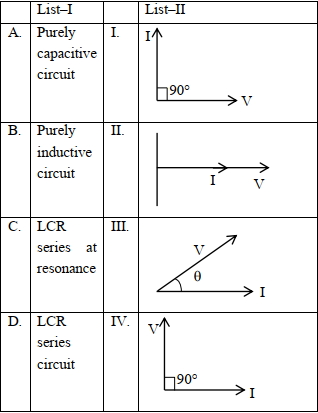
- 197. Match List I with List \(II\) Choose the correct answer from the options given below:
 2024 Hard
- (A) \(A-I, B-IV, C-III, D-II\)
- (B) \(A-IV, B-I, C-III, D-II\)
- (C) \(A-IV, B-I, C-II, D-III\)
- (D) \(A-I, B-IV, C-II, D-III\)
Show answer and solution
Correct Answer: (D)
\(A - V\) lags by \(90^{\circ}\) from I hence option \((I)\) is correct.\(B - V\) lead by \(90^{\circ}\) from \(I\) hence option \((IV)\) is correct
\(\mathrm{C}-\mathrm{In} \mathrm{LCR}\) resonance \(\mathrm{X}_{\mathrm{L}}=\mathrm{X}_{\mathrm{C}}\). Hence circuit is purely resistive so option \((II)\) is correct \(D\) - In LCR series \(V\) is at some angle from \(I\) hence \((III)\) is correct
Hence option \((4)\) is correct.
-
- (A) \(8\)
- (B) \(7\)
- (C) \(9\)
- (D) \(10\)
Show answer and solution
Correct Answer: (D)
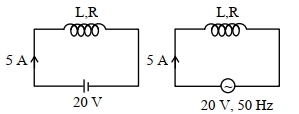
(Image)Case-\(I\):
\(\mathrm{i}=\frac{20}{\mathrm{R}} \Rightarrow \mathrm{R}=4 \Omega\)
Case-\(II\):
(Image)
\(i=\frac{20}{Z}\)
\(4=\frac{20}{\sqrt{R^2+X_L^2}} \Rightarrow \sqrt{R^2+X_L^2}=5\)
\(R^2+X_L^2=25 \Rightarrow X_L=3 \Omega\)
\(L=\frac{3}{2 \pi f}=\frac{1}{2 \times 50}=\frac{1000}{100} m H\)
\(L=10 m H\)
-
- (A) \(238\)
- (B) \(240\)
- (C) \(245\)
- (D) \(250\)
Show answer and solution
Correct Answer: (D)
For \(DC\) voltage\(\mathrm{R}=\frac{\mathrm{V}}{\mathrm{I}}=\frac{100}{5}=20 \Omega\)
for \(AC\) voltage
\(\mathrm{X}_{\mathrm{L}}=20 \sqrt{3} \Omega\)
\(\mathrm{R}=20 \Omega\)
\(\mathrm{Z}=\sqrt{\mathrm{X}_{\mathrm{L}}^2+\mathrm{R}^2}=\sqrt{3 \times 400+400}=40\)
Power \(-i_{\text {rms }}^2 R\)
\(=\left(\frac{\mathrm{V}_{\text {rms }}}{\mathrm{Z}}\right)^2 \times \mathrm{R}=\left(\frac{\frac{200}{\sqrt{2}}}{40}\right)^2 \times 20=250 \mathrm{~W}\)
-
- (A) \(8\)
- (B) \(9\)
- (C) \(10\)
- (D) \(11\)
Show answer and solution
Correct Answer: (A)
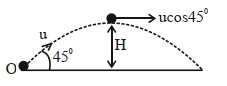
\(\mathrm{L}=\mathrm{mu} \cos \theta \frac{\mathrm{u}^2 \sin ^2 \theta}{2 \mathrm{~g}}\)\(=m \mathrm{u}^3 \frac{1}{4 \sqrt{2} \mathrm{~g}} \Rightarrow \mathrm{x}=8\)
No questions on this page match these filters.