


Questions
12 questionsShowing 1–12 of 12 questions
-
- (A) \(1\)
- (B) \(\frac{1}{\sqrt{3}}\)
- (C) \(0.5\)
- (D) \(1.7\)
Show answer and solution
Correct Answer: (A)
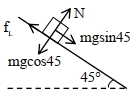
\(\mathrm{mg} \sin 45=\mathrm{f}_{\mathrm{L}}\)\(\mathrm{mg} \cos 45=\mathrm{N}\)
\(\mathrm{f}_{\mathrm{L}}=\mu_{\mathrm{x}} \mathrm{N}\)
\(\mu_{\mathrm{x}}=\tan 45=1\)
or
\(\tan \theta=\mu_{\star}\) ( \(\theta\) is angle of repose)
\(\tan 45=\mu_\alpha=1\)
correct option \((1)\)
-
- (A) \(25 \sqrt{3} \mathrm{~N}\)
- (B) \(5 \sqrt{3} \mathrm{~N}\)
- (C) \(\frac{5 \sqrt{3}}{2} \mathrm{~N}\)
- (D) \(10 \mathrm{~N}\)
Show answer and solution
Correct Answer: (B)
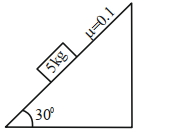
\(\mathrm{f}_{\mathrm{K}}=\mu \mathrm{mg} \cos \theta\)
\(=0.1 \times \frac{50 \times \sqrt{3}}{2}\)
\(=2.5 \sqrt{3} \mathrm{~N}\)
\({F}_1=\mathrm{mg} \sin \theta+\mathrm{f}_{\mathrm{K}} \)
\(=25+2.5 \sqrt{3}\)
\(\mathrm{F}_2=\mathrm{mg} \sin \theta-\mathrm{f}_{\mathrm{K}}\)
\(\quad=25-2.5 \sqrt{3}\)
\(\therefore \mathrm{F}_1-\mathrm{F}_2=5 \sqrt{3} \mathrm{~N}\)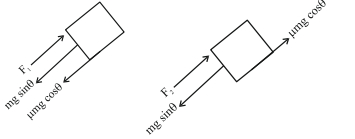
-
- (A) \(1 / 4 \mathrm{~m}\)
- (B) \(1 / 2 \mathrm{~m}\)
- (C) \(1 / 6 \mathrm{~m}\)
- (D) \(1 / 3 \mathrm{~m}\)
Show answer and solution
Correct Answer: (A)
\(\frac{d y}{d x}=\tan \theta=\frac{x}{2}=\mu=\frac{1}{2}\)\(x=1, y=1 / 4\)
-
- (A) \(70.4 \mathrm{~m} / \mathrm{s}\)
- (B) \(51.4 \mathrm{~m} / \mathrm{s}\)
- (C) \(264 \mathrm{~m} / \mathrm{s}\)
- (D) \(102.8 \mathrm{~m} / \mathrm{s}\)
Show answer and solution
Correct Answer: (B)
\(\mathrm{m}=800 \mathrm{~kg}\)\(\mathrm{r}=300 \mathrm{~m}\)
\(\theta=30^{\circ}\)
\(\mu_2=0.2\)
\(\mathrm{~V}_{\max }=\sqrt{\operatorname{Rg}\left[\frac{\tan \theta+\mu}{1-\mu \tan \theta}\right]}\)
\(=\sqrt{300 \times \mathrm{g} \times\left[\frac{\tan 30^{\circ}+0.2}{1-0.2 \times \tan 30^{\circ}}\right]}\)
\(=\sqrt{300 \times 10 \times\left[\frac{0.57+0.2}{1-0.2 \times 0.57}\right]}\)
\(\mathrm{V}_{\max }=51.4 \mathrm{~m} / \mathrm{s}\)
-
- (A) \(\frac{\mu g}{r}\)
- (B) \(\sqrt{\frac{\mathrm{r}}{\mu g}}\)
- (C) \(\sqrt{\frac{\mu g}{r}}\)
- (D) \(\frac{\mu}{\sqrt{\mathrm{rg}}}\)
Show answer and solution
Correct Answer: (C)
\(\mathrm{N}=\mathrm{mg}\)
\(\mathrm{f}=\mathrm{m} \omega^2 \mathrm{r}\)
\(\mathrm{f}=\mu \mathrm{N}\)
\(\mu \mathrm{mg}=\mathrm{mr} \omega^2\)
\(\omega=\sqrt{\frac{\mu g}{r}}\)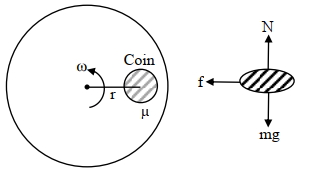
-
- (A) \(1-\frac{1}{\mathrm{n}^2}\)
- (B) \(1-n^2\)
- (C) \(\sqrt{1-\frac{1}{n^2}}\)
- (D) \(\sqrt{1-n^2}\)
Show answer and solution
Correct Answer: (A)
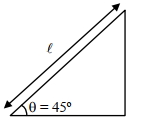
Case-\(1\) : No friction\(\mathrm{a}=\mathrm{g} \sin \theta\)
\(\ell=\frac{1}{2}(\mathrm{~g} \sin \theta) \mathrm{t}_1^2\)
\(\mathrm{t}_1=\sqrt{\frac{2 \ell}{\mathrm{g} \sin \theta}}\)
Case-\(2\) : With friction
\(a=g \sin \theta-\mu g \cos \theta\)
\(\ell=\frac{1}{2}(g \sin \theta-\mu g \cos \theta) t_2^2\)
\(\sqrt{\frac{2 \ell}{g \sin \theta-\mu g \cos \theta}}=n \sqrt{\frac{2 \ell}{g \sin \theta}}\)
\(\mu=1-\frac{1}{n^2}\)
-
- (A) \(14.7 \mathrm{~N}\)
- (B) \(147 \mathrm{~N}\)
- (C) \(1.47 \mathrm{~N}\)
- (D) \(1470 \mathrm{~N}\)
Show answer and solution
Correct Answer: (B)
\(\mathrm{F}_{\mathrm{L}}=\mu_{\mathrm{L}} \mathrm{N}=0.3 \times 50 \times 9.8=147 \mathrm{~N}\)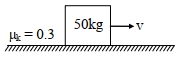
-
- (A) \(6.0 \mathrm{~cm}\)
- (B) \(5.4 \mathrm{~cm}\)
- (C) \(4.8 \mathrm{~cm}\)
- (D) \(4.2 \mathrm{~cm}\)
Show answer and solution
Correct Answer: (B)
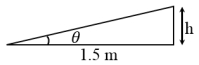
\(\tan \theta=\frac{\mathrm{v}^2}{\mathrm{Rg}}=\frac{12 \times 12}{10 \times 400}\)\( \tan \theta=\frac{\mathrm{h}}{1.5} \)
\( \Rightarrow \frac{\mathrm{h}}{1.5}=\frac{144}{4000} \)
\( \mathrm{~h}=5.4 \mathrm{~cm}\)
-
- (A) \(3\)
- (B) \(4\)
- (C) \(2\)
- (D) \(1.2\)
Show answer and solution
Correct Answer: (C)
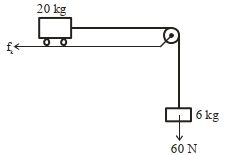
\(\mathrm{f}_{\mathrm{k}}=\mu \mathrm{N}=0.04 \times 20 \mathrm{~g}=8 \text { Newton }\)\(\mathrm{a}=\frac{60-8}{26}=2 \mathrm{~m} / \mathrm{s}^2\)
-
- (A) Statement \(I\) is correct but Statement \(II\) is incorrect
- (B) Statement \(I\) is incorrect but Statement \(II\) is correct
- (C) Both Statement \(I\) and Statement \(II\) are incorrect
- (D) Both Statement \(I\) and Statement \(II\) are correct
Show answer and solution
Correct Answer: (B)
Co-efficient of friction depends on surface in contact So, depends on material of object. -
- (A) \(\sqrt{3}: 2\)
- (B) \(1: \sqrt{3}\)
- (C) \(\sqrt{3}: 1\)
- (D) \(2: \sqrt{3}\)
Show answer and solution
Correct Answer: (A)
Given \(\mathrm{m}_1=\mathrm{m}_2\)\(\text { and } \frac{\mathrm{r}_1}{\mathrm{r}_2}=\frac{3}{4}\)
As centripetal force \(F=\frac{\mathrm{mv}^2}{\mathrm{r}}\)
In order to have constant (same in this question) centripetal force
\( \mathrm{F}_1=\mathrm{F}_2 \)
\( \frac{\mathrm{m}_1 \mathrm{v}_1^2}{\mathrm{r}_1}=\frac{\mathrm{m}_2 \mathrm{v}_2^2}{\mathrm{r}_2} \)
\( \Rightarrow \frac{\mathrm{v}_1}{\mathrm{v}_2}=\sqrt{\frac{\mathrm{r}_1}{\mathrm{r}_2}}=\frac{\sqrt{3}}{2}\)
-
- (A) \(9 \mathrm{~kg}\)
- (B) \(4.5 \mathrm{~kg}\)
- (C) \(6.5 \mathrm{~kg}\)
- (D) \(2.25 \mathrm{~kg}\)
Show answer and solution
Correct Answer: (B)
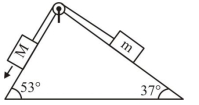
For M block\(10 \mathrm{~g} \sin 53^{\circ}-\mu(10 \mathrm{~g}) \cos 53^{\circ}-\mathrm{T}=10 \times 2\)
\(\mathrm{~T}=80-15-20\)
\(\mathrm{~T}=45 \mathrm{~N}\)
For \(\mathrm{m}\) block
\(\mathrm{T}-\mathrm{mg} \sin 37^{\circ}-\mu \mathrm{mg} \cos 37^{\circ}=\mathrm{m} \times 2\)
\(45=10 \mathrm{~m}\)
\(\mathrm{~m}=4.5 \mathrm{~kg}\)
No questions on this page match these filters.