


Questions
21 questionsShowing 1–21 of 21 questions
-
- (A) \(5\)
- (B) \(6\)
- (C) \(7\)
- (D) \(8\)
Show answer and solution
Correct Answer: (D)
\(I_{\text {rms }}=\sqrt{\frac{\int i^2 d t}{\int d t}}\)\(I_{\text {rms }}=\sqrt{(6)^2+\frac{(\sqrt{56})^2}{2}}\)
\(=\sqrt{36+28}\)
\(=\sqrt{64}\)
\(=8 \mathrm{~A}\)
-
- (A) increases
- (B) remains same
- (C) becomes zero
- (D) decreases
Show answer and solution
Correct Answer: (A)
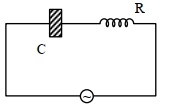
\(\mathrm{Z}=\sqrt{\mathrm{R}^2+\mathrm{X}_{\mathrm{C}}^2} \& \mathrm{X}_{\mathrm{C}}=\frac{1}{\mathrm{WC}}\)due to dielectric
\(\mathrm{C} \uparrow \Rightarrow \mathrm{X}_{\mathrm{c}} \downarrow \Rightarrow \mathrm{Z} \downarrow\)
So, current increases & thus bulb will glow more brighter.
-
- (A) \(3.2 \mathrm{~A}\)
- (B) \(1.5 \mathrm{~A}\)
- (C) \(2.0 \mathrm{~A}\)
- (D) \(1.2 \mathrm{~A}\)
Show answer and solution
Correct Answer: (B)
By energy conservation\( \frac{1}{2} \mathrm{CV}^2=\frac{1}{2} \mathrm{LI}_{\max }^2 \)
\( \mathrm{I}_{\max }=\sqrt{\frac{\mathrm{C}}{\mathrm{L}}} \mathrm{V} \)
\( =\sqrt{\frac{100 \times 10^{-6}}{6.4 \times 10^{-3}}} \times 12\)
\( =\frac{12}{8}=\frac{3}{2}=1.5 \mathrm{~A}\)
-
- (A) \(3\)
- (B) \(2\)
- (C) \(4\)
- (D) \(5\)
Show answer and solution
Correct Answer: (C)
\(\mathrm{Z}=\sqrt{\mathrm{R}^2+\mathrm{X}^2 \mathrm{~L}}\)
\(\mathrm{Z}=\sqrt{4^2+(4 \sqrt{3})^2}=8 \Omega\)
\(\mathrm{V}_{\mathrm{mms}}=\frac{\mathrm{V}}{\sqrt{2}}=\frac{8 \sqrt{2}}{\sqrt{2}}=(8 \mathrm{~V})\)
\(\mathrm{I}_{\mathrm{rms}}=\frac{\mathrm{V}_{\mathrm{rms}}}{\mathrm{z}}=\frac{8}{8}=1 \mathrm{~A}\)
Power dissipated \(=\mathrm{I}_{\mathrm{rms}}^2 \times \mathrm{R}=1 \times 4=(4 \mathrm{~W})\)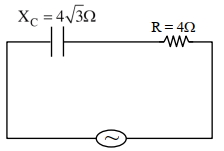
-
- (A) \(0.76 \mathrm{H}\)
- (B) \(2.86 \mathrm{H}\)
- (C) \(0.286 \mathrm{H}\)
- (D) \(0.91 \mathrm{H}\)
Show answer and solution
Correct Answer: (A)
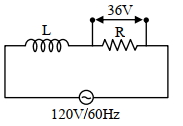
\(36=I_{\text {ms }} R\)\(36=\frac{120}{\sqrt{\mathrm{X}_{\mathrm{L}}^2+\mathrm{R}^2}} \times \mathrm{R}\)
\(\mathrm{R}=90 \Omega \Rightarrow 36=\frac{120 \times 90}{\sqrt{\mathrm{X}_{\mathrm{L}}^2+90^2}}\)
\(\sqrt{\mathrm{X}_{\mathrm{L}}^2+90^2}=300\)
\(\mathrm{X}_{\mathrm{L}}^2=81900\)
\(\mathrm{X}_{\mathrm{L}}=286.18\)
\(\omega \mathrm{L}=286.18\)
\(\mathrm{~L}=\frac{286.18}{376.8}\)
\(\mathrm{~L}=0.76 \mathrm{H}\)
-
- (A) \(1.38 \mu \mathrm{A}\) and \(1.38 \mu \mathrm{A}\)
- (B) \(14.3 \mu \mathrm{A}\) and \(143 \mu \mathrm{A}\)
- (C) \(13.8 \mu \mathrm{A}\) and \(138 \mu \mathrm{A}\)
- (D) \(13.8 \mu \mathrm{A}\) and \(13.8 \mu \mathrm{A}\)
Show answer and solution
Correct Answer: (D)
\(I=\frac{V}{X_C}=230 \times 300 \times 200 \times 10^{-12}=13.8 \mu \mathrm{A}\) -
- (A) \(5\)
- (B) \(1\)
- (C) \(45\)
- (D) \(43\)
Show answer and solution
Correct Answer: (B)
\( \mathrm{X}_{\mathrm{c}}=\frac{1}{\omega \mathrm{C}}=\frac{\pi}{2 \pi \times 50 \times 10^{-3}}=10\ \Omega \)\( \mathrm{x}_{\mathrm{L}}=\omega \mathrm{L}=2 \pi \times 50 \times \frac{100}{\pi} \times 10^{-3} \)
\( =10\ \Omega \)
\( \because \mathrm{x}_{\mathrm{C}}=\mathrm{x}_{\mathrm{L}}, \text { Hence, circuit is in resonance } \)
\( \therefore \text { power factor }=\frac{\mathrm{R}}{\mathrm{Z}}=\frac{\mathrm{R}}{\mathrm{R}}=1\)
-
- (A) \(68 \mathrm{~A}\)
- (B) \(63 \mathrm{~A}\)
- (C) \(10 \mathrm{~A}\)
- (D) \(10 \mathrm{~mA}\)
Show answer and solution
Correct Answer: (C)
Voltage across inductor \(\mathrm{V}_{\mathrm{L}}=\mathrm{IX}_{\mathrm{L}}\)\(31.4=\mathrm{I}[\mathrm{L} \omega]\)
\(31.4=\mathrm{I}[\mathrm{L}(2 \pi \mathrm{f})]\)
\(31.4=\mathrm{I}\left[10 \times 10^{-3}(2 \times 3.14) \times 50\right.\)
\(\Rightarrow \mathrm{I}=10 \mathrm{~A}\)
-
- (A) \(\frac{1}{\sqrt{2}}\)
- (B) \(\frac{1}{\sqrt{3}}\)
- (C) \(\frac{1}{\sqrt{5}}\)
- (D) \(\frac{1}{\sqrt{7}}\)
Show answer and solution
Correct Answer: (C)
\( E=25 \sin (1000 t) \)\( \cos \theta=\frac{1}{\sqrt{2}}\)
LR circuit
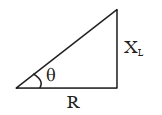
\( \text { Initially } \frac{R}{\omega_1 L}=\frac{1}{\tan \theta}=\frac{1}{\tan 45^{\circ}}= \)
\( X_L=\omega_1 L \)
\( \omega_2=2 \omega_1 \text {, given } \)
\( \tan \theta^{\prime}=\frac{\omega_2 L}{R}=\frac{2 \omega_1 L}{R} \)
\( \tan \theta^{\prime}=2 \)
\( \cos \theta^{\prime}=\frac{1}{\sqrt{5}}\)
-
- (A) \(22\)
- (B) \(20\)
- (C) \(25\)
- (D) \(30\)
Show answer and solution
Correct Answer: (A)
\(C=2 \mu f ; \quad E=110 \sqrt{2} \sin (100 \mathrm{t})\)\(\mathrm{X}_{\mathrm{C}}=\frac{1}{\omega c}=\frac{1}{100 \times 2 \times 10^6}\)
\(=\frac{10000}{2}=5000 \Omega\)
\(\mathrm{i}_0=\frac{110 \sqrt{2}}{5000}\)
\(\mathrm{i}_{\mathrm{rms}}=\frac{110 \sqrt{2}}{5000 \sqrt{2}}\)
\(=\frac{110}{5} \mathrm{~mA}\)
\(=22 \mathrm{~mA}\)
-
- (A) \(20\)
- (B) \(30\)
- (C) \(40\)
- (D) \(50\)
Show answer and solution
Correct Answer: (D)
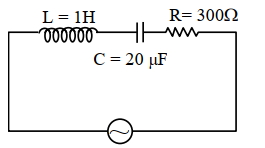
\(\mathrm{X}_{\mathrm{L}}=\omega \mathrm{L}=100 \times 1=100 \Omega\)
\(\mathrm{X}_{\mathrm{C}}=\frac{1}{\omega \mathrm{C}}=\frac{1}{100 \times 20 \times 10^{-6}}=500 \Omega\)
\(\mathrm{Z}=\sqrt{\left(\mathrm{X}_{\mathrm{L}}-\mathrm{X}_{\mathrm{C}}\right)^2+\mathrm{R}^2}\)
\(\sqrt{(100-500)^2+300^2}\)
\(\mathrm{Z}=500 \Omega\)
\(\mathrm{i}_{\text {ms }}=\frac{\mathrm{V}_{\text {ms }}}{\mathrm{Z}}=\frac{50}{500}=0.1 \mathrm{~A}\)
\(\text { rms voltage across capacitor }\)
\(\mathrm{V}_{\text {ms }}=\mathrm{X}_{\mathrm{C}} \mathrm{i}_{\mathrm{mms}}\)
\(=500 \times 0.1=50 \mathrm{~V}\) -
- (A) \(21.6 \mathrm{~W}\)
- (B) \(200 \mathrm{~W}\)
- (C) \(173.2 \mathrm{~W}\)
- (D) \(50 \mathrm{~W}\)
Show answer and solution
Correct Answer: (D)
\(\langle\mathrm{P}\rangle=\mathrm{IV} \cos \phi\)\(=\frac{20}{\sqrt{2}} \times \frac{10}{\sqrt{2}} \times \cos 60^{\circ}\)
\(=50 \mathrm{~W}\)
-
- (A) \(5 \mathrm{~ms}\)
- (B) \(3.3 \mathrm{~ms}\)
- (C) \(7.2 \mathrm{~ms}\)
- (D) \(2.2 \mathrm{~ms}\)
Show answer and solution
Correct Answer: (B)
Given equation of alternating voltage:
\( V(t) = 220 \sin(100 \pi t) \)
Comparing this with the standard alternating voltage equation \( V(t) = V_0 \sin(\omega t) \), we get:
Peak voltage, \( V_0 = 220\text{ V} \)
Angular frequency, \( \omega = 100 \pi\text{ rad/s} \)
For a purely resistive load, the current \( I(t) \) is in phase with the voltage and is given by:
\( I(t) = I_0 \sin(\omega t) \) (where \( I_0 \) is the peak current value)
Step 1: Find the time \( t_1 \) when the current reaches half of its peak value \( \left(\frac{I_0}{2}\right) \):
\( I(t_1) = \frac{I_0}{2} \)
\( I_0 \sin(\omega t_1) = \frac{I_0}{2} \)
\( \sin(\omega t_1) = \frac{1}{2} \)
\( \omega t_1 = \frac{\pi}{6} \implies t_1 = \frac{\pi}{6\omega} \)
Step 2: Find the time \( t_2 \) when the current reaches its full peak value \( (I_0) \):
\( I(t_2) = I_0 \)
\( I_0 \sin(\omega t_2) = I_0 \)
\( \sin(\omega t_2) = 1 \)
\( \omega t_2 = \frac{\pi}{2} \implies t_2 = \frac{\pi}{2\omega} \)
Step 3: Calculate the time taken \( t \) to rise from half of the peak value to the peak value:
\( t = t_2 - t_1 = \frac{\pi}{2\omega} - \frac{\pi}{6\omega} \)
\( t = \frac{3\pi - \pi}{6\omega} = \frac{2\pi}{6\omega} = \frac{\pi}{3\omega} \)
Explanation of your doubt (\( \frac{\pi}{3\omega} = \frac{\pi}{300\pi} \)):
Since we found \( \omega = 100\pi \) from the given voltage equation, substituting this value into the denominator gives:
\( 3\omega = 3 \times 100\pi = 300\pi \)
Now, substitute \( \omega = 100\pi \) into the time equation:
\( t = \frac{\pi}{3 \times 100\pi} = \frac{\pi}{300\pi} \)
\( t = \frac{1}{300}\text{ seconds} \)
Converting seconds into milliseconds (\( 1\text{ s} = 1000\text{ ms} \)):
\( t = \frac{1}{300} \times 1000\text{ ms} = \frac{10}{3}\text{ ms} \approx 3.33\text{ ms} \)
Therefore, the correct option is B. -
- (A) \(9\)
- (B) \(10\)
- (C) \(11\)
- (D) \(12\)
Show answer and solution
Correct Answer: (B)
for maximum current, circuit must be in resonance\(\mathrm{f}_0=\frac{1}{2 \pi \sqrt{\mathrm{L} \times \mathrm{C}}}\)
\(\mathrm{f}_0=\frac{1}{2 \pi \sqrt{100 \times 10^{-3} \times 2.5 \times 10^{-9}}}\)
\(=\frac{1}{2 \pi \sqrt{25 \times 10^{-11}}}\)
\(=\frac{1}{2 \pi \times 5} \times 10^5 \times \sqrt{10} \mathrm{~Hz}\)
\(=\frac{100}{10} \times 10^3 \mathrm{~Hz}\)
\(\mathrm{f}_0=10 \times 10^3 \mathrm{~Hz}\)
-
- (A) Statement \(I\) is true but Statement \(II\) is false
- (B) Statement \(I\) is false but Statement \(II\) is true
- (C) Both Statement \(I\) and Statement \(II\) are true
- (D) Both Statement \(I\) and Statement \(II\) are false
Show answer and solution
Correct Answer: (C)
Statement-\(I\)\(\mathrm{I}_{\mathrm{m}}=\frac{\mathrm{V}_{\mathrm{m}}}{\sqrt{\mathrm{R}^2+\left(\mathrm{X}_{\mathrm{L}}-\mathrm{X}_{\mathrm{C}}\right)^2}}\) at resonance \(\mathrm{X}_{\mathrm{L}}=\mathrm{X}_{\mathrm{C}}\)
Thus, \(I_m=\frac{V_m}{R}\)
\(\because\) Impendence is minimum therefore \(I\) is maximum at resonance.
Statement-\(II\)
\(\mathrm{I}=\left(\frac{\mathrm{V}}{\mathrm{R}}\right)\) in purely resistive circuit.
-
- (A) \(5 \mathrm{~W}\)
- (B) \(10 \mathrm{~W}\)
- (C) \(2.5 \mathrm{~W}\)
- (D) \(25 \mathrm{~W}\)
Show answer and solution
Correct Answer: (C)
\( P_{\text {avg }}=V_{\text {rms }} I_{\text {rms }} \cos (\Delta \phi) \)\( =\frac{100}{\sqrt{2}} \times \frac{100 \times 10^{-3}}{\sqrt{2}} \times \cos \left(\frac{\pi}{3}\right) \)
\( =\frac{10^4}{2} \times \frac{1}{2} \times 10^{-3} \)
\( =\frac{10}{4}=2.5 \mathrm{~W}\)
-
- (A) \(A, B\) and \(C\) only
- (B) \(B, C\) and \(D\) only
- (C) \(A\) and \(B\) only
- (D) \(A, B\) and \(D\) only
Show answer and solution
Correct Answer: (D)
This is possible when phase difference is \(\frac{\pi}{2}\) between current and voltage so correct answer will be \((4)\) -
- (A) Zero
- (B) double
- (C) same
- (D) halved
Show answer and solution
Correct Answer: (B)
In resonance \(Z=R\)\(\mathrm{I}=\frac{\mathrm{V}}{\mathrm{R}}\)
\(\mathrm{R} \rightarrow \text { halved }\)
\(\Rightarrow \mathrm{I} \rightarrow 2 \mathrm{I}\)
I becomes doubled.
-
- (A) \(A-I, B-IV, C-III, D-II\)
- (B) \(A-IV, B-I, C-III, D-II\)
- (C) \(A-IV, B-I, C-II, D-III\)
- (D) \(A-I, B-IV, C-II, D-III\)
Show answer and solution
Correct Answer: (D)
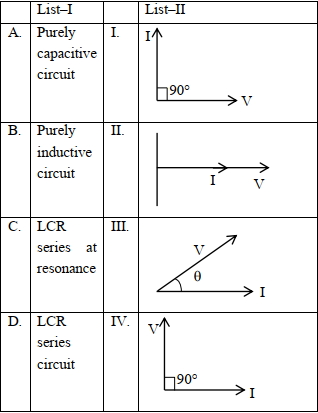
\(A - V\) lags by \(90^{\circ}\) from I hence option \((I)\) is correct.\(B - V\) lead by \(90^{\circ}\) from \(I\) hence option \((IV)\) is correct
\(\mathrm{C}-\mathrm{In} \mathrm{LCR}\) resonance \(\mathrm{X}_{\mathrm{L}}=\mathrm{X}_{\mathrm{C}}\). Hence circuit is purely resistive so option \((II)\) is correct \(D\) - In LCR series \(V\) is at some angle from \(I\) hence \((III)\) is correct
Hence option \((4)\) is correct.
-
- (A) \(8\)
- (B) \(7\)
- (C) \(9\)
- (D) \(10\)
Show answer and solution
Correct Answer: (D)
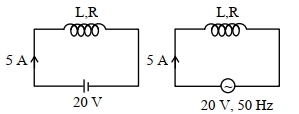
(Image)Case-\(I\):
\(\mathrm{i}=\frac{20}{\mathrm{R}} \Rightarrow \mathrm{R}=4 \Omega\)
Case-\(II\):
(Image)
\(i=\frac{20}{Z}\)
\(4=\frac{20}{\sqrt{R^2+X_L^2}} \Rightarrow \sqrt{R^2+X_L^2}=5\)
\(R^2+X_L^2=25 \Rightarrow X_L=3 \Omega\)
\(L=\frac{3}{2 \pi f}=\frac{1}{2 \times 50}=\frac{1000}{100} m H\)
\(L=10 m H\)
-
- (A) \(238\)
- (B) \(240\)
- (C) \(245\)
- (D) \(250\)
Show answer and solution
Correct Answer: (D)
For \(DC\) voltage\(\mathrm{R}=\frac{\mathrm{V}}{\mathrm{I}}=\frac{100}{5}=20 \Omega\)
for \(AC\) voltage
\(\mathrm{X}_{\mathrm{L}}=20 \sqrt{3} \Omega\)
\(\mathrm{R}=20 \Omega\)
\(\mathrm{Z}=\sqrt{\mathrm{X}_{\mathrm{L}}^2+\mathrm{R}^2}=\sqrt{3 \times 400+400}=40\)
Power \(-i_{\text {rms }}^2 R\)
\(=\left(\frac{\mathrm{V}_{\text {rms }}}{\mathrm{Z}}\right)^2 \times \mathrm{R}=\left(\frac{\frac{200}{\sqrt{2}}}{40}\right)^2 \times 20=250 \mathrm{~W}\)
No questions on this page match these filters.