


Questions
16 questionsShowing 1–16 of 16 questions
-
- (A) \(3.2 \times 10^{-8} \ \hat{\mathrm{k}} \mathrm{T}\)
- (B) \(3.2 \times 10^{-8}\ \hat{\mathrm{i}}\)
- (C) \(9.6 \ \hat{\mathrm{j}} \mathrm{T}\)
- (D) \(9.6 \times 10^{-8}\ \hat{\mathrm{kT}}\)
Show answer and solution
Correct Answer: (A)
\( \frac{E}{B}=C \)\( \frac{E}{B}=3 \times 10^8\)
\(B =\frac{E}{3 \times 10^8}=\frac{9.6}{3 \times 10^8} \)
\(B =3.2 \times 10^{-8} \mathrm{~T} \)
\(\hat{B} =\hat{v} \times \hat{E} \)
\( =\hat{i} \times \hat{j}=\hat{k}\)
So,
\(\overrightarrow{\mathrm{B}}=3.2 \times 10^{-8} \hat{\mathrm{k}} \mathrm{T}\)
-
- (A) \(35.4 \ \mathrm{Wm}^{-2}\)
- (B) \(53.1 \ \mathrm{Wm}^{-2}\)
- (C) \(26.6 \ \mathrm{Wm}^{-2}\)
- (D) \(106.2 \ \mathrm{Wm}^{-2}\)
Show answer and solution
Correct Answer: (B)
\( \mathrm{I}=\frac{1}{2} \varepsilon_0 \mathrm{E}_0^2 \times \mathrm{c} \)\( \mathrm{I}=\frac{1}{2} \times 8.85 \times 10^{-12} \times 4 \times 10^4 \times 3 \times 10^8 \)
\( \mathrm{I}=53.1 \mathrm{~W} / \mathrm{m}^2\)
-
- (A) \(\mathrm{B}_z=60 \sin \left[\frac{\pi}{2}\left(\mathrm{x}-3 \times 10^8 \mathrm{t}\right)\right] \hat{\mathrm{kT}}\)
- (B) \(\mathrm{B}_z=2 \times 10^{-7} \sin \left[\frac{\pi}{2} \times 10^3\left(\mathrm{x}-3 \times 10^8 \mathrm{t}\right)\right] \hat{\mathrm{kT}}\)
- (C) \(\mathrm{B}_{\mathrm{x}}=60 \sin \left[\frac{\pi}{2}\left(\mathrm{x}-3 \times 10^8 \mathrm{t}\right)\right]\) i \(\mathrm{i} \mathrm{T}\)
- (D) \(\mathrm{B}_z=2 \times 10^{-7} \sin \left[\frac{\pi}{2}\left(\mathrm{x}-3 \times 10^8 \mathrm{t}\right)\right] \hat{\mathrm{k} T}\)
Show answer and solution
Correct Answer: (B)
\(\mathrm{E}=\mathrm{BC} \Rightarrow 60=\mathrm{B} \times 3 \times 10^8\)\(\Rightarrow \mathrm{B}=2 \times 10^{-7}\)
\(\text { Also } \mathrm{C}=\mathrm{f} \lambda\)
\(\Rightarrow 3 \times 10^8=\mathrm{f} \times 4 \times 10^{-3}\)
\(\Rightarrow \mathrm{f}=\frac{3}{4} \times 10^{11}\)
\(\Rightarrow \omega=2 \pi \mathrm{f}=\frac{3}{4} \times 2 \pi \times 10^{11}\)
\(\Rightarrow \omega=\frac{\pi}{2} \times 10^3 \mathrm{C}\)
\(\Rightarrow \quad \text { Electric field } \Rightarrow \mathrm{y} \text { direction }\)
\(\text { Propagation } \Rightarrow \mathrm{x} \text { direction }\)
\(\text { Magnetic field } \Rightarrow z \text {-direction }\)
-
- (A) \(13 \mathrm{~A}\)
- (B) \(8 \mathrm{~A}\)
- (C) \(10 \mathrm{~A}\)
- (D) \(12 \mathrm{~A}\)
Show answer and solution
Correct Answer: (D)
Displacement current is same as conduction current in capacitor.\(\mathrm{x}_{\mathrm{C}}=\frac{1}{\omega \mathrm{C}}=\frac{1}{2 \pi \mathrm{fC}}\)
\(=\frac{1}{2 \pi \times 4 \times 10^3 \times 12 \times 10^{-6}}=3.317 \Omega\)
\(I=\frac{V}{X_C}=\frac{40}{3.317}=12 \mathrm{~A}\)
-
- (A) \(\lambda_4<\lambda_3<\lambda_1<\lambda_2\)
- (B) \(\lambda_4<\lambda_3<\lambda_2<\lambda_1\)
- (C) \(\lambda_1<\lambda_2<\lambda_3<\lambda_4\)
- (D) \(\lambda_2<\lambda_1<\lambda_4<\lambda_3\)
Show answer and solution
Correct Answer: (C)
\(\lambda_1<\lambda_2<\lambda_3<\lambda_4\) -
- (A) \(5\)
- (B) \(1\)
- (C) \(4\)
- (D) \(2\)
Show answer and solution
Correct Answer: (D)
\(\frac{\varepsilon_{\mathrm{II}} \times \mu_{\mathrm{mL}}}{\varepsilon_0 \times \mu_0}=\frac{\frac{1}{\mathrm{v}^2}}{\frac{1}{\mathrm{c}^2}}\)\(\varepsilon_{\mathrm{r}} \times \mu_{\mathrm{r}}=\frac{\mathrm{c}^2}{\mathrm{v}^2}\)
\(\varepsilon_{\mathrm{r}} \times 2=\frac{\left(3 \times 10^8\right)^2}{\left(1.5 \times 10^8\right)^2}\)
\(\varepsilon_{\mathrm{r}} \times 2=4\)
\(\varepsilon_{\mathrm{r}}=2\)
-
- (A) Statement \(I\) is incorrect but Statement \(II\) is correct
- (B) Both Statement \(I\) and Statement \(II\) are correct.
- (C) Both Statement \(I\) and Statement \(II\) are incorrect.
- (D) Statement \(I\) is correct but Statement \(II\) is incorrect.
Show answer and solution
Correct Answer: (B)
\(\frac{1}{2} \varepsilon_0 \mathrm{E}^2=\frac{\mathrm{B}^2}{2 \mu_0}\)
\(\because \mathrm{E}=\mathrm{CB} \text { and } \mathrm{C}=\frac{1}{\mu_0 \varepsilon_0}\) -
- (A) \(2.5\)
- (B) \(10\)
- (C) \(5\)
- (D) \(2\)
Show answer and solution
Correct Answer: (C)
\(\lambda=\frac{\mathrm{c}}{\mathrm{f}}=\frac{3 \times 10^8}{60 \times 10^6}=5 \mathrm{~m}\) -
- (A) \(1.106 \times 10^{-8} \mathrm{Jm}^{-3}\)
- (B) \(4.425 \times 10^{-8} \mathrm{Jm}^{-3}\)
- (C) \(2.212 \times 10^{-8} \mathrm{Jm}^{-3}\)
- (D) \(2.212 \times 10^{-10} \mathrm{Jm}^{-3}\)
Show answer and solution
Correct Answer: (A)
\(\mathrm{U}_{\mathrm{E}}=\frac{1}{2} \epsilon_0 \mathrm{E}^2\)\(\mathrm{U}_{\mathrm{E}}=\frac{1}{2} \times 8.85 \times 10^{-12} \times(50)^2\)
\(=1.106 \times 10^{-8} \mathrm{~J} / \mathrm{m}^3\)
-
- (A) \(486\)
- (B) \(243\)
- (C) \(729\)
- (D) \(972\)
Show answer and solution
Correct Answer: (A)
\(Intensity =\frac{1}{2} \varepsilon_0 \mathrm{E}_0^2 \mathrm{c}\)\(=\frac{1}{2} \times 9 \times 10^{-12} \times(600)^2 \times 3 \times 10^8\)
\(=\frac{9}{2} \times 36 \times 3=486 \mathrm{w} / \mathrm{m}^2\)
-
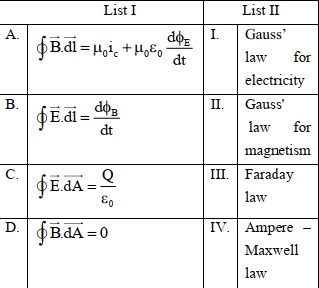
- (A) \( A-IV, B-I, C-III, D-II\)
- (B) \( A-II, B-III, C-I, D-IV\)
- (C) \( A-IV, B-III, C-I, D-II\)
- (D) \(A-I, B-II, C-III, D-IV\)
Show answer and solution
Correct Answer: (C)
Ampere - Maxwell law\(\rightarrow \oint \overrightarrow{\mathrm{B}} \cdot \overrightarrow{\mathrm{dl}}=\mu_0 i_c+\mu_0 \varepsilon_0 \frac{\mathrm{d} \phi_{\mathrm{E}}}{\mathrm{dt}}\)
Faraday law \(\rightarrow \oint \overrightarrow{\mathrm{E}} \cdot \overrightarrow{\mathrm{dl}}=\frac{\mathrm{d} \phi_{\mathrm{B}}}{\mathrm{dt}}\)
Gauss' law for electricity \(\rightarrow \oint \vec{E} \cdot \overrightarrow{d A}=\frac{Q}{\varepsilon_0}\)
Gauss ' law for magnetism \(\rightarrow \oint \vec{B} \cdot \overrightarrow{d A}=0\)
-
- (A) \((A)-(II), (B)-(I), (C)-(IV), (D)-(III)\)
- (B) \((A)-(III), (B)-(II), (C)-(IV), (D)-(I)\)
- (C) \((A)-(IV), (B)-(III), (C)-(II), (D)-(I)\)
- (D) \((A)-(I), (B)-(III), (C)-(II), (D)-(IV)\)
Show answer and solution
Correct Answer: (B)
Infrared is the least energetic thus having biggest wavelength \((\lambda)\) and gamma rays are most energetic thus having smallest wavelength. -
- (A) \(A-IV, B-I, C-II, D-III\)
- (B) \(A-I, B-II, C-III, D-IV\)
- (C) \(A-III, B-IV, C-I, D-II\)
- (D) \(A-II, B-III, C-IV, D-I\)
Show answer and solution
Correct Answer: (A)
Gauss's Law of electrostatic\(\phi=\oint \overrightarrow{ E } \cdot d \overrightarrow{ s }=\frac{ q }{\epsilon_0}\)
Faraday's law \(\oint \vec{E} \cdot d \vec{l}=\frac{-d \phi_B}{d t}\)
Gauss's law of magnetism \(\oint \overrightarrow{ B } \cdot d \overrightarrow{ A }=0\)
Ampere's Maxwell law
\(\oint \vec{B} . d \vec{l}=\mu_0 i_C+\mu_0 \in_0 \frac{d \phi_E}{d t}\)
Where, \(i_{ C }\) : Conduction current \(\epsilon_0 \frac{ d \phi_{ E }}{ dt }\) : Displacement current
-
- (A) \(\overrightarrow{\mathrm{B}}=\hat{\mathrm{i}} \frac{40}{\mathrm{c}} \cos \omega\left(\mathrm{t}-\frac{\mathrm{z}}{\mathrm{c}}\right)\)
- (B) \(\vec{B}=\hat{j} 40 \cos \omega\left(t-\frac{z}{c}\right)\)
- (C) \(\overrightarrow{\mathrm{B}}=\hat{\mathrm{k}} \frac{40}{\mathrm{c}} \cos \omega\left(\mathrm{t}-\frac{\mathrm{z}}{\mathrm{c}}\right)\)
- (D) \(\vec{B}=\hat{j} \frac{40}{c} \cos \omega\left(t-\frac{z}{c}\right)\)
Show answer and solution
Correct Answer: (D)
\(\overrightarrow{\mathrm{E}}=\hat{\mathrm{i}} 40 \cos \omega\left(\mathrm{t}-\frac{\mathrm{z}}{\mathrm{c}}\right)\)\(\overrightarrow{\mathrm{E}}\) is along \(+\mathrm{x}\) direction
\(\overrightarrow{\mathrm{v}}\) is along \(+\mathrm{z}\) direction
So direction of \(\vec{B}\) will be along +y and magnitude of \(B\) will be \(\frac{E}{C}\)
So answer is \(\frac{40}{c} \cos \omega\left(t-\frac{z}{c}\right) \hat{j}\)
-
- (A) \(\vec{B}=E_0 C \cos (\omega t-k z) \hat{j}\)
- (B) \(\vec{B}=\frac{E_0}{C} \cos (\omega t-k z) \hat{j}\)
- (C) \(\vec{B}=E_0 \operatorname{Cos}(\omega t+k z) \hat{j}\)
- (D) \(\vec{B}=\frac{E_0}{C} \cos (\omega t+k z) \hat{j}\)
Show answer and solution
Correct Answer: (B)
Given \(\vec{E}=E_0 \cos (\omega t-k z) \hat{i}\)\( \vec{B}=\frac{E_0}{C} \cos (\omega t-k z) \hat{j} \)
\( \hat{C}=\hat{E} \times \hat{B}\)
-
- (A) \(\mathrm{E}_{\mathrm{y}}=1.17 \sin \left(1.5 \times 10^3 \mathrm{x}+0.5 \times 10^{11} \mathrm{t}\right) \mathrm{Vm}^1\)
- (B) \(\mathrm{E}_{\mathrm{z}}=105 \sin \left(1.5 \times 10^3 \mathrm{x}+0.5 \times 10^{11} \mathrm{t}\right) \mathrm{Vm}^{-1}\)
- (C) \(\mathrm{E}_z=1.17 \sin \left(1.5 \times 10^5 \mathrm{x}+0.5 \times 10^{11} \mathrm{t}\right) \mathrm{Vm}^{-1}\)
- (D) \(\mathrm{E}_{\mathrm{y}}=10.5 \sin \left(1.5 \times 10^3 \mathrm{x}+0.5 \times 10^{11} \mathrm{t}\right) \mathrm{Vm}^{-1}\)
Show answer and solution
Correct Answer: (B)
\(\mathrm{E}_0=\mathrm{B}_0 \mathrm{C}\)\(\mathrm{E}_0=3 \times 10^8 \times\left(3.5 \times 10^{-7}\right) \sin \left(1.5 \times 10^3 \mathrm{x}+0.5 \times 10^{11} \mathrm{t}\right)\)
\(\mathrm{E}_0=105 \sin \left(1.5 \times 10^3 \mathrm{x}+0.5 \times 10^{11} \mathrm{t}\right) \mathrm{Vm}^{-1}\)
No questions on this page match these filters.