


All JEE Mains 2024 Physics questions
31 chaptersShowing 351–400 of 593 questions
-
- (A) \(\frac{1}{4} \mathrm{CV}^2\)
- (B) \(2 \mathrm{CV}^2\)
- (C) \(\frac{1}{2} \mathrm{CV}^2\)
- (D) \(\frac{3}{4} \mathrm{CV}^2\)
Show answer and solution
Correct Answer: (A)
\(\mathrm{V}_{\mathrm{C}}-\frac{\mathrm{q}_{\text {net }}}{\mathrm{C}_{\text {net }}}=\frac{\mathrm{CV}+2 \mathrm{CV}}{2 \mathrm{C}}\)\(\mathrm{V}_{\mathrm{C}}=\frac{3 \mathrm{~V}}{2}\)
Loss of energy
\(=\frac{1}{2} \mathrm{CV}^2+\frac{1}{2} \mathrm{C}(2 \mathrm{~V})^2-\frac{1}{2} 2 \mathrm{C}\left(\frac{3 \mathrm{~V}}{2}\right)^2\)
\(=\left(\frac{\mathrm{CV}^2}{4}\right)\)
-
- (A) \(1\)
- (B) \(3\)
- (C) \(2\)
- (D) \(10\)
Show answer and solution
Correct Answer: (C)
\(\text T \cos \theta=\mathrm{mg}\)
\(\mathrm{T} \sin \theta=\mathrm{F}_{\mathrm{e}}\)
\(\tan \theta=\frac{\mathrm{Fe}_{\mathrm{e}}}{\mathrm{mg}}\)
\(\tan \theta=\frac{F_e}{\rho_B V g}\) \(....(i)\)
\(\tan \theta=\frac{F_e}{\frac{k}{\left(\rho_B-\rho_{\mathrm{L}}\right) V g}}\) \(....(ii)\)
\(\text {From Eq. (i) (ii) }\)
\(\rho_{\mathrm{B}} \mathrm{Vg}=\left(\rho_{\mathrm{B}}-\rho_{\mathrm{L}}\right) \mathrm{kVg}\)
\(1.4=0.7 \mathrm{k}\)
\(\mathrm{k}=2\)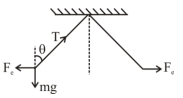
-
- (A) \(4\)
- (B) \(8\)
- (C) \(7\)
- (D) \(3\)
Show answer and solution
Correct Answer: (D)
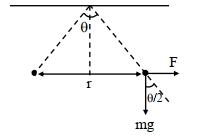
In air \(\tan \frac{\theta}{2}=\frac{F}{m g}=\frac{q^2}{4 \pi \varepsilon_0 \mathrm{r}^2 m g}\)In water \(\tan \frac{\theta}{2}=\frac{\mathrm{F}^{\prime}}{\mathrm{mg}^{\prime}}=\frac{\mathrm{q}^2}{4 \pi \varepsilon_0 \varepsilon_{\mathrm{r}} \mathrm{r}^2 \mathrm{mg}_{\text {eff }}}\)
Equate both equations
\(\varepsilon_0 g=\varepsilon_0 \varepsilon_{\mathrm{r}} \mathrm{g}\left[1-\frac{1}{1.5}\right]\)
\(\varepsilon_{\mathrm{T}}=3\)
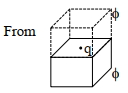
- 354. A charge \(q\) is placed at the center of one of the surface of a cube. The flux linked with the cube is _______. 2024 Hard
- (A) \(\frac{q}{4 \epsilon_0}\)
- (B) \(\frac{q}{2 \epsilon_0}\)
- (C) \(\frac{q}{8 \epsilon_0}\)
- (D) Zero
Show answer and solution
Correct Answer: (B)
\(2 \phi=\frac{q}{\epsilon_0}\)\(\phi=\frac{q}{2 \epsilon_0}\)
-
- (A) \(\mathrm{T}^2=\frac{4 \pi^2 \mathrm{~m}}{2 \mathrm{k} \lambda \mathrm{q}} \mathrm{r}^3\)
- (B) \(T=2 \pi r \sqrt{\frac{m}{2 k \lambda q}}\)
- (C) \(\mathrm{T}=\frac{1}{2 \pi \mathrm{r}} \sqrt{\frac{\mathrm{m}}{2 \mathrm{k} \lambda \mathrm{q}}}\)
- (D) \(\mathrm{T}=\frac{1}{2 \pi} \sqrt{\frac{2 \mathrm{k} \lambda \mathrm{q}}{\mathrm{m}}}\)
Show answer and solution
Correct Answer: (B)
\(\frac{2 \mathrm{k} \lambda \mathrm{q}}{\mathrm{r}}=\mathrm{m} \omega^2 \mathrm{r}\)\(\omega^2=\frac{2 \mathrm{k} \lambda \mathrm{q}}{\mathrm{mr}^2}\)
\(\left(\frac{2 \pi}{\mathrm{T}}\right)^2=\frac{2 \mathrm{k} \lambda \mathrm{q}}{\mathrm{mr}^2}\)
\(\mathrm{~T}=2 \pi \mathrm{r} \sqrt{\frac{\mathrm{m}}{2 \mathrm{k} \lambda \mathrm{q}}}\)
-
- (A) \(7\)
- (B) \(3\)
- (C) \(5\)
- (D) \(6\)
Show answer and solution
Correct Answer: (B)
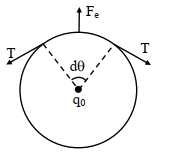
\( 2 \mathrm{~T} \sin \frac{\mathrm{d} \theta}{2}=\frac{\mathrm{kq}_0}{\mathrm{R}^2} \cdot \lambda \mathrm{Rd} \theta \)\( {\left[\lambda=\frac{\mathrm{Q}}{2 \pi \mathrm{R}}\right]}\)
\( \Rightarrow \mathrm{T}=\frac{\mathrm{Kq} \mathrm{q}_0 \mathrm{Q}}{\left(\mathrm{R}^2\right) \times 2 \pi} \)
\( =\frac{\left(9 \times 10^9\right)\left(2 \pi \times 30 \times 10^{-12}\right)}{(0.30)^2 \times 2 \pi} \)
\( =\frac{9 \times 10^{-3} \times 30}{9 \times 10^{-2}}=3 \mathrm{~N}\)
-
- (A) \(12\)
- (B) \(13\)
- (C) \(15\)
- (D) \(16\)
Show answer and solution
Correct Answer: (A)
\(\phi =\overrightarrow{\mathrm{E}} \cdot \overrightarrow{\mathrm{A}}\)\(=\left(\frac{2 \hat{\mathrm{i}}+6 \hat{\mathrm{j}}+8 \hat{\mathrm{k}}}{\sqrt{6}}\right) \cdot 4\left(\frac{2 \hat{\mathrm{i}}+\hat{\mathrm{j}}+\hat{\mathrm{k}}}{\sqrt{6}}\right)\)
\(=\frac{4}{6} \times(4+6+8)=12 \mathrm{Vm}\)
-
- (A) \(13\)
- (B) \(14\)
- (C) \(15\)
- (D) \(16\)
Show answer and solution
Correct Answer: (D)
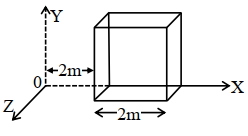
\(\overrightarrow{\mathrm{E}}=2 x \hat{\mathrm{i}}\)
\(\phi=\overrightarrow{\mathrm{E}} \cdot \overrightarrow{\mathrm{A}}\)
\(\phi_{\text {in }}=-4 \times 4=-16 \mathrm{Nm}^2 / \mathrm{c}\)
\(\phi_{\text {out }}=8 \times 4=32 \mathrm{Nm}^2 / \mathrm{c}\)
\(d_{\text {net }}=\phi_{\text {in }} \phi_{\text {out }}=-16+32=16 \mathrm{Nm}^2\)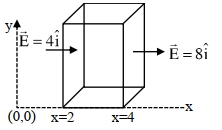
-
- (A) \(90\)
- (B) \(150\)
- (C) \(180\)
- (D) \(60\)
Show answer and solution
Correct Answer: (C)
\( \overrightarrow{\mathrm{E}}=6 \hat{\mathrm{i}}+5 \hat{\mathrm{j}}+3 \hat{\mathrm{k}}\)\( \overrightarrow{\mathrm{A}}=30 \hat{\mathrm{i}} \)
\( \phi=\overrightarrow{\mathrm{E}} \cdot \overrightarrow{\mathrm{A}} \)
\( \phi=(6 \hat{\mathrm{i}}+5 \hat{\mathrm{j}}+3 \hat{\mathrm{k}}) \cdot(30 \hat{\mathrm{i}}) \)
\( \phi=6 \times 30=180\)
-
- (A) 2
- (B) 4
- (C) 6
- (D) 8
Show answer and solution
Correct Answer: (D)
\(u=1 m / s ; a=-\frac{\sigma e}{2 \epsilon_0 m}\)
\(t=1 s\)
\(S=-1 m\)
Using \(S=u t+\frac{1}{2} a t^2\)
\(-1=1 \times 1-\frac{1}{2} \times \frac{\sigma e}{2 \epsilon_0 m} \times(1)^2\)
\(\therefore \sigma=8 \frac{\epsilon_e m}{e}\)
\(\therefore \alpha=8\) -
- (A) \(16\)
- (B) \(20\)
- (C) \(23\)
- (D) \(30\)
Show answer and solution
Correct Answer: (A)
Explanation:
Let us calculate the ratio of the electric fields step-by-step based on the Electric Charges and Fields chapter of the NCERT Class 12 Physics textbook:
Step 1: Electric field due to an infinite plane sheet of charge (\(E_s\))
The magnitude of the electric field produced by an infinite plane sheet of charge with uniform surface charge density \(\sigma_s\) at any given point is independent of its distance from the sheet and is expressed as:
\(E_s = \frac{\sigma_s}{2\varepsilon_0}\)
Step 2: Electric field due to an infinitely long straight line charge (\(E_l\))
The magnitude of the electric field produced by an infinitely long line charge with uniform linear charge density \(\lambda_e\) at a perpendicular distance \(r\) from the line is given by:
\(E_l = \frac{\lambda_e}{2\pi\varepsilon_0 r}\)
Step 3: Determine the perpendicular distance (\(r\)) from the line charge to the point
- The infinite sheet lies on the flat \(x-y\) plane where \(z = 0\).
- The line charge is parallel to the \(y\)-axis on the \(z = 4\text{ m}\) plane, meaning it effectively passes through the cross-section coordinates \(x = 0, z = 4\text{ m}\).
- The target test point is located at \((0,0,2)\), where \(z = 2\text{ m}\).
Thus, the absolute perpendicular distance \(r\) from the line charge to the test point is:
\(r = |4 - 2| = 2\text{ m}\)
Step 4: Calculate the ratio of the magnitudes of the electric fields
Taking the ratio of the sheet's field strength (\(E_s\)) to the line's field strength (\(E_l\)):
\(\frac{E_s}{E_l} = \frac{\left(\frac{\sigma_s}{2\varepsilon_0}\right)}{\left(\frac{\lambda_e}{2\pi\varepsilon_0 r}\right)} = \frac{\sigma_s \cdot \pi r}{\lambda_e}\)
Substituting the given relationship \(|\sigma_s| = 2|\lambda_e|\) and the calculated distance \(r = 2\text{ m}\) into the equation:
\(\frac{E_s}{E_l} = \frac{(2\lambda_e) \cdot \pi \cdot 2}{\lambda_e} = 4\pi = \frac{4\pi}{1}\)
Step 5: Compute the final value of \(n\)
We are given that this field magnitude ratio is equal to \(\pi\sqrt{n} : 1\):
\(\pi\sqrt{n} = 4\pi\)
\(\sqrt{n} = 4\)
Squaring both sides of the relation yields:
\(n = 16\)
Hence, Option A is the correct choice.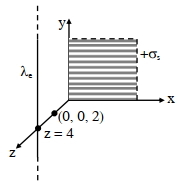
-
- (A) \(2: 5\)
- (B) \(5: 2\)
- (C) \(2: 3\)
- (D) \(3: 2\)
Show answer and solution
Correct Answer: (A)
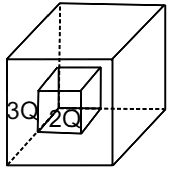
Flux through \(C_1, \phi_1=\frac{q_{\text {in }}}{\varepsilon_0}=\frac{2 Q}{\varepsilon_0}\)
Flux through \(C_2, \phi_2=\frac{q_{\text {in }}}{\varepsilon_0}=\frac{2 Q+3 Q}{\varepsilon_0}=\frac{5 Q}{\varepsilon_0}\)
\(\frac{C_1}{C_2}=\frac{\phi_1}{\phi_2}=\frac{2 Q / \varepsilon_0}{5 Q / \varepsilon_0}=\frac{2}{5}\) -
- (A) \(\frac{5 q}{\epsilon_0}\)
- (B) \(\frac{4 q}{\epsilon_0}\)
- (C) \(\frac{3 q}{\epsilon_0}\)
- (D) \(\frac{q}{\epsilon_0}\)
Show answer and solution
Correct Answer: (B)
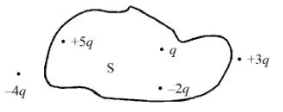
As per gauss theorem,\(\phi=\frac{q_{\text {in }}}{\epsilon_0}=\frac{q+(-2 q)+5 q}{\epsilon_0}\)
\(\frac{4 \mathrm{q}}{\epsilon_0}\)
-
- (A) \(F / 25\)
- (B) \(5 \mathrm{~F}\)
- (C) \(F / 5\)
- (D) \(25 \mathrm{~F}\)
Show answer and solution
Correct Answer: (B)
In air \(F=\frac{1}{4 \pi \epsilon_0} \frac{q_1 q_2}{r_2}\)In medium
\(F^{\prime}=\frac{1}{4 \pi\left(K \epsilon_0\right)} \frac{q_1 q_2}{\left(r^{\prime}\right)^2}=\frac{25}{4 \pi\left(5 \epsilon_0\right)} \frac{q_1 q_2}{(r)^2}=5 F\)
-
- (A) \(2\)
- (B) \(3\)
- (C) \(5\)
- (D) \(6\)
Show answer and solution
Correct Answer: (C)
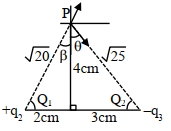
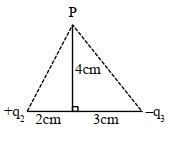
\(\frac{\mathrm{Kq}_2}{20} \cos \beta=\frac{\mathrm{Kq}_3}{25} \cos \theta\)\(\frac{\mathrm{Kq}_2}{20} \frac{4}{\sqrt{20}}=\frac{\mathrm{Kq}_3}{25} \frac{4}{\sqrt{25}}\)
\(\frac{\mathrm{q}_2}{\mathrm{q}_3}=\frac{20}{25} \sqrt{\frac{20}{25}}=\frac{8}{5 \sqrt{\mathrm{x}}}\)
\(\Rightarrow \sqrt{\mathrm{x}}=\frac{8 \times 25 \sqrt{25}}{5 \times 20 \sqrt{20}}\)
\(\mathrm{x}=5\)
-
- (A) \(10^{39}\)
- (B) \(10^{19}\)
- (C) \(10^{29}\)
- (D) \(10^{36}\)
Show answer and solution
Correct Answer: (A)
\(\mathrm{F}_{\mathrm{e}}=\frac{\mathrm{kQ}_1 \mathrm{Q}_2}{\mathrm{r}^2}=\frac{9 \times 10^9 \times 1.6 \times 10^{-19} \times 1.6 \times 10^{-19}}{\mathrm{r}^2}\)\(\frac{\mathrm{Gm}_1 \mathrm{~m}_2}{\mathrm{r}^2}=\frac{6.67 \times 10^{-11} \times 9.1 \times 10^{-51} \times 1.6 \times 10^{-2 /}}{\mathrm{r}^2}\)
\(\frac{\mathrm{F}_{\mathrm{e}}}{\mathrm{F}_{\mathrm{g}}} \cong 0.23 \times 10^{40} \cong 2.3 \times 10^{39}\)
Option \((1)\)
-
- (A) \(\sigma / \epsilon_0 R\)
- (B) \(\sigma / 2 \in_0\)
- (C) \(\sigma / \epsilon_0\)
- (D) \(\sigma / 4 \in_0\)
Show answer and solution
Correct Answer: (C)
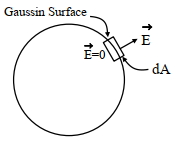
By Gauss law \(\int \vec{E} \cdot d \vec{A}=\frac{q_{\text {in }}}{\varepsilon_0}\)\(\mathrm{EdA}=\frac{\sigma \times \mathrm{dA}}{\varepsilon_0}\)
\(\mathrm{E}=\frac{\sigma}{\varepsilon_0}\)
-
- (A) \(2\)
- (B) \(3\)
- (C) \(4\)
- (D) \(5\)
Show answer and solution
Correct Answer: (B)
\(\sin \theta=\frac{10}{20}=\frac{1}{2}\)\(\theta=30^{\circ}\)
\(\tan \theta=\frac{\mathrm{qE}}{\mathrm{mg}}\)
\(\tan 30^{\circ}=\frac{\mathrm{q} \times 2 \times 10^4}{1 \times 10^{-3} \times 10}\)
\(\frac{1}{\sqrt{3}}=\mathrm{q} \times 10^6\)
\(\mathrm{q}=\frac{1}{\sqrt{3}} \times 10^{-6} \mathrm{C}\)
\(x=3\)
-
- (A) 8
- (B) 10
- (C) 12
- (D) 14
Show answer and solution
Correct Answer: (A)
Potential \(=\frac{k Q}{R}=\frac{k \cdot Z e}{R}\)
\(=\frac{9 \times 10^9 \times 50 \times 1.6 \times 10^{-19}}{9 \times 10^{-13} \times 10^{-2}}\)
\(=8 \times 10^6 V\) -
- (A) \(1\)
- (B) \(2\)
- (C) \(5\)
- (D) \(6\)
Show answer and solution
Correct Answer: (B)
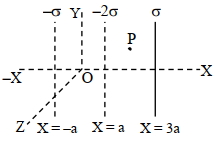
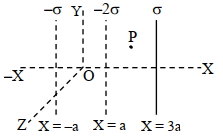
\(\overrightarrow{\mathrm{E}}_{\mathrm{p}}=\left(\frac{\sigma}{2 \varepsilon_0}+\frac{2 \sigma}{2 \varepsilon_0}+\frac{\sigma}{2 \varepsilon_0}\right)(-\hat{\mathrm{i}})\)\(=-\frac{2 \sigma}{\varepsilon_0} \hat{\mathrm{i}}\)
-
- (A) \(7\)
- (B) \(2\)
- (C) \(11\)
- (D) \(14\)
Show answer and solution
Correct Answer: (B)
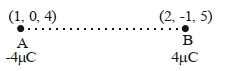
\( \vec{\tau}=\vec{p} \times \vec{E} \)\( \vec{p}=q \vec{\ell} \)
\( \vec{E}=0.2 \frac{V}{\mathrm{~cm}}=20 \frac{\mathrm{V}}{\mathrm{m}} \)
\( \vec{p}=4 \times(\hat{i}-\hat{j}+\hat{k}) \)
\( =(4 \hat{i}-4 \hat{j}+4 \hat{k}) \mu \mathrm{C}-\mathrm{m} \)
\( \vec{\tau}=(4 \hat{i}-4 \hat{j}+4 \hat{k}) \times(20 \hat{i}) \times 10^{-6} \mathrm{Nm} \)
\( =(8 \hat{\mathrm{k}}+8 \hat{\mathrm{j}}) \times 10^{-5}=8 \sqrt{2} \times 10^{-5} \)
\( \alpha=2\)
-
- (A) \(\frac{2 Q}{\varepsilon_0}\)
- (B) \(\frac{5 \mathrm{Q}}{\varepsilon_0}\)
- (C) \(\frac{7 Q}{\varepsilon_0}\)
- (D) \(\frac{3 Q}{\varepsilon_0}\)
Show answer and solution
Correct Answer: (B)
\(5 \mathrm{Q}\) charge is inside the spherical region flux through sphere \(=\frac{5 \mathrm{Q}}{\varepsilon_0}\)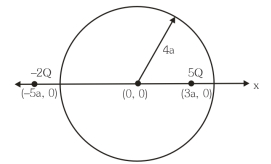
-
- (A) \(\frac{(1+\sqrt{3})}{r}\)
- (B) \(\frac{\mathrm{r}}{3(1+\sqrt{3})}\)
- (C) \(\frac{r}{(1+\sqrt{3})}\)
- (D) \(r(1+\sqrt{3})\)
Show answer and solution
Correct Answer: (C)
\(\left(\vec{E}_{\text {net }}\right)_p=0\)\(\frac{\mathrm{kq}}{\mathrm{x}^2}=\frac{\mathrm{k} \cdot 3 \mathrm{q}}{(\mathrm{r}-\mathrm{x})^2}\)
\((\mathrm{r}-\mathrm{x})^2=3 \mathrm{x}^2\)
\(\mathrm{r}-\mathrm{x}=\sqrt{3} \mathrm{x}\)
\(\mathrm{x}=\frac{\mathrm{r}}{\sqrt{3}+1}\)

-
- (A) \(4 \mathrm{~N}\)
- (B) \(6 \mathrm{~N}\)
- (C) \(1 \mathrm{~N}\)
- (D) \(12 \mathrm{~N}\)
Show answer and solution
Correct Answer: (B)
\(F_{P S} \propto Q^2\)
\(F_{P S}=16 N\)
Now If \(\mathrm{P} \& \mathrm{R}\) are brought in contact then
Now If \(\mathrm{S} \& \mathrm{R}\) are brought in contact then
New force between \(P \& S\) is :
\(\mathrm{F}_{\mathrm{PS}} \propto \frac{\mathrm{Q}}{2} \times \frac{3 \mathrm{Q}}{4}\)
\(\mathrm{~F}_{\mathrm{PS}} \propto \frac{3 \mathrm{Q}^2}{8}=\frac{3}{8} \times 16=6\)
-
- (A) \(11\)
- (B) \(15\)
- (C) \(16\)
- (D) \(20\)
Show answer and solution
Correct Answer: (C)
For closed organ pipe\(\mathrm{f}_{\mathrm{c}}=(2 \mathrm{n}+1) \frac{\mathrm{v}}{4 \ell}=\frac{15 \mathrm{v}}{4 \ell}\)
For open organ pipe
\(\mathrm{f}_{\mathrm{o}}=(\mathrm{n}+1) \frac{\mathrm{v}}{2 \ell}=\frac{8 \mathrm{v}}{2 \ell}\)
\(\frac{\mathrm{f}_{\mathrm{c}}}{\mathrm{f}_{\mathrm{o}}}=\frac{15}{16}=\frac{\mathrm{a}-1}{\mathrm{a}}\)
\(\Rightarrow \mathrm{a}=16\)
-
- (A) \(754\)
- (B) \(654\)
- (C) \(294\)
- (D) \(354\)
Show answer and solution
Correct Answer: (C)
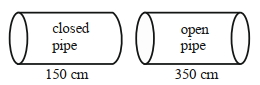
\( \mathrm{f}_{\mathrm{c}}=\frac{\mathrm{v}}{4 \ell_1} \quad \mathrm{f}_{\mathrm{o}}=\frac{\mathrm{v}}{2 \ell_2} \)\( \left|\mathrm{f}_{\mathrm{c}}-\mathrm{f}_0\right|=7 \)
\( \frac{\mathrm{v}}{4 \times 150}-\frac{\mathrm{v}}{2 \times 350}=7 \)
\( \frac{\mathrm{v}}{600 \mathrm{~cm}}-\frac{\mathrm{v}}{700 \mathrm{~cm}}=7 \)
\( \frac{\mathrm{v}}{6 \mathrm{~m}}-\frac{\mathrm{v}}{7 \mathrm{~m}}=7 \)
\( \mathrm{v}\left(\frac{1}{42}\right)=7 \)
\( \mathrm{v}=42 \times 7 \)
\( =294 \mathrm{~m} / \mathrm{s}\)
- 377. A plane progressive wave is given by \(y=2 \cos 2 \pi(330 t-x) m\). The frequency of the wave is _______. 2024 Hard
- (A) \(165 \mathrm{~Hz}\)
- (B) \(330 \mathrm{~Hz}\)
- (C) \(660 \mathrm{~Hz}\)
- (D) \(340 \mathrm{~Hz}\)
Show answer and solution
Correct Answer: (B)
\(y=2 \cos 2 \pi(330 t-x) m\)\(y=A \cos (\omega t-k x)\)
\(\text { by comparing } \omega=2 \pi \times 330\)
\(2 \pi f=2 \pi \times 330\)
\(f=330\)
-
- (A) \(30\)
- (B) \(40\)
- (C) \(50\)
- (D) \(60\)
Show answer and solution
Correct Answer: (D)
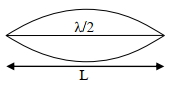
\(\mathrm{f}_0=400 \mathrm{~Hz} ; \mathrm{v}=\sqrt{\frac{\mathrm{T}}{\mu}}=\text { constant }\)\(\frac{\lambda}{2}=\mathrm{L} ; \mathrm{v}=\mathrm{f}_0 \lambda\)
\(\frac{\mathrm{v}}{2 \mathrm{f}_0}=\mathrm{L} \Rightarrow \mathrm{v}=2 \mathrm{Lf}_0\)
\(\mathrm{~L}^{\prime}=\frac{\mathrm{v}}{2 \mathrm{f}^{\prime}}=\frac{2 \mathrm{Lf}_0}{2 \mathrm{f}^{\prime}}\)
\(=\frac{L f_0}{\mathrm{f}^{\prime}}=\frac{90 \times 400}{600}=60\)
-
- (A) \(4\)
- (B) \(5\)
- (C) \(6\)
- (D) \(7\)
Show answer and solution
Correct Answer: (C)
\(\mathrm{f}=\frac{1}{2 L} \sqrt{\frac{T}{\mu}}\)\(\mathrm{f}_1=\frac{1}{2} \sqrt{\frac{6}{\mu}} \mathrm{f}_2=\frac{1}{2} \sqrt{\frac{54}{\mu}}\)
\(\frac{\mathrm{f}_1}{\mathrm{f}_2}=\frac{1}{3} \mathrm{f}_2-\mathrm{f}_1=12\)
\(\mathrm{f}_1=6 \mathrm{HZ}\)
-
- (A) \(400\)
- (B) \(200\)
- (C) \(600\)
- (D) \(800\)
Show answer and solution
Correct Answer: (A)
\( \frac{V}{4 \ell_1}=30 \Rightarrow \ell_1=\frac{11}{4} \mathrm{~m} \)\( \frac{V}{4 \ell_2}=110 \Rightarrow \ell_2=\frac{3}{4} \mathrm{~m} \)
\( \Delta \ell=2 \mathrm{~m},\)
Change in volume \(=A \Delta \ell=400 \mathrm{~cm}^3\)
\(M=\mathbf{4 0 0} \mathrm{g} ;\left(\because \rho=1 \mathrm{~g} / \mathrm{cm}^3\right)\)
-
- (A) \(60 \mathrm{~cm}\)
- (B) \(45 \mathrm{~cm}\)
- (C) \(30 \mathrm{~cm}\)
- (D) \(15 \mathrm{~cm}\)
Show answer and solution
Correct Answer: (D)
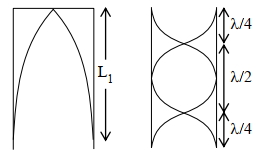
\(\frac{\lambda}{4}=\mathrm{L}_1 \quad 2\left(\frac{\lambda}{2}\right)=\lambda\)\(\mathrm{v}=\mathrm{f} \lambda \quad \mathrm{f}_2=\frac{2 \mathrm{v}}{2 \mathrm{~L}_2}\)
\(\mathrm{v}=\mathrm{f}_1\left(4 \mathrm{~L}_1\right) \quad \mathrm{f}_2=\frac{\mathrm{v}}{\mathrm{L}_2}\)
\({v}=\mathrm{f}_1\left(4 \mathrm{~L}_1\right)\)
\({f}_2=\frac{\mathrm{v}}{\mathrm{L}_2}\)
\({f}_1=\frac{\mathrm{v}}{4 \mathrm{~L}_1}\)
\({f}_1=\mathrm{f}_2\)
\(\frac{\mathrm{V}}{4 \mathrm{~L}_1}=\frac{\mathrm{V}}{\mathrm{L}_2}\)
\(\Rightarrow \mathrm{L}_2=4 \mathrm{~L}_1\)
\(60=4 \times \mathrm{L}_1\)
\({~L}_1=15 \mathrm{~cm} \)
- 382. The speed of sound in oxygen at \(S.T.P. \)will be approximately _______. (Given, \(\mathrm{R}=8.3 \mathrm{JK}^{-1}, \gamma=1.4\) ) 2024 Easy
- (A) \(310 \mathrm{~m} / \mathrm{s}\)
- (B) \(333 \mathrm{~m} / \mathrm{s}\)
- (C) \(341 \mathrm{~m} / \mathrm{s}\)
- (D) \(325 \mathrm{~m} / \mathrm{s}\)
Show answer and solution
Correct Answer: (A)
\(\mathrm{v}=\sqrt{\frac{\gamma \mathrm{RT}}{\mathrm{M}}}=\sqrt{\frac{1.4 \times 8.3 \times 273}{32 \times 10^{-3}}}\)\(=314.8541 \simeq 315 \mathrm{~m} / \mathrm{s}\)
-
- (A) \(740\)
- (B) \(730\)
- (C) \(720\)
- (D) \(710\)
Show answer and solution
Correct Answer: (A)
The difference in frequency in open organ pipe \(=\)\(\mathrm{f}=\frac{\mathrm{nv}}{2 \mathrm{~L}}\)
\(\Delta \mathrm{f}=\frac{6 \mathrm{v}}{2 \times 0.6}-\frac{5 \mathrm{v}}{2 \times 0.9}\)
\(\mathrm{v}=333 \mathrm{~m} / \mathrm{s}\)
\(\Delta \mathrm{f}=740 \mathrm{~Hz}\)
-
- (A) \(\tan ^{-1}(\sqrt{2})\)
- (B) \(2 \tan ^{-1}\left(\frac{1}{2}\right)\)
- (C) \(\tan ^{-1}\left(\frac{1}{2}\right)\)
- (D) \(2 \tan ^{-1}\left(\frac{1}{\sqrt{5}}\right)\)
Show answer and solution
Correct Answer: (B)
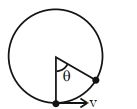
Loss in kinetic energy \(=\) Gain in potential energy\( \Rightarrow \frac{1}{2} \mathrm{mv}^2=\mathrm{mg} \ell(1-\cos \theta)\)
\( \Rightarrow \frac{\mathrm{v}^2}{\ell}=2 \mathrm{~g}(1-\cos \theta)\)
Acceleration at lowest point \(=\frac{\mathrm{v}^2}{\ell}\)
Acceleration at extreme point \(=g \sin \theta\)
Hence, \(\frac{\mathrm{v}^2}{\ell}=\mathrm{g} \sin \theta\)
\( \therefore \sin \theta=2(1-\cos \theta) \)
\( \Rightarrow \tan \frac{\theta}{2}=\frac{1}{2} \Rightarrow \theta=2 \tan ^{-1}\left(\frac{1}{2}\right)\)
-
- (A) \(3\)
- (B) \(4\)
- (C) \(5\)
- (D) \(6\)
Show answer and solution
Correct Answer: (A)
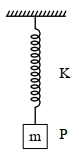
\(\mathrm{f}_1=\frac{1}{2 \pi} \sqrt{\frac{\mathrm{k}}{\mathrm{m}}}\)\(\mathrm{f}_2=\frac{1}{2 \pi} \sqrt{\frac{\mathrm{k}}{9 \mathrm{~m}}}\)
\(\frac{\mathrm{f}_1}{\mathrm{f}_2}=\sqrt{\frac{9}{1}}=\frac{3}{1}\)
-
- (A) \(11\)
- (B) \(22\)
- (C) \(12\)
- (D) \(15\)
Show answer and solution
Correct Answer: (C)
\( \mathrm{V}_{\mathrm{at} \text { mann position }}=\mathrm{A} \omega \Rightarrow 10=4 \omega \)\( \omega=\frac{5}{2} \)
\( \mathrm{~V}=\omega \sqrt{\mathrm{A}^2-\mathrm{x}^2} \)
\( 5=\frac{5}{2} \sqrt{4^2-\mathrm{x}^2} \Rightarrow \mathrm{x}^2=16-4 \)
\( \mathrm{x}=\sqrt{12} \mathrm{~cm}\)
-
- (A) \(12\)
- (B) \(15\)
- (C) \(20\)
- (D) \(22\)
Show answer and solution
Correct Answer: (A)
We know\(\mathrm{V}_{\max } =\omega \mathrm{A} \quad \text { at mean position }\)
\(=\frac{2 \pi}{\mathrm{T}} \mathrm{A}=\frac{2 \pi}{\pi} \times 0.06=0.12 \mathrm{~m} / \mathrm{sec}\)
\(\mathrm{V}_{\max } =12 \mathrm{~cm} / \mathrm{sec}\)
-
- (A) \(21\)
- (B) \(22\)
- (C) \(23\)
- (D) \(24\)
Show answer and solution
Correct Answer: (B)
\(\mathrm{m}=0.5 \mathrm{~kg}\)\(\mathrm{~F}=-50(\mathrm{x})\)
\(\mathrm{ma}=(-50 \mathrm{x})\)
\(0.5 \mathrm{a}=-50 \mathrm{x}\)
\(\mathrm{a}=(-100 \mathrm{x})\)
\(\mathrm{W}^2=100 \Rightarrow(\mathrm{w}=10)\)
\(\mathrm{T}=\frac{2 \pi}{10}=\left(\frac{\pi}{5}\right)=\frac{22}{7 \times 15}=\left(\frac{22}{35}\right)\)
\(\frac{\pi}{35}=\frac{22}{35} \Rightarrow \mathrm{x}=22\)
-
- (A) \(A\)\(\sqrt 3 \;\;\;\;\;\;\;\;\;\;\;\;\;\;\;\;\;\;\;\;\;\;\)
- (B) \(\;\frac{{7A}}{3}\)
- (C) \(\;\frac{A}{3}\sqrt {41} \)
- (D) \(3A\)
Show answer and solution
Correct Answer: (B)
Let new amplitude is \(A'\)initial velocity
\(v^{2}=\omega^{2}\left(A^{2}-\left(\frac{2 A}{3}\right)^{2}\right)\) \(...(1)\)
Where \(A\) is initial amplitude \(\&\, \omega\) is angular frequency.
Final velocity
\((3 v)^{2}=\omega^{2}\left(A^{\prime 2}-\left(\frac{2 A}{3}\right)^{2}\right)\) \(...(2)\)
From equation \(\&\) equation \(( 2)\)
\(\frac{1}{9}=\frac{A^{2}-\frac{4 A^{2}}{9}}{A^{2}-\frac{4 A^{2}}{9}}\)
\(A^{\prime}=\frac{7 A}{3}\)
-
- (A) \(7\)
- (B) \(8\)
- (C) \(9\)
- (D) \(10\)
Show answer and solution
Correct Answer: (A)
\(v=\omega \sqrt{A^2-x^2}\)\(\text { at } x=\frac{2 A}{3}\)
\(v=\omega \sqrt{A^2-\left(\frac{2 A}{3}\right)^2}=\frac{\sqrt{5} A \omega}{3}\)
New amplitude \(=\mathrm{A}^{\prime}\)
\(\mathrm{v}^{\prime}=3 \mathrm{v}=\sqrt{5} \mathrm{~A} \omega=\omega \sqrt{\left(\mathrm{A}^{\prime}\right)^2-\left(\frac{2 \mathrm{~A}}{3}\right)^2}\)
\(\mathrm{A}^{\prime}=\frac{7 \mathrm{~A}}{3}\)
-
- (A) \(2\)
- (B) \(12\)
- (C) \(4\)
- (D) \(9\)
Show answer and solution
Correct Answer: (A)
From phasor diagram particle has to move from \(\mathrm{P}\) to \(Q\) in a circle of radius equal to amplitude of \(SHM\)
\( \cos \phi=\frac{\frac{\sqrt{3} \mathrm{~A}}{2}}{\mathrm{~A}}=\frac{\sqrt{3}}{2} \)
\( \phi=\frac{\pi}{6}\)
Now, \(\frac{\pi}{6}=\omega t\)
\(\frac{\pi}{6}=\frac{2 \pi}{T} t\)
\(\frac{\pi}{6}=\frac{2 \pi}{6 \pi} t\)
\(\mathrm{t}=\frac{\pi}{2}\)
So, \(\mathrm{x}=2\)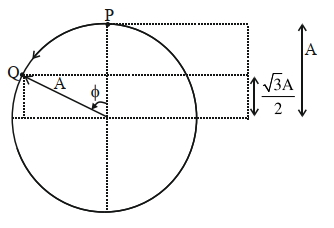
-
- (A) \(5\)
- (B) \(6\)
- (C) \(7\)
- (D) \(8\)
Show answer and solution
Correct Answer: (D)
Acceleration due to gravity \(\mathrm{g}^{\prime}=\frac{\mathrm{g}}{4}\)\(T=2 \pi \sqrt{\frac{4 \ell}{g}}\)
\(T=2 \pi \sqrt{\frac{4 \times 4}{g}}\)
\(T=2 \pi \frac{4}{\pi}=8 s\)
-
- (A) \(3\)
- (B) \(5\)
- (C) \(6\)
- (D) \(7\)
Show answer and solution
Correct Answer: (C)
\(\text { Total energy }=\text { K.E. }+ \text { P.E. }\)\(\text { at } \mathrm{x}=0.04 \mathrm{~m}, \text { T.E. }=0.5+0.4=0.9 \mathrm{~J}\)
\(\text { T.E }=1 \mathrm{~m}^2 \mathrm{~A}^2=0.9\)
\(\quad=\frac{1}{2} \times 0.2\left(2 \pi \times \frac{25}{\pi}\right)^2 \times \mathrm{A}^2=0.9\)
\(\Rightarrow \mathrm{A}=0.06 \mathrm{~m}\)
\(\mathrm{~A}=6 \mathrm{~cm}\)
-
- (A) \(\frac{E}{\sqrt{2}}\)
- (B) \(\mathrm{E}\)
- (C) \(\mathrm{E} \sqrt{2}\)
- (D) \(2 \mathrm{E}\)
Show answer and solution
Correct Answer: (B)
\(\text { T.E. }=\frac{1}{2} \mathrm{kA}^2\)since \(A\) is same \(T.E.\) will be same correct option \((2)\)
-
- (A) \(6 \sqrt{5} \mathrm{~ms}^{-1}\)
- (B) \(5 \sqrt{6} \mathrm{~ms}^{-1}\)
- (C) \(5 \sqrt{5} \mathrm{~ms}^{-1}\)
- (D) \(2 \sqrt{5} \mathrm{~ms}^{-1}\)
Show answer and solution
Correct Answer: (A)
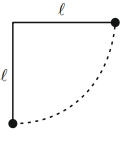
\( \ell=10 \mathrm{~m} \)\( \text { Initial energy }=\mathrm{mg} \ell \)
\( \text { So, } \frac{9}{10} \mathrm{mg} \ell=\frac{1}{2} \mathrm{mv}^2 \)
\( \Rightarrow \frac{9}{10} \times 10 \times 10=\frac{1}{2} \mathrm{v}^2 \)
\( \mathrm{v}^2=180 \)
\( \mathrm{v}=\sqrt{180}=6 \sqrt{5} \mathrm{~m} / \mathrm{s}\)
-
- (A) \(10\)
- (B) \(15\)
- (C) \(20\)
- (D) \(25\)
Show answer and solution
Correct Answer: (A)
Given,\(\mathrm{T}=3.14=\frac{2 \pi}{\omega}\)
\(\omega=2 \mathrm{rad} / \mathrm{s}\)
\(\mathrm{x}=10 \sin \left(\omega \mathrm{t}+\frac{\pi}{3}\right)\)
\(\mathrm{v}=\frac{\mathrm{dx}}{\mathrm{dt}}=10 \omega \cos \left(\omega \mathrm{t}+\frac{\pi}{3}\right)\)
\(\text { at } \mathrm{t}=0\)
\(\mathrm{v}=10 \omega \cos \left(\frac{\pi}{3}\right)=10 \times 2 \times \frac{1}{2}[\text { using } \omega=2 \mathrm{rad} / \mathrm{s}]\)
\(\mathrm{v}=10 \mathrm{~m} / \mathrm{s}\)
-
- (A) \(\frac{2}{9}\,m\)
- (B) \(\frac{4}{9}\,m\)
- (C) \(\frac{8}{9}\,m\)
- (D) \(\frac{1}{9}\,m\)
Show answer and solution
Correct Answer: (D)
\(T =2 \pi \sqrt{\frac{ L }{ g }}, \quad g ^{\prime}=\frac{ GM }{9 R ^{2}}=\frac{ g }{9}=\frac{\pi^{2}}{9}\)\(2=2 \pi \sqrt{\frac{ L }{\pi^{2}} \times 9}\)
\(1=\pi \sqrt{ L } \times \frac{3}{\pi} \Rightarrow L =\frac{1}{9}\,m\)
-
- (A) \(17\)
- (B) \(18\)
- (C) \(19\)
- (D) \(20\)
Show answer and solution
Correct Answer: (A)
\(x=4 \mathrm{~m}, \mathrm{~V}=2 \mathrm{~m} / \mathrm{s}, \mathrm{a}=16 \mathrm{~m} / \mathrm{s}^2\)\(|\mathrm{a}|=\omega^2 \mathrm{x}\)
\(\Rightarrow 16=\omega^2(4)\)
\(\omega=2 \mathrm{rad} / \mathrm{s}\)
\(\mathrm{v}=\omega \sqrt{\mathrm{A}^2-\mathrm{x}^2}\)
\(A=\sqrt{\frac{\mathrm{v}^2}{\omega^2}+\mathrm{x}^2} \Rightarrow \mathrm{A}=\sqrt{\frac{4}{4}+16}\)
\(A=\sqrt{17} \mathrm{~m}\)
-
- (A) \(12\)
- (B) \(15\)
- (C) \(30\)
- (D) \(35\)
Show answer and solution
Correct Answer: (A)
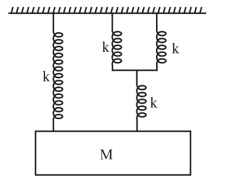
\(\mathrm{k}_{\mathrm{eq}}=\frac{2 \mathrm{k} \cdot \mathrm{k}}{3 \mathrm{k}}+\mathrm{k}=\frac{5 \mathrm{k}}{3}\)Angular frequency of oscillation \((\omega)=\sqrt{\frac{\mathrm{k}_{\mathrm{eq}}}{\mathrm{m}}}\)
\((\omega)=\sqrt{\frac{5 \mathrm{k}}{3 \mathrm{~m}}}\)
Period of oscillation \((\tau)=\frac{2 \pi}{\omega}=2 \pi \sqrt{\frac{3 \mathrm{~m}}{5 \mathrm{k}}}\)
\(=\pi \sqrt{\frac{12 \mathrm{~m}}{5 \mathrm{k}}}\)
-
- (A) \(3 \%\)
- (B) \(1 \%\)
- (C) \(4 \%\)
- (D) \(5 \%\)
Show answer and solution
Correct Answer: (D)
\(\mathrm{T}=2 \pi \sqrt{\frac{\mathrm{m}}{\mathrm{k}}}\)\(\mathrm{T}^2 \propto \frac{\mathrm{m}}{\mathrm{k}}\)
\(\frac{2 \Delta \mathrm{T}}{\mathrm{T}} \%=\frac{\Delta \mathrm{m}}{\mathrm{m}} \%-\frac{\Delta \mathrm{k}}{\mathrm{k}} \%\)
\(\frac{\Delta \mathrm{k}}{\mathrm{k}} \%=\frac{\Delta \mathrm{m}}{\mathrm{m}} \%-\frac{2 \Delta \mathrm{T}}{\mathrm{T}} \% \)
\(\frac{\Delta \mathrm{k}}{\mathrm{k}} \%=(-1) \%-2(2) \%=|-5 \%|=5 \%\)
No questions on this page match these filters.