


Questions
39 questionsShowing 1–39 of 39 questions
-
- (A) 5
- (B) 10
- (C) 15
- (D) 20
Show answer and solution
Correct Answer: (A)
\(R=\frac{\rho \ell}{A} \Rightarrow \frac{2 \times 10^{-6} \times \ell}{10^{-5}}=1 \Rightarrow \ell=5\)
\(mg = Bi \ell\)
\(B =\frac{ mg }{ i \ell}=\frac{5}{2 \times 5}=0.5=5 \times 10^{-1}\) Tesla -
- (A) \(12\)
- (B) \(78\)
- (C) \(85\)
- (D) \(32\)
Show answer and solution
Correct Answer: (D)
\(\mathrm{q} =4 \mu \mathrm{C}, \overrightarrow{\mathrm{v}}=4 \times 10^6\)\( \hat{\mathrm{j}} \mathrm{m} / \mathrm{s} \)
\(\overrightarrow{\mathrm{B}} =2 \hat{\mathrm{k}} \mathrm{T} \)
\(\overrightarrow{\mathrm{F}} =\mathrm{q}(\overrightarrow{\mathrm{v}} \times \overrightarrow{\mathrm{B}}) \)
\( =4 \times 10^{-6}\left(4 \times 10^6 \hat{\mathrm{j}} \times 2 \hat{\mathrm{k}}\right) \)
\( =4 \times 10^{-6} \times 8 \times 10^6 \hat{\mathrm{i}} \)
\(\overrightarrow{\mathrm{F}} =32 \hat{\mathrm{i}} \mathrm{N} \)
\(\mathrm{x} =32\) -
- (A) \(8\)
- (B) \(3\)
- (C) \(4\)
- (D) \(5\)
Show answer and solution
Correct Answer: (D)
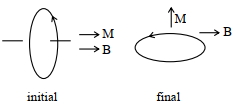
We know\(\mathrm{W}_{\text {ext }} =\Delta \mathrm{U}+\Delta \mathrm{KE} \quad(\mathrm{P} . \mathrm{E} .=-\overrightarrow{\mathrm{M}} \cdot \overrightarrow{\mathrm{B}})\)
\(=-\overrightarrow{\mathrm{M}} \cdot \overrightarrow{\mathrm{B}}_{\mathrm{f}}+\overrightarrow{\mathrm{M}} \cdot \overrightarrow{\mathrm{B}}_{\mathrm{i}}+0\)
\(=-\mathrm{MB} \cos 90+\mathrm{MB} \cos 0\)
\(=\mathrm{MB}\)
\(=\mathrm{NIAB}\)
\(=200 \times 100 \times 10^{-6} \times \frac{5}{2} \times 10^{-4} \times 1=5 \mu\)
-
- (A) \(100\)
- (B) \(99\)
- (C) \(200\)
- (D) \(199\)
Show answer and solution
Correct Answer: (A)
\(W=\Delta \mathrm{U}=\mathrm{U}_{\mathrm{f}}-\mathrm{U}_{\mathrm{i}}\)\(\mathrm{W}=(-\vec{\mu} \cdot \overrightarrow{\mathrm{B}})_{\mathrm{f}}-(-\vec{\mu} \cdot \overrightarrow{\mathrm{B}})_i\)
\(=0+(\vec{\mu} \cdot \overrightarrow{\mathrm{B}})_i\)
\(=\left(100 \times 5 \times 10^{-3} \times 1 \times 10^{-3}\right) \times 0.2 \mathrm{~J}\)
\(=1 \times 10^{-4} \mathrm{~J}=100 \mu \mathrm{J}\)
-
- (A) \(30 \ \mu \mathrm{A}\)
- (B) \(120\ \mu \mathrm{A}\)
- (C) \(60 \ \mu \mathrm{A}\)
- (D) \(180\ \mu \mathrm{A}\)
Show answer and solution
Correct Answer: (C)
\(i \propto \theta\) (angle of deflection)\( \therefore \frac{i_2}{i_1}=\frac{\theta_2}{\theta_1} \Rightarrow \frac{i_2}{200 \mu \mathrm{A}}=\frac{\pi / 10}{\pi / 3}=\frac{3}{10}\)
\( \Rightarrow \mathrm{i}_2=60\ \mu \mathrm{A}\)
-
- (A) \(0.40 \Omega\)
- (B) \(0.20 \Omega\)
- (C) \(0.50 \Omega\)
- (D) \(0.10 \Omega\)
Show answer and solution
Correct Answer: (B)
\(\mathrm{G}=200 \Omega\)\(\mathrm{i}_{\mathrm{g}}=20 \mu \mathrm{A}\)
\(\mathrm{i}=\mathrm{i}_{\mathrm{g}}\left(\frac{\mathrm{G}}{\mathrm{S}}+1\right)\)
\(\Rightarrow 20 \times 10^{-3}=20 \times 10^{-6}\left(\frac{200}{\mathrm{~S}}+1\right)\)
\(\Rightarrow \frac{200}{\mathrm{~S}}=999\)
\(\Rightarrow \mathrm{S} \approx 0.2 \Omega\)
-
- (A) \(5975 \Omega\)
- (B) \(20050 \Omega\)
- (C) \(19950 \Omega\)
- (D) \(19500 \Omega\)
Show answer and solution
Correct Answer: (C)
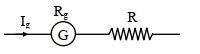
R= \(\frac{V}{I_g}-R_g=\frac{100}{5 \times 10^{-3}}-50\)\(=20000-50\)
\(=19950 \Omega\)
-
- (A) \(3 \times 10^{-3}\ \Omega\)
- (B) \(4.85 \times 10^{-3} \ \Omega\)
- (C) \(3.75 \times 10^{-3} \ \Omega\)
- (D) \(2.75 \times 10^{-3} \ \Omega\)
Show answer and solution
Correct Answer: (C)
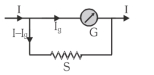
Given \(\mathrm{G}=10\ \Omega\)\( \mathrm{I}_{\mathrm{g}}=3 \mathrm{~mA} \)
\( \mathrm{I}=8 \mathrm{~A}\)
In case of conversion of galvanometer into ammeter.
We have \(\mathrm{I}_{\mathrm{g}} \mathrm{G}=\left(\mathrm{I}-\mathrm{I}_{\mathrm{g}}\right) \mathrm{S}\)
\( S=\frac{I_g G}{I-I_g} \)
\( S=\frac{\left(3 \times 10^{-3}\right) 10}{8-0.003}=3.75 \times 10^{-5} \Omega\)
-
- (A) \(2\)
- (B) \(800\)
- (C) \(20\)
- (D) \(200\)
Show answer and solution
Correct Answer: (C)
\(\mathrm{i}_{\mathrm{g}}=\frac{10}{400+100}=20 \times 10^{-3} \mathrm{~A}\)For ammeter
Let shunt resistance \(=\mathrm{S}\)
\(i_g R=\left(i-i_g\right) S\)
\(20 \times 10^{-3} \times 100=10 S\)
\(S=20 \times 10^{-2} \Omega\)
-
- (A) \(1: 4\)
- (B) \(4: 1\)
- (C) \(1: 1\)
- (D) \(3: 4\)
Show answer and solution
Correct Answer: (C)
\(\mathrm{B}_1 2 \pi \frac{\mathrm{a}}{2}=\mu_0 \frac{\mathrm{I}}{4}\)\(\mathrm{~B}_1=\frac{\mu_0 \mathrm{I}}{4 \pi \mathrm{a}}\)
\(\mathrm{B}_2 2 \pi 2 \mathrm{a}=\mu_0 \mathrm{I}\)
\(\mathrm{B}_2=\frac{\mu_{\mathrm{v}} \mathrm{I}}{4 \pi \mathrm{a}}\)
-
- (A) \(8\)
- (B) \(7\)
- (C) \(4\)
- (D) \(3\)
Show answer and solution
Correct Answer: (C)
\(\tau=\text { BINAsin } \phi\)\(\mathrm{C} \theta=\mathrm{BINA} \sin 90^{\circ}\)
\(\mathrm{C}=\frac{\mathrm{BINA}}{\theta}=\frac{0.01 \times 10 \times 10^{-3} \times 100 \times 2 \times 10^{-4}}{0.05}\)
\(=4 \times 10^{-5} \mathrm{~N}-\mathrm{m} / \mathrm{rad} .\)
\(\mathrm{x}=4\)
-
- (A) \(1: 1\)
- (B) \(1: \sqrt{2}\)
- (C) \(\sqrt{2}: 1\)
- (D) \(1: 2\)
Show answer and solution
Correct Answer: (C)
In uniform magnetic field,\(\mathrm{R}=\frac{\mathrm{m} v}{\mathrm{qB}}=\frac{\sqrt{2 \mathrm{~m}(\mathrm{~K} \cdot \mathrm{E})}}{\mathrm{qB}}\)
Since same \(K.E\)
\(\mathrm{R} \propto \frac{\sqrt{\mathrm{m}}}{\mathrm{q}}\)
\(\therefore \frac{\mathrm{R}_{\text {deutron }}}{\mathrm{R}_{\text {proton }}}=\sqrt{\frac{\mathrm{m}_{\mathrm{d}}}{\mathrm{m}_{\mathrm{p}}}} \times \frac{\mathrm{q}_{\mathrm{p}}}{\mathrm{q}_{\mathrm{d}}}\)
\(=\sqrt{2} \times 1\)
\(\therefore \gamma_{\mathrm{d}}: \gamma_{\mathrm{p}}=\sqrt{2}: 1\)
-
- (A) \((A)\), \((B)\) and \((C)\) only
- (B) \((A)\), \((C)\) and \((D)\) only
- (C) \((A)\), \((B)\) and \((D)\) only
- (D) \((B)\), \((C)\) and \((D)\) only
Show answer and solution
Correct Answer: (C)
Net force on particle must be zero i.e. \(\mathrm{q} \overrightarrow{\mathrm{E}}+\mathrm{q} \overrightarrow{\mathrm{V}} \times \overrightarrow{\mathrm{B}}=0\)Possible cases are
\((i)\) \(\overrightarrow{\mathrm{E}} \& \overrightarrow{\mathrm{B}}=0\)
\((ii)\) \(\overrightarrow{\mathrm{V}} \times \overrightarrow{\mathrm{B}}=0, \overrightarrow{\mathrm{E}}=0\)
\((iii)\) \(\mathrm{q} \overrightarrow{\mathrm{E}}=-\mathrm{q} \overrightarrow{\mathrm{V}} \times \overrightarrow{\mathrm{B}}\)
\(\overrightarrow{\mathrm{E}} \neq 0 \& \overrightarrow{\mathrm{B}} \neq 0\)
-
- (A) \(72\)
- (B) \(75\)
- (C) \(80\)
- (D) \(82\)
Show answer and solution
Correct Answer: (A)
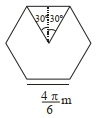
\(s = \frac{P}{n} = \frac{4\pi}{6} = \frac{2\pi}{3} \mathrm{~m}\)
\(a = \frac{s}{2 \tan(\pi/n)} = \frac{2\pi/3}{2 \tan(\pi/6)} = \frac{2\pi/3}{2(1/\sqrt{3})} = \frac{\pi\sqrt{3}}{3} \mathrm{~m}\)
\(B = \frac{n \mu_0 I}{2 \pi a} \sin(\pi/n) = \frac{6 \times (4\pi \times 10^{-7}) \times (4\pi\sqrt{3})}{2 \pi \times (\pi\sqrt{3}/3)} \times \sin(\pi/6)\)
\(B = \frac{6 \times 4\pi \times 10^{-7} \times 4\pi\sqrt{3}}{2 \pi^2 \sqrt{3}/3} \times \frac{1}{2}\)
\(B = \frac{96 \pi^2 \sqrt{3} \times 10^{-7}}{2 \pi^2 \sqrt{3}/3} \times \frac{1}{2}\)
\(B = 72 \times 10^{-7} \mathrm{~T}\)
\(x = 72\)
-
- (A) \(-\mathrm{iBR} \hat{\mathrm{j}}\)
- (B) \(2 \mathrm{iBR} \hat{\mathrm{j}}\)
- (C) \(i B R \hat{j}\)
- (D) \(-2 i B R \hat{j}\)
Show answer and solution
Correct Answer: (D)
Note : Direction of magnetic field is in \(+\hat{k}\)\(\vec{F}=i \vec{\ell} \times \vec{B}\)
\(\ell=2 \mathrm{R}\)
\(\vec{F}=-2 i R B \hat{j}\)
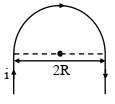
-
- (A) \(500\)
- (B) \(400\)
- (C) \(600\)
- (D) \(300\)
Show answer and solution
Correct Answer: (A)
\(\mu_0 n i=B \quad n=\) number of turns per unit length\(\mu_0\left(\frac{\mathrm{m}}{\ell}\right) \mathrm{i}=\mathrm{B}\)
\(\mathrm{m}=\frac{\mathrm{B} \ell}{\mu_0 \mathrm{i}}=\frac{6.28 \times 10^{-3} \times 0.5}{12.56 \times 10^{-7} \times 5}\)
\(\mathrm{~m}=500\)
-
- (A) \(159\)
- (B) \(160\)
- (C) \(170\)
- (D) \(171\)
Show answer and solution
Correct Answer: (B)
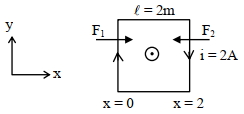
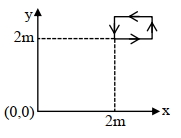
\(\mathrm{B}(\mathrm{x}=0)=\mathrm{B}_0, \quad \mathrm{~B}(\mathrm{x}=2)=9 \mathrm{~B}_0\)\(\text { Also, } \mathrm{F}=\mathrm{i} \ell \mathrm{B}\)
\(\Rightarrow \mathrm{F}_1=\mathrm{i} \ell \mathrm{B}_0 \& \mathrm{~F}_2=9 \mathrm{i} \ell \mathrm{B}_0\)
\(\mathrm{~F}=\mathrm{F}_2-\mathrm{F}_1=8 \mathrm{i} \ell \mathrm{B}_0=8 \times 2 \times 2 \times 5\)
\(\mathrm{~F}=160 \mathrm{~N}\)
-
- (A) \(2 \times 10^{-4} \mathrm{~N}-\mathrm{m}\) along positive \(\mathrm{Z}\)-direction
- (B) \(2 \times 10^{-4} \mathrm{~N}-\mathrm{m}\) along negative \(Z\)-direction
- (C) \(2 \times 10^{-4} \mathrm{~N}-\mathrm{m}\) along positive \(\mathrm{X}\)-direction
- (D) \(2 \times 10^{-4} \mathrm{~N}-\mathrm{m}\) along positive \(\mathrm{Y}\)-direction
Show answer and solution
Correct Answer: (B)
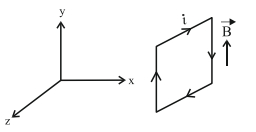
\(\overrightarrow{\mathrm{M}}=\mathrm{iA}\)\(=5 \times(0.2) \times(0.1)(-\hat{\mathrm{i}})\)
\(=0.1(-\hat{\mathrm{i}})\)
\(\vec{\tau}=\overrightarrow{\mathrm{M}} \times \overrightarrow{\mathrm{B}}=0.1(-\hat{\mathrm{i}}) \times\left(2 \times 10^{-3}\right)(\hat{\mathrm{j}})\)
\(=2 \times 10^{-4}(-\hat{\mathrm{k}}) \mathrm{N}-\mathrm{m}\)
- 19. An electron is projected with uniform velocity along the axis inside a current carrying long solenoid. Then : 2024 Hard
- (A) the electron will be accelerated along the axis.
- (B) the electron will continue to move with uniform velocity along the axis of the solenoid.
- (C) the electron path will be circular about the axis.
- (D) the electron will experience a force at \(45^{\circ}\) to the axis and execute a helical path.
Show answer and solution
Correct Answer: (B)
Since \(\vec{v} \| \vec{B}\) so force on electron due to magnetic field is zero. So it will move along axis with uniform velocity.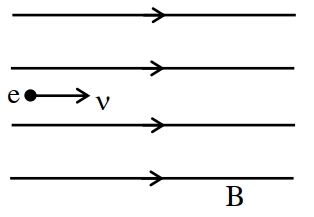
-
- (A) \(5\)
- (B) \(6\)
- (C) \(7\)
- (D) \(8\)
Show answer and solution
Correct Answer: (A)
\(\vec{F}=q(\vec{v} \times \vec{B})\)\(5 e \hat{k}=e(3 \hat{i}+5 \hat{j}) \times\left(B_0 \hat{i}+2 B_0 \hat{j}\right)\)
\(5 e \hat{k}=e\left(6 B_0 \hat{k}-5 B_0 \hat{k}\right)\)
\(\Rightarrow B_0=5 T\)
-
- (A) \(3\)
- (B) \(4\)
- (C) \(5\)
- (D) \(6\)
Show answer and solution
Correct Answer: (B)
For the given condition of moving undeflected, net force should be zero.\(\mathrm{qE} =\mathrm{qVB}\)
\(\mathrm{E} =\mathrm{VB}\)
\(=\sqrt{\frac{2 \times \mathrm{KE}}{\mathrm{m}}} \times \mathrm{B}\)
\(=\sqrt{\frac{2 \times 5 \times 1.6 \times 10^{-19}}{9 \times 10^{-31}}} \times 3 \times 10^{-6}\)
\(=4 \mathrm{~N} / \mathrm{C}\)
-
- (A) \(4 \times 10^{-8} \mathrm{~T}\)
- (B) \(8 \times 10^{-8} \mathrm{~T}\)
- (C) \(12 \times 10^{-8} \mathrm{~T}\)
- (D) \(10 \times 10^{-8} \mathrm{~T}\)
Show answer and solution
Correct Answer: (A)
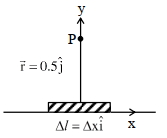
\(\overrightarrow{\mathrm{dB}}=\frac{\mu_0 \mathrm{I}}{4 \pi} \frac{(\overrightarrow{\mathrm{d} l} \times \overrightarrow{\mathrm{r}})}{\mathrm{r}^3} \text { (Tesla) }\)\(=\frac{10^{-7} \times 10 \times\left(\frac{1}{2} \times \frac{1}{100}\right)(+\hat{\mathrm{k}})}{\left(\frac{1}{2}\right)^3}=4 \times 10^{-8} \mathrm{~T}(+\hat{\mathrm{k}})\)
-
- (A) inside the outer conductor
- (B) in between the two conductors
- (C) outside the cable
- (D) inside the inner conductor
Show answer and solution
Correct Answer: (C)
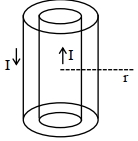
\(\oint \overrightarrow{\mathrm{B}} \cdot \overrightarrow{\mathrm{d} \ell}=\mu_0 \mathrm{i}_{\mathrm{enc}}=0\)\(\dot{\triangle} \mathrm{B}=0\) outside the cable
-
- (A) \(\frac{G}{20}\)
- (B) \(\frac{G}{199}\)
- (C) \(199 \mathrm{G}\)
- (D) \(200 \mathrm{G}\)
Show answer and solution
Correct Answer: (A)
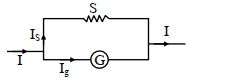
\(\mathrm{I}_{\mathrm{S}} \mathrm{S}=\mathrm{I}_{\mathrm{g}} \mathrm{G}\)\(\frac{95}{100} \mathrm{IS}=\frac{5 \mathrm{I}}{100} \mathrm{G}\)
\(\mathrm{S}=\frac{\mathrm{G}}{19}\)
\(\mathrm{R}_{\mathrm{A}}=\frac{\mathrm{SG}}{\mathrm{S}+\mathrm{G}}=\frac{\frac{\mathrm{G}^2}{19}}{\frac{20 \mathrm{G}}{19}}\)
\(\mathrm{R}_{\mathrm{A}}=\frac{\mathrm{G}}{20}\)
-
- (A) \(5\)
- (B) \(6\)
- (C) \(7\)
- (D) \(8\)
Show answer and solution
Correct Answer: (A)
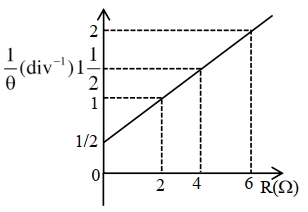
\(i=K \theta\)
\(\frac{2}{G+R}=K \theta\)
\(\Rightarrow \frac{1}{\theta}=\frac{(G+R) K}{2}=R\left(\frac{K}{2}\right)+\frac{K G}{2}\)
\(\text {Slope }=\frac{K}{2}=\frac{1}{4} \Rightarrow K=0.5=5 \times 10^{-1} A\) -
- (A) \(150\)
- (B) \(160\)
- (C) \(170\)
- (D) \(180\)
Show answer and solution
Correct Answer: (B)
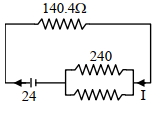
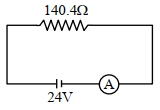
\(\text { Req }\)\(=140.4+\frac{240 \times 10}{240+10}\)
\(\text { Req }=140.4+\frac{2400}{250}\)
\(\text { Req. }=150 \Omega\)
\(\therefore\) Current in ammeter\( =\frac{24}{150}\)
\(=160 \mathrm{~mA}\)
- 27. Match List-\(I\) with List-\(II\) Choose the correct answer from the options given below :
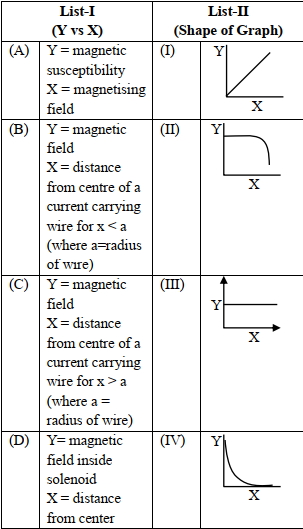 2024 Hard
- (A) \((A)-(III), (B)-(I), (C)-(IV), (D)-(II)\)
- (B) \((A)-(I), (B)-(III), (C)-(II), (D)-(IV)\)
- (C) \((A)-(IV), (B)-(I), (C)-(III), (D)-(II)\)
- (D) \((A)-(III), (B)-(IV), (C)-(I), (D)-(II)\)
Show answer and solution
Correct Answer: (A)
\((A)\) Graph between Magnetic susceptibility and magnetising field is:(Image)
\((B)\) magnetic field due to a current carrying wire for \(\mathrm{x}<\mathrm{a}\) :
\(\mathrm{B}=\frac{\mu_0 \mathrm{ir}}{2 \pi \mathrm{a}^2}\)
(Image)
\((C)\) magnetic field due to a current carrying wire for \(x>a\) :
\(B=\frac{\mu_0 i}{2 \pi a}\)
(Image)
\((D)\) magnetic field inside solenoid varies as:
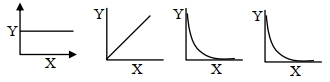
-
- (A) \(35\)
- (B) \(40\)
- (C) \(45\)
- (D) \(50\)
Show answer and solution
Correct Answer: (B)
\(B=4 \times \frac{\mu_0 i}{4 \pi(1 / 2)}\left(\frac{1}{\sqrt{2}}+\frac{1}{\sqrt{2}}\right)\)\(=4 \times 10^{-7} \times 5 \times 2 \times \sqrt{2}\)
\(=40 \sqrt{2} \times 10^{-7} \mathrm{~T}\)
-
- (A) \(12\ \Omega\)
- (B) \(96\ \Omega\)
- (C) \(48\ \Omega\)
- (D) \(100 \ \Omega\)
Show answer and solution
Correct Answer: (B)
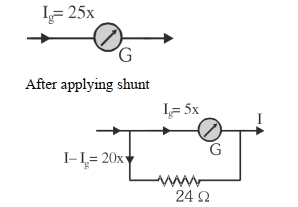
Let \(\mathrm{x}=\) current/divisionNow \(5 \mathrm{x} \times \mathrm{G}=20 \mathrm{x} \times 24\)
\( \mathrm{G}=4 \times 24 \)
\( \mathrm{G}=96 \ \Omega\)
-
- (A) \(\vec{F}_1=q \vec{V} \cdot \vec{E}, \vec{F}_2=q(\vec{B} \cdot \vec{V})\)
- (B) \(\overrightarrow{\mathrm{F}}_1=\mathrm{q} \overrightarrow{\mathrm{B}}, \overrightarrow{\mathrm{F}}_2=\mathrm{q}(\overrightarrow{\mathrm{B}} \times \overrightarrow{\mathrm{V}})\)
- (C) \(\overrightarrow{\mathrm{F}}_1=\mathrm{q} \overrightarrow{\mathrm{E}}, \overrightarrow{\mathrm{F}}_2=\mathrm{q}(\overrightarrow{\mathrm{V}} \times \overrightarrow{\mathrm{B}})\)
- (D) \(\overrightarrow{\mathrm{F}}_1=\mathrm{q} \overrightarrow{\mathrm{B}}, \overrightarrow{\mathrm{F}}_2=\mathrm{q}(\overrightarrow{\mathrm{B}} \times \overrightarrow{\mathrm{V}})\)
Show answer and solution
Correct Answer: (C)
\(\overrightarrow{\mathrm{F}}_1=\mathrm{q} \overrightarrow{\mathrm{E}} \quad \text { (Theory) }\)\(\overrightarrow{\mathrm{F}}_2=\mathrm{q}(\overrightarrow{\mathrm{V}} \times \overrightarrow{\mathrm{B}})\)
-
- (A) \(35\)
- (B) \(15\)
- (C) \(74\)
- (D) \(64\)
Show answer and solution
Correct Answer: (A)
\( B_H=3.5 \times 10^{-5} T \)\( F=i \ell B \sin \theta, \quad \mathrm{i}=\sqrt{2} A \)
\( \frac{F}{\ell}=i B \sin \theta=\sqrt{2} \times 3.5 \times 10^{-5} \times \frac{1}{\sqrt{2}} \)
\( =35 \times 10^{-6} \mathrm{~N} / \mathrm{m}\)
-
- (A) \(3\)
- (B) \(7\)
- (C) \(1\)
- (D) \(9\)
Show answer and solution
Correct Answer: (A)
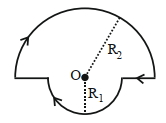
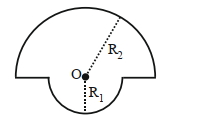
\( \frac{\mu_0 \mathrm{i}}{2 \mathrm{R}_2}\left(\frac{\pi}{2 \pi}\right) \otimes+\frac{\mu_0 \mathrm{i}}{2 \mathrm{R}_1}\left(\frac{\pi}{2 \pi}\right) \otimes \)\( \left(\frac{\mu_0 \mathrm{i}}{4 \mathrm{R}_2}+\frac{\mu_0 \mathrm{i}}{4 \mathrm{R}_1}\right) \otimes \)
\( \frac{4 \pi \times 10^{-7} \times 4}{4 \times 4 \pi}+\frac{4 \pi \times 10^{-7} \times 4}{4 \times 2 \pi} \)
\( =3 \times 10^{-7}=\alpha \times 10^{-7} \)
\( \alpha=3\)
-
- (A) \(15\)
- (B) \(40\)
- (C) \(50\)
- (D) \(65\)
Show answer and solution
Correct Answer: (C)
Force on segment parallel to \(\mathrm{x}\)-axis will cancel each other. Hence \(F_{\text {net }}\) will be due to portion parallel to \(y\)-axis.\(F=0.5 \times 0.5 \times 6 \times 0.2-0.5 \times 0.5 \times 0.2 \times 5\)
\(=0.5 \times 0.5 \times 0.2\)
\(=0.25 \times 0.2\)
\(=50 \times 10^{-3} \mathrm{~N}\)
\(=50 \mathrm{mN}\)
-
- (A) \(16 \times 10^{-2} \mathrm{~J}\)
- (B) \(8 \times 10^{-2} \mathrm{~J}\)
- (C) \(4 \times 10^{-2} \mathrm{~J}\)
- (D) Zero
Show answer and solution
Correct Answer: (B)
At stable equilibrium\(\mathrm{U}=-\mathrm{mB} \cos 0^{\circ}=-\mathrm{mB}\)
At unstable equilibrium
\(\mathrm{U}=-\mathrm{mB} \cos 180^{\circ}=+\mathrm{mB}\)
\(\mathrm{W}=\Delta \mathrm{U}\)
\(\text { W.D. }=2 \mathrm{mB}\)
\(=2(0.5) 8 \times 10^{-2}=8 \times 10^{-2} \mathrm{~J}\)
-
- (A) \(10\)
- (B) \(20\)
- (C) \(30\)
- (D) \(40\)
Show answer and solution
Correct Answer: (B)
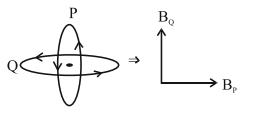
\(\mathrm{B}_{\mathrm{p}}=\frac{\mu_0 \mathrm{Ni}_1}{2 \mathrm{r}}=\frac{\mu_0 \times 1 \times 100}{2 \pi}=2 \times 10^{-3} \mathrm{~T}\)\(\mathrm{~B}_{\mathrm{Q}}=\frac{\mu_0 \mathrm{Ni}_2}{2 \mathrm{r}}=\frac{\mu_0 \times 2 \times 100}{2 \pi}=4 \times 10^{-3} \mathrm{~T}\)
\(\mathrm{~B}_{\text {net }}=\sqrt{\mathrm{B}_{\mathrm{p}}^2+\mathrm{B}_{\mathrm{Q}}^2}\)
\(=\sqrt{20} \mathrm{mT}\)
\(\mathrm{x}=20\)
-
- (A) \(\frac{\sqrt{2} \mu_0 I}{a}\)
- (B) \(\frac{\mu_0 I}{2 a}\)
- (C) \(\frac{\mu_0 I}{\sqrt{2} a}\)
- (D) \(\frac{2 \mu_0 I}{a}\)
Show answer and solution
Correct Answer: (C)
\(\because B_{n e t}=\frac{\sqrt{2} \mu_0 I}{2 a}\)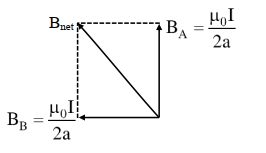
-
- (A) \(65\)
- (B) \(34\)
- (C) \(14\)
- (D) \(160\)
Show answer and solution
Correct Answer: (D)
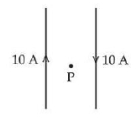
\( B=\left(\frac{\mu_0 i}{2 \pi \mathrm{a}}\right) \times 2=\frac{4 \pi \times 10^{-7} \times 10}{\pi \times\left(\frac{5}{2} \times 10^{-2}\right)} \)\( =16 \times 10^{-5}=160 \mu \mathrm{T}\)
-
- (A) \(5\)
- (B) \(4\)
- (C) \(3\)
- (D) \(2\)
Show answer and solution
Correct Answer: (A)
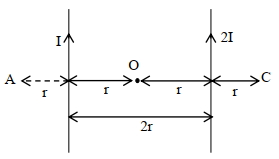
\(\mathrm{B}_{\mathrm{A}}=\frac{\mu_0 \mathrm{i}}{2 \pi \mathrm{r}}+\frac{\mu_0(2 \mathrm{i})}{2 \pi(3 \mathrm{r})}=\frac{5 \mu_0 \mathrm{i}}{6 \pi \mathrm{r}}\)\(\mathrm{B}_C=\frac{\mu_0(2 \mathrm{i})}{2 \pi \mathrm{r}}+\frac{\mu_0 \mathrm{i}}{2 \pi(3 \mathrm{r})}=\frac{7 \mu_0 \mathrm{i}}{6 \pi \mathrm{r}}\)
\(\therefore \frac{\mathrm{B}_A}{\mathrm{~B}_C}=\frac{5}{7}\)
\(\therefore \mathrm{x}=5\)
-
- (A) \(\left(\frac{R_2}{R_1}\right)^2\)
- (B) \(\left(\frac{R_1}{R_2}\right)^2\)
- (C) \(\left(\frac{R_1}{R_2}\right)\)
- (D) \(\left(\frac{R_2}{R_1}\right)\)
Show answer and solution
Correct Answer: (B)
\( \mathrm{R}=\frac{\mathrm{mv}}{\mathrm{qB}}=\frac{\mathrm{p}}{\mathrm{qB}}=\frac{\sqrt{2 \mathrm{~m}(\mathrm{KE})}}{\mathrm{qB}}=\frac{\sqrt{2 \mathrm{mqV}}}{\mathrm{qB}} \)\( \mathrm{R} \propto \sqrt{\mathrm{m}}\)
\( \mathrm{m} \propto \mathrm{R}^2 \)
\( \frac{\mathrm{m}_1}{\mathrm{~m}_2}=\left(\frac{\mathrm{R}_1}{\mathrm{R}_2}\right)^2\)
No questions on this page match these filters.