


Questions
18 questionsShowing 1–18 of 18 questions
-
- (A) \(\tan ^{-1}(\sqrt{2})\)
- (B) \(2 \tan ^{-1}\left(\frac{1}{2}\right)\)
- (C) \(\tan ^{-1}\left(\frac{1}{2}\right)\)
- (D) \(2 \tan ^{-1}\left(\frac{1}{\sqrt{5}}\right)\)
Show answer and solution
Correct Answer: (B)
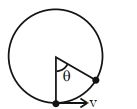
Loss in kinetic energy \(=\) Gain in potential energy\( \Rightarrow \frac{1}{2} \mathrm{mv}^2=\mathrm{mg} \ell(1-\cos \theta)\)
\( \Rightarrow \frac{\mathrm{v}^2}{\ell}=2 \mathrm{~g}(1-\cos \theta)\)
Acceleration at lowest point \(=\frac{\mathrm{v}^2}{\ell}\)
Acceleration at extreme point \(=g \sin \theta\)
Hence, \(\frac{\mathrm{v}^2}{\ell}=\mathrm{g} \sin \theta\)
\( \therefore \sin \theta=2(1-\cos \theta) \)
\( \Rightarrow \tan \frac{\theta}{2}=\frac{1}{2} \Rightarrow \theta=2 \tan ^{-1}\left(\frac{1}{2}\right)\)
-
- (A) \(3\)
- (B) \(4\)
- (C) \(5\)
- (D) \(6\)
Show answer and solution
Correct Answer: (A)
\(\mathrm{f}_1=\frac{1}{2 \pi} \sqrt{\frac{\mathrm{k}}{\mathrm{m}}}\)\(\mathrm{f}_2=\frac{1}{2 \pi} \sqrt{\frac{\mathrm{k}}{9 \mathrm{~m}}}\)
\(\frac{\mathrm{f}_1}{\mathrm{f}_2}=\sqrt{\frac{9}{1}}=\frac{3}{1}\)
-
- (A) \(11\)
- (B) \(22\)
- (C) \(12\)
- (D) \(15\)
Show answer and solution
Correct Answer: (C)
\( \mathrm{V}_{\mathrm{at} \text { mann position }}=\mathrm{A} \omega \Rightarrow 10=4 \omega \)\( \omega=\frac{5}{2} \)
\( \mathrm{~V}=\omega \sqrt{\mathrm{A}^2-\mathrm{x}^2} \)
\( 5=\frac{5}{2} \sqrt{4^2-\mathrm{x}^2} \Rightarrow \mathrm{x}^2=16-4 \)
\( \mathrm{x}=\sqrt{12} \mathrm{~cm}\)
-
- (A) \(12\)
- (B) \(15\)
- (C) \(20\)
- (D) \(22\)
Show answer and solution
Correct Answer: (A)
We know\(\mathrm{V}_{\max } =\omega \mathrm{A} \quad \text { at mean position }\)
\(=\frac{2 \pi}{\mathrm{T}} \mathrm{A}=\frac{2 \pi}{\pi} \times 0.06=0.12 \mathrm{~m} / \mathrm{sec}\)
\(\mathrm{V}_{\max } =12 \mathrm{~cm} / \mathrm{sec}\)
-
- (A) \(21\)
- (B) \(22\)
- (C) \(23\)
- (D) \(24\)
Show answer and solution
Correct Answer: (B)
\(\mathrm{m}=0.5 \mathrm{~kg}\)\(\mathrm{~F}=-50(\mathrm{x})\)
\(\mathrm{ma}=(-50 \mathrm{x})\)
\(0.5 \mathrm{a}=-50 \mathrm{x}\)
\(\mathrm{a}=(-100 \mathrm{x})\)
\(\mathrm{W}^2=100 \Rightarrow(\mathrm{w}=10)\)
\(\mathrm{T}=\frac{2 \pi}{10}=\left(\frac{\pi}{5}\right)=\frac{22}{7 \times 15}=\left(\frac{22}{35}\right)\)
\(\frac{\pi}{35}=\frac{22}{35} \Rightarrow \mathrm{x}=22\)
-
- (A) \(A\)\(\sqrt 3 \;\;\;\;\;\;\;\;\;\;\;\;\;\;\;\;\;\;\;\;\;\;\)
- (B) \(\;\frac{{7A}}{3}\)
- (C) \(\;\frac{A}{3}\sqrt {41} \)
- (D) \(3A\)
Show answer and solution
Correct Answer: (B)
Let new amplitude is \(A'\)initial velocity
\(v^{2}=\omega^{2}\left(A^{2}-\left(\frac{2 A}{3}\right)^{2}\right)\) \(...(1)\)
Where \(A\) is initial amplitude \(\&\, \omega\) is angular frequency.
Final velocity
\((3 v)^{2}=\omega^{2}\left(A^{\prime 2}-\left(\frac{2 A}{3}\right)^{2}\right)\) \(...(2)\)
From equation \(\&\) equation \(( 2)\)
\(\frac{1}{9}=\frac{A^{2}-\frac{4 A^{2}}{9}}{A^{2}-\frac{4 A^{2}}{9}}\)
\(A^{\prime}=\frac{7 A}{3}\)
-
- (A) \(7\)
- (B) \(8\)
- (C) \(9\)
- (D) \(10\)
Show answer and solution
Correct Answer: (A)
\(v=\omega \sqrt{A^2-x^2}\)\(\text { at } x=\frac{2 A}{3}\)
\(v=\omega \sqrt{A^2-\left(\frac{2 A}{3}\right)^2}=\frac{\sqrt{5} A \omega}{3}\)
New amplitude \(=\mathrm{A}^{\prime}\)
\(\mathrm{v}^{\prime}=3 \mathrm{v}=\sqrt{5} \mathrm{~A} \omega=\omega \sqrt{\left(\mathrm{A}^{\prime}\right)^2-\left(\frac{2 \mathrm{~A}}{3}\right)^2}\)
\(\mathrm{A}^{\prime}=\frac{7 \mathrm{~A}}{3}\)
-
- (A) \(2\)
- (B) \(12\)
- (C) \(4\)
- (D) \(9\)
Show answer and solution
Correct Answer: (A)
From phasor diagram particle has to move from \(\mathrm{P}\) to \(Q\) in a circle of radius equal to amplitude of \(SHM\)
\( \cos \phi=\frac{\frac{\sqrt{3} \mathrm{~A}}{2}}{\mathrm{~A}}=\frac{\sqrt{3}}{2} \)
\( \phi=\frac{\pi}{6}\)
Now, \(\frac{\pi}{6}=\omega t\)
\(\frac{\pi}{6}=\frac{2 \pi}{T} t\)
\(\frac{\pi}{6}=\frac{2 \pi}{6 \pi} t\)
\(\mathrm{t}=\frac{\pi}{2}\)
So, \(\mathrm{x}=2\)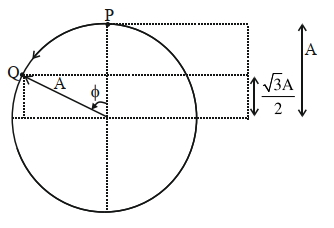
-
- (A) \(5\)
- (B) \(6\)
- (C) \(7\)
- (D) \(8\)
Show answer and solution
Correct Answer: (D)
Acceleration due to gravity \(\mathrm{g}^{\prime}=\frac{\mathrm{g}}{4}\)\(T=2 \pi \sqrt{\frac{4 \ell}{g}}\)
\(T=2 \pi \sqrt{\frac{4 \times 4}{g}}\)
\(T=2 \pi \frac{4}{\pi}=8 s\)
-
- (A) \(3\)
- (B) \(5\)
- (C) \(6\)
- (D) \(7\)
Show answer and solution
Correct Answer: (C)
\(\text { Total energy }=\text { K.E. }+ \text { P.E. }\)\(\text { at } \mathrm{x}=0.04 \mathrm{~m}, \text { T.E. }=0.5+0.4=0.9 \mathrm{~J}\)
\(\text { T.E }=1 \mathrm{~m}^2 \mathrm{~A}^2=0.9\)
\(\quad=\frac{1}{2} \times 0.2\left(2 \pi \times \frac{25}{\pi}\right)^2 \times \mathrm{A}^2=0.9\)
\(\Rightarrow \mathrm{A}=0.06 \mathrm{~m}\)
\(\mathrm{~A}=6 \mathrm{~cm}\)
-
- (A) \(\frac{E}{\sqrt{2}}\)
- (B) \(\mathrm{E}\)
- (C) \(\mathrm{E} \sqrt{2}\)
- (D) \(2 \mathrm{E}\)
Show answer and solution
Correct Answer: (B)
\(\text { T.E. }=\frac{1}{2} \mathrm{kA}^2\)since \(A\) is same \(T.E.\) will be same correct option \((2)\)
-
- (A) \(6 \sqrt{5} \mathrm{~ms}^{-1}\)
- (B) \(5 \sqrt{6} \mathrm{~ms}^{-1}\)
- (C) \(5 \sqrt{5} \mathrm{~ms}^{-1}\)
- (D) \(2 \sqrt{5} \mathrm{~ms}^{-1}\)
Show answer and solution
Correct Answer: (A)
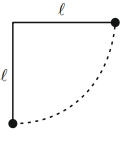
\( \ell=10 \mathrm{~m} \)\( \text { Initial energy }=\mathrm{mg} \ell \)
\( \text { So, } \frac{9}{10} \mathrm{mg} \ell=\frac{1}{2} \mathrm{mv}^2 \)
\( \Rightarrow \frac{9}{10} \times 10 \times 10=\frac{1}{2} \mathrm{v}^2 \)
\( \mathrm{v}^2=180 \)
\( \mathrm{v}=\sqrt{180}=6 \sqrt{5} \mathrm{~m} / \mathrm{s}\)
-
- (A) \(10\)
- (B) \(15\)
- (C) \(20\)
- (D) \(25\)
Show answer and solution
Correct Answer: (A)
Given,\(\mathrm{T}=3.14=\frac{2 \pi}{\omega}\)
\(\omega=2 \mathrm{rad} / \mathrm{s}\)
\(\mathrm{x}=10 \sin \left(\omega \mathrm{t}+\frac{\pi}{3}\right)\)
\(\mathrm{v}=\frac{\mathrm{dx}}{\mathrm{dt}}=10 \omega \cos \left(\omega \mathrm{t}+\frac{\pi}{3}\right)\)
\(\text { at } \mathrm{t}=0\)
\(\mathrm{v}=10 \omega \cos \left(\frac{\pi}{3}\right)=10 \times 2 \times \frac{1}{2}[\text { using } \omega=2 \mathrm{rad} / \mathrm{s}]\)
\(\mathrm{v}=10 \mathrm{~m} / \mathrm{s}\)
-
- (A) \(\frac{2}{9}\,m\)
- (B) \(\frac{4}{9}\,m\)
- (C) \(\frac{8}{9}\,m\)
- (D) \(\frac{1}{9}\,m\)
Show answer and solution
Correct Answer: (D)
\(T =2 \pi \sqrt{\frac{ L }{ g }}, \quad g ^{\prime}=\frac{ GM }{9 R ^{2}}=\frac{ g }{9}=\frac{\pi^{2}}{9}\)\(2=2 \pi \sqrt{\frac{ L }{\pi^{2}} \times 9}\)
\(1=\pi \sqrt{ L } \times \frac{3}{\pi} \Rightarrow L =\frac{1}{9}\,m\)
-
- (A) \(17\)
- (B) \(18\)
- (C) \(19\)
- (D) \(20\)
Show answer and solution
Correct Answer: (A)
\(x=4 \mathrm{~m}, \mathrm{~V}=2 \mathrm{~m} / \mathrm{s}, \mathrm{a}=16 \mathrm{~m} / \mathrm{s}^2\)\(|\mathrm{a}|=\omega^2 \mathrm{x}\)
\(\Rightarrow 16=\omega^2(4)\)
\(\omega=2 \mathrm{rad} / \mathrm{s}\)
\(\mathrm{v}=\omega \sqrt{\mathrm{A}^2-\mathrm{x}^2}\)
\(A=\sqrt{\frac{\mathrm{v}^2}{\omega^2}+\mathrm{x}^2} \Rightarrow \mathrm{A}=\sqrt{\frac{4}{4}+16}\)
\(A=\sqrt{17} \mathrm{~m}\)
-
- (A) \(12\)
- (B) \(15\)
- (C) \(30\)
- (D) \(35\)
Show answer and solution
Correct Answer: (A)
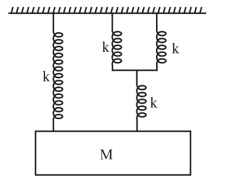
\(\mathrm{k}_{\mathrm{eq}}=\frac{2 \mathrm{k} \cdot \mathrm{k}}{3 \mathrm{k}}+\mathrm{k}=\frac{5 \mathrm{k}}{3}\)Angular frequency of oscillation \((\omega)=\sqrt{\frac{\mathrm{k}_{\mathrm{eq}}}{\mathrm{m}}}\)
\((\omega)=\sqrt{\frac{5 \mathrm{k}}{3 \mathrm{~m}}}\)
Period of oscillation \((\tau)=\frac{2 \pi}{\omega}=2 \pi \sqrt{\frac{3 \mathrm{~m}}{5 \mathrm{k}}}\)
\(=\pi \sqrt{\frac{12 \mathrm{~m}}{5 \mathrm{k}}}\)
-
- (A) \(3 \%\)
- (B) \(1 \%\)
- (C) \(4 \%\)
- (D) \(5 \%\)
Show answer and solution
Correct Answer: (D)
\(\mathrm{T}=2 \pi \sqrt{\frac{\mathrm{m}}{\mathrm{k}}}\)\(\mathrm{T}^2 \propto \frac{\mathrm{m}}{\mathrm{k}}\)
\(\frac{2 \Delta \mathrm{T}}{\mathrm{T}} \%=\frac{\Delta \mathrm{m}}{\mathrm{m}} \%-\frac{\Delta \mathrm{k}}{\mathrm{k}} \%\)
\(\frac{\Delta \mathrm{k}}{\mathrm{k}} \%=\frac{\Delta \mathrm{m}}{\mathrm{m}} \%-\frac{2 \Delta \mathrm{T}}{\mathrm{T}} \% \)
\(\frac{\Delta \mathrm{k}}{\mathrm{k}} \%=(-1) \%-2(2) \%=|-5 \%|=5 \%\)
-
- (A) \(1\)
- (B) \(12\)
- (C) \(15\)
- (D) \(9\)
Show answer and solution
Correct Answer: (D)
\( \text { Let total energy }=\mathrm{E}=\frac{1}{2} \mathrm{KA}^2 \)\( \mathrm{U}=\frac{1}{2} \mathrm{~K}\left(\frac{\mathrm{A}}{3}\right)^2=\frac{\mathrm{KA}^2}{2 \times 9}=\frac{\mathrm{E}}{9} \)
\( \mathrm{KE}=\mathrm{E}-\frac{\mathrm{E}}{9}=\frac{8 \mathrm{E}}{9} \)
\( \text { Ratio } \frac{\text { Total }}{\mathrm{KE}}=\frac{\mathrm{E}}{\frac{8 \mathrm{E}}{9}}=\frac{9}{8} \)
\( \mathrm{x}=9\)
No questions on this page match these filters.