


Questions
45 questionsShowing 1–45 of 45 questions
-
- (A) \(1\)
- (B) \(5\)
- (C) \(8\)
- (D) \(10\)
Show answer and solution
Correct Answer: (A)
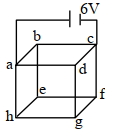
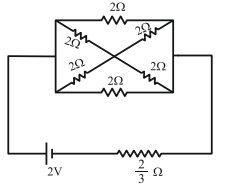
From symmetry, current through \(e-b \& g-d = 0\)\(\therefore \mathrm{R}_{\mathrm{eq}}=\frac{3}{4} \times \mathrm{R}=\frac{3}{2} \Omega\)
\(\therefore \text { Current through battery }=\frac{6 \times 2}{3}=4 \mathrm{~A}\)
\(\mathrm{i}_2=\frac{4}{8} \times 2=1 \mathrm{~A}\)
\(\therefore \Delta \mathrm{V} \text { across e-f }=\frac{\mathrm{i}_2}{2} \times \mathrm{R}=\frac{1}{2} \times 2=1 \mathrm{~V}\)
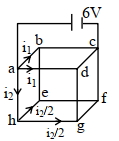
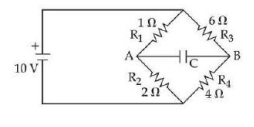
-
- (A) \(\frac{2}{3}\)
- (B) \(\frac{3}{2}\)
- (C) \(1\)
- (D) \(\frac{1}{2}\)
Show answer and solution
Correct Answer: (D)
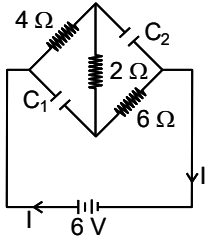
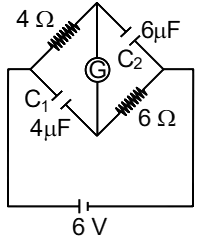
In steady state
Req \(=12 \Omega\)
\(I=\frac{6}{12}=0.5 A\)
P.D across \(C _1=3 V\)
P.D acoross \(C _2=4 V\)
\(q_1=C_1 V_1=12 \mu C\)
\(q_2=C_2 V_2=24 \mu C\)
\(\frac{q_1}{q_2}=\frac{1}{2}\) -
- (A) \(7\)
- (B) \(9\)
- (C) \(3\)
- (D) \(5\)
Show answer and solution
Correct Answer: (D)
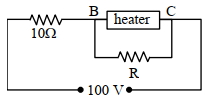
\(R_{\text {heater }}=\frac{V^2}{P}=\frac{(100)^2}{1000}=10 \Omega\)For heater \(P=\frac{V^2}{R} \Rightarrow V=\sqrt{P R}\)
\(\mathrm{V}=\sqrt{62.5 \times 10}\)
\(\mathrm{~V}=25 \mathrm{v}\)
(Image)
\(i_1=\frac{75}{10}=7.5 A, i_H=\frac{25}{10}=2.5 A\)
\(i_R=i_1-i_H=5\)
\(V=I R\)
\(R=\frac{25}{5}=5 \Omega\)
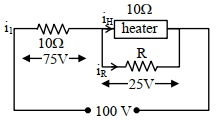
-
- (A) \(4 \mathrm{~V}\)
- (B) \(2 \ \mathrm{mV}\)
- (C) \(0.5 \mathrm{~V}\)
- (D) \(12\ \mathrm{mV}\)
Show answer and solution
Correct Answer: (C)
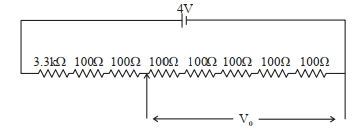
\( R_{e q}=4000 \Omega \)\( i=\frac{4}{4000}=\frac{1}{1000} \mathrm{~A} \)
\( V_0=i \cdot R=\frac{1}{1000} \times 500=0.5 \mathrm{~V}\)
-
- (A) \(63\)
- (B) \(70\)
- (C) \(66\)
- (D) \(35\)
Show answer and solution
Correct Answer: (C)
For null point,\( \frac{4.5}{60}=\frac{R}{40} \)
\( \text { Also, } R=\frac{\rho \ell}{A}=\frac{\rho \ell}{\pi r^2} \)
\( 4.5 \times 40=\rho \times \frac{0.1}{\pi \times 7 \times 10^{-8}} \times 60 \)
\( \rho=66 \times 10^{-7} \Omega \times \mathrm{m}\)
-
- (A) \(5\)
- (B) \(7\)
- (C) \(8\)
- (D) \(10\)
Show answer and solution
Correct Answer: (A)
Each part has resistance \(=2 \Omega\)\(2\) parts are connected in parallel so, \(R=1 \Omega\)
Now, there will be 5 parts each of resistance \(1 \Omega\), they are connected in series.
\(\mathrm{R}_{\mathrm{xq}}=5 \mathrm{R}, \mathrm{R}_{\mathrm{sq}}=5 \Omega\)
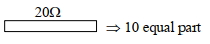
-
- (A) \(\frac{R}{25}\)
- (B) \(\frac{R}{5}\)
- (C) \(25 R\)
- (D) \(5 R\)
Show answer and solution
Correct Answer: (A)
Resistance of each part \(=\frac{R}{5}\)
Total resistance \(=\frac{1}{5} \times \frac{R}{5}=\frac{R}{25}\) -
- (A) \(15\)
- (B) \(16\)
- (C) \(17\)
- (D) \(18\)
Show answer and solution
Correct Answer: (B)
We know \(\mathrm{R}=\frac{\rho l}{\mathrm{~A}}, \mathrm{R} \propto \frac{l}{\mathrm{r}^2}\)As we starch the wire, its length will increase but its radius will decrease keeping the volume constant
\(\mathrm{V}_{\mathrm{i}}=\mathrm{V}_{\mathrm{f}}\)
\(\pi^2 l=\pi \frac{\mathrm{r}^2}{4} l_{\mathrm{f}}\)
\(l_{\mathrm{f}}=4 l\)
\(\frac{\mathrm{R}_{\text {nelv }}}{\mathrm{R}_{\text {old }}}=\left(\frac{4 l}{\frac{\mathrm{r}^2}{4}}\right) \frac{\mathrm{r}^2}{l}=16\)
\(\mathrm{R}_{\text {neer }}=16 \mathrm{R}\)
\(\therefore \mathrm{x}=16\)
-
- (A) \(\frac{1}{25}\ \mathrm{R}\)
- (B) \( \frac{1}{5} R \)
- (C) \(25\ \mathrm{R}\)
- (D) \(5\ \mathrm{R}\)
Show answer and solution
Correct Answer: (A)
Explanation:
1. Resistance of each part: The resistance of a wire is directly proportional to its length (\( R \propto L \)). When the wire is cut into 5 equal parts, the length of each part becomes \( L/5 \). Therefore, the resistance of each part will be \( r = \frac{R}{5} \).
2. Parallel Combination: When these 5 identical parts, each of resistance \( \frac{R}{5} \), are connected in parallel, the equivalent resistance (\( R_{eq} \)) is given by the formula:
\( \frac{1}{R_{eq}} = \frac{1}{r_1} + \frac{1}{r_2} + \frac{1}{r_3} + \frac{1}{r_4} + \frac{1}{r_5} \)
3. Calculation:
\( \frac{1}{R_{eq}} = \frac{5}{R} + \frac{5}{R} + \frac{5}{R} + \frac{5}{R} + \frac{5}{R} \)
\( \frac{1}{R_{eq}} = \frac{25}{R} \)
\( R_{eq} = \frac{R}{25} = \frac{1}{25} R \)
Hence, Option A is the correct choice. -
- (A) \(12.5 \mathrm{~W}\)
- (B) \(25 \mathrm{~W}\)
- (C) \(50 \mathrm{~W}\)
- (D) \(100 \mathrm{~W}\)
Show answer and solution
Correct Answer: (A)
Rated power \(\&\) voltage gives resistance\(\mathrm{R}=\frac{\mathrm{V}^2}{\mathrm{P}}=\frac{(200)^2}{50}=\frac{40000}{50}\)
\(\mathrm{R}=800\)
\(\mathrm{P}=\frac{\left(\mathrm{V}_{\text {applied }}\right)^2}{\mathrm{R}}=\frac{(100)^2}{800}\)
\(\mathrm{P}=12.5 \text { watt }\)
Hence option \(1\) is correct.
-
- (A) \(694^{\circ} \mathrm{C}\)
- (B) \(1235^{\circ} \mathrm{C}\)
- (C) \(1694^{\circ} \mathrm{C}\)
- (D) \(1667^{\circ} \mathrm{C}\)
Show answer and solution
Correct Answer: (C)
\( \mathrm{R}_{\mathrm{T}=27}=60 \Omega, R_T=\frac{220}{2.75}=80 \Omega \)\( \mathrm{R}=\mathrm{R}_0(1+\alpha \Delta \mathrm{T}) \)
\( 80=60\left[1+2 \times 10^{-4}(\mathrm{~T}-27)\right] \)
\( \mathrm{T} \approx 1694^{\circ} \mathrm{C}\)
-
- (A) \(1026\)
- (B) \(1027\)
- (C) \(1028\)
- (D) \(1029\)
Show answer and solution
Correct Answer: (B)
Explanation:
The variation of electrical resistance with temperature is given by the formula:
\( R = R_0(1 + \alpha \Delta T) \)
Where:
\( R = \) resistance at final temperature \( T = 62\ \Omega \)
\( R_0 = \) resistance at initial temperature \( T_0 = 50\ \Omega \)
\( \alpha = \) temperature coefficient of resistance \( = 2.4 \times 10^{-4}\text{ }^{\circ}\text{C}^{-1} \)
\( \Delta T = \) change in temperature \( = T - T_0 \)
Rearranging the terms to solve for \( \Delta T \):
\( \frac{R}{R_0} = 1 + \alpha \Delta T \)
\( \frac{R}{R_0} - 1 = \alpha \Delta T \)
\( \frac{R - R_0}{R_0} = \alpha \Delta T \)
Substituting the given values into the equation:
\( \frac{62 - 50}{50} = (2.4 \times 10^{-4}) \times \Delta T \)
\( \frac{12}{50} = (2.4 \times 10^{-4}) \times \Delta T \)
\( 0.24 = (2.4 \times 10^{-4}) \times \Delta T \)
\( \Delta T = \frac{0.24}{2.4 \times 10^{-4}} \)
\( \Delta T = 1000^{\circ}\text{C} \)
Since \( \Delta T = T - T_0 \):
\( T - 27^{\circ}\text{C} = 1000^{\circ}\text{C} \)
\( T = 1000 + 27 = 1027^{\circ}\text{C} \)
Therefore, option B is the correct choice. - 13. By what percentage will the illumination of the lamp decrease if the current drops by \(20 \%\) ? 2024 Hard
- (A) \(46 \%\)
- (B) \(26 \%\)
- (C) \(36 \%\)
- (D) \(56 \%\)
Show answer and solution
Correct Answer: (C)
\(P=i^2 R\)\(P_{\text {int }}=I^2{ }_{\text {int }} R\)
\(P_{\text {final }}=\left(0.8 I_{\text {int }}\right)^2 R\)
\(\% \text { change in power }=\)
\(\frac{P_{\text {final }}-P_{\text {int }}}{P_{\text {int }}} \times 100=(0.64-1) \times 100=-36 \%\)
-
- (A) \(4\)
- (B) \(3\)
- (C) \(1\)
- (D) \(5\)
Show answer and solution
Correct Answer: (C)
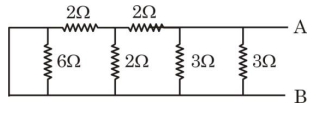
\(6 \ \Omega\) is short circuit
\({R}_{\mathrm{eq}}=3 \times \frac{1}{3}=1\ \Omega\)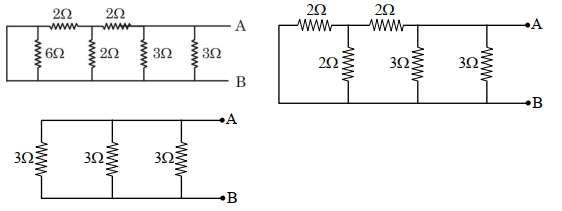
-
- (A) \(22.5 \mathrm{~cm}\)
- (B) \(20 \mathrm{~cm}\)
- (C) \(62.5 \mathrm{~cm}\)
- (D) \(65 \mathrm{~cm}\)
Show answer and solution
Correct Answer: (A)
First case \(\frac{2}{40}=\frac{X}{60} \Rightarrow X=3 \Omega\)
In second case \(X^{\prime}=\frac{2 \times 3}{2+3}=1.2 \Omega\)
\(\frac{2}{\ell}=\frac{1.2}{100-\ell}\)
\(200-2 \ell=1.2 \ell\)
\(\ell=\frac{200}{3.2}=62 . \mathrm{bm}\)
Balance length changes by \(22.5 \mathrm{~cm}\)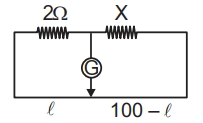
-
- (A) \(2\)
- (B) \(3\)
- (C) \(4\)
- (D) \(5\)
Show answer and solution
Correct Answer: (B)
\(\mathrm{R}_{\text {eq }}=\frac{4}{3} \Omega\)\(\therefore \mathrm{P}=\frac{\mathrm{V}^2}{\mathrm{R}_{\text {eq }}}=\frac{4}{4 / 3}=3 \mathrm{~W}\)
-
- (A) \(12\)
- (B) \(78\)
- (C) \(45\)
- (D) \(30\)
Show answer and solution
Correct Answer: (D)
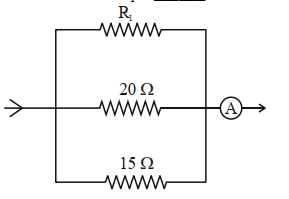
Given, \(i_1=0.3 \mathrm{~A}, \mathrm{i}_1+\mathrm{i}_2+\mathrm{i}_3=0.9 \mathrm{~A}\)
So, \(\mathrm{V}_{\mathrm{AB}}=\mathrm{i}_1 \times 20 \Omega=20 \times 0.3 \mathrm{~V}=6 \mathrm{~V}\)
\( \mathrm{i}_2=\frac{6 \mathrm{~V}}{15 \Omega}=\frac{2}{5} \mathrm{~A} \)
\( \mathrm{i}_1+\mathrm{i}_2+\mathrm{i}_3=\frac{9}{10} \mathrm{~A} \)
\( \frac{3}{10}+\frac{2}{5}+\mathrm{i}_3=\frac{9}{10} \)
\( \frac{7}{10}+\mathrm{i}_3=\frac{9}{10} \)
\( \mathrm{i}_3=0.2 \mathrm{~A} \)
\( \text { So, } \mathrm{i}_3 \times \mathrm{R}_1=6 \mathrm{~V} \)
\( (0.2) \mathrm{R}_1=6 \)
\( \mathrm{R}_1=\frac{6}{0.2}=30 \Omega\)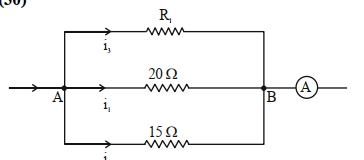
-
- (A) \(1 \mathrm{~A}\)
- (B) \(1.5 \mathrm{~A}\)
- (C) \(2 \mathrm{~A}\)
- (D) \(2.5 \mathrm{~A}\)
Show answer and solution
Correct Answer: (A)
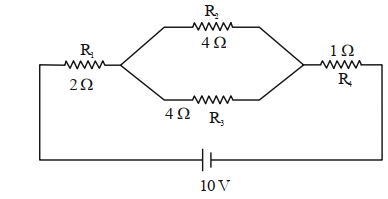
\(\mathrm{R}_{\mathrm{eq}}=2 \Omega+2 \Omega+1 \Omega=5 \Omega\)
\(\mathrm{i}=\frac{\mathrm{V}}{\mathrm{R}_{\mathrm{eq}}}=\frac{10}{5}=2 \mathrm{~A}\)
Current in resistance \(\mathrm{R}_3=2 \times\left(\frac{4}{4+4}\right)\)
\( =2 \times \frac{4}{8} \)
\( =1 \mathrm{~A}\)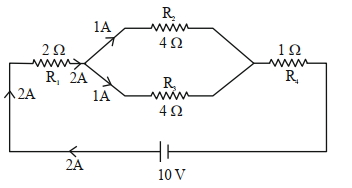
-
- (A) \(4 \mathrm{~V}\)
- (B) \(2 \mathrm{~V}\)
- (C) \(1.5 \mathrm{~V}\)
- (D) \(3 \mathrm{~V}\)
Show answer and solution
Correct Answer: (B)
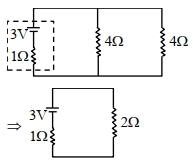
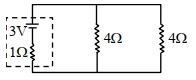
\(\mathrm{i} =\frac{3}{1+2}=1 \mathrm{~A}\)\(\mathrm{v} =\mathrm{E}-\mathrm{ir}\)
\(=3-1 \times 1=2 \mathrm{~V}\)
-
- (A) \(12 \Omega\) and \(11.4 \mathrm{~A}\)
- (B) \(10.5 \Omega\) and \(1.14 \mathrm{~A}\)
- (C) \(10.5 \Omega\) and \(1 \mathrm{~A}\)
- (D) \(12 \Omega\) and \(1 \mathrm{~A}\)
Show answer and solution
Correct Answer: (D)
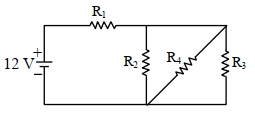
Here \(R_2, R_3, R_4\) are in parallel\(\frac{1}{\mathrm{R}_{254}}=\frac{1}{\mathrm{R}_2}+\frac{1}{\mathrm{R}_5}+\frac{1}{\mathrm{R}_4}\)
\(\mathrm{R}_{254}=2 \Omega\)
\(R_{234}\) is in series with \(R_1\) so
\(\mathrm{R}_{\mathrm{eq}}=\mathrm{R}_{234}+\mathrm{R}_1=2+10=12 \Omega\)
\(\mathrm{i}=\frac{12}{12}=1 \mathrm{Amp}\)
-
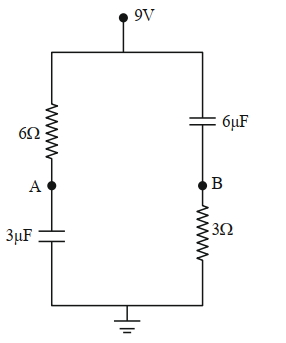
- (A) \(58\)
- (B) \(36\)
- (C) \(45\)
- (D) \(32\)
Show answer and solution
Correct Answer: (B)
At steady state, capacitor behaves as an open circuit and current flows in circuit as shown in the diagram.
\( \mathrm{R}_{\text {eq }}=9 \Omega \)
\( \mathrm{i}=\frac{9 \mathrm{~V}}{9 \Omega}=1 \mathrm{~A} \)
\( \Delta \mathrm{V}_{6 \Omega}=1 \times 6=6 \mathrm{~V} \)
\( \mathrm{~V}_{\mathrm{A}}=3 \mathrm{~V}\)
So, potential difference across \(6 \mu \mathrm{F}\) is \(6 \mathrm{~V}\).
Hence
\(Q =C \Delta V \)
\( =6 \times 6 \times 10^{-6} \mathrm{C} \)
\( =36 \mu \mathrm{C}\)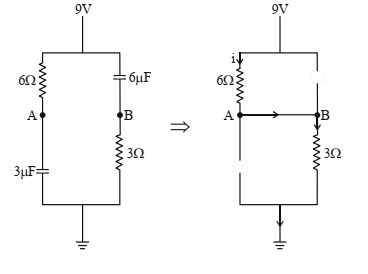
-
- (A) \(735\)
- (B) \(738\)
- (C) \(740\)
- (D) \(748\)
Show answer and solution
Correct Answer: (D)
\(\mathrm{R}=\mathrm{R}_0(1+\alpha \Delta \mathrm{T})\)\(\frac{\Delta \mathrm{R}}{\mathrm{R}_0}=\alpha \Delta \mathrm{T}\)
Case-I
\(0{ }^{\circ} \mathrm{C} \rightarrow 100^{\circ} \mathrm{C}\)
\(\frac{10.2-10}{10}=\alpha(100-0)\)
Case-II
\(0^{\circ} \mathrm{C} \rightarrow t^{\circ} \mathrm{C}\)
\(\frac{10.95-10}{10}=\alpha(t-0)\)
\(\Rightarrow \frac{t}{100}=\frac{0.95}{0.2}=475^{\circ} \mathrm{C}\)
\(t=475+273=748 \mathrm{~K}\)
-
- (A) \(400\)
- (B) \(700\)
- (C) \(500\)
- (D) \(460\)
Show answer and solution
Correct Answer: (A)
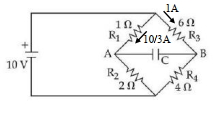
\( V_A+\frac{10}{3}(1)-6(1)=V_B \)\( V_A-V_B=6-\frac{10}{3}=\frac{8}{3} \text { volt } \)
\( Q=C\left(V_A-V_B\right) \)
\( =150 \times \frac{8}{3}=400 \mu C\)
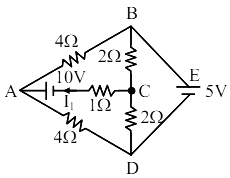
- 24. The current flowing through the \(1 \Omega\) resistor is \(\frac{\mathrm{n}}{10} \ A.\) The value of \(n\) is _______.
 2024 Hard
- (A) \(20\)
- (B) \(25\)
- (C) \(30\)
- (D) \(35\)
Show answer and solution
Correct Answer: (B)
\(\frac{y-5}{2}+\frac{y-0}{2}+\frac{y-x+10}{1}=0\)
\(y-5+y+2 y-2 x+20=0\)
\(4 y-2 x+15=0 \quad \ldots .(i)\)
\(\frac{x-5}{4}+\frac{x-0}{4}+\frac{x-10-y}{1}=0\)
\(x-5+x+4 x-40-4 y=0\)
\(6 x-4 y-45=0 \quad . .(i)\)
\(\frac{-2 x+4 y+15=0 . .(i i)}{4 x-30=0}\)
\(x=\frac{15}{2} \& 4 y-15+15=0\)
\(y=0\)
\(i=\frac{y-x+10}{1}\)
\(i=\frac{0-7.5+10}{1}\)
\(i=2.5 A=\frac{n}{10} A\)
\(n=25\)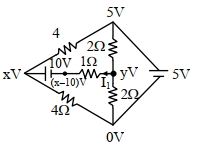
-
- (A) \(22\)
- (B) \(30\)
- (C) \(35\)
- (D) \(40\)
Show answer and solution
Correct Answer: (A)
\(q=\int_1^2 i d t=\int_1^2\left(3 t^2+4 t^3\right) d t\)\(q=\left.\left(t^3+t^4\right)\right|_1 ^2\)
\(q=22 C\)
- 26. The effective resistance between \(A\) and \(B\), if resistance of each resistor is \(R\) will be _______.
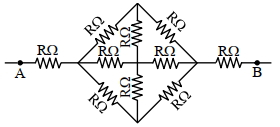 2024 Hard
- (A) \(\frac{2}{3} \mathrm{R}\)
- (B) \(\frac{8 R}{3}\)
- (C) \(\frac{5 R}{3}\)
- (D) \(\frac{4 R}{3}\)
Show answer and solution
Correct Answer: (B)
From symmetry we can remove two middle resistance.
New circuit is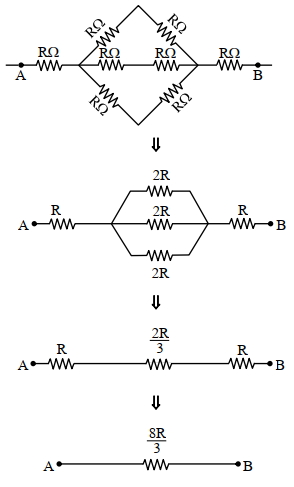
-
- (A) \(80\ \mathrm{C}\)
- (B) \(1000 \ \mathrm{C}\)
- (C) \(800 \ \mathrm{C}\)
- (D) \(1600 \ \mathrm{C}\)
Show answer and solution
Correct Answer: (B)
Given thatCurrent \(I=I_0+\beta t\)
\( I_0=20 \mathrm{~A} \)
\( \beta=3 \mathrm{~A} / \mathrm{s}\)
\( \mathrm{I}=20+3 \mathrm{t} \)
\( \frac{\mathrm{dq}}{\mathrm{dt}}=20+3 \mathrm{t} \)
\( \int_0^q \mathrm{dq}=\int_0^{20}(20+3 \mathrm{t}) \mathrm{dt} \)
\( \mathrm{q}=\int_0^{20} 20 \mathrm{dt}+\int_0^{20} 3 \mathrm{tdt} \)
\( \mathrm{q}=\left[20 \mathrm{t}+\frac{3 \mathrm{t}^2}{2}\right]_0^{20}=1000\ \mathrm{C}\)
-
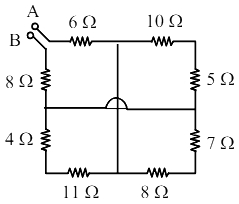
- (A) \(18 \Omega\)
- (B) \(25 \Omega\)
- (C) \(27 \Omega\)
- (D) \(19 \Omega\)
Show answer and solution
Correct Answer: (D)
\(\Rightarrow \mathrm{R}_{\mathrm{eq}}=6 \Omega+5 \Omega+8 \Omega=19 \Omega\)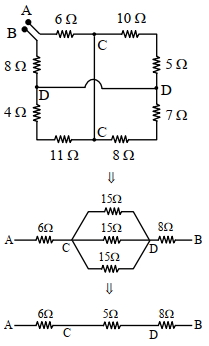
-
- (A) \(31.25 \times 10^{17}\)
- (B) \(6.25 \times 10^{18}\)
- (C) \(6.25 \times 10^{17}\)
- (D) \(1.25 \times 10^{19}\)
Show answer and solution
Correct Answer: (A)
\(\text { Power }(P)=V . I\)\(\Rightarrow 110=(220)(I)\)
\(\Rightarrow I=0.5 \mathrm{~A}\)
\(\text { Now, } I=\frac{\mathrm{n} \cdot \mathrm{e}}{\mathrm{t}}\)
\(\Rightarrow 0.5=\left(\frac{\mathrm{n}}{\mathrm{t}}\right)\left(1.6 \times 10^{-19}\right)\)
\(\Rightarrow \frac{\mathrm{n}}{\mathrm{t}}=\frac{0.5}{1.6 \times 10^{-19}}\)
\(\Rightarrow \frac{\mathrm{n}}{\mathrm{t}}=31.25 \times 10^{17}\)
-
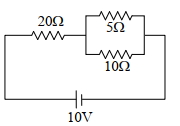
- (A) \(1: 2\)
- (B) \(2: 1\)
- (C) \(4: 1\)
- (D) \(1: 1\)
Show answer and solution
Correct Answer: (B)
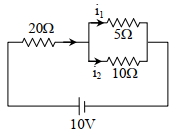
\(\frac{i_1}{i_2}=\frac{10}{5}=\frac{2}{1}\)\(\frac{P_1}{P_2}=\frac{i_1^2 R_1}{i_2^2 R_2}=\left(\frac{2}{1}\right)^2 \times \frac{5}{10}=\frac{2}{1}\)
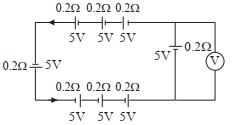
- 31. The reading in the ideal voltmeter \((V)\) shown in the given circuit diagram is _______.
 2024 Hard
- (A) \(5 \mathrm{~V}\)
- (B) \(10 \mathrm{~V}\)
- (C) \(0 \mathrm{~V}\)
- (D) \(3 \mathrm{~V}\)
Show answer and solution
Correct Answer: (C)
\({i}=\frac{\mathrm{E}_{\text {eq }}}{\mathrm{r}_{\text {eq }}}=\frac{8 \times 5}{8 \times 0.2}\)\(I=25 \mathrm{~A}\)
\(V=E-1 \mathrm{r}\)
\(=5-0.2 \times 25\)
\(=0\)
-
- (A) \(20 \mathrm{~cm}\)
- (B) \(10 \mathrm{~cm}\)
- (C) \(80 \mathrm{~cm}\)
- (D) \(40 \mathrm{~cm}\)
Show answer and solution
Correct Answer: (D)
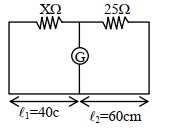
\(\frac{25}{\mathrm{r} \ell_1}=\frac{\mathrm{x}}{\mathrm{r} \ell_2}\) \(.....(i)\)\(\frac{25}{2 \mathrm{r} \ell_1^{\prime}}=\frac{\mathrm{X}}{2 \mathrm{r} \ell_2^{\prime}}\) \(...(ii)\)
From \((i)\) and \((ii)\)
\(\ell_2^{\prime}=\ell_2=40 \mathrm{~cm}\)
-
- (A) \(2 \Omega\)
- (B) \(16 \Omega\)
- (C) \(8 \Omega\)
- (D) \(10 \Omega\)
Show answer and solution
Correct Answer: (B)
\(\text { Given } \mathrm{R}_0=8 \Omega, \mathrm{R}_{100}=10 \Omega\)\(\therefore \mathrm{R}_{100}=\mathrm{R}_0(1+\alpha \Delta \mathrm{T})\)
\(\text { Also, } \mathrm{R}_{400}=\mathrm{R}_0\left(1+\alpha \Delta \mathrm{T}^1\right)\)
\(\therefore 10=8(1+\alpha \times 100) \Rightarrow 100 \alpha=\frac{1}{4}\)
\(\therefore \mathrm{R}_{400}=8(1+400 \alpha)=8(1+1)=16 \Omega\)
Hence option \((2)\)
-
- (A) \(3 \Omega\)
- (B) \(9 \Omega\)
- (C) \(6 \Omega\)
- (D) \(42 \Omega\)
Show answer and solution
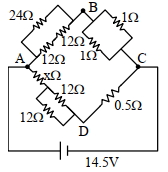
Correct Answer: (C)
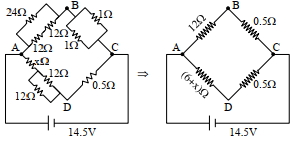
In case of balanced Wheatstone Bridge\(\frac{\mathrm{V}_{\mathrm{AB}}}{\mathrm{V}_{\mathrm{AD}}}=\frac{\mathrm{V}_{\mathrm{BC}}}{\mathrm{V}_{\mathrm{CD}}} \Rightarrow \frac{12}{6+\mathrm{x}}=\frac{0.5}{0.5}\)
\(\mathrm{x}=6 \Omega\)
-
- (A) \(V_1=V_2\)
- (B) \(V_1 \neq V_3-V_2\)
- (C) \(V_1+V_2>V_3\)
- (D) \(V_1+V_2=V_3\)
Show answer and solution
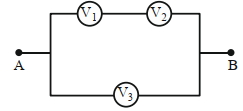
Correct Answer: (D)
From \(KVL\),\(v_1+v_2-v_3=0 \Rightarrow \mathrm{V}_1+\mathrm{V}_2=\mathrm{V}_3\)
-
- (A) \(2400\)
- (B) \(2500\)
- (C) \(2600\)
- (D) \(2700\)
Show answer and solution
Correct Answer: (B)
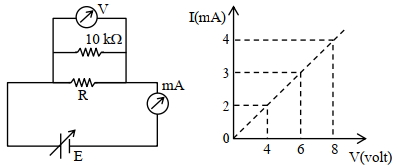
\(\text { Req }=\frac{10^4 R}{10^4+R}\)\(E=4 V, I=2 m A\)
\(I=\frac{E}{R e q} \Rightarrow 2 \times 10^{-3}=\frac{4\left(10^4+R\right)}{10^4 R}\)
\(\Rightarrow 20 R=40000+4 R\)
\(\quad 16 R=40000\)
\(R=2500 \Omega\)
-
- (A) \(0.2 \Omega\)
- (B) \(0.4 \Omega\)
- (C) \(0.1 \Omega\)
- (D) \(0.3 \Omega\)
Show answer and solution
Correct Answer: (D)
Let potential gradient be \(\lambda\).\(\therefore \mathrm{i} \times 10=\lambda \times 500=\varepsilon-\mathrm{ir}_{\mathrm{s}}\)
\(\Rightarrow 500 \lambda=\varepsilon-50 \lambda \mathrm{r}_{\mathrm{s}}\)
Also,
\(\mathrm{i}^{\prime} \times 1=\lambda \times 400=\varepsilon-\mathrm{i}^{\prime} \mathrm{r}_{\mathrm{s}}\)
\(\Rightarrow 400 \lambda=\varepsilon-400 \lambda \mathrm{r}_{\mathrm{s}}\)
\(\therefore 100 \lambda=350 \lambda \mathrm{r}_{\mathrm{s}} \Rightarrow \mathrm{r}_{\mathrm{s}}=\frac{10}{35} \approx 0.3 \Omega\)
Hence option \((4)\)
-
- (A) \(-2 \times 10^{-2} \ { }^{\circ} \mathrm{C}^{-1}\)
- (B) \(-1.5 \times 10^2\ { }^{\circ} \mathrm{C}^{-1}\)
- (C) \(-1 \times 10^{-2}\ { }^{\circ} \mathrm{C}^{-1}\)
- (D) \(-2.5 \times 10^{-2} \ { }^{\circ} \mathrm{C}^{-1}\)
Show answer and solution
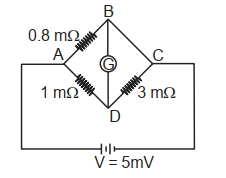
Correct Answer: (C)
For no deflection \(\frac{0.8}{1}=\frac{R}{3}\)
\(\Rightarrow \mathrm{R}=2.4 \mathrm{~m} \Omega\)
Temperature fall in \(10 \mathrm{~s}=20^{\circ} \mathrm{C}\)
\(\Delta \mathrm{R}=\mathrm{R} \alpha \Delta \mathrm{t}\)
\(\alpha=\frac{\Delta \mathrm{R}}{\mathrm{R} \Delta \mathrm{t}}=\frac{-0.6}{3 \times 20}\)
\(=-10^{-2} \mathrm{C}^{-1}\) -
- (A) \(10\)
- (B) \(6\)
- (C) \(7\)
- (D) \(45\)
Show answer and solution
Correct Answer: (B)
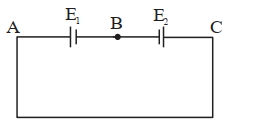
\(I=\frac{8-2}{2+4}=\frac{6}{6}=1 \mathrm{~A}\)
Applying Kirchhoff from \(C\) to \(B\)
\( V_C-2-4 \times 1=V_B \)
\( V_C-V_B=6 \mathrm{~V} \)
\( =6 \mathrm{~V}\)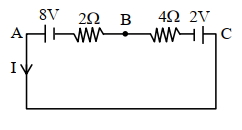
-
- (A) \(\alpha_1+\alpha_2, \frac{\alpha_1+\alpha_2}{2}\)
- (B) \(\frac{\alpha_1+\alpha_2}{2}, \frac{\alpha_1+\alpha_2}{2}\)
- (C) \(\alpha_1+\alpha_2, \frac{\alpha_1 \alpha_2}{\alpha_1+\alpha_2}\)
- (D) \(\frac{\alpha_1+\alpha_2}{2}, \alpha_1+\alpha_2\)
Show answer and solution
Correct Answer: (B)
Series :\(R_{e q}=R_1+R_2\)
\(2 R\left(1+\alpha_{e q} \Delta \theta\right)=R\left(1+\alpha_1 \Delta \theta\right)+R\left(1+\alpha_2 \Delta \theta\right)\)
\(2 R\left(1+\alpha_{\mathrm{eq}} \Delta \theta\right)=2 R+\left(\alpha_1+\alpha_2\right) R \Delta \theta\)
\(\alpha_{\mathrm{eq}}=\frac{\alpha_1+\alpha_2}{2}\)
Parallel :
\(\frac{1}{R_{e q}}=\frac{1}{R_1}+\frac{1}{R_2}\)
\(\frac{1}{\frac{R}{2}\left(1+\alpha_{e q} \Delta \theta\right)}=\frac{1}{R\left(1+\alpha_1 \Delta \theta\right)}+\frac{1}{R\left(1+\alpha_2 \Delta \theta\right)}\)
\(\frac{2}{1+\alpha_{\mathrm{eq}} \Delta \theta}=\frac{1}{1+\alpha_1 \Delta \theta}+\frac{1}{1+\alpha_2 \Delta \theta}\)
\(\frac{2}{1+\alpha_{\mathrm{eq}} \Delta \theta}=\frac{1+\alpha_2 \Delta \theta+1+\alpha_1 \Delta \theta}{\left(1+\alpha_1 \Delta \theta\right)\left(1+\alpha_2 \Delta \theta\right)}\)
\(2\left[\left(1+\alpha_1 \Delta \theta\right)\left(1+\alpha_2 \Delta \theta\right)\right]\)
\(=\left[2+\left(\alpha_1+\alpha_{22}\right) \Delta \theta\right]\left[1+\alpha_{\mathrm{eq}} \Delta \theta\right]\)
\(2\left[1+\alpha_1 \Delta \theta+\alpha_2 \Delta \theta+\alpha_1 \alpha_2 \Delta \theta\right]\)
\(=2+2 \alpha_{\mathrm{eq}} \Delta \theta+\left(\alpha_1+\alpha_{22}\right) \Delta \theta+\alpha_{\mathrm{eq}}\left(\alpha_1+\alpha_2\right) \Delta \theta^2\)
Neglecting small terms
\(2+2\left(\alpha_1+\alpha_2\right) \Delta \theta=2+2 \alpha_{\mathrm{eq}} \Delta \theta+\left(\alpha_1+\alpha_2\right) \Delta \theta\)
\(\left(\alpha_1+\alpha_2\right) \Delta \theta=2 \alpha_{\mathrm{eq}} \Delta \theta\)
\(\alpha_{\mathrm{eq}}=\frac{\alpha_1+\alpha_2}{2}\)
-
- (A) \(100\)
- (B) \(200\)
- (C) \(300\)
- (D) \(400\)
Show answer and solution
Correct Answer: (B)
\(\frac{R_V \cdot 100}{R_\gamma+100}=\frac{200}{3}\)\(3 R_v=2 R_v+200\)
\(R_v=200\)
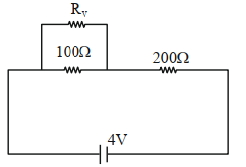
-
- (A) \(29\)
- (B) \(30\)
- (C) \(31\)
- (D) \(32\)
Show answer and solution
Correct Answer: (D)
\(\because \mathrm{R}=\frac{\rho \ell}{A}=\frac{\rho \mathrm{V}}{\mathrm{A}^2}\)\(\therefore \frac{\mathrm{R}_{\mathrm{A}}}{\mathrm{R}_{\mathrm{B}}}=\frac{\mathrm{A}_{\mathrm{B}}^2}{\mathrm{~A}_{\mathrm{A}}^2}=\frac{\mathrm{r}_{\mathrm{B}}^4}{\mathrm{r}_{\mathrm{A}}^4}\)
\(\Rightarrow \frac{\mathrm{R}_{\mathrm{A}}}{2}=\left[\frac{4 \times 10^{-3}}{2 \times 10^{-3}}\right]^4\)
\(\Rightarrow \mathrm{R}_{\mathrm{A}}=32 \Omega .\)
-
- (A) increased, \(\frac{3}{4}\)
- (B) increased, \(\frac{4}{3}\)
- (C) decreased, \(\frac{3}{4}\)
- (D) decreased, \(\frac{4}{3}\)
Show answer and solution
Correct Answer: (C)
\(\mathrm{P}=\frac{\mathrm{v}^2}{\mathrm{R}}, \mathrm{R}=\frac{\rho \ell}{\mathrm{A}}\)\(\mathrm{P} \propto \frac{1}{\ell}\)
\(\frac{\mathrm{P}_1}{\mathrm{P}_2}=\frac{\mathrm{t}_2}{\mathrm{t}_1}=\frac{15}{20}=\frac{\ell_2}{\ell_1}\)
\(\ell_2=\frac{3}{4} \ell_1\)
-
- (A) \(\frac{S_1}{4}\)
- (B) \(2 \mathrm{~S}_1\)
- (C) \(\frac{S_1}{2}\)
- (D) \(S_1\)
Show answer and solution
Correct Answer: (D)
As specific resistance does not depends on dimension of wire so, it will not change. -
- (A) \(1 / 4 \mathrm{~W}\)
- (B) \(1 / 2 \mathrm{~W}\)
- (C) \(2 \mathrm{~W}\)
- (D) \(4 \mathrm{~W}\)
Show answer and solution
Correct Answer: (D)
\( \frac{\mathrm{v}^2}{\mathrm{R}}=\mathrm{W}\) \(....(i)\)\(\frac{\mathrm{v}^2}{\frac{1}{2}\left(\frac{\mathrm{R}}{2}\right)}=\mathrm{W}^{\prime}\) \(...(ii)\)
From \((i)\)&\((ii)\), we get
\(W^{\prime}=4 W\)
No questions on this page match these filters.