


All JEE Mains 2024 Physics questions
31 chaptersShowing 51–100 of 593 questions
-
- (A)
\(A\) \(B\) \(Y\) \(0\) \(0\) \(1\) \(0\) \(1\) \(1\) \(1\) \(0\) \(1\) \(1\) \(1\) \(0\) - (B)
\(A\) \(B\) \(Y\) \(0\) \(0\) \(0\) \(0\) \(1\) \(1\) \(1\) \(0\) \(0\) \(1\) \(1\) \(1\) - (C)
\(A\) \(B\) \(Y\) \(0\) \(0\) \(0\) \(0\) \(1\) \(0\) \(1\) \(0\) \(0\) \(1\) \(1\) \(1\) - (D)
\(A\) \(B\) \(Y\) \(0\) \(0\) \(1\) \(0\) \(1\) \(0\) \(1\) \(0\) \(1\) \(1\) \(1\) \(0\)
Show answer and solution
Correct Answer: (B)
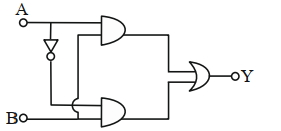
\(\mathrm{Y} =\mathrm{A} \cdot \mathrm{B}+\overline{\mathrm{A}} \cdot \mathrm{B} \)
\( =(\mathrm{A}+\overline{\mathrm{A}}) \cdot \mathrm{B} \)
\(\mathrm{Y} =1 \cdot \mathrm{B} \)
\(\mathrm{Y} =\mathrm{B}\)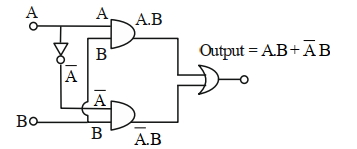
- (A)
-
- (A) \(\left(\frac{5}{2}\right) \Omega\)
- (B) \(\left(\frac{15}{4}\right) \Omega\)
- (C) \(6 \Omega\)
- (D) \(\left(\frac{30}{11}\right) \Omega\)
Show answer and solution
Correct Answer: (C)
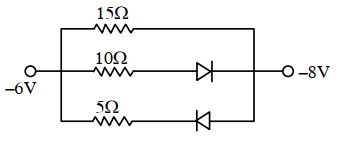
Diode \(2\) is in reverse bias
So current will not flow in branch of \(2^{\text {nd }}\) diode, So we can assume it to be broken wire.
Diode \(1\) is in forward bias
So it will behave like conducting wire. So new circuit will be
Correct answer \((3)\)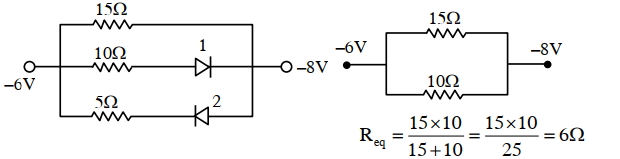
-
- (A) \(In\) opposite directions with speed in the ratio of \(1: 2\) respectively
- (B) \(In\) opposite directions with speed in the ratio of \(2:1\) respectively
- (C) \(In\) the same direction with same speed.
- (D) \(In\) opposite directions with the same speed.
Show answer and solution
Correct Answer: (A)
By conservation of momentum\(\mathrm{p}_{\mathrm{i}}=\mathrm{p}_{\mathrm{f}}\)
\(\mathrm{O}=\mathrm{m}_1 \mathrm{u}_1 \mathrm{~m}_2 \mathrm{u}_2\)
\(\frac{\mathrm{u}_1}{\mathrm{u}_2}=-\left[\frac{1}{2}\right]\)as
\(\frac{\mathrm{m}_1}{\mathrm{~m}_2}=\frac{2}{1}\)
-
- (A) \(3\)
- (B) \(4\)
- (C) \(5\)
- (D) \(6\)
Show answer and solution
Correct Answer: (B)
For a nucleusVolume: \(\mathrm{V}=\frac{4}{3} \pi \mathrm{R}^3\)
\(\mathrm{R}=\mathrm{R}_0(\mathrm{~A})^{1 / 3}\)
\(\mathrm{~V}=\frac{4}{3} \pi \mathrm{R}_0^3 \mathrm{~A}\)
\(\Rightarrow \frac{V_2}{V_1}=\frac{A_2}{A_1}=4\)
-
- (A) \(14\)
- (B) \(5\)
- (C) \(15\)
- (D) \(20\)
Show answer and solution
Correct Answer: (C)
\({ }^4 \mathrm{He}+{ }^4 \mathrm{He}+{ }^4 \mathrm{He} \rightarrow{ }^{12} \mathrm{C}+\mathrm{Q}\)\(\text { power generated }=\frac{\mathrm{N}}{\mathrm{t}} \mathrm{Q}\)
\(\text { where, } \mathrm{N} \rightarrow \text { No. of reaction/sec. }\)
\(\mathrm{Q}=\left(3 \mathrm{~m}_{\mathrm{He}}-\mathrm{m}_{\mathrm{C}}\right) \mathrm{C}^2\)
\(\mathrm{Q}=(3 \times 4.0026-12)\left(3 \times 10^5\right)^2\)
\(\mathrm{Q}=7.266 \mathrm{MeV}\)
\(\frac{\mathrm{N}}{\mathrm{t}}=\frac{\text { power }}{\mathrm{Q}}=\frac{5.808 \times 10^{30}}{7.266 \times 10^6 \times 1.6 \times 10^{-19}}\)
\(\frac{\mathrm{N}}{\mathrm{t}}=5 \times 10^{42}\)
rate of conversion of \({ }^4 \mathrm{He}\) into \({ }^{12} \mathrm{C}=15 \times 10^{42}\)
Hence, \(n=15\)
-
- (A) \(10 \mu g\)
- (B) \(20 \mu g\)
- (C) \(0.2 \mu g\)
- (D) \(2 \mu g\)
Show answer and solution
Correct Answer: (B)
\(\Delta mc ^2=18 \times 10^8\)
\(\Delta m \times 9 \times 10^{16}=18 \times 10^8\)
\(\Delta m =2 \times 10^{-8} kg=20 \mu g\) -
- (A) \((A), (B), (C), (D) \) only
- (B) \((A), (C), (D), (E)\) only
- (C) \((A), (B), (C), (E)\) only
- (D) \((B), (C), (D), (E)\) only
Show answer and solution
Correct Answer: (C)
Part of theory -
- (A) \(\left(5 \mathrm{M}_{\mathrm{p}}+7 \mathrm{M}_{\mathrm{n}}-\mathrm{M}_0\right) \mathrm{C}^2\)
- (B) \(\left(\mathrm{M}_{\mathrm{v}}-5 \mathrm{M}_y\right) \mathrm{C}^2\)
- (C) \(\left(M_0-12 M_n\right) C^2\)
- (D) \(\left(M_0-5 M_p-7 M_n\right) C^2\)
Show answer and solution
Correct Answer: (A)
\(\text { B.E. }=\Delta m C^2\)\(\left(5 M_p+7 M_n-M_0\right) C^2\)
-
- (A) \(725\)
- (B) \(726\)
- (C) \(727\)
- (D) \(728\)
Show answer and solution
Correct Answer: (C)
Reaction:\(3{ }_2^4 \mathrm{He} \longrightarrow{ }_6^{12} \mathrm{C}+\gamma \text { rays }\)
\(\text { Mass defect }=\Delta \mathrm{m}=\left(3 \mathrm{~m}_{\mathrm{He}}-\mathrm{m}_{\mathrm{C}}\right)\)
\(=(3 \times 4.002603-12)=0.007809 \mathrm{u}\)
Energy released
\(=931 \Delta \mathrm{m} \mathrm{MeV}\)
\(=7.27 \mathrm{MeV}=727 \times 10^{-2} \mathrm{MeV}\)
-
- (A) Proton
- (B) Electron
- (C) Neutron
- (D) \(\gamma\)-radiations
Show answer and solution
Correct Answer: (C)
\(\mathrm{Z} \text { in LHS }=92\)\(\mathrm{Z} \text { in } \mathrm{RHS}=56+36=92\)
\(\mathrm{~A} \text { in } \mathrm{LHS}=236\)
\(\mathrm{~A} \text { in } \mathrm{RHS}=141+92=233\)
So \(3\) neutrons are released.
-
- (A) \(236\)
- (B) \(623\)
- (C) \(359\)
- (D) \(417\)
Show answer and solution
Correct Answer: (A)
\( \mathrm{Q}=\mathrm{BE}_{\text {Product }}-\mathrm{BE}_{\text {Rectant }} \)\( =2(118)(8.6)-236(7.6) \)
\( =236 \times 1=236 \mathrm{MeV}\)
-
- (A) \(\sqrt{\frac{2 \mathrm{c} \Delta M}{\mathrm{M}}}\)
- (B) \(\frac{\Delta \mathrm{Mc}^2}{3}\)
- (C) \(c \sqrt{\frac{2 \Delta M}{M}}\)
- (D) \(c \sqrt{\frac{3 \Delta M}{M}}\)
Show answer and solution
Correct Answer: (C)
\((\mathrm{X}) \rightarrow(\mathrm{Y})+(\mathrm{Z})+(\mathrm{P})\)\(\mathrm{M} \quad \mathrm{M} / 3 \mathrm{M} / 3 \mathrm{M} / 3\)
\(\Delta \mathrm{Mc}^2=\frac{1}{2} \frac{\mathrm{M}}{3} \mathrm{~V}^2+\frac{1}{2} \frac{\mathrm{M}}{3} \mathrm{~V}^2+\frac{1}{2} \frac{\mathrm{M}}{3} \mathrm{~V}^2\)
\(\mathrm{~V}=\mathrm{c} \sqrt{\frac{2 \Delta \mathrm{M}}{\mathrm{M}}}\)
-
- (A) \(62.5\ \mathrm{MeV}\)
- (B) \(6.25\ \mathrm{MeV}\)
- (C) \(4.95 \ \mathrm{MeV}\)
- (D) \(49.5\ \mathrm{MeV}\)
Show answer and solution
Correct Answer: (C)
\( { }_6 \mathrm{C}^{13}+\text { Energy } \rightarrow{ }_6 \mathrm{C}^{12}+{ }_0 \mathrm{n}^1 \)\( \Delta \mathrm{m}=(12.000000+1.008665)-13.003354 \)
\( =-0.00531\ \mathrm{u} \)
\( \therefore \text { Energy required }=0.00531 \times 931.5 \mathrm{MeV} \)
\( =4.95\ \mathrm{MeV}\)
-
- (A) \(208\)
- (B) \(209\)
- (C) \(210\)
- (D) \(211\)
Show answer and solution
Correct Answer: (A)
\({ }^{235} \mathrm{U} \rightarrow{ }^{140} \mathrm{Ce}+{ }^{94} \mathrm{Zr}+\mathrm{n}\)Disintegration energy
\(\mathrm{Q} =\left(\mathrm{m}_{\mathrm{k}}-\mathrm{m}_{\mathrm{r}}\right) \mathrm{c}^2\)
\(\mathrm{~m}_{\mathrm{n}} =235.0439 \mathrm{u}\)
\(\mathrm{m}_{\mathrm{r}} =139.9054 \mathrm{u}+93.9063 \mathrm{u}+1.0086 \mathrm{u}\)
\(=234.8203 \mathrm{u}\)
\(\mathrm{Q} =(235.0439 \mathrm{u}-234.8203 \mathrm{u}) \mathrm{c}^2\)
\(=0.2236 \mathrm{c}^2\)
\(=0.2236 \times 931\)
\(\mathrm{Q} =208.1716\)
-
- (A) \(11.2 \times 10^{24} \mathrm{MeV}\)
- (B) \(5.6 \times 10^{12} \mathrm{MeV}\)
- (C) \(5.6 \mathrm{eV}\)
- (D) \(5.6 \times 10^{26} \mathrm{MeV}\)
Show answer and solution
Correct Answer: (D)
\(\mathrm{E}=\mathrm{mC}^2\)\(\Rightarrow \mathrm{E}=\left(1 \times 10^{-3}\right) \times\left(3 \times 10^5\right)^2 \mathrm{~J}\)
\(\Rightarrow \mathrm{E}=\left(10^{-3}\right)\left(9 \times 10^{16}\right)\left(6.241 \times 10^{18}\right) \mathrm{eV}\)
\(\mathrm{E}=56.169 \times 10^{31} \mathrm{eV}\)
\(\mathrm{E} \approx 5.6 \times 10^{26} \mathrm{MeV}\)
-
- (A) \(9.13\)
- (B) \(15.04\)
- (C) \(7.62\)
- (D) \(25.6\)
Show answer and solution
Correct Answer: (C)
In each fusion reaction, \(4{ }_1^1 \mathrm{H}\) nucleus are used.Energy released per Nuclei of \({ }_1^1 \mathrm{H}=\frac{26.7}{4} \mathrm{MeV}\)
\(\therefore\) Energy released by \(2 \mathrm{~kg}\) hydrogen \(\left(\mathrm{E}_{\mathrm{H}}\right)\)
\(=\frac{2000}{1} \times \mathrm{N}_{\mathrm{A}} \times \frac{26.7}{4} \mathrm{MeV}\)
\(\therefore\) Energy released by \(2 \mathrm{~kg}\) Vranium \(\left(\mathrm{E}_{\mathrm{v}}\right.\) )
\(=\frac{2000}{235} \times \mathrm{N}_{\mathrm{A}} \times 200 \mathrm{MeV}\)
So,
\(\frac{E_H}{E_V}=235 \times \frac{26.7}{4 \times 200}=7.84\)
\(\therefore\) Approximately close to \(7.62\)
-
- (A) \(28.12\ \mathrm{MeV}\)
- (B) \(12.64\ \mathrm{MeV}\)
- (C) \(16.48\ \mathrm{MeV}\)
- (D) \(22.22\ \mathrm{MeV}\)
Show answer and solution
Correct Answer: (D)
\( { }_3 \mathrm{Li}^6+{ }_0 \mathrm{n}^1 \rightarrow{ }_2 \mathrm{He}^4+{ }_1 \mathrm{H}^3 \)\( { }_1 \mathrm{H}^2+{ }_1 \mathrm{H}^3 \rightarrow{ }_2 \mathrm{He}^4+{ }_0 \mathrm{n}^1\)
--------------------------------------------------------------
\({ }_3 \mathrm{Li}^6+{ }_1 \mathrm{H}^2 \rightarrow 2\left({ }_2 \mathrm{He}^4\right)\)
---------------------------------------------------------------
Energy released in process
\( \mathrm{Q}=\Delta \mathrm{mc}^2 \)
\( \mathrm{Q}=\left[\mathrm{M}(\mathrm{Li})+\mathrm{M}\left({ }_1 \mathrm{H}^2\right)-2 \times \mathrm{M}\left({ }_2 \mathrm{He}^4\right)\right] \times 931.5\ \mathrm{MeV} \)
\( \mathrm{Q}=[6.01690+2.01471-2 \times 4.00388] \times 931.5\ \mathrm{MeV} \)
\( \mathrm{Q}=22.216 \ \mathrm{MeV} \)
\( \mathrm{Q}=22.22\ \mathrm{MeV}\)
-
- (A) \(10\)
- (B) \(1\)
- (C) \(5\)
- (D) \(11\)
Show answer and solution
Correct Answer: (B)
\(\mathrm{E}=\Delta \mathrm{mc}^2\)\(=0.4 \times 10^{-3} \times\left(3 \times 10^8\right)^2\)
\(=3600 \times 10^7 \mathrm{kWs}\)
\(=\frac{3600 \times 10^7}{3600} \mathrm{kWh}=1 \times 10^7 \mathrm{kWh}\)
- 69. The mass number of nucleus having radius equal to half of the radius of nucleus with mass number \(192\) is _______. 2024 Hard
- (A) \(24\)
- (B) \(32\)
- (C) \(40\)
- (D) \(20\)
Show answer and solution
Correct Answer: (A)
\(R_1=\frac{R_2}{2}\)\(R_0\left(A_1\right)^{1 / 3}=\frac{R_0}{2}\left(A_2\right)^{1 / 3}\)
\(A_1=\frac{1}{8} A_2\)
\(A_1=\frac{192}{8}=24\)
-
- (A) \(27\)
- (B) \(28\)
- (C) \(29\)
- (D) \(30\)
Show answer and solution
Correct Answer: (A)
\(\mathrm{R}=\mathrm{R}_0 \mathrm{~A}^{1 / 3}\)\(\mathrm{R}^3 \propto \mathrm{A}\)
\(\left(\frac{4.8}{4}\right)^3=\frac{64}{\mathrm{~A}}\)
\(=\frac{64}{\mathrm{~A}}=(1.2)^3\)
\(\frac{64}{\mathrm{~A}}=1.44 \times 1.2\)
\(\mathrm{~A}=\frac{64}{1.44 \times 1.2}=\frac{1000}{\mathrm{x}}\)
\(\mathrm{x}=\frac{144 \times 12}{64}=27\)
-
- (A) \({ }_{56}^{144} \mathrm{Ba}+{ }_{36}^{89} \mathrm{Kr}+4{ }_0^1 \mathrm{n}\)
- (B) \({ }_{56}^{140} \mathrm{Xe}+{ }_{38}^{94} \mathrm{Sr}+3{ }_0^1 \mathrm{n}\)
- (C) \({ }_{51}^{153} \mathrm{Sb}+{ }_{41}^{99} \mathrm{Nb}+3{ }_0^1 \mathrm{n}\)
- (D) \({ }_{56}^{144} \mathrm{Ba}+{ }_{36}^{89} \mathrm{Kr}+3{ }_0^1 \mathrm{n}\)
Show answer and solution
Correct Answer: (D)
Balancing mass number and atomic number\({ }_{92}^{235} \mathrm{U}+{ }_0^1 \mathrm{n} \rightarrow{ }_{56}^{144} \mathrm{Ba}+{ }_{36}^{89} \mathrm{Kr}+3{ }_0^1 \mathrm{n}\)
-
- (A) \(5\)
- (B) \(7\)
- (C) \(6\)
- (D) \(12\)
Show answer and solution
Correct Answer: (C)
\( E_n=-\frac{13.6}{n^2}=-0.85 \)\( \Rightarrow n=4\)
No of transition
\(=\frac{n(n-1)}{2}=\frac{4(4-1)}{2}=6\)
-
- (A) \(5\)
- (B) \(7\)
- (C) \(9\)
- (D) \(11\)
Show answer and solution
Correct Answer: (C)
\(\Delta \mathrm{E}=13.6\left(\frac{1}{2^2}-\frac{1}{3^2}\right)=1.9 \mathrm{eV}\)\(\Delta \mathrm{E}=\frac{\mathrm{hc}}{\lambda}\)
\(\lambda=\frac{\mathrm{hc}}{\Delta \mathrm{E}}\)
\(\mathrm{P}_{\mathrm{i}}=\mathrm{P}_{\mathrm{f}}\)
\(0=-\mathrm{mv}+\frac{\mathrm{h}}{\lambda^{\prime}}\)
\(\Rightarrow \mathrm{v}=\frac{\mathrm{h}}{\mathrm{m} \lambda^{\prime}}\)
\(\Delta \mathrm{E}=\frac{1}{2} \mathrm{mv^{2 }}+\frac{\mathrm{hc}}{\lambda^{\prime}}\)
\(=\frac{1}{2} \mathrm{~m}\left(\frac{\mathrm{h}}{\mathrm{m} \lambda^{\prime}}\right)^2+\frac{\mathrm{hc}}{\lambda^{\prime}}\)
Now
\(\Delta \mathrm{E}=\frac{\mathrm{h}^2}{2 \mathrm{~m} \lambda^{\prime 2}}+\frac{\mathrm{hc}}{\lambda^{\prime}}\)
\(\lambda^{\prime 2} \Delta \mathrm{E}-\mathrm{hc} \lambda^{\prime}-\frac{\mathrm{h}^2}{2 \mathrm{~m}}=0\)
\(\lambda^{\prime}=\frac{\mathrm{hc} \pm \sqrt{\mathrm{h}^2 \mathrm{c}^2+\frac{4 \Delta \mathrm{Eh}^2}{2 \mathrm{~m}}}}{2 \Delta \mathrm{E}}\)
\(\lambda^{\prime}=\frac{\mathrm{hc} \pm \mathrm{hc} \sqrt{1+\frac{2 \Delta \mathrm{E}}{\mathrm{mc}^2}}}{2 \Delta \mathrm{E}}\)
\(\frac{\lambda^{\prime}}{\lambda}=\frac{1+\left(1+\frac{2 \Delta \mathrm{E}}{\mathrm{mc}^2}\right)^{\frac{1}{2}}}{2}=\frac{1+1+\frac{\Delta \mathrm{E}}{\mathrm{mc}^2}}{2}\)
\(\frac{\lambda^{\prime}}{\lambda}=1+\frac{\Delta \mathrm{E}}{2 \mathrm{mc}^2}\)
\(\frac{\lambda^{\prime}-\lambda}{\lambda}=\frac{\Delta \mathrm{E}}{2 \mathrm{mc}^2}=\frac{1.9 \times 1.6 \times 10^{-19}}{2 \times 1.67 \times 10^{-27} \times 9 \times 10^{16}}=10^{-9}\)
\(\therefore \% \text { change } \approx 10^{-7}\)
Correct answer \(7\)
-
- (A) \(6\)
- (B) \(3\)
- (C) \(10\)
- (D) \(1\)
Show answer and solution
Correct Answer: (D)
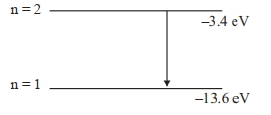
Hydrogen will be in first excited state therefore it will emit one spectral line corresponding to transition b/w energy level \(2\) to \(1\). -
- (A) \(32\)
- (B) \(35\)
- (C) \(37\)
- (D) \(38\)
Show answer and solution
Correct Answer: (A)
\(E=-13.6 z^2\left(\frac{1}{n_i^2}-\frac{1}{n_f^2}\right)\)\(\mathrm{E}=\mathrm{C}\left(\frac{1}{\mathrm{n}_{\mathrm{f}}^2}-\frac{1}{\mathrm{n}_{\mathrm{i}}^2}\right)\)
\(\mathrm{h} \nu=\mathrm{C}\left[\frac{1}{\mathrm{n}_{\mathrm{f}}^2}-\frac{1}{\mathrm{n}_{\mathrm{i}}^2}\right]\)
\(\frac{v_1}{v_2}=\frac{\left[\frac{1}{n_f^2}-\frac{1}{n_i^2}\right]_{2-1}}{\left[\frac{1}{n_f^2}-\frac{1}{n_i^2}\right]_{3-1}}\)
\(=\frac{\left[\frac{1}{1}-\frac{1}{4}\right]}{\left[\frac{1}{1}-\frac{1}{9}\right]}=\frac{3 / 4}{8 / 9}\)
\(=\frac{3}{4} \times \frac{9}{8}\)
\(\frac{v_1}{v_2}=\frac{27}{32}\)
\(v_2=\frac{32}{27} v_1=\frac{32}{27} \times 3 \times 10^{15} \mathrm{~Hz}=\frac{32}{9} \times 10^{15} \mathrm{~Hz}\)
-
- (A) \(8 \frac{\mathrm{h}}{\pi}\)
- (B) \(\frac{\mathrm{h}}{\pi}\)
- (C) \(2 \frac{\mathrm{h}}{\pi}\)
- (D) \(\frac{\mathrm{h}}{2 \pi}\)
Show answer and solution
Correct Answer: (C)
Moment of momentum is \(\vec{r} \times \vec{P}\)\(\overrightarrow{\mathrm{L}}=\overrightarrow{\mathrm{r}} \times \mathrm{m} \overrightarrow{\mathrm{v}}\)
\(\mathrm{L}=\mathrm{mvr}=\frac{\mathrm{nh}}{2 \pi}=\frac{4 \mathrm{~h}}{2 \pi}=\frac{2 \mathrm{~h}}{\pi}\)
-
- (A) \(2\)
- (B) \(1\)
- (C) \(3\)
- (D) \(0\)
Show answer and solution
Correct Answer: (A)
\(\mu_n = \frac{eL}{2m_e}\)
\(L = n\hbar\)
\(\mu_n = \frac{en\hbar}{2m_e}\)
\(\mu_n \propto n\)
\(x = 1\)
-
- (A) \(\mathrm{E}=2 \mathrm{U}\)
- (B) \(2 \mathrm{E}=3 \mathrm{U}\)
- (C) \(E=U\)
- (D) \(2 E=U\)
Show answer and solution
Correct Answer: (D)
\(\mathrm{F}=\frac{\mathrm{k}(\mathrm{Ze})(\mathrm{e})}{\mathrm{r}^2}=\frac{\mathrm{mv}^2}{\mathrm{r}}\)\(\mathrm{KE}=\frac{1}{2} \mathrm{mv}^2=\frac{1}{2} \frac{\mathrm{K}(\mathrm{Ze})(\mathrm{e})}{\mathrm{r}}\)
\(\mathrm{PE}=-\frac{\mathrm{K}(\mathrm{Ze})(\mathrm{e})}{\mathrm{r}}\)
\(\mathrm{TE}=\frac{\mathrm{K}(\mathrm{Ze})(\mathrm{e})}{2 \mathrm{r}}-\frac{\mathrm{K}(\mathrm{Ze})(\mathrm{e})}{\mathrm{r}}=\frac{-\mathrm{K}(\mathrm{Ze})(\mathrm{e})}{2 \mathrm{r}}\)
\(\mathrm{TE}=\frac{\mathrm{PE}}{2}\)
\(\text { 2TE }=\mathrm{PE}\)
\(\text { Option (4) }\)
-
- (A) Both statement \(I\) and statement \(II\) are false
- (B) Statement \(I\) is false but statement \(II\) is true
- (C) Statement \(I\) is true but statement \(II\) is false
- (D) Both statement \(I\) and statement \(II\) are true
Show answer and solution
Correct Answer: (C)
According to Rutherford atomic model, most of mass of atom and all its positive charge is concentrated in tiny nucleus electron revolve around it.According to Thomson atomic model, atom is spherical cloud of positive charge with electron embedded in it.
Hence,
Statement \(I\) is true but statement \(II\) false.
-
- (A) \(456\)
- (B) \(158\)
- (C) \(121\)
- (D) \(498\)
Show answer and solution
Correct Answer: (C)
For minimum potential difference electron has to make transition from \(n=3\) to \(n=2\) state but first electron has to reach to \(\mathrm{n}=3\) state from ground state. So, energy of bombarding electron should be equal to energy difference of \(n=3\) and \(n=1\) state.\( \Delta \mathrm{E}=13.6\left[1-\frac{1}{3^2}\right] \mathrm{e}=\mathrm{eV} \)
\( \frac{13.6 \times 8}{9}=\mathrm{V} \)
\( \mathrm{V}=12.09 \mathrm{~V} \approx 12.1 \mathrm{~V}\)
So, \(\alpha=121\)
-
- (A) \(144\)
- (B) \(155\)
- (C) \(188\)
- (D) \(120\)
Show answer and solution
Correct Answer: (A)
Longest wavelength corresponds to transition between \(n=3\) and \(n=4\)\( \frac{1}{\lambda}=R Z^2\left(\frac{1}{3^2}-\frac{1}{4^2}\right)=R Z^2\left(\frac{1}{9}-\frac{1}{16}\right) \)
\( =\frac{7 R Z^2}{9 \times 16} \)
\( \Rightarrow \lambda=\frac{144}{7 R} \text { for } Z=1 \quad \therefore \alpha=144\)
-
- (A) \(\frac{27}{32} \lambda\)
- (B) \(\frac{32}{27} \lambda\)
- (C) \(\frac{27}{5} \lambda\)
- (D) \(\frac{5}{27} \lambda\)
Show answer and solution
Correct Answer: (A)
\(\frac{1}{\lambda}=\frac{13.6 \mathrm{z}^2}{\mathrm{hc}}\left[\frac{1}{1^2}-\frac{1}{2^2}\right] \) \(...(i)\)\(\frac{1}{\lambda^{\prime}}=\frac{13.6 \mathrm{z}^2}{\mathrm{hc}}\left[\frac{1}{1^2}-\frac{1}{3^2}\right] \) \(...(ii)\)
On dividing \((i)\) & \((ii)\)
\(\lambda^{\prime}=\frac{27}{32} \lambda\)
-
- (A) \(155\)
- (B) \(156\)
- (C) \(157\)
- (D) \(158\)
Show answer and solution
Correct Answer: (D)
\(v=\sqrt{\frac{4 \mathrm{KZe}^2}{\mathrm{mr}_{\min }}}\)\(=\sqrt{\frac{4 \times 9 \times 10^9 \times 80}{6.72 \times 10^{-27} \times 4.5 \times 10^{-14}}} \times 1.6 \times 10^{-19}\)
\(=9.759 \times 10^{25} \times 1.6 \times 10^{-19}\)
\(=156 \times 10^5 \mathrm{~m} / \mathrm{s}\)
-
- (A) \(14\)
- (B) \(15\)
- (C) \(16\)
- (D) \(20\)
Show answer and solution
Correct Answer: (C)
We know\(\mathrm{r}=0.529 \frac{\mathrm{n}^2}{\mathrm{Z}} \Rightarrow 8.48=0.529 \frac{\mathrm{n}^2}{1}\)
\(\mathrm{n}^2=16 \Rightarrow \mathrm{n}=4\)
We know
\(E \propto \frac{1}{n^2}\)
\(E_{n^{\text {dh }}}=\frac{E}{16}\)
\(x=16\)
-
- (A) \(\sqrt{\mathrm{r}}\)
- (B) \(\frac{1}{\mathrm{r}}\)
- (C) \(r\)
- (D) \(\frac{1}{\sqrt{\mathrm{r}}}\)
Show answer and solution
Correct Answer: (A)
\(\mathrm{F}_{\mathrm{C}}=\frac{\mathrm{mv}^2}{\mathrm{r}}\)\(\frac{\mathrm{Kq}_1 \mathrm{q}_2}{\mathrm{r}^2}=\frac{\mathrm{mv}^2}{\mathrm{r}}\)
\(\mathrm{mv}^2 \mathrm{r}^2=\mathrm{K}_{\mathrm{q}_1 \mathrm{q}_2 \mathrm{r}}\)
\(\frac{\mathrm{L}^2}{\mathrm{~m}}=\mathrm{Kq}_1 \mathrm{q}_2 \mathrm{r}\)
\(\mathrm{L} \propto \sqrt{\mathrm{r}}\)
- 86. The longest wavelength associated with Paschen series is _______. (Given \(R_H=1.097 \times 10^7 \mathrm{SI}\) unit) 2024 Hard
- (A) \(1.094 \times 10^{-6} \mathrm{~m}\)
- (B) \(2.973 \times 10^{-6} \mathrm{~m}\)
- (C) \(3.646 \times 10^{-6} \mathrm{~m}\)
- (D) \(1.876 \times 10^{-6} \mathrm{~m}\)
Show answer and solution
Correct Answer: (D)
For longest wavelength in Paschen's series:\(\frac{1}{\lambda}=\mathrm{R}\left[\frac{1}{\mathrm{n}_1{ }^2}-\frac{1}{\mathrm{n}_2{ }^2}\right]\)
\(\text { For longest } \mathrm{n}_1=3\)
\(\frac{1}{\lambda}=\mathrm{n}\left[\frac{1}{(3)^2}-\frac{1}{(4)^2}\right]\)
\(\frac{1}{\lambda}=\mathrm{R}\left[\frac{1}{9}-\frac{1}{16}\right]\)
\(\frac{1}{\lambda}=\mathrm{R}\left[\frac{16-9}{16 \times 9}\right]\)
\(\Rightarrow \lambda=\frac{16 \times 9}{7 \mathrm{R}}=\frac{16 \times 9}{7 \times 1.097 \times 10^7}\)
\(\lambda=1.876 \times 10^{-6} \mathrm{~m}\)
- 87. The minimum energy required by a hydrogen atom in ground state to emit radiation in Balmer series is nearly _______. 2024 Hard
- (A) \(1.5 \mathrm{eV}\)
- (B) \(13.6 \mathrm{eV}\)
- (C) \(1.9 \mathrm{eV}\)
- (D) \(12.1 \mathrm{eV}\)
Show answer and solution
Correct Answer: (D)
\(E_n = -\frac{13.6}{n^2} \, \mathrm{eV}\)
\(\Delta E = E_3 - E_1\)
\(\Delta E = \left(-\frac{13.6}{3^2}\right) - \left(-\frac{13.6}{1^2}\right)\)
\(\Delta E = 13.6 \left(1 - \frac{1}{9}\right) = 13.6 \left(\frac{8}{9}\right) \approx 12.089 \, \mathrm{eV}\)
\(\Delta E \approx 12.1 \, \mathrm{eV}\)
- 88. The radius of third stationary orbit of electron for Bohr's atom is \(R\). The radius of fourth stationary orbit will be: 2024 Hard
- (A) \(\frac{4}{3} \mathrm{R}\)
- (B) \(\frac{16}{9} R\)
- (C) \(\frac{3}{4} R\)
- (D) \(\frac{9}{16} R\)
Show answer and solution
Correct Answer: (B)
\( \mathrm{r} \propto \frac{\mathrm{n}^2}{\mathrm{Z}} \)\( \frac{\mathrm{r}_4}{\mathrm{r}_3}=\frac{4^2}{3^2} \)
\( \mathrm{r}_4=\frac{16}{9} \mathrm{R}\)
- 89. The radius of third stationary orbit of electron for Bohr's atom is \(R\). The radius of fourth stationary orbit will be what? 2024 Medium
- (A) \(\frac{4}{3} R\)
- (B) \(\frac{16}{9} R\)
- (C) \(\frac{3}{4} R\)
- (D) \(\frac{9}{16} R\)
Show answer and solution
Correct Answer: (B)
\(r \propto \frac{n^2}{Z}\)
\(\frac{r_4}{r_3}=\frac{4^2}{3^2}\)
\(r_4=\frac{16}{9} R\) -
- (A) \(4\)
- (B) \(\frac{1}{4}\)
- (C) \(\frac{1}{2}\)
- (D) \(1\)
Show answer and solution
Correct Answer: (C)
\(\frac{1}{2}|P E|=K E\) for each value of \(\mathrm{n}\) (orbit)\(\therefore \frac{K E}{|P E|}=\frac{1}{2}\)
- 91. The ratio of the shortest wavelength of Balmer series to the shortest wavelength of Lyman series for hydrogen atom is _______. 2024 Hard
- (A) \(4: 1\)
- (B) \(1: 2\)
- (C) \(1: 4\)
- (D) \(2: 1\)
Show answer and solution
Correct Answer: (A)
\(\frac{1}{\lambda}=\mathrm{Rz}^2\left(\frac{1}{\mathrm{n}_1^2}-\frac{1}{\mathrm{n}_2^2}\right)\)\(\frac{1}{\lambda_{\mathrm{L}}}=\mathrm{Rz}^2\left(\frac{1}{1^2}\right)\)
\(\frac{1}{\lambda_{\mathrm{B}}}=\mathrm{Rz}^2\left(\frac{1}{2^2}\right)\)
\(\frac{\lambda_{\mathrm{B}}}{\lambda_{\mathrm{I}}}=4: 1\)
-
- (A) \(6587\)
- (B) \(6588\)
- (C) \(6590\)
- (D) \(6596\)
Show answer and solution
Correct Answer: (A)
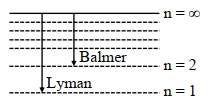
Lyman SeriesShortest, \(\frac{\mathrm{hc}}{\lambda}=-13.6\left(\frac{1}{\mathrm{n}_1^2}-\frac{1}{\mathrm{n}_2^2}\right)\)
\(\lambda \downarrow \mathrm{E} \uparrow ; \frac{\mathrm{hc}}{\lambda_0}=-13.6(1)\)
Balmer Series:
\(\mathrm{n}=3\)
\(\mathrm{n}=2\)
\(\frac{\mathrm{hc}}{\lambda_1}=-13.6\left(\frac{1}{2^2}-\frac{1}{3^2}\right)\)
\(\frac{\mathrm{hc}}{\lambda_1}=-13.6\left(\frac{1}{4}-\frac{1}{9}\right)\)
\(\frac{\mathrm{hc}}{\lambda_1}=-13.6 \times\left(\frac{5}{36}\right)\)
\(\Rightarrow \frac{-13.6 \lambda_0}{\lambda_1}=-13.6 \times \frac{5}{36}\)
\(\lambda_1=\frac{\lambda_0 \times 36}{5}=\frac{915 \times 36}{5}=6588\)
-
- (A) \(17\)
- (B) \(18\)
- (C) \(19\)
- (D) \(20\)
Show answer and solution
Correct Answer: (C)
\( \Delta E=10.2 \mathrm{eV} \)\( \text { Recoil speed(v) }=\frac{\Delta \mathrm{E}}{\mathrm{mc}} \)
\( =\frac{10.2 \mathrm{eV}}{1.6 \times 10^{-27} \times 3 \times 10^8} \)
\( =\frac{10.2 \times 1.6 \times 10^{-19}}{1.6 \times 10^{-27} \times 3 \times 10^8} \)
\( \mathrm{v}=3.4 \mathrm{~m} / \mathrm{s}=\frac{17}{5} \mathrm{~m} / \mathrm{s}\)
Therefore, \(x=17\)
-
- (A) \(\frac{I}{2}\)
- (B) \(4\) \( I\)
- (C) \(2 \ \mathrm{I}\)
- (D) \( I\)
Show answer and solution
Correct Answer: (D)
As amount of energy incident on cell is same so current will remain same. -
- (A) \(3\)
- (B) \(2\)
- (C) \(1\)
- (D) \(5\)
Show answer and solution
Correct Answer: (A)
Correct answer is : \(3\)
We know for point source, \(I \propto \frac{1}{r^2}=\frac{K}{4 \pi r^2}\)
\(r_1=2 m, r_2=4 m=2 r_1 \)
\(I_0=16 \times 10^{-8} W / m ^2\)
at \(2 m\),
\(I_1=\frac{I_0}{(2)^2}=\frac{16 \times 10^{-8}}{4} \)
\(I_1=4 \times 10^{-8} \)
\( I_2=\frac{I_0}{4_2}=\frac{16 \times 10^{-8}}{16}=10^{-8} \)
\(\left|I_2-I_1\right|=3 \times 10^{-8} W / m ^2, x=3\)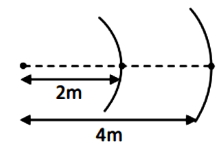
- 96. A proton, an electron and an alpha particle have the same energies. Their de-Broglie wavelengths will be compared as _______. 2024 Hard
- (A) \(\lambda_{\mathrm{e}}>\lambda_\alpha>\lambda_{\mathrm{p}}\)
- (B) \(\lambda_\alpha<\lambda_p<\lambda_c\)
- (C) \(\lambda_p<\lambda_e<\lambda_a^p\)
- (D) \(\lambda_p>\lambda_c^p>\lambda_a\)
Show answer and solution
Correct Answer: (B)
\(\lambda_{\mathrm{DB}}=\frac{\mathrm{h}}{\mathrm{p}}=\frac{\mathrm{h}}{\sqrt{2 \mathrm{mk}}}\)\(\Rightarrow \lambda_{\mathrm{DB}} \alpha \frac{1}{\sqrt{\mathrm{m}}}\)
\(\Rightarrow \lambda_{\mathrm{a}}<\lambda_{\mathrm{p}}<\lambda_{\mathrm{c}}\)
-
- (A) \(1: 1836\)
- (B) \(1: \frac{1}{1836}\)
- (C) \(1: \frac{1}{\sqrt{1836}}\)
- (D) \(1: \sqrt{1836}\)
Show answer and solution
Correct Answer: (A)
\(\lambda\) is same for both \(\mathrm{P}=\frac{\mathrm{h}}{\lambda}\) same for both\(\mathrm{P}=\sqrt{2 \mathrm{mK}}\)
Hence,
\(\mathrm{K} \propto \frac{1}{\mathrm{~m}}\)
\(\Rightarrow \frac{\mathrm{KE}_{\mathrm{p}}}{\mathrm{KE}_{\mathrm{e}}}=\frac{\mathrm{m}_{\mathrm{e}}}{\mathrm{m}_{\mathrm{p}}}=\frac{1}{1836}\)
-
- (A) \(\mathrm{K}_{\mathrm{p}}>\mathrm{K}_{\mathrm{e}}\)
- (B) \(\mathrm{K}_{\mathrm{p}}=\mathrm{K}_{\mathrm{e}}\)
- (C) \(\mathrm{K}_{\mathrm{p}}=\mathrm{K}_{\mathrm{e}}^2\)
- (D) \(\mathrm{K}_{\mathrm{p}}<\mathrm{K}_{\mathrm{e}}\)
Show answer and solution
Correct Answer: (D)
De Broglie wavelength of proton & electron \(=\lambda\)\(\because \lambda=\frac{\mathrm{h}}{\mathrm{p}}\)
\(\therefore \mathrm{p}_{\text {proton }}=\mathrm{p}_{\text {electron }}\)
\(\because \mathrm{KE}=\frac{\mathrm{p}^2}{2 \mathrm{~m}}\)
\(\therefore \mathrm{KE}_{\text {proton }}<\mathrm{KE}_{\text {electron }}\)
\({\left[\mathrm{K}_{\mathrm{p}}<\mathrm{K}_{\mathrm{e}}\right]}\)
-
- (A) \(0.2 \mathrm{~m}^2\)
- (B) \(0.02 \mathrm{~m}^2\)
- (C) \(20 \mathrm{~m}^2\)
- (D) \(0.1 \mathrm{~m}^2\)
Show answer and solution
Correct Answer: (B)
\(\text { Pressure }=\frac{I}{C}=\frac{F}{A}\)\(\Rightarrow \frac{360}{10^{-4} \times 3 \times 10^8}=\frac{2.4 \times 10^{-4}}{A}\)
\(\Rightarrow A=2 \times 10^{-2} \mathrm{~m}^2=0.02 \mathrm{~m}^2\)
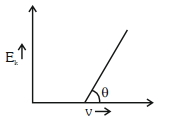
-
- (A) Ratio of Planck's constant to electric charge
- (B) Work function of the metal
- (C) Charge of electron
- (D) Planck's constant
Show answer and solution
Correct Answer: (D)
\(\text { K.E. }=\mathrm{hf}-\phi\)\(\tan \theta=\mathrm{h}\)
No questions on this page match these filters.