


All JEE Mains 2024 Physics questions
31 chaptersShowing 551–593 of 593 questions
-
- (A) Statement \(I\) is correct but Statement \(II\) is incorrect
- (B) Statement \(I\) is incorrect but Statement \(II\) is correct
- (C) Both Statement \(I\) and Statement \(II\) are incorrect
- (D) Both Statement \(I\) and Statement \(II\) are correct
Show answer and solution
Correct Answer: (B)
Co-efficient of friction depends on surface in contact So, depends on material of object. -
- (A) \(\sqrt{3}: 2\)
- (B) \(1: \sqrt{3}\)
- (C) \(\sqrt{3}: 1\)
- (D) \(2: \sqrt{3}\)
Show answer and solution
Correct Answer: (A)
Given \(\mathrm{m}_1=\mathrm{m}_2\)\(\text { and } \frac{\mathrm{r}_1}{\mathrm{r}_2}=\frac{3}{4}\)
As centripetal force \(F=\frac{\mathrm{mv}^2}{\mathrm{r}}\)
In order to have constant (same in this question) centripetal force
\( \mathrm{F}_1=\mathrm{F}_2 \)
\( \frac{\mathrm{m}_1 \mathrm{v}_1^2}{\mathrm{r}_1}=\frac{\mathrm{m}_2 \mathrm{v}_2^2}{\mathrm{r}_2} \)
\( \Rightarrow \frac{\mathrm{v}_1}{\mathrm{v}_2}=\sqrt{\frac{\mathrm{r}_1}{\mathrm{r}_2}}=\frac{\sqrt{3}}{2}\)
-
- (A) \(9 \mathrm{~kg}\)
- (B) \(4.5 \mathrm{~kg}\)
- (C) \(6.5 \mathrm{~kg}\)
- (D) \(2.25 \mathrm{~kg}\)
Show answer and solution
Correct Answer: (B)
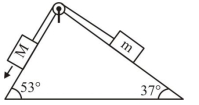
For M block\(10 \mathrm{~g} \sin 53^{\circ}-\mu(10 \mathrm{~g}) \cos 53^{\circ}-\mathrm{T}=10 \times 2\)
\(\mathrm{~T}=80-15-20\)
\(\mathrm{~T}=45 \mathrm{~N}\)
For \(\mathrm{m}\) block
\(\mathrm{T}-\mathrm{mg} \sin 37^{\circ}-\mu \mathrm{mg} \cos 37^{\circ}=\mathrm{m} \times 2\)
\(45=10 \mathrm{~m}\)
\(\mathrm{~m}=4.5 \mathrm{~kg}\)
-
- (A) \(1600\)
- (B) \(40\)
- (C) \(1000\)
- (D) \(20\)
Show answer and solution
Correct Answer: (B)
\(\mathrm{T}=\mathrm{m} \omega^2 \ell\)\(400=0.5 \omega^2 \times 0.5\)
\(\omega=40 \mathrm{rad} / \mathrm{s} .\)
-
- (A) \(1\)
- (B) \(2\)
- (C) \(3\)
- (D) \(4\)
Show answer and solution
Correct Answer: (B)
The ball needs to just cross \(4\) steps to just hit \(5^{\text {th }}\) step
Therefore, horizontal range \((R)=0.4 \mathrm{~m}\)
\(\mathrm{R}=\mathrm{u} . \mathrm{t}\)
Similarly, in vertical direction
\( \mathrm{h}=\frac{1}{2} \mathrm{gt}^2 \)
\( 0.4=\frac{1}{2} \mathrm{gt}^2 \)
\( 0.4=\frac{1}{2} \mathrm{~g}\left(\frac{0.4}{\mathrm{u}}\right)^2 \)
\( \mathrm{u}^2=2 \)
\( \mathrm{u}=\sqrt{2} \mathrm{~m} / \mathrm{s}\)
Therefore, \(\mathrm{x}=2\)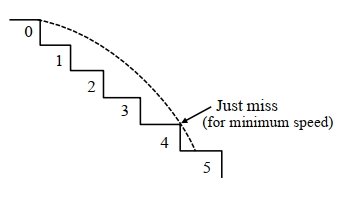
-
- (A) \(100\)
- (B) \(199\)
- (C) \(198\)
- (D) \(197\)
Show answer and solution
Correct Answer: (A)
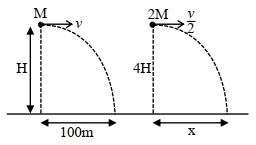
\(100=v \sqrt{\frac{2 \mathrm{H}}{\mathrm{g}}} ; \quad \mathrm{x}=\frac{v}{2} \sqrt{\frac{2(4 \mathrm{H})}{\mathrm{g}}}=v \sqrt{\frac{2 \mathrm{H}}{\mathrm{g}}}\)\(\Rightarrow \mathrm{x}=100\)
-
- (A) \(1\)
- (B) \(2\)
- (C) \(5\)
- (D) \(7\)
Show answer and solution
Correct Answer: (B)
\(a_c=\omega^2 x\)\(\frac{v d v}{d x}=\omega^2 x\)
\(\int_0^v v d v=\int_1^3 \omega^2 x d x\)
\(\frac{v^2}{2}=\omega^2\left[\frac{x^2}{2}\right]\)
\(\frac{v^2}{2}=\frac{\omega^2}{2}\left[3^2-1^2\right]\)
\(v=2 \sqrt{2} \omega\)
\(x=2\)
-
- (A) \(220.0\)
- (B) \(140.5\)
- (C) \(139.4\)
- (D) \(118.9\)
Show answer and solution
Correct Answer: (C)
\(\mathrm{x}_{\text {min }}=\pi \times \mathrm{r}_{\text {min }}\)\(=\pi \times \frac{60}{100} \mathrm{~m}.\)
\(\mathrm{x}_{\text {second }}=30 \times 2 \pi \times \mathrm{r}_{\text {second }}\)
\(=30 \times 2 \pi \times \frac{75}{100}\)
\(\mathrm{x}=\mathrm{x}_{\mathrm{scond}}-\mathrm{x}_{\mathrm{min}}\)
\(=139.4 \mathrm{~m}\)
-
- (A) zero
- (B) \(16 \pi^2 \mathrm{~ms}^{-2}\)
- (C) \(4 \pi^2 \mathrm{~ms}^{-2}\)
- (D) \(57600 \pi^2 \mathrm{~ms}^{-2}\)
Show answer and solution
Correct Answer: (B)
\(\text { Given : } R=9 \mathrm{~m},\)\(120 \text { revolution in } 3 \mathrm{~min}\)
\(\omega=\frac{120 \mathrm{Rev}}{3 \mathrm{~min} .}=\frac{120 \times 2 \pi \mathrm{rad}}{3 \times 60 \mathrm{sec}}=\frac{4 \pi}{3} \mathrm{rad} / \mathrm{s}\)
\(\mathrm{a}_{\text {centripetal }}=\omega^2 \mathrm{R}=\left(\frac{4 \pi}{3}\right)^2 \times 9=16 \pi^2 \mathrm{~m} / \mathrm{s}^2\)
-
- (A) \(8\)
- (B) \(5\)
- (C) \(98\)
- (D) \(45\)
Show answer and solution
Correct Answer: (A)
\( \left|\overrightarrow{\mathrm{a}}_{\mathrm{c}}\right|=\left|\overrightarrow{\mathrm{a}}_{\mathrm{t}}\right| \)\( \frac{\mathrm{v}^2}{\mathrm{r}}=\frac{\mathrm{dv}}{\mathrm{dt}} \)
\( \Rightarrow \int_4^{\mathrm{v}} \frac{\mathrm{dv}}{\mathrm{v}^2}=\int_0^{\mathrm{t}} \frac{\mathrm{dt}}{\mathrm{r}} \)
\( \Rightarrow\left[\frac{-1}{\mathrm{v}}\right]_4^{\mathrm{v}}=\frac{\mathrm{t}}{\mathrm{r}} \)
\( \Rightarrow \frac{-1}{\mathrm{v}}+\frac{1}{4}=2 \mathrm{t}\)
\( \Rightarrow \mathrm{v}=\frac{4}{1-8 \mathrm{t}}=\frac{\mathrm{ds}}{\mathrm{dt}} \)
\( 4 \int_0^{\mathrm{t}} \frac{\mathrm{dt}}{1-8 \mathrm{t}}=\int_0^5 \mathrm{ds} \)
\( (\mathrm{r}=0.5 \mathrm{~m} \)
\( \mathrm{s}=2 \pi \mathrm{r}=\pi) \)
\( 4 \times \frac{[\ln (1-8 \mathrm{t})]_0^{\mathrm{t}}}{-8}=\pi \)
\( \ln (1-8 \mathrm{t})=-2 \pi \)
\( 1-8 \mathrm{t}=\mathrm{e}^{-2 \pi} \)
\( \mathrm{t}=\left(1-\mathrm{e}^{-2 \pi}\right) \frac{1}{8} \mathrm{~s}\)
So, \(\alpha=8\)
-
- (A) \(\sin ^{-1}\left[\frac{2 g T^2}{\pi^2 R}\right]^{\frac{1}{2}}\)
- (B) \(\sin ^{-1}\left[\frac{\pi^2 R}{2 \mathrm{gT}^2}\right]^{\frac{1}{2}}\)
- (C) \(\cos ^{-1}\left[\frac{2 \mathrm{gT}^2}{\pi^2 \mathrm{R}}\right]^{\frac{1}{2}}\)
- (D) \(\cos ^{-1}\left[\frac{\pi R}{2 g T^2}\right]^{\frac{1}{2}}\)
Show answer and solution
Correct Answer: (A)
\(\frac{2 \pi R}{T}=V\)\(\text { Maximum height } H=\frac{v^2 \sin ^2 \theta}{2 g}\)
\(4 R=\frac{4 \pi^2 R^2}{T^2 2 g} \sin ^2 \theta\)
\(\sin \theta=\sqrt{\frac{2 g T^2}{\pi^2 R}}\)
\(\theta=\sin ^{-1}\left(\frac{2 g T^2}{\pi^2 R}\right)^{\frac{1}{2}}\)
-
- (A) \(97 \mathrm{~N}\)
- (B) \(9.8 \mathrm{~N}\)
- (C) \(8.82 \mathrm{~N}\)
- (D) \(17.8 \mathrm{~N}\)
Show answer and solution
Correct Answer: (B)
Given thaat\( \mathrm{m}=900 \mathrm{gm}=\frac{900}{1000} \mathrm{~kg}=\frac{9}{10} \mathrm{~kg} \)
\( \mathrm{r}=1 \mathrm{~m} \)
\( \omega=\frac{2 \pi \mathrm{N}}{60}=\frac{2 \pi(10)}{60}=\frac{\pi}{3} \mathrm{rad} / \mathrm{sec} \)
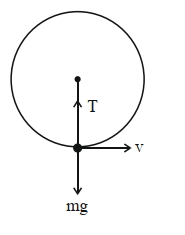
\( \mathrm{T}-\mathrm{mg}=\mathrm{mr} \omega^2 \)
\( \mathrm{~T}=\mathrm{mg}+\mathrm{mr} \omega^2 \)
\( =\frac{9}{10} \times 9.8+\frac{9}{10} \times 1\left(\frac{\pi}{3}\right)^2 \)
\( =8.82+\frac{9}{10} \times \frac{\pi^2}{9} \)
\( =8.82+0.98 \)
\( =9.80 \mathrm{~N}\)
-
- (A) \(1: \sqrt{3}\)
- (B) \(\sqrt{2}: 1\)
- (C) \(1: 2\)
- (D) \(1: \sqrt{2}\)
Show answer and solution
Correct Answer: (A)
For \(\mathrm{u}_{\mathrm{A}} \& \mathrm{u}_{\mathrm{B}}\) time of flight and range can not be same. So above options are incorrect.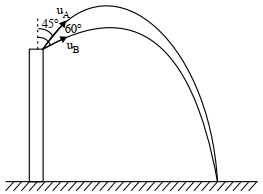
- 564. The angle of projection for a projectile to have same horizontal range and maximum height is _______. 2024 Hard
- (A) \(\tan ^{-1}(2)\)
- (B) \(\tan ^{-1}(4)\)
- (C) \(\tan ^{-1}\left(\frac{1}{4}\right)\)
- (D) \(\tan ^{-1}\left(\frac{1}{2}\right)\)
Show answer and solution
Correct Answer: (B)
\(\frac{u^2 \sin 2 \theta}{g}=\frac{u^2 \sin ^2 \theta}{2 g}\)\(4 \sin \theta \cos \theta=\sin ^2 \theta\)
\(4=\tan \theta\)
-
- (A) non-uniformly accelerated.
- (B) uniformly accelerated having motion along a straight line.
- (C) uniform motion along a straight line.
- (D) uniformly accelerated having motion along a parabolic path.
Show answer and solution
Correct Answer: (D)
\(x=2+4 t\)\(\frac{d x}{d t}=v_x=4\)
\(\frac{d v_x}{d t}=a_x=0\)
\(y=3 t+8 t^2\)
\(\frac{d y}{d t}=v_y=3+16 t\)
\(\frac{d v_y}{d t}=a_y=16\)
the motion will be uniformly accelerated motion.
For path
\(\mathrm{x}=2+4 \mathrm{t}\)
\(\frac{(\mathrm{x}-2)}{4}=\mathrm{t}\)
Put this value of \(t\) is equation of \(y\)
\(y=3\left(\frac{x-2}{4}\right)+8\left(\frac{x-2}{4}\right)^2\)
this is a quadratic equation so path will be parabola.
Correct answer \((4)\)
-
- (A) \(11\)
- (B) \(14\)
- (C) \(15\)
- (D) \(16\)
Show answer and solution
Correct Answer: (D)
\(\mathrm{H}_{\max }=\frac{\mathrm{u}^2 \sin ^2 \theta}{2 \mathrm{~g}}\)\(\frac{\mathrm{H}_{1 \max }}{\mathrm{H}_{2 \max }}=\frac{\mathrm{u}_1^2}{\mathrm{u}_2^2}\)
\(\frac{64}{\mathrm{H}_{2 \max }}=\frac{\mathrm{u}^2}{(\mathrm{u} / 2)^2}\)
\(\mathrm{H}_{2 \max }=16 \mathrm{~m}\)
-
- (A) \(73\)
- (B) \(43\)
- (C) \(75\)
- (D) \(45\)
Show answer and solution
Correct Answer: (D)
From \(A \rightarrow B\)\( -80=-\mathrm{v}_1 \mathrm{t}-\frac{1}{2} \times 10 \mathrm{t}^2 \)
\( -80=-2 \mathrm{v}_1-\frac{1}{2} \times 10 \times 2^2 \)
\( -80=-2 \mathrm{v}_1-20 \)
\( -60=-2 \mathrm{v}_1 \)
\( \mathrm{v}_1=30 \mathrm{~m} / \mathrm{s}\)
From \(\mathrm{O}\) to \(\mathrm{A}\)
\( \mathrm{v}^2=\mathrm{u}^2+2 \mathrm{gS} \)
\( 30^2=0+2 \times(-10)(-\mathrm{S}) \)
\( 900=20 \mathrm{~S} \)
\( \mathrm{~S}=45 \mathrm{~m}\)
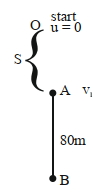
-
- (A) \(18\)
- (B) \(19\)
- (C) \(20\)
- (D) \(21\)
Show answer and solution
Correct Answer: (B)
\(\mathrm{S}_{\mathrm{n}}=\frac{1}{2} \mathrm{a}(2 \mathrm{n}-1)=\frac{19 \mathrm{a}}{2}\)\(\mathrm{~S}_{\mathrm{n}-1}=\frac{1}{2} \mathrm{a}(2 \mathrm{n}-3)=\frac{17 \mathrm{a}}{2}\)
\(\frac{\mathrm{S}_{\mathrm{n}-1}}{\mathrm{~S}_{\mathrm{n}}}=\frac{17}{19}=1-\frac{2}{\mathrm{x}} \Rightarrow \mathrm{x}=19\)
-
- (A) \(\sqrt{t_1 t_2}\)
- (B) \(\sqrt{t_1-t_2}\)
- (C) \(\sqrt{\frac{t_1}{t_2}}\)
- (D) \(\sqrt{t_1+t_2}\)
Show answer and solution
Correct Answer: (A)
\(t_1=\frac{u+\sqrt{u^2+2 g h}}{g}\)\(t_2=\frac{-u+\sqrt{u^2+2 g h}}{g}\)
\(t=\frac{\sqrt{2 g h}}{g}\)
\(t_1 t_2=\frac{\left(u^2+2 g h\right)-u^2}{g^2}=\frac{2 g h}{g^2}=t^2\)
\(\Rightarrow t=\sqrt{t_1 t_2}\)
-
- (A) \((2 \mathrm{p}+1) \mathrm{s}\)
- (B) \(\sqrt{\left(2 \mathrm{p}^2-2 \mathrm{p}+1\right) \mathrm{s}}\)
- (C) \((2 \mathrm{p}-1) \mathrm{s}\)
- (D) \(\left(2 p^2-2 p+1\right) s\)
Show answer and solution
Correct Answer: (B)
\(S_1\) in first \((p-1) \mathrm{sec}\)\(S_2\) in first \(p\) sec
\( \mathrm{S}_1=\frac{1}{2} \mathrm{a}(\mathrm{p}-1)^2 \)
\( \mathrm{~S}_2=\frac{1}{2} \mathrm{a}(\mathrm{p})^2 \)
\( \mathrm{~S}_1+\mathrm{S}_2=\frac{1}{2} \mathrm{at}^2 \)
\( (\mathrm{p}-1)^2+\mathrm{p}^2=\mathrm{t}^2 \)
\( \mathrm{t}=\sqrt{2 \mathrm{p}^2+1-2 \mathrm{p}}\)
-
- (A) \(9 \mathrm{~m} / \mathrm{s}^2\)
- (B) \(6.25 \mathrm{~m} / \mathrm{s}^2\)
- (C) \(12.5 \mathrm{~m} / \mathrm{s}^2\)
- (D) \(5 \mathrm{~m} / \mathrm{s}^2\)
Show answer and solution
Correct Answer: (B)
Given, \(102.5=\mathrm{u}+\frac{\mathrm{a}}{2}(2 \mathrm{n}-1) \&\)\(115=\mathrm{u}+\frac{\mathrm{a}}{2}(2 \mathrm{n}+3)\)
\(\Rightarrow 102.5=\mathrm{u}+\mathrm{an}-\frac{\mathrm{a}}{2} \&\)
\(115=\mathrm{u}+\mathrm{an}+\frac{3 \mathrm{a}}{2}\)
\(12.5=2 \mathrm{a} \Rightarrow \mathrm{a}=6.25 \mathrm{~m} / \mathrm{s}^2\)
Hence option \((2)\)
-
- (A) \(30\)
- (B) \(40\)
- (C) \(60\)
- (D) \(70\)
Show answer and solution
Correct Answer: (B)
\(\text { Initial velocity }=u=72 \mathrm{~km} / \mathrm{h}=20 \mathrm{~m} / \mathrm{s}\)\(\mathrm{v}=\mathrm{u}+\mathrm{at}\)
\(\Rightarrow 0=20+\mathrm{a} \times 4\)
\(\mathrm{a}=-5 \mathrm{~m} / \mathrm{s}^2\)
\(\mathrm{v}^2-\mathrm{u}^2=2 \mathrm{as}\)
\(\Rightarrow 0^2-20^2=2(-5) \mathrm{s}\)
\(\mathrm{s}=40 \mathrm{~m}\)
-
- (A) \(6 \mathrm{~km}\)
- (B) \(\sqrt{8} \mathrm{~km}\)
- (C) \(4 \mathrm{~km}\)
- (D) \(8 \mathrm{~km}\)
Show answer and solution
Correct Answer: (B)
\(\therefore\) Displacement \(=\mathrm{R} \sqrt{2}=2 \sqrt{2}=\sqrt{8} \mathrm{~km}\)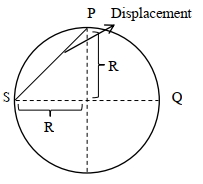
-
- (A) \(7\)
- (B) \(8\)
- (C) \(9\)
- (D) \(10\)
Show answer and solution
Correct Answer: (B)
\(\mathrm{V}=4 \sqrt{\mathrm{x}}\)\(\mathrm{a}=\mathrm{V} \frac{\mathrm{dv}}{\mathrm{dx}}\)
\(=4 \sqrt{\mathrm{x}} \times 4 \times \frac{1}{2} \mathrm{x}^{-1 / 2}=8 \mathrm{~m} / \mathrm{s}^2\)
-
- (A) \(4 \mathrm{~m} / \mathrm{s}\)
- (B) \(8 \mathrm{~m} / \mathrm{s}\)
- (C) \(10 \mathrm{~m} / \mathrm{s}\)
- (D) \(6 \mathrm{~m} / \mathrm{s}\)
Show answer and solution
Correct Answer: (B)
\( x=t^3-6 t^2+20 t+15 \)\( \frac{d x}{d t}=v=3 t^2-12 t+20\)
\( \frac{d v}{d t}=a=6 t-12\)
When \(\mathrm{a}=0\)
\(6 \mathrm{t}-12=0 ; \mathrm{t}=2 \mathrm{sec}\)
At \(\mathrm{t}=2 \mathrm{sec}\)
\(\mathrm{v}=3(2)^2-12(2)+20\)
\(\mathrm{v}=8 \mathrm{~m} / \mathrm{s}\)
-
- (A) \(50\)
- (B) \(52\)
- (C) \(57\)
- (D) \(60\)
Show answer and solution
Correct Answer: (B)
Explanation:
1. Finding Velocity: Velocity \( v \) is the first derivative of position with respect to time (\( v = \frac{dx}{dt} \)):
\( v = \frac{d}{dt}(-3t^3 + 18t^2 + 16t + 16) \)
\( v = -9t^2 + 36t + 16 \)
2. Finding Acceleration: Acceleration \( a \) is the first derivative of velocity with respect to time (\( a = \frac{dv}{dt} \)):
\( a = \frac{d}{dt}(-9t^2 + 36t + 16) \)
\( a = -18t + 36 \)
3. Condition for Zero Acceleration: Setting the acceleration equation to zero allows us to determine the specific time \( t \):
\( -18t + 36 = 0 \)
\( 18t = 36 \implies t = 2\text{ s} \)
4. Calculating Velocity at \( t = 2\text{ s} \):
Substituting \( t = 2 \) back into the velocity equation yields:
\( v(2) = -9(2)^2 + 36(2) + 16 \)
\( v(2) = -9(4) + 72 + 16 \)
\( v(2) = -36 + 72 + 16 = 52\text{ m/s} \)
Hence, Option B is the correct choice. -
- (A) \(5\)
- (B) \(2\)
- (C) \(3\)
- (D) \(1\)
Show answer and solution
Correct Answer: (C)
\(x^2=1+t^2\)\(2 x \frac{d x}{d t}=2 t\)
\(x v=t\)
\(x \frac{d v}{d t}+v \frac{d x}{d t}=1\)
\(x \cdot a+v^2=1\)
\(a=\frac{1-v^2}{x}=\frac{1-t^2 / x^2}{x}\)
\(a=\frac{1}{x^3}=x^{-3}\)
-
- (A) \(8.8 \mathrm{~m} / \mathrm{s}\)
- (B) \(10 \mathrm{~m} / \mathrm{s}\)
- (C) \(9.2 \mathrm{~m} / \mathrm{s}\)
- (D) \(8 \mathrm{~m} / \mathrm{s}\)
Show answer and solution
Correct Answer: (D)
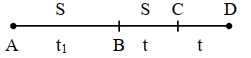
\(B D \Rightarrow S=9 t+15 t=24 t\)\(A B \Rightarrow S=6 t_1=24 t \Rightarrow t_1=4 t\)
\(<\text { speed }>=\frac{\text { dist. }}{\text { time }}=\frac{48 t}{2 t+t_1}\)
\(=\frac{48 t}{2 t+4 t} \Rightarrow \frac{48 t}{6 t} \Rightarrow 8 \mathrm{~m} / \mathrm{s}\)
-
- (A) \(673\)
- (B) \(685\)
- (C) \(756\)
- (D) \(741\)
Show answer and solution
Correct Answer: (A)
\( \mathrm{u}_{\mathrm{x}}=5 \mathrm{~m} / \mathrm{s} \quad \mathrm{a}_{\mathrm{x}}=3 \mathrm{~m} / \mathrm{s}^2 \quad \mathrm{x}=84 \mathrm{~m} \)\( \mathrm{v}_{\mathrm{x}}^2-\mathrm{u}_{\mathrm{x}}^2=2 \mathrm{ax} \)
\( \mathrm{v}_{\mathrm{x}}^2-25=2(3)(84) \)
\( \mathrm{V}_{\mathrm{x}}=23 \mathrm{~m} / \mathrm{s} \)
\( \mathrm{v}_{\mathrm{x}}-\mathrm{u}_{\mathrm{x}}=\mathrm{a}_{\mathrm{x}} \mathrm{t} \)
\( \mathrm{t}=\frac{23-5}{3}=6 \mathrm{~s} \)
\( \mathrm{v}_{\mathrm{y}}=0+\mathrm{a}_{\mathrm{y}} \mathrm{t}=0+2 \times(6)=12 \mathrm{~m} / \mathrm{s} 4\)
\( \mathrm{v}^2=\mathrm{v}_{\mathrm{x}}^2+\mathrm{v}_{\mathrm{y}}^2=23^2+12^2=673 \)
\( \mathrm{v}=\sqrt{673} \mathrm{~m} / \mathrm{s}\)
-
- (A) \(80\)
- (B) \(70\)
- (C) \(30\)
- (D) \(40\)
Show answer and solution
Correct Answer: (B)
Given:
Final speed = \(80 \, \text{km/h}\)
Time of acceleration = \(t\)
Time at constant speed = \(3t\)
Solution:
During uniform acceleration from rest,
\(\text{Average speed} = \frac{0 + 80}{2} = 40 \, \text{km/h}\)
Distance covered during acceleration:
\(s_1 = 40t\)
Distance covered at constant speed:
\(s_2 = 80 \times 3t = 240t\)
Total distance:
\(s = 40t + 240t = 280t\)
Total time:
\(T = t + 3t = 4t\)
Average speed:
\(\displaystyle v_{\text{avg}} = \frac{280t}{4t} = 70 \, \text{km/h}\)
Answer: \(70 \, \text{km/h}\)
-
- (A) \(16 \mathrm{~m} / \mathrm{s}\) in \(y\)-direction
- (B) \(4 \mathrm{~m} / \mathrm{s}\) in \(x\)-direction
- (C) \(9 \mathrm{~m} / \mathrm{s}\) in \(z\)-direction
- (D) \(4 \mathrm{~m} / \mathrm{s}\) in \(y\)-direction
Show answer and solution
Correct Answer: (D)
\(\overrightarrow{\mathrm{v}}=\frac{\mathrm{ds}}{\mathrm{dt}}=4 \mathrm{t} \hat{j}\)At \(\mathrm{t}=1 \sec \overrightarrow{\mathrm{v}}=4 \hat{\mathrm{j}}\)
-
- (A) \(24\)
- (B) \(175\)
- (C) \(458\)
- (D) \(157\)
Show answer and solution
Correct Answer: (B)
Considering acceleration is constant\( v=u+a t \)
\( u+50=u+a \Rightarrow a=50 \mathrm{~m} / \mathrm{s}^2 \)
\( 125=u t+\frac{1}{2} a t^2 \)
\( 125=u+\frac{a}{2} \)
\( \Rightarrow u=100 \mathrm{~m} / \mathrm{s} \)
\( \therefore S_{n^{r k}}=u+\frac{a}{2}[2 n-1] \)
\( =175 \mathrm{~m} \)
-
- (A) \(a=-2 \alpha v^3\)
- (B) \(a=-5 \alpha v^5\)
- (C) \(a=-3 \alpha v^2\)
- (D) \(a=-4 \alpha v^4\)
Show answer and solution
Correct Answer: (A)
\(\mathrm{t}=\alpha \mathrm{x}^2+\beta \mathrm{x} \text { (differentiating wrt time) }\)\(\frac{\mathrm{dt}}{\mathrm{dx}}=2 \alpha \mathrm{x}+\beta\)
\(\frac{1}{\mathrm{v}}=2 \alpha \mathrm{x}+\beta\)
\(\text { (differentiating wrt time) }\)
\(-\frac{1}{\mathrm{v}^2} \frac{\mathrm{dv}}{\mathrm{dt}}=2 \alpha \frac{\mathrm{dx}}{\mathrm{dt}}\)
\(\frac{\mathrm{dv}}{\mathrm{dt}}=-2 \alpha \mathrm{v}^3\)
-
- (A) \(-30\) and \(50\)
- (B) \(-50\) and -\(30\)
- (C) \(-50\) and \(30\)
- (D) \(50\) and -\(30\)
Show answer and solution
Correct Answer: (C)
\(\mathrm{B} \downarrow 30 \mathrm{~m} / \mathrm{s}\)\(\uparrow 20 \mathrm{~m} / \mathrm{s}\)
\(\mathrm{A}^{\uparrow}\)
\(\mathrm{V}_{\mathrm{A}}=20 \mathrm{~m} / \mathrm{s}\)
\(\mathrm{V}_{\mathrm{B}}=-30 \mathrm{~m} / \mathrm{s}\)
Velocity of \(B w.r.t. A\)
\(\mathrm{V}_{\mathrm{B} / \mathrm{A}}=-50 \mathrm{~m} / \mathrm{s}\)
Velocity of ground \(w.r.t. B\)
\(\mathrm{V}_{\mathrm{G} / \mathrm{B}}=30 \mathrm{~m} / \mathrm{s}\)
-
- (A) \(200 \mathrm{~m}\)
- (B) \(50 \mathrm{~m}\)
- (C) \(100 \mathrm{~m}\)
- (D) \(25 \mathrm{~m}\)
Show answer and solution
Correct Answer: (C)
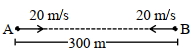
\(\left|\overrightarrow{\mathrm{u}}_{\mathrm{BA}}\right|=40 \mathrm{~m} / \mathrm{s}\)\(\left|\overrightarrow{\mathrm{a}}_{\mathrm{BA}}\right|=4 \mathrm{~m} / \mathrm{s}\)
\(\text { Apply }\left(\mathrm{v}^2=\mathrm{u}^2+2 \mathrm{as}\right)_{\text {relitive }}\)
\(\mathrm{O}=(40)^2+2(-4)(\mathrm{S})\)
\(\mathrm{S}=200 \mathrm{~m}\)
Remaining distance\(=300-200=100 \mathrm{~m}\)
-
- (A) \(4\)
- (B) \(5\)
- (C) \(6\)
- (D) \(7\)
Show answer and solution
Correct Answer: (A)
\(\overline{\mathrm{N}}=|\overline{\mathrm{A}}| \hat{\mathrm{B}}=\frac{5(4 \hat{\mathrm{i}}+3 \hat{\mathrm{j}})}{5}=4 \hat{\mathrm{i}}+3 \hat{\mathrm{j}}\)\(\therefore \mathrm{x}=4\)
-
- (A) \(2\)
- (B) \(4\)
- (C) \(6\)
- (D) \(8\)
Show answer and solution
Correct Answer: (B)
\(\vec{B} \times \vec{C}=\left|\begin{array}{ccc}\hat{i} & \hat{j} & \hat{k} \\ -1 & 4 & 3 \\ -8 & -1 & 3\end{array}\right|=15 \hat{i}-21 \hat{j}+33 \hat{k}\)\(\vec{A} \cdot(\vec{B} \times \vec{C})=(-x \hat{i}-6 \hat{j}-2 \hat{k}) \cdot(15 \hat{i}-21 \hat{j}+33 \hat{k})\)
\(0=-15 x+126-66\)
\(15 x=60\)
\(x=4\)
-
- (A) \(3\)
- (B) \(5\)
- (C) \(4\)
- (D) \(6\)
Show answer and solution
Correct Answer: (A)
\(\cos \theta=\frac{5}{9}\)\(\frac{\vec{a} \cdot \vec{b}}{a b}=\frac{5}{9}\)
\(\mid \vec{a}+\cdots(1)\)
\(a^2+b^2+2 \vec{a} \cdot \vec{b}=2 a^2+2 b^2-4 \vec{a} \cdot \vec{b}\)
\(6 \vec{a} \cdot \vec{b}=a^2+b^2\)
\(6 \times \frac{5}{9} a b=a^2+b^2\)
\(\frac{10}{3} a b=a^2+b^2 \quad \& \quad a=n b\)
\(\frac{10}{3} n b^2=n^2 b^2+b^2\)
\(3 n^2-10 n+3=0\)
\(n=\frac{1}{3} \text { and } n=3\)
\(\text { integer value } n=3\)
- 589. If two vectors \(\vec{A}\) and \(\vec{B}\) having equal magnitude \(\mathrm{R}\) are inclined at an angle \(\theta\), then... 2024 Hard
- (A) \(|\overrightarrow{\mathrm{A}}-\overrightarrow{\mathrm{B}}|=\sqrt{2} \mathrm{R} \sin \left(\frac{\theta}{2}\right)\)
- (B) \(|\overrightarrow{\mathrm{A}}+\overrightarrow{\mathrm{B}}|=2 \mathrm{R} \sin \left(\frac{\theta}{2}\right)\)
- (C) \(|\overrightarrow{\mathrm{A}}+\overrightarrow{\mathrm{B}}|=2 \mathrm{R} \cos \left(\frac{\theta}{2}\right)\)
- (D) \(|\overrightarrow{\mathrm{A}}-\overrightarrow{\mathrm{B}}|=2 R \cos \left(\frac{\theta}{2}\right)\)
Show answer and solution
Correct Answer: (C)
The magnitude of resultant vector
\(R^{\prime}=\sqrt{a^2+b^2+2 a b \cos \theta}\)
Here \(a=b=R\)
Then \(R^{\prime}=\sqrt{R^2+R^2+2 R^2 \cos \theta}\)
\(=R \sqrt{2} \sqrt{1+\cos \theta}\)
\(=\sqrt{2} R \sqrt{2 \cos ^2 \frac{\theta}{2}}\)
\(=2 R \cos \frac{\theta}{2}\) -
- (A) \(0^{\circ}\)
- (B) \(\tan ^{-1} \frac{(2 \overrightarrow{\mathrm{Q}}-2 \overrightarrow{\mathrm{P}})}{2 \overrightarrow{\mathrm{Q}}+2 \overrightarrow{\mathrm{P}}}\)
- (C) \(\tan ^{-1}\left(\frac{P}{Q}\right)\)
- (D) \(\tan ^{-1}\left(\frac{2 Q}{P}\right)\)
Show answer and solution
Correct Answer: (A)
\(\overrightarrow{\mathrm{R}}=(2 \overrightarrow{\mathrm{Q}}+2 \overrightarrow{\mathrm{P}})+(2 \overrightarrow{\mathrm{Q}}-2 \overrightarrow{\mathrm{P}})\)\(\overrightarrow{\mathrm{R}}=4 \overrightarrow{\mathrm{Q}}\)
Angle between \(\vec{Q}\) and \(\vec{R}\) is zero
Option \((1)\) is correct
-
- (A) \(100^\circ\)
- (B) \(110^\circ\)
- (C) \(150^\circ\)
- (D) \(160^\circ\)
Show answer and solution
Correct Answer: (C)
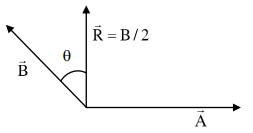
Explanation:
Let the angle between vector \(\vec{A}\) and vector \(\vec{B}\) be \(\alpha\), and let the resultant vector be \(\vec{R}\). We can analyze the vector components geometrically or analytically:
1. Analytical Method:
The magnitude of the component of \(\vec{B}\) perpendicular to \(\vec{A}\) must balance out to form the resultant vector \(\vec{R}\), since \(\vec{R}\) has no component along the direction of \(\vec{A}\). This means that the components can be split as:
- Along the direction of \(\vec{A}\): \(A + B \cos\alpha = 0 \implies \cos\alpha = -\frac{A}{B}\)
- Perpendicular to \(\vec{A}\): \(R = B \sin\alpha\)
2. Using the Given Conditions:
We are given that the magnitude of the resultant is half of \(\vec{B}\), so \(R = \frac{B}{2}\). Substituting this into the perpendicular component equation yields:
\( \frac{B}{2} = B \sin\alpha \implies \sin\alpha = \frac{1}{2} \)
3. Determining the Angle (\(\alpha\)):
Since \(\cos\alpha = -\frac{A}{B}\) is negative (as magnitudes \(A\) and \(B\) are positive), the angle \(\alpha\) must lie in the second quadrant (\(90^\circ < \alpha < 180^\circ\)).
For \(\sin\alpha = \frac{1}{2}\) in the second quadrant:
\( \alpha = 180^\circ - 30^\circ = 150^\circ \)
4. Geometric Verification:
Consider a right-angled triangle formed by the vectors where \(\vec{R}\) is perpendicular to \(\vec{A}\). Let \(\theta\) be the angle that \(\vec{B}\) makes with the vector \(\vec{R}\).
From the geometry of the components:
\( \cos\theta = \frac{R}{B} = \frac{\left(\frac{B}{2}\right)}{B} = \frac{1}{2} \implies \theta = 60^\circ \)
Since \(\vec{R}\) is at \(90^\circ\) relative to \(\vec{A}\), the total angle \(\alpha\) between \(\vec{A}\) and \(\vec{B}\) is:
\( \alpha = 90^\circ + \theta = 90^\circ + 60^\circ = 150^\circ \)
Hence, Option C is the correct choice. -
- (A) \(5\)
- (B) \(4\)
- (C) \(2\)
- (D) \(3\)
Show answer and solution
Correct Answer: (D)
Explanation:
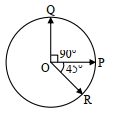
1. Components of the Vectors: Based on the given coordinate system in the figure, we can resolve each vector into its horizontal (\( \hat{i} \)) and vertical (\( \hat{j} \)) components:
• \( \vec{\text{OP}} \) acts along the positive x-axis: \( \vec{\text{OP}} = A\hat{i} \)
• \( \vec{\text{OQ}} \) acts along the positive y-axis: \( \vec{\text{OQ}} = A\hat{j} \)
• \( \vec{\text{OR}} \) acts at an angle of \( 45^\circ \) below the positive x-axis (in the fourth quadrant): \( \vec{\text{OR}} = A\cos 45^\circ\hat{i} - A\sin 45^\circ\hat{j} = \frac{A}{\sqrt{2}}\hat{i} - \frac{A}{\sqrt{2}}\hat{j} \)
2. Finding the Resultant Vector (\( \vec{R} \)):
Summing all three vectors together:
\( \vec{R} = \vec{\text{OP}} + \vec{\text{OQ}} + \vec{\text{OR}} \)
\( \vec{R} = (A\hat{i}) + (A\hat{j}) + \left(\frac{A}{\sqrt{2}}\hat{i} - \frac{A}{\sqrt{2}}\hat{j}\right) \)
\( \vec{R} = \left(A + \frac{A}{\sqrt{2}}\right)\hat{i} + \left(A - \frac{A}{\sqrt{2}}\right)\hat{j} \)
3. Calculating the Magnitude (\( |\vec{R}| \)):
\( |\vec{R}| = \sqrt{\left(A + \frac{A}{\sqrt{2}}\right)^2 + \left(A - \frac{A}{\sqrt{2}}\right)^2} \)
\( |\vec{R}| = \sqrt{\left(A^2 + \sqrt{2}A^2 + \frac{A^2}{2}\right) + \left(A^2 - \sqrt{2}A^2 + \frac{A^2}{2}\right)} \)
\( |\vec{R}| = \sqrt{2A^2 + A^2} = \sqrt{3A^2} = A\sqrt{3} \)
Comparing this with the given resultant magnitude \( A\sqrt{x} \):
\( A\sqrt{x} = A\sqrt{3} \implies x = 3 \)
Hence, Option D is the correct choice. -
- (A) \(6\)
- (B) \(7\)
- (C) \(8\)
- (D) \(9\)
Show answer and solution
Correct Answer: (A)
\(\left|\overrightarrow{\mathrm{F}}_1\right|=\mathrm{F}\)\(\left|\overrightarrow{\mathrm{F}}_{\mathrm{R}}\right|=\left|\overrightarrow{\mathrm{F}}_2\right|=3 \mathrm{~F}\)
\(\mathrm{~F}_{\mathrm{R}}^2=\mathrm{F}_1^2+\mathrm{F}_2^2+2 \mathrm{~F}_1 \mathrm{~F}_2 \cos \theta\)
\(9 \mathrm{~F}^2=\mathrm{F}^2+9 \mathrm{~F}^2+6 \mathrm{~F}^2 \cos \theta\)
\(\cos \theta=-\frac{1}{6}\)
\(\theta=\cos ^{-1}\left(\frac{1}{-6}\right)\)
\(\mathrm{n}=-6\)
\(|\mathrm{n}|=6\)
No questions on this page match these filters.