


Questions
8 questionsShowing 1–8 of 8 questions
-
- (A) \(4\)
- (B) \(5\)
- (C) \(6\)
- (D) \(7\)
Show answer and solution
Correct Answer: (A)
\(\overline{\mathrm{N}}=|\overline{\mathrm{A}}| \hat{\mathrm{B}}=\frac{5(4 \hat{\mathrm{i}}+3 \hat{\mathrm{j}})}{5}=4 \hat{\mathrm{i}}+3 \hat{\mathrm{j}}\)\(\therefore \mathrm{x}=4\)
-
- (A) \(2\)
- (B) \(4\)
- (C) \(6\)
- (D) \(8\)
Show answer and solution
Correct Answer: (B)
\(\vec{B} \times \vec{C}=\left|\begin{array}{ccc}\hat{i} & \hat{j} & \hat{k} \\ -1 & 4 & 3 \\ -8 & -1 & 3\end{array}\right|=15 \hat{i}-21 \hat{j}+33 \hat{k}\)\(\vec{A} \cdot(\vec{B} \times \vec{C})=(-x \hat{i}-6 \hat{j}-2 \hat{k}) \cdot(15 \hat{i}-21 \hat{j}+33 \hat{k})\)
\(0=-15 x+126-66\)
\(15 x=60\)
\(x=4\)
-
- (A) \(3\)
- (B) \(5\)
- (C) \(4\)
- (D) \(6\)
Show answer and solution
Correct Answer: (A)
\(\cos \theta=\frac{5}{9}\)\(\frac{\vec{a} \cdot \vec{b}}{a b}=\frac{5}{9}\)
\(\mid \vec{a}+\cdots(1)\)
\(a^2+b^2+2 \vec{a} \cdot \vec{b}=2 a^2+2 b^2-4 \vec{a} \cdot \vec{b}\)
\(6 \vec{a} \cdot \vec{b}=a^2+b^2\)
\(6 \times \frac{5}{9} a b=a^2+b^2\)
\(\frac{10}{3} a b=a^2+b^2 \quad \& \quad a=n b\)
\(\frac{10}{3} n b^2=n^2 b^2+b^2\)
\(3 n^2-10 n+3=0\)
\(n=\frac{1}{3} \text { and } n=3\)
\(\text { integer value } n=3\)
-
- (A) \(|\overrightarrow{\mathrm{A}}-\overrightarrow{\mathrm{B}}|=\sqrt{2} \mathrm{R} \sin \left(\frac{\theta}{2}\right)\)
- (B) \(|\overrightarrow{\mathrm{A}}+\overrightarrow{\mathrm{B}}|=2 \mathrm{R} \sin \left(\frac{\theta}{2}\right)\)
- (C) \(|\overrightarrow{\mathrm{A}}+\overrightarrow{\mathrm{B}}|=2 \mathrm{R} \cos \left(\frac{\theta}{2}\right)\)
- (D) \(|\overrightarrow{\mathrm{A}}-\overrightarrow{\mathrm{B}}|=2 R \cos \left(\frac{\theta}{2}\right)\)
Show answer and solution
Correct Answer: (C)
The magnitude of resultant vector
\(R^{\prime}=\sqrt{a^2+b^2+2 a b \cos \theta}\)
Here \(a=b=R\)
Then \(R^{\prime}=\sqrt{R^2+R^2+2 R^2 \cos \theta}\)
\(=R \sqrt{2} \sqrt{1+\cos \theta}\)
\(=\sqrt{2} R \sqrt{2 \cos ^2 \frac{\theta}{2}}\)
\(=2 R \cos \frac{\theta}{2}\) -
- (A) \(0^{\circ}\)
- (B) \(\tan ^{-1} \frac{(2 \overrightarrow{\mathrm{Q}}-2 \overrightarrow{\mathrm{P}})}{2 \overrightarrow{\mathrm{Q}}+2 \overrightarrow{\mathrm{P}}}\)
- (C) \(\tan ^{-1}\left(\frac{P}{Q}\right)\)
- (D) \(\tan ^{-1}\left(\frac{2 Q}{P}\right)\)
Show answer and solution
Correct Answer: (A)
\(\overrightarrow{\mathrm{R}}=(2 \overrightarrow{\mathrm{Q}}+2 \overrightarrow{\mathrm{P}})+(2 \overrightarrow{\mathrm{Q}}-2 \overrightarrow{\mathrm{P}})\)\(\overrightarrow{\mathrm{R}}=4 \overrightarrow{\mathrm{Q}}\)
Angle between \(\vec{Q}\) and \(\vec{R}\) is zero
Option \((1)\) is correct
-
- (A) \(100^\circ\)
- (B) \(110^\circ\)
- (C) \(150^\circ\)
- (D) \(160^\circ\)
Show answer and solution
Correct Answer: (C)
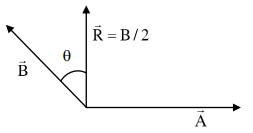
Explanation:
Let the angle between vector \(\vec{A}\) and vector \(\vec{B}\) be \(\alpha\), and let the resultant vector be \(\vec{R}\). We can analyze the vector components geometrically or analytically:
1. Analytical Method:
The magnitude of the component of \(\vec{B}\) perpendicular to \(\vec{A}\) must balance out to form the resultant vector \(\vec{R}\), since \(\vec{R}\) has no component along the direction of \(\vec{A}\). This means that the components can be split as:
- Along the direction of \(\vec{A}\): \(A + B \cos\alpha = 0 \implies \cos\alpha = -\frac{A}{B}\)
- Perpendicular to \(\vec{A}\): \(R = B \sin\alpha\)
2. Using the Given Conditions:
We are given that the magnitude of the resultant is half of \(\vec{B}\), so \(R = \frac{B}{2}\). Substituting this into the perpendicular component equation yields:
\( \frac{B}{2} = B \sin\alpha \implies \sin\alpha = \frac{1}{2} \)
3. Determining the Angle (\(\alpha\)):
Since \(\cos\alpha = -\frac{A}{B}\) is negative (as magnitudes \(A\) and \(B\) are positive), the angle \(\alpha\) must lie in the second quadrant (\(90^\circ < \alpha < 180^\circ\)).
For \(\sin\alpha = \frac{1}{2}\) in the second quadrant:
\( \alpha = 180^\circ - 30^\circ = 150^\circ \)
4. Geometric Verification:
Consider a right-angled triangle formed by the vectors where \(\vec{R}\) is perpendicular to \(\vec{A}\). Let \(\theta\) be the angle that \(\vec{B}\) makes with the vector \(\vec{R}\).
From the geometry of the components:
\( \cos\theta = \frac{R}{B} = \frac{\left(\frac{B}{2}\right)}{B} = \frac{1}{2} \implies \theta = 60^\circ \)
Since \(\vec{R}\) is at \(90^\circ\) relative to \(\vec{A}\), the total angle \(\alpha\) between \(\vec{A}\) and \(\vec{B}\) is:
\( \alpha = 90^\circ + \theta = 90^\circ + 60^\circ = 150^\circ \)
Hence, Option C is the correct choice. -
- (A) \(5\)
- (B) \(4\)
- (C) \(2\)
- (D) \(3\)
Show answer and solution
Correct Answer: (D)
Explanation:
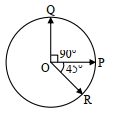
1. Components of the Vectors: Based on the given coordinate system in the figure, we can resolve each vector into its horizontal (\( \hat{i} \)) and vertical (\( \hat{j} \)) components:
• \( \vec{\text{OP}} \) acts along the positive x-axis: \( \vec{\text{OP}} = A\hat{i} \)
• \( \vec{\text{OQ}} \) acts along the positive y-axis: \( \vec{\text{OQ}} = A\hat{j} \)
• \( \vec{\text{OR}} \) acts at an angle of \( 45^\circ \) below the positive x-axis (in the fourth quadrant): \( \vec{\text{OR}} = A\cos 45^\circ\hat{i} - A\sin 45^\circ\hat{j} = \frac{A}{\sqrt{2}}\hat{i} - \frac{A}{\sqrt{2}}\hat{j} \)
2. Finding the Resultant Vector (\( \vec{R} \)):
Summing all three vectors together:
\( \vec{R} = \vec{\text{OP}} + \vec{\text{OQ}} + \vec{\text{OR}} \)
\( \vec{R} = (A\hat{i}) + (A\hat{j}) + \left(\frac{A}{\sqrt{2}}\hat{i} - \frac{A}{\sqrt{2}}\hat{j}\right) \)
\( \vec{R} = \left(A + \frac{A}{\sqrt{2}}\right)\hat{i} + \left(A - \frac{A}{\sqrt{2}}\right)\hat{j} \)
3. Calculating the Magnitude (\( |\vec{R}| \)):
\( |\vec{R}| = \sqrt{\left(A + \frac{A}{\sqrt{2}}\right)^2 + \left(A - \frac{A}{\sqrt{2}}\right)^2} \)
\( |\vec{R}| = \sqrt{\left(A^2 + \sqrt{2}A^2 + \frac{A^2}{2}\right) + \left(A^2 - \sqrt{2}A^2 + \frac{A^2}{2}\right)} \)
\( |\vec{R}| = \sqrt{2A^2 + A^2} = \sqrt{3A^2} = A\sqrt{3} \)
Comparing this with the given resultant magnitude \( A\sqrt{x} \):
\( A\sqrt{x} = A\sqrt{3} \implies x = 3 \)
Hence, Option D is the correct choice. -
- (A) \(6\)
- (B) \(7\)
- (C) \(8\)
- (D) \(9\)
Show answer and solution
Correct Answer: (A)
\(\left|\overrightarrow{\mathrm{F}}_1\right|=\mathrm{F}\)\(\left|\overrightarrow{\mathrm{F}}_{\mathrm{R}}\right|=\left|\overrightarrow{\mathrm{F}}_2\right|=3 \mathrm{~F}\)
\(\mathrm{~F}_{\mathrm{R}}^2=\mathrm{F}_1^2+\mathrm{F}_2^2+2 \mathrm{~F}_1 \mathrm{~F}_2 \cos \theta\)
\(9 \mathrm{~F}^2=\mathrm{F}^2+9 \mathrm{~F}^2+6 \mathrm{~F}^2 \cos \theta\)
\(\cos \theta=-\frac{1}{6}\)
\(\theta=\cos ^{-1}\left(\frac{1}{-6}\right)\)
\(\mathrm{n}=-6\)
\(|\mathrm{n}|=6\)
No questions on this page match these filters.