


All JEE Mains 2024 Physics questions
31 chaptersShowing 501–550 of 593 questions
-
- (A) \(300 \mathrm{~N}\)
- (B) \(225 \mathrm{~N}\)
- (C) \(120 \mathrm{~N}\)
- (D) \(100 \mathrm{~N}\)
Show answer and solution
Correct Answer: (D)
Value of \(g=g_5\left(1+\frac{h}{R}\right)^{-2}\)\(=\mathrm{g}_5(1+2)^{-2}=\frac{\mathrm{g}_5}{9}\)
Here \(\mathrm{g}, \mathrm{g}\) gravitational acceleration at surface
\(\text { Force }=m g=90 \times \frac{g_5}{9}=100 \mathrm{~N}\)
-
- (A) \(\mathrm{T}^2 \propto \mathrm{R}^{5 / 2}\)
- (B) \(T^2 \propto R^{7 / 2}\)
- (C) \(T^2 \propto R^{3 / 2}\)
- (D) \(T^2 \propto R^3\)
Show answer and solution
Correct Answer: (A)
\(\mathrm{F}=\frac{\mathrm{GMm}}{\mathrm{R}^{3 / 2}}=\mathrm{m} \omega^2 \mathrm{R}\)\(\omega^2 \propto \frac{1}{\mathrm{R}^{5 / 2}} \quad \because \mathrm{T}=\frac{2 \pi}{\omega} \quad \text { so }\)
\(\mathrm{T}^2 \propto \mathrm{R}^{5 / 2}\)
-
- (A) \(\frac{\mathrm{GMm} \pi}{2 \mathrm{~L}^2}\)
- (B) \(0\)
- (C) \(\frac{\mathrm{GmM} \pi^2}{\mathrm{~L}^2}\)
- (D) \(\frac{2 \mathrm{GmM} \pi}{\mathrm{L}^2}\)
Show answer and solution
Correct Answer: (D)
\(R = \frac{L}{\pi}\)
\(F = \int_{-\pi/2}^{\pi/2} \frac{G m (\frac{M}{L} R d\theta)}{R^2} \cos\theta\)
\(F = \frac{GmM}{LR} [\sin\theta]_{-\pi/2}^{\pi/2}\)
\(F = \frac{GmM}{LR} (1 - (-1)) = \frac{2GmM}{LR}\)
\(F = \frac{2GmM}{L(L/\pi)} = \frac{2GmM\pi}{L^2}\)
-
- (A) \(25\)
- (B) \(50\)
- (C) \(100\)
- (D) \(20\)
Show answer and solution
Correct Answer: (A)
\( \mathrm{T}^2 \propto \mathrm{r}^3 \)\( \frac{\mathrm{T}_1^2}{\mathrm{r}_1^3}=\frac{\mathrm{T}_2^2}{\mathrm{r}_2^3} \)
\( \frac{(200)^2}{\mathrm{r}^3}=\frac{\mathrm{T}_2^2}{\left(\frac{\mathrm{r}}{4}\right)^3} \)
\( \frac{200 \times 200}{4 \times 4 \times 4}=\mathrm{T}_2^2 \)
\( \mathrm{~T}_2=\frac{200}{4 \times 2} \)
\( \mathrm{~T}_2=25 \text { days }\)
-
- (A) \(2.5 \mathrm{R}\)
- (B) \(3 \mathrm{R}\)
- (C) \(4 \mathrm{R}\)
- (D) \(6 \mathrm{R}\)
Show answer and solution
Correct Answer: (D)
Total energy \(=\frac{-\mathrm{GMm}}{2(2 \mathrm{R})}\)
if energy \(=\frac{10^4 \mathrm{R}}{6}\) is added then
\(\frac{-\mathrm{GMm}}{4 \mathrm{R}}+\frac{10^4 \mathrm{R}}{6}=\frac{-\mathrm{GMm}}{2 \mathrm{r}}\)
where \(r\) is new radius of revolving and \(g=\frac{G M}{R^2}\)
\(-\frac{\mathrm{mgR}}{4}+\frac{10^4 \mathrm{R}}{6}=-\frac{\mathrm{mgR}^2}{2 \mathrm{r}} \quad\left(\mathrm{m}=10^3 \mathrm{~kg}\right)\)
\(-\frac{10^3 \times 10 \times \mathrm{R}}{4}+\frac{10^4 \mathrm{R}}{6}=-\frac{10^3 \times 10 \times \mathrm{R}^2}{2 \mathrm{r}}\)
\(-\frac{1}{4}+\frac{1}{6}=-\frac{\mathrm{R}}{2 \mathrm{r}}\)
\(\mathrm{r}=6 \mathrm{R}\)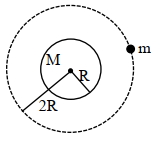
-
- (A) \(1.4 \times 10^4 \mathrm{~km}\)
- (B) \(8.4 \times 10^4 \mathrm{~km}\)
- (C) \(1.68 \times 10^5 \mathrm{~km}\)
- (D) \(1.05 \times 10^4 \mathrm{~km}\)
Show answer and solution
Correct Answer: (D)
\(\mathrm{T}=\frac{2 \pi \mathrm{r}^{3 / 2}}{\sqrt{\mathrm{GM}}}\)\(\frac{\mathrm{T}_1}{\mathrm{~T}_2}=\left(\frac{\mathrm{r}_1}{\mathrm{r}_2}\right)^{3 / 2}\left(\frac{\mathrm{M}_2}{\mathrm{M}_1}\right)^{1 / 2}\)
\(\frac{6}{24}=\frac{\left(\mathrm{r}_1\right)^{3 / 2}}{\left(4.2 \times 10^4\right)^{3 / 2}}\left(\frac{\mathrm{M}}{\mathrm{M} / 4}\right)^{1 / 2}\)
\(\mathrm{r}_1=1.05 \times 10^4 \mathrm{~km}\)
-
- (A) \(\mathrm{T}_1=\mathrm{T}_2\)
- (B) \(2 \mathrm{~T}_1=3 \mathrm{~T}_2\)
- (C) \(3 \mathrm{~T}_1=2 \mathrm{~T}_2\)
- (D) \(2 \mathrm{~T}_1=\mathrm{T}_2\)
Show answer and solution
Correct Answer: (C)
\(\mathrm{T}_1=2 \pi \sqrt{\frac{\ell}{\mathrm{GM}}(2 \mathrm{R})^2}\)\(\mathrm{~T}_2=2 \pi \sqrt{\frac{\ell}{\mathrm{GM}}(3 \mathrm{R})^2}\)
\(\therefore \frac{\mathrm{T}_1}{\mathrm{~T}_2}=\frac{2}{3}\)
-
- (A) \(11\)
- (B) \(9\)
- (C) \(12\)
- (D) \(10\)
Show answer and solution
Correct Answer: (A)
\(\mathrm{h}=318.5 \approx\left(\frac{\mathrm{R}_{\mathrm{e}}}{20}\right)\)\(\mathrm{T} \cdot \mathrm{E}_{\mathrm{i}}=\frac{-\mathrm{GM}_{\mathrm{e}} \mathrm{m}}{\mathrm{R}_{\mathrm{e}}}\)
\(\mathrm{T} \cdot \mathrm{E}_{\mathrm{r}}=\frac{-\mathrm{GM}_{\mathrm{e}} \mathrm{m}}{2\left(\mathrm{R}_{\mathrm{e}}+\mathrm{h}\right)}=\frac{-\mathrm{GM}_{\mathrm{e}} \mathrm{m}}{2\left(\mathrm{R}_{\mathrm{e}}+\frac{\mathrm{R}_{\mathrm{e}}}{20}\right)}\)
\(\Rightarrow \mathrm{T} \cdot \mathrm{E}_{\mathrm{f}}=\frac{-10 \mathrm{GM}_{\mathrm{e}} \mathrm{m}}{21 \mathrm{R}_{\mathrm{e}}}\)
Change in total mechanical energy
\(=\mathrm{TE}_{\mathrm{f}}-\mathrm{TE}\)
\(=\frac{\mathrm{GM}_{\mathrm{i}} \mathrm{m}}{\mathrm{Re}}\left[1-\frac{10}{21}\right]=\frac{11 \mathrm{GM}_{\mathrm{e}} \mathrm{m}}{21 \mathrm{Re}}\)
-
- (A) \(75 \mathrm{~N}\)
- (B) \(375 \mathrm{~N}\)
- (C) \(300 \mathrm{~N}\)
- (D) \(225 \mathrm{~N}\)
Show answer and solution
Correct Answer: (D)
\(\text { At surface: } \mathrm{mg}=300 \mathrm{~N}\)\(\mathrm{~m}=\frac{300}{\mathrm{~g}_{\mathrm{s}}}\)
\(\text { At Depth } \frac{R}{4}: g_d=g_s\left[1-\frac{d}{R}\right]\)
\(g_d=g_s\left[1-\frac{R}{4 R}\right]\)
\(\mathrm{g}_{\mathrm{d}}=\frac{3 \mathrm{~g}_{\mathrm{s}}}{4}\)
\(\text { weight at depth } \quad=\mathrm{m} \times \mathrm{g}_{\mathrm{d}}\)
\(=\mathrm{m} \times \frac{3 \mathrm{~g}_{\mathrm{s}}}{4}\)
\(=\frac{3}{4} \times 300\)
\(=225 \mathrm{~N}\)
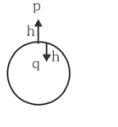
- 510. At what distance above and below the surface of the earth a body will have same weight? (take radius of earth as \(R\).) 2024 Hard
- (A) \(\sqrt{5} \mathrm{R}-\mathrm{R}\)
- (B) \(\frac{\sqrt{3} R-R}{2}\)
- (C) \(\frac{R}{2}\)
- (D) \(\frac{\sqrt{5} \mathrm{R}-\mathrm{R}}{2}\)
Show answer and solution
Correct Answer: (D)
\( g_p=\frac{g R^2}{(R+h)^2} \)\( g_q=g\left(1-\frac{h}{R}\right) \)
\( g_p=g_q \)
\( \frac{g}{\left(1+\frac{h}{R}\right)^2}=g\left(1-\frac{h}{R}\right) \)
\( \left(1-\frac{h^2}{R^2}\right)\left(1+\frac{h}{R}\right)=1\)
Take \(\frac{\mathrm{h}}{\mathrm{R}}=\mathrm{x}\)
So
\( \mathrm{x}^3-\mathrm{x}+\mathrm{x}^2=0 \)
\( \mathrm{x}=\frac{\sqrt{5}-1}{2} \)
\( \mathrm{~h}=\frac{\mathrm{R}}{2}(\sqrt{5}-1)\)
-
- (A) \(\left(\frac{T^2 R^2 g}{4 \pi}\right)^{1 / 2}-R\)
- (B) \(\left(\frac{T^2 R^2 g}{4 \pi^2}\right)^{1 / 3}-R\)
- (C) \(\left(\frac{\mathrm{T}^2 \mathrm{R}^2}{4 \pi^2 \mathrm{~g}}\right)^{1 / 3}-\mathrm{R}\)
- (D) \(\left(\frac{T^2 R^2}{4 \pi^2}\right)^{-1 / 3}+R\)
Show answer and solution
Correct Answer: (B)
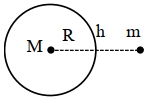
\(\Rightarrow \frac{\mathrm{GMm}}{(\mathrm{R}+\mathrm{h})^2}=\frac{\mathrm{mv}^2}{(\mathrm{R}+\mathrm{h})}\)\(\Rightarrow \frac{\mathrm{GM}}{(\mathrm{R}+\mathrm{h})}=\mathrm{v}^2 \ldots(1)\)
\(\Rightarrow \mathrm{v}=(\mathrm{R}+\mathrm{h}) \omega\)
\(\Rightarrow \mathrm{v}=(\mathrm{R}+\mathrm{h}) \frac{2 \pi}{\mathrm{T}} .\)
\(\Rightarrow \frac{\mathrm{GM}}{\mathrm{R}^2}=\mathrm{g}\)
\(\Rightarrow \mathrm{GM}=\mathrm{gR}^2 .\)
Put value from \((2) \& (3) in eq. (1)\)
\(\Rightarrow \frac{\mathrm{gR}^2}{(\mathrm{R}+\mathrm{h})}=(\mathrm{R}+\mathrm{h})^2\left(\frac{2 \pi}{\mathrm{T}}\right)^2\)
\(\Rightarrow \frac{\mathrm{T}^2 \mathrm{R}^2 \mathrm{~g}}{(2 \pi)^2}=(\mathrm{R}+\mathrm{h})^3\)
\(\Rightarrow\left[\frac{\mathrm{T}^2 \mathrm{R}^2 \mathrm{~g}}{(2 \pi)^2}\right]^{1 / 3}-\mathrm{R}=\mathrm{h}\)
-
- (A) \(11.2 \mathrm{~km} / \mathrm{s}\)
- (B) (8.4 \mathrm{~km} / \mathrm{s}\)
- (C) \(4.2 \mathrm{~km} / \mathrm{s}\)
- (D) \(7.9 \mathrm{~km} / \mathrm{s}\)
Show answer and solution
Correct Answer: (D)
\(R_p=\frac{R_E}{3}, M_P=\frac{M_E}{6}\)\(V_e=\sqrt{\frac{2 G_e}{R_e}}\) \(...(1)\)
\(V_p=\sqrt{\frac{2 \mathrm{GM}_p}{R_p}}\) \(....(2)\)
\(\frac{V_e}{V_p}=\sqrt{2}\)
\(V_P=\frac{V_e}{\sqrt{2}}=\frac{11.2}{\sqrt{2}}=7.9 \mathrm{~km} / \mathrm{sec}\)
-
- (A) \(\frac{L}{2}\)
- (B) \(4 \mathrm{~L}\)
- (C) \(3 \mathrm{~L}\)
- (D) \(2 \mathrm{~L}\)
Show answer and solution
Correct Answer: (B)
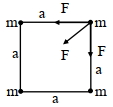
\(F_{\text {net }}=\sqrt{2} F+F^{\prime}\)\(F=\frac{G m^2}{a^2} \text { and } F^{\prime}=\frac{G m^2}{(\sqrt{2} a)^2}\)
\(F_{\text {net }}=\sqrt{2} \frac{G m^2}{a^2}+\frac{G m^2}{2 a^2}\)
\(\left(\frac{2 \sqrt{2}+1}{32}\right) \frac{G m^2}{L^2}=\frac{G m^2}{a^2}\left(\frac{2 \sqrt{2}+1}{2}\right)\)
\(a=4 L\)
-
- (A) (A) is correct but (R) is not correct
- (B) Both \((A)\) and \((R)\) are correct and \((R)\) is the correct explanation of \((\mathrm{A})\)
- (C) Both \((A)\) and \((R)\) are correct but \((R)\) is not the correct explanation of \((A)\)
- (D) \((A)\) is not correct but \((R)\) is correct
Show answer and solution
Correct Answer: (B)
\( \omega=\frac{2 \pi}{\mathrm{T}} \Rightarrow \omega \propto \frac{1}{\mathrm{~T}} \)\( \mathrm{~T}_{\text {moon }}=27 \text { days } \)
\( \mathrm{T}_{\text {earth }}=365 \text { days } 4 \text { hour }\)
\( \Rightarrow \omega_{\text {moon }}>\omega_{\text {earth }}\)
-
- (A) \((A) - II, (B) - I, (C) - IV, (D) - III\)
- (B) \((A) - III, (B) - IV, (C) - I, (D) - II\)
- (C) \((A) - I, (B) - IV, (C) - II, (D) - III\)
- (D) \((A) - I, (B) - II, (C) - III, (D) - IV\)
Show answer and solution
Correct Answer: (A)
\(\mathrm{KE}=\frac{1}{2} \mathrm{mv}^2=\frac{\mathrm{GMm}}{2 \mathrm{a}}\)
\(\mathrm{PE}=-2 \mathrm{KE}\)
\(\mathrm{TE}=-\mathrm{KE}\) -
- (A) \(g / 4\)
- (B) \(2 \mathrm{~g}\)
- (C) \(g / 2\)
- (D) \(4 \mathrm{~g}\)
Show answer and solution
Correct Answer: (D)
\( g=\frac{G M}{R^2} \Rightarrow g \propto \frac{1}{R^2} \)\( \frac{g_2}{g_1}=\frac{R_1^2}{R_2^2} \)
\( g_2=4 g_1\left(R_2=\frac{R_1}{2}\right)\)
-
- (A) \(1600 \mathrm{~km}\)
- (B) \(540 \mathrm{~km}\)
- (C) \(1200 \mathrm{~km}\)
- (D) \(1000 \mathrm{~km}\)
Show answer and solution
Correct Answer: (A)
\( -\frac{G M_E}{R_E+h}=-5.12 \times 10^{-7} \ldots . \text { (i) } \)\( \frac{G M_E}{\left(R_E+h\right)^2}=6.4 \ldots \text { (ii) }\)
By \((i)\) and \((ii)\)
\(\Rightarrow h=16 \times 10^5 \mathrm{~m}=1600 \mathrm{~km}\)
-
- (A) \(\frac{\mathrm{v}}{3}\)
- (B) \(\frac{\mathrm{v}}{4}\)
- (C) \(\frac{\mathrm{v}}{12}\)
- (D) \(\frac{v}{6}\)
Show answer and solution
Correct Answer: (A)
\(\mathrm{V}_{\text {escape }}=\sqrt{\frac{2 \mathrm{GM}}{\mathrm{R}}}\)\(\mathrm{V}_{\text {planet }}=\sqrt{\frac{2 \mathrm{GM}}{\mathrm{R}}}=\mathrm{V}\)
\(V_{\text {Moon }}=\sqrt{\frac{2 \mathrm{GM} \times 16}{144 \mathrm{R}}}=\frac{1}{3} \sqrt{\frac{2 \mathrm{GM}}{\mathrm{R}}}\)
\(\mathrm{V}_{\text {DIoon }}=\frac{\mathrm{V}_{\text {Planet }}}{3}=\frac{\mathrm{V}}{3}\)
-
- (A) \(2 \mathrm{mgR}_{\mathrm{E}}\)
- (B) \(m g R_E\)
- (C) \(\frac{1}{2} \mathrm{mgR}_{\mathrm{E}}\)
- (D) \(4 \mathrm{mgR} R_E\)
Show answer and solution
Correct Answer: (B)
\(\frac{1}{2} \mathrm{mv}_{\mathrm{e}}^2=\frac{\mathrm{GMm}}{\mathrm{R}_{\mathrm{E}}}\)\(\mathrm{g}=\frac{\mathrm{GM}}{\mathrm{R}_{\mathrm{E}}^2}\)
\(\mathrm{~K}=\mathrm{mgR}_{\mathrm{E}}\)
-
- (A) \(\left(\frac{r_2}{r_1}\right)^{\frac{3}{2}}\)
- (B) \(\left(\frac{r_1}{r_2}\right)^3\)
- (C) \(\frac{1}{27}\left(\frac{m_2}{m_1}\right)^3\)
- (D) \(27\left(\frac{m_1}{m_2}\right)^3\)
Show answer and solution
Correct Answer: (C)
\(\frac{\pi \mathrm{r}_1^2}{\mathrm{~T}_{\mathrm{A}}}=\frac{\mathrm{L}}{2 \mathrm{~m}_1} \ldots \ldots . .(1)\)\(\frac{\pi \mathrm{r}_2^2}{\mathrm{~T}_{\mathrm{B}}}=\frac{3 \mathrm{~L}}{2 \mathrm{~m}_2} \ldots \ldots .(2)\)
\(\Rightarrow \frac{\mathrm{T}_{\mathrm{A}}}{\mathrm{T}_{\mathrm{B}}}=3 \cdot \frac{\mathrm{m}_1}{\mathrm{~m}_2} \cdot\left(\frac{\mathrm{r}_1}{\mathrm{r}_2}\right)^2\)
\(\left(\frac{\mathrm{T}_{\mathrm{A}}}{\mathrm{T}_{\mathrm{B}}}\right)^2=\left(\frac{\mathrm{r}_1}{\mathrm{r}_2}\right)^3\)\(\Rightarrow\left(\frac{\mathrm{r}_1}{\mathrm{r}_2}\right)^2=\left(\frac{\mathrm{T}_{\mathrm{A}}}{\mathrm{T}_{\mathrm{B}}}\right)^{\frac{4}{3}}\)
\(\Rightarrow \frac{1}{27} \cdot\left(\frac{\mathrm{m}_2}{\mathrm{~m}_1}\right)^3=\left(\frac{\mathrm{T}_{\mathrm{A}}}{\mathrm{T}_{\mathrm{B}}}\right)\)
-
- (A) \(\frac{4}{3} v\)
- (B) \(3 v\)
- (C) \(6 \mathrm{v}\)
- (D) \(12 v\)
Show answer and solution
Correct Answer: (C)
\(v=\sqrt{\frac{G M}{R}}\)\(\frac{v_A}{v_B}=\sqrt{\frac{R_B}{R_A}}=\sqrt{\frac{R}{4 R}}=\frac{1}{2}\)
\(v_B=2 v_A=6 v\)
-
- (A) \(\sqrt{6} \mathrm{~m}\)
- (B) \(2 \mathrm{~m}\)
- (C) \(1 \mathrm{~m}\)
- (D) \(\sqrt{5} \mathrm{~m}\)
Show answer and solution
Correct Answer: (B)
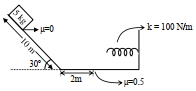
\(\mathrm{w}_{\mathrm{g}}+\mathrm{w}_{\mathrm{FT}}+\mathrm{w}_{\mathrm{s}}=\Delta \mathrm{KE}\)\(5 \times 10 \times 5-0.5 \times 5 \times 10 \times \mathrm{x}-\frac{1}{2} \mathrm{Kx}^2=0-0\)
\(250=25 \mathrm{x}+50 \mathrm{x}^2\)
\(2 \mathrm{x}^2+\mathrm{x}-10=0\)
\(\mathrm{x}=2\)
-
- (A) \(5 \sqrt{3} \mathrm{~J}\)
- (B) \(5 \mathrm{~J}\)
- (C) \(5 \times 10^3 \mathrm{~J}\)
- (D) \(10 \mathrm{~J}\)
Show answer and solution
Correct Answer: (B)
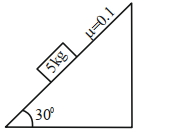
Work done against frictional force
\(=\mu \mathrm{N} \times 10\)
\(=0.1 \times 5 \times 10=5 \mathrm{~J}\) -
- (A) \(4200\)
- (B) \(3900\)
- (C) \(4000\)
- (D) \(4500\)
Show answer and solution
Correct Answer: (C)
Given \(\mathrm{m}=100 \mathrm{~kg}\)\( \mathrm{s}=10 \mathrm{~m} \)
\( \mu=0.4\)
As \(\mathrm{f}=\mu \mathrm{mg}=0.4 \times 100 \times 10=400 \mathrm{~N}\)
Now \(W=f . s=400 \times 10=4000 \mathrm{~J}\)
-
- (A) \(3:2\)
- (B) \(5:1\)
- (C) \(2:5\)
- (D) \(1:5\)
Show answer and solution
Correct Answer: (B)
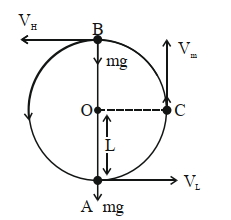
Apply energy conservation between \(A\) & \(B\)\( \frac{1}{2} \mathrm{mV}_{\mathrm{L}}^2=\frac{1}{2} \mathrm{mV}_{\mathrm{H}}^2+\mathrm{mg}(2 \mathrm{~L}) \)
\( \because \mathrm{V}_{\mathrm{L}}=\sqrt{5 \mathrm{gL}}\)
So, \(\mathrm{V}_{\mathrm{H}}=\sqrt{\mathrm{gL}}\)
\(\frac{(\mathrm{K} . \mathrm{E})_{\mathrm{A}}}{(\mathrm{K} . \mathrm{E})_{\mathrm{B}}}=\frac{\frac{1}{2} \mathrm{~m}(\sqrt{5 \mathrm{gL}})^2}{\frac{1}{2} \mathrm{~m}(\sqrt{\mathrm{gL}})^2}=\frac{5}{1}\)
-
- (A) \(t^2\)
- (B) \(\mathrm{t}^{2 / 3}\)
- (C) \(t^{3 / 2}\)
- (D) \(\mathrm{t}\)
Show answer and solution
Correct Answer: (C)
\(\mathrm{P}=\text { costant } \Rightarrow \mathrm{FV}=\text { constant }\)\(\Rightarrow \mathrm{m} \frac{\mathrm{dV}}{\mathrm{dt}} \mathrm{V}=\text { constant }\)
\(\int_0^{\mathrm{V}} \mathrm{VdV}=(\mathrm{C}) \int_0^{\mathrm{t}} \mathrm{dt}\)
\(\left(\frac{\mathrm{V}^2}{2}\right)=\mathrm{Ct}\)
\(\mathrm{V} \propto \mathrm{t}^{1 / 2}\)
\(\frac{\mathrm{ds}}{\mathrm{dt}} \propto \mathrm{t}^{1 / 2}\)
\(\int_0^{\mathrm{s}} \mathrm{ds}=\mathrm{K} \int_0^{\mathrm{t}} \mathrm{t}^{1 / 2} \mathrm{dt}\)
\(\mathrm{S}=\mathrm{K} \times \frac{2}{3} \mathrm{t}^{3 / 2}\)
\(\mathrm{~S} \propto \mathrm{t}^{3 / 2}\)
\(\therefore \text { displacement is proportional to }(\mathrm{t})^{3 / 2}\)
-
- (A) \(19.8 \mathrm{~m} / \mathrm{s}\)
- (B) \(21.9 \mathrm{~m} / \mathrm{s}\)
- (C) \(16.7 \mathrm{~m} / \mathrm{s}\)
- (D) \(10.6 \mathrm{~m} / \mathrm{s}\)
Show answer and solution
Correct Answer: (B)
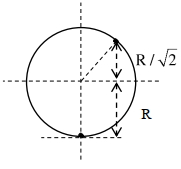
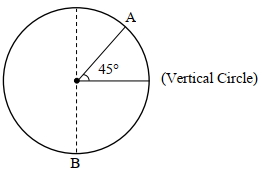
Apply \(W.E.T.\) from \(A\) to \(B\)\(\Rightarrow \mathrm{W}_{\mathrm{mg}}=\mathrm{K}_{\mathrm{B}}-\mathrm{K}_{\mathrm{A}}\)
\(\Rightarrow \mathrm{mg} \times\left(\frac{\mathrm{R}}{\sqrt{2}}+\mathrm{R}\right)=\frac{1}{2} \mathrm{mv}_{\mathrm{B}}^2-0\left\{\mathrm{v}_{\mathrm{A}}=0 \text { rest }\right\}\)
\(\Rightarrow \mathrm{mgR} \frac{(\sqrt{2}+1)}{\sqrt{2}}=\frac{1}{2} \mathrm{mv}_{\mathrm{B}}^2\)
\(\Rightarrow \sqrt{\mathrm{gR} \frac{2(\sqrt{2}+1)}{\sqrt{2}}}=\mathrm{v}_{\mathrm{B}}\)
\(\Rightarrow \sqrt{\frac{10 \times 14 \times 2(2.4)}{1.4}}=\mathrm{v}_{\mathrm{B}}\)
\(\Rightarrow 21.9=\mathrm{v}_{\mathrm{B}}\)
Hence option \((2)\) is correct
-
- (A) \(\left(6 t^4+9 t^5\right)\ \mathrm{W}\)
- (B) \(\left(3 t^3+6 t^5\right)\ W\)
- (C) \(\left(9 t^5+6 t^3\right)\ \mathrm{W}\)
- (D) \(\left(9 t^3+6 t^5\right)\ W\)
Show answer and solution
Correct Answer: (D)
\(\overrightarrow{\mathrm{F}}=\left(6 \mathrm{t} \hat{\mathrm{i}}+6 \mathrm{t}^2 \hat{\mathrm{j}}\right) \mathrm{N}\)\(\overrightarrow{\mathrm{F}}=\mathrm{ma}=\left(6 \mathrm{t}+6 \mathrm{t}^2 \hat{\mathrm{j}}\right)\)
\(\overrightarrow{\mathrm{a}}=\frac{\overrightarrow{\mathrm{F}}}{\mathrm{m}}=\left(3 \mathrm{t}+3 \mathrm{t}^2 \hat{\mathrm{j}}\right)\)
\(\overrightarrow{\mathrm{v}}=\int_0^{\mathrm{t}} \overrightarrow{\mathrm{a}} d \mathrm{~d}=\frac{3 \mathrm{t}^2}{2} \hat{\mathrm{i}}+\mathrm{t}^3 \hat{\mathrm{j}}\)
\(\mathrm{P}=\overrightarrow{\mathrm{F}} \cdot \overrightarrow{\mathrm{v}}=\left(9 \mathrm{t}^3+6 \mathrm{t}^5\right) \mathrm{W}\)
-
- (A) \(1: 1\)
- (B) \(2: 1\)
- (C) \(\sqrt{3}: 2\)
- (D) \(1: 2\)
Show answer and solution
Correct Answer: (A)
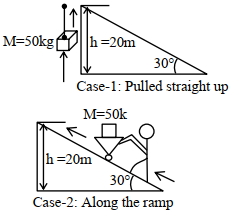
Work done by gravity is independent of path. It depends only on vertical displacement so work done in both cases will be same.Option \((1)\) is correct
-
- (A) \(2\)
- (B) \(3\)
- (C) \(4\)
- (D) \(5\)
Show answer and solution
Correct Answer: (A)
Total time of flight \(=\mathrm{T}\)
\(T=\sqrt{\frac{2 h}{g}}+\sqrt{\frac{2(H-h)}{g}}\)
For \(\max\) time \(=\frac{d T}{d h}=0\)
\(\sqrt{\frac{2}{g}}\left(\frac{-1}{2 \sqrt{\mathrm{H}-\mathrm{h}}}+\frac{1}{2 \sqrt{\mathrm{h}}}\right)=0\)
\(\sqrt{\mathrm{H}-\mathrm{h}}=\sqrt{\mathrm{h}}\)
\(\mathrm{h}=\frac{\mathrm{H}}{2} \Rightarrow \frac{\mathrm{H}}{\mathrm{h}}=2\)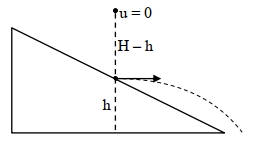
-
- (A) \(32 \%\)
- (B) \(44 \%\)
- (C) \(16 \%\)
- (D) \(84 \%\)
Show answer and solution
Correct Answer: (D)
\(\mathrm{K}_{\mathrm{i}} =\frac{1}{2} \mathrm{~m}(100)^2\)\(\mathrm{~K}_{\mathrm{f}} =\frac{1}{2} \mathrm{~m}(40)^2\)
\(\% \text { loss }=\frac{\left|\mathrm{K}_{\mathrm{f}}-\mathrm{K}_{\mathrm{i}}\right|}{\mathrm{K}_{\mathrm{i}}} \times 100\)
\(=\frac{\left|\frac{1}{2} \mathrm{~m}(40)^2-\frac{1}{2} \mathrm{~m}(100)^2\right|}{\frac{1}{2} \mathrm{~m}(100)^2} \times 100\)
\(=\frac{|1600-100 \times 100|}{100}=84 \%\)
-
- (A) \(58\)
- (B) \(59\)
- (C) \(60\)
- (D) \(61\)
Show answer and solution
Correct Answer: (A)
\(\mathrm{W}=\int_{\mathrm{x}_1}^{\mathrm{x}_2} \mathrm{Fdx}\)\(\mathrm{W}=\int_2^4\left(3 \mathrm{x}^2+2 \mathrm{x}-5\right) \mathrm{dx}\)
\(\mathrm{W}=\left[\mathrm{x}^3+\mathrm{x}^2-5 \mathrm{x}\right]_2^4\)
\(\mathrm{~W}=[60-2] \mathrm{J}=58 \mathrm{~J}\)
-
- (A) \(20 \mathrm{~m} / \mathrm{s}\)
- (B) \(\sqrt{10} \mathrm{~m} / \mathrm{s}\)
- (C) \(2 \sqrt{10} \mathrm{~m} / \mathrm{s}\)
- (D) \(10 \mathrm{~m} / \mathrm{s}\)
Show answer and solution
Correct Answer: (B)
By COME
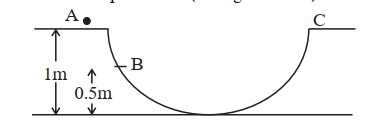
\( \mathrm{KE}_{\mathrm{A}}+\mathrm{U}_{\mathrm{A}}=\mathrm{KE}_{\mathrm{B}}+\mathrm{U}_{\mathrm{B}} \)
\( 0+\mathrm{mg}(1)=\frac{1}{2} \mathrm{mv}^2+\mathrm{mg} \times 0.5 \)
\( v=\sqrt{g}=\sqrt{10} \mathrm{~m} / \mathrm{s}\) -
- (A) \(\frac{\mathrm{m}}{2 \alpha^2 \mathrm{~d}}\)
- (B) \(\frac{\mathrm{md}}{2 \alpha^2}\)
- (C) \(\frac{m \alpha^2 d}{2}\)
- (D) \(2 m \alpha^2 d\)
Show answer and solution
Correct Answer: (C)
\(\mathrm{v}=\alpha \sqrt{\mathrm{x}}\)\(\text { at } \mathrm{x}=0: \mathrm{v}=0\)
\(\&\text { at } \mathrm{x}=\mathrm{d} ; \mathrm{v}=\alpha \sqrt{\mathrm{d}}\)
\(\text { W.D }=\mathrm{K}_1-\mathrm{K}_{\mathrm{i}}\)
\(\text { W.D }=\frac{1}{2} \mathrm{~m}(\alpha \sqrt{\mathrm{d}})^2-\frac{1}{2} \mathrm{~m}(0)^2\)
\(\Rightarrow \text { W.D }=\frac{\mathrm{m} \alpha^2 \mathrm{~d}}{2}\)
-
- (A) \(v_B: v_A\)
- (B) \(m_B: m_A\)
- (C) \(m_B v_B: m_A v_A\)
- (D) \(1: 1\)
Show answer and solution
Correct Answer: (A)
Initial momentum is zero.\(\text { Hence }\left|P_A\right|=\left|P_B\right|\)
\(\Rightarrow m_A v_B=m_B v_B\)
\(\frac{(\mathrm{KE})_A}{(\mathrm{KE})_B}=\frac{\frac{1}{2} m_A v_A^2}{\frac{1}{2} m_B v_B^2}=\frac{v_A}{v_B}\)
\(\frac{(\mathrm{KE})_B}{(\mathrm{KE})_A}=\frac{v_B}{v_A}\)
-
- (A) \(3\)
- (B) \(8\)
- (C) \(4\)
- (D) \(5\)
Show answer and solution
Correct Answer: (D)
\(3=K(a-\ell)\)\(2=K(b-\ell)\)
\(T=K(3 a-2 b-\ell)\)
\(T=K(3(a-\ell)-2(b-\ell)\)
\(=K\left[3\left(\frac{3}{K}\right)-2\left(\frac{2}{K}\right)\right]\)
\(=9-4\)
\(=5 \mathrm{~N}\)
-
- (A) \(\mathrm{D}\)
- (B) \(\mathrm{C}\)
- (C) \(\mathrm{A}\)
- (D) \(B\)
Show answer and solution
Correct Answer: (C)
\(\mathrm{KE}=\frac{\mathrm{p}^2}{2 \mathrm{~m}}\)Same momentum, so less mass means more \(\mathrm{KE}\).
So \(\frac{\mathrm{m}}{2}\) will have \(\max\). \(\mathrm{KE}\).
-
- (A) \(50 \%, \sqrt{\frac{\mathrm{gh}}{2}}\)
- (B) \(50 \%, \sqrt{\mathrm{gh}}\)
- (C) \(40 \%, \sqrt{2 \mathrm{gh}}\)
- (D) \(50 \%, \sqrt{2 \mathrm{gh}}\)
Show answer and solution
Correct Answer: (D)
\(\text { Velocity just before collision }=\sqrt{2 \mathrm{gh}}\)\(\text { Velocity just after collision }=\sqrt{2 \mathrm{~g}\left(\frac{\mathrm{h}}{2}\right)}\)
\(\therefore \Delta \mathrm{KE}=\frac{1}{2} \mathrm{~m}(2 \mathrm{gh})-\frac{1}{2} \mathrm{mgh}\)
\(=\frac{1}{2} \mathrm{mgh}\)
\(\therefore \% \text { loss in energy }\)
\(=\frac{\Delta \mathrm{KE}}{\mathrm{KE}_{\mathrm{i}}} \times 100=\frac{\frac{1}{2} \mathrm{mgh}}{\frac{1}{2} \mathrm{mg} 2 \mathrm{~h}} \times 100=50 \%\)
Hence option \((4)\)
-
- (A) \(2\)
- (B) \(6\)
- (C) \(4\)
- (D) \(8\)
Show answer and solution
Correct Answer: (C)
Given \(\mathrm{U}=2 \mathrm{x}^2+3 \mathrm{y}^3+2 \mathrm{z}\)\(\mathrm{F}_{\mathrm{x}}=-\frac{\partial \mathrm{U}}{\partial \mathrm{x}}=-4 \mathrm{x}\)
At \(x=1\) magnitude of \(F_x\) is \(4 \mathrm{~N}\)
-
- (A) \(1: \sqrt{3}: 2\)
- (B) \(1: \sqrt{3}: \sqrt{2}\)
- (C) \(\sqrt{2}: \sqrt{3}: 1\)
- (D) \(\sqrt{3}: \sqrt{2}: 1\)
Show answer and solution
Correct Answer: (A)
\(\mathrm{KE}=\frac{\mathrm{P}^2}{2 \mathrm{~m}}\)\(\mathrm{P} \propto \sqrt{\mathrm{m}}\)
\(\text { Hence, } \mathrm{P}_{\mathrm{A}}: \mathrm{P}_{\mathrm{B}}: \mathrm{P}_{\mathrm{C}}\)
\(=\sqrt{400}: \sqrt{1200}: \sqrt{1600}=1: \sqrt{3}: 2\)
-
- (A) \(500 \%\)
- (B) \(600 \%\)
- (C) \(6 \%\)
- (D) \(60 \%\)
Show answer and solution
Correct Answer: (A)
\(\text { Kinetic energy }(\mathrm{K})=\frac{\mathrm{P}^2}{2 \mathrm{~m}}\)\(\Rightarrow \mathrm{P}=\sqrt{2 \mathrm{mK}}\)
\(\text { If } \mathrm{K}_{\mathrm{f}}=36 \mathrm{~K}_{\mathrm{i}}\)
\(\text { So, } \mathrm{P}_{\mathrm{f}}=6 \mathrm{P}_{\mathrm{i}}\)
\(\% \text { increase in momentum }=\frac{P_f-P_i}{P_i} \times 100 \%\)
\(=\frac{6 \mathrm{P}_{\mathrm{i}}-\mathrm{P}_{\mathrm{i}}}{\mathrm{P}_{\mathrm{i}}} \times 100 \%\)
\(=500 \%\)
-
- (A) \(1\)
- (B) \(\frac{1}{\sqrt{3}}\)
- (C) \(0.5\)
- (D) \(1.7\)
Show answer and solution
Correct Answer: (A)
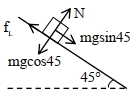
\(\mathrm{mg} \sin 45=\mathrm{f}_{\mathrm{L}}\)\(\mathrm{mg} \cos 45=\mathrm{N}\)
\(\mathrm{f}_{\mathrm{L}}=\mu_{\mathrm{x}} \mathrm{N}\)
\(\mu_{\mathrm{x}}=\tan 45=1\)
or
\(\tan \theta=\mu_{\star}\) ( \(\theta\) is angle of repose)
\(\tan 45=\mu_\alpha=1\)
correct option \((1)\)
-
- (A) \(25 \sqrt{3} \mathrm{~N}\)
- (B) \(5 \sqrt{3} \mathrm{~N}\)
- (C) \(\frac{5 \sqrt{3}}{2} \mathrm{~N}\)
- (D) \(10 \mathrm{~N}\)
Show answer and solution
Correct Answer: (B)
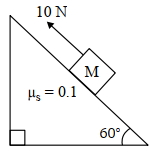
\(\mathrm{f}_{\mathrm{K}}=\mu \mathrm{mg} \cos \theta\)
\(=0.1 \times \frac{50 \times \sqrt{3}}{2}\)
\(=2.5 \sqrt{3} \mathrm{~N}\)
\({F}_1=\mathrm{mg} \sin \theta+\mathrm{f}_{\mathrm{K}} \)
\(=25+2.5 \sqrt{3}\)
\(\mathrm{F}_2=\mathrm{mg} \sin \theta-\mathrm{f}_{\mathrm{K}}\)
\(\quad=25-2.5 \sqrt{3}\)
\(\therefore \mathrm{F}_1-\mathrm{F}_2=5 \sqrt{3} \mathrm{~N}\)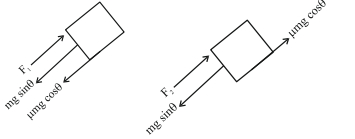
-
- (A) \(1 / 4 \mathrm{~m}\)
- (B) \(1 / 2 \mathrm{~m}\)
- (C) \(1 / 6 \mathrm{~m}\)
- (D) \(1 / 3 \mathrm{~m}\)
Show answer and solution
Correct Answer: (A)
\(\frac{d y}{d x}=\tan \theta=\frac{x}{2}=\mu=\frac{1}{2}\)\(x=1, y=1 / 4\)
-
- (A) \(70.4 \mathrm{~m} / \mathrm{s}\)
- (B) \(51.4 \mathrm{~m} / \mathrm{s}\)
- (C) \(264 \mathrm{~m} / \mathrm{s}\)
- (D) \(102.8 \mathrm{~m} / \mathrm{s}\)
Show answer and solution
Correct Answer: (B)
\(\mathrm{m}=800 \mathrm{~kg}\)\(\mathrm{r}=300 \mathrm{~m}\)
\(\theta=30^{\circ}\)
\(\mu_2=0.2\)
\(\mathrm{~V}_{\max }=\sqrt{\operatorname{Rg}\left[\frac{\tan \theta+\mu}{1-\mu \tan \theta}\right]}\)
\(=\sqrt{300 \times \mathrm{g} \times\left[\frac{\tan 30^{\circ}+0.2}{1-0.2 \times \tan 30^{\circ}}\right]}\)
\(=\sqrt{300 \times 10 \times\left[\frac{0.57+0.2}{1-0.2 \times 0.57}\right]}\)
\(\mathrm{V}_{\max }=51.4 \mathrm{~m} / \mathrm{s}\)
-
- (A) \(\frac{\mu g}{r}\)
- (B) \(\sqrt{\frac{\mathrm{r}}{\mu g}}\)
- (C) \(\sqrt{\frac{\mu g}{r}}\)
- (D) \(\frac{\mu}{\sqrt{\mathrm{rg}}}\)
Show answer and solution
Correct Answer: (C)
\(\mathrm{N}=\mathrm{mg}\)
\(\mathrm{f}=\mathrm{m} \omega^2 \mathrm{r}\)
\(\mathrm{f}=\mu \mathrm{N}\)
\(\mu \mathrm{mg}=\mathrm{mr} \omega^2\)
\(\omega=\sqrt{\frac{\mu g}{r}}\)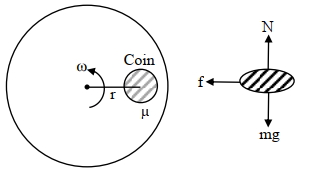
-
- (A) \(1-\frac{1}{\mathrm{n}^2}\)
- (B) \(1-n^2\)
- (C) \(\sqrt{1-\frac{1}{n^2}}\)
- (D) \(\sqrt{1-n^2}\)
Show answer and solution
Correct Answer: (A)
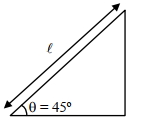
Case-\(1\) : No friction\(\mathrm{a}=\mathrm{g} \sin \theta\)
\(\ell=\frac{1}{2}(\mathrm{~g} \sin \theta) \mathrm{t}_1^2\)
\(\mathrm{t}_1=\sqrt{\frac{2 \ell}{\mathrm{g} \sin \theta}}\)
Case-\(2\) : With friction
\(a=g \sin \theta-\mu g \cos \theta\)
\(\ell=\frac{1}{2}(g \sin \theta-\mu g \cos \theta) t_2^2\)
\(\sqrt{\frac{2 \ell}{g \sin \theta-\mu g \cos \theta}}=n \sqrt{\frac{2 \ell}{g \sin \theta}}\)
\(\mu=1-\frac{1}{n^2}\)
-
- (A) \(14.7 \mathrm{~N}\)
- (B) \(147 \mathrm{~N}\)
- (C) \(1.47 \mathrm{~N}\)
- (D) \(1470 \mathrm{~N}\)
Show answer and solution
Correct Answer: (B)
\(\mathrm{F}_{\mathrm{L}}=\mu_{\mathrm{L}} \mathrm{N}=0.3 \times 50 \times 9.8=147 \mathrm{~N}\)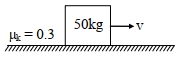
-
- (A) \(6.0 \mathrm{~cm}\)
- (B) \(5.4 \mathrm{~cm}\)
- (C) \(4.8 \mathrm{~cm}\)
- (D) \(4.2 \mathrm{~cm}\)
Show answer and solution
Correct Answer: (B)
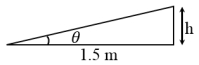
\(\tan \theta=\frac{\mathrm{v}^2}{\mathrm{Rg}}=\frac{12 \times 12}{10 \times 400}\)\( \tan \theta=\frac{\mathrm{h}}{1.5} \)
\( \Rightarrow \frac{\mathrm{h}}{1.5}=\frac{144}{4000} \)
\( \mathrm{~h}=5.4 \mathrm{~cm}\)
-
- (A) \(3\)
- (B) \(4\)
- (C) \(2\)
- (D) \(1.2\)
Show answer and solution
Correct Answer: (C)
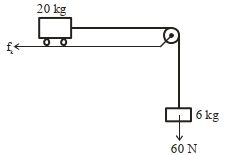
\(\mathrm{f}_{\mathrm{k}}=\mu \mathrm{N}=0.04 \times 20 \mathrm{~g}=8 \text { Newton }\)\(\mathrm{a}=\frac{60-8}{26}=2 \mathrm{~m} / \mathrm{s}^2\)
No questions on this page match these filters.