


Questions
12 questionsShowing 1–12 of 12 questions
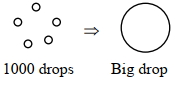
- 1. A big drop is formed by coalescing \(1000\) small droplets of water. The surface energy will become _______. 2024 Hard
- (A) \(100\) times
- (B) \(10\) times
- (C) \(\frac{1}{100}\) th
- (D) \(\frac{1}{10}\) th
Show answer and solution
Correct Answer: (D)
Lets say radius of small droplets is \(r\) and that of big drop is \(R\)\(\frac{4}{3} \pi R^3=1000 \frac{4}{3} \pi r^3\)
\(R=10 r\)
\(U_i=1000\left(4 \pi r^2 S\right)\)
\(U_f=4 \pi R^2 S\)
\(=100\left(4 \pi r^2 S\right)\)
\(U_f=\frac{1}{10} U_i\)
-
- (A) \(5\)
- (B) \(8\)
- (C) \(1\)
- (D) \(3\)
Show answer and solution
Correct Answer: (C)
\(1000 \frac{4}{3} \pi \mathrm{r}^3=\frac{4}{3} \pi \mathrm{R}^3\)\(10 \mathrm{r}=\mathrm{R}\)
\(\mathrm{R}=10 \mathrm{r}\)
\(\frac{\text { S.E. of } 1000 \text { drops }}{\text { S.E. of Big drop }}=\frac{1000\left(4 \pi^2\right) T}{4 \pi R^2 T}\)
\(=\frac{1000 \times \mathrm{r}^2}{(10 \mathrm{r})^2}=10=\frac{10}{\mathrm{x}}\)
\(\therefore \quad \mathrm{x}=1\)
-
- (A) \(9\)
- (B) \(10\)
- (C) \(11\)
- (D) \(12\)
Show answer and solution
Correct Answer: (B)
\(\rho\left({ }_3^4 \pi r^3\right) 1000={ }_3^4 \pi R^3 \rho\)\(R=10 r\)
\(E_1=1000 \times 4 \pi r^2 \times S\)
\(E_2=4 \pi(10 r)^2 S\)
\(\frac{E_1}{E_2}=\frac{10}{1}, x=10\)
-
- (A) \(8\)
- (B) \(7\)
- (C) \(6\)
- (D) \(9\)
Show answer and solution
Correct Answer: (B)
\(\rho g h=\frac{4 S}{R}\)\(\Rightarrow R=\frac{4 \times 0.28}{8 \times 10^3 \times 10 \times 4 \times 10^{-4}}\)
\(\Rightarrow \frac{0.28}{8} \mathrm{~m}=\frac{28}{8} \mathrm{~cm}\)
\(\Rightarrow R=3.5 \mathrm{~cm}\)
\(\text { Diameter }=7 \mathrm{~cm}\)
-
- (A) \(8 \pi R^2 \mathrm{~T}\)
- (B) \(3 \pi R^2 T\)
- (C) \(\frac{1}{8} \pi R^2 T\)
- (D) \(4 \pi R^2 \mathrm{~T}\)
Show answer and solution
Correct Answer: (A)
Volume constant\( \frac{4}{3} \pi \mathrm{R}^3=27 \times \frac{4}{3} \times \pi \mathrm{r}^3 \)
\( \mathrm{R}^3=27 \mathrm{r}^3 \)
\( \mathrm{R}=3 \mathrm{r} \)
\( \mathrm{r}=\frac{\mathrm{R}}{3} \)
\( \mathrm{r}^2=\frac{\mathrm{R}^2}{9}\)
Work done \(=\mathrm{T} \Delta \mathrm{A}\)
\(=27 \mathrm{~T}\left(4 \pi \mathrm{r}^2\right)-\mathrm{T} 4 \pi \mathrm{R}^2\)
\(=27 \mathrm{~T} 4 \pi \frac{\mathrm{R}^2}{9}-4 \pi \mathrm{R}^2 \mathrm{~T}\)
\(8 \pi \mathrm{R}^2 \mathrm{~T}\)
-
- (A) \(5\)
- (B) \(7\)
- (C) \(10\)
- (D) \(15\)
Show answer and solution
Correct Answer: (B)
\(\omega=\Delta \mathrm{U}=\mathrm{S} \Delta \mathrm{A}\)\(36960\) \(\mathrm{erg}=\frac{40 \text { dyne }}{\mathrm{cm}} 8 \pi\left[(\mathrm{r})^2-\left(\frac{7}{2}\right)^2\right] \mathrm{cm}^2\)
\(\mathrm{r}=7 \mathrm{~cm}\)
-
- (A) Both Statement \(I\) and Statement \(II\) are true
- (B) Both Statement \(I\) and Statement \(II\) are false
- (C) Statement\(I\) is true but Statement \(II\) is false
- (D) Statement \(I\) is false but Statement \(II\) is true
Show answer and solution
Correct Answer: (C)
Surface tension will be less as temperature increases\(\mathrm{h}=\frac{2 \mathrm{~T} \cos \theta}{\rho \mathrm{gr}}\)
Height of capillary rise will be smaller in hot water and larger in cold water.
-
- (A) Both Statement \(I\)and Statement \(II\) are false
- (B) Statement \(I\) is false but Statement \(II\) is true.
- (C) Statement \(I\) is true but Statement \(II\) is false.
- (D) Both Statement \(I\) and Statement \(II\) are true.
Show answer and solution
Correct Answer: (C)
Statement \(I\) is correct as we know contact angle depends on cohesine and adhesive forces.Statement \(II\) is incorrect because height of liquid is given by \(h==\frac{2 T \cos \theta_C}{\rho g r}\) where \(r\) is radius of
Tube (assuming length of capillary is sufficient) Hence option \((3)\) is correct.
-
- (A) Statement \(I\) is correct but statement \(II\) is incorrect
- (B) Statement \(I\) is incorrect but Statement \(II\) is correct
- (C) Both Statement \(I\) and Statement \(II\) are incorrect
- (D) Both Statement \(I\) and Statement \(II\) are correct
Show answer and solution
Correct Answer: (B)
Gases have less viscosity.Due to insoluble impurities like detergent surface tension decreases
-
- (A) Statement-\(I\) is false but Statement-\(II\) is true.
- (B) Both Statement-\(I\) and Statement-\(II\) are true.
- (C) Both Statement-\(I\) and Statement-\(II\) are false.
- (D) Statement-\(I\) is true and Statement-\(II\) is false.
Show answer and solution
Correct Answer: (A)
Capillary rise\(\mathrm{h}=\frac{2 \mathrm{~T} \cos \theta}{\rho \mathrm{gr}} \text {; }\)
If \(\theta=0^{\circ}\) then rise is non-zero
\(\therefore\) Statement- \(1\) is incorrect.
Option\((1)\) is correct
-
- (A) \(\frac{4 S}{R}\)
- (B) \(\frac{4 R}{S}\)
- (C) \(\frac{S}{R}\)
- (D) \(\frac{2 S}{R}\)
Show answer and solution
Correct Answer: (A)
There are two liquid-air surfaces in bubble so\(\Delta \mathrm{P}=2\left(\frac{2 \mathrm{~S}}{\mathrm{R}}\right)=\frac{4 \mathrm{~S}}{\mathrm{R}}\)
-
- (A) \(1: 9\)
- (B) \(1: 3\)
- (C) \(1: 81\)
- (D) \(1: 27\)
Show answer and solution
Correct Answer: (D)
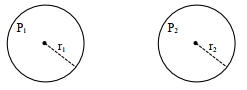
\(\mathrm{P}_1-\mathrm{P}_0=\frac{4 \mathrm{~T}}{\mathrm{r}_1} \quad \mathrm{P}_2-\mathrm{P}_0=\frac{4 \mathrm{~T}}{\mathrm{r}_2}\)\(\mathrm{P}_1-\mathrm{P}_0=3\left(\mathrm{P}_2-\mathrm{P}_0\right)\)
\(\frac{4 \mathrm{~T}}{\mathrm{r}_1}=3 \frac{4 \mathrm{~T}}{\mathrm{r}_2}\)
\(\mathrm{r}_2=3 \mathrm{r}_1\)
\(\frac{\mathrm{V}_1}{\mathrm{~V}_2}=\frac{\frac{4}{3} \pi \mathrm{r}_1^3}{\frac{4}{3} \pi \mathrm{r}_2^3}=\frac{1}{27}\)
No questions on this page match these filters.