


All JEE Mains 2024 Physics questions
31 chaptersShowing 251–300 of 593 questions
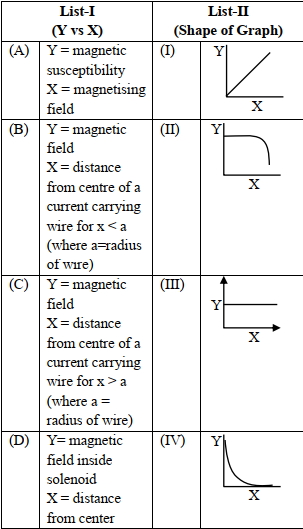
- 251. Match List-\(I\) with List-\(II\) Choose the correct answer from the options given below :
 2024 Hard
- (A) \((A)-(III), (B)-(I), (C)-(IV), (D)-(II)\)
- (B) \((A)-(I), (B)-(III), (C)-(II), (D)-(IV)\)
- (C) \((A)-(IV), (B)-(I), (C)-(III), (D)-(II)\)
- (D) \((A)-(III), (B)-(IV), (C)-(I), (D)-(II)\)
Show answer and solution
Correct Answer: (A)
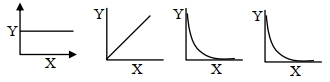
\((A)\) Graph between Magnetic susceptibility and magnetising field is:(Image)
\((B)\) magnetic field due to a current carrying wire for \(\mathrm{x}<\mathrm{a}\) :
\(\mathrm{B}=\frac{\mu_0 \mathrm{ir}}{2 \pi \mathrm{a}^2}\)
(Image)
\((C)\) magnetic field due to a current carrying wire for \(x>a\) :
\(B=\frac{\mu_0 i}{2 \pi a}\)
(Image)
\((D)\) magnetic field inside solenoid varies as:
-
- (A) \(35\)
- (B) \(40\)
- (C) \(45\)
- (D) \(50\)
Show answer and solution
Correct Answer: (B)
\(B=4 \times \frac{\mu_0 i}{4 \pi(1 / 2)}\left(\frac{1}{\sqrt{2}}+\frac{1}{\sqrt{2}}\right)\)\(=4 \times 10^{-7} \times 5 \times 2 \times \sqrt{2}\)
\(=40 \sqrt{2} \times 10^{-7} \mathrm{~T}\)
-
- (A) \(12\ \Omega\)
- (B) \(96\ \Omega\)
- (C) \(48\ \Omega\)
- (D) \(100 \ \Omega\)
Show answer and solution
Correct Answer: (B)
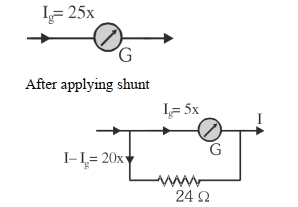
Let \(\mathrm{x}=\) current/divisionNow \(5 \mathrm{x} \times \mathrm{G}=20 \mathrm{x} \times 24\)
\( \mathrm{G}=4 \times 24 \)
\( \mathrm{G}=96 \ \Omega\)
-
- (A) \(\vec{F}_1=q \vec{V} \cdot \vec{E}, \vec{F}_2=q(\vec{B} \cdot \vec{V})\)
- (B) \(\overrightarrow{\mathrm{F}}_1=\mathrm{q} \overrightarrow{\mathrm{B}}, \overrightarrow{\mathrm{F}}_2=\mathrm{q}(\overrightarrow{\mathrm{B}} \times \overrightarrow{\mathrm{V}})\)
- (C) \(\overrightarrow{\mathrm{F}}_1=\mathrm{q} \overrightarrow{\mathrm{E}}, \overrightarrow{\mathrm{F}}_2=\mathrm{q}(\overrightarrow{\mathrm{V}} \times \overrightarrow{\mathrm{B}})\)
- (D) \(\overrightarrow{\mathrm{F}}_1=\mathrm{q} \overrightarrow{\mathrm{B}}, \overrightarrow{\mathrm{F}}_2=\mathrm{q}(\overrightarrow{\mathrm{B}} \times \overrightarrow{\mathrm{V}})\)
Show answer and solution
Correct Answer: (C)
\(\overrightarrow{\mathrm{F}}_1=\mathrm{q} \overrightarrow{\mathrm{E}} \quad \text { (Theory) }\)\(\overrightarrow{\mathrm{F}}_2=\mathrm{q}(\overrightarrow{\mathrm{V}} \times \overrightarrow{\mathrm{B}})\)
-
- (A) \(35\)
- (B) \(15\)
- (C) \(74\)
- (D) \(64\)
Show answer and solution
Correct Answer: (A)
\( B_H=3.5 \times 10^{-5} T \)\( F=i \ell B \sin \theta, \quad \mathrm{i}=\sqrt{2} A \)
\( \frac{F}{\ell}=i B \sin \theta=\sqrt{2} \times 3.5 \times 10^{-5} \times \frac{1}{\sqrt{2}} \)
\( =35 \times 10^{-6} \mathrm{~N} / \mathrm{m}\)
-
- (A) \(3\)
- (B) \(7\)
- (C) \(1\)
- (D) \(9\)
Show answer and solution
Correct Answer: (A)
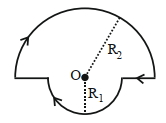
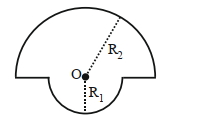
\( \frac{\mu_0 \mathrm{i}}{2 \mathrm{R}_2}\left(\frac{\pi}{2 \pi}\right) \otimes+\frac{\mu_0 \mathrm{i}}{2 \mathrm{R}_1}\left(\frac{\pi}{2 \pi}\right) \otimes \)\( \left(\frac{\mu_0 \mathrm{i}}{4 \mathrm{R}_2}+\frac{\mu_0 \mathrm{i}}{4 \mathrm{R}_1}\right) \otimes \)
\( \frac{4 \pi \times 10^{-7} \times 4}{4 \times 4 \pi}+\frac{4 \pi \times 10^{-7} \times 4}{4 \times 2 \pi} \)
\( =3 \times 10^{-7}=\alpha \times 10^{-7} \)
\( \alpha=3\)
-
- (A) \(15\)
- (B) \(40\)
- (C) \(50\)
- (D) \(65\)
Show answer and solution
Correct Answer: (C)
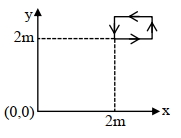
Force on segment parallel to \(\mathrm{x}\)-axis will cancel each other. Hence \(F_{\text {net }}\) will be due to portion parallel to \(y\)-axis.\(F=0.5 \times 0.5 \times 6 \times 0.2-0.5 \times 0.5 \times 0.2 \times 5\)
\(=0.5 \times 0.5 \times 0.2\)
\(=0.25 \times 0.2\)
\(=50 \times 10^{-3} \mathrm{~N}\)
\(=50 \mathrm{mN}\)
-
- (A) \(16 \times 10^{-2} \mathrm{~J}\)
- (B) \(8 \times 10^{-2} \mathrm{~J}\)
- (C) \(4 \times 10^{-2} \mathrm{~J}\)
- (D) Zero
Show answer and solution
Correct Answer: (B)
At stable equilibrium\(\mathrm{U}=-\mathrm{mB} \cos 0^{\circ}=-\mathrm{mB}\)
At unstable equilibrium
\(\mathrm{U}=-\mathrm{mB} \cos 180^{\circ}=+\mathrm{mB}\)
\(\mathrm{W}=\Delta \mathrm{U}\)
\(\text { W.D. }=2 \mathrm{mB}\)
\(=2(0.5) 8 \times 10^{-2}=8 \times 10^{-2} \mathrm{~J}\)
-
- (A) \(10\)
- (B) \(20\)
- (C) \(30\)
- (D) \(40\)
Show answer and solution
Correct Answer: (B)
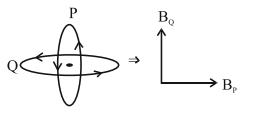
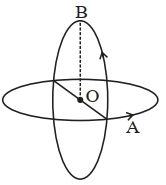
\(\mathrm{B}_{\mathrm{p}}=\frac{\mu_0 \mathrm{Ni}_1}{2 \mathrm{r}}=\frac{\mu_0 \times 1 \times 100}{2 \pi}=2 \times 10^{-3} \mathrm{~T}\)\(\mathrm{~B}_{\mathrm{Q}}=\frac{\mu_0 \mathrm{Ni}_2}{2 \mathrm{r}}=\frac{\mu_0 \times 2 \times 100}{2 \pi}=4 \times 10^{-3} \mathrm{~T}\)
\(\mathrm{~B}_{\text {net }}=\sqrt{\mathrm{B}_{\mathrm{p}}^2+\mathrm{B}_{\mathrm{Q}}^2}\)
\(=\sqrt{20} \mathrm{mT}\)
\(\mathrm{x}=20\)
-
- (A) \(\frac{\sqrt{2} \mu_0 I}{a}\)
- (B) \(\frac{\mu_0 I}{2 a}\)
- (C) \(\frac{\mu_0 I}{\sqrt{2} a}\)
- (D) \(\frac{2 \mu_0 I}{a}\)
Show answer and solution
Correct Answer: (C)
\(\because B_{n e t}=\frac{\sqrt{2} \mu_0 I}{2 a}\)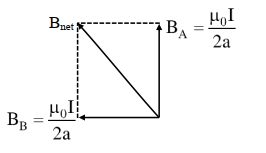
-
- (A) \(65\)
- (B) \(34\)
- (C) \(14\)
- (D) \(160\)
Show answer and solution
Correct Answer: (D)
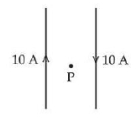
\( B=\left(\frac{\mu_0 i}{2 \pi \mathrm{a}}\right) \times 2=\frac{4 \pi \times 10^{-7} \times 10}{\pi \times\left(\frac{5}{2} \times 10^{-2}\right)} \)\( =16 \times 10^{-5}=160 \mu \mathrm{T}\)
-
- (A) \(5\)
- (B) \(4\)
- (C) \(3\)
- (D) \(2\)
Show answer and solution
Correct Answer: (A)
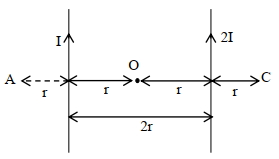
\(\mathrm{B}_{\mathrm{A}}=\frac{\mu_0 \mathrm{i}}{2 \pi \mathrm{r}}+\frac{\mu_0(2 \mathrm{i})}{2 \pi(3 \mathrm{r})}=\frac{5 \mu_0 \mathrm{i}}{6 \pi \mathrm{r}}\)\(\mathrm{B}_C=\frac{\mu_0(2 \mathrm{i})}{2 \pi \mathrm{r}}+\frac{\mu_0 \mathrm{i}}{2 \pi(3 \mathrm{r})}=\frac{7 \mu_0 \mathrm{i}}{6 \pi \mathrm{r}}\)
\(\therefore \frac{\mathrm{B}_A}{\mathrm{~B}_C}=\frac{5}{7}\)
\(\therefore \mathrm{x}=5\)
-
- (A) \(\left(\frac{R_2}{R_1}\right)^2\)
- (B) \(\left(\frac{R_1}{R_2}\right)^2\)
- (C) \(\left(\frac{R_1}{R_2}\right)\)
- (D) \(\left(\frac{R_2}{R_1}\right)\)
Show answer and solution
Correct Answer: (B)
\( \mathrm{R}=\frac{\mathrm{mv}}{\mathrm{qB}}=\frac{\mathrm{p}}{\mathrm{qB}}=\frac{\sqrt{2 \mathrm{~m}(\mathrm{KE})}}{\mathrm{qB}}=\frac{\sqrt{2 \mathrm{mqV}}}{\mathrm{qB}} \)\( \mathrm{R} \propto \sqrt{\mathrm{m}}\)
\( \mathrm{m} \propto \mathrm{R}^2 \)
\( \frac{\mathrm{m}_1}{\mathrm{~m}_2}=\left(\frac{\mathrm{R}_1}{\mathrm{R}_2}\right)^2\)
-
- (A) \(89\)
- (B) \(32\)
- (C) \(45\)
- (D) \(27\)
Show answer and solution
Correct Answer: (B)
\( B_v=B \sin 30=\frac{1}{4} \times 10^{-4} \)\( \omega=2 \pi \times f=\frac{2 \pi}{60} \times 1200 \mathrm{rad} / \mathrm{s} \)
\( \varepsilon=\frac{1}{2} B_V \omega \ell^2 \)
\( =32 \pi \times 10^{-5} \mathrm{~V}\)
-
- (A) 7
- (B) 70
- (C) 35
- (D) 140
Show answer and solution
Correct Answer: (B)
\(\varepsilon=N\left(\frac{\Delta \phi}{t}\right)\)
\(\triangle \phi=(\triangle B) A\)
\(B_i=5000 T\)
\(B_f=3000 T\)
\(d =0.02 m\)
r = 0.01 m
\(\triangle \phi=(\triangle B) A\)
\(=(2000) \pi(0.01)^2=0.2 \pi\)
\(\varepsilon=N\left(\frac{\Delta \phi}{t}\right) \Rightarrow 22=N\left(\frac{0.2 \pi}{2}\right)\)
\(N=70\) -
- (A) \(3\)
- (B) \(4\)
- (C) \(5\)
- (D) \(6\)
Show answer and solution
Correct Answer: (C)
\(\phi=\mathrm{NAB} \cos (\omega \mathrm{t})\)\(\varepsilon=-\frac{\mathrm{d} \phi}{\mathrm{dt}}=\mathrm{NAB} \omega \sin (\omega \mathrm{t})\)
\(\varepsilon_{\max }=\mathrm{NAB} \omega\)
\(=200 \times 0.2 \times 0.01 \times \pi\)
\(=\frac{4 \pi}{10}=\frac{2 \pi}{5} \mathrm{volt}\)
-
- (A) \(8\)
- (B) \(3\)
- (C) \(10\)
- (D) \(45\)
Show answer and solution
Correct Answer: (B)
\( \mathrm{B}_{\mathrm{H}}=0.60 \times 10^{-4} \mathrm{~Wb} / \mathrm{m}^2 \)\( \text { Induced emf } e=B_H v \ell \)
\( =0.60 \times 10^{-4} \times 10 \times 5 \)
\( =3 \times 10^{-3} \mathrm{~V} \)
-
- (A) \(45\)
- (B) \(40\)
- (C) \(50\)
- (D) \(55\)
Show answer and solution
Correct Answer: (A)
\(P_1=2300 \times 5\) watt\(P_0=2300 \times 5 \times 0.9=230 \times I_2\)
\(I_2=45 A\)
-
- (A) \(-2 \mathrm{~V}\)
- (B) \(+2 \mathrm{~V}\)
- (C) \(+1\mathrm{ V}\)
- (D) \(-1 \mathrm{~V}\)
Show answer and solution
Correct Answer: (C)
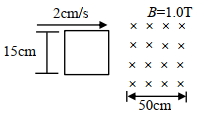
\( \text { Average emf }=\frac{\text { Change in flux }}{\text { Time }}=-\frac{\Delta \phi}{\Delta t} \)\( =-\frac{0-\left(4 \times(2.5 \times 2) \cos 60^{\circ}\right)}{10} \)
\( =+1 \mathrm{~V}\)
-
- (A) \(215\)
- (B) \(216\)
- (C) \(217\)
- (D) \(218\)
Show answer and solution
Correct Answer: (B)
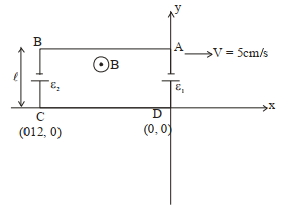
\(\mathrm{B}_0\) is the magnetic field at origin\(\frac{d B}{d x}=-\frac{10^{-3}}{10^{-2}}\)
\(\int_{B_0}^B d B=-\int_0^x 10^{-1} d x\)
\(B-B_0=-10^{-1} x\)
\(B=\left(B_0-\frac{x}{10}\right)\)
Motional emf in \(\mathrm{AB}=0\)
Motional emf in \(\mathrm{CD}=0\)
Motional emf in \(\mathrm{AD}=\varepsilon_1=\mathrm{B}_0 / \mathrm{v}\)
Magnetic field on \(\operatorname{rod} B C B\)
\(=\left(\mathrm{B}_0-\frac{\left(-12 \times 10^{-2}\right)}{10}\right)\)
Motional emf in \(\mathrm{BC}=\varepsilon_2=\left(\mathrm{B}_0+\frac{12 \times 10^{-2}}{10}\right) \ell \times \mathrm{v}\)
\(\varepsilon_{\text {eq }}=\varepsilon_2-\varepsilon_1=300 \times 10^{-7} \mathrm{~V}\)
For time variation
\(\left(\varepsilon_{\text {eq }}\right)^{\prime}=\mathrm{A} \frac{\mathrm{dB}}{\mathrm{dt}}=60 \times 10^{-7} \mathrm{~V}\)
\(\left(\varepsilon_{\text {eq }}\right)_{\text {net }}=\varepsilon_{\text {eq }}+\left(\varepsilon_{\text {eq }}\right)^{\prime}=360 \times 10^{-7} \mathrm{~V}\)
\(\text { Power }=\frac{\left(\varepsilon_{\text {eq }}\right)_{\text {net }}^2}{\mathrm{R}}=216 \times 10^{-9} \mathrm{~W}\)
-
- (A) \(1\)
- (B) \(3\)
- (C) \(0\)
- (D) \(4\)
Show answer and solution
Correct Answer: (C)
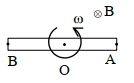
\(\because \mathrm{V}_0-\mathrm{V}_{\mathrm{A}}=\frac{\mathrm{B} \omega \ell^2}{2}\)\(\mathrm{~V}_0-\mathrm{V}_{\mathrm{B}}=\frac{\mathrm{B} \omega \ell^2}{2}\)
\(\therefore \mathrm{V}_{\mathrm{A}}=\mathrm{V}_{\mathrm{B}} \therefore \mathrm{V}_{\mathrm{A}}-\mathrm{V}_{\mathrm{B}}=0\)
-
- (A) \(120\)
- (B) \(125\)
- (C) \(128\)
- (D) \(130\)
Show answer and solution
Correct Answer: (C)
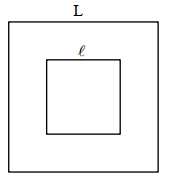
Flux linkage for inner loop.\(\phi=\mathrm{B}_{\text {crater }} \ell^2\)
\(=4 \times \frac{\mu_0 \mathrm{i}}{4 \pi \frac{\mathrm{L}}{2}}(\sin 45+\sin 45) \ell^2\)
\(\phi=2 \sqrt{2} \frac{\mu_0 \mathrm{i}}{\pi \mathrm{L}} \ell^2\)
\(\mathrm{M}=\frac{\phi}{\mathrm{i}}=\frac{2 \sqrt{2} \mu_0 \ell^2}{\pi \mathrm{L}}=2 \sqrt{2} \frac{\mu_0}{\pi}\)
\(=2 \sqrt{2} \frac{4 \pi}{\pi} \times 10^{-7}\)
\(=8 \sqrt{2} \times 10^{-7} \mathrm{H}\)
\(=\sqrt{128} \times 10^{-7} \mathrm{H}\)
\(x=128\)
-
- (A) \(1\)
- (B) \(11\)
- (C) \(2\)
- (D) \(3\)
Show answer and solution
Correct Answer: (C)
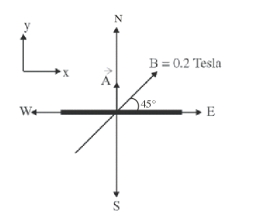
\( \overrightarrow{\mathrm{A}}=(0.1)^2 \hat{\mathrm{j}} \)\( \overrightarrow{\mathrm{B}}=\frac{0.2}{\sqrt{2}} \hat{\mathrm{i}}+\frac{0.2}{\sqrt{2}} \hat{\mathrm{j}}\)
Magnitude of induced emf
\(\mathrm{e}=\frac{\Delta \phi}{\Delta \mathrm{t}}=\frac{\overrightarrow{\mathrm{B}} \cdot \overrightarrow{\mathrm{A}}-0}{1}=\sqrt{2} \times 10^{-3} \mathrm{~V}\)
-
- (A) \(0.3 \mathrm{mV}\)
- (B) \(4.5 \mathrm{mV}\)
- (C) zero
- (D) \(3 \mathrm{mV}\)
Show answer and solution
Correct Answer: (C)
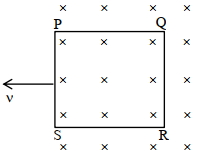
At \(\mathrm{t}=10 \mathrm{sec}\) complete loop is in magnetic field therefore no change in flux(Image)
\(e=\frac{d \phi}{d t}=0 \)
\(e=0\) for complete loop
-
- (A) \(2\)
- (B) \(1\)
- (C) \(3\)
- (D) \(4\)
Show answer and solution
Correct Answer: (C)
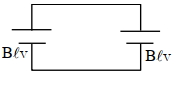
\(\epsilon=N B \ell v\)\(i=\frac{\epsilon}{R}=\frac{N B \ell v}{R}\)
\(F=N(i \ell B)=\frac{N^2 B^2 \ell^2 v}{R}\)
\(\mathrm{W}=\mathrm{F} \times \ell=\frac{\mathrm{N}^2 \mathrm{~B}^2 \ell^3}{\mathrm{R}}\left(\frac{\ell}{\mathrm{t}}\right)\)
\(\mathrm{A}=\ell^2\)
\(\mathrm{~W}=\frac{(10 \times 10)(0.5)^2 \times\left(3.6 \times 10^{-3}\right)^2}{100 \times 1}\)
\(\mathrm{~W}=3.24 \times 10^{-6} \mathrm{~J}\)
-
- (A) \(1.59 \mathrm{~A}\)
- (B) \(13.33 \mathrm{~A}\)
- (C) \(1.33 \mathrm{~A}\)
- (D) \(15.1 \mathrm{~A}\)
Show answer and solution
Correct Answer: (B)
\(\text { Efficiency }=\frac{E_{\mathrm{S}} I_{\mathrm{S}}}{\mathrm{E}_{\mathrm{P}} \mathrm{I}_{\mathrm{P}}}\)\(0.8=\frac{240 \mathrm{I}_{\mathrm{S}}}{4000}\)
\(\mathrm{I}_{\mathrm{S}}=\frac{3200}{240}=13.33 \mathrm{~A}\)
-
- (A) \(5 \mathrm{mH}\)
- (B) \(1 \mathrm{mH}\)
- (C) \(2.5 \mathrm{mH}\)
- (D) \(4 \mathrm{mH}\)
Show answer and solution
Correct Answer: (A)
\((E m f)_{\text {induced }}=-L \frac{d i}{d t}\)In magnitude form,
\(\left|\operatorname{Emf}_{\text {ind }}\right|=\left|(-) L \frac{d i}{d t}\right|\)
\(\Rightarrow 0.1=\frac{(\mathrm{L})[+2-(-2)]}{0.2}\)
\(\Rightarrow \mathrm{L}=\frac{0.1 \times 0.2}{4}=5 \mathrm{mH}\)
-
- (A) \(7 \mathrm{~V}\)
- (B) \(15 \mathrm{~V}\)
- (C) \(44 \mathrm{~V}\)
- (D) \(22 \mathrm{~V}\)
Show answer and solution
Correct Answer: (A)
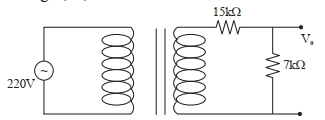
\( \frac{\varepsilon_1}{\varepsilon_2}=\frac{N_1}{N_2}=\frac{100}{10} \Rightarrow \varepsilon_2=22 \mathrm{~V} \)\( I=\frac{22}{22 \times 10^3}=1 \mathrm{~mA}, V_0=7 \mathrm{~V}\)
-
- (A) \(12.5 \mathrm{~W}\)
- (B) \(10.0 \mathrm{~W}\)
- (C) \(11.5 \mathrm{~W}\)
- (D) \(12.0 \mathrm{~W}\)
Show answer and solution
Correct Answer: (C)
\( \frac{\mathrm{V}_1}{\mathrm{~V}_2}=\frac{\mathrm{N}_1}{\mathrm{~N}_2} \)\( \frac{230}{\mathrm{~V}_2}=\frac{10}{1} \)
\( \mathrm{~V}_2=23 \mathrm{~V}\)
Power consumed \(=\frac{\mathrm{V}_2^2}{\mathrm{R}}\)
\(=\frac{23 \times 23}{46}=11.5 \mathrm{~W}\)
-
- (A) \(3\)
- (B) \(4\)
- (C) \(6\)
- (D) \(7\)
Show answer and solution
Correct Answer: (B)
\(\mathrm{I}=3 \mathrm{t}+8\)\(\varepsilon=12 \mathrm{mV}\)
\(|\varepsilon|=\mathrm{L}\left|\frac{\mathrm{dI}}{\mathrm{dt}}\right|\)
\(12=\mathrm{L} \times 3\)
\(\mathrm{~L}=4 \mathrm{mH}\)
-
- (A) \(3\)
- (B) \(5\)
- (C) \(2\)
- (D) \(4\)
Show answer and solution
Correct Answer: (C)
\(\varepsilon=-\left(\frac{\mathrm{d} \phi}{\mathrm{dt}}\right)=10 \mathrm{t}-36\)\(t=2, \varepsilon=16{~V}\)
\(i=\frac{\varepsilon}{R}=\frac{16}{8}=2 \mathrm{~A}\)
-
- (A) \(10\)
- (B) \(7\)
- (C) \(2\)
- (D) \(73\)
Show answer and solution
Correct Answer: (C)
\( \phi=\mathrm{Mi}=\mathrm{Mi}_0 \sin \omega \mathrm{t} \)\( \mathrm{EMF}=-\mathrm{M} \frac{\mathrm{di}}{\mathrm{dt}}=-0.002\left(\mathrm{i}_0 \omega \cos \omega \mathrm{t}\right) \)
\( \mathrm{EMF}_{\max }=\mathrm{i}_0 \omega(0.002)=(5)(50 \pi)(0.002) \)
\( \mathrm{EMF}_{\max }=\frac{\pi}{2} \mathrm{~V}\)
-
- (A) \(\frac{\mu_0 \pi a^2}{2 b}\)
- (B) \(\frac{\mu_0}{2 \pi} \cdot \frac{b^2}{a}\)
- (C) \(\frac{\mu_0 \pi b^2}{2 a}\)
- (D) \(\frac{\mu_0}{2 \pi} \cdot \frac{a^2}{b}\)
Show answer and solution
Correct Answer: (A)
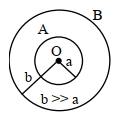
\(\phi=\mathrm{Mi}=\mathrm{BA}\)\(\Rightarrow \mathrm{Mi}=\frac{\mu_0 \mathrm{i}}{2 \mathrm{~b}} \pi \mathrm{a}^2\)
\(\therefore \mathrm{M}=\frac{\mu_0 \pi \mathrm{a}^2}{2 \mathrm{~b}}\)
-
- (A) \(28\)
- (B) \(27\)
- (C) \(26\)
- (D) \(25\)
Show answer and solution
Correct Answer: (A)
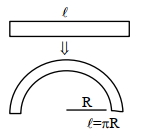
Magnetic moment of straight wire \(=\mathrm{mx} \ell=44\)(Image)
Magnetic moment of arc
\(=\mathrm{m} \times 2 \mathrm{r}\)
\(=\mathrm{m} \times \frac{2 \ell}{\pi}\)
\(=\frac{44 \times 2}{\pi}=\frac{88}{\pi}=28\)
-
- (A) \(A, C\) Only
- (B) \(B, D\) Only
- (C) \(A, B, C\) Only
- (D) \(A, B, C, D\)
Show answer and solution
Correct Answer: (A)
\(A, C\) only -
- (A) \(10\)
- (B) \(12\)
- (C) \(15\)
- (D) \(20\)
Show answer and solution
Correct Answer: (A)
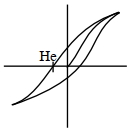
\(\mathrm{H}_{\mathrm{c}}=\frac{\mu_{\mathrm{v}} \mathrm{ni}}{\mu_{\mathrm{o}}}\)\(5 \times 10^3=\frac{150}{30} \times 100 \times \mathrm{i}\)
\(\frac{50}{5}=\mathrm{i}\)
\(\mathrm{I}=10\)
-
- (A) \(6\)
- (B) \(5\)
- (C) \(4\)
- (D) \(12\)
Show answer and solution
Correct Answer: (A)
\( \mathrm{V}=\frac{\mu_0}{4 \pi} \frac{\mathrm{M}}{\mathrm{r}^2} \)\( \Rightarrow 1.5 \times 10^{-5}=10^{-7} \times \frac{\mathrm{M}}{\left(20 \times 10^{-2}\right)^2} \)
\( \Rightarrow \mathrm{M}=\frac{1.5 \times 10^{-5} \times 20 \times 20 \times 10^{-4}}{10^{-7}} \)
\( \mathrm{M}=1.5 \times 4=6\)
-
- (A) \(1\)
- (B) \(5\)
- (C) \(8\)
- (D) \(10\)
Show answer and solution
Correct Answer: (A)
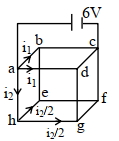
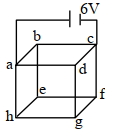
From symmetry, current through \(e-b \& g-d = 0\)\(\therefore \mathrm{R}_{\mathrm{eq}}=\frac{3}{4} \times \mathrm{R}=\frac{3}{2} \Omega\)
\(\therefore \text { Current through battery }=\frac{6 \times 2}{3}=4 \mathrm{~A}\)
\(\mathrm{i}_2=\frac{4}{8} \times 2=1 \mathrm{~A}\)
\(\therefore \Delta \mathrm{V} \text { across e-f }=\frac{\mathrm{i}_2}{2} \times \mathrm{R}=\frac{1}{2} \times 2=1 \mathrm{~V}\)
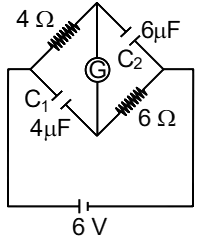
- 289. A galvanometer ( \(G\) ) of \(2 \Omega\) resistance is connected in the given circuit. The ratio of charge stored in \(C_1\) and \(C_2\) is _______.
 2024 Medium
- (A) \(\frac{2}{3}\)
- (B) \(\frac{3}{2}\)
- (C) \(1\)
- (D) \(\frac{1}{2}\)
Show answer and solution
Correct Answer: (D)
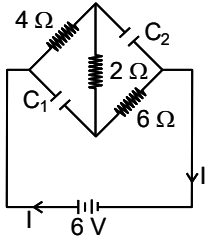
In steady state
Req \(=12 \Omega\)
\(I=\frac{6}{12}=0.5 A\)
P.D across \(C _1=3 V\)
P.D acoross \(C _2=4 V\)
\(q_1=C_1 V_1=12 \mu C\)
\(q_2=C_2 V_2=24 \mu C\)
\(\frac{q_1}{q_2}=\frac{1}{2}\) -
- (A) \(7\)
- (B) \(9\)
- (C) \(3\)
- (D) \(5\)
Show answer and solution
Correct Answer: (D)
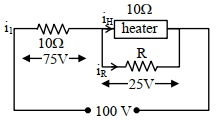
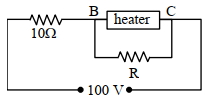
\(R_{\text {heater }}=\frac{V^2}{P}=\frac{(100)^2}{1000}=10 \Omega\)For heater \(P=\frac{V^2}{R} \Rightarrow V=\sqrt{P R}\)
\(\mathrm{V}=\sqrt{62.5 \times 10}\)
\(\mathrm{~V}=25 \mathrm{v}\)
(Image)
\(i_1=\frac{75}{10}=7.5 A, i_H=\frac{25}{10}=2.5 A\)
\(i_R=i_1-i_H=5\)
\(V=I R\)
\(R=\frac{25}{5}=5 \Omega\)
- 291. A potential divider circuit is shown in figure. The output voltage \(V_0\) is _______.
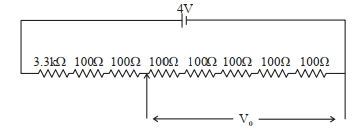 2024 Hard
- (A) \(4 \mathrm{~V}\)
- (B) \(2 \ \mathrm{mV}\)
- (C) \(0.5 \mathrm{~V}\)
- (D) \(12\ \mathrm{mV}\)
Show answer and solution
Correct Answer: (C)
\( R_{e q}=4000 \Omega \)\( i=\frac{4}{4000}=\frac{1}{1000} \mathrm{~A} \)
\( V_0=i \cdot R=\frac{1}{1000} \times 500=0.5 \mathrm{~V}\)
-
- (A) \(63\)
- (B) \(70\)
- (C) \(66\)
- (D) \(35\)
Show answer and solution
Correct Answer: (C)
For null point,\( \frac{4.5}{60}=\frac{R}{40} \)
\( \text { Also, } R=\frac{\rho \ell}{A}=\frac{\rho \ell}{\pi r^2} \)
\( 4.5 \times 40=\rho \times \frac{0.1}{\pi \times 7 \times 10^{-8}} \times 60 \)
\( \rho=66 \times 10^{-7} \Omega \times \mathrm{m}\)
-
- (A) \(5\)
- (B) \(7\)
- (C) \(8\)
- (D) \(10\)
Show answer and solution
Correct Answer: (A)
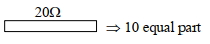
Each part has resistance \(=2 \Omega\)\(2\) parts are connected in parallel so, \(R=1 \Omega\)
Now, there will be 5 parts each of resistance \(1 \Omega\), they are connected in series.
\(\mathrm{R}_{\mathrm{xq}}=5 \mathrm{R}, \mathrm{R}_{\mathrm{sq}}=5 \Omega\)
- 294. A wire of resistance \(R\) and length \(L\) is cut into 5 equal parts. If these parts are joined parallely, then resultant resistance will be _______. 2024 Medium
- (A) \(\frac{R}{25}\)
- (B) \(\frac{R}{5}\)
- (C) \(25 R\)
- (D) \(5 R\)
Show answer and solution
Correct Answer: (A)
Resistance of each part \(=\frac{R}{5}\)
Total resistance \(=\frac{1}{5} \times \frac{R}{5}=\frac{R}{25}\) -
- (A) \(15\)
- (B) \(16\)
- (C) \(17\)
- (D) \(18\)
Show answer and solution
Correct Answer: (B)
We know \(\mathrm{R}=\frac{\rho l}{\mathrm{~A}}, \mathrm{R} \propto \frac{l}{\mathrm{r}^2}\)As we starch the wire, its length will increase but its radius will decrease keeping the volume constant
\(\mathrm{V}_{\mathrm{i}}=\mathrm{V}_{\mathrm{f}}\)
\(\pi^2 l=\pi \frac{\mathrm{r}^2}{4} l_{\mathrm{f}}\)
\(l_{\mathrm{f}}=4 l\)
\(\frac{\mathrm{R}_{\text {nelv }}}{\mathrm{R}_{\text {old }}}=\left(\frac{4 l}{\frac{\mathrm{r}^2}{4}}\right) \frac{\mathrm{r}^2}{l}=16\)
\(\mathrm{R}_{\text {neer }}=16 \mathrm{R}\)
\(\therefore \mathrm{x}=16\)
-
- (A) \(\frac{1}{25}\ \mathrm{R}\)
- (B) \( \frac{1}{5} R \)
- (C) \(25\ \mathrm{R}\)
- (D) \(5\ \mathrm{R}\)
Show answer and solution
Correct Answer: (A)
Explanation:
1. Resistance of each part: The resistance of a wire is directly proportional to its length (\( R \propto L \)). When the wire is cut into 5 equal parts, the length of each part becomes \( L/5 \). Therefore, the resistance of each part will be \( r = \frac{R}{5} \).
2. Parallel Combination: When these 5 identical parts, each of resistance \( \frac{R}{5} \), are connected in parallel, the equivalent resistance (\( R_{eq} \)) is given by the formula:
\( \frac{1}{R_{eq}} = \frac{1}{r_1} + \frac{1}{r_2} + \frac{1}{r_3} + \frac{1}{r_4} + \frac{1}{r_5} \)
3. Calculation:
\( \frac{1}{R_{eq}} = \frac{5}{R} + \frac{5}{R} + \frac{5}{R} + \frac{5}{R} + \frac{5}{R} \)
\( \frac{1}{R_{eq}} = \frac{25}{R} \)
\( R_{eq} = \frac{R}{25} = \frac{1}{25} R \)
Hence, Option A is the correct choice. -
- (A) \(12.5 \mathrm{~W}\)
- (B) \(25 \mathrm{~W}\)
- (C) \(50 \mathrm{~W}\)
- (D) \(100 \mathrm{~W}\)
Show answer and solution
Correct Answer: (A)
Rated power \(\&\) voltage gives resistance\(\mathrm{R}=\frac{\mathrm{V}^2}{\mathrm{P}}=\frac{(200)^2}{50}=\frac{40000}{50}\)
\(\mathrm{R}=800\)
\(\mathrm{P}=\frac{\left(\mathrm{V}_{\text {applied }}\right)^2}{\mathrm{R}}=\frac{(100)^2}{800}\)
\(\mathrm{P}=12.5 \text { watt }\)
Hence option \(1\) is correct.
-
- (A) \(694^{\circ} \mathrm{C}\)
- (B) \(1235^{\circ} \mathrm{C}\)
- (C) \(1694^{\circ} \mathrm{C}\)
- (D) \(1667^{\circ} \mathrm{C}\)
Show answer and solution
Correct Answer: (C)
\( \mathrm{R}_{\mathrm{T}=27}=60 \Omega, R_T=\frac{220}{2.75}=80 \Omega \)\( \mathrm{R}=\mathrm{R}_0(1+\alpha \Delta \mathrm{T}) \)
\( 80=60\left[1+2 \times 10^{-4}(\mathrm{~T}-27)\right] \)
\( \mathrm{T} \approx 1694^{\circ} \mathrm{C}\)
-
- (A) \(1026\)
- (B) \(1027\)
- (C) \(1028\)
- (D) \(1029\)
Show answer and solution
Correct Answer: (B)
Explanation:
The variation of electrical resistance with temperature is given by the formula:
\( R = R_0(1 + \alpha \Delta T) \)
Where:
\( R = \) resistance at final temperature \( T = 62\ \Omega \)
\( R_0 = \) resistance at initial temperature \( T_0 = 50\ \Omega \)
\( \alpha = \) temperature coefficient of resistance \( = 2.4 \times 10^{-4}\text{ }^{\circ}\text{C}^{-1} \)
\( \Delta T = \) change in temperature \( = T - T_0 \)
Rearranging the terms to solve for \( \Delta T \):
\( \frac{R}{R_0} = 1 + \alpha \Delta T \)
\( \frac{R}{R_0} - 1 = \alpha \Delta T \)
\( \frac{R - R_0}{R_0} = \alpha \Delta T \)
Substituting the given values into the equation:
\( \frac{62 - 50}{50} = (2.4 \times 10^{-4}) \times \Delta T \)
\( \frac{12}{50} = (2.4 \times 10^{-4}) \times \Delta T \)
\( 0.24 = (2.4 \times 10^{-4}) \times \Delta T \)
\( \Delta T = \frac{0.24}{2.4 \times 10^{-4}} \)
\( \Delta T = 1000^{\circ}\text{C} \)
Since \( \Delta T = T - T_0 \):
\( T - 27^{\circ}\text{C} = 1000^{\circ}\text{C} \)
\( T = 1000 + 27 = 1027^{\circ}\text{C} \)
Therefore, option B is the correct choice. - 300. By what percentage will the illumination of the lamp decrease if the current drops by \(20 \%\) ? 2024 Hard
- (A) \(46 \%\)
- (B) \(26 \%\)
- (C) \(36 \%\)
- (D) \(56 \%\)
Show answer and solution
Correct Answer: (C)
\(P=i^2 R\)\(P_{\text {int }}=I^2{ }_{\text {int }} R\)
\(P_{\text {final }}=\left(0.8 I_{\text {int }}\right)^2 R\)
\(\% \text { change in power }=\)
\(\frac{P_{\text {final }}-P_{\text {int }}}{P_{\text {int }}} \times 100=(0.64-1) \times 100=-36 \%\)
No questions on this page match these filters.