


All JEE Mains 2024 Physics questions
31 chaptersShowing 301–350 of 593 questions
-
- (A) \(4\)
- (B) \(3\)
- (C) \(1\)
- (D) \(5\)
Show answer and solution
Correct Answer: (C)
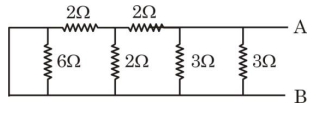
\(6 \ \Omega\) is short circuit
\({R}_{\mathrm{eq}}=3 \times \frac{1}{3}=1\ \Omega\)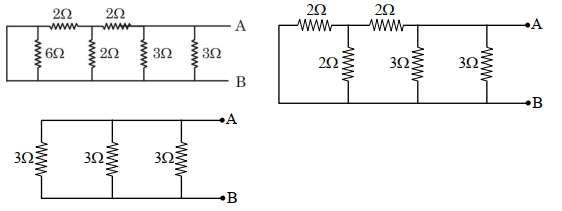
-
- (A) \(22.5 \mathrm{~cm}\)
- (B) \(20 \mathrm{~cm}\)
- (C) \(62.5 \mathrm{~cm}\)
- (D) \(65 \mathrm{~cm}\)
Show answer and solution
Correct Answer: (A)
First case \(\frac{2}{40}=\frac{X}{60} \Rightarrow X=3 \Omega\)
In second case \(X^{\prime}=\frac{2 \times 3}{2+3}=1.2 \Omega\)
\(\frac{2}{\ell}=\frac{1.2}{100-\ell}\)
\(200-2 \ell=1.2 \ell\)
\(\ell=\frac{200}{3.2}=62 . \mathrm{bm}\)
Balance length changes by \(22.5 \mathrm{~cm}\)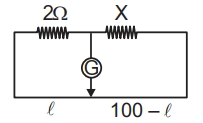
-
- (A) \(2\)
- (B) \(3\)
- (C) \(4\)
- (D) \(5\)
Show answer and solution
Correct Answer: (B)
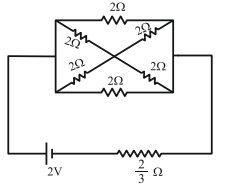
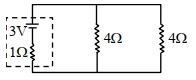
\(\mathrm{R}_{\text {eq }}=\frac{4}{3} \Omega\)\(\therefore \mathrm{P}=\frac{\mathrm{V}^2}{\mathrm{R}_{\text {eq }}}=\frac{4}{4 / 3}=3 \mathrm{~W}\)
-
- (A) \(12\)
- (B) \(78\)
- (C) \(45\)
- (D) \(30\)
Show answer and solution
Correct Answer: (D)
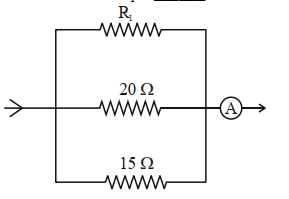
Given, \(i_1=0.3 \mathrm{~A}, \mathrm{i}_1+\mathrm{i}_2+\mathrm{i}_3=0.9 \mathrm{~A}\)
So, \(\mathrm{V}_{\mathrm{AB}}=\mathrm{i}_1 \times 20 \Omega=20 \times 0.3 \mathrm{~V}=6 \mathrm{~V}\)
\( \mathrm{i}_2=\frac{6 \mathrm{~V}}{15 \Omega}=\frac{2}{5} \mathrm{~A} \)
\( \mathrm{i}_1+\mathrm{i}_2+\mathrm{i}_3=\frac{9}{10} \mathrm{~A} \)
\( \frac{3}{10}+\frac{2}{5}+\mathrm{i}_3=\frac{9}{10} \)
\( \frac{7}{10}+\mathrm{i}_3=\frac{9}{10} \)
\( \mathrm{i}_3=0.2 \mathrm{~A} \)
\( \text { So, } \mathrm{i}_3 \times \mathrm{R}_1=6 \mathrm{~V} \)
\( (0.2) \mathrm{R}_1=6 \)
\( \mathrm{R}_1=\frac{6}{0.2}=30 \Omega\)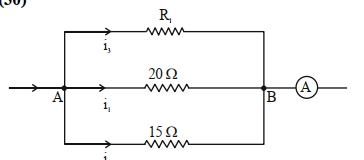
-
- (A) \(1 \mathrm{~A}\)
- (B) \(1.5 \mathrm{~A}\)
- (C) \(2 \mathrm{~A}\)
- (D) \(2.5 \mathrm{~A}\)
Show answer and solution
Correct Answer: (A)
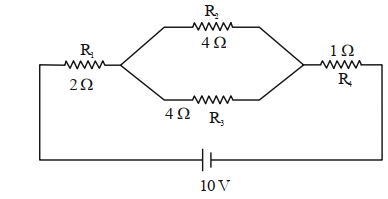
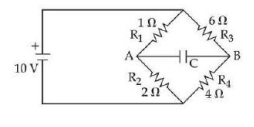
\(\mathrm{R}_{\mathrm{eq}}=2 \Omega+2 \Omega+1 \Omega=5 \Omega\)
\(\mathrm{i}=\frac{\mathrm{V}}{\mathrm{R}_{\mathrm{eq}}}=\frac{10}{5}=2 \mathrm{~A}\)
Current in resistance \(\mathrm{R}_3=2 \times\left(\frac{4}{4+4}\right)\)
\( =2 \times \frac{4}{8} \)
\( =1 \mathrm{~A}\)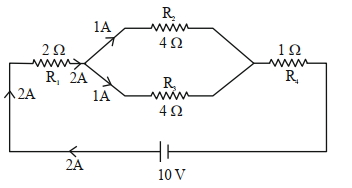
-
- (A) \(4 \mathrm{~V}\)
- (B) \(2 \mathrm{~V}\)
- (C) \(1.5 \mathrm{~V}\)
- (D) \(3 \mathrm{~V}\)
Show answer and solution
Correct Answer: (B)
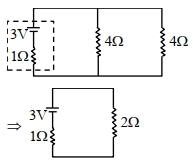
\(\mathrm{i} =\frac{3}{1+2}=1 \mathrm{~A}\)\(\mathrm{v} =\mathrm{E}-\mathrm{ir}\)
\(=3-1 \times 1=2 \mathrm{~V}\)
-
- (A) \(12 \Omega\) and \(11.4 \mathrm{~A}\)
- (B) \(10.5 \Omega\) and \(1.14 \mathrm{~A}\)
- (C) \(10.5 \Omega\) and \(1 \mathrm{~A}\)
- (D) \(12 \Omega\) and \(1 \mathrm{~A}\)
Show answer and solution
Correct Answer: (D)
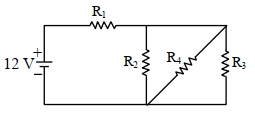
Here \(R_2, R_3, R_4\) are in parallel\(\frac{1}{\mathrm{R}_{254}}=\frac{1}{\mathrm{R}_2}+\frac{1}{\mathrm{R}_5}+\frac{1}{\mathrm{R}_4}\)
\(\mathrm{R}_{254}=2 \Omega\)
\(R_{234}\) is in series with \(R_1\) so
\(\mathrm{R}_{\mathrm{eq}}=\mathrm{R}_{234}+\mathrm{R}_1=2+10=12 \Omega\)
\(\mathrm{i}=\frac{12}{12}=1 \mathrm{Amp}\)
-
- (A) \(58\)
- (B) \(36\)
- (C) \(45\)
- (D) \(32\)
Show answer and solution
Correct Answer: (B)
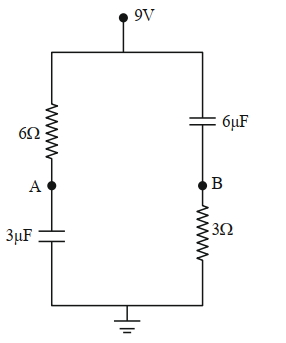
At steady state, capacitor behaves as an open circuit and current flows in circuit as shown in the diagram.
\( \mathrm{R}_{\text {eq }}=9 \Omega \)
\( \mathrm{i}=\frac{9 \mathrm{~V}}{9 \Omega}=1 \mathrm{~A} \)
\( \Delta \mathrm{V}_{6 \Omega}=1 \times 6=6 \mathrm{~V} \)
\( \mathrm{~V}_{\mathrm{A}}=3 \mathrm{~V}\)
So, potential difference across \(6 \mu \mathrm{F}\) is \(6 \mathrm{~V}\).
Hence
\(Q =C \Delta V \)
\( =6 \times 6 \times 10^{-6} \mathrm{C} \)
\( =36 \mu \mathrm{C}\)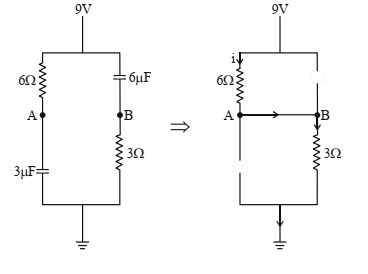
-
- (A) \(735\)
- (B) \(738\)
- (C) \(740\)
- (D) \(748\)
Show answer and solution
Correct Answer: (D)
\(\mathrm{R}=\mathrm{R}_0(1+\alpha \Delta \mathrm{T})\)\(\frac{\Delta \mathrm{R}}{\mathrm{R}_0}=\alpha \Delta \mathrm{T}\)
Case-I
\(0{ }^{\circ} \mathrm{C} \rightarrow 100^{\circ} \mathrm{C}\)
\(\frac{10.2-10}{10}=\alpha(100-0)\)
Case-II
\(0^{\circ} \mathrm{C} \rightarrow t^{\circ} \mathrm{C}\)
\(\frac{10.95-10}{10}=\alpha(t-0)\)
\(\Rightarrow \frac{t}{100}=\frac{0.95}{0.2}=475^{\circ} \mathrm{C}\)
\(t=475+273=748 \mathrm{~K}\)
-
- (A) \(400\)
- (B) \(700\)
- (C) \(500\)
- (D) \(460\)
Show answer and solution
Correct Answer: (A)
\( V_A+\frac{10}{3}(1)-6(1)=V_B \)\( V_A-V_B=6-\frac{10}{3}=\frac{8}{3} \text { volt } \)
\( Q=C\left(V_A-V_B\right) \)
\( =150 \times \frac{8}{3}=400 \mu C\)
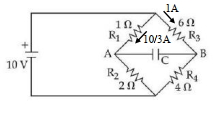
- 311. The current flowing through the \(1 \Omega\) resistor is \(\frac{\mathrm{n}}{10} \ A.\) The value of \(n\) is _______.
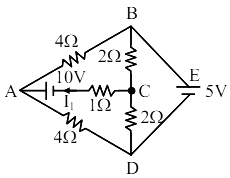 2024 Hard
- (A) \(20\)
- (B) \(25\)
- (C) \(30\)
- (D) \(35\)
Show answer and solution
Correct Answer: (B)
\(\frac{y-5}{2}+\frac{y-0}{2}+\frac{y-x+10}{1}=0\)
\(y-5+y+2 y-2 x+20=0\)
\(4 y-2 x+15=0 \quad \ldots .(i)\)
\(\frac{x-5}{4}+\frac{x-0}{4}+\frac{x-10-y}{1}=0\)
\(x-5+x+4 x-40-4 y=0\)
\(6 x-4 y-45=0 \quad . .(i)\)
\(\frac{-2 x+4 y+15=0 . .(i i)}{4 x-30=0}\)
\(x=\frac{15}{2} \& 4 y-15+15=0\)
\(y=0\)
\(i=\frac{y-x+10}{1}\)
\(i=\frac{0-7.5+10}{1}\)
\(i=2.5 A=\frac{n}{10} A\)
\(n=25\)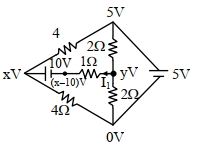
-
- (A) \(22\)
- (B) \(30\)
- (C) \(35\)
- (D) \(40\)
Show answer and solution
Correct Answer: (A)
\(q=\int_1^2 i d t=\int_1^2\left(3 t^2+4 t^3\right) d t\)\(q=\left.\left(t^3+t^4\right)\right|_1 ^2\)
\(q=22 C\)
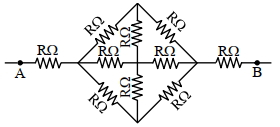
- 313. The effective resistance between \(A\) and \(B\), if resistance of each resistor is \(R\) will be _______.
 2024 Hard
- (A) \(\frac{2}{3} \mathrm{R}\)
- (B) \(\frac{8 R}{3}\)
- (C) \(\frac{5 R}{3}\)
- (D) \(\frac{4 R}{3}\)
Show answer and solution
Correct Answer: (B)
From symmetry we can remove two middle resistance.
New circuit is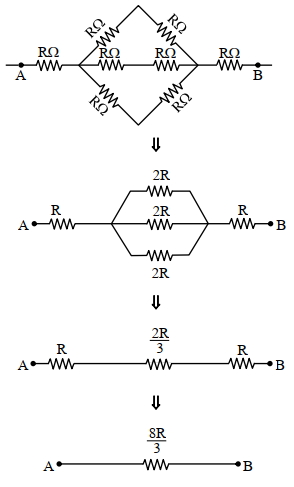
-
- (A) \(80\ \mathrm{C}\)
- (B) \(1000 \ \mathrm{C}\)
- (C) \(800 \ \mathrm{C}\)
- (D) \(1600 \ \mathrm{C}\)
Show answer and solution
Correct Answer: (B)
Given thatCurrent \(I=I_0+\beta t\)
\( I_0=20 \mathrm{~A} \)
\( \beta=3 \mathrm{~A} / \mathrm{s}\)
\( \mathrm{I}=20+3 \mathrm{t} \)
\( \frac{\mathrm{dq}}{\mathrm{dt}}=20+3 \mathrm{t} \)
\( \int_0^q \mathrm{dq}=\int_0^{20}(20+3 \mathrm{t}) \mathrm{dt} \)
\( \mathrm{q}=\int_0^{20} 20 \mathrm{dt}+\int_0^{20} 3 \mathrm{tdt} \)
\( \mathrm{q}=\left[20 \mathrm{t}+\frac{3 \mathrm{t}^2}{2}\right]_0^{20}=1000\ \mathrm{C}\)
-
- (A) \(18 \Omega\)
- (B) \(25 \Omega\)
- (C) \(27 \Omega\)
- (D) \(19 \Omega\)
Show answer and solution
Correct Answer: (D)
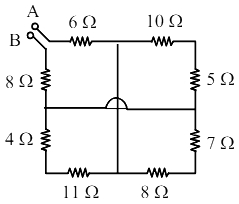
\(\Rightarrow \mathrm{R}_{\mathrm{eq}}=6 \Omega+5 \Omega+8 \Omega=19 \Omega\)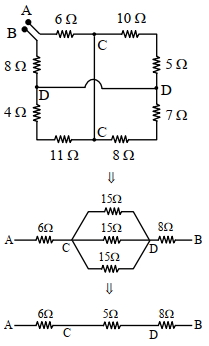
-
- (A) \(31.25 \times 10^{17}\)
- (B) \(6.25 \times 10^{18}\)
- (C) \(6.25 \times 10^{17}\)
- (D) \(1.25 \times 10^{19}\)
Show answer and solution
Correct Answer: (A)
\(\text { Power }(P)=V . I\)\(\Rightarrow 110=(220)(I)\)
\(\Rightarrow I=0.5 \mathrm{~A}\)
\(\text { Now, } I=\frac{\mathrm{n} \cdot \mathrm{e}}{\mathrm{t}}\)
\(\Rightarrow 0.5=\left(\frac{\mathrm{n}}{\mathrm{t}}\right)\left(1.6 \times 10^{-19}\right)\)
\(\Rightarrow \frac{\mathrm{n}}{\mathrm{t}}=\frac{0.5}{1.6 \times 10^{-19}}\)
\(\Rightarrow \frac{\mathrm{n}}{\mathrm{t}}=31.25 \times 10^{17}\)
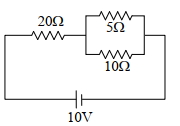
- 317. The ratio of heat dissipated per second through the resistance \(5 \Omega\) and \(10 \Omega\) in the circuit given below is _______.
 2024 Hard
- (A) \(1: 2\)
- (B) \(2: 1\)
- (C) \(4: 1\)
- (D) \(1: 1\)
Show answer and solution
Correct Answer: (B)
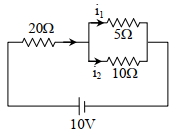
\(\frac{i_1}{i_2}=\frac{10}{5}=\frac{2}{1}\)\(\frac{P_1}{P_2}=\frac{i_1^2 R_1}{i_2^2 R_2}=\left(\frac{2}{1}\right)^2 \times \frac{5}{10}=\frac{2}{1}\)
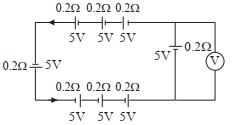
- 318. The reading in the ideal voltmeter \((V)\) shown in the given circuit diagram is _______.
 2024 Hard
- (A) \(5 \mathrm{~V}\)
- (B) \(10 \mathrm{~V}\)
- (C) \(0 \mathrm{~V}\)
- (D) \(3 \mathrm{~V}\)
Show answer and solution
Correct Answer: (C)
\({i}=\frac{\mathrm{E}_{\text {eq }}}{\mathrm{r}_{\text {eq }}}=\frac{8 \times 5}{8 \times 0.2}\)\(I=25 \mathrm{~A}\)
\(V=E-1 \mathrm{r}\)
\(=5-0.2 \times 25\)
\(=0\)
-
- (A) \(20 \mathrm{~cm}\)
- (B) \(10 \mathrm{~cm}\)
- (C) \(80 \mathrm{~cm}\)
- (D) \(40 \mathrm{~cm}\)
Show answer and solution
Correct Answer: (D)
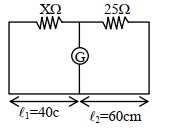
\(\frac{25}{\mathrm{r} \ell_1}=\frac{\mathrm{x}}{\mathrm{r} \ell_2}\) \(.....(i)\)\(\frac{25}{2 \mathrm{r} \ell_1^{\prime}}=\frac{\mathrm{X}}{2 \mathrm{r} \ell_2^{\prime}}\) \(...(ii)\)
From \((i)\) and \((ii)\)
\(\ell_2^{\prime}=\ell_2=40 \mathrm{~cm}\)
-
- (A) \(2 \Omega\)
- (B) \(16 \Omega\)
- (C) \(8 \Omega\)
- (D) \(10 \Omega\)
Show answer and solution
Correct Answer: (B)
\(\text { Given } \mathrm{R}_0=8 \Omega, \mathrm{R}_{100}=10 \Omega\)\(\therefore \mathrm{R}_{100}=\mathrm{R}_0(1+\alpha \Delta \mathrm{T})\)
\(\text { Also, } \mathrm{R}_{400}=\mathrm{R}_0\left(1+\alpha \Delta \mathrm{T}^1\right)\)
\(\therefore 10=8(1+\alpha \times 100) \Rightarrow 100 \alpha=\frac{1}{4}\)
\(\therefore \mathrm{R}_{400}=8(1+400 \alpha)=8(1+1)=16 \Omega\)
Hence option \((2)\)
-
- (A) \(3 \Omega\)
- (B) \(9 \Omega\)
- (C) \(6 \Omega\)
- (D) \(42 \Omega\)
Show answer and solution
Correct Answer: (C)
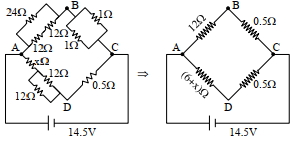
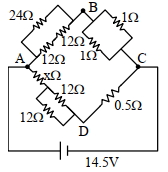
In case of balanced Wheatstone Bridge\(\frac{\mathrm{V}_{\mathrm{AB}}}{\mathrm{V}_{\mathrm{AD}}}=\frac{\mathrm{V}_{\mathrm{BC}}}{\mathrm{V}_{\mathrm{CD}}} \Rightarrow \frac{12}{6+\mathrm{x}}=\frac{0.5}{0.5}\)
\(\mathrm{x}=6 \Omega\)
-
- (A) \(V_1=V_2\)
- (B) \(V_1 \neq V_3-V_2\)
- (C) \(V_1+V_2>V_3\)
- (D) \(V_1+V_2=V_3\)
Show answer and solution
Correct Answer: (D)
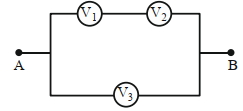
From \(KVL\),\(v_1+v_2-v_3=0 \Rightarrow \mathrm{V}_1+\mathrm{V}_2=\mathrm{V}_3\)
-
- (A) \(2400\)
- (B) \(2500\)
- (C) \(2600\)
- (D) \(2700\)
Show answer and solution
Correct Answer: (B)
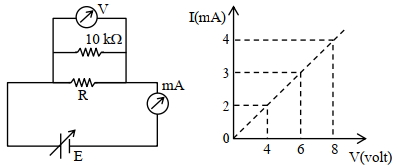
\(\text { Req }=\frac{10^4 R}{10^4+R}\)\(E=4 V, I=2 m A\)
\(I=\frac{E}{R e q} \Rightarrow 2 \times 10^{-3}=\frac{4\left(10^4+R\right)}{10^4 R}\)
\(\Rightarrow 20 R=40000+4 R\)
\(\quad 16 R=40000\)
\(R=2500 \Omega\)
-
- (A) \(0.2 \Omega\)
- (B) \(0.4 \Omega\)
- (C) \(0.1 \Omega\)
- (D) \(0.3 \Omega\)
Show answer and solution
Correct Answer: (D)
Let potential gradient be \(\lambda\).\(\therefore \mathrm{i} \times 10=\lambda \times 500=\varepsilon-\mathrm{ir}_{\mathrm{s}}\)
\(\Rightarrow 500 \lambda=\varepsilon-50 \lambda \mathrm{r}_{\mathrm{s}}\)
Also,
\(\mathrm{i}^{\prime} \times 1=\lambda \times 400=\varepsilon-\mathrm{i}^{\prime} \mathrm{r}_{\mathrm{s}}\)
\(\Rightarrow 400 \lambda=\varepsilon-400 \lambda \mathrm{r}_{\mathrm{s}}\)
\(\therefore 100 \lambda=350 \lambda \mathrm{r}_{\mathrm{s}} \Rightarrow \mathrm{r}_{\mathrm{s}}=\frac{10}{35} \approx 0.3 \Omega\)
Hence option \((4)\)
-
- (A) \(-2 \times 10^{-2} \ { }^{\circ} \mathrm{C}^{-1}\)
- (B) \(-1.5 \times 10^2\ { }^{\circ} \mathrm{C}^{-1}\)
- (C) \(-1 \times 10^{-2}\ { }^{\circ} \mathrm{C}^{-1}\)
- (D) \(-2.5 \times 10^{-2} \ { }^{\circ} \mathrm{C}^{-1}\)
Show answer and solution
Correct Answer: (C)
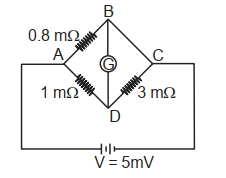
For no deflection \(\frac{0.8}{1}=\frac{R}{3}\)
\(\Rightarrow \mathrm{R}=2.4 \mathrm{~m} \Omega\)
Temperature fall in \(10 \mathrm{~s}=20^{\circ} \mathrm{C}\)
\(\Delta \mathrm{R}=\mathrm{R} \alpha \Delta \mathrm{t}\)
\(\alpha=\frac{\Delta \mathrm{R}}{\mathrm{R} \Delta \mathrm{t}}=\frac{-0.6}{3 \times 20}\)
\(=-10^{-2} \mathrm{C}^{-1}\) -
- (A) \(10\)
- (B) \(6\)
- (C) \(7\)
- (D) \(45\)
Show answer and solution
Correct Answer: (B)
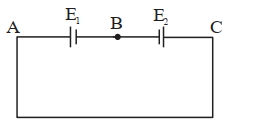
\(I=\frac{8-2}{2+4}=\frac{6}{6}=1 \mathrm{~A}\)
Applying Kirchhoff from \(C\) to \(B\)
\( V_C-2-4 \times 1=V_B \)
\( V_C-V_B=6 \mathrm{~V} \)
\( =6 \mathrm{~V}\)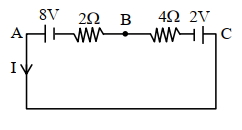
-
- (A) \(\alpha_1+\alpha_2, \frac{\alpha_1+\alpha_2}{2}\)
- (B) \(\frac{\alpha_1+\alpha_2}{2}, \frac{\alpha_1+\alpha_2}{2}\)
- (C) \(\alpha_1+\alpha_2, \frac{\alpha_1 \alpha_2}{\alpha_1+\alpha_2}\)
- (D) \(\frac{\alpha_1+\alpha_2}{2}, \alpha_1+\alpha_2\)
Show answer and solution
Correct Answer: (B)
Series :\(R_{e q}=R_1+R_2\)
\(2 R\left(1+\alpha_{e q} \Delta \theta\right)=R\left(1+\alpha_1 \Delta \theta\right)+R\left(1+\alpha_2 \Delta \theta\right)\)
\(2 R\left(1+\alpha_{\mathrm{eq}} \Delta \theta\right)=2 R+\left(\alpha_1+\alpha_2\right) R \Delta \theta\)
\(\alpha_{\mathrm{eq}}=\frac{\alpha_1+\alpha_2}{2}\)
Parallel :
\(\frac{1}{R_{e q}}=\frac{1}{R_1}+\frac{1}{R_2}\)
\(\frac{1}{\frac{R}{2}\left(1+\alpha_{e q} \Delta \theta\right)}=\frac{1}{R\left(1+\alpha_1 \Delta \theta\right)}+\frac{1}{R\left(1+\alpha_2 \Delta \theta\right)}\)
\(\frac{2}{1+\alpha_{\mathrm{eq}} \Delta \theta}=\frac{1}{1+\alpha_1 \Delta \theta}+\frac{1}{1+\alpha_2 \Delta \theta}\)
\(\frac{2}{1+\alpha_{\mathrm{eq}} \Delta \theta}=\frac{1+\alpha_2 \Delta \theta+1+\alpha_1 \Delta \theta}{\left(1+\alpha_1 \Delta \theta\right)\left(1+\alpha_2 \Delta \theta\right)}\)
\(2\left[\left(1+\alpha_1 \Delta \theta\right)\left(1+\alpha_2 \Delta \theta\right)\right]\)
\(=\left[2+\left(\alpha_1+\alpha_{22}\right) \Delta \theta\right]\left[1+\alpha_{\mathrm{eq}} \Delta \theta\right]\)
\(2\left[1+\alpha_1 \Delta \theta+\alpha_2 \Delta \theta+\alpha_1 \alpha_2 \Delta \theta\right]\)
\(=2+2 \alpha_{\mathrm{eq}} \Delta \theta+\left(\alpha_1+\alpha_{22}\right) \Delta \theta+\alpha_{\mathrm{eq}}\left(\alpha_1+\alpha_2\right) \Delta \theta^2\)
Neglecting small terms
\(2+2\left(\alpha_1+\alpha_2\right) \Delta \theta=2+2 \alpha_{\mathrm{eq}} \Delta \theta+\left(\alpha_1+\alpha_2\right) \Delta \theta\)
\(\left(\alpha_1+\alpha_2\right) \Delta \theta=2 \alpha_{\mathrm{eq}} \Delta \theta\)
\(\alpha_{\mathrm{eq}}=\frac{\alpha_1+\alpha_2}{2}\)
-
- (A) \(100\)
- (B) \(200\)
- (C) \(300\)
- (D) \(400\)
Show answer and solution
Correct Answer: (B)
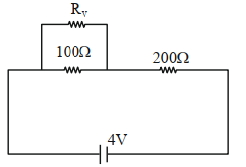
\(\frac{R_V \cdot 100}{R_\gamma+100}=\frac{200}{3}\)\(3 R_v=2 R_v+200\)
\(R_v=200\)
-
- (A) \(29\)
- (B) \(30\)
- (C) \(31\)
- (D) \(32\)
Show answer and solution
Correct Answer: (D)
\(\because \mathrm{R}=\frac{\rho \ell}{A}=\frac{\rho \mathrm{V}}{\mathrm{A}^2}\)\(\therefore \frac{\mathrm{R}_{\mathrm{A}}}{\mathrm{R}_{\mathrm{B}}}=\frac{\mathrm{A}_{\mathrm{B}}^2}{\mathrm{~A}_{\mathrm{A}}^2}=\frac{\mathrm{r}_{\mathrm{B}}^4}{\mathrm{r}_{\mathrm{A}}^4}\)
\(\Rightarrow \frac{\mathrm{R}_{\mathrm{A}}}{2}=\left[\frac{4 \times 10^{-3}}{2 \times 10^{-3}}\right]^4\)
\(\Rightarrow \mathrm{R}_{\mathrm{A}}=32 \Omega .\)
-
- (A) increased, \(\frac{3}{4}\)
- (B) increased, \(\frac{4}{3}\)
- (C) decreased, \(\frac{3}{4}\)
- (D) decreased, \(\frac{4}{3}\)
Show answer and solution
Correct Answer: (C)
\(\mathrm{P}=\frac{\mathrm{v}^2}{\mathrm{R}}, \mathrm{R}=\frac{\rho \ell}{\mathrm{A}}\)\(\mathrm{P} \propto \frac{1}{\ell}\)
\(\frac{\mathrm{P}_1}{\mathrm{P}_2}=\frac{\mathrm{t}_2}{\mathrm{t}_1}=\frac{15}{20}=\frac{\ell_2}{\ell_1}\)
\(\ell_2=\frac{3}{4} \ell_1\)
-
- (A) \(\frac{S_1}{4}\)
- (B) \(2 \mathrm{~S}_1\)
- (C) \(\frac{S_1}{2}\)
- (D) \(S_1\)
Show answer and solution
Correct Answer: (D)
As specific resistance does not depends on dimension of wire so, it will not change. -
- (A) \(1 / 4 \mathrm{~W}\)
- (B) \(1 / 2 \mathrm{~W}\)
- (C) \(2 \mathrm{~W}\)
- (D) \(4 \mathrm{~W}\)
Show answer and solution
Correct Answer: (D)
\( \frac{\mathrm{v}^2}{\mathrm{R}}=\mathrm{W}\) \(....(i)\)\(\frac{\mathrm{v}^2}{\frac{1}{2}\left(\frac{\mathrm{R}}{2}\right)}=\mathrm{W}^{\prime}\) \(...(ii)\)
From \((i)\)&\((ii)\), we get
\(W^{\prime}=4 W\)
-
- (A) \(52\)
- (B) \(42\)
- (C) \(81\)
- (D) \(12\)
Show answer and solution
Correct Answer: (C)
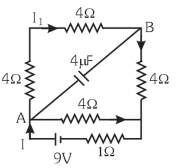
\( I=\frac{V}{R_{e q}} I=\frac{V}{R_{e q}}=\frac{9}{1+\frac{12 \times 4}{12+4}}=\frac{9}{4} \)\( I_1=\frac{9}{4} \times \frac{4}{16}=\frac{9}{16} \)
\( V_A-V_B=I_1 \times 8=\frac{9}{16} \times 8=\frac{9}{2} V \)
\( \therefore U=\frac{1}{2} \times 4 \times \frac{81}{4} \mu \mathrm{J} \)
\( \therefore U=\frac{81}{2} \mu \mathrm{J} \)
\( \therefore \mathrm{X}=81\)
-
- (A) \(1.50\)
- (B) \(1.33\)
- (C) \(0.66\)
- (D) \(1\)
Show answer and solution
Correct Answer: (A)
\(\frac{\mathrm{A} \varepsilon_{\mathrm{o}}}{\mathrm{d}}=\frac{\mathrm{A} \varepsilon_0}{\left(0.2+\frac{\mathrm{d}}{\mathrm{k}}\right)}\)\(0.6=0.2+\frac{0.6}{\mathrm{k}}\)
\(\mathrm{k}=\frac{3}{2}\)
-
- (A) \(\frac{11 \varepsilon_0 \mathrm{~A}}{18 \mathrm{~d}}\)
- (B) \(\frac{13 \varepsilon_0 \mathrm{~A}}{17 \mathrm{~d}}\)
- (C) \(\frac{11 \varepsilon_0 \mathrm{~A}}{20 \mathrm{~d}}\)
- (D) \(\frac{18 \varepsilon_0 \mathrm{~A}}{11 \mathrm{~d}}\)
Show answer and solution
Correct Answer: (A)
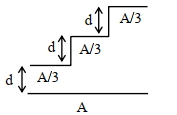
All capacitor are in parallel combination.Also effective area is common area only
\(\Rightarrow C_{e q}=C_1+C_2+C_3\)
\(\Rightarrow C_{e q}=\frac{A \varepsilon_0}{3 d}+\frac{A \varepsilon_0}{3(2 d)}+\frac{A \varepsilon_0}{3(3 d)}\)
\(\Rightarrow C_{e q}=\frac{A \varepsilon_0}{3}\left(\frac{11}{6 d}\right)\)
\(\Rightarrow C_{e q}=\frac{11 A \varepsilon_0}{18 d}\)
-
- (A) \(50\)
- (B) \(93\)
- (C) \(60\)
- (D) \(30\)
Show answer and solution
Correct Answer: (B)
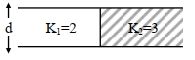
\(\mathrm{C}_{\mathrm{eq}}=\mathrm{C}_1+\mathrm{C}_2\)\(\mathrm{C}_1=\frac{2 \epsilon_0 \mathrm{~A}}{2 \times \mathrm{d}}=10 \mu \mathrm{F}\)
\(\mathrm{C}_2=\frac{3 \epsilon_0 \mathrm{~A}}{2 \mathrm{~d}}=15 \mu \mathrm{F}\)
\(\mathrm{C}_{\mathrm{eq}}=25 \mu \mathrm{F}\)
Now the charge on
\(\mathrm{C}_1=10 \mathrm{~V} \mu \mathrm{c}\)
\(\mathrm{C}_2=1.5 \mathrm{~V} \mu \mathrm{C}.\)
Now force between the plates \(\left[\mathrm{F}=\frac{\mathrm{Q}^2}{2 \mathrm{~A} \epsilon_0}\right]\)
\(\frac{100 \mathrm{~V}^2 \times 10^{-12}}{2 \times 2 \times 10^{-4} \epsilon_0}+\frac{225 \mathrm{~V}^2 \times 10^{-12}}{2 \times 2 \times 10^{-4} \times \epsilon_0}=8\)
\(325 \mathrm{~V}^2=8 \times 4 \times 10^{-4} \times 8.85\)
\(\mathrm{~V}^2-\frac{32 \times 8.85 \times 10^{-4}}{325}\)
\(\therefore \mathrm{V}=\sqrt{\frac{283.2 \times 10^{-4}}{325}}\)
\(\mathrm{~V}=0.93 \times 10^{-2}\)
-
- (A) \(45\)
- (B) \(8\)
- (C) \(2\)
- (D) \(19\)
Show answer and solution
Correct Answer: (C)
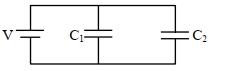
Energy loss \(=\frac{1}{2} \frac{C_1 C_2}{C_1+C_2}\left(V_1-V_2\right)^2\)\( =\frac{2}{3} \cdot E \)
\( \therefore x=2\)
-
- (A) \(720\)
- (B) \(730\)
- (C) \(750\)
- (D) \(770\)
Show answer and solution
Correct Answer: (C)
Before inserting dielectric capacitance is given \(\mathrm{C}_0=12.5 \mathrm{pF}\) and charge on the capacitor \(\mathrm{Q}=\mathrm{C}_0 \mathrm{~V}\) After inserting dielectric capacitance will become \(\epsilon_{\mathrm{s}} \mathrm{C}_0\).Change in potential energy of the capacitor
\(=\mathrm{E}_{\mathrm{i}}-\mathrm{E}_{\mathrm{r}}\)
\(=\frac{\mathrm{Q}^2}{2 \mathrm{C}_{\mathrm{i}}}-\frac{\mathrm{Q}^2}{2 \mathrm{C}_{\mathrm{f}}}=\frac{\mathrm{Q}^2}{2 \mathrm{C}_0}\left[1-\frac{1}{\epsilon_{\mathrm{r}}}\right]\)
\(=\frac{\left(\mathrm{C}_0 \mathrm{~V}\right)^2}{2 \mathrm{C}_0}\left[1-\frac{1}{\epsilon_{\mathrm{r}}}\right]=\frac{1}{2} \mathrm{C}_0 \mathrm{~V}^2\left[1-\frac{1}{\epsilon_{\mathrm{r}}}\right]\)
Using \(\mathrm{C}_0=12.5 \mathrm{pF}, \mathrm{V}=12 \mathrm{~V}, \epsilon_{\mathrm{r}}=6\)
\(=\frac{1}{2}(12.5) \times 12^2\left[1-\frac{1}{6}\right]=\frac{1}{2}(12.5) \times 12^2 \times\)
\(\frac{5}{6}\)
\(=750 \mathrm{pJ}=750 \times 10^{-12} \mathrm{~J}\)
-
- (A) \(1\)
- (B) \(2\)
- (C) \(3\)
- (D) \(4\)
Show answer and solution
Correct Answer: (B)
Without dielectric\(\mathrm{Q}=\frac{\mathrm{A} \in_0}{\mathrm{~d}} \mathrm{~V}\)
with dielectric
Q=\(\frac{A \in_0 V}{d-t+\frac{t}{K}}\)
given
\(\frac{\mathrm{A} \in_0 \mathrm{~V}}{\mathrm{~d}-\mathrm{t}+\frac{\mathrm{t}}{\mathrm{K}}}=(1.25) \frac{\mathrm{A} \in_0 \mathrm{~V}}{\mathrm{~d}}\)
\(\Rightarrow 1.25\left(3+\frac{2}{\mathrm{~K}}\right)=5\)
\(\Rightarrow \mathrm{K}=2\)
-
- (A) \(\sqrt{3} \mathrm{~V}\)
- (B) \(\sqrt{6} \mathrm{~V}\)
- (C) \(0 \mathrm{~V}\)
- (D) \(3 \mathrm{~V}\)
Show answer and solution
Correct Answer: (C)
Potential difference \(=\frac{K Q}{r_1}-\frac{K Q}{r_2}\)\( \mathrm{r}_1=\sqrt{(\sqrt{3})^2+(\sqrt{3})^2}\)
\( \mathrm{r}_2=\sqrt{(\sqrt{6})^2+0}\)
As \(r_1=r_2=\sqrt{6} \mathrm{~m}\)
So potential difference \(=0\)
-
- (A) \(35\)
- (B) \(36\)
- (C) \(37\)
- (D) \(38\)
Show answer and solution
Correct Answer: (B)
Potential at centre of half ring\(\mathrm{V}=\frac{\mathrm{KQ}}{\mathrm{R}}\)
\(\mathrm{V}=\frac{\mathrm{K} \lambda \pi \mathrm{R}}{\mathrm{R}}\)
\(\mathrm{V}=\mathrm{K} \lambda \pi \Rightarrow \mathrm{V}=9 \times 10^9 \times 4 \times 10^{-9} \pi\)
\(\mathrm{V}=36 \pi\)
-
- (A) Both \((A)\) and \((R)\) are correct but \((R)\) is not the correct explanation of \((\mathrm{A})\)
- (B) \((A)\) is correct but \((R)\) is not correct
- (C) \((A)\) is not correct but \((R)\) is correct
- (D) Both \((A)\) and \((R)\) are correct and \((R)\) is the correct explanation of \((A)\)
Show answer and solution
Correct Answer: (D)
Electric line of force are always perpendicular to equipotential surface so angle between farce and displacement will always be \(90^{\circ}\). So work done equal to \(0\) . - 343. In an electrical circuit drawn below the amount of charge stored in the capacitor is _______ \(\mu \mathrm{C}\).
 2024 Hard
- (A) \(50\)
- (B) \(60\)
- (C) \(70\)
- (D) \(80\)
Show answer and solution
Correct Answer: (B)
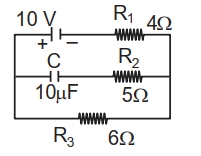
In steady state there will be no current in branch of capacitor, so no voltage drop across \(\mathrm{R}_2=5 \Omega\)
\(\mathrm{I}_2=0\)
\(\mathrm{I}_1=\mathrm{I}_3=\frac{10}{4+6}=1 \mathrm{~A}\)
\(\mathrm{~V}_{\mathrm{R}_3}=\mathrm{V}_{\mathrm{c}}+\mathrm{V}_{\mathrm{R}_2} \quad \mathrm{~V}_{\mathrm{R}_2}=0\)
\(\mathrm{I}_3 \mathrm{R}_3=\mathrm{V}_{\mathrm{c}}\)
\(\mathrm{V}_{\mathrm{c}}=1 \times 6=6 \mathrm{volt}\)
\(\mathrm{q}_{\mathrm{c}}=\mathrm{CV}_{\mathrm{c}}=10 \times 6=60 \mu \mathrm{C}\)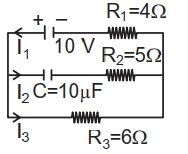
-
- (A) \(25\)
- (B) \(26\)
- (C) \(27\)
- (D) \(28\)
Show answer and solution
Correct Answer: (C)
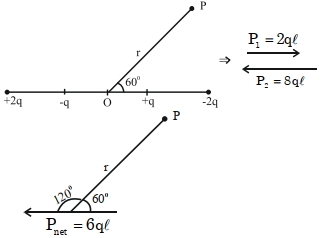
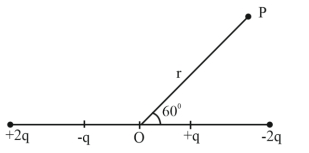
\(\mathrm{V}=\frac{\mathrm{K} \dot{\mathrm{p}} \cdot \overrightarrow{\mathrm{r}}}{\mathrm{r}^3}=\frac{9 \times 10^9(6 \mathrm{q} \ell)}{\mathrm{r}^2} \cos \left(120^{\circ}\right)\)\(=-(27)\left(\frac{\mathrm{q} \ell}{\mathrm{r}^2}\right) \times 10^9 \mathrm{Nm}^2 \mathrm{c}^{-2}\)
\(\Rightarrow \alpha=27\)
-
- (A) 12
- (B) 14
- (C) 16
- (D) 18
Show answer and solution
Correct Answer: (C)
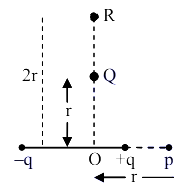
\(E_P=\frac{2 K P}{r^3}=E\)
\(E_R=\frac{K P}{(2 r)^3}=\frac{E}{16}\)
\(x=16\) -
- (A) \(2\)
- (B) \(3\)
- (C) \(4\)
- (D) \(6\)
Show answer and solution
Correct Answer: (C)
\(\mathrm{E}=\frac{\mathrm{E}_0}{3} \Rightarrow \mathrm{V}=\frac{\mathrm{V}_0}{3}\)\(\frac{\mathrm{V}_0}{3}=\mathrm{V}_0 \mathrm{e}^{-\frac{\mathrm{t}}{\mathrm{t}}}\)
\(\mathrm{t}=\tau \ell \mathrm{n} 3\)
\(6.6 \times 10^{-6}=\mathrm{R}\left(1.5 \times 10^{-6}\right)(1.1)\)
\(\mathrm{R}=\frac{6}{1.5}=4 \Omega\)
- 347. The electrostatic potential due to an electric dipole at a distance '\(r\)' varies as _______. 2024 Hard
- (A) \(\mathrm{r}\)
- (B) \(\frac{1}{r^2}\)
- (C) \(\frac{1}{r^3}\)
- (D) \(\frac{1}{r}\)
Show answer and solution
Correct Answer: (B)
\(V=\frac{k P \cos \theta}{r^2}\)& can also checked dimensionally
- 348. The vehicles carrying inflammable fluids usually have _______ metallic chains touching the ground. 2024 Hard
- (A) To conduct excess charge due to air friction to ground and prevent sparking.
- (B) To alert other vehicles.
- (C) To protect tyres from catching dirt from ground.
- (D) It is a custom.
Show answer and solution
Correct Answer: (A)
Static charge is developed due to air friction. This can result in combustion. So, metallic chains is used to discharge excess charge. -
- (A) \(85\)
- (B) \(86\)
- (C) \(87\)
- (D) \(88\)
Show answer and solution
Correct Answer: (B)
In parallel combination : Potential difference is same across all\(\text { Energy }=\frac{1}{2}\left(\mathrm{C}_1+\mathrm{C}_2+\mathrm{C}_3\right) \mathrm{V}^2\)
\(=\frac{1}{2}(25+30+45) \times(100)^2 \times 10^{-6}=0.5=\mathrm{E}\)
In series combination: Charge is same on all.
\(\frac{1}{\mathrm{C}_{\text {equ }}}=\frac{1}{\mathrm{C}_1}+\frac{1}{\mathrm{C}_2}+\frac{1}{\mathrm{C}_3}=\frac{1}{25}+\frac{1}{30}+\frac{1}{45}\)
\(\frac{1}{\mathrm{C}_{\text {equ }}}=\frac{(18+15+10)}{450}=\frac{43}{450} \Rightarrow \mathrm{C}_{\text {equ }}=\frac{450}{43}\)
\(\text { Energy }=\frac{Q^2}{2 C_1}+\frac{Q^2}{2 C_2}+\frac{Q^2}{2 C_3}\)
\(=\frac{Q^2}{2}\left[\frac{1}{C_1}+\frac{1}{C_2}+\frac{1}{C_3}\right]\)
\(\frac{\left(V \times C_{\text {equ }}\right.}{2} \times \frac{1}{C_{\text {equ }}}frac{V^2 C_{\text {equ }}}{2}\)
\(\frac{(100)^2}{2} \times \frac{450}{} \times 10^{-6}\)
\(\Rightarrow \frac{4.5}{86}=\frac{9}{x} E=\frac{9}{x} \times 0.5 \Rightarrow x=86\)
-
- (A) \(\sqrt{\mathrm{ab}}\)
- (B) \(a b\)
- (C) \(\frac{a}{b}\)
- (D) \(\frac{\mathrm{b}}{\mathrm{a}}\)
Show answer and solution
Correct Answer: (C)
Potential at surface will be same\(\frac{\mathrm{Kq}_1}{\mathrm{a}}=\frac{\mathrm{Kq}}{\mathrm{b}}\)
\(\frac{\mathrm{q}_1}{\mathrm{q}_2}=\frac{\mathrm{a}}{\mathrm{b}}\)
No questions on this page match these filters.