


All JEE Mains 2024 Physics questions
31 chaptersShowing 201–250 of 593 questions
-
- (A) \(45\)
- (B) \(60\)
- (C) \(75\)
- (D) \(12\)
Show answer and solution
Correct Answer: (B)
\(y-x-4=0\)\(d_1\) is perpendicular distance of given line from origin.
\(\mathrm{d}_1=\left|\frac{-4}{\sqrt{1^2+1^2}}\right| \Rightarrow 2 \sqrt{2} \mathrm{~m}\)
So \(|\overrightarrow{\mathrm{L}}|=\operatorname{mvd}_1 =5 \times 3 \sqrt{2} \times 2 \sqrt{2} \mathrm{~kg} \mathrm{~m}^2 / \mathrm{s} \)
\( =60 \mathrm{~kg} \mathrm{~m}^2 / \mathrm{s}\)
-
- (A) \(3\)
- (B) \(4\)
- (C) \(5\)
- (D) \(6\)
Show answer and solution
Correct Answer: (A)
For slipping\(\mathrm{a}=\mathrm{g} \sin \theta\)
\(\ell=\frac{1}{2} \mathrm{at}^2 \Rightarrow \mathrm{t}=\sqrt{\frac{2 \ell}{\mathrm{g} \sin \theta}}\)
For rolling
\(\mathrm{a}^{\prime}=\frac{\mathrm{g} \sin \theta}{1+\frac{\mathrm{k}^2}{\mathrm{R}^2}}\left[\mathrm{k}=\frac{\mathrm{R}}{\sqrt{2}}\right]\)
\(\Rightarrow \mathrm{a}^{\prime}=\frac{2 \mathrm{~g} \sin \theta}{3}\)
\(\ell=\frac{1}{2} \mathrm{a}^{\prime}\left(\mathrm{t}^{\prime}\right)^2\)
\(\Rightarrow \mathrm{t}^{\prime}=\sqrt{\frac{6 \ell}{2 \mathrm{~g} \sin \theta}}=\sqrt{\frac{\alpha}{2}} \sqrt{\frac{2 \ell}{\mathrm{s} \sin \theta}}\)
\(\Rightarrow \alpha=3 \)
-
- (A) \(1\)
- (B) \(5\)
- (C) \(7\)
- (D) \(10\)
Show answer and solution
Correct Answer: (D)
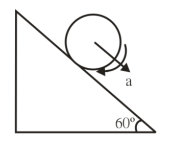
For rolling motion, \(\mathrm{a}=\frac{\mathrm{g} \sin \theta}{1+\frac{\mathrm{I}_{\mathrm{cm}}}{\mathrm{MR}^2}}\)\( a=\frac{g \sin \theta}{1+\frac{1}{2}} \)
\( =\frac{2 \times 10 \times \frac{\sqrt{3}}{2}}{3} \)
\( =\frac{10}{\sqrt{3}}\)
Therefore \(\mathrm{x}=10\)
-
- (A) \(\frac{v^2}{g}\)
- (B) \(\frac{3}{4} \frac{v^2}{g}\)
- (C) \(\frac{1}{2} \frac{v^2}{g}\)
- (D) \(\frac{2}{3} \frac{v^2}{g}\)
Show answer and solution
Correct Answer: (C)
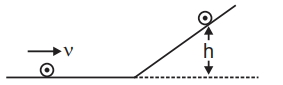
Only the translational kinetic energy of disc changes into gravitational potential energy. And rotational \(\mathrm{KE}\) remains unchanged as there is no friction.\(\frac{1}{2} \mathrm{mv}^2=\mathrm{mgh}\)
\(\mathrm{h}=\frac{\mathrm{v}^2}{2 \mathrm{~g}}\)
-
- (A) \(6 \mathrm{~kg}\)
- (B) \(12 \mathrm{~kg}\)
- (C) \(3 \mathrm{~kg}\)
- (D) \(6 \sqrt{3} \mathrm{~kg}\)
Show answer and solution
Correct Answer: (C)
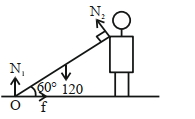
Torque about \(\mathrm{O}=0\)\( 120\left(\frac{\mathrm{L}}{2} \cos 60^{\circ}\right)-\mathrm{N}_2 \mathrm{~L}=0 \)
\( \mathrm{~N}_2=30 \mathrm{~N}\)
-
- (A) \(\frac{W}{2}\)
- (B) \(W\)
- (C) \(\mathrm{W} \cos \theta\)
- (D) \(\mathrm{W} \sin \theta\)
Show answer and solution
Correct Answer: (A)
\(R=\) net reaction force by shoulder
Balancing torque about pt of contact on ground:
\(\mathrm{W}\left(\frac{\mathrm{L}}{2} \cos \theta\right)=\mathrm{R}(\mathrm{L} \cos \theta)\)
\(\Rightarrow \mathrm{R}=\frac{\mathrm{W}}{2}\)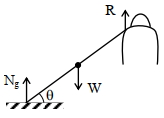
-
- (A) \(2\)
- (B) \(5\)
- (C) \(4\)
- (D) \(3\)
Show answer and solution
Correct Answer: (A)
\(\frac{\frac{1}{2} \mathrm{I} \omega^2}{\frac{1}{2} \mathrm{I} \omega^2+\frac{1}{2} m v^2}=\frac{\left(\frac{1}{2}\right)\left(\frac{2}{3} m R^2\right) \omega^2}{\left(\frac{1}{2}\right)\left(\frac{2}{3} \mathrm{mR}^2\right) \omega^2+\frac{1}{2} \mathrm{~m}(\mathrm{R} \omega)^2}\)\(=\frac{\frac{2}{3}}{\frac{2}{3}+1}=\frac{2}{5}\)
\(\mathrm{x}=2\)
-
- (A) \(\frac{\sqrt{3}}{16} \frac{\mathrm{mu}^3}{\mathrm{~g}}\)
- (B) \(\frac{\sqrt{3}}{2} \frac{m u^2}{g}\)
- (C) \(\frac{m u^3}{\sqrt{2} g}\)
- (D) zero
Show answer and solution
Correct Answer: (A)
\( \mathrm{L}=m u \cos \theta H \)\( =m u \cos \theta \times \frac{u^2 \sin ^2 \theta}{2 g} \)
\( =\frac{m u^3}{2 g} \times \frac{\sqrt{3}}{2} \times\left(\frac{1}{2}\right)^2=\frac{\sqrt{3} m u^3}{16 g}\)
-
- (A) \(5\)
- (B) \(7\)
- (C) \(10\)
- (D) \(40\)
Show answer and solution
Correct Answer: (B)
In pure rolling work done by friction is zero. Hence potential energy is converted into kinetic energy. Since initially the ring and the sphere have same potential energy, finally they will have same kinetic energy too.\(\therefore\) Ratio of kinetic energies \(=1\)
\(\Rightarrow \frac{7}{x}=1 \Rightarrow x=7\)
-
- (A) \(3\)
- (B) \(4\)
- (C) \(5\)
- (D) \(6\)
Show answer and solution
Correct Answer: (D)
Using work energy theorem\(\mathrm{W}=\Delta \mathrm{KE}=0-\left(\frac{1}{2} \mathrm{mv}^2+\frac{1}{2} \mathrm{I} \omega^2\right)\)
\(\mathrm{W}=0-\frac{1}{2} \mathrm{mv}^2\left(1+\frac{\mathrm{K}^2}{\mathrm{R}^2}\right) \)
\(=-\frac{1}{2} \times 50 \times 0.4^2\left(1+\frac{1}{2}\right)=-6 \mathrm{~J}\)
Absolute work \(=+6 \mathrm{~J}\)
\(W=-6 J \quad|W|=6 J\)
-
- (A) \(6\)
- (B) \(7\)
- (C) \(8\)
- (D) \(9\)
Show answer and solution
Correct Answer: (B)
\(\text { Gain in P.E. }=\text { Loss in K.E. }\)\(\mathrm{mgh}=\frac{1}{2} \mathrm{mv}^2\left(1+\frac{\mathrm{K}^2}{\mathrm{R}^2}\right)\)
\(\mathrm{h} \propto 1+\frac{\mathrm{K}^2}{\mathrm{R}^2}\)
\(\frac{\mathrm{h}_1}{\mathrm{~h}_2}=\frac{1+\frac{2}{5}}{1+1}=\frac{7}{5 \times 2}=\frac{7}{10}\)
\(\mathrm{n}=7\)
-
- (A) \(100\)
- (B) \(199\)
- (C) \(198\)
- (D) \(99\)
Show answer and solution
Correct Answer: (A)
\(\tau=\mathrm{FR}=\mathrm{I} \alpha \Rightarrow 40 \times 0.1=0.4 \alpha\)\(\alpha=10 \mathrm{rad} / \mathrm{s}^2\)
\(\mathrm{~W}_{\mathrm{f}}=10 \times 10=100 \mathrm{rad} / \mathrm{s}\)
-
- (A) \(\frac{4}{5} \omega\)
- (B) \(\frac{5}{4} \omega\)
- (C) \(\frac{2}{3} \omega\)
- (D) \(\frac{3}{2} \omega\)
Show answer and solution
Correct Answer: (C)
\(\mathrm{I}_1 \omega=\mathrm{I}_2 \omega_2\)\(\frac{\mathrm{MR}^2}{2} \omega=\frac{3}{2}\left(\frac{\mathrm{MR}^2}{2}\right) \omega_2\)
\(\omega_2=\frac{2}{3} \omega\)
-
- (A) \(4\)
- (B) \(5\)
- (C) \(6\)
- (D) \(7\)
Show answer and solution
Correct Answer: (A)
Impulse \(\mathrm{J}=0.2 \mathrm{~N}-\mathrm{S}\)\(\mathrm{J}=\int \mathrm{Fdt}=0.2 \mathrm{~N}-\mathrm{s}\)
Angular impuls ( \(\overrightarrow{\mathrm{M}})\)
\(\overrightarrow{\mathrm{M}}_{\mathrm{c}}=\int \tau \mathrm{dt}\)
\(=\int \mathrm{F} \frac{\mathrm{L}}{2} \mathrm{dt}\)
\(=\frac{\mathrm{L}}{2} \int \mathrm{Fdt}=\frac{\mathrm{L}}{2} \times \mathrm{J}v\)
\(=\frac{0.3}{2} \times 0.2\)
\(=0.03\)
\(I_{c m}=\frac{\mathrm{LL}^2}{12}=\frac{2 \times(0.3)^2}{12}=\frac{0.09}{6}\)
\(\mathrm{M}=\mathrm{I}_{\mathrm{cm}}\left(\omega_{\mathrm{f}}-\omega_{\mathrm{i}}\right)\)
\(0.03=\frac{0.09}{6}\left(\omega_{\mathrm{f}}\right)\)
\(\omega_{\mathrm{f}}=2 \mathrm{rad} / \mathrm{s}\)
\(\theta=\omega \mathrm{t}\)
\(\mathrm{t}=\frac{\theta}{\omega}=\frac{\pi}{2 \times 2}=\frac{\pi}{4} \mathrm{sec} .\)
\(\mathrm{X}=4\)
-
- (A) \(15\)
- (B) \(17\)
- (C) \(18\)
- (D) \(20\)
Show answer and solution
Correct Answer: (A)
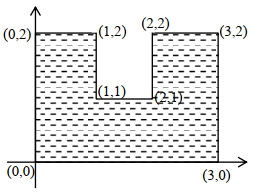
\(\mathrm{m}_1 =\sigma \times 5=10 \mathrm{Kg}\)
\(\mathrm{m}_1 =\sigma \times 5=10 \mathrm{Kg} \quad \mathrm{m}_2=\sigma \times 1=2 \mathrm{Kg}\)
\(\mathrm{m}_3=\sigma \times 6=12 \mathrm{Kg}\)
\(\Rightarrow \mathrm{m}_1 \mathrm{x}_1+\mathrm{m}_2 \mathrm{x}_2=\mathrm{m}_3 \mathrm{x}_3\)
\(10 \mathrm{x}_1+2(1.5)=12(1.5) \Rightarrow \mathrm{x}_1=1.5 \mathrm{~cm}\)
\(\Rightarrow \mathrm{m}_1 \mathrm{y}_1+\mathrm{m}_2 \mathrm{y}_2=\mathrm{m}_3 \mathrm{y}_3\)
\(10 \mathrm{y}_1+2(1.5)=12 \times 1 \Rightarrow \mathrm{y}_1=0.9 \mathrm{~cm}\)
\(\frac{\mathrm{x}_1}{\mathrm{y}_1}=\frac{1.5}{0.9}=\frac{15}{9}\)
\(\mathrm{n}=15\)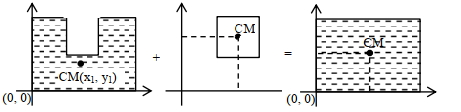
-
- (A) \(349\)
- (B) \(248\)
- (C) \(78\)
- (D) \(250\)
Show answer and solution
Correct Answer: (D)
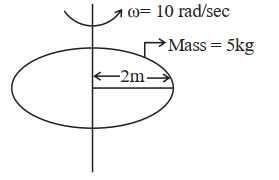
\( \vec{L}_i=I \omega_i=\frac{M R^2}{2} \cdot \omega=100 \mathrm{kgm}^2 / \mathrm{s} \)
\( E_i=\frac{1}{2} \cdot \frac{M R^2}{2} \cdot \omega^2=500 \mathrm{~J} \)
\( \vec{L}_i=\vec{L}_f \Rightarrow 100=2 I \omega_f \)
\( \omega_{\mathrm{f}}=5 \mathrm{rad} / \mathrm{sec} \)
\( E_f=2 \times \frac{1}{2} \cdot \frac{5(2)^2}{2} \cdot(5)^2=250 \mathrm{~J} \)
\( \Delta E=250 \mathrm{~J}\) -
- (A) \(35\)
- (B) \(16\)
- (C) \(42\)
- (D) \(75\)
Show answer and solution
Correct Answer: (B)
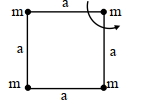
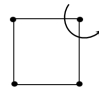
\( \mathrm{I}=m a^2+m a^2+\mathrm{m}(\sqrt{2} \mathrm{a})^2 \)\( =4 \mathrm{ma}^2 \)
\( =4 \times 1 \times(2)^2=16\)
-
- (A) \(13\)
- (B) \(15\)
- (C) \(20\)
- (D) \(25\)
Show answer and solution
Correct Answer: (A)
By conservation of angular momentum\(\mathrm{I}_1 \omega_1=\mathrm{I}_2 \omega_2\)
\(\left(\frac{2}{5} \mathrm{MR}^2\right) \frac{2 \pi}{\mathrm{T}_1}=\frac{2}{5} \mathrm{M}\left(\frac{3}{4} \mathrm{R}\right)^2 \frac{2 \pi}{\mathrm{T}_2}\)
\(\frac{1}{\mathrm{~T}_1}=\frac{9}{16 \mathrm{~T}_2}\)
\(\frac{1}{\mathrm{~T}_2}=\frac{9}{16} \times \mathrm{T}_1=\frac{9}{16} \times 24 \mathrm{hr}=\frac{27}{2} \mathrm{hr}=13 \mathrm{hr} 30 \text { mins. }\)
-
- (A) \(5\)
- (B) \(4\)
- (C) \(6\)
- (D) \(3\)
Show answer and solution
Correct Answer: (D)
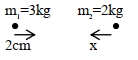
\(\Delta \mathrm{X}_{\text {C.O.M }}=\frac{\mathrm{m}_1 \Delta \mathrm{x}_1+\mathrm{m}_2 \Delta \mathrm{x}_2}{\mathrm{~m}_1+\mathrm{m}_2}\)\(\Rightarrow 0=\frac{3 \times 2+2(-\mathrm{x})}{3+2}\)
\(\Rightarrow \mathrm{x}=3 \mathrm{~cm}\)
-
- (A) \(34\)
- (B) \(17\)
- (C) \(67\)
- (D) \(51\)
Show answer and solution
Correct Answer: (C)
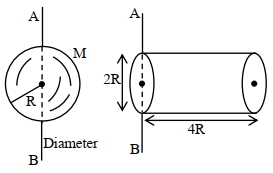
\(\mathrm{I}_{\text {sphere }}=\frac{2}{3} \mathrm{MR}^2=\mathrm{Mk}_1^2\)\(\mathrm{I}_{\text {cylinder }}=\frac{1}{12} \mathrm{M}\left(4 \mathrm{R}^2\right)+\frac{1}{4} \mathrm{MR}^2+\mathrm{M}(2 \mathrm{R})^2\)
\(=\frac{67}{12} \mathrm{MR}^2=\mathrm{Mk}_2^2\)
\(\frac{\mathrm{k}_1}{\mathrm{k}_2}=\sqrt{\frac{2}{3} \cdot \frac{12}{67}}=\sqrt{\frac{8}{67}}\)
-
- (A) \(2\)
- (B) \(3\)
- (C) \(4\)
- (D) \(5\)
Show answer and solution
Correct Answer: (B)
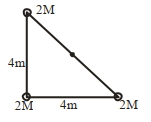
\(\text { Position vector } \overrightarrow{\mathrm{r}}_{\text {COM }}=\frac{\mathrm{m}_1 \overrightarrow{\mathrm{r}}_1+\mathrm{m}_2 \overrightarrow{\mathrm{r}}_2+\mathrm{m}_3 \overrightarrow{\mathrm{r}}_3}{\mathrm{~m}_1+\mathrm{m}_2+\mathrm{m}_3}\)\(\overrightarrow{\mathrm{r}}_{\text {COM }}=\frac{2 \mathrm{M} \times 0+2 \mathrm{M} \times 4 \hat{\mathrm{i}}+2 \mathrm{M} \times 4 \hat{\mathrm{j}}}{6 \mathrm{M}}\)
\(\overrightarrow{\mathrm{r}}=\frac{4}{3} \hat{\mathrm{i}}+\frac{4}{3} \hat{\mathrm{j}}\)
\(|\overrightarrow{\mathrm{r}}|=\frac{4 \sqrt{2}}{3}\)
\(\mathrm{x}=3\)
-
- (A) \(5\)
- (B) \(8\)
- (C) \(7\)
- (D) \(4\)
Show answer and solution
Correct Answer: (D)
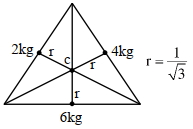
Moment of inertia about \(\mathrm{C}\) and perpendicular to the plane is:\(\mathrm{I} =\mathrm{r}^2[2+4+6]\)
\(=\frac{1}{3} \times 12\)
\(\mathrm{I} =4 \mathrm{~kg}-\mathrm{m}^2\)
-
- (A) \(20\)
- (B) \(22\)
- (C) \(24\)
- (D) \(30\)
Show answer and solution
Correct Answer: (C)
\(I_1 \omega_1+I_2 \omega_2=\left(I_1+I_2\right) \omega_0 \text { (C.O.A.M.) }\)\(\text { gives } \omega_0=8 \mathrm{rad} / \mathrm{s}\)
\(E_1=\frac{1}{2} I_1 \omega_1^2+\frac{1}{2} I_2 \omega_2^2=216 J\)
\(E_2=\frac{1}{2}\left(I_1+I_2\right) \omega_0^2=192 J\)
\(\therefore \Delta E=24 J\)
-
- (A) \(48\)
- (B) \(49\)
- (C) \(50\)
- (D) \(53\)
Show answer and solution
Correct Answer: (D)
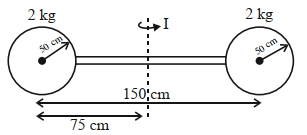
\(\mathrm{I}=\left(\frac{2}{5} \mathrm{mR}^2+\mathrm{md}^2\right) \times 2\)\(\mathrm{I}=2\left(\frac{2}{5} \times 2 \times\left(\frac{1}{2}\right)^2+2 \times\left(\frac{3}{4}\right)^2\right)=\frac{53}{20} \mathrm{~kg}-\mathrm{m}^2\)
\(\mathrm{X}=53\)
-
- (A) 5
- (B) 10
- (C) 15
- (D) 20
Show answer and solution
Correct Answer: (A)
\(R=\frac{\rho \ell}{A} \Rightarrow \frac{2 \times 10^{-6} \times \ell}{10^{-5}}=1 \Rightarrow \ell=5\)
\(mg = Bi \ell\)
\(B =\frac{ mg }{ i \ell}=\frac{5}{2 \times 5}=0.5=5 \times 10^{-1}\) Tesla -
- (A) \(12\)
- (B) \(78\)
- (C) \(85\)
- (D) \(32\)
Show answer and solution
Correct Answer: (D)
\(\mathrm{q} =4 \mu \mathrm{C}, \overrightarrow{\mathrm{v}}=4 \times 10^6\)\( \hat{\mathrm{j}} \mathrm{m} / \mathrm{s} \)
\(\overrightarrow{\mathrm{B}} =2 \hat{\mathrm{k}} \mathrm{T} \)
\(\overrightarrow{\mathrm{F}} =\mathrm{q}(\overrightarrow{\mathrm{v}} \times \overrightarrow{\mathrm{B}}) \)
\( =4 \times 10^{-6}\left(4 \times 10^6 \hat{\mathrm{j}} \times 2 \hat{\mathrm{k}}\right) \)
\( =4 \times 10^{-6} \times 8 \times 10^6 \hat{\mathrm{i}} \)
\(\overrightarrow{\mathrm{F}} =32 \hat{\mathrm{i}} \mathrm{N} \)
\(\mathrm{x} =32\) -
- (A) \(8\)
- (B) \(3\)
- (C) \(4\)
- (D) \(5\)
Show answer and solution
Correct Answer: (D)
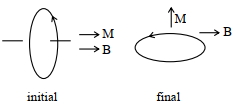
We know\(\mathrm{W}_{\text {ext }} =\Delta \mathrm{U}+\Delta \mathrm{KE} \quad(\mathrm{P} . \mathrm{E} .=-\overrightarrow{\mathrm{M}} \cdot \overrightarrow{\mathrm{B}})\)
\(=-\overrightarrow{\mathrm{M}} \cdot \overrightarrow{\mathrm{B}}_{\mathrm{f}}+\overrightarrow{\mathrm{M}} \cdot \overrightarrow{\mathrm{B}}_{\mathrm{i}}+0\)
\(=-\mathrm{MB} \cos 90+\mathrm{MB} \cos 0\)
\(=\mathrm{MB}\)
\(=\mathrm{NIAB}\)
\(=200 \times 100 \times 10^{-6} \times \frac{5}{2} \times 10^{-4} \times 1=5 \mu\)
-
- (A) \(100\)
- (B) \(99\)
- (C) \(200\)
- (D) \(199\)
Show answer and solution
Correct Answer: (A)
\(W=\Delta \mathrm{U}=\mathrm{U}_{\mathrm{f}}-\mathrm{U}_{\mathrm{i}}\)\(\mathrm{W}=(-\vec{\mu} \cdot \overrightarrow{\mathrm{B}})_{\mathrm{f}}-(-\vec{\mu} \cdot \overrightarrow{\mathrm{B}})_i\)
\(=0+(\vec{\mu} \cdot \overrightarrow{\mathrm{B}})_i\)
\(=\left(100 \times 5 \times 10^{-3} \times 1 \times 10^{-3}\right) \times 0.2 \mathrm{~J}\)
\(=1 \times 10^{-4} \mathrm{~J}=100 \mu \mathrm{J}\)
-
- (A) \(30 \ \mu \mathrm{A}\)
- (B) \(120\ \mu \mathrm{A}\)
- (C) \(60 \ \mu \mathrm{A}\)
- (D) \(180\ \mu \mathrm{A}\)
Show answer and solution
Correct Answer: (C)
\(i \propto \theta\) (angle of deflection)\( \therefore \frac{i_2}{i_1}=\frac{\theta_2}{\theta_1} \Rightarrow \frac{i_2}{200 \mu \mathrm{A}}=\frac{\pi / 10}{\pi / 3}=\frac{3}{10}\)
\( \Rightarrow \mathrm{i}_2=60\ \mu \mathrm{A}\)
-
- (A) \(0.40 \Omega\)
- (B) \(0.20 \Omega\)
- (C) \(0.50 \Omega\)
- (D) \(0.10 \Omega\)
Show answer and solution
Correct Answer: (B)
\(\mathrm{G}=200 \Omega\)\(\mathrm{i}_{\mathrm{g}}=20 \mu \mathrm{A}\)
\(\mathrm{i}=\mathrm{i}_{\mathrm{g}}\left(\frac{\mathrm{G}}{\mathrm{S}}+1\right)\)
\(\Rightarrow 20 \times 10^{-3}=20 \times 10^{-6}\left(\frac{200}{\mathrm{~S}}+1\right)\)
\(\Rightarrow \frac{200}{\mathrm{~S}}=999\)
\(\Rightarrow \mathrm{S} \approx 0.2 \Omega\)
-
- (A) \(5975 \Omega\)
- (B) \(20050 \Omega\)
- (C) \(19950 \Omega\)
- (D) \(19500 \Omega\)
Show answer and solution
Correct Answer: (C)
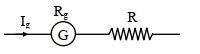
R= \(\frac{V}{I_g}-R_g=\frac{100}{5 \times 10^{-3}}-50\)\(=20000-50\)
\(=19950 \Omega\)
-
- (A) \(3 \times 10^{-3}\ \Omega\)
- (B) \(4.85 \times 10^{-3} \ \Omega\)
- (C) \(3.75 \times 10^{-3} \ \Omega\)
- (D) \(2.75 \times 10^{-3} \ \Omega\)
Show answer and solution
Correct Answer: (C)
Given \(\mathrm{G}=10\ \Omega\)\( \mathrm{I}_{\mathrm{g}}=3 \mathrm{~mA} \)
\( \mathrm{I}=8 \mathrm{~A}\)
In case of conversion of galvanometer into ammeter.
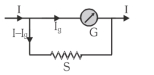
We have \(\mathrm{I}_{\mathrm{g}} \mathrm{G}=\left(\mathrm{I}-\mathrm{I}_{\mathrm{g}}\right) \mathrm{S}\)
\( S=\frac{I_g G}{I-I_g} \)
\( S=\frac{\left(3 \times 10^{-3}\right) 10}{8-0.003}=3.75 \times 10^{-5} \Omega\)
-
- (A) \(2\)
- (B) \(800\)
- (C) \(20\)
- (D) \(200\)
Show answer and solution
Correct Answer: (C)
\(\mathrm{i}_{\mathrm{g}}=\frac{10}{400+100}=20 \times 10^{-3} \mathrm{~A}\)For ammeter
Let shunt resistance \(=\mathrm{S}\)
\(i_g R=\left(i-i_g\right) S\)
\(20 \times 10^{-3} \times 100=10 S\)
\(S=20 \times 10^{-2} \Omega\)
-
- (A) \(1: 4\)
- (B) \(4: 1\)
- (C) \(1: 1\)
- (D) \(3: 4\)
Show answer and solution
Correct Answer: (C)
\(\mathrm{B}_1 2 \pi \frac{\mathrm{a}}{2}=\mu_0 \frac{\mathrm{I}}{4}\)\(\mathrm{~B}_1=\frac{\mu_0 \mathrm{I}}{4 \pi \mathrm{a}}\)
\(\mathrm{B}_2 2 \pi 2 \mathrm{a}=\mu_0 \mathrm{I}\)
\(\mathrm{B}_2=\frac{\mu_{\mathrm{v}} \mathrm{I}}{4 \pi \mathrm{a}}\)
-
- (A) \(8\)
- (B) \(7\)
- (C) \(4\)
- (D) \(3\)
Show answer and solution
Correct Answer: (C)
\(\tau=\text { BINAsin } \phi\)\(\mathrm{C} \theta=\mathrm{BINA} \sin 90^{\circ}\)
\(\mathrm{C}=\frac{\mathrm{BINA}}{\theta}=\frac{0.01 \times 10 \times 10^{-3} \times 100 \times 2 \times 10^{-4}}{0.05}\)
\(=4 \times 10^{-5} \mathrm{~N}-\mathrm{m} / \mathrm{rad} .\)
\(\mathrm{x}=4\)
-
- (A) \(1: 1\)
- (B) \(1: \sqrt{2}\)
- (C) \(\sqrt{2}: 1\)
- (D) \(1: 2\)
Show answer and solution
Correct Answer: (C)
In uniform magnetic field,\(\mathrm{R}=\frac{\mathrm{m} v}{\mathrm{qB}}=\frac{\sqrt{2 \mathrm{~m}(\mathrm{~K} \cdot \mathrm{E})}}{\mathrm{qB}}\)
Since same \(K.E\)
\(\mathrm{R} \propto \frac{\sqrt{\mathrm{m}}}{\mathrm{q}}\)
\(\therefore \frac{\mathrm{R}_{\text {deutron }}}{\mathrm{R}_{\text {proton }}}=\sqrt{\frac{\mathrm{m}_{\mathrm{d}}}{\mathrm{m}_{\mathrm{p}}}} \times \frac{\mathrm{q}_{\mathrm{p}}}{\mathrm{q}_{\mathrm{d}}}\)
\(=\sqrt{2} \times 1\)
\(\therefore \gamma_{\mathrm{d}}: \gamma_{\mathrm{p}}=\sqrt{2}: 1\)
-
- (A) \((A)\), \((B)\) and \((C)\) only
- (B) \((A)\), \((C)\) and \((D)\) only
- (C) \((A)\), \((B)\) and \((D)\) only
- (D) \((B)\), \((C)\) and \((D)\) only
Show answer and solution
Correct Answer: (C)
Net force on particle must be zero i.e. \(\mathrm{q} \overrightarrow{\mathrm{E}}+\mathrm{q} \overrightarrow{\mathrm{V}} \times \overrightarrow{\mathrm{B}}=0\)Possible cases are
\((i)\) \(\overrightarrow{\mathrm{E}} \& \overrightarrow{\mathrm{B}}=0\)
\((ii)\) \(\overrightarrow{\mathrm{V}} \times \overrightarrow{\mathrm{B}}=0, \overrightarrow{\mathrm{E}}=0\)
\((iii)\) \(\mathrm{q} \overrightarrow{\mathrm{E}}=-\mathrm{q} \overrightarrow{\mathrm{V}} \times \overrightarrow{\mathrm{B}}\)
\(\overrightarrow{\mathrm{E}} \neq 0 \& \overrightarrow{\mathrm{B}} \neq 0\)
-
- (A) \(72\)
- (B) \(75\)
- (C) \(80\)
- (D) \(82\)
Show answer and solution
Correct Answer: (A)
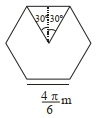
\(s = \frac{P}{n} = \frac{4\pi}{6} = \frac{2\pi}{3} \mathrm{~m}\)
\(a = \frac{s}{2 \tan(\pi/n)} = \frac{2\pi/3}{2 \tan(\pi/6)} = \frac{2\pi/3}{2(1/\sqrt{3})} = \frac{\pi\sqrt{3}}{3} \mathrm{~m}\)
\(B = \frac{n \mu_0 I}{2 \pi a} \sin(\pi/n) = \frac{6 \times (4\pi \times 10^{-7}) \times (4\pi\sqrt{3})}{2 \pi \times (\pi\sqrt{3}/3)} \times \sin(\pi/6)\)
\(B = \frac{6 \times 4\pi \times 10^{-7} \times 4\pi\sqrt{3}}{2 \pi^2 \sqrt{3}/3} \times \frac{1}{2}\)
\(B = \frac{96 \pi^2 \sqrt{3} \times 10^{-7}}{2 \pi^2 \sqrt{3}/3} \times \frac{1}{2}\)
\(B = 72 \times 10^{-7} \mathrm{~T}\)
\(x = 72\)
-
- (A) \(-\mathrm{iBR} \hat{\mathrm{j}}\)
- (B) \(2 \mathrm{iBR} \hat{\mathrm{j}}\)
- (C) \(i B R \hat{j}\)
- (D) \(-2 i B R \hat{j}\)
Show answer and solution
Correct Answer: (D)
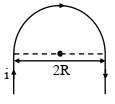
Note : Direction of magnetic field is in \(+\hat{k}\)\(\vec{F}=i \vec{\ell} \times \vec{B}\)
\(\ell=2 \mathrm{R}\)
\(\vec{F}=-2 i R B \hat{j}\)
-
- (A) \(500\)
- (B) \(400\)
- (C) \(600\)
- (D) \(300\)
Show answer and solution
Correct Answer: (A)
\(\mu_0 n i=B \quad n=\) number of turns per unit length\(\mu_0\left(\frac{\mathrm{m}}{\ell}\right) \mathrm{i}=\mathrm{B}\)
\(\mathrm{m}=\frac{\mathrm{B} \ell}{\mu_0 \mathrm{i}}=\frac{6.28 \times 10^{-3} \times 0.5}{12.56 \times 10^{-7} \times 5}\)
\(\mathrm{~m}=500\)
-
- (A) \(159\)
- (B) \(160\)
- (C) \(170\)
- (D) \(171\)
Show answer and solution
Correct Answer: (B)
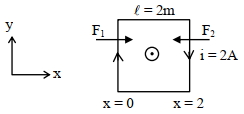
\(\mathrm{B}(\mathrm{x}=0)=\mathrm{B}_0, \quad \mathrm{~B}(\mathrm{x}=2)=9 \mathrm{~B}_0\)\(\text { Also, } \mathrm{F}=\mathrm{i} \ell \mathrm{B}\)
\(\Rightarrow \mathrm{F}_1=\mathrm{i} \ell \mathrm{B}_0 \& \mathrm{~F}_2=9 \mathrm{i} \ell \mathrm{B}_0\)
\(\mathrm{~F}=\mathrm{F}_2-\mathrm{F}_1=8 \mathrm{i} \ell \mathrm{B}_0=8 \times 2 \times 2 \times 5\)
\(\mathrm{~F}=160 \mathrm{~N}\)
-
- (A) \(2 \times 10^{-4} \mathrm{~N}-\mathrm{m}\) along positive \(\mathrm{Z}\)-direction
- (B) \(2 \times 10^{-4} \mathrm{~N}-\mathrm{m}\) along negative \(Z\)-direction
- (C) \(2 \times 10^{-4} \mathrm{~N}-\mathrm{m}\) along positive \(\mathrm{X}\)-direction
- (D) \(2 \times 10^{-4} \mathrm{~N}-\mathrm{m}\) along positive \(\mathrm{Y}\)-direction
Show answer and solution
Correct Answer: (B)
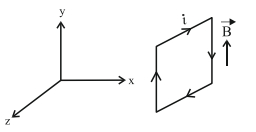
\(\overrightarrow{\mathrm{M}}=\mathrm{iA}\)\(=5 \times(0.2) \times(0.1)(-\hat{\mathrm{i}})\)
\(=0.1(-\hat{\mathrm{i}})\)
\(\vec{\tau}=\overrightarrow{\mathrm{M}} \times \overrightarrow{\mathrm{B}}=0.1(-\hat{\mathrm{i}}) \times\left(2 \times 10^{-3}\right)(\hat{\mathrm{j}})\)
\(=2 \times 10^{-4}(-\hat{\mathrm{k}}) \mathrm{N}-\mathrm{m}\)
- 243. An electron is projected with uniform velocity along the axis inside a current carrying long solenoid. Then : 2024 Hard
- (A) the electron will be accelerated along the axis.
- (B) the electron will continue to move with uniform velocity along the axis of the solenoid.
- (C) the electron path will be circular about the axis.
- (D) the electron will experience a force at \(45^{\circ}\) to the axis and execute a helical path.
Show answer and solution
Correct Answer: (B)
Since \(\vec{v} \| \vec{B}\) so force on electron due to magnetic field is zero. So it will move along axis with uniform velocity.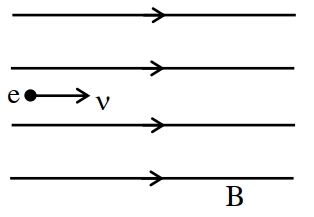
-
- (A) \(5\)
- (B) \(6\)
- (C) \(7\)
- (D) \(8\)
Show answer and solution
Correct Answer: (A)
\(\vec{F}=q(\vec{v} \times \vec{B})\)\(5 e \hat{k}=e(3 \hat{i}+5 \hat{j}) \times\left(B_0 \hat{i}+2 B_0 \hat{j}\right)\)
\(5 e \hat{k}=e\left(6 B_0 \hat{k}-5 B_0 \hat{k}\right)\)
\(\Rightarrow B_0=5 T\)
-
- (A) \(3\)
- (B) \(4\)
- (C) \(5\)
- (D) \(6\)
Show answer and solution
Correct Answer: (B)
For the given condition of moving undeflected, net force should be zero.\(\mathrm{qE} =\mathrm{qVB}\)
\(\mathrm{E} =\mathrm{VB}\)
\(=\sqrt{\frac{2 \times \mathrm{KE}}{\mathrm{m}}} \times \mathrm{B}\)
\(=\sqrt{\frac{2 \times 5 \times 1.6 \times 10^{-19}}{9 \times 10^{-31}}} \times 3 \times 10^{-6}\)
\(=4 \mathrm{~N} / \mathrm{C}\)
-
- (A) \(4 \times 10^{-8} \mathrm{~T}\)
- (B) \(8 \times 10^{-8} \mathrm{~T}\)
- (C) \(12 \times 10^{-8} \mathrm{~T}\)
- (D) \(10 \times 10^{-8} \mathrm{~T}\)
Show answer and solution
Correct Answer: (A)
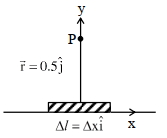
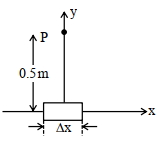
\(\overrightarrow{\mathrm{dB}}=\frac{\mu_0 \mathrm{I}}{4 \pi} \frac{(\overrightarrow{\mathrm{d} l} \times \overrightarrow{\mathrm{r}})}{\mathrm{r}^3} \text { (Tesla) }\)\(=\frac{10^{-7} \times 10 \times\left(\frac{1}{2} \times \frac{1}{100}\right)(+\hat{\mathrm{k}})}{\left(\frac{1}{2}\right)^3}=4 \times 10^{-8} \mathrm{~T}(+\hat{\mathrm{k}})\)
-
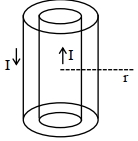
- (A) inside the outer conductor
- (B) in between the two conductors
- (C) outside the cable
- (D) inside the inner conductor
Show answer and solution
Correct Answer: (C)
\(\oint \overrightarrow{\mathrm{B}} \cdot \overrightarrow{\mathrm{d} \ell}=\mu_0 \mathrm{i}_{\mathrm{enc}}=0\)\(\dot{\triangle} \mathrm{B}=0\) outside the cable
-
- (A) \(\frac{G}{20}\)
- (B) \(\frac{G}{199}\)
- (C) \(199 \mathrm{G}\)
- (D) \(200 \mathrm{G}\)
Show answer and solution
Correct Answer: (A)
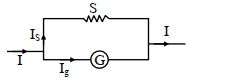
\(\mathrm{I}_{\mathrm{S}} \mathrm{S}=\mathrm{I}_{\mathrm{g}} \mathrm{G}\)\(\frac{95}{100} \mathrm{IS}=\frac{5 \mathrm{I}}{100} \mathrm{G}\)
\(\mathrm{S}=\frac{\mathrm{G}}{19}\)
\(\mathrm{R}_{\mathrm{A}}=\frac{\mathrm{SG}}{\mathrm{S}+\mathrm{G}}=\frac{\frac{\mathrm{G}^2}{19}}{\frac{20 \mathrm{G}}{19}}\)
\(\mathrm{R}_{\mathrm{A}}=\frac{\mathrm{G}}{20}\)
-
- (A) \(5\)
- (B) \(6\)
- (C) \(7\)
- (D) \(8\)
Show answer and solution
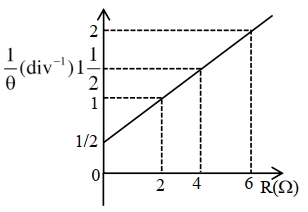
Correct Answer: (A)
\(i=K \theta\)
\(\frac{2}{G+R}=K \theta\)
\(\Rightarrow \frac{1}{\theta}=\frac{(G+R) K}{2}=R\left(\frac{K}{2}\right)+\frac{K G}{2}\)
\(\text {Slope }=\frac{K}{2}=\frac{1}{4} \Rightarrow K=0.5=5 \times 10^{-1} A\) -
- (A) \(150\)
- (B) \(160\)
- (C) \(170\)
- (D) \(180\)
Show answer and solution
Correct Answer: (B)
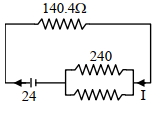
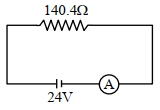
\(\text { Req }\)\(=140.4+\frac{240 \times 10}{240+10}\)
\(\text { Req }=140.4+\frac{2400}{250}\)
\(\text { Req. }=150 \Omega\)
\(\therefore\) Current in ammeter\( =\frac{24}{150}\)
\(=160 \mathrm{~mA}\)
No questions on this page match these filters.