


Questions
18 questionsShowing 1–18 of 18 questions
-
- (A) \(650 \mathrm{~nm}\)
- (B) \(1243 \mathrm{~nm}\)
- (C) \(875 \mathrm{~nm}\)
- (D) \(1400 \mathrm{~nm}\)
Show answer and solution
Correct Answer: (C)
\(\lambda=\frac{1240}{1.42}=875 \mathrm{~nm}\) (Approx) -
- (A) 2
- (B) 3
- (C) 4
- (D) 5
Show answer and solution
Correct Answer: (D)
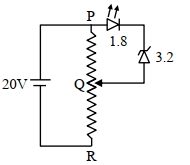
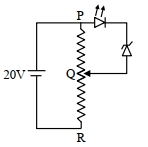
\(PR=20cm\)
\(\mathrm{~V}_{\mathrm{PQ}}=\frac{1}{4} \times \mathrm{R}_{\mathrm{PR}}\)
\(\ell_{\min }(\mathrm{PQ})=\frac{1}{4} \times 20\)
\(=5 \mathrm{~cm}\) -
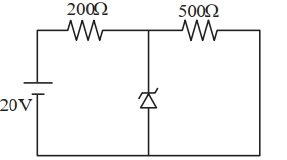
- (A) \(50 \mathrm{~mA}\)
- (B) \(0\)
- (C) \(30 \mathrm{~mA}\)
- (D) \(20 \mathrm{~mA}\)
Show answer and solution
Correct Answer: (C)
Zener is in breakdown region.
\( I_3=\frac{10}{500}=\frac{1}{50} \)
\( I_1=\frac{10}{200}=\frac{1}{20} \)
\( I_2=I_1-I_3 \)
\( I_2=\left(\frac{1}{20}-\frac{1}{50}\right)=\left(\frac{3}{100}\right)=30 \ m A\)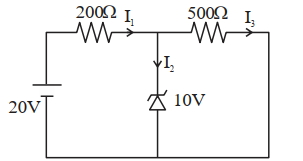
-
- (A) \(15\)
- (B) \(11\)
- (C) \(13\)
- (D) \(21\)
Show answer and solution
Correct Answer: (A)
\(\mathrm{E}_{\mathrm{s}}=\frac{\mathrm{hc}}{\lambda}=\frac{6.6 \times 10^{-34} \times 3 \times 10^8}{660 \times 10^{-9}} \mathrm{~J}\)\(=\frac{6.6 \times 10^{-34} \times 3 \times 10^8}{660 \times 10^{-9} \times 1.6 \times 10^{-19}} \mathrm{eV}\)
\(=\frac{15}{8} \mathrm{eV}\)
So \(x=15\)
-
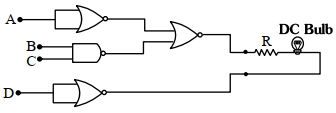
- (A) \(\mathrm{A}=0, \mathrm{~B}=1, \mathrm{C}=1, \mathrm{D}=1\)
- (B) \(\mathrm{A}=1, \mathrm{~B}=0, \mathrm{C}=0, \mathrm{D}=0\)
- (C) \(\mathrm{A}=0, \mathrm{~B}=0, \mathrm{C}=0, \mathrm{D}=1\)
- (D) \(A=1, B=1, C=1, D=0\)
Show answer and solution
Correct Answer: (B)
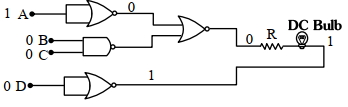
Bulb will glow if bulb have potential drop on it. One end of bulb must be at high \((1)\) and other must be at low \((0)\).Option \((2)\) satisfy this condition
-
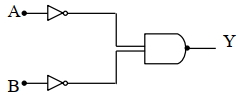
- (A) \(NAND\) - gate
- (B) \(OR\) - gate
- (C) \(AND\) gate
- (D) \(NOR\) gate
Show answer and solution
Correct Answer: (B)
\(\mathrm{Y}=\overline{\overline{\mathrm{A}} \cdot \overline{\mathrm{B}}}\)By De-Morgan Law
\(\mathrm{Y}=\overline{\overline{\mathrm{A}+\mathrm{B}}}\)
\(\mathrm{Y}=\mathrm{A}+\mathrm{B}\)
Hence \(OR\) gate
-
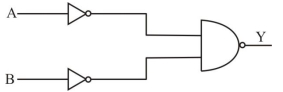
- (A) \(NAND\)
- (B) \(NOR\)
- (C) \(OR\)
- (D) \(AND\)
Show answer and solution
Correct Answer: (C)
\(\mathrm{Y}=\overline{\overline{\mathrm{A}} \cdot \overline{\mathrm{B}}}=\overline{\overline{\mathrm{A}}}+\overline{\overline{\mathrm{B}}}=\mathrm{A}+\mathrm{B}\)(De-Morgan's law)
-
- (A) reduced by \(\frac{1}{4} \mathrm{~L}\)
- (B) increased by \(2 \mathrm{~L}\)
- (C) reduced by \(\frac{3}{4} \mathrm{~L}\)
- (D) increased to \(4 \mathrm{~L}\)
Show answer and solution
Correct Answer: (C)
\(\omega^{\prime}=\omega\)\(\frac{1}{\sqrt{\mathrm{L}^{\prime} \mathrm{C}^{\prime}}}=\frac{1}{\sqrt{\mathrm{LC}}}\)
\(\therefore \mathrm{L}^{\prime} \mathrm{C}^{\prime}=\mathrm{LC}\)
\(\mathrm{L}^{\prime}(4 \mathrm{C})=\mathrm{LC}\)
\(\mathrm{L}^{\prime}=\frac{\mathrm{L}}{4}\)
\(\because\) Inductance must be decreased by \(\frac{3 L}{4}\)
-
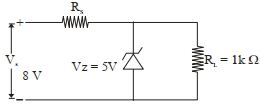
- (A) \(5 \mathrm{k} \Omega\)
- (B) \(10 \Omega\)
- (C) \(1 \mathrm{k} \Omega\)
- (D) \(10 \mathrm{k} \Omega\)
Show answer and solution
Correct Answer: (A)
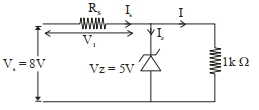
Pd across \(R_{\text {s }}\)\(V_1=8-5=3 \mathrm{~V}\)
Current through the load resistor
\(\mathrm{I}=\frac{5}{1 \times 10^3}=5 \mathrm{~mA}\)
Maximum current through Zener diode
\(I_{z \max .}=\frac{10}{5}=2 \mathrm{~mA}\)
And minimum current through Zener diode
\(\mathrm{I}_{z_{\text {min. }}}=0\)
\(\therefore \mathrm{I}_{5 \text { max. }}=5+2=7 \mathrm{~mA}\)
\(\text { And } \mathrm{R}_{5 \text { min }}=\frac{\mathrm{V}_1}{\mathrm{I}_{5 \max } \cdot}=\frac{3}{7} \mathrm{k} \Omega\)
\(\text { Similarly }\)
\(\mathrm{I}_{5 \text { min. }}=5 \mathrm{~mA}\)
\(\text { And } \mathrm{R}_{5 \text { max. }}=\frac{\mathrm{V}_1}{\mathrm{I}_{\mathrm{s} \text { min. }}}=\frac{3}{5} \mathrm{k} \Omega\)
\(\therefore \frac{3}{7} \mathrm{k} \Omega<\mathrm{R}_5<\frac{3}{5} \mathrm{k} \Omega\)
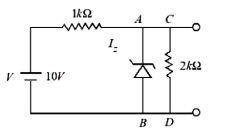
- 10. In the given circuit, the breakdown voltage of the Zener diode is \(3.0 \mathrm{~V}\). What is the value of \(\mathrm{I}_z\) ?
 2024 Hard
- (A) \(3.3 \mathrm{~mA}\)
- (B) \(5.5 \mathrm{~mA}\)
- (C) \(10 \mathrm{~mA}\)
- (D) \(7 \mathrm{~mA}\)
Show answer and solution
Correct Answer: (B)
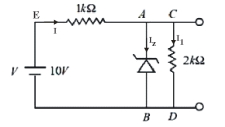
\(\mathrm{V}_z=3 \mathrm{~V}\)Let potential at \(B=0 \mathrm{~V}\)
Potential at \(E\left(V_E\right)=10 \mathrm{~V}\)
\( V_C=V_A=3 \mathrm{~V} \)
\( I_z+I_1=I \)
\( I=\frac{10-3}{1000}=\frac{7}{1000} \mathrm{~A} \)
\( I_1=\frac{3}{2000} \mathrm{~A}\)
Therefore \(I_z=\frac{7-1.5}{1000}=5.5 \mathrm{~mA}\)
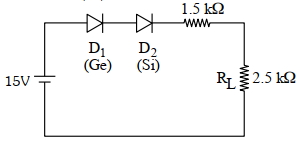
- 11. In the given circuit, the voltage across load resistance \(\left(R_L\right)\) is _______.
 2024 Hard
- (A) \(8.75 \mathrm{~V}\)
- (B) \(9.00 \mathrm{~V}\)
- (C) \(8.50 \mathrm{~V}\)
- (D) \(14.00 \mathrm{~V}\)
Show answer and solution
Correct Answer: (A)
\(\mathrm{i}=\frac{14}{4}=3.5 \mathrm{~mA}\)
\(\mathrm{V}_{\mathrm{L}}=i \mathrm{R}_{\mathrm{L}}=3.5 \times 2.5\) volt
\(=8.75 \mathrm{volt}\)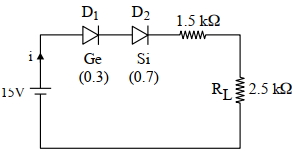
-
- (A) \(407 \mathrm{~nm}\)
- (B) \(414 \mathrm{~nm}\)
- (C) \(207 \mathrm{~nm}\)
- (D) \(103.5 \mathrm{~nm}\)
Show answer and solution
Correct Answer: (C)
\(\text { Energy }=\frac{hc}{\lambda}\)\(E=\frac{1240}{\lambda(\mathrm{nm})} \mathrm{eV}\)
\(6=\frac{1240}{\lambda(\mathrm{nm})}\)
\(\lambda=\frac{1240}{6}=207 \mathrm{~nm}\)
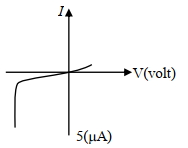
- 13. The \(I-V\) characteristics of an electronic device shown in the figure. The device is _______.
 2024 Hard
- (A) a solar cell
- (B) a transistor which can be used as an amplifier
- (C) a zener diode which can be used as voltage regulator
- (D) a diode which can be used as a rectifier
Show answer and solution
Correct Answer: (C)
TheoryZener diode used as voltage regulator
-
- (A)
\(A\) \(B\) \(Y\) \(0\) \(0\) \(0\) \(1\) \(0\) \(0\) \(0\) \(1\) \(0\) \(1\) \(1\) \(1\) - (B)
\(A\) \(B\) \(Y\) \(0\) \(0\) \(0\) \(1\) \(0\) \(1\) \(0\) \(1\) \(1\) \(1\) \(1\) \(0\) - (C)
\(A\) \(B\) \(Y\) \(0\) \(0\) \(0\) \(1\) \(0\) \(0\) \(0\) \(1\) \(0\) \(1\) \(1\) \(0\) - (D)
\(A\) \(B\) \(Y\) \(0\) \(0\) \(0\) \(1\) \(0\) \(0\) \(0\) \(1\) \(1\) \(1\) \(1\) \(0\)
Show answer and solution
Correct Answer: (C)
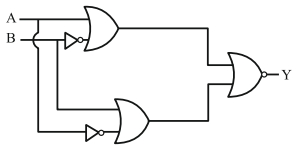
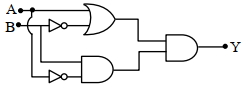
\(\text { If } \mathrm{A}=0 ; \overline{\mathrm{A}}=1\)
\(\mathrm{~A}=1 ; \overline{\mathrm{A}}=0\)
\(\mathrm{~B}=0 ; \overline{\mathrm{B}}=1\)
\(\mathrm{~B}=1 ; \overline{\mathrm{B}}=0\)
\(\mathrm{Y}=\overline{(\mathrm{A}+\overline{\mathrm{B}})+(\overline{\mathrm{A}}+\mathrm{B})}=\overline{(1+1)}=0\)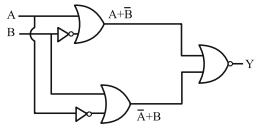
- (A)
-
- (A) \(A \cdot B(A+B)\)
- (B) \(A \cdot B\)
- (C) \(0\)
- (D) \(\bar{A} \cdot B\)
Show answer and solution
Correct Answer: (C)
By truth table\(A\) \(B\) \(Y\) \(0\) \(0\) \(0\) \(0\) \(1\) \(0\) \(1\) \(0\) \(0\) \(1\) \(1\) \(0\) -
- (A)
\(A\) \(B\) \(y\) \(0\) \(0\) \(1\) \(0\) \(1\) \(0\) \(1\) \(0\) \(0\) \(1\) \(1\) \(1\) - (B)
\(A\) \(B\) \(y\) \(0\) \(0\) \(0\) \(0\) \(1\) \(1\) \(1\) \(0\) \(1\) \(1\) \(1\) \(0\) - (C)
\(A\) \(B\) \(y\) \(0\) \(0\) \(0\) \(0\) \(1\) \(0\) \(1\) \(0\) \(0\) \(1\) \(1\) \(1\) - (D)
\(A\) \(B\) \(y\) \(0\) \(0\) \(1\) \(0\) \(1\) \(1\) \(1\) \(0\) \(1\) \(1\) \(1\) \(0\)
Show answer and solution
Correct Answer: (B)
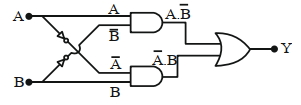
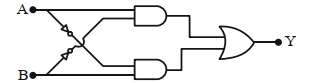
\(\mathrm{Y}=\mathrm{A} \cdot \overline{\mathrm{B}}+\overline{\mathrm{A}} \cdot \mathrm{B}\)This is \(XOR\) \(GATE\)
- (A)
-
- (A)
\(A\) \(B\) \(Y\) \(0\) \(0\) \(1\) \(0\) \(1\) \(1\) \(1\) \(0\) \(1\) \(1\) \(1\) \(0\) - (B)
\(A\) \(B\) \(Y\) \(0\) \(0\) \(0\) \(0\) \(1\) \(1\) \(1\) \(0\) \(0\) \(1\) \(1\) \(1\) - (C)
\(A\) \(B\) \(Y\) \(0\) \(0\) \(0\) \(0\) \(1\) \(0\) \(1\) \(0\) \(0\) \(1\) \(1\) \(1\) - (D)
\(A\) \(B\) \(Y\) \(0\) \(0\) \(1\) \(0\) \(1\) \(0\) \(1\) \(0\) \(1\) \(1\) \(1\) \(0\)
Show answer and solution
Correct Answer: (B)
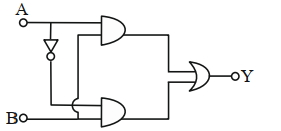
\(\mathrm{Y} =\mathrm{A} \cdot \mathrm{B}+\overline{\mathrm{A}} \cdot \mathrm{B} \)
\( =(\mathrm{A}+\overline{\mathrm{A}}) \cdot \mathrm{B} \)
\(\mathrm{Y} =1 \cdot \mathrm{B} \)
\(\mathrm{Y} =\mathrm{B}\)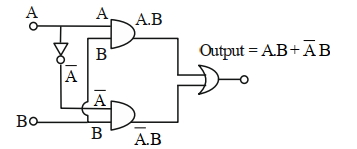
- (A)
-
- (A) \(\left(\frac{5}{2}\right) \Omega\)
- (B) \(\left(\frac{15}{4}\right) \Omega\)
- (C) \(6 \Omega\)
- (D) \(\left(\frac{30}{11}\right) \Omega\)
Show answer and solution
Correct Answer: (C)
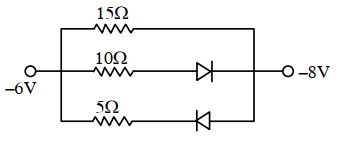
Diode \(2\) is in reverse bias
So current will not flow in branch of \(2^{\text {nd }}\) diode, So we can assume it to be broken wire.
Diode \(1\) is in forward bias
So it will behave like conducting wire. So new circuit will be
Correct answer \((3)\)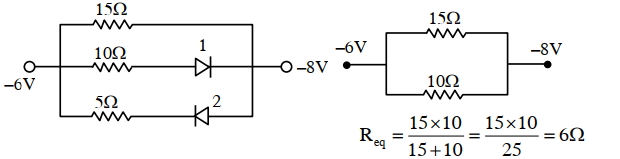
No questions on this page match these filters.