


Questions
21 questionsShowing 1–21 of 21 questions
-
- (A) \(52\)
- (B) \(42\)
- (C) \(81\)
- (D) \(12\)
Show answer and solution
Correct Answer: (C)
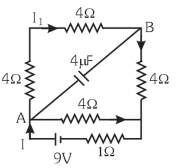
\( I=\frac{V}{R_{e q}} I=\frac{V}{R_{e q}}=\frac{9}{1+\frac{12 \times 4}{12+4}}=\frac{9}{4} \)\( I_1=\frac{9}{4} \times \frac{4}{16}=\frac{9}{16} \)
\( V_A-V_B=I_1 \times 8=\frac{9}{16} \times 8=\frac{9}{2} V \)
\( \therefore U=\frac{1}{2} \times 4 \times \frac{81}{4} \mu \mathrm{J} \)
\( \therefore U=\frac{81}{2} \mu \mathrm{J} \)
\( \therefore \mathrm{X}=81\)
-
- (A) \(1.50\)
- (B) \(1.33\)
- (C) \(0.66\)
- (D) \(1\)
Show answer and solution
Correct Answer: (A)
\(\frac{\mathrm{A} \varepsilon_{\mathrm{o}}}{\mathrm{d}}=\frac{\mathrm{A} \varepsilon_0}{\left(0.2+\frac{\mathrm{d}}{\mathrm{k}}\right)}\)\(0.6=0.2+\frac{0.6}{\mathrm{k}}\)
\(\mathrm{k}=\frac{3}{2}\)
-
- (A) \(\frac{11 \varepsilon_0 \mathrm{~A}}{18 \mathrm{~d}}\)
- (B) \(\frac{13 \varepsilon_0 \mathrm{~A}}{17 \mathrm{~d}}\)
- (C) \(\frac{11 \varepsilon_0 \mathrm{~A}}{20 \mathrm{~d}}\)
- (D) \(\frac{18 \varepsilon_0 \mathrm{~A}}{11 \mathrm{~d}}\)
Show answer and solution
Correct Answer: (A)
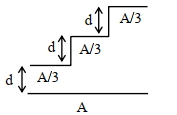
All capacitor are in parallel combination.Also effective area is common area only
\(\Rightarrow C_{e q}=C_1+C_2+C_3\)
\(\Rightarrow C_{e q}=\frac{A \varepsilon_0}{3 d}+\frac{A \varepsilon_0}{3(2 d)}+\frac{A \varepsilon_0}{3(3 d)}\)
\(\Rightarrow C_{e q}=\frac{A \varepsilon_0}{3}\left(\frac{11}{6 d}\right)\)
\(\Rightarrow C_{e q}=\frac{11 A \varepsilon_0}{18 d}\)
-
- (A) \(50\)
- (B) \(93\)
- (C) \(60\)
- (D) \(30\)
Show answer and solution
Correct Answer: (B)
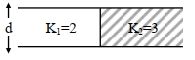
\(\mathrm{C}_{\mathrm{eq}}=\mathrm{C}_1+\mathrm{C}_2\)\(\mathrm{C}_1=\frac{2 \epsilon_0 \mathrm{~A}}{2 \times \mathrm{d}}=10 \mu \mathrm{F}\)
\(\mathrm{C}_2=\frac{3 \epsilon_0 \mathrm{~A}}{2 \mathrm{~d}}=15 \mu \mathrm{F}\)
\(\mathrm{C}_{\mathrm{eq}}=25 \mu \mathrm{F}\)
Now the charge on
\(\mathrm{C}_1=10 \mathrm{~V} \mu \mathrm{c}\)
\(\mathrm{C}_2=1.5 \mathrm{~V} \mu \mathrm{C}.\)
Now force between the plates \(\left[\mathrm{F}=\frac{\mathrm{Q}^2}{2 \mathrm{~A} \epsilon_0}\right]\)
\(\frac{100 \mathrm{~V}^2 \times 10^{-12}}{2 \times 2 \times 10^{-4} \epsilon_0}+\frac{225 \mathrm{~V}^2 \times 10^{-12}}{2 \times 2 \times 10^{-4} \times \epsilon_0}=8\)
\(325 \mathrm{~V}^2=8 \times 4 \times 10^{-4} \times 8.85\)
\(\mathrm{~V}^2-\frac{32 \times 8.85 \times 10^{-4}}{325}\)
\(\therefore \mathrm{V}=\sqrt{\frac{283.2 \times 10^{-4}}{325}}\)
\(\mathrm{~V}=0.93 \times 10^{-2}\)
-
- (A) \(45\)
- (B) \(8\)
- (C) \(2\)
- (D) \(19\)
Show answer and solution
Correct Answer: (C)
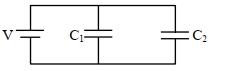
Energy loss \(=\frac{1}{2} \frac{C_1 C_2}{C_1+C_2}\left(V_1-V_2\right)^2\)\( =\frac{2}{3} \cdot E \)
\( \therefore x=2\)
-
- (A) \(720\)
- (B) \(730\)
- (C) \(750\)
- (D) \(770\)
Show answer and solution
Correct Answer: (C)
Before inserting dielectric capacitance is given \(\mathrm{C}_0=12.5 \mathrm{pF}\) and charge on the capacitor \(\mathrm{Q}=\mathrm{C}_0 \mathrm{~V}\) After inserting dielectric capacitance will become \(\epsilon_{\mathrm{s}} \mathrm{C}_0\).Change in potential energy of the capacitor
\(=\mathrm{E}_{\mathrm{i}}-\mathrm{E}_{\mathrm{r}}\)
\(=\frac{\mathrm{Q}^2}{2 \mathrm{C}_{\mathrm{i}}}-\frac{\mathrm{Q}^2}{2 \mathrm{C}_{\mathrm{f}}}=\frac{\mathrm{Q}^2}{2 \mathrm{C}_0}\left[1-\frac{1}{\epsilon_{\mathrm{r}}}\right]\)
\(=\frac{\left(\mathrm{C}_0 \mathrm{~V}\right)^2}{2 \mathrm{C}_0}\left[1-\frac{1}{\epsilon_{\mathrm{r}}}\right]=\frac{1}{2} \mathrm{C}_0 \mathrm{~V}^2\left[1-\frac{1}{\epsilon_{\mathrm{r}}}\right]\)
Using \(\mathrm{C}_0=12.5 \mathrm{pF}, \mathrm{V}=12 \mathrm{~V}, \epsilon_{\mathrm{r}}=6\)
\(=\frac{1}{2}(12.5) \times 12^2\left[1-\frac{1}{6}\right]=\frac{1}{2}(12.5) \times 12^2 \times\)
\(\frac{5}{6}\)
\(=750 \mathrm{pJ}=750 \times 10^{-12} \mathrm{~J}\)
-
- (A) \(1\)
- (B) \(2\)
- (C) \(3\)
- (D) \(4\)
Show answer and solution
Correct Answer: (B)
Without dielectric\(\mathrm{Q}=\frac{\mathrm{A} \in_0}{\mathrm{~d}} \mathrm{~V}\)
with dielectric
Q=\(\frac{A \in_0 V}{d-t+\frac{t}{K}}\)
given
\(\frac{\mathrm{A} \in_0 \mathrm{~V}}{\mathrm{~d}-\mathrm{t}+\frac{\mathrm{t}}{\mathrm{K}}}=(1.25) \frac{\mathrm{A} \in_0 \mathrm{~V}}{\mathrm{~d}}\)
\(\Rightarrow 1.25\left(3+\frac{2}{\mathrm{~K}}\right)=5\)
\(\Rightarrow \mathrm{K}=2\)
-
- (A) \(\sqrt{3} \mathrm{~V}\)
- (B) \(\sqrt{6} \mathrm{~V}\)
- (C) \(0 \mathrm{~V}\)
- (D) \(3 \mathrm{~V}\)
Show answer and solution
Correct Answer: (C)
Potential difference \(=\frac{K Q}{r_1}-\frac{K Q}{r_2}\)\( \mathrm{r}_1=\sqrt{(\sqrt{3})^2+(\sqrt{3})^2}\)
\( \mathrm{r}_2=\sqrt{(\sqrt{6})^2+0}\)
As \(r_1=r_2=\sqrt{6} \mathrm{~m}\)
So potential difference \(=0\)
-
- (A) \(35\)
- (B) \(36\)
- (C) \(37\)
- (D) \(38\)
Show answer and solution
Correct Answer: (B)
Potential at centre of half ring\(\mathrm{V}=\frac{\mathrm{KQ}}{\mathrm{R}}\)
\(\mathrm{V}=\frac{\mathrm{K} \lambda \pi \mathrm{R}}{\mathrm{R}}\)
\(\mathrm{V}=\mathrm{K} \lambda \pi \Rightarrow \mathrm{V}=9 \times 10^9 \times 4 \times 10^{-9} \pi\)
\(\mathrm{V}=36 \pi\)
-
- (A) Both \((A)\) and \((R)\) are correct but \((R)\) is not the correct explanation of \((\mathrm{A})\)
- (B) \((A)\) is correct but \((R)\) is not correct
- (C) \((A)\) is not correct but \((R)\) is correct
- (D) Both \((A)\) and \((R)\) are correct and \((R)\) is the correct explanation of \((A)\)
Show answer and solution
Correct Answer: (D)
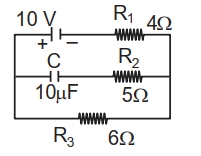
Electric line of force are always perpendicular to equipotential surface so angle between farce and displacement will always be \(90^{\circ}\). So work done equal to \(0\) . - 11. In an electrical circuit drawn below the amount of charge stored in the capacitor is _______ \(\mu \mathrm{C}\).
 2024 Hard
- (A) \(50\)
- (B) \(60\)
- (C) \(70\)
- (D) \(80\)
Show answer and solution
Correct Answer: (B)
In steady state there will be no current in branch of capacitor, so no voltage drop across \(\mathrm{R}_2=5 \Omega\)
\(\mathrm{I}_2=0\)
\(\mathrm{I}_1=\mathrm{I}_3=\frac{10}{4+6}=1 \mathrm{~A}\)
\(\mathrm{~V}_{\mathrm{R}_3}=\mathrm{V}_{\mathrm{c}}+\mathrm{V}_{\mathrm{R}_2} \quad \mathrm{~V}_{\mathrm{R}_2}=0\)
\(\mathrm{I}_3 \mathrm{R}_3=\mathrm{V}_{\mathrm{c}}\)
\(\mathrm{V}_{\mathrm{c}}=1 \times 6=6 \mathrm{volt}\)
\(\mathrm{q}_{\mathrm{c}}=\mathrm{CV}_{\mathrm{c}}=10 \times 6=60 \mu \mathrm{C}\)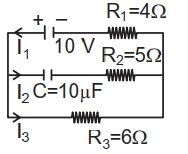
-
- (A) \(25\)
- (B) \(26\)
- (C) \(27\)
- (D) \(28\)
Show answer and solution
Correct Answer: (C)
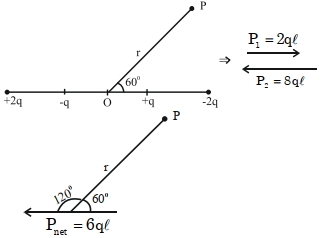
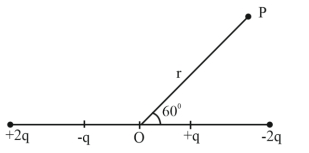
\(\mathrm{V}=\frac{\mathrm{K} \dot{\mathrm{p}} \cdot \overrightarrow{\mathrm{r}}}{\mathrm{r}^3}=\frac{9 \times 10^9(6 \mathrm{q} \ell)}{\mathrm{r}^2} \cos \left(120^{\circ}\right)\)\(=-(27)\left(\frac{\mathrm{q} \ell}{\mathrm{r}^2}\right) \times 10^9 \mathrm{Nm}^2 \mathrm{c}^{-2}\)
\(\Rightarrow \alpha=27\)
-
- (A) 12
- (B) 14
- (C) 16
- (D) 18
Show answer and solution
Correct Answer: (C)
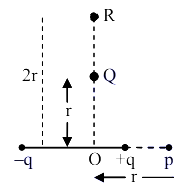
\(E_P=\frac{2 K P}{r^3}=E\)
\(E_R=\frac{K P}{(2 r)^3}=\frac{E}{16}\)
\(x=16\) -
- (A) \(2\)
- (B) \(3\)
- (C) \(4\)
- (D) \(6\)
Show answer and solution
Correct Answer: (C)
\(\mathrm{E}=\frac{\mathrm{E}_0}{3} \Rightarrow \mathrm{V}=\frac{\mathrm{V}_0}{3}\)\(\frac{\mathrm{V}_0}{3}=\mathrm{V}_0 \mathrm{e}^{-\frac{\mathrm{t}}{\mathrm{t}}}\)
\(\mathrm{t}=\tau \ell \mathrm{n} 3\)
\(6.6 \times 10^{-6}=\mathrm{R}\left(1.5 \times 10^{-6}\right)(1.1)\)
\(\mathrm{R}=\frac{6}{1.5}=4 \Omega\)
- 15. The electrostatic potential due to an electric dipole at a distance '\(r\)' varies as _______. 2024 Hard
- (A) \(\mathrm{r}\)
- (B) \(\frac{1}{r^2}\)
- (C) \(\frac{1}{r^3}\)
- (D) \(\frac{1}{r}\)
Show answer and solution
Correct Answer: (B)
\(V=\frac{k P \cos \theta}{r^2}\)& can also checked dimensionally
- 16. The vehicles carrying inflammable fluids usually have _______ metallic chains touching the ground. 2024 Hard
- (A) To conduct excess charge due to air friction to ground and prevent sparking.
- (B) To alert other vehicles.
- (C) To protect tyres from catching dirt from ground.
- (D) It is a custom.
Show answer and solution
Correct Answer: (A)
Static charge is developed due to air friction. This can result in combustion. So, metallic chains is used to discharge excess charge. -
- (A) \(85\)
- (B) \(86\)
- (C) \(87\)
- (D) \(88\)
Show answer and solution
Correct Answer: (B)
In parallel combination : Potential difference is same across all\(\text { Energy }=\frac{1}{2}\left(\mathrm{C}_1+\mathrm{C}_2+\mathrm{C}_3\right) \mathrm{V}^2\)
\(=\frac{1}{2}(25+30+45) \times(100)^2 \times 10^{-6}=0.5=\mathrm{E}\)
In series combination: Charge is same on all.
\(\frac{1}{\mathrm{C}_{\text {equ }}}=\frac{1}{\mathrm{C}_1}+\frac{1}{\mathrm{C}_2}+\frac{1}{\mathrm{C}_3}=\frac{1}{25}+\frac{1}{30}+\frac{1}{45}\)
\(\frac{1}{\mathrm{C}_{\text {equ }}}=\frac{(18+15+10)}{450}=\frac{43}{450} \Rightarrow \mathrm{C}_{\text {equ }}=\frac{450}{43}\)
\(\text { Energy }=\frac{Q^2}{2 C_1}+\frac{Q^2}{2 C_2}+\frac{Q^2}{2 C_3}\)
\(=\frac{Q^2}{2}\left[\frac{1}{C_1}+\frac{1}{C_2}+\frac{1}{C_3}\right]\)
\(\frac{\left(V \times C_{\text {equ }}\right.}{2} \times \frac{1}{C_{\text {equ }}}frac{V^2 C_{\text {equ }}}{2}\)
\(\frac{(100)^2}{2} \times \frac{450}{} \times 10^{-6}\)
\(\Rightarrow \frac{4.5}{86}=\frac{9}{x} E=\frac{9}{x} \times 0.5 \Rightarrow x=86\)
-
- (A) \(\sqrt{\mathrm{ab}}\)
- (B) \(a b\)
- (C) \(\frac{a}{b}\)
- (D) \(\frac{\mathrm{b}}{\mathrm{a}}\)
Show answer and solution
Correct Answer: (C)
Potential at surface will be same\(\frac{\mathrm{Kq}_1}{\mathrm{a}}=\frac{\mathrm{Kq}}{\mathrm{b}}\)
\(\frac{\mathrm{q}_1}{\mathrm{q}_2}=\frac{\mathrm{a}}{\mathrm{b}}\)
-
- (A) \(\frac{1}{4} \mathrm{CV}^2\)
- (B) \(2 \mathrm{CV}^2\)
- (C) \(\frac{1}{2} \mathrm{CV}^2\)
- (D) \(\frac{3}{4} \mathrm{CV}^2\)
Show answer and solution
Correct Answer: (A)
\(\mathrm{V}_{\mathrm{C}}-\frac{\mathrm{q}_{\text {net }}}{\mathrm{C}_{\text {net }}}=\frac{\mathrm{CV}+2 \mathrm{CV}}{2 \mathrm{C}}\)\(\mathrm{V}_{\mathrm{C}}=\frac{3 \mathrm{~V}}{2}\)
Loss of energy
\(=\frac{1}{2} \mathrm{CV}^2+\frac{1}{2} \mathrm{C}(2 \mathrm{~V})^2-\frac{1}{2} 2 \mathrm{C}\left(\frac{3 \mathrm{~V}}{2}\right)^2\)
\(=\left(\frac{\mathrm{CV}^2}{4}\right)\)
-
- (A) \(1\)
- (B) \(3\)
- (C) \(2\)
- (D) \(10\)
Show answer and solution
Correct Answer: (C)
\(\text T \cos \theta=\mathrm{mg}\)
\(\mathrm{T} \sin \theta=\mathrm{F}_{\mathrm{e}}\)
\(\tan \theta=\frac{\mathrm{Fe}_{\mathrm{e}}}{\mathrm{mg}}\)
\(\tan \theta=\frac{F_e}{\rho_B V g}\) \(....(i)\)
\(\tan \theta=\frac{F_e}{\frac{k}{\left(\rho_B-\rho_{\mathrm{L}}\right) V g}}\) \(....(ii)\)
\(\text {From Eq. (i) (ii) }\)
\(\rho_{\mathrm{B}} \mathrm{Vg}=\left(\rho_{\mathrm{B}}-\rho_{\mathrm{L}}\right) \mathrm{kVg}\)
\(1.4=0.7 \mathrm{k}\)
\(\mathrm{k}=2\)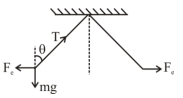
-
- (A) \(4\)
- (B) \(8\)
- (C) \(7\)
- (D) \(3\)
Show answer and solution
Correct Answer: (D)
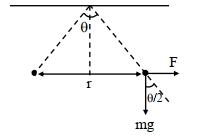
In air \(\tan \frac{\theta}{2}=\frac{F}{m g}=\frac{q^2}{4 \pi \varepsilon_0 \mathrm{r}^2 m g}\)In water \(\tan \frac{\theta}{2}=\frac{\mathrm{F}^{\prime}}{\mathrm{mg}^{\prime}}=\frac{\mathrm{q}^2}{4 \pi \varepsilon_0 \varepsilon_{\mathrm{r}} \mathrm{r}^2 \mathrm{mg}_{\text {eff }}}\)
Equate both equations
\(\varepsilon_0 g=\varepsilon_0 \varepsilon_{\mathrm{r}} \mathrm{g}\left[1-\frac{1}{1.5}\right]\)
\(\varepsilon_{\mathrm{T}}=3\)
No questions on this page match these filters.