


Questions
16 questionsShowing 1–16 of 16 questions
-
- (A) \(318 \mathrm{~J}\)
- (B) \(298 \mathrm{~J}\)
- (C) \(284 \mathrm{~J}\)
- (D) \(142 \mathrm{~J}\)
Show answer and solution
Correct Answer: (C)
\( \mathrm{Q}=\Delta \mathrm{U} \text { as work done is zero [constant volume] } \)\( \Delta \mathrm{U}=\mathrm{ms} \Delta \mathrm{T} \)
\( =0.08 \times(170 \times 4.18) \times 5 \)
\( \simeq 284 \mathrm{~J}\)
-
- (A) \(850 \mathrm{~J}\)
- (B) \(800 \mathrm{~J}\)
- (C) \(600 \mathrm{~J}\)
- (D) \(700 \mathrm{~J}\)
Show answer and solution
Correct Answer: (D)
\(\gamma=1+\frac{2}{f}=1.4 \Rightarrow \frac{2}{f}=0.4\)\(\Rightarrow f=5\)
\(W=n R \Delta T=200 J\)
\(Q=\left(\frac{f+2}{2}\right) n R \Delta T\)
\(=\frac{7}{2} \times 200=700 J\)
-
- (A) \(29 \mathrm{RT}\)
- (B) \(20 \mathrm{RT}\)
- (C) \(27 \mathrm{RT}\)
- (D) \(21 \mathrm{RT}\)
Show answer and solution
Correct Answer: (C)
\(\mathrm{U}=\mathrm{nC}_{\mathrm{V}} \mathrm{T}\)\(\Rightarrow \mathrm{U}=\mathrm{n}_1 \mathrm{C}_{\mathrm{V}_1} \mathrm{~T}+\mathrm{n}_2 \mathrm{C}_{\mathrm{V}_2} \mathrm{~T}\)
\(\Rightarrow 8 \times \frac{3 \mathrm{R}}{2} \times \mathrm{T}+6 \times \frac{5 \mathrm{R}}{2} \times \mathrm{T}\)
\(=27 \mathrm{RT}\)
-
- (A) \(225 \mathrm{~J}\)
- (B) \(205 \mathrm{~J}\)
- (C) \(20 \mathrm{~J}\)
- (D) \(-20 \mathrm{~J}\)
Show answer and solution
Correct Answer: (B)
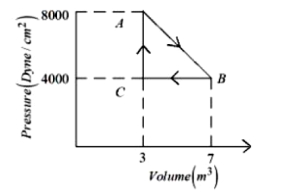
\(\mathrm{W}_{\mathrm{AB}} =\int \mathrm{PdV} \quad \text { (Assuming } \mathrm{T} \text { to be constant) }\)\(=\int \frac{\mathrm{RTdV}}{\mathrm{V}^3}\)
\(=\mathrm{RT} \int_2^4 \mathrm{~V}^{-3} \mathrm{dV}\)
\(=8 \times 300 \times\left(-\frac{1}{2}\left[\frac{1}{4^2}-\frac{1}{2^2}\right]\right)\)
\(=225 \mathrm{~J}\)
\(\mathrm{~W}_{\mathrm{BC}} =\mathrm{P} \int_4^2 \mathrm{dV}=10(2-4)=-20 \mathrm{~J}\)
\(\mathrm{~W}_{\mathrm{CA}} =0\)
\(\therefore \mathrm{W}_{\text {cyck }} =205 \mathrm{~J}\)
Note: Data is inconsistent in process \(A B\).
So needs to be challenged.
-
- (A) \(\mathrm{RT}[2-\sqrt{2}]\)
- (B) \(\frac{\mathrm{R}}{\mathrm{T}}[2-\sqrt{2}]\)
- (C) \(\mathrm{RT}[2+\sqrt{2}]\)
- (D) \(\frac{T}{R}[2+\sqrt{2}]\)
Show answer and solution
Correct Answer: (A)
\(\mathrm{TV}^{\gamma-1}=\text { constant }\)\(\Rightarrow \mathrm{T}(\mathrm{V})^{\frac{3}{2}-1}=\mathrm{T}_{\mathrm{f}}(2 \mathrm{~V})^{\frac{3}{2}-1}\)
\(\Rightarrow \mathrm{TV}^{\frac{1}{2}}=\mathrm{T}_{\mathrm{f}}(2)^{\frac{1}{2}}(\mathrm{~V})^{\frac{1}{2}}\)
\(\Rightarrow \mathrm{T}_{\mathrm{f}}=\left(\frac{\mathrm{T}}{\sqrt{2}}\right)\)
\(\text { Now, W.D. }=\frac{\mathrm{nR} \Delta \mathrm{T}}{1-\gamma}=\frac{1 \cdot \mathrm{R}\left[\frac{\mathrm{T}}{\sqrt{2}}-\mathrm{T}\right]}{1-\frac{3}{2}}\)
\(\Rightarrow \text { W.D. }=2 \mathrm{RT}\left[1-\frac{1}{\sqrt{2}}\right]\)
\(\Rightarrow \text { W.D. }=\mathrm{RT}[2-\sqrt{2}]\)
-
- (A) \(\mathrm{RT}[\sqrt{2}-2]\)
- (B) \(\mathrm{RT}[1-2 \sqrt{2}]\)
- (C) \(\mathrm{RT}[2 \sqrt{2}-1]\)
- (D) \(\mathrm{RT}[2-\sqrt{2}]\)
Show answer and solution
Correct Answer: (D)
\(\mathrm{W}=\frac{\mathrm{nR} \Delta \mathrm{T}}{1-\gamma}\)\(\mathrm{TV}^{\gamma-1}=\text { constant }=\mathrm{T}_{\mathrm{f}}(2 \mathrm{~V})^{\gamma-1}\)
\(\mathrm{~T}_{\mathrm{f}}=\mathrm{T}\left(\frac{1}{2}\right)^{1 / 2}=\frac{\mathrm{T}}{\sqrt{2}}\)
\(\mathrm{~W}=\frac{\mathrm{R}\left(\frac{\mathrm{T}}{\sqrt{2}}-\mathrm{T}\right)}{1-\frac{3}{2}}=2 \mathrm{RT} \frac{(\sqrt{2}-1)}{\sqrt{2}}\)
\(=\mathrm{RT}(2-\sqrt{2})\)
-
- (A) \(33800 \mathrm{~J}\)
- (B) \(2200 \mathrm{~J}\)
- (C) \(800 \mathrm{~J}\)
- (D) \(1200 \mathrm{~J}\)
Show answer and solution
Correct Answer: (C)
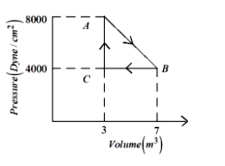
Work done \(\mathrm{AB}=\frac{1}{2}(8000+6000)\) Dyne \(/ \mathrm{cm}^2 \times\) \(4 \mathrm{~m}^3=\left(6000 \mathrm{Dyne} / \mathrm{cm}^2\right) \times 4 \mathrm{~m}^3\)Work done \(\mathrm{BC}=-\left(4000\right.\) Dyne \(\left./ \mathrm{cm}^2\right) \times 4 \mathrm{~m}^3\)
Total work done \(=2000\) Dyne \(/ \mathrm{cm}^2 \times 4 \mathrm{~m}^3\)
\(=2 \times 10^3 \) \(\times \frac{1}{10^5} \frac{\mathrm{N}}{\mathrm{cm}^2} \times 4 \mathrm{~m}^3 \)
\( =2 \times 10^{-2} \times \frac{\mathrm{N}}{10^{-4} \mathrm{~m}^2} \times 4 \mathrm{~m}^3 \)
\( =2 \times 10^2 \times 4 \mathrm{Nm}=800 \mathrm{~J}\)
-
- (A) \(72.9 \mathrm{~J}\)
- (B) \(24.9 \mathrm{~J}\)
- (C) \(48 \mathrm{~J}\)
- (D) \(23.1 \mathrm{~J}\)
Show answer and solution
Correct Answer: (D)
\(1^{\text {st }}\) law of thermodynamics\(\Delta \mathrm{Q}=\Delta \mathrm{U}+\mathrm{W}\)
\(\Rightarrow+48=\mathrm{nC}_{\mathrm{v}} \Delta \mathrm{T}+\mathrm{W}\)
\(\Rightarrow 48=(1)\left(\frac{3 \mathrm{R}}{2}\right)(2)+\mathrm{W}\)
\(\Rightarrow \mathrm{W}=48-3 \times \mathrm{R}\)
\(\Rightarrow \mathrm{W}=48-3 \times(8.3)\)
\(\Rightarrow \mathrm{W}=23.1 \text { Joule }\)
-
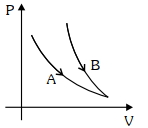
- (A) \(\mathrm{PV}^\gamma=\mathrm{k}\) for process \(\mathrm{B}\) and \(\mathrm{PV}=\mathrm{k}\) for process \(\mathrm{A}\).
- (B) \(\mathrm{PV}=\mathrm{k}\) for process \(\mathrm{B}\) and \(\mathrm{A}\).
- (C) \(\frac{P^{\gamma-1}}{T^\gamma}=k\) forprocess \(B\) and \(T=k\) for process \(A\)
- (D) \(\frac{T^\gamma}{P^{\gamma-1}}=k\) for process \(A\) and \(P V=k\) for process \(B\).
Show answer and solution
Correct Answer: (A)
Steeper curve \((B)\) is adiabaticAdiabatic \(\Rightarrow \mathrm{PV}^{\prime}=\) const.
Or \(\mathrm{P}\left(\frac{\mathrm{T}}{\mathrm{P}}\right)^{\mathrm{r}}=\) const.
\(\frac{\mathrm{T}^v}{\mathrm{P}^{v-1}}=\text { const. }\)
Curve \((A)\) is isothermal
\(\mathrm{T}=\) const.
\(\mathrm{PV}=\) const.
-
- (A) \(\frac{5}{3}\)
- (B) \(\frac{9}{7}\)
- (C) \(\frac{3}{2}\)
- (D) \(\frac{7}{5}\)
Show answer and solution
Correct Answer: (C)
\(\mathrm{P} \propto \mathrm{T}^3\)\(\mathrm{PT}^{-3}=\text { constant }\)
\(\because \frac{\mathrm{PV}}{\mathrm{T}}=\mathrm{nR}=\text { constant from ideal gas equation }\)
\((\mathrm{P})(\mathrm{PV})^{-3}=\text { constant }\)
\(\mathrm{P}^{-2} \mathrm{~V}^{-3}=\text { cosntant } \quad . .(1)\)
\(\because \text { Process equation for adiabatic process is }\)
\(\mathrm{PV}^y=\text { constant } \quad . .(2)\)
\(\text { Comparing equation (1) and (2) }\)
\(\frac{\mathrm{C}_{\mathrm{p}}}{\mathrm{C}_{\mathrm{V}}}=\mathrm{y}=\frac{3}{2}\)
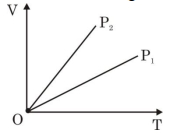
- 11. The given figure represents two isobaric processes for the same mass of an ideal gas, then ....
 2024 Hard
- (A) \(P_2 \geq P_1\)
- (B) \(P_2>P_1\)
- (C) \(P_1=P_2\)
- (D) \(P_1>P_2\)
Show answer and solution
Correct Answer: (D)
\(\mathrm{PV}=\mathrm{nRT}\)\(\mathrm{V}=\left(\frac{\mathrm{nR}}{\mathrm{P}}\right)_{\mathrm{T}}\)
\(\text { Slope }=\frac{\mathrm{nR}}{\mathrm{P}}\)
\(\text { Slope } \propto \frac{1}{\mathrm{P}}\)
\((\text { Slope })_2>(\text { Slope })_1\)
\(\mathrm{P}_2<\mathrm{P}_1\)
-
- (A) \(61.6 \mathrm{~J}\)
- (B) \(431.2 \mathrm{~J}\)
- (C) \(616 \mathrm{~J}\)
- (D) \(19.6 \mathrm{~J}\)
Show answer and solution
Correct Answer: (A)
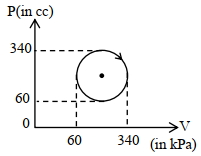
\(\Delta \mathrm{U}=0 \text { (Cyclic process) }\)\(\Delta \mathrm{Q}=\mathrm{W}=\text { area of } \mathrm{P}-\mathrm{V} \text { curve. }\)
\(=\pi \times\left(140 \times 10^3 \mathrm{~Pa}\right) \times\left(140 \times 10^{-6} \mathrm{~m}^3\right)\)
\(\Delta \mathrm{Q}=61.6 \mathrm{~J}\)
-
- (A) \(2\left(\mathrm{P}_1 \mathrm{~V}_1-\mathrm{P}_2 \mathrm{~V}_2\right)\)
- (B) \(2\left(\mathrm{P}_2 \mathrm{~V}_2-\mathrm{P}_1 \mathrm{~V}_1\right)\)
- (C) \(2\left(\sqrt{\mathrm{P}_1} V_1-\sqrt{\mathrm{P}_2} V_2\right)\)
- (D) \(2\left(\mathrm{P}_2 \sqrt{\mathrm{V}_2}-\mathrm{P}_1 \sqrt{\mathrm{V}_1}\right)\)
Show answer and solution
Correct Answer: (A)
For \(\mathrm{PV}^{\mathrm{x}}=\) constantIf work done by gas is asked then
\({W}=\frac{\mathrm{nR} \Delta \mathrm{T}}{1-\mathrm{x}}\)
Here x \(=\frac{3}{2}\)
\( W =\frac{\mathrm{P}_2 \mathrm{~V}_2-\mathrm{P}_1 \mathrm{~V}_1}{-\frac{1}{2}}\)
\(=2\left(\mathrm{P}_1 \mathrm{~V}_1-\mathrm{P}_2 \mathrm{~V}_2\right) \ldots . \text { Option (1) is correct }\)
If work done by external is asked then
\(\mathrm{W}=-2\left(\mathrm{P}_1 \mathrm{~V}_1-\mathrm{P}_2 \mathrm{~V}_2\right) \ldots \ldots\) Option \((2)\) is correct
- 14. The specific heat at constant pressure of a real gas obeying \(\mathrm{PV}^2=\mathrm{RT}\) equation is _______. 2024 Hard
- (A) \(\mathrm{C}_{\mathrm{V}}+\mathrm{R}\)
- (B) \(\frac{\mathrm{R}}{3}+\mathrm{C}_{\mathrm{V}}\)
- (C) \(\mathrm{R}\)
- (D) \(C_V+\frac{R}{2 V}\)
Show answer and solution
Correct Answer: (D)
\(\mathrm{dQ}=\mathrm{du}+\mathrm{dW}\)\(\mathrm{CdT}=\mathrm{C}_{\mathrm{V}} \mathrm{dT}+\mathrm{PdV}\) \(....(1)\)
\(\therefore \quad \mathrm{PV}^2=\mathrm{RT}\)
\(\quad \mathrm{P}=\text { constant }\)
\(\quad \mathrm{P}(2 \mathrm{VdV})=\mathrm{RdT}\)
\(\quad \mathrm{PdV}=\frac{\mathrm{RdT}}{2 \mathrm{~V}}\)
Put in equation \((1)\)
\(\mathrm{C}=\mathrm{C}_{\mathrm{V}}+\frac{\mathrm{R}}{2 \mathrm{~V}}\)
-
- (A) \(\frac{4}{5}\)
- (B) \(\frac{16}{25}\)
- (C) \(\frac{8}{5 \sqrt{5}}\)
- (D) \(\frac{2}{\sqrt{5}}\)
Show answer and solution
Correct Answer: (C)
For Adiabatic process\(P_i V_i=P_f V_f^\gamma\)
\(P_i(5)^{1.5}=P_f(4)^{1.5}\)
\(\frac{P_i}{P_f}=\left(\frac{4}{5}\right)^{\frac{3}{2}}=\frac{4}{5} \cdot\left(\frac{4}{5}\right)^{\frac{1}{2}} \Rightarrow \frac{8}{5 \sqrt{5}}\)
-
- (A) \(\frac{V_a}{V_d}=\left(\frac{V_b}{V_c}\right)^{-1}\)
- (B) \(\frac{V_a}{V_d} \neq \frac{V_b}{V_c}\)
- (C) \(\frac{V_a}{V_d}=\frac{V_b}{V_c}\)
- (D) \(\frac{V_a}{V_d}=\left(\frac{V_b}{V_c}\right)^2\)
Show answer and solution
Correct Answer: (C)
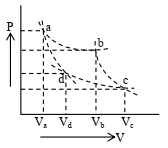
For adiabatic process\(\mathrm{TV}^{\gamma-1}=\text { constant }\)
\(\mathrm{T}_{\mathrm{a}} \cdot \mathrm{V}_{\mathrm{a}}^{\gamma-1}=\mathrm{T}_{\mathrm{d}} \cdot \mathrm{V}_{\mathrm{d}}^{\gamma-1}\)
\(\left(\frac{\mathrm{V}_{\mathrm{a}}}{\mathrm{V}_{\mathrm{d}}}\right)^{\gamma-1}=\frac{\mathrm{T}_{\mathrm{d}}}{\mathrm{T}_{\mathrm{a}}}\)
\(\mathrm{T}_{\mathrm{b}} \cdot \mathrm{V}_{\mathrm{b}}^{\gamma-1}=\mathrm{T}_{\mathrm{c}} \cdot \mathrm{V}_{\mathrm{c}}^{\gamma-1}\)
\(\left(\frac{\mathrm{V}_{\mathrm{b}}}{\mathrm{V}_{\mathrm{c}}}\right)^{\gamma-1}=\frac{\mathrm{T}_{\mathrm{c}}}{\mathrm{T}_{\mathrm{b}}}\)
\(\mathrm{T}_{\mathrm{b}} \cdot \mathrm{V}_{\mathrm{b}}^{\gamma-1}=\mathrm{T}_{\mathrm{c}} \cdot \mathrm{V}_{\mathrm{c}}^{\gamma-1}\)
\(\left(\frac{\mathrm{V}_{\mathrm{b}}}{\mathrm{V}_{\mathrm{c}}}\right)^{\gamma-1}=\frac{\mathrm{T}_{\mathrm{c}}}{\mathrm{T}_{\mathrm{b}}}\)
\(\frac{\mathrm{V}_{\mathrm{a}}}{\mathrm{V}_{\mathrm{d}}}=\frac{\mathrm{V}_{\mathrm{b}}}{\mathrm{V}_{\mathrm{c}}} \quad\left(\begin{array}{r}\because \mathrm{T}_{\mathrm{d}}=\mathrm{T}_{\mathrm{c}} \\ \mathrm{T}_{\mathrm{a}}=\mathrm{T}_{\mathrm{b}}\end{array}\right)\)
No questions on this page match these filters.