


Questions
23 questionsShowing 1–23 of 23 questions
-
- (A) \(350 \mathrm{~J}\)
- (B) \(490 \mathrm{~J}\)
- (C) \(150 \mathrm{~J}\)
- (D) \(250 \mathrm{~J}\)
Show answer and solution
Correct Answer: (A)
For Isobaric process\(\mathrm{w}=\mathrm{P} \Delta \mathrm{v}=\mathrm{nR} \Delta \mathrm{T}=100 \mathrm{~J}\)
\(\mathrm{Q}=\Delta \mathrm{u}+\mathrm{w}\)
\(\Delta \mathrm{Q}=\frac{\mathrm{F}}{2} \mathrm{nR} \Delta \mathrm{T}+\mathrm{nR} \Delta \mathrm{T}\)
\(\left(\frac{\mathrm{f}}{2}+1\right) \mathrm{nR} \Delta \mathrm{T}\)
\(\left(\frac{5}{2}+1\right) 100=350 \mathrm{~J}\)
-
- (A) \(\frac{7}{5}\)
- (B) \(\frac{3}{2}\)
- (C) \(\frac{3}{5}\)
- (D) \(\frac{5}{3}\)
Show answer and solution
Correct Answer: (C)
\(\frac{\left(\mathrm{C}_{\mathrm{v}}\right)_{\text {mono }}}{\left(\mathrm{C}_{\mathrm{v}}\right)_{\text {dia }}}=\frac{\frac{3}{2} \mathrm{R}}{\frac{5}{2} \mathrm{R}}=\frac{3}{5}\) -
- (A) \(\frac{1}{32}\)
- (B) \(\frac{2 \sqrt{2}}{1}\)
- (C) \(\frac{1}{4}\)
- (D) \(\frac{1}{2 \sqrt{2}}\)
Show answer and solution
Correct Answer: (B)
\(\mathrm{V}_{\mathrm{rms}} =\sqrt{\frac{3 \mathrm{RT}}{\mathrm{M}_{\mathrm{w}}}}\)\(\Rightarrow \frac{\mathrm{V}_{\mathrm{O}_2}}{\mathrm{~V}_{\mathrm{He}}}\) \(=\sqrt{\frac{\mathrm{M}_{\mathrm{w}, \mathrm{He}}}{\mathrm{M}_{\mathrm{w}, \mathrm{O}_2}}}\)
\(=\sqrt{\frac{4}{32}}=\frac{1}{2 \sqrt{2}}\)
\(\frac{\mathrm{V}_{\mathrm{He}}}{\mathrm{V}_{\mathrm{O}_2}} =\frac{2 \sqrt{2}}{1}\)
-
- (A) \(36\ \mathrm{Nm}^{-2}\)
- (B) \(18\ \mathrm{Nm}^{-2}\)
- (C) \(6 \ \mathrm{Nm}^{-2}\)
- (D) \(2\ \mathrm{Nm}^{-2}\)
Show answer and solution
Correct Answer: (C)
\( \text { Radiation pressure }=\frac{I}{V} \)\( =\frac{I \cdot \mu}{c} \)
\( =\frac{6 \times 10^8 \times 3}{3 \times 10^8} \)
\( =6 \mathrm{~N} / \mathrm{m}^2\)
-
- (A) \(80 \mathrm{~K}\)
- (B) \(-73 \mathrm{~K}\)
- (C) \(4 \mathrm{~K}\)
- (D) \(20 \mathrm{~K}\)
Show answer and solution
Correct Answer: (D)
\( \sqrt{\frac{3 R T}{2}}=\sqrt{\frac{3 R(320)}{32}} \)\( T=\frac{320}{16}=20 \mathrm{~K}\)
-
- (A) \(\frac{5}{3}\)
- (B) \(\frac{3}{2}\)
- (C) \(\frac{7}{5}\)
- (D) \(\frac{9}{7}\)
Show answer and solution
Correct Answer: (B)
\( \mathrm{P} \propto \mathrm{T}^3 \Rightarrow \mathrm{PT}^{-3}=\text { constant } \)\( \mathrm{PV}^\gamma=\text { const } \)
\( \mathrm{P}\left(\frac{\mathrm{nRT}}{\mathrm{P}}\right)^\gamma=\text { const } \)
\( \mathrm{P}^{1-\gamma} \mathrm{T}^\gamma=\text { const }\)
\( \mathrm{PT}^{\frac{\gamma}{1-\gamma}}=\text { const } \)
\( \frac{\gamma}{1-\gamma}=-3 \)
\( \gamma=-3+3 \gamma \)
\( 3=2 \gamma \)
\( \gamma=\frac{3}{2}\)
- 7. Energy of \(10\) non rigid diatomic molecules at temperature \(\mathrm{T}\) is _______. 2024 Hard
- (A) \(\frac{7}{2} \mathrm{RT}\)
- (B) \(70 \mathrm{~K}_{\mathrm{B}} \mathrm{T}\)
- (C) \(35 \mathrm{RT}\)
- (D) \(35 \mathrm{~K}_{\mathrm{B}} \mathrm{T}\)
Show answer and solution
Correct Answer: (D)
\(\text { Degree of freedom }(f)=5+2(3 N-5)\)\( f=5+2(3 \times 2-1)=7\)
\(\text { energy of one molecule }=\frac{f}{2} K_B T\)
energy of 10 molecules
\(=10\left(\frac{\mathrm{f}}{2} \mathrm{~K}_{\mathrm{B}} \mathrm{T}\right)=10\left(\frac{7}{2} \mathrm{~K}_{\mathrm{B}} \mathrm{T}\right)=35 \mathrm{~K}_{\mathrm{B}} \mathrm{T}\)
-
- (A) Statement \(I\) is false but Statement \(II\) is true.
- (B) Statement \(I\) is true but Statement \(II\) is false.
- (C) Both Statement \(I\) and Statement \(II\) are false
- (D) Both Statement \(I\) and Statement \(II\) are true.
Show answer and solution
Correct Answer: (D)
The mean free path \( \lambda \) of gas molecules is given by:
\( \lambda = \frac{1}{\sqrt{2}\,\pi d^2 n} \)where \( d \) is the molecular diameter and \( n \) is the number density. Hence,
\( \lambda \propto \frac{1}{d^2} \)Therefore, Statement (I) is true.
The average kinetic energy of a gas molecule is:
\( \langle E_k \rangle = \frac{3}{2}kT \)which shows that the average kinetic energy is directly proportional to the absolute temperature \( T \). Hence, Statement (II) is also true.
However, the mean free path depends on molecular diameter and number density, not directly on the average kinetic energy or temperature.
Both Statement (I) and Statement (II) are true, but Statement (II) is not the correct explanation of Statement (I).
-
- (A) \(\frac{1}{\sqrt{2 n \pi d^2}}\)
- (B) \(\sqrt{2} \mathrm{n} \pi \mathrm{d}^2\)
- (C) \(\frac{1}{\sqrt{2} \mathrm{n} \pi \mathrm{d}^2}\)
- (D) \(\frac{1}{\sqrt{2} n^2 \pi^2 d^2}\)
Show answer and solution
Correct Answer: (C)
\(\mathrm{n}=\) number of molecule per unit volume\(\mathrm{d}=\) diameter of the molecule
\(\lambda=\frac{1}{\sqrt{2} \pi \mathrm{d}^2 \mathrm{n}}\) (By Theory)
-
- (A) \(\frac{\sqrt{3}}{2} \mathrm{Z}\)
- (B) \(\frac{4}{3} \mathrm{Z}\)
- (C) \(\frac{2}{\sqrt{3}} \mathrm{Z}\)
- (D) \(\frac{3}{4} Z\)
Show answer and solution
Correct Answer: (C)
Assuming mean free path constant.\(\mathrm{f} \propto \mathrm{v} \propto \sqrt{\mathrm{T}}\)
\(\frac{\mathrm{f}_1}{\mathrm{f}_2}=\sqrt{\frac{\mathrm{T}_1}{\mathrm{~T}_2}}=\sqrt{\frac{300}{400}}\)
\(\mathrm{f}_2=\sqrt{\frac{4}{3}}=\mathrm{f}_1=\frac{2}{\sqrt{3}} \mathrm{Z}\)
-
- (A) \(2.0\)
- (B) \(0.5\)
- (C) \(1.5\)
- (D) \(1.0\)
Show answer and solution
Correct Answer: (B)
\(V_{1 \mathrm{~ms}}=\sqrt{\frac{3 \mathrm{RT}}{\mathrm{M}}}\)\(\frac{\mathrm{V}_1}{\mathrm{~V}_2}=\sqrt{\frac{\mathrm{M}_2}{\mathrm{M}_1}} \Rightarrow \frac{2}{\mathrm{~V}_2}=\sqrt{\frac{32}{2}}\)
\(\mathrm{~V}_2=0.5 \mathrm{~km} / \mathrm{s}\)
-
- (A) \(1.75\)
- (B) \(1.40\)
- (C) \(1.52\)
- (D) \(1.35\)
Show answer and solution
Correct Answer: (C)
\(\mathrm{f}_1=3, \quad \mathrm{f}_2=5\)\(\mathrm{n}_1=3, \quad \mathrm{n}_2=2\)
\(\mathrm{f}_{\text {mixture }}=\frac{\mathrm{n}_1 \mathrm{f}_1+\mathrm{n}_2 \mathrm{f}_2}{\mathrm{n}_1+\mathrm{n}_2}=\frac{9+10}{\mathrm{f}}=\frac{19}{5}\)
\(\gamma_{\text {mixture }}=1+\frac{2 \times 5}{19}=\frac{29}{19}=1.52\)
-
- (A) \(6\)
- (B) \(3\)
- (C) \(4\)
- (D) \(2\)
Show answer and solution
Correct Answer: (C)
\(\mathrm{f}_{\mathrm{eq}}=\frac{\mathrm{n}_1 \mathrm{f}_1+\mathrm{n}_2 \mathrm{f}_2}{\mathrm{n}_1+\mathrm{n}_2}\)For diatomic gas \(\mathrm{f}_{\mathrm{eq}}=5\)
\( 5=\frac{(N)(6)+(2)(3)}{N+2} \)
\( 5 N+10=6 N+6 \)
\( N=4\)
-
- (A) \(\rho_2<\rho_3\)
- (B) \(\rho_1>\rho_2\)
- (C) \(\rho_1<\rho_2\)
- (D) \(\rho_1=\rho_2=\rho_3\)
Show answer and solution
Correct Answer: (B)
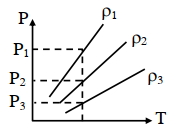
For ideal gas\(P V=n R T\)
\(P V=\frac{m}{M} R T\)
\(P=\left(\frac{M}{V}\right) \frac{R T}{M}\)
\(P=\frac{\rho R T}{M}\)
(Where \(\mathrm{m}\) is mass of gas and \(\mathrm{M}\) is molecular mass of gas)
for same temperature \(\mathrm{P}_1>\mathrm{P}_2>\mathrm{P}_3\)
So \(\rho_1>\rho_2>\rho_3\)
So correct answer is \((2)\)
-
- (A) \(3000 \mathrm{~K}\)
- (B) \(3200 \mathrm{~K}\)
- (C) \(1600 \mathrm{~K}\)
- (D) \(1500 \mathrm{~K}\)
Show answer and solution
Correct Answer: (B)
For monoatomic molecule degree of freedom \(=3\).\( \therefore \mathrm{K}_{v-\mathrm{g}}=\frac{3}{2} \mathrm{~K}_{\mathrm{B}} \mathrm{T} \)
\( \mathrm{T}=\frac{0.414 \times 1.6 \times 10^{-19} \times 2}{3 \times 1.38 \times 10^{-23}} \)
\( =3200 \mathrm{~K}\)
- 16. The parameter that remains the same for molecules of all gases at a given temperature is _______. 2024 Hard
- (A) kinetic energy
- (B) momentum
- (C) mass
- (D) speed
Show answer and solution
Correct Answer: (A)
\(\mathrm{KE}=\frac{\mathrm{f}}{2} \mathrm{kT}\)Conceptual
-
- (A) \(500 \mathrm{~K}\)
- (B) \(200 \mathrm{~K}\)
- (C) \(100 \mathrm{~K}\)
- (D) \(300 \mathrm{~K}\)
Show answer and solution
Correct Answer: (A)
\( \mathrm{PV}=\mathrm{nRT} \)\( \mathrm{PV}=\frac{\mathrm{N}}{\mathrm{N}_{\mathrm{A}}} \mathrm{RT}\)
\(\mathrm{N}=\) Total no. of molecules
\(\mathrm{P}=\frac{\mathrm{N}}{\mathrm{V}} \mathrm{kT}\)
\(1.38 \times 1.01 \times 10^5=2 \times 10^{25} \times 1.38 \times 10^{-23} \times \mathrm{T}\)
\(1.01 \times 10^5=2 \times 10^2 \times \mathrm{T}\)
\(\mathrm{T}=\frac{1.01 \times 10^3}{2} \approx 500 \mathrm{~K}\)
-
- (A) \(-39^{\circ} \mathrm{C}\)
- (B) \(117^{\circ} \mathrm{C}\)
- (C) \(127^{\circ} \mathrm{C}\)
- (D) \(-78^{\circ} \mathrm{C}\)
Show answer and solution
Correct Answer: (B)
\(\mathrm{K} . \mathrm{E}=\frac{\mathrm{nf}_1 \mathrm{RT}}{2}\)\(\mathrm{~T}_{\mathrm{i}}=-78^{\circ} \mathrm{C} \rightarrow 273+\left[-78^{\circ} \mathrm{C}\right]=195 \mathrm{~K}\)
\(\mathrm{~K} . \mathrm{E} \alpha \mathrm{T}\)
To double the \(K.E\) energy temp also become double
\(\mathrm{T}_{\mathrm{f}}=390 \mathrm{~K}\)
\(\mathrm{~T}_{\mathrm{f}}=117^{\circ} \mathrm{C}\)
-
- (A) \(6845.5 \mathrm{~J}\)
- (B) \(5942.0 \mathrm{~J}\)
- (C) \(6232.5 \mathrm{~J}\)
- (D) \(5670.5 \mathrm{~J}\)
Show answer and solution
Correct Answer: (C)
\( \text { Kinetic energy }=\frac{f}{2} \mathrm{nRT} \)\( =\frac{5}{2} \times 1 \times 8.31 \times 300 \mathrm{~J} \)
\( =6232.5 \mathrm{~J}\)
-
- (A) \(f=2\) and \(f=2\)
- (B) \(f_t=3\) and \(f=3\)
- (C) \(f=3\) and \(f=2\)
- (D) \(f=2\) and \(f=3\)
Show answer and solution
Correct Answer: (B)
\(\text { Since } \mathrm{CH}_4 \text { is polyatomic Non-Linear }\)\(\text { D.O.F of } \mathrm{CH}_4\)
\(\text { T. DOF }=3\)
\(\text { R DOF }=3\)
-
- (A) \(\frac{9}{4} R\)
- (B) \(\frac{7}{4} R\)
- (C) \(\frac{3}{2} R\)
- (D) \(\frac{5}{2} R\)
Show answer and solution
Correct Answer: (A)
\( \mathrm{C}_{\mathrm{V}} \)\( =\frac{\mathrm{n}_1 \mathrm{C}_{\mathrm{r}_1}+\mathrm{n}_2 \mathrm{C}_{\mathrm{r}_2}}{\mathrm{n}_1+\mathrm{n}_2} \)\( =\frac{2 \times \frac{3}{2} \mathrm{R}+6 \times \frac{5}{2} \mathrm{R}}{2+6} \)
\( =\frac{9}{4} \mathrm{R}\)
-
- (A) \(C_B=\infty, C_A=0\)
- (B) \(C_A=0\) and \(C_B=\infty\)
- (C) \(C_P>C_B>C_A>C_v\)
- (D) \(C_A>C_P>C_V\)
Show answer and solution
Correct Answer: (C)
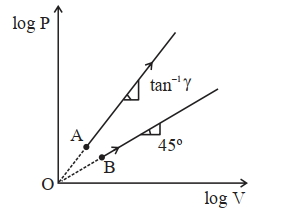
For process \(\mathrm{A}\)
\( \log P=\gamma \log \mathrm{V} \Rightarrow \mathrm{P}=\mathrm{V}^\gamma,(\gamma>1) \)
\( P V^{-\gamma}=\text { Constant } \)
\( C_A=C_V+\frac{R}{1+\gamma} \ldots . \text { (i) }\)
Likewise for process \(\mathrm{B} \rightarrow P V^{-1}=\) \(Cons\) \(\tan t\)
\(C_B\) \( =C_v+\frac{R}{1+1} \)
\(C_B\) \( =C_v+\frac{R}{2} \) \(.............(ii)\)
\(C_P\) \(=C_v+R\) \(...........(iii)\)
By \((i)\), \((ii)\) & \((iii)\) \(C_P>C_B>C_A>C_v\) [No answer matching] -
- (A) \(16\)
- (B) \(8\)
- (C) \(4\)
- (D) \(32\)
Show answer and solution
Correct Answer: (A)
\(\frac{\mathrm{P}_{\mathrm{A}} \mathrm{V}_{\mathrm{A}}}{\mathrm{P}_{\mathrm{B}} \mathrm{V}_{\mathrm{B}}}=\frac{\mathrm{n}_{\mathrm{A}} R \mathrm{RT}_{\mathrm{A}}}{\mathrm{n}_{\mathrm{B}} \mathrm{RT}_{\mathrm{B}}}\)Given \(V_A=V_B\)
And \(T_{\mathrm{A}}=T_{\mathrm{B}}\)
\(\frac{\mathrm{P}_{\mathrm{A}}}{\mathrm{P}_{\mathrm{B}}}=\frac{\mathrm{n}_{\mathrm{A}}}{\mathrm{n}_{\mathrm{B}}}\)
\(\frac{\mathrm{P}_{\mathrm{A}}}{\mathrm{P}_{\mathrm{B}}}=\frac{1 / 2}{1 / 32}=16\)
No questions on this page match these filters.