


Questions
25 questionsShowing 1–25 of 25 questions
-
- (A) \(8\)
- (B) \(9\)
- (C) \(10\)
- (D) \(11\)
Show answer and solution
Correct Answer: (A)
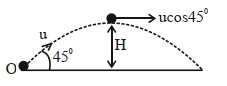
\(\mathrm{L}=\mathrm{mu} \cos \theta \frac{\mathrm{u}^2 \sin ^2 \theta}{2 \mathrm{~g}}\)\(=m \mathrm{u}^3 \frac{1}{4 \sqrt{2} \mathrm{~g}} \Rightarrow \mathrm{x}=8\)
-
- (A) \(45\)
- (B) \(60\)
- (C) \(75\)
- (D) \(12\)
Show answer and solution
Correct Answer: (B)
\(y-x-4=0\)\(d_1\) is perpendicular distance of given line from origin.
\(\mathrm{d}_1=\left|\frac{-4}{\sqrt{1^2+1^2}}\right| \Rightarrow 2 \sqrt{2} \mathrm{~m}\)
So \(|\overrightarrow{\mathrm{L}}|=\operatorname{mvd}_1 =5 \times 3 \sqrt{2} \times 2 \sqrt{2} \mathrm{~kg} \mathrm{~m}^2 / \mathrm{s} \)
\( =60 \mathrm{~kg} \mathrm{~m}^2 / \mathrm{s}\)
-
- (A) \(3\)
- (B) \(4\)
- (C) \(5\)
- (D) \(6\)
Show answer and solution
Correct Answer: (A)
For slipping\(\mathrm{a}=\mathrm{g} \sin \theta\)
\(\ell=\frac{1}{2} \mathrm{at}^2 \Rightarrow \mathrm{t}=\sqrt{\frac{2 \ell}{\mathrm{g} \sin \theta}}\)
For rolling
\(\mathrm{a}^{\prime}=\frac{\mathrm{g} \sin \theta}{1+\frac{\mathrm{k}^2}{\mathrm{R}^2}}\left[\mathrm{k}=\frac{\mathrm{R}}{\sqrt{2}}\right]\)
\(\Rightarrow \mathrm{a}^{\prime}=\frac{2 \mathrm{~g} \sin \theta}{3}\)
\(\ell=\frac{1}{2} \mathrm{a}^{\prime}\left(\mathrm{t}^{\prime}\right)^2\)
\(\Rightarrow \mathrm{t}^{\prime}=\sqrt{\frac{6 \ell}{2 \mathrm{~g} \sin \theta}}=\sqrt{\frac{\alpha}{2}} \sqrt{\frac{2 \ell}{\mathrm{s} \sin \theta}}\)
\(\Rightarrow \alpha=3 \)
-
- (A) \(1\)
- (B) \(5\)
- (C) \(7\)
- (D) \(10\)
Show answer and solution
Correct Answer: (D)
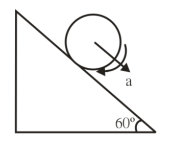
For rolling motion, \(\mathrm{a}=\frac{\mathrm{g} \sin \theta}{1+\frac{\mathrm{I}_{\mathrm{cm}}}{\mathrm{MR}^2}}\)\( a=\frac{g \sin \theta}{1+\frac{1}{2}} \)
\( =\frac{2 \times 10 \times \frac{\sqrt{3}}{2}}{3} \)
\( =\frac{10}{\sqrt{3}}\)
Therefore \(\mathrm{x}=10\)
-
- (A) \(\frac{v^2}{g}\)
- (B) \(\frac{3}{4} \frac{v^2}{g}\)
- (C) \(\frac{1}{2} \frac{v^2}{g}\)
- (D) \(\frac{2}{3} \frac{v^2}{g}\)
Show answer and solution
Correct Answer: (C)
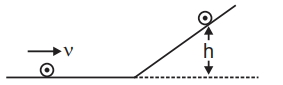
Only the translational kinetic energy of disc changes into gravitational potential energy. And rotational \(\mathrm{KE}\) remains unchanged as there is no friction.\(\frac{1}{2} \mathrm{mv}^2=\mathrm{mgh}\)
\(\mathrm{h}=\frac{\mathrm{v}^2}{2 \mathrm{~g}}\)
-
- (A) \(6 \mathrm{~kg}\)
- (B) \(12 \mathrm{~kg}\)
- (C) \(3 \mathrm{~kg}\)
- (D) \(6 \sqrt{3} \mathrm{~kg}\)
Show answer and solution
Correct Answer: (C)
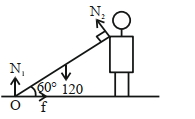
Torque about \(\mathrm{O}=0\)\( 120\left(\frac{\mathrm{L}}{2} \cos 60^{\circ}\right)-\mathrm{N}_2 \mathrm{~L}=0 \)
\( \mathrm{~N}_2=30 \mathrm{~N}\)
-
- (A) \(\frac{W}{2}\)
- (B) \(W\)
- (C) \(\mathrm{W} \cos \theta\)
- (D) \(\mathrm{W} \sin \theta\)
Show answer and solution
Correct Answer: (A)
\(R=\) net reaction force by shoulder
Balancing torque about pt of contact on ground:
\(\mathrm{W}\left(\frac{\mathrm{L}}{2} \cos \theta\right)=\mathrm{R}(\mathrm{L} \cos \theta)\)
\(\Rightarrow \mathrm{R}=\frac{\mathrm{W}}{2}\)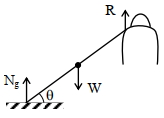
-
- (A) \(2\)
- (B) \(5\)
- (C) \(4\)
- (D) \(3\)
Show answer and solution
Correct Answer: (A)
\(\frac{\frac{1}{2} \mathrm{I} \omega^2}{\frac{1}{2} \mathrm{I} \omega^2+\frac{1}{2} m v^2}=\frac{\left(\frac{1}{2}\right)\left(\frac{2}{3} m R^2\right) \omega^2}{\left(\frac{1}{2}\right)\left(\frac{2}{3} \mathrm{mR}^2\right) \omega^2+\frac{1}{2} \mathrm{~m}(\mathrm{R} \omega)^2}\)\(=\frac{\frac{2}{3}}{\frac{2}{3}+1}=\frac{2}{5}\)
\(\mathrm{x}=2\)
-
- (A) \(\frac{\sqrt{3}}{16} \frac{\mathrm{mu}^3}{\mathrm{~g}}\)
- (B) \(\frac{\sqrt{3}}{2} \frac{m u^2}{g}\)
- (C) \(\frac{m u^3}{\sqrt{2} g}\)
- (D) zero
Show answer and solution
Correct Answer: (A)
\( \mathrm{L}=m u \cos \theta H \)\( =m u \cos \theta \times \frac{u^2 \sin ^2 \theta}{2 g} \)
\( =\frac{m u^3}{2 g} \times \frac{\sqrt{3}}{2} \times\left(\frac{1}{2}\right)^2=\frac{\sqrt{3} m u^3}{16 g}\)
-
- (A) \(5\)
- (B) \(7\)
- (C) \(10\)
- (D) \(40\)
Show answer and solution
Correct Answer: (B)
In pure rolling work done by friction is zero. Hence potential energy is converted into kinetic energy. Since initially the ring and the sphere have same potential energy, finally they will have same kinetic energy too.\(\therefore\) Ratio of kinetic energies \(=1\)
\(\Rightarrow \frac{7}{x}=1 \Rightarrow x=7\)
-
- (A) \(3\)
- (B) \(4\)
- (C) \(5\)
- (D) \(6\)
Show answer and solution
Correct Answer: (D)
Using work energy theorem\(\mathrm{W}=\Delta \mathrm{KE}=0-\left(\frac{1}{2} \mathrm{mv}^2+\frac{1}{2} \mathrm{I} \omega^2\right)\)
\(\mathrm{W}=0-\frac{1}{2} \mathrm{mv}^2\left(1+\frac{\mathrm{K}^2}{\mathrm{R}^2}\right) \)
\(=-\frac{1}{2} \times 50 \times 0.4^2\left(1+\frac{1}{2}\right)=-6 \mathrm{~J}\)
Absolute work \(=+6 \mathrm{~J}\)
\(W=-6 J \quad|W|=6 J\)
-
- (A) \(6\)
- (B) \(7\)
- (C) \(8\)
- (D) \(9\)
Show answer and solution
Correct Answer: (B)
\(\text { Gain in P.E. }=\text { Loss in K.E. }\)\(\mathrm{mgh}=\frac{1}{2} \mathrm{mv}^2\left(1+\frac{\mathrm{K}^2}{\mathrm{R}^2}\right)\)
\(\mathrm{h} \propto 1+\frac{\mathrm{K}^2}{\mathrm{R}^2}\)
\(\frac{\mathrm{h}_1}{\mathrm{~h}_2}=\frac{1+\frac{2}{5}}{1+1}=\frac{7}{5 \times 2}=\frac{7}{10}\)
\(\mathrm{n}=7\)
-
- (A) \(100\)
- (B) \(199\)
- (C) \(198\)
- (D) \(99\)
Show answer and solution
Correct Answer: (A)
\(\tau=\mathrm{FR}=\mathrm{I} \alpha \Rightarrow 40 \times 0.1=0.4 \alpha\)\(\alpha=10 \mathrm{rad} / \mathrm{s}^2\)
\(\mathrm{~W}_{\mathrm{f}}=10 \times 10=100 \mathrm{rad} / \mathrm{s}\)
-
- (A) \(\frac{4}{5} \omega\)
- (B) \(\frac{5}{4} \omega\)
- (C) \(\frac{2}{3} \omega\)
- (D) \(\frac{3}{2} \omega\)
Show answer and solution
Correct Answer: (C)
\(\mathrm{I}_1 \omega=\mathrm{I}_2 \omega_2\)\(\frac{\mathrm{MR}^2}{2} \omega=\frac{3}{2}\left(\frac{\mathrm{MR}^2}{2}\right) \omega_2\)
\(\omega_2=\frac{2}{3} \omega\)
-
- (A) \(4\)
- (B) \(5\)
- (C) \(6\)
- (D) \(7\)
Show answer and solution
Correct Answer: (A)
Impulse \(\mathrm{J}=0.2 \mathrm{~N}-\mathrm{S}\)\(\mathrm{J}=\int \mathrm{Fdt}=0.2 \mathrm{~N}-\mathrm{s}\)
Angular impuls ( \(\overrightarrow{\mathrm{M}})\)
\(\overrightarrow{\mathrm{M}}_{\mathrm{c}}=\int \tau \mathrm{dt}\)
\(=\int \mathrm{F} \frac{\mathrm{L}}{2} \mathrm{dt}\)
\(=\frac{\mathrm{L}}{2} \int \mathrm{Fdt}=\frac{\mathrm{L}}{2} \times \mathrm{J}v\)
\(=\frac{0.3}{2} \times 0.2\)
\(=0.03\)
\(I_{c m}=\frac{\mathrm{LL}^2}{12}=\frac{2 \times(0.3)^2}{12}=\frac{0.09}{6}\)
\(\mathrm{M}=\mathrm{I}_{\mathrm{cm}}\left(\omega_{\mathrm{f}}-\omega_{\mathrm{i}}\right)\)
\(0.03=\frac{0.09}{6}\left(\omega_{\mathrm{f}}\right)\)
\(\omega_{\mathrm{f}}=2 \mathrm{rad} / \mathrm{s}\)
\(\theta=\omega \mathrm{t}\)
\(\mathrm{t}=\frac{\theta}{\omega}=\frac{\pi}{2 \times 2}=\frac{\pi}{4} \mathrm{sec} .\)
\(\mathrm{X}=4\)
-
- (A) \(15\)
- (B) \(17\)
- (C) \(18\)
- (D) \(20\)
Show answer and solution
Correct Answer: (A)
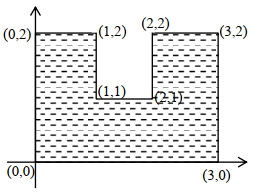
\(\mathrm{m}_1 =\sigma \times 5=10 \mathrm{Kg}\)
\(\mathrm{m}_1 =\sigma \times 5=10 \mathrm{Kg} \quad \mathrm{m}_2=\sigma \times 1=2 \mathrm{Kg}\)
\(\mathrm{m}_3=\sigma \times 6=12 \mathrm{Kg}\)
\(\Rightarrow \mathrm{m}_1 \mathrm{x}_1+\mathrm{m}_2 \mathrm{x}_2=\mathrm{m}_3 \mathrm{x}_3\)
\(10 \mathrm{x}_1+2(1.5)=12(1.5) \Rightarrow \mathrm{x}_1=1.5 \mathrm{~cm}\)
\(\Rightarrow \mathrm{m}_1 \mathrm{y}_1+\mathrm{m}_2 \mathrm{y}_2=\mathrm{m}_3 \mathrm{y}_3\)
\(10 \mathrm{y}_1+2(1.5)=12 \times 1 \Rightarrow \mathrm{y}_1=0.9 \mathrm{~cm}\)
\(\frac{\mathrm{x}_1}{\mathrm{y}_1}=\frac{1.5}{0.9}=\frac{15}{9}\)
\(\mathrm{n}=15\)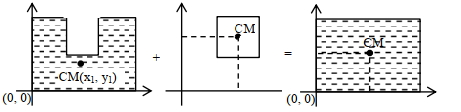
-
- (A) \(349\)
- (B) \(248\)
- (C) \(78\)
- (D) \(250\)
Show answer and solution
Correct Answer: (D)
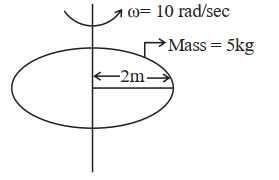
\( \vec{L}_i=I \omega_i=\frac{M R^2}{2} \cdot \omega=100 \mathrm{kgm}^2 / \mathrm{s} \)
\( E_i=\frac{1}{2} \cdot \frac{M R^2}{2} \cdot \omega^2=500 \mathrm{~J} \)
\( \vec{L}_i=\vec{L}_f \Rightarrow 100=2 I \omega_f \)
\( \omega_{\mathrm{f}}=5 \mathrm{rad} / \mathrm{sec} \)
\( E_f=2 \times \frac{1}{2} \cdot \frac{5(2)^2}{2} \cdot(5)^2=250 \mathrm{~J} \)
\( \Delta E=250 \mathrm{~J}\) -
- (A) \(35\)
- (B) \(16\)
- (C) \(42\)
- (D) \(75\)
Show answer and solution
Correct Answer: (B)
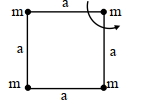
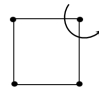
\( \mathrm{I}=m a^2+m a^2+\mathrm{m}(\sqrt{2} \mathrm{a})^2 \)\( =4 \mathrm{ma}^2 \)
\( =4 \times 1 \times(2)^2=16\)
-
- (A) \(13\)
- (B) \(15\)
- (C) \(20\)
- (D) \(25\)
Show answer and solution
Correct Answer: (A)
By conservation of angular momentum\(\mathrm{I}_1 \omega_1=\mathrm{I}_2 \omega_2\)
\(\left(\frac{2}{5} \mathrm{MR}^2\right) \frac{2 \pi}{\mathrm{T}_1}=\frac{2}{5} \mathrm{M}\left(\frac{3}{4} \mathrm{R}\right)^2 \frac{2 \pi}{\mathrm{T}_2}\)
\(\frac{1}{\mathrm{~T}_1}=\frac{9}{16 \mathrm{~T}_2}\)
\(\frac{1}{\mathrm{~T}_2}=\frac{9}{16} \times \mathrm{T}_1=\frac{9}{16} \times 24 \mathrm{hr}=\frac{27}{2} \mathrm{hr}=13 \mathrm{hr} 30 \text { mins. }\)
-
- (A) \(5\)
- (B) \(4\)
- (C) \(6\)
- (D) \(3\)
Show answer and solution
Correct Answer: (D)
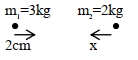
\(\Delta \mathrm{X}_{\text {C.O.M }}=\frac{\mathrm{m}_1 \Delta \mathrm{x}_1+\mathrm{m}_2 \Delta \mathrm{x}_2}{\mathrm{~m}_1+\mathrm{m}_2}\)\(\Rightarrow 0=\frac{3 \times 2+2(-\mathrm{x})}{3+2}\)
\(\Rightarrow \mathrm{x}=3 \mathrm{~cm}\)
-
- (A) \(34\)
- (B) \(17\)
- (C) \(67\)
- (D) \(51\)
Show answer and solution
Correct Answer: (C)
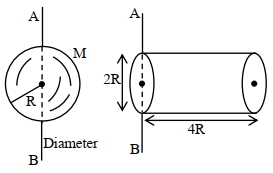
\(\mathrm{I}_{\text {sphere }}=\frac{2}{3} \mathrm{MR}^2=\mathrm{Mk}_1^2\)\(\mathrm{I}_{\text {cylinder }}=\frac{1}{12} \mathrm{M}\left(4 \mathrm{R}^2\right)+\frac{1}{4} \mathrm{MR}^2+\mathrm{M}(2 \mathrm{R})^2\)
\(=\frac{67}{12} \mathrm{MR}^2=\mathrm{Mk}_2^2\)
\(\frac{\mathrm{k}_1}{\mathrm{k}_2}=\sqrt{\frac{2}{3} \cdot \frac{12}{67}}=\sqrt{\frac{8}{67}}\)
-
- (A) \(2\)
- (B) \(3\)
- (C) \(4\)
- (D) \(5\)
Show answer and solution
Correct Answer: (B)
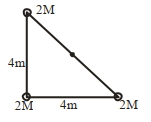
\(\text { Position vector } \overrightarrow{\mathrm{r}}_{\text {COM }}=\frac{\mathrm{m}_1 \overrightarrow{\mathrm{r}}_1+\mathrm{m}_2 \overrightarrow{\mathrm{r}}_2+\mathrm{m}_3 \overrightarrow{\mathrm{r}}_3}{\mathrm{~m}_1+\mathrm{m}_2+\mathrm{m}_3}\)\(\overrightarrow{\mathrm{r}}_{\text {COM }}=\frac{2 \mathrm{M} \times 0+2 \mathrm{M} \times 4 \hat{\mathrm{i}}+2 \mathrm{M} \times 4 \hat{\mathrm{j}}}{6 \mathrm{M}}\)
\(\overrightarrow{\mathrm{r}}=\frac{4}{3} \hat{\mathrm{i}}+\frac{4}{3} \hat{\mathrm{j}}\)
\(|\overrightarrow{\mathrm{r}}|=\frac{4 \sqrt{2}}{3}\)
\(\mathrm{x}=3\)
-
- (A) \(5\)
- (B) \(8\)
- (C) \(7\)
- (D) \(4\)
Show answer and solution
Correct Answer: (D)
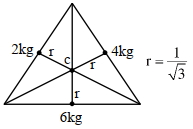
Moment of inertia about \(\mathrm{C}\) and perpendicular to the plane is:\(\mathrm{I} =\mathrm{r}^2[2+4+6]\)
\(=\frac{1}{3} \times 12\)
\(\mathrm{I} =4 \mathrm{~kg}-\mathrm{m}^2\)
-
- (A) \(20\)
- (B) \(22\)
- (C) \(24\)
- (D) \(30\)
Show answer and solution
Correct Answer: (C)
\(I_1 \omega_1+I_2 \omega_2=\left(I_1+I_2\right) \omega_0 \text { (C.O.A.M.) }\)\(\text { gives } \omega_0=8 \mathrm{rad} / \mathrm{s}\)
\(E_1=\frac{1}{2} I_1 \omega_1^2+\frac{1}{2} I_2 \omega_2^2=216 J\)
\(E_2=\frac{1}{2}\left(I_1+I_2\right) \omega_0^2=192 J\)
\(\therefore \Delta E=24 J\)
-
- (A) \(48\)
- (B) \(49\)
- (C) \(50\)
- (D) \(53\)
Show answer and solution
Correct Answer: (D)
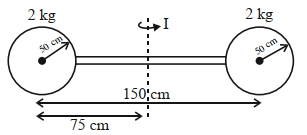
\(\mathrm{I}=\left(\frac{2}{5} \mathrm{mR}^2+\mathrm{md}^2\right) \times 2\)\(\mathrm{I}=2\left(\frac{2}{5} \times 2 \times\left(\frac{1}{2}\right)^2+2 \times\left(\frac{3}{4}\right)^2\right)=\frac{53}{20} \mathrm{~kg}-\mathrm{m}^2\)
\(\mathrm{X}=53\)
No questions on this page match these filters.