


All JEE Mains 2019 Physics questions
31 chaptersShowing 201–250 of 468 questions
-
- (A) \(F = 0\)
- (B) \(F \propto \left( {\frac{a}{d}} \right)\)
- (C) \(F \propto \left( {\frac{a^2}{d^3}} \right)\)
- (D) \(F \propto {\left( {\frac{a}{d}} \right)^2}\)
Show answer and solution
Correct Answer: (D)
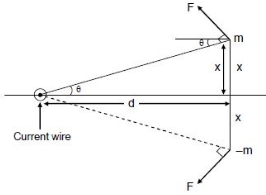
Force on one pole\(F = \frac{{m{\mu _0}I}}{{2\pi \sqrt {{d^2} + {x^2}} }}\)
\(m=\) pole strength
Total force \(=2 F \sin \theta\)
\(=\frac{2 \times \mu_{0} \operatorname{Im} \times x}{2 \pi \sqrt{d^{2}+a^{2}} \sqrt{d^{2}+a^{2}}}=\frac{\mu_{0} \operatorname{Im} x}{\pi\left[d^{2}+a^{2}\right]}\)
\(=m 2 x=M=I \pi a^{2}\)
Total force \(=\frac{\mu_{0} I a^{2}}{2\left(d^{2}+a^{2}\right)}\)
\(\approx \frac{\mu_{0} I a^{2}}{2 d^{2}} \quad[\because d>>a]\)
-
- (A) \(\pi n\rho {l^3}\)
- (B) \(\frac{\pi }{3}n\rho {l^3}\)
- (C) \(\frac{\pi }{4}n\rho {l^3}\)
- (D) \( n\rho {l^3}\)
Show answer and solution
Correct Answer: (C)
\(\mathrm{dM} =\mathrm{di} \mathrm{A} \)\(=\left(\frac{\mathrm{d} \mathrm{q} \omega}{2 \pi}\right) \pi \mathrm{x}^{2} \)
\(=(\rho \mathrm{d} \mathrm{x}) \frac{\omega}{2 \pi} \pi \mathrm{x}^{2} \)
\(\mathrm{M} =\int_{0}^{\mathrm{L}} \mathrm{dM}\)
-
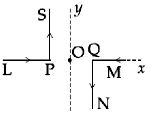
- (A) \(20\, A\), perpendicular out of the page
- (B) \(40\, A\), perpendicular out of the page
- (C) \(20\, A\), perpendicular into the page
- (D) \(40\, A\), perpendicular into the page
Show answer and solution
Correct Answer: (C)
\(B=2\left[\frac{\mu_{0} i}{4 n d}\left(\cos \theta_{1}-\cos \theta_{2}\right)\right]\)\(B=10^{-4} \quad \theta_{1}=90^{\circ}\)
\(\mu_{0}=4 \pi \times 10^{-7} \quad \theta_{2}=180^{\circ}\)
\(d=4 \times 10^{-2}\)
\(\Rightarrow \mathrm{i}=20\, \mathrm{A}\) (into the page)
-
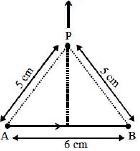
- (A) \(2.0\times10^{-5}\, T\)
- (B) \(3.0\times10^{-5}\, T\)
- (C) \(2.5\times10^{-5}\, T\)
- (D) \(1.5\times10^{-5}\, T\)
Show answer and solution
Correct Answer: (D)
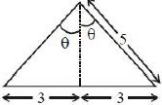
\(B=\frac{\mu_{0} I}{4 \pi d} 2 \sin \theta\)\(d=4\, \mathrm{cm}\)
\(\sin \theta=\frac{3}{5}\)
-
- (A) \(7.5\times 10^{-3}\,m\)
- (B) \(7.5\times 10^{-2}\,m\)
- (C) \(7.5\,m\)
- (D) \(7.5\times 10^{-4}\,m\)
Show answer and solution
Correct Answer: (D)
\({{\text{k}}_{\text{e}}} = \frac{{{{\text{p}}^2}}}{{2{{\text{M}}_{\text{e}}}}} = 500\,{\text{e}} \ldots ({\text{i}})\)\(\ \,{\text{R}} = \frac{{\text{p}}}{{{\text{eB}}}} = \frac{{1000{{\text{m}}_{\text{e}}}{\text{e}}}}{{{\text{eB}}}}\)
\( = \frac{{1010 \times 9.1 \times {{10}^{ - 31}}}}{{1.6 \times {{10}^{ - 19}}}}\)
\( = 100 \times 7.541 \times {10^{ - 6}}\)
-
- (A) \(N\)
- (B) \(\frac {1}{N}\)
- (C) \(N^2\)
- (D) \(\frac {1}{N^2}\)
Show answer and solution
Correct Answer: (D)
\(B_{L}=\frac{\mu_{0} i}{2 R}\)\(B_{C}=\frac{\mu_{0} N i}{2(R / N)}\)
\(\therefore \quad \frac{B_{L}}{B_{C}}=\frac{1}{N^{2}}\)
-
- (A) \(9\)
- (B) \(1\)
- (C) \(3\)
- (D) \(18\)
Show answer and solution
Correct Answer: (C)
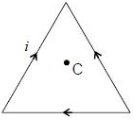
\(i=10\, \mathrm{A}\)\(\ell=1\, \mathrm{m}\)
\(\mu_{0}=4 \pi \times 10^{-7} \,\frac{\mathrm{N}}{\mathrm{A}^{2}}\)
\(\mathrm{B}=\frac{\mu_{0} \mathrm{i}}{\frac{4 \pi \sqrt{3} \ell}{2}} \times 3\)
\(=\frac{\mu_{0} \mathrm{i} \sqrt{3}}{2 \pi \ell}=\frac{4 \pi \times 10^{-7} \times 10 \times \sqrt{3}}{2 \pi \times 1}=20 \sqrt{3} \times 10^{-7}\)
\(=3 \,\mu \mathrm{T}\)
-
- (A) \(\frac{{qvB}}{m}\,\left( {\,\frac{{ \hat j + \hat i}}{{\sqrt 2 }}} \right)\)
- (B) \(\frac{{qvB}}{m}{\mkern 1mu} \left( {{\mkern 1mu} \frac{{\sqrt 3 }}{2}{\mkern 1mu} \hat i + \frac{1}{2}\hat j} \right)\)
- (C) \(\frac{{qvB}}{m}\,\left( {\,\frac{{ - \hat j + \hat i}}{{\sqrt 2 }}} \right)\)
- (D) \(\frac{{qvB}}{m}{\mkern 1mu} \left( {\frac{1}{2}\hat j - \frac{{\sqrt 3 }}{2}\hat i} \right)\)
Show answer and solution
Correct Answer: (D)
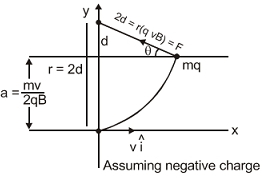
\(\overrightarrow{\mathrm{B}}=\mathrm{B} \hat{\mathrm{k}}\)\(r=\frac{m v}{q B}\)
\(r=2 d\)
\(\sin \theta=\frac{d}{2 d} \Rightarrow \sin \theta=\frac{1}{2} \Rightarrow \theta=\frac{\pi}{6}\)
\(\vec{a}=\frac{|q| v b}{m}(\cos \theta(-\hat{i})+\sin \theta \hat{j})\)
\(\vec{a}=\frac{|q| v b}{m}\left(-\frac{\sqrt{3}}{2} i+\frac{1}{2} \hat{j}\right)\)
-
- (A) \(0.2\)
- (B) \(0.002\)
- (C) \(0.02\)
- (D) \(0.5\)
Show answer and solution
Correct Answer: (A)
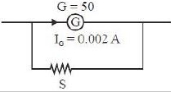
since shunt resistance is connected in parallel with galvanometer, both will have same voltage drop.\((0.002)\left(R_{G}\right)=(0.5-0.002)\left(r_{s}\right)\)
\(\Rightarrow r_{s} \approx 0.2\, \Omega\)
-
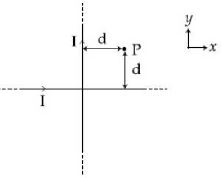
- (A) \(\frac{{{\mu _0}I}}{{2\pi d}}\left( {\hat x + \hat y} \right)\)
- (B) \(\frac{{ + {\mu _0}I}}{{\pi d}}\left( {\hat z} \right)\)
- (C) Zero
- (D) \(-\frac{{{\mu _0}I}}{{2\pi d}}\left( {\hat x + \hat y} \right)\)
Show answer and solution
Correct Answer: (C)
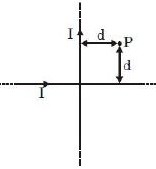
Magnetic field at point \(P\)\(\overrightarrow{\mathrm{B}}_{\mathrm{net}}=\frac{\mu_{0} \mathrm{i}}{2 \pi \mathrm{d}}(-\hat{\mathrm{k}})+\frac{\mu_{0} \mathrm{i}}{2 \pi \mathrm{d}}(\hat{\mathrm{k}})=0\)
-
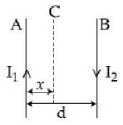
- (A) \(x = \left( {\frac{{{I_1}}}{{{I_1} - {I_2}}}} \right)d\) and \(\,x = \frac{{{I_2}}}{{\left( {{I_1} + {I_2}} \right)}}d\)
- (B) \(\,\,x = \pm \frac{{{I_1}d}}{{\left( {{I_1} - {I_2}} \right)}}\)
- (C) \(x = \left( {\frac{{{I_2}}}{{{I_1} + {I_2}}}} \right)d\) and \(\,x = \frac{{{I_2}}}{{\left( {{I_1} - {I_2}} \right)}}d\)
- (D) \(x = \left( {\frac{{{I_1}}}{{{I_1} + {I_2}}}} \right)d\) and \(\,x = \frac{{{I_2}}}{{\left( {{I_1} - {I_2}} \right)}}d\)
Show answer and solution
Correct Answer: (B)
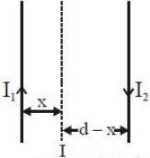
Net force on wire carrying current \(I\) per unit length is\(\frac{\mu_{0} I_{1} I}{2 \pi x}+\frac{\mu_{0} I_{2} I}{2 \pi(d-x)}=0\)
\(\frac{I_{1}}{x}=\frac{I_{2}}{x-d}\)
\(\Rightarrow x=\frac{I_{1} d}{I_{1}-I_{2}}\)
-
- (A) \(1.5\times 10^{-3}\,V\)
- (B) \(1.1\times 10^{-3}\,V\)
- (C) \(2.5\times 10^{-3}\,V\)
- (D) \(0.3\times 10^{-3}\,V\)
Show answer and solution
Correct Answer: (B)
\( \therefore \quad \mathrm{Emf} =\mathrm{B} \ell \mathrm{v} \sin 45^{\circ} \)\(=\left(0.3 \times 10^{-4}\right) \times(10) \times 5 \times \frac{1}{\sqrt{2}} \)
\(=1.1 \times 10^{-3}\, \mathrm{V} \)
-
- (A) \(0.016\,s\)
- (B) \(0.324\,s\)
- (C) \(0.002\,s\)
- (D) \(0.103\,s\)
Show answer and solution
Correct Answer: (A)
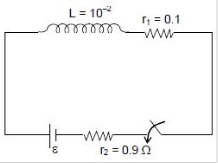
\(\mathrm{L}=10 \times 10^{-3} \,\mathrm{H}, \mathrm{r}_{1}=0.1\, \Omega\)\(i=\varepsilon\left\{1-e^{-t / 2}\right\}\)
\(i_{saturation}\) \(=\varepsilon\)
\(80 \%\) \(i_{saturastion}\) \(=0.8\, \mathrm{\varepsilon}\)
\(0.8 \varepsilon=\varepsilon\left\{1-e^{-t / 2}\right\}\)
\(0.8=1-\mathrm{e}^{-\mathrm{t/2} } \quad ; \quad \mathrm{e}^{-\mathrm{t/2} }=0.2\)
\(e^{t/L}=5\)
\(\mathrm{t}=\mathrm{L} \ln 5=10 \times 10^{-3} \times 1.6=16 \times 10^{-3}\)
-
- (A) \(14\)
- (B) \(7\)
- (C) \(21\)
- (D) \(140\)
Show answer and solution
Correct Answer: (D)
\({\text{B}}({\text{t}}) = 0.4\sin \left( {50\pi \times {{10}^{ - 2}}} \right)\)\( = 0.4\sin \left( {\frac{{50\pi }}{{100}}} \right) = 0.4\)
\(\Delta q = \frac{{ - \Delta {\text{Q}}}}{{\text{R}}} = \frac{{\Delta {\text{Q}}}}{{\text{R}}}\)
\( = \frac{{0.4 \times 3.5 \times {{10}^{ - 3}}}}{{10}}\)
\( = 140\,{\text{mc}}\)
-
- (A) decreases by a factor of \(9\)
- (B) increases by a factor of \(27\)
- (C) increases by a factor of \(3\)
- (D) decreases by a factor of \(9\sqrt 3 \)
Show answer and solution
Correct Answer: (C)
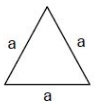
Total length \(L\) will remain constant\(\mathrm{L}=(3 \mathrm{a}) \mathrm{N} \quad(\mathrm{N}=\text { total tums })\)
And length of winding \(=(d) N=\ell\)
\((d=\text { diameter of wire })\)
Self inductance \(=\mu_{0} \mathrm{n}^{2} \mathrm{A} \ell\)
\(=\mu_{0} n^{2}\left(\frac{\sqrt{3} a^{2}}{4}\right) d N\)
\(\alpha a^{2} N \propto a\)
So self inductance will become \(3\) times.
-
- (A) \(20\)
- (B) \(40\)
- (C) \(45\)
- (D) \(25\)
Show answer and solution
Correct Answer: (C)
Given \(: V_{P}=2300\, \mathrm{V}, V_{s}=230\, \mathrm{V}, I_{P}=5\, \mathrm{A}\)\(\eta=90 \%=0.9\)
Efficiency \(\eta=0.9=\frac{P_{s}}{P_{p}} \Rightarrow P_{s}=0.9 P_{p}\)
\(\mathrm{V}_{\mathrm{s}} \mathrm{I}_{\mathrm{s}}=0.9 \times \mathrm{V}_{\mathrm{P}} \mathrm{I}_{\mathrm{P}} \quad(\because \mathrm{P}=\mathrm{VI})\)
\({I_s} = \frac{{0.9 \times 2300 \times 5}}{{230}} = 45{\mkern 1mu} {\text{A}}\)
-
- (A) \(12\)
- (B) \(6\)
- (C) \(1\)
- (D) \(2\)
Show answer and solution
Correct Answer: (A)
\(E = vB\)
\(V = Ed = dvB\)\(=2\times 10^{-2}\times 6\times 0.1=12\;mV\) -
- (A) \(50000\)
- (B) \(10000\)
- (C) \(1000\)
- (D) \(5000\)
Show answer and solution
Correct Answer: (D)
\(\mathrm{T}_{0}=2 \pi \sqrt{\frac{\mathrm{m}}{\mathrm{k}}}=\frac{2 \pi}{\sqrt{10}}\)\(\mathrm{A}=\mathrm{A}_{0} \mathrm{e}^{-1 / \gamma}\)
\(\therefore\) for \(\mathrm{A}=\frac{\mathrm{A}_{0}}{\mathrm{e}}, \mathrm{t}=\gamma\)
\(\mathrm{t}=\gamma=\frac{2 \mathrm{m}}{\mathrm{b}}=\frac{\frac{2 \mathrm{m}}{\mathrm{B}^{2} \ell^{2}}}{\frac{\mathrm{B}^{2} \ell^{2}}{\mathrm{R}}}=10^{4} \,\mathrm{s}\)
\(\therefore \) No of oscillation \(\frac{\mathrm{t}}{\mathrm{T}_{0}}=\frac{10^{4}}{2 \pi / \sqrt{10}} \approx 5000\)
-
- (A) \(440\, V\) and \(5\, A\)
- (B) \(440\, V\) and \(20\, A\)
- (C) \(220\, V\) and \(20\, A\)
- (D) \(220\, V\) and \(10\, A\)
Show answer and solution
Correct Answer: (A)
Given \(\mathrm{N}_{\mathrm{P}}=300, \mathrm{N}_{\mathrm{s}}=150, \mathrm{P}_{0}=2200 \,\mathrm{W}\) \(\mathrm{l}_{\mathrm{s}}=10\, \mathrm{A}\)\(\mathrm{P}_{0}=\mathrm{V}_{0} \mathrm{l}_{0} \)
\(\Rightarrow 2200=\mathrm{V}_{0} \times 10 \)
\(\Rightarrow \mathrm{V}_{0}=220\, \mathrm{V}\)
\(\because \frac{V_{i}}{V_{0}}=\frac{N_{p}}{N_{s}} \)
\(\Rightarrow V_{1}=2 \times 220=440\, \mathrm{V}\)
Also, \(\quad \mathrm{P}_{0}=\mathrm{V}_{\mathrm{i}} \mathrm{l}_{\mathrm{i}}\)
\(\Rightarrow \mathrm{I}_{\mathrm{i}}=\frac{2200}{440}=5\, \mathrm{A}\)
-
- (A) \(115\)
- (B) \(170\)
- (C) \(60\)
- (D) \(150\)
Show answer and solution
Correct Answer: (B)
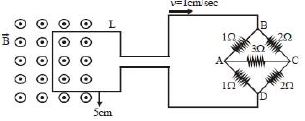
since it is a balanced wheatstone bridge, its equivalent resistance \(=\frac{4}{3}\, \Omega\)\(\varepsilon=\mathrm{B} \ell \mathrm{v}=5 \times 10^{-4}\, \mathrm{V}\)
So total resistance
\(\mathrm{R}=\frac{4}{3}+1.7 \approx 3\, \Omega\)
\(\therefore \quad \mathrm{i}=\frac{\varepsilon}{\mathrm{R}} \approx 166\, \mu \mathrm{A} \approx 170\, \mu \mathrm{A}\)
-
- (A) \(437.5\)
- (B) \(740\)
- (C) \(540\)
- (D) \(637.5\)
Show answer and solution
Correct Answer: (A)
\(\frac{L \Delta T}{\Delta t}=25\)\(\Rightarrow L=\frac{25 \times 1}{15}=\frac{5}{3}\)
\(\Delta U=\frac{1}{2} L\left(l_{f}^{2}-l_{1}^{2}\right)=\frac{1}{2} \times \frac{5}{3} \times\left(25^{2}-10^{2}\right)\)
\(\quad=\frac{5}{6} \times 525=437 .5\, \mathrm{J}\)
-
- (A) \(1/L\)
- (B) \(L\)
- (C) \(1/L^2\)
- (D) \(L^2\)
Show answer and solution
Correct Answer: (A)
\(\phi=\mathrm{NBA}=\mathrm{LI}\)\({\mathrm{N}} \mu_{0} \mathrm{n} \mathrm{I} \pi \mathrm{R}^{2}=\mathrm{LI}\)
\(\mathrm{N} \mu_{0} \frac{\mathrm{N}}{\ell} \mathrm{I} \pi \mathrm{R}^{2}=\mathrm{LI}\)
\(\mathrm{N}\) and \(\mathrm{R}\) constant
Self inductance \((L)\) \(\propto \frac{1}{\ell} \propto \frac{1}{\text { length }}\)
-
- (A) \(\frac{{{n_1}}}{{{n_2}}}\)
- (B) \(\frac{{{n_2}}}{{{n_1}}}.\frac{{{r_1}}}{{{r_2}}}\)
- (C) \(\frac{{{n_2}}}{{{n_1}}}.\frac{{r_2^2}}{{r_1^2}}\)
- (D) \(\frac{{{n_2}}}{{{n_1}}}\)
Show answer and solution
Correct Answer: (D)
\(\ \frac{M}{L} =\frac{\mu_{0} n n_{1} n_{2} n_{1}^{2} \ell}{\mu_{0} \pi n_{1}^{2} r_{1}^{2} \ell}\)\(=\frac{n_{2}}{n_{1}}\)
-
- (A) \(6.67 \times {10^{ - 3}}\,Wb\)
- (B) \(6.67 \times {10^{ - 4}}\,Wb\)
- (C) \(3.67 \times {10^{ - 4}}\,Wb\)
- (D) \(3.67 \times {10^{ - 3}}\,Wb\)
Show answer and solution
Correct Answer: (B)
Mutual induction\(\phi_{q}=M l_{p}\)
\(10^{-3}=\mathrm{M}(3)\)
\(\Rightarrow M=\frac{1}{3} \times 10^{-3}\)
\(\phi_{\mathrm{p}}=\mathrm{Ml}_{\mathrm{q}}\)
\(\Rightarrow \phi_{p}=6.67 \times 10^{-4}\, \mathrm{Wb}\)
-
- (A) \(285\)
- (B) \(2600\)
- (C) \(520\)
- (D) \(1200\)
Show answer and solution
Correct Answer: (B)
\(\mathrm{B}=\mu_{\mathrm{o}} \mathrm{H} \quad ; \quad \mu_{\mathrm{o}} n i=\mu_{\mathrm{o}} \mathrm{H}\)\(\frac{100}{0.2} \times 5.2=\mathrm{H}\)
\(\mathrm{H}=2600 \,\mathrm{A} / \mathrm{m}\)
-
- (A) \(T_h = T_c\)
- (B) \(T_h = 2T_c\)
- (C) \(T_h = 1.5T_c\)
- (D) \(T_h = 0.5T_c\)
Show answer and solution
Correct Answer: (A)
\(\because \quad \mathrm{T}=2 \pi \sqrt{\frac{1}{\mu \mathrm{B}}}\)\(\frac{T_{h}}{T_{c}} =\sqrt{\frac{I_{R}}{I_{c}} \times \frac{\mu_{c}}{\mu_{h}}} \)
\(=\sqrt{2 \times \frac{1}{2}}=1\)
\(T_{h} =T_{c}\)
-
- (A) \(0.01\,J\)
- (B) \(0.007\,J\)
- (C) \(0.028\,J\)
- (D) \(0.014\,J\)
Show answer and solution
Correct Answer: (D)
Work done by external agent \( = {U_f} - {U_i}\)\(W=M B(1-\cos \Theta)\)
\(W=2 M B \quad \quad M=10^{-2} \widehat{l}\, A-m^{2}\)
\(=2 \times 10^{-2} \times 1 \times \cos (0.125) \quad B=B \widehat{l} \cos w t\)
\(W=2 \times 10^{-2} \times 1 \times \cos (0.125) \quad w=0.125\, \mathrm{rad} / \mathrm{s}\)
\(w \approx 0.02\, J\) \(B=1\,Tesla\)
\(W \approx 0.02 \,J\)
\(W \approx 0.02 \,J\)
\(W \approx 0.014 \,J\)
-
- (A) \(3.6\)
- (B) \(1.8\)
- (C) \(2.2\)
- (D) \(0.7\)
Show answer and solution
Correct Answer: (D)
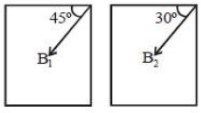
\(\mathrm{f}_{1}=\frac{1}{2 \pi} \sqrt{\frac{\mu \mathrm{B}_{1} \cos 45^{\circ}}{1}} \quad\)\(\frac{\mathrm{f}_{1}}{\mathrm{f}_{2}}=\frac{\mathrm{B}_{1} \cos 45^{\circ}}{\mathrm{B}_{2} \cos 30^{\circ}}\)
\({{\text{f}}_2} = \frac{1}{{2\pi }}\sqrt {\frac{{\mu {{\text{B}}_2}\cos {{30}^\circ }}}{1}} \)
\(\therefore \frac{\mathrm{B}_{1}}{\mathrm{B}_{2}}= 0.7\)
-
- (A) \(3.267\times 10^{-4}\)
- (B) \(3.672\times 10^{-4}\)
- (C) \(3.726\times 10^{-4}\)
- (D) \(2.672\times 10^{-4}\)
Show answer and solution
Correct Answer: (A)
For paramagnetic materials \(\chi \propto \frac{1}{\mathrm{T}}\)\(\frac{\chi _{1}}{\chi _{2}}=\frac{T_{2}}{T_{1}}\)
\(\Rightarrow \chi _{2}=\frac{T_{1}}{T_{2}} \times \chi _{1}=\frac{350}{300} \times 2.8 \times 10^{-4}\)
\(=3.267 \times 10^{-4}\)
-
- (A) \(3.3 \times {10^{ - 2}}\)
- (B) \(40.3 \times {10^{ - 2}}\)
- (C) \(2.3 \times {10^{ - 2}}\)
- (D) \(3.3 \times {10^{ - 4}}\)
Show answer and solution
Correct Answer: (D)
\({\chi=\frac{1}{\mathrm{H}}}\)\({\mathrm{I}=\frac{\text { Magnetic moment }}{\text { Volume }}}\)
\({\mathrm{I}=\frac{20 \times 10^{-6}}{10^{-6}}=20\, \mathrm{N} / \mathrm{m}^{2}}\)
\({x=\frac{20}{60 \times 10^{3}}=\frac{1}{3} \times 10^{-3}}\)
\({=0.33 \times 10^{-3}=3.3 \times 10^{-4}}\)
-
- (A) \(3.6\times10^{-5}\,N\)
- (B) \(1.8\times10^{-5}\,N\)
- (C) \(1.3\times10^{-5}\,N\)
- (D) \(6.5\times10^{-5}\,N\)
Show answer and solution
Correct Answer: (D)
\(\tau = F \times 0.06 = 1.8 \times 0.012 \times 18 \times {10^{ - 6}}\)\(F = 6.48\times10^{-5}\)
-
- (A) \(\left( {\frac{{{\mu _0}}}{{4\pi }}} \right)\frac{M}{{{{\left( {d/2} \right)}^3}}} \times {q^\upsilon }\)
- (B) \(0\)
- (C) \(\left( {\frac{{{\mu _0}}}{{4\pi }}} \right)\frac{2M}{{{{\left( {d/2} \right)}^3}}} \times {q^\upsilon }\)
- (D) \(\sqrt 2 \left( {\frac{{{\mu _0}}}{{4\pi }}} \right)\frac{M}{{{{\left( {d/2} \right)}^3}}} \times {q^\upsilon }\)
Show answer and solution
Correct Answer: (B)
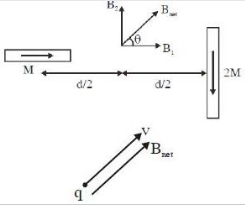
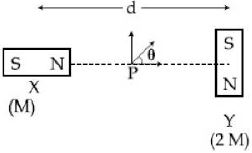
\(B_{1}=2\left(\frac{\mu_{0}}{4 \pi}\right) \frac{M}{(d / 2)^{3}} ; B_{2}=\left(\frac{\mu_{0}}{4 \pi}\right) \frac{2 M}{(d / 2)^{3}}\)\(B_{1}=B_{2}\)
\(\Rightarrow \) \(B_{net}\) is at \(45^{\circ}\left(\theta=45^{\circ}\right)\)
Velocity of charge and \(B_{net}\) are parallel so by
\(\overrightarrow{\mathrm{F}}=q(\overrightarrow{\mathrm{b}} \times \overrightarrow{\mathrm{B}})\) force on charge particle is Zero.
-
- (A) \(20\)
- (B) \(100\)
- (C) \(0.4\)
- (D) \(63\)
Show answer and solution
Correct Answer: (A)
By colour coding,\({\mathrm{R}=50 \times 10^{2}\, \Omega} \)
\({\mathrm{I}^{2} \mathrm{R}=\mathrm{P}} \)
\({\mathrm{I}=\sqrt{\frac{\mathrm{P}}{\mathrm{R}}}=20 \,\mathrm{m} \mathrm{A}}\)
-
- (A) \(500\)
- (B) \(400\)
- (C) \(300\)
- (D) \(100\)
Show answer and solution
Correct Answer: (A)
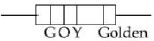
When red is replace with green \(1^{st}\) digit changes to \(5\) so new resistance will be \(500\,\Omega \). - 235. A carbon resistance has a following colour code. What is the value of the resistance?
 2019 Medium
- (A) \(530\,\,K\Omega \,\, \pm \,\,5\% \)
- (B) \(5.3\,\,M\Omega \,\, \pm \,\,5\% \)
- (C) \(6.4\,\,M\Omega \,\, \pm \,\,5\% \)
- (D) \(64\,\,K\Omega \,\, \pm \,\,10\% \)
Show answer and solution
Correct Answer: (A)
\(R = 530\,\,K\Omega \,\, \pm \,\,5\% \) -
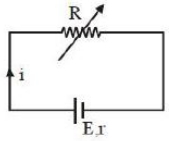
- (A) \(R = 0.001\,r\)
- (B) \(R = 1000\,r\)
- (C) \(R = 2\,r\)
- (D) \(R = r\)
Show answer and solution
Correct Answer: (D)
Current \(i=\frac{E}{r+R}\)Power generated in \(R\)
\(P=i^{2} R\)
\(P=\frac{E^{2} R}{(r+R)^{2}}\)
For maximum power \(\frac{\mathrm{dP}}{\mathrm{dR}}=0\)
\(E^{2}\left[\frac{(r+R)^{2} \times 1-R \times 2(r+R)}{(r+R)^{4}}\right]=0\)
\(\Rightarrow r=R\)
-
- (A) \(2\)
- (B) \(2.5\)
- (C) \(1\)
- (D) \(0.5\)
Show answer and solution
Correct Answer: (C)
\( \mathrm{R} =\frac{\rho \ell}{\mathrm{A}} \)\( \mathrm{R} =\frac{\rho \ell^{2}}{\mathrm{A} \ell}=\frac{\rho \ell^{2}}{\mathrm{V}}\)
\(\frac{\mathrm{d} \mathrm{R}}{\mathrm{R}}=\frac{2 \mathrm{d} \ell}{\ell} \)
\({\rm{ Hence, }}\frac{{{\rm{dR}}}}{{\rm{R}}}{\rm{ }} = 1\% \)
-
- (A) \(11\times10^{-5}\, W\)
- (B) \(11\times10^{-3}\, W\)
- (C) \(11\times10^{-4}\, W\)
- (D) \(11\times10^{5}\, W\)
Show answer and solution
Correct Answer: (A)
\(R =\frac{P}{l^{2}}=\frac{4.4}{4 \times 10^{-6}} \,\Omega \)\( P^{\prime}= \frac{V^{2}}{R}=\frac{11 \times 11 \times 4 \times 10^{-6}}{4.4} \,W \)
\(=11 \times 10^{-5} \,W \)
-
- (A) \(1.8\)
- (B) \(1\)
- (C) \(1.3\)
- (D) \(1.5\)
Show answer and solution
Correct Answer: (B)
\( \mu =\frac{V_{d}}{E} \quad E=\rho J\)\(=\frac{1.1 \times 10^{-3}}{1.7 \times 10^{-8} \times \frac{5}{\pi \times 25 \times 10^{-6}}} \)
\(=\frac{1.1 \times 10^{-3} \times \pi \times 25 \times 10^{-6}}{1.7 \times 10^{-8} \times 5} \approx 1.01\, \mathrm{m}^{2} / \mathrm{Vs} \)
-
- (A) \(\frac{{12}}{5}\,\Omega \)
- (B) \(\frac{{5}}{3}\,\Omega \)
- (C) \(\frac{{5}}{2}\,\Omega \)
- (D) \(\frac{{7}}{2}\,\Omega \)
Show answer and solution
Correct Answer: (B)
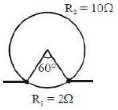
\(R=\frac{\rho \ell}{A}=\frac{\rho \ell}{(V / \ell)}=\frac{\rho \ell^{2}}{V} \quad(V \rightarrow \text { Volume of wire })\)\(\Rightarrow\) Final resistance \(=3 \times(\mathrm{B})^{2}=12 \,\Omega\)
\(\begin{aligned} \mathrm{R}_{\mathrm{eq}} &=2\, \Omega \| 10\, \Omega \\ &=\frac{5}{3} \,\Omega \end{aligned}\)
-
- (A) \(\frac{{11}}{{12}}\,L\)
- (B) \(\frac{{11}}{{24}}\,L\)
- (C) \(\frac{{13}}{{24}}\,L\)
- (D) \(\frac{{5}}{{12}}\,L\)
Show answer and solution
Correct Answer: (C)
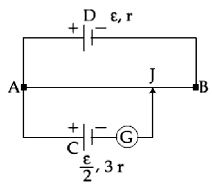
\(V_{A J}=I R_{A J}\)\(\frac{E}{3}=\left(\frac{E}{12 r+3 r}\right) \times\left(\frac{x}{L} \times 12 r\right)\)
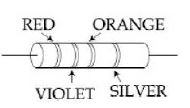
- 242. A resistance is shown in the figure. Its value and tolerance are given respectively by
 2019 Medium
- (A) \(270\,\Omega ,\,10\% \)
- (B) \(27\,k\Omega ,\,10\% \)
- (C) \(27\,k\Omega ,\,20\% \)
- (D) \(270\,\Omega ,\,5\% \)
Show answer and solution
Correct Answer: (B)
Color code\(:\)Red violet orange silver
\(R=27 \times 10^{3} \Omega \pm 10 \%\)
\(=27 K \Omega \pm 10 \%\)
-
- (A) \(\frac {1}{16}R\)
- (B) \(\frac {7}{64}R\)
- (C) \(\frac {3}{4}R\)
- (D) \(R\)
Show answer and solution
Correct Answer: (B)
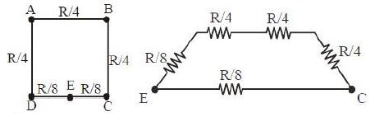
\(\frac{1}{R_{e q}}=\frac{8}{7 R}+\frac{8}{R}\)\(\frac{1}{R_{e q}}=\frac{8+56}{7 R} ; \quad R_{e q i}=\frac{7 R}{64}\)
-
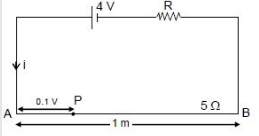
- (A) \(490\)
- (B) \(480\)
- (C) \(395\)
- (D) \(495\)
Show answer and solution
Correct Answer: (C)
\(i=\frac{4}{5+R}\)\(V_{A B}=i(5)=\frac{20}{5+R}\)
\(V_{A P}=\frac{V_{A B}}{L}(0.1)=\frac{20}{5+R}\left(\frac{0.1}{1}\right)=\frac{2}{5+R}\)
Now, \(\frac{2}{5+R}=5 \times 10^{-3}\)
\(\Rightarrow \quad R=395\, \Omega\)
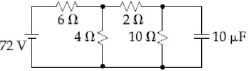
- 245. Determine the charge on the capacitor in the following circuit ................ \(\mu C\)
 2019 Medium
- (A) \(200\)
- (B) \(60\)
- (C) \(10\)
- (D) \(2\)
Show answer and solution
Correct Answer: (A)
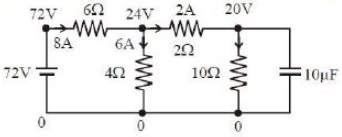
Different potential is shown at different point.\(q=e V\)
\(q=10\, \mu F \times 20=200\, \mu C\)
-
- (A) \(0.02\)
- (B) \(3\)
- (C) \(2\)
- (D) \(0.2\)
Show answer and solution
Correct Answer: (A)
\(\mathrm{i}=\mathrm{ne} \mathrm{AV}_{\mathrm{d}}\)\(1.5=9 \times 10^{28} \times 1.6 \times 10^{-19} \times 5 \times \mathrm{Vd}\)
\(\mathrm{Vd}=0.02\)
-
- (A) \(3.3\)
- (B) \(2.3\)
- (C) \(3.7\)
- (D) \(2.7\)
Show answer and solution
Correct Answer: (A)
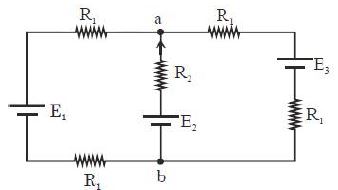
\( E_{e q}= \frac{\frac{E_{1}}{2 R_{1}}+\frac{E_{2}}{R_{2}}+\frac{E_{3}}{2 R_{1}}}{\frac{1}{2 R_{1}}+\frac{1}{R_{2}}+\frac{1}{2 R_{1}}} \)\( = \frac{{\frac{2}{2} + \frac{4}{2} + \frac{4}{2}}}{{\frac{1}{2} + \frac{1}{2} + \frac{1}{2}}} = \frac{5}{{\frac{3}{2}}} = \frac{{10}}{3} = 3.3\)
-
- (A) \({10^{ - 5}}\,\Omega m\)
- (B) \({10^{ - 6}}\,\Omega m\)
- (C) \({10^{ - 7}}\,\Omega m\)
- (D) \({10^{ - 8}}\,\Omega m\)
Show answer and solution
Correct Answer: (D)
\(\begin{array}{l}
\rho = \frac{{2m}}{{n{e^2}\tau }}\\
= 3.34 \times {10^{ - 8}}\,\Omega \,m
\end{array}\) -
- (A) \(4\)
- (B) \(3\)
- (C) \(2\)
- (D) \(1\)
Show answer and solution
Correct Answer: (A)
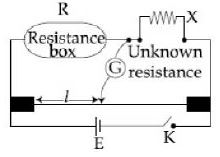
as \(x=\frac{R(100-\ell)}{\ell}\)\(\text { for (1) } \quad x=\frac{1000 \times(100-60)}{40} \approx 667\)
\(\text { for (2) } \quad x=\frac{100 \times(100-13)}{13} \approx 669\)
\(\text { for }(\mathrm{3}) \quad x=\frac{10 \times(100-1.5)}{98.5} \approx 656\)
\(\text { for (4) } \quad x=\frac{1 \times(100-1)}{1} \approx 95\)
So reading in serial no. \((4)\) is completely different hence correct answer \((A).\)
-
- (A) \(0.2\)
- (B) \(0.3\)
- (C) \(0.25\)
- (D) \(0.35\)
Show answer and solution
Correct Answer: (C)
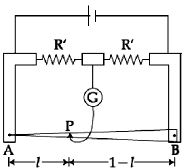
\(\frac{\mathrm{d} \mathrm{R}}{\mathrm{d} \ell}=\frac{\mathrm{k}}{\sqrt{\ell}} \quad \mathrm{k}=\mathrm{constant}\)\(\int_{0}^{R} d R=k \int_{0}^{1} \frac{d \ell}{\sqrt{\ell}}\)
\(\mathrm{R}=2 \mathrm{k}\) resistance of wire \(\mathrm{AB}\)
Again, \(\int_{0}^{R / 2} \mathrm{d} \mathrm{R}=\mathrm{k} \int_{0}^{L} \frac{\mathrm{d} \ell}{\sqrt{\ell}} \quad \mathrm{L} \rightarrow\) Length \(\mathrm{AP}\)
\(\frac{\mathrm{R}}{2}=\mathrm{k} 2 \mathrm{L}^{1 / 2} \quad ; \quad \mathrm{k}=\mathrm{k} 2 \mathrm{L}^{1 / 2}\)
\(\Rightarrow \quad \mathrm{L}=\frac{1}{4}\, \mathrm{m}=0.25 \,\mathrm{m}\)
No questions on this page match these filters.