


Questions
21 questionsShowing 1–21 of 21 questions
-
- (A) \(6\)
- (B) \(4\)
- (C) \(7\)
- (D) \(5\)
Show answer and solution
Correct Answer: (A)
For closed organ pipe, resonate frequency is odd multiple of fundamental frequency. \((2 n+1) f_{o} \leq 20,000\)\(\left(f_{o} \text { is fundamental frequency }=1.5 Khz \right)\)
\(n=6\)
-
- (A) \(\frac{g}{{30}}\)
- (B) \(\frac{g}{{10}}\)
- (C) \(\frac{g}{{5}}\)
- (D) \(\frac{g}{{20}}\)
Show answer and solution
Correct Answer: (C)
\(60=\sqrt{\frac{M g}{\mu}}\)\(60.5=\sqrt{\frac{M\left(g^{2}+a^{2}\right)^{1 / 2}}{\mu}} \Rightarrow \frac{60.5}{60}=\sqrt{\sqrt{\frac{g^{2}+a^{2}}{g^{2}}}}\)
\(\left(1+\frac{0.5}{60}\right)^{4}=\frac{g^{2}+a^{2}}{g^{2}}=1+\frac{2}{60}\)
\(\Rightarrow g^{2}+a^{2}=g^{2}+g^{2} \times \frac{2}{60}\)
\(a=g \sqrt{\frac{2}{60}}=\frac{g}{\sqrt{30}}=\frac{g}{5.47}\)
\(\simeq \frac{g}{5}\)
-
- (A) \(666\)
- (B) \(753\)
- (C) \(500\)
- (D) \(333\)
Show answer and solution
Correct Answer: (A)
\(f=\frac{2}{2 \ell} V_{s}=\frac{330}{0.5}=660 \mathrm{Hz}\)\( \therefore \quad f^{\prime}=f\left(\frac{v_{s}+v}{v_{s}}\right)=(660)\left(\frac{330+\frac{50}{18}}{330}\right)=660\left(1+\frac{50}{18 \times 330}\right)\)
\(=666 \mathrm{Hz}\)
-
- (A) \(\frac{{\sqrt 3 }}{2}\upsilon \)
- (B) \(\frac{{2\upsilon }}{{\sqrt 3 }}\)
- (C) \(\upsilon \)
- (D) \(\frac{\upsilon }{2}\)
Show answer and solution
Correct Answer: (D)
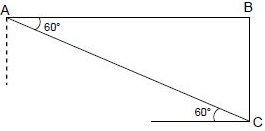
\(\mathrm{V}_{\mathrm{P}} \rightarrow\) Speed of plane\(\vee \rightarrow\) Speed of sound
\(\vee \cos 60^{\circ}=V_{P}\)
\(V_{P}=\frac{V}{2}\)
-
- (A) \(\pi \)
- (B) \(\frac{\pi }{2}\)
- (C) \(-\frac{\pi }{2}\)
- (D) \(0\)
Show answer and solution
Correct Answer: (A)
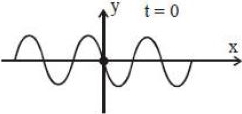
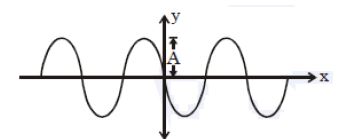
\(y=A \sin (k x-w t+\phi)\)at \(x=0, t=0\) and slope is negative
\(\Rightarrow \phi=\pi\)
-
- (A) \(322\)
- (B) \(341\)
- (C) \(335\)
- (D) \(328\)
Show answer and solution
Correct Answer: (D)
\(\lambda_{1}=4(11+\mathrm{e}) =\frac{\mathrm{v}}{512}\)\(\lambda_{2}=4(27+e)=\frac{V}{256}\)
\(\frac{11+e}{27+e}=\frac{1}{2}\)
\(\Rightarrow \quad 22+2 e=27+e\)
\(\Rightarrow \quad e=5\)
-
- (A) \(30\)
- (B) \(10\)
- (C) \(40\)
- (D) \(20\)
Show answer and solution
Correct Answer: (C)
Loudness of sound is given by\(\mathrm{dB}=10 \log \frac{I}{\mathrm{I}_{0}}\) (\(I\) is intensity of sound, \(I_0\) is reference intensity of sound)
\(120=10 \log \left(\frac{I}{I_{0}}\right)\)
\(\Rightarrow I=1 \mathrm{W} / \mathrm{m}^{2}\)
Also, \(\mathrm{I}=\frac{\mathrm{P}}{4 \pi \mathrm{r}^{2}}=\frac{2}{4 \pi \mathrm{r}^{2}}\)
\(\therefore r=\sqrt{\frac{2}{4 \pi}}=\sqrt{\frac{I}{2 \pi}} \mathrm{m}=0.399 \mathrm{m}\)
\(\approx 40 \mathrm{cm}\)
-
- (A) \(1143\)
- (B) \(857\)
- (C) \(750\)
- (D) \(807\)
Show answer and solution
Correct Answer: (C)
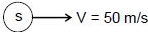
\(\mathrm{f}_{\mathrm{a}}=\frac{\mathrm{V}}{\mathrm{V}-\mathrm{V}_{\mathrm{s}}} \mathrm{f}_{\mathrm{o}}=1000 \mathrm{Hz}\)\(\mathrm{f}_{\mathrm{a}}^{\prime}=\frac{\mathrm{V}}{\mathrm{V}+\mathrm{V}_{\mathrm{s}}} \mathrm{f}_{\mathrm{o}}\)
\(\frac{f_{a}^{\prime}}{f_{a}}=\frac{V-V_{s}}{V+V_{s}}=\frac{350-50}{350+50}=\frac{300}{400}=\frac{3}{4}\)
\(\mathrm{f}_{\mathrm{a}}^{\prime}=\frac{3}{4} \times 1000=750 \mathrm{Hz}\)
-
- (A) \(16, 14\)
- (B) \(12, 16\)
- (C) \(8, 18\)
- (D) \(12, 18\)
Show answer and solution
Correct Answer: (D)
\( v= \frac{v+v_{0}}{v} v_{0}\)\(\Rightarrow v_{0}=\left(\frac{v}{v_{0}}-1\right) v\)
\(v_{0}=\left(\frac{530}{500}-1\right) 300=18 \mathrm{m} / \mathrm{s}\)
\(v_{0}=\left|\left(\frac{480}{500}-1\right) 300\right|=12 \mathrm{m} / \mathrm{s}\)
-
- (A) \(320\, m/s, 120\, Hz\)
- (B) \(180\, m/s, 80\, Hz\)
- (C) \(180\, m/s, 120\, Hz\)
- (D) \(320\, m/s, 80\, Hz\)
Show answer and solution
Correct Answer: (D)
We have:\(f=\frac{n v}{2 \ell}\)
\(240=\frac{3 \times v}{2 \times 2}\)
\(\Rightarrow \quad v=320 \mathrm{m} / \mathrm{s}\)
Fundamental frequency \(=\frac{v}{2 \ell}=80 \mathrm{Hz}\)
-
- (A) \(60\)
- (B) \(80\)
- (C) \(40\)
- (D) \(20\)
Show answer and solution
Correct Answer: (B)
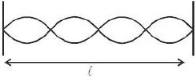
\(4^{\text {th }}\) harmonic\(4 \frac{\lambda}{2}=\ell \quad ; 2 \lambda=\ell\)
From equation \(\frac{2 \pi}{\lambda}=0.157\)
\(\lambda=40 ; \quad \ell=2 \lambda=80 \mathrm{m}\)
-
- (A) \(10\)
- (B) \(33.3\)
- (C) \(16.6\)
- (D) \(20.0\)
Show answer and solution
Correct Answer: (D)
\(\mathrm{f}=\frac{\mathrm{n}}{2 \ell} \sqrt{\frac{\mathrm{T}}{\mathrm{m}}}\)On solving, \(n=5\)
\(5\) loops are formed in \(1 \mathrm{m}\)
Separation between successive nodes \(=\frac{1}{5} \mathrm{m}=20 \mathrm{cm}\)
-
- (A) \(499\)
- (B) \(502\)
- (C) \(504\)
- (D) \(507\)
Show answer and solution
Correct Answer: (B)
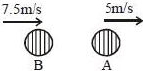
\(v =\) speed of sound in water \(=1500 m / s\)frequency received by \(A = f\)
\(=\left[\frac{ V - V _{ A }}{ V - V _{ B }}\right] f _{0}=\left[\frac{1500-5}{1500-7.5}\right] f _{0}\)
frequency received by \(B = f ^{\prime \prime}=\)
\(\left[\frac{ V + V _{ B }}{ V + V _{ A }}\right] f ^{\prime}=\left[\frac{1500+7.5}{1500+5}\right]\left[ \frac{1500-5}{1500-7.5}\right] f\)
\(f ^{\prime \prime}=\left(\frac{1500+7.5}{1500-7.5}\right)\left(\frac{1500-5}{1500+5}\right)(500)\)
\(=502\; Hz\)
-
- (A) \(18/17\)
- (B) \(19/18\)
- (C) \(20/19\)
- (D) \(21/20\)
Show answer and solution
Correct Answer: (B)
\(\mathrm{f}_{1}=\mathrm{f}_{0}\left(\frac{340}{340-34}\right) \quad ; \quad \mathrm{f}_{2}=\mathrm{f}_{0}\left(\frac{340}{340-17}\right)\)\(\frac{f_{1}}{f_{2}}=\frac{323}{306}=\frac{19}{18}\)
-
- (A) The wave is propagating along the positive \(x-\) axis with speed \(25\, ms^{-1}\).
- (B) The wave is propagating along the positive \(x-\) axis with speed \(100\, ms^{-1}\).
- (C) The wave is propagating along the negative \(x-\) axis with speed \(25\, ms^{-1}\).
- (D) The wave is propagating along the negative \(x-\) axis with speed \(100\, ms^{-1}\).
Show answer and solution
Correct Answer: (C)
\(y=10^{-3} \sin (50 t+2 x)\)Wave is travelling along negative \(X-axis\)
Wave speed \(=\frac{\omega}{\mathrm{k}}=\frac{50}{2}=25 \mathrm{m} / \mathrm{s}\)
-
- (A) \(332\)
- (B) \(338\)
- (C) \(384\)
- (D) \(379\)
Show answer and solution
Correct Answer: (C)
\(v=2 f(l_2-l_1)\)\(v=2 \times 480 \times(70-30) \times 10^{-2}\)
\(v=960 \times 40 \times 10^{-2}\)
\(\mathrm{v}=38400 \times 10^{-2} \mathrm{m} / \mathrm{s}\)
\(v=384 \mathrm{m} / \mathrm{s}\)
-
- (A) \(1 : 4\)
- (B) \(1 : 2\)
- (C) \(3 : 5\)
- (D) \(4 : 9\)
Show answer and solution
Correct Answer: (B)
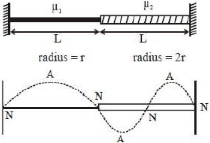
Let mass per unit length of wires are \(\mu_{1}\) and \(\mu_{2}\) respectively.\(\because\) Materials are same, so density \(\rho\) is same.
\(\mu_{1}=\frac{\rho \pi r^{2} L}{L}=\mu \text { and } \mu_{2}=\frac{\rho 4 \pi r^{2} L}{L}=4 \mu\)
Tension in both are same \(=\mathrm{T},\) let speed of wave in wires are \(V_{1}\) and \(V_{2}\)
\(V_{1}=\frac{V_{1}}{2 L}=\frac{V}{2 L} \& f_{02}=\frac{V_{2}}{2 L}=\frac{V}{4 L}\)
Frequency at which both resonate is \(L.C.M.\) of both frequencies i.e. \(\frac{\mathrm{V}}{2 \mathrm{L}}\)
Hence number of loops in wires are \(1\) and \(2\) respectively
So, ratio of number of antinodes is \(1:2\)
-
- (A) \(10\)
- (B) \(7.5\)
- (C) \(12.5\)
- (D) \(5\)
Show answer and solution
Correct Answer: (C)
\(y=0.03 \sin \left[450\left(t-\frac{9 x}{450}\right)\right]\)So, \(\mathrm{v}=\frac{450}{9}=50 \mathrm{m} / \mathrm{s}\)
Also, \(v=\sqrt{\frac{T}{\lambda}}\)
\(\Rightarrow 50=\sqrt{\frac{T}{5 \times 10^{-3}}}\)
\(\Rightarrow T=2500 \times 5 \times 10^{-3}=12.5 \mathrm{N}\)
-
- (A) \(12\)
- (B) \(11\)
- (C) \(15\)
- (D) \(4\)
Show answer and solution
Correct Answer: (D)
Speed of wave from wave equation\(v=-\frac{(\text { coeffecient of } t)}{(\text { coeffecient of } x)}\)
\(v=-\frac{1000}{(-3)}=\frac{1000}{3}\)
since speed of wave \(\propto \sqrt{T}\)
\(\mathrm{So}=\frac{1000}{\frac{3}{336}}=\sqrt{\frac{273}{\mathrm{T}}}\)
\(\Rightarrow T=277.41 \mathrm{K}\)
\(\mathrm{T}=4.41^{\circ} \mathrm{C}\)
-
- (A) \(2250\)
- (B) \(2060\)
- (C) \(2150\)
- (D) \(2300\)
Show answer and solution
Correct Answer: (A)
Doppler effect:
\(f=\left(\frac{v+u_{0}}{v-u_{s}}\right)\left(f_{0}\right)\)
\(2000=\left(\frac{340+(-20)}{340-(-20)}\right)\left(f_{0}\right)\)
\(\mathrm{f}_{\mathrm{o}}=2250 \mathrm{Hz}\) -
- (A) \(15.0\)
- (B) \(10.0\)
- (C) \(5.5\)
- (D) \(2.5\)
Show answer and solution
Correct Answer: (D)
\(f=660\,Hz,\) \(v=330\,m/s\)\(f_{1}=f\left(\frac{v-u}{v}\right) ; \quad f_{2}=f\left(\frac{v+u}{v}\right)\)
\(\mathrm{f}_{2}-\mathrm{f}_{1}=\frac{\mathrm{f}}{\mathrm{v}}[\mathrm{v}+\mathrm{u}-(\mathrm{v}-\mathrm{u})]\)
\(10=\mathrm{f}_{2}-\mathrm{f}_{1}=\frac{\mathrm{f}}{\mathrm{v}}[2 \mathrm{u}]\)
\(u=2.5 \mathrm{m} / \mathrm{s}\)

No questions on this page match these filters.