


JEE Mains · Physics · STD 12 - 12. atoms
A particle \(P\) is formed due to a completely inelastic collision of particles \(x\) and \(y\) having de -Broglie wavelengths \({\lambda _x}\) and \({\lambda _y}\) respectively. If \(x\) and \(y\) were moving in opposite directions, then the de -Broglie wavelength of \(P\) is
- A \({\lambda _x} + {\lambda _y}\)
- B \(\frac{{{\lambda _x}{\lambda _y}}}{{{\lambda _x} + {\lambda _y}}}\)
- C \(\frac{{{\lambda _x}{\lambda _y}}}{{\left| {{\lambda _x} - {\lambda _y}} \right|}}\)
- D \({\lambda _x} - {\lambda _y}\)
Answer & Solution
Correct Answer
(C) \(\frac{{{\lambda _x}{\lambda _y}}}{{\left| {{\lambda _x} - {\lambda _y}} \right|}}\)
Step-by-step Solution
Detailed explanation
Conservation of momentum \({\overrightarrow {\text{p}} _x} + {\overrightarrow {\text{p}} _y} = {\overrightarrow {\text{p}} _{{\text{final}}}}\)…
See the Complete Solution
Get step-by-step explanations for this and 2.5 Lakh+ more JEE, NEET & CET questions.
- Unlock all solutions
- Practice the full chapter
- Track accuracy across PYQs
4.8 rated on Google Play · 14,000+ reviews
More questions from Physics
- The width of fringe is \(2\,mm\) on the screen in a double slits experiment for the light of wavelength of \(400\,nm\). The width of the fringe for the light of wavelength \(600\,nm\) will be \(..............\,mm\)JEE Mains 2023 Medium
- A square shaped wire with resistance of each side \(3\, \Omega\) is bent to form a complete circle. The resistance between two diametrically opposite points of the circle in unit of \(\Omega\) will be ......JEE Mains 2021 Medium
- in circular plate of mass \(M\) and radius \(R\) has its density varying as \(p\left( r \right) = {p_0}\,r\) with \(P_0\) as constant and \(r\) is the distance from its center. The moment of Inertia of the circular plate about an axis perpendicular to the plate and passing through its edge is \(I = aMR^2\) . The value of the coefficient \(a\) isJEE Mains 2019 Hard
- A magnetic needle of magnetic moment \(6.7 \times 10^{-2} \) \(Am^2\) and moment of inertia \(7.5 \times 10^{-6}\) \( kgm^2\) is performing simple harmonic oscillations in a magnetic field of \(0.01\ T\). Time taken for \(10\) complete oscillations is.....\(s\)JEE Mains 2017 Medium
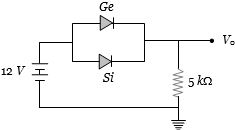
- Ge and Si diodes conduct at \(0.3 \,V\) and \(0.7\, V\) respectively. In the following figure if Ge diode connection are reversed, the valve of \(V0\) changes by.....\(V\)
 JEE Mains 2019 Hard
 - In the isothermal expansion of \(10\,g\) of gas from volume \(V\) to \(2V\) the work done by the gas is \(575\,J\). What is the root mean square speed of the molecules of the gas at that temperature ..... \(m/s\)?JEE Mains 2013 Medium
More PYQs from JEE Mains
- If \(A\) and \(B\) are two events such that \(P\left( {A \cup B} \right) = P\left( {A \cap B} \right)\), then the incorrect statement amongst the following statements isJEE Mains 2014 Hard
- Let the parabola \(y = x^2 + px + q\) passing through the point \((1, -1)\) be such that the distance between its vertex and the \(x\)-axis is minimum. Then the value of \(p^2 + q^2\) is:JEE Mains 2026 Medium
- An electric dipole has a fixed dipole moment \(\vec P\) which makes angle \(\theta \) with respect to \(x-\)axis. When subjected to an electric field \(\overrightarrow {{E_1}} \) \(=E\)\(\hat i\) it experiences a torque \(\overrightarrow {{T_1}} \) =\(\;\tau \hat k\) When subjected to another electric field \(\overrightarrow {{E_2}} = \sqrt 3 {E_1}\hat j\) it experiences torque \(\overrightarrow {{T_2}} \) = \( - \overrightarrow {{T_1}} \) The angle \(\theta \;\) is.......\(^o\)JEE Mains 2017 Hard
- If the three normals drawn to the parabola, \(y ^{2}=2 x\) pass through the point \(( a , 0) a \neq 0,\) then \('a'\) must be greater thanJEE Mains 2021 Hard
- In thermodynamics, heat and work areJEE Mains 2021 Medium
- Let \(f: \mathbf{R}-\{0\} \rightarrow(-\infty, 1)\) be a polynomial of degree 2, satisfying \(f(x) f\left(\frac{1}{x}\right)=f(x)+f\left(\frac{1}{x}\right)\). If \(f(K)=-2 K\), then the sum of squares of all possible values of \(K\) is :JEE Mains 2025 Medium