


All JEE Mains 2019 Physics questions
31 chaptersShowing 151–200 of 468 questions
-
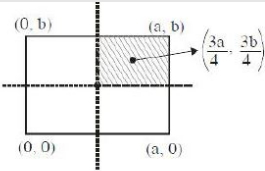
- (A) \(\left( {\frac{{5a}}{3},\frac{{5b}}{3}} \right)\)
- (B) \(\left( {\frac{{2a}}{3},\frac{{2b}}{3}} \right)\)
- (C) \(\left( {\frac{{3a}}{4},\frac{{3b}}{4}} \right)\)
- (D) \(\left( {\frac{{5a}}{12},\frac{{5b}}{12}} \right)\)
Show answer and solution
Correct Answer: (D)
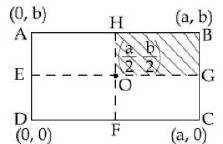
\(x = \frac{{M\frac{a}{2} - \frac{M}{4} \times \frac{{3a}}{4}}}{{M - \frac{M}{4}}}\)\( = \frac{{\frac{a}{2} - \frac{{3a}}{{16}} \times \frac{{3a}}{4}}}{{\frac{3}{4}}} = \frac{{\frac{{5a}}{{16}}}}{{\frac{3}{4}}} = \frac{{5a}}{{12}}\)
\(y = \frac{{M\frac{b}{2} - \frac{M}{4} \times \frac{{3b}}{4}}}{{M - \frac{M}{4}}} = \frac{{5b}}{{12}}\)
-
- (A) \(\tan \,\theta = \frac{1}{{2\sqrt 3 }}\)
- (B) \(\tan \,\theta = \frac{1}{3}\)
- (C) \(\tan \,\theta = \frac{2}{{\sqrt 3 }}\)
- (D) \(\tan \,\theta = \frac{1}{2}\)
Show answer and solution
Correct Answer: (B)
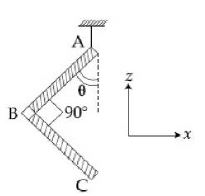
Lets considered mass of each rod is m for stable equilibrium the torque about point \(O\) should be zero. Torque balance about \(O\)\(\begin{array}{l}
mg\frac{a}{2}\sin \theta = mg\left( {\frac{a}{2}\cos \theta - a\sin \theta } \right)\\
\tan \theta = \frac{1}{3}\\
\Rightarrow {\tan ^{ - 1}}\left( {\frac{1}{3}} \right)
\end{array}\)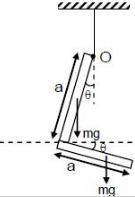
-
- (A) \(\tan \,\theta = \frac{1}{{2\sqrt 3 }}\)
- (B) \(\tan \,\theta = \frac{1}{3}\)
- (C) \(\tan \,\theta = \frac{2}{{\sqrt 3 }}\)
- (D) \(\tan \,\theta = \frac{1}{2}\)
Show answer and solution
Correct Answer: (B)
Lets considered mass of each rod is m for stable equilibrium the torque about point \(O\) should be zero. Torque balance about \(O\)\(\begin{array}{l}
mg\frac{a}{2}\sin \theta = mg\left( {\frac{a}{2}\cos \theta - a\sin \theta } \right)\\
\tan \theta = \frac{1}{3}\\
\Rightarrow {\tan ^{ - 1}}\left( {\frac{1}{3}} \right)
\end{array}\) -
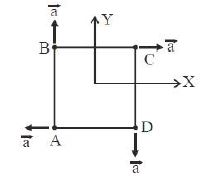
- (A) \(\frac{a}{5}\,\left( {\hat i - \hat j} \right)\)
- (B) Zero
- (C) \(\frac{a}{5}\,\left( {\hat i + \hat j} \right)\)
- (D) \(a\left( {\hat i + \hat j} \right)\)
Show answer and solution
Correct Answer: (A)
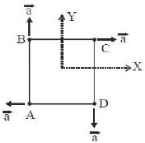
\({\overrightarrow a _A} = - a\hat i\,\,\,\,\,\,\,\,\,\,;\,\,\,\,\,\,\,\,\,\,\,\,{\overrightarrow a _S} = a\hat j\)\({\overrightarrow a _C} = a\hat i\,\,\,\,\,\,\,\,\,\,\,\,\,;\,\,\,\,\,\,\,\,\,\,\,\,{\overrightarrow a _D} = - a\hat j\)
\({\overrightarrow a _{cm}} = \frac{{{m_a}{{\overrightarrow a }_a}a + {m_b}{{\overrightarrow a }_b} + {m_c}{{\overrightarrow a }_c} + {m_d}{{\overrightarrow a }_d}}}{{{m_a} + {m_b} + {m_c} + {m_d}}}\)
\({\overrightarrow a _{cm}} = \frac{{ - ma\hat i + 2ma\hat j + 3ma\hat i - 4ma\hat j}}{{10m}}\)
\( = \frac{{2ma\hat i - 2ma\hat j}}{{10m}} = \frac{a}{5}\hat i - \frac{a}{5}\hat j = \frac{a}{5}\left( {\hat i - \hat j} \right)\)
-
- (A) \(\frac{a}{5}\,\left( {\hat i - \hat j} \right)\)
- (B) Zero
- (C) \(\frac{a}{5}\,\left( {\hat i + \hat j} \right)\)
- (D) \(a\left( {\hat i + \hat j} \right)\)
Show answer and solution
Correct Answer: (A)
\({\overrightarrow a _A} = - a\hat i\,\,\,\,\,\,\,\,\,\,;\,\,\,\,\,\,\,\,\,\,\,\,{\overrightarrow a _S} = a\hat j\)\({\overrightarrow a _C} = a\hat i\,\,\,\,\,\,\,\,\,\,\,\,\,;\,\,\,\,\,\,\,\,\,\,\,\,{\overrightarrow a _D} = - a\hat j\)
\({\overrightarrow a _{cm}} = \frac{{{m_a}{{\overrightarrow a }_a}a + {m_b}{{\overrightarrow a }_b} + {m_c}{{\overrightarrow a }_c} + {m_d}{{\overrightarrow a }_d}}}{{{m_a} + {m_b} + {m_c} + {m_d}}}\)
\({\overrightarrow a _{cm}} = \frac{{ - ma\hat i + 2ma\hat j + 3ma\hat i - 4ma\hat j}}{{10m}}\)
\( = \frac{{2ma\hat i - 2ma\hat j}}{{10m}} = \frac{a}{5}\hat i - \frac{a}{5}\hat j = \frac{a}{5}\left( {\hat i - \hat j} \right)\)
-
- (A) \(\frac{8}{5}\)
- (B) \(\frac{1}{2}\)
- (C) \(\frac{3}{5}\)
- (D) \(\frac{3}{2}\)
Show answer and solution
Correct Answer: (A)
\(M = \int\limits_0^R {{\rho _0}r\left( {2\pi rdr} \right) = \frac{{{\rho _0} \times 2\pi \times {R^3}}}{3}} \)\(\,\,\,\mathop {{I_0}}\limits_{\left( {MOl\,about\,COM} \right)} = \int\limits_0^R {{\rho _0}r} \left( {2\pi rdr} \right) \times {r^2} = \frac{{{\rho _0} \times 2\pi {R^5}}}{5}\)
By parallel axis theorem
\(I = {I_0} + M{R^2}\)
\( = \frac{{{\rho _0} \times 2\pi {R^5}}}{5} + \frac{{{\rho _0} \times 2\pi {R^3}}}{3} \times {R^2} = {\rho _0}2\pi {R^5} \times \frac{8}{{15}}\)
\( = M{R^2} \times \frac{8}{5}\)
-
- (A) \(12\)
- (B) \(16\)
- (C) \(14\)
- (D) \(18\)
Show answer and solution
Correct Answer: (B)
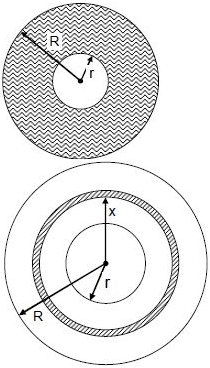
\(r = 10 cm\) mass per unit\(R = 20 cm\) area
\(Mass = m\) \(\sigma = \frac{m}{{\pi \left( {{R^2} - {r^2}} \right)}}\)
Consider an element of radius \(x\) and thickness \(dx\)
Mass of element \(dm =\) \(\sigma \,2\pi \times x\left( {dx} \right)\)
Moment of inertia of element, \(dI = (dm)\)\({x^2}\)
\( \Rightarrow \,\,I = \sigma 2\pi \int_r^R {{X^3}dx} \)
\( = \sigma \frac{{2\pi }}{4}\left( {{R^4} - {r^4}} \right)\)
\( = \frac{m}{{\pi \left( {{R^2} - {r^2}} \right)}}\frac{\pi }{2}\left( {{R^4} - {r^4}} \right)\)
\(\,I = \frac{m}{2}\left( {{R^2} + {r^2}} \right)\,\,\,\,\,\,\,\,\,...\left( i \right)\)
Moment of inertia of thin cylinder of same mass,
\(I = mr_0^2\,\,\,\,\,\,\,\,\,\,\,\,\,\,\,\,\,\,\,\,\,\,\,...\left( {ii} \right)\)
\( \Rightarrow \,\,mr_0^2 = \frac{m}{2}\left( {{R^2} + {r^2}} \right)\)
\(r_0^2 = 250\,\,\,\,\,\,;\,\,\,\,\,\,{r_0}\, \approx \,16\,cm.\)
-
- (A) \(12\)
- (B) \(16\)
- (C) \(14\)
- (D) \(18\)
Show answer and solution
Correct Answer: (B)
\(r = 10 cm\) mass per unit\(R = 20 cm\) area
\(Mass = m\) \(\sigma = \frac{m}{{\pi \left( {{R^2} - {r^2}} \right)}}\)
Consider an element of radius \(x\) and thickness \(dx\)
Mass of element \(dm =\) \(\sigma \,2\pi \times x\left( {dx} \right)\)
Moment of inertia of element, \(dI = (dm)\)\({x^2}\)
\( \Rightarrow \,\,I = \sigma 2\pi \int_r^R {{X^3}dx} \)
\( = \sigma \frac{{2\pi }}{4}\left( {{R^4} - {r^4}} \right)\)
\( = \frac{m}{{\pi \left( {{R^2} - {r^2}} \right)}}\frac{\pi }{2}\left( {{R^4} - {r^4}} \right)\)
\(\,I = \frac{m}{2}\left( {{R^2} + {r^2}} \right)\,\,\,\,\,\,\,\,\,...\left( i \right)\)
Moment of inertia of thin cylinder of same mass,
\(I = mr_0^2\,\,\,\,\,\,\,\,\,\,\,\,\,\,\,\,\,\,\,\,\,\,\,...\left( {ii} \right)\)
\( \Rightarrow \,\,mr_0^2 = \frac{m}{2}\left( {{R^2} + {r^2}} \right)\)
\(r_0^2 = 250\,\,\,\,\,\,;\,\,\,\,\,\,{r_0}\, \approx \,16\,cm.\)
-
- (A) \(2\)
- (B) \(5\)
- (C) \(2.5\)
- (D) \(3\)
Show answer and solution
Correct Answer: (A)
\(KE = \frac{1}{2}I{\omega ^2} = 1200\left( {given} \right)\)\( \Rightarrow \omega = 40\,rad/s\)
\(\,\,\,\,\,\,\,\omega = {\omega _0} + \alpha t\)
\(\,\,\,\,\,\,\,40 = 0 + \left( {20} \right)\,t\)
\( \Rightarrow t = 2\,\sec .\)
-
- (A) \(I = \frac{{15}}{{16}}{I_0}\)
- (B) \(I = \frac{{3}}{{4}}{I_0}\)
- (C) \(I = \frac{{9}}{{16}}{I_0}\)
- (D) \(I = \frac{{{I_0}}}{4}\)
Show answer and solution
Correct Answer: (A)
\(I\, \propto \,m{\ell ^2}\,\,\,\,\,\,\left( {let\,\sigma = mass\,present\,area} \right)\)\(\therefore \,\,\,{I_1}\, \propto \,{\ell ^4}\,\,\,\,\,\,\,...\left( 1 \right)\)
\(and\,\,{I_2}\, \propto \,{\left( {\frac{\ell }{2}} \right)^4}\,\,\,\,\,\,\,\,...\left( 2 \right)\)
\(So,\,{I_2} = \frac{I}{{16}}\)
Moment of inertia of remaining sheet = \(I - \frac{1}{{16}}\)
\( = \frac{{151}}{{16}}\)
-
- (A) \(10 : 15 : 7\)
- (B) \(14: 15: 20\)
- (C) \(4 : 3 : 2\)
- (D) \(2 : 3 : 4\)
Show answer and solution
Correct Answer: (B)
\(\frac{1}{2}\left( {m + \frac{1}{{{R^2}}}} \right){v^2} = mgh\)If radius of gyration is, then
\(h = \frac{{\left( {1 + \frac{{{k^2}}}{{{R^2}}}} \right)}}{{2g}};\frac{{{k_{ring}}}}{{{R_{ring}}}} = 1,\frac{{{k_{solid\,cylinder}}}}{{{R_{solid\,cylinder}}}} = \frac{1}{{\sqrt 2 }}\)
\(\frac{{{k_{solid\,sphere}}}}{{{R_{solid\,sphere}}}} = \sqrt {\frac{2}{5}} \)
\({H_1}\,:\,{h_2}\,:\,{h_3}\,::\left( {1 + 1} \right)\,:\,\left( {1 + \frac{1}{2}} \right):\left( {1 + \frac{2}{5}} \right)::20\,:\,15\,:\,14\)
Therefore most appropriate option is \((B)\)
Although which is not in correct sequence.
-
- (A) \(\frac{\pi }{6}\)
- (B) \(\frac{\pi }{3}\)
- (C) \(\frac{\pi }{8}\)
- (D) \(\frac{\pi }{4}\)
Show answer and solution
Correct Answer: (A)
\(2.5 = 1 \times 5\,\sin \,\theta \)\(\,\sin \,\theta = 0.5 = \frac{1}{2}\)
\(\,\theta = \frac{\pi }{6}\)
-
- (A) \(\frac{\pi }{6}\)
- (B) \(\frac{\pi }{3}\)
- (C) \(\frac{\pi }{8}\)
- (D) \(\frac{\pi }{4}\)
Show answer and solution
Correct Answer: (A)
\(2.5 = 1 \times 5\,\sin \,\theta \)\(\,\sin \,\theta = 0.5 = \frac{1}{2}\)
\(\,\theta = \frac{\pi }{6}\)
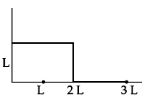
- 168. The position vector of the centre of mass \(\vec r\, cm\) of an asymmetric uniform bar of negligible area of cross-section as shown in figure is
 2019 Medium
- (A) \(\vec r\,cm = \frac{{13}}{8}L\hat x + \frac{5}{8}L\hat y\)
- (B) \(\vec r\,cm = \frac{{5}}{8}L\hat x + \frac{13}{8}L\hat y\)
- (C) \(\vec r\,cm = \frac{{3}}{8}L\hat x + \frac{11}{8}L\hat y\)
- (D) \(\vec r\,cm = \frac{{11}}{8}L\hat x + \frac{3}{8}L\hat y\)
Show answer and solution
Correct Answer: (A)
Three parts of rod can be considered as point masses.\({\overrightarrow r _{cm}} = \frac{{2m\,{{\overrightarrow r }_1} + m{{\overrightarrow r }_2} + m{{\overrightarrow r }_3}}}{{4\,m}}\)
\({\overrightarrow r _{cm}} = \frac{{2m\left( {L\hat i + L\hat j} \right) + m\left( {2L\hat i + \frac{L}{2}\hat j} \right) + m\left( {\frac{{5L}}{2}\hat i} \right)}}{{4\,m}}\)
\( = \frac{{\frac{{13}}{2}L\hat i + \frac{5}{2}L\hat j}}{4}\)
\( = \frac{{13}}{8}L\hat i + \frac{5}{8}L\hat j\)
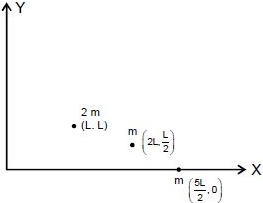
- 169. The position vector of the centre of mass \(\vec r\, cm\) of an asymmetric uniform bar of negligible area of cross-section as shown in figure is 2019 Medium
- (A) \(\vec r\,cm = \frac{{13}}{8}L\hat x + \frac{5}{8}L\hat y\)
- (B) \(\vec r\,cm = \frac{{5}}{8}L\hat x + \frac{13}{8}L\hat y\)
- (C) \(\vec r\,cm = \frac{{3}}{8}L\hat x + \frac{11}{8}L\hat y\)
- (D) \(\vec r\,cm = \frac{{11}}{8}L\hat x + \frac{3}{8}L\hat y\)
Show answer and solution
Correct Answer: (A)
Three parts of rod can be considered as point masses.\({\overrightarrow r _{cm}} = \frac{{2m\,{{\overrightarrow r }_1} + m{{\overrightarrow r }_2} + m{{\overrightarrow r }_3}}}{{4\,m}}\)
\({\overrightarrow r _{cm}} = \frac{{2m\left( {L\hat i + L\hat j} \right) + m\left( {2L\hat i + \frac{L}{2}\hat j} \right) + m\left( {\frac{{5L}}{2}\hat i} \right)}}{{4\,m}}\)
\( = \frac{{\frac{{13}}{2}L\hat i + \frac{5}{2}L\hat j}}{4}\)
\( = \frac{{13}}{8}L\hat i + \frac{5}{8}L\hat j\)
-
- (A) \(-48\,\hat k\)
- (B) \(48\,(\hat i\, + \,\hat j)\)
- (C) \(36\,\hat k\)
- (D) \( - \,34\,(\hat k\, - \,\hat i)\)
Show answer and solution
Correct Answer: (A)
\(\overrightarrow v = 2\hat i - 6 + \hat j\)\(At\,t = 2\)
\(\overrightarrow v = 2\hat i - 12\hat j\)
\(\overrightarrow p = m\overrightarrow v = 4i - 24\hat j\)
\(At\,t = 2\)
\(\overrightarrow r = 4\hat i - 12\hat j\)
\(\overrightarrow L = \overrightarrow r \times \overrightarrow p = \left| \begin{array}{l}
\hat i\,\,\,\,\,\,\,\,\,\,\hat j\,\,\,\,\,\,\,\,\,\,\,\hat k\\
4\,\,\,\,\,\, - 12\,\,\,\,\,\,\,\,\,0\\
4\,\,\,\,\,\, - 24\,\,\,\,\,\,\,\,\,0
\end{array} \right|\)\( = \left\{ {4\left( { - 24} \right) + 4 \times 12} \right\}\hat k\)
\( = \left( { - 96 + 48} \right)\hat k\)
\( = \left( - \right)48\,\hat k\)
-
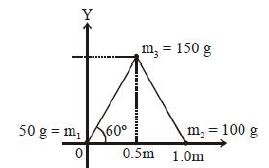
- (A) \(\left( {\frac{{\sqrt 3 }}{7}\,m,\,\frac{7}{{12}}\,m} \right)\)
- (B) \(\left( {\frac{7}{{12}}m,\,\frac{{\sqrt 3 }}{8}\,m} \right)\)
- (C) \(\left( {\frac{{\sqrt 3 }}{4}\,m,\,\frac{5}{{12}}\,m} \right)\)
- (D) \(\left( {\frac{7}{{12}}m,\,\frac{{\sqrt 3 }}{4}\,m} \right)\)
Show answer and solution
Correct Answer: (D)
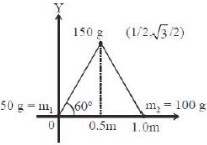
The co-ordinates of the center of mass\({\overrightarrow r _{cm}} = \frac{{0 + 150 \times \left( {\frac{1}{2}i + \frac{{\sqrt 3 }}{2}\hat j} \right) + 100 \times \hat i}}{{300}}\)
\({\overrightarrow r _{cm}} = \frac{7}{{12}}\hat i + \frac{{\sqrt 3 }}{4}\hat j\)
\(\therefore \,\,Co - ordinate\left( {\frac{7}{{12}},\frac{{\sqrt 3 }}{4}} \right)m\)
-
- (A) \(\left( {\frac{{\sqrt 3 }}{7}\,m,\,\frac{7}{{12}}\,m} \right)\)
- (B) \(\left( {\frac{7}{{12}}m,\,\frac{{\sqrt 3 }}{8}\,m} \right)\)
- (C) \(\left( {\frac{{\sqrt 3 }}{4}\,m,\,\frac{5}{{12}}\,m} \right)\)
- (D) \(\left( {\frac{7}{{12}}m,\,\frac{{\sqrt 3 }}{4}\,m} \right)\)
Show answer and solution
Correct Answer: (D)
The co-ordinates of the center of mass\({\overrightarrow r _{cm}} = \frac{{0 + 150 \times \left( {\frac{1}{2}i + \frac{{\sqrt 3 }}{2}\hat j} \right) + 100 \times \hat i}}{{300}}\)
\({\overrightarrow r _{cm}} = \frac{7}{{12}}\hat i + \frac{{\sqrt 3 }}{4}\hat j\)
\(\therefore \,\,Co - ordinate\left( {\frac{7}{{12}},\frac{{\sqrt 3 }}{4}} \right)m\)
-
- (A) \(\mu FR/3\)
- (B) \(\mu FR/6\)
- (C) \(\mu FR/2\)
- (D) \(\frac{2}{3}\,\mu FR\)
Show answer and solution
Correct Answer: (D)
\(\begin{array}{l}
d\tau = \left( {\mu dN} \right)x\\
\,\,\,\,\,\,\, = \mu \left( {\frac{F}{{\pi {R^2}}} \times 2\pi \times dx} \right)x\\
\,\,\,\,\tau = \int\limits_0^R {d\tau }
\end{array}\)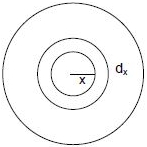
-
- (A) \(\mu FR/3\)
- (B) \(\mu FR/6\)
- (C) \(\mu FR/2\)
- (D) \(\frac{2}{3}\,\mu FR\)
Show answer and solution
Correct Answer: (D)
\(\begin{array}{l}
d\tau = \left( {\mu dN} \right)x\\
\,\,\,\,\,\,\, = \mu \left( {\frac{F}{{\pi {R^2}}} \times 2\pi \times dx} \right)x\\
\,\,\,\,\tau = \int\limits_0^R {d\tau }
\end{array}\) -
- (A) \(\frac{{{I_1}\omega _1^2}}{6}\)
- (B) \(\frac{3}{8}{I_1}\omega _1^2\)
- (C) \( - \frac{{{I_1}\omega _1^2}}{{12}}\)
- (D) \( - \frac{{{I_1}\omega _1^2}}{{24}}\)
Show answer and solution
Correct Answer: (D)
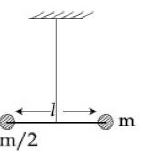
\({E_i} = \frac{1}{2}{I_1} \times \omega _1^2 + \frac{1}{2}\frac{I}{2} \times \frac{{\omega _1^2}}{4}\)\( = \frac{{{I_1}\omega _1^2}}{2}\left( {\frac{9}{8}} \right) = \frac{9}{{16}}{I_1}\omega _1^2\)
\({I_1}{\omega _1} + \frac{{{I_1}\omega { _1}}}{4} = \frac{{3{I_1}}}{2}\omega \,\,\,;\,\,\,\frac{5}{4}{I_1}{\omega _1} = \frac{{3{I_1}}}{2}\omega \)
\(\omega = \frac{5}{6}{\omega _1}\,\,\,\,\,\,\,\,\,\,;\,\,\,\,\,\,\,{E_f} = \frac{1}{2} \times \frac{{3{I_1}}}{2} \times \frac{{25}}{{36}}\omega _1^2\)
\( = \frac{{25}}{{48}}{I_1}\omega _1^2\)
\( \Rightarrow {E_f} - {E_i} = {I_1}\omega _1^2\frac{{25}}{{49}} - \frac{{ - 2}}{{48}}{I_2}\omega _1^2\)
\( = \frac{{25}}{{48}}{I_1}\omega _1^2\)
\( \Rightarrow {E_f} - {E_i} = {I_1}\omega _1^2\left( {\frac{{25}}{{48}} - \frac{9}{{16}}} \right) = \frac{{ - 2}}{{48}}{I_1}\omega _1^2\)
\( = \frac{{ - {I_1}\omega _1^2}}{{24}}\)
-
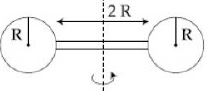
- (A) \(\frac{{137}}{{15}}M{R^2}\)
- (B) \(\frac{{17}}{{15}}M{R^2}\)
- (C) \(\frac{{209}}{{15}}M{R^2}\)
- (D) \(\frac{{152}}{{15}}M{R^2}\)
Show answer and solution
Correct Answer: (A)
\(\begin{array}{l}
l = 2\left[ {\frac{2}{5}M{R^2} + M4{R^2}} \right] + M\frac{{4{R^2}}}{{12}}\\
\,\,\, = M{R^2}\left[ {\frac{1}{3} + \frac{4}{5} + 8} \right] = \frac{{137}}{{15}}M{R^2}
\end{array}\) -
- (A) \(\frac{{3k\,\theta _0^2}}{l}\)
- (B) \(\frac{{2k\,\theta _0^2}}{l}\)
- (C) \(\frac{{k\,\theta _0^2}}{l}\)
- (D) \(\frac{{k\,\theta _0^2}}{2l}\)
Show answer and solution
Correct Answer: (C)
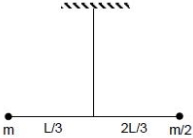
\(\omega \)\( = \sqrt {\frac{K}{I}} \,\,\,;\,\,\,\omega = {\theta _0} \times \Omega \)\(T = m{\omega ^2}\frac{\ell }{3}\)
\(T = m{\omega ^2}\frac{\ell }{3}{\theta _0}\frac{k}{I}\) where \(\,l = m\frac{{{\ell ^2}}}{3}\)
\(\,\,\,\,\, = \frac{{\theta _0^2k}}{\ell }\)
-
- (A) \(\frac{{3k\,\theta _0^2}}{l}\)
- (B) \(\frac{{2k\,\theta _0^2}}{l}\)
- (C) \(\frac{{k\,\theta _0^2}}{l}\)
- (D) \(\frac{{k\,\theta _0^2}}{2l}\)
Show answer and solution
Correct Answer: (C)
\(\omega \)\( = \sqrt {\frac{K}{I}} \,\,\,;\,\,\,\omega = {\theta _0} \times \Omega \)\(T = m{\omega ^2}\frac{\ell }{3}\)
\(T = m{\omega ^2}\frac{\ell }{3}{\theta _0}\frac{k}{I}\) where \(\,l = m\frac{{{\ell ^2}}}{3}\)
\(\,\,\,\,\, = \frac{{\theta _0^2k}}{\ell }\)
-
- (A) \(\omega ({R_1} + {R_2})\,\hat i\)
- (B) \(-\omega ({R_1} + {R_2})\,\hat i\)
- (C) \(\omega ({R_2} - {R_1})\,\hat i\)
- (D) \(\omega ({R_1} - {R_2})\,\hat i\)
Show answer and solution
Correct Answer: (C)
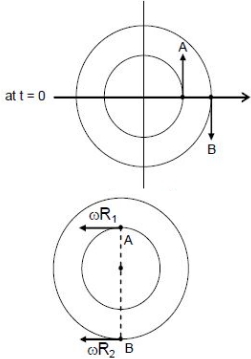
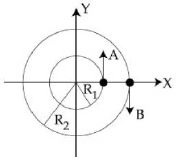
at \(t= 0\) \(at\,t = \frac{\pi }{{2\omega }}\)\({\overrightarrow V _A} = {\overrightarrow V _B} = - \omega {R_1}\hat i + \omega .{R_2}\hat i\)
\( = \omega \left( {{R_2} - {R_1}} \right)\hat i\)
-
- (A) \(\omega ({R_1} + {R_2})\,\hat i\)
- (B) \(-\omega ({R_1} + {R_2})\,\hat i\)
- (C) \(\omega ({R_2} - {R_1})\,\hat i\)
- (D) \(\omega ({R_1} - {R_2})\,\hat i\)
Show answer and solution
Correct Answer: (C)
at \(t= 0\) \(at\,t = \frac{\pi }{{2\omega }}\)\({\overrightarrow V _A} = {\overrightarrow V _B} = - \omega {R_1}\hat i + \omega .{R_2}\hat i\)
\( = \omega \left( {{R_2} - {R_1}} \right)\hat i\)
-
- (A) \(\frac{{B{r^2}I}}{{\pi N}}\)
- (B) zero
- (C) \(\frac{{B\pi {r^2}I}}{N}\)
- (D) \({B\pi {r^2}IN}\)
Show answer and solution
Correct Answer: (D)
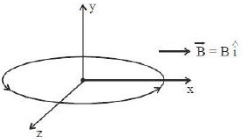
\( \text { Magnetic moment of coil } =\mathrm{NIA} \hat{\mathrm{j}}\)\(=\mathrm{Nl}\left(\pi \mathrm{r}^{2}\right) \hat{\mathrm{j}} \)
Torque on loop (coil) \(=\overline{\mathrm{M}} \times \overline{\mathrm{B}}\)
\(=\mathrm{Nl}\left(\pi \mathrm{r}^{2}\right) \mathrm{B} \sin 90^{\circ}(-\hat{\mathrm{k}})\)
\(=\mathrm{NI} \pi \mathrm{r}^{2} \mathrm{B}(-\hat{\mathrm{k}})\)
-
- (A) \(1.0 \times {10^{ - 7}}\,T\)
- (B) \(1.5 \times {10^{ - 7}}\,T\)
- (C) \(1.5 \times {10^{ - 5}}\,T\)
- (D) \(1.0 \times {10^{ - 5}}\,T\)
Show answer and solution
Correct Answer: (D)
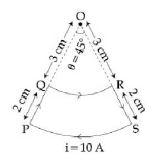
Magnetic field at clentre of an area subtending angle \(\theta\) at the centre \(\frac{\mu_{0} I}{4 \pi r} \theta\)\(B=\left(\frac{\mu_{0}}{4 \pi}\right) \times 10\left(\frac{1}{3 \times 10^{-2}}-\frac{1}{5 \times 10^{-2}}\right) \frac{\pi}{4}\)
\(\quad=B=\frac{\pi}{30} \times 10^{-4}=\frac{\pi}{3} \times 10^{-5} \approx 10^{-5}\)
-
- (A) \(100\)
- (B) \(120\)
- (C) \(80\)
- (D) \(125\)
Show answer and solution
Correct Answer: (C)
\(\mathrm{R}_{9}=20 \,\Omega\)\(\mathrm{N}_{\mathrm{L}}=\mathrm{N}_{\mathrm{g}}=\mathrm{N}=30\)
\(\mathrm{FOM}=\frac{1}{\phi}=0.005 \,\mathrm{A/Div}\)
Current sentivity \(=\mathrm{CS}=\left(\frac{1}{0.005}\right)=\frac{\phi}{1}\)
\(I{g_{\max }} = 0.005 \times 30\)
\(=15 \times 10^{-2}=0.15\)
\(15=0.15[20+\mathrm{R}]\)
\(100=20+R\)
\(R=80\).
-
- (A) \(250\)
- (B) \(200\)
- (C) \(6200\)
- (D) \(6250\)
Show answer and solution
Correct Answer: (B)
\({{\text{V}}_{\text{o}}} = {{\text{i}}_{{{\text{g}}_0}}}\left( {{{\text{R}}_{\text{G}}} + {\text{R}}} \right)\)\({{\text{i}}_{{g_0}}} = 4 \times {10^{ - 4}} \times 25 = {10^{ - 2}}{\mkern 1mu} {\text{A}}\)
\(\mathrm{V}_{0}=2.5\, \mathrm{V}\)
\(R_{0}+R=\frac{V_{0}}{i_{0}}=\frac{2.5}{10^{-2}}=250\)
\(\Rightarrow \quad \mathrm{R}=200\, \Omega\)
-
- (A) \(200\)
- (B) \(100\)
- (C) \(10\)
- (D) None of these
Show answer and solution
Correct Answer: (D)
\(200 + 10^{-4}\, G = 5\)
\(G = -ve\) -
- (A) \(10^{-3}\)
- (B) \(10^{-1}\)
- (C) \(10^{-4}\)
- (D) \(10^{-2}\)
Show answer and solution
Correct Answer: (A)
\(\tau=\overrightarrow{\mathrm{M}} \times \overrightarrow{\mathrm{B}}\)\(\mathrm{C} \theta=\mathrm{i} \mathrm{N} \mathrm{A} \mathrm{B}\)
\(10^{-6} \times \frac{\pi}{180}=10^{-3} \times 10^{-4} \times 175 \times B\)
\(B=10^{-3}\) \(Tesla\)
-
- (A) \(15\)
- (B) \(20\)
- (C) \(10\)
- (D) \(40\)
Show answer and solution
Correct Answer: (B)
\(G=50\, \Omega\)\(\mathrm{S}=5000 \,\Omega\)
\(\mathrm{I}_{\mathrm{g}}=4 \times 10^{-3}\)
\(\mathrm{V}=\mathrm{i}_{g}(\mathrm{G}+\mathrm{S})\)
\(V=4 \times 10^{-3}(50+5000)\)
\(=4 \times 10^{-3}(5050)=20.2\) \(volt\)
-
- (A) \({R_A}{R_V} = {G^2}\) and \(\,\frac{{{R_A}}}{{{R_V}}} = \frac{{{I_g}}}{{\left( {{I_0} - {I_g}} \right)}}\)
- (B) \({R_A}{R_V} = {G^2}\) and \(\,\,\frac{{{R_A}}}{{{R_V}}} = {\left( {\frac{{{I_g}}}{{{I_0} - {I_g}}}} \right)^2}\)
- (C) \({R_A}{R_V} = {G^2}\left( {\frac{{{I_g}}}{{{I_0} - {I_g}}}} \right)\,\) and \(\,\,\frac{{{R_A}}}{{{R_V}}} = {\left( {\frac{{{I_0} - {I_g}}}{{{I_g}}}} \right)^2}\)
- (D) \({R_A} - {R_V} = {G^2}\left( {\frac{{{I_0} - {I_g}}}{{{I_g}}}} \right)\,\) and \(\,\,\frac{{{R_A}}}{{{R_V}}} = {\left( {\frac{{{I_g}}}{{{I_0} - {I_g}}}} \right)^2}\)
Show answer and solution
Correct Answer: (B)
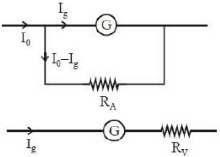
When galvanometer is used an ammeter shunt is used in parallel with galvanometer.\(\therefore \quad \mathrm{I}_{g} \mathrm{G}=\left(\mathrm{I}_{0}-\mathrm{I}_{g}\right) \mathrm{R}_{\mathrm{A}}\)
\(\therefore \quad R_{A}=\left(\frac{I_{g}}{I_{0}-I_{g}}\right) G\)
When galvanometer is used as a voltmeter, resistance is used in series with galvanometer.
\(\mathrm{I}_{g}\left(\mathrm{G}+\mathrm{R}_{\mathrm{v}}\right)=\mathrm{V}=\mathrm{GI}_{0}\left(\text { given } \mathrm{V}=\mathrm{GI}_{0}\right)\)
\(\therefore R_{v}=\frac{\left(I_{0}-I_{g}\right) G}{I_{g}}\)
\(\therefore \quad {{\text{R}}_{\text{A}}}{{\text{R}}_{\text{v}}} = {{\text{G}}^2}\& \frac{{{{\text{R}}_{\text{A}}}}}{{{{\text{R}}_{\text{v}}}}} = {\left( {\frac{{{{\text{I}}_g}}}{{{{\text{I}}_0} - {{\text{I}}_g}}}} \right)^2}\)
-
- (A) \(9.1 \times 10^{-31}\, kg\)
- (B) \(1.6 \times 10^{-27}\, kg\)
- (C) \(1.6 \times 10^{-19}\, kg\)
- (D) \(2.0 \times 10^{-24}\, kg\)
Show answer and solution
Correct Answer: (D)
\(\mathrm{eE}=\mathrm{evB}\)\(\Rightarrow E=\left(\frac{e B r}{m}\right) B\)
\(\Rightarrow m=\frac{e B^{2} r}{E}\)
\(\Rightarrow \mathrm{m}=\frac{\left(1.6 \times 10^{-10}\right)(0.5)^{2}\left(0.5 \times 10^{-2}\right)}{100}=2 \times 10^{-24}\, \mathrm{kg}\)
-
- (A) \((0.35)\,q\)
- (B) \(5\,q\)
- (C) \((2.5)\,q\)
- (D) \((0.15)\,q\)
Show answer and solution
Correct Answer: (B)
\({{\vec F}_{{\text{net }}}} = d\vec E + q(\vec v \times \vec B)\)\( = (2q\hat i + 3q\hat i) + q(\vec v \times \vec B)\)
\(W = {{\vec F}_{net}} \cdot \vec S\)
\( = 2q + 3q\)
\( = 5q\)
-
- (A) \(r_e > r_p = r_{He}\)
- (B) \(r_e > r_p > r_{He}\)
- (C) \(r_e < r_p < r_{He}\)
- (D) \(r_e < r_p = r_{He}\)
Show answer and solution
Correct Answer: (D)
\(r=\frac{m v}{q B}=\frac{\sqrt{2 m K}}{q B}\)\(r_{\mathrm{He}}=r_{p}>r_{e}\)
-
- (A) \(1: \sqrt 2\)
- (B) \(1 : 2\)
- (C) \(1 : 3\)
- (D) \(1: \sqrt 3\)
Show answer and solution
Correct Answer: (A)
\({{\text{m}}_p} = {\text{m}}\) \({{\text{q}}_{\text{p}}} = {\text{q}}\) \({{\text{k}}_{\text{p}}} = {\text{qV}} = {\text{k}}\)\({{\text{m}}_\alpha } = {\text{4m}}\) \({q_\alpha } = 2q\) \({k_\alpha } = 2qV = 2k\)
Radius of circular path,
\(r=\frac{m v}{q B}=\frac{\sqrt{2 k m}}{q B}\)
\( \Rightarrow \) \(\frac{{{r_p}}}{{{r_\alpha }}} = \frac{1}{{\sqrt 2 }}\)
-
- (A) \(0.42\)
- (B) \(0.27\)
- (C) \(0.55\)
- (D) \(0.38\)
Show answer and solution
Correct Answer: (B)
\(|\overrightarrow{\mathrm{t}}|=|\overrightarrow{\mathrm{M}} \times \overrightarrow{\mathrm{B}}|\)\(\tau=\mathrm{NI} \times \mathrm{A} \times \mathrm{B} \times \sin 45^{\circ}\)
\(\tau=0.27\, \mathrm{Nm}\)
-
- (A) Repulsive and equal to \(\frac{{{\mu _0}{I_1}{I_2}}}{{2\pi }}\)
- (B) Repulsive and equal to \(\frac{{{\mu _0}{I_1}{I_2}}}{{4\pi }}\)
- (C) Zero
- (D) Attractive and equal to \(\frac{{{\mu _0}{I_1}{I_2}}}{{3\pi }}\)
Show answer and solution
Correct Answer: (B)
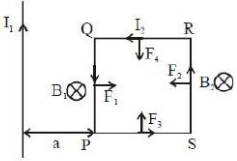
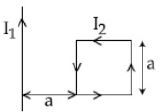
\({{\text{F}}_3}{\text{& }}{{\text{F}}_4}\,{\text{cancel}}\,{\text{each}}\,{\text{other}}{\text{. }}\)\({\text{Force on PQ will be }}{{\text{F}}_1} = {2_B}{\text{Ia}}\)
\({\text{ = }}{{\text{I}}_2}\frac{{{\mu _0}{I_1}}}{{2\pi {\text{a}}}}{\text{a}}\)
\( = \frac{{{\mu _0}I}}{{2\pi {\text{a}}}}{\text{a}}\)
\( = \frac{{{\mu _0}{I_1}{I_2}}}{{2\pi }}\)
Force on \(RS\) will be \(F_{2}=I_{2} B_{2} a\)
\({=\mathrm{I}_{2} \frac{\mu_{0} \mathrm{I}_{1}}{2 \pi 2 \mathrm{a}} \mathrm{a}}\)
\({=\frac{\mu_{0} I_{1} I_{2}}{4 \pi}}\)
Net force \(=\mathrm{F}_{1}-\mathrm{F}_{2}=\frac{\mu_{0} I_1 \mathrm{I}_{2}}{4 \pi}\) repulsion
-
- (A) \(\frac {m}{\pi }\)
- (B) \(\frac {3m}{\pi }\)
- (C) \(\frac {4m}{\pi }\)
- (D) \(\frac {2m}{\pi }\)
Show answer and solution
Correct Answer: (C)
\(m = I{l^2}\) \(2\pi r = 4l\)\({{{\text{m}}^\prime } = \frac{{I4{\ell ^2}}}{\pi }}\) \({{\text{r}} = \frac{{2\ell }}{\pi }}\)
\({{{\text{m}}^\prime } = \frac{{I4{\ell ^2}}}{\pi }}\) \({\pi {r^2} = \frac{{\pi 4{\ell ^2}}}{{{\pi ^2}}} = \frac{{4{\ell ^2}}}{\pi }}\)
\({{{\text{m}}^\prime } = \frac{4}{\pi }\,{\text{m}}}\)
-
- (A) \(2 \times {10^{ - 6}}\,C\)
- (B) \(7 \times {10^{ - 6}}\,C\)
- (C) \(4 \times {10^{ - 5}}\,C\)
- (D) \(3 \times {10^{ - 5}}\,C\)
Show answer and solution
Correct Answer: (D)
\(B=\frac{\mu_{0} i}{2 R}=\frac{\mu_{0} q \omega}{2 R 2 \pi}\)\(\Rightarrow q=3 \times 10^{-5}\, \mathrm{C}\)
-
- (A) \(1.22\)
- (B) \(2.25\)
- (C) \(12.87\)
- (D) \(11.65\)
Show answer and solution
Correct Answer: (C)
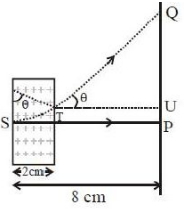
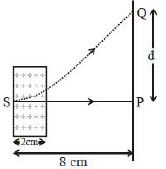
\({\text{R}} = \frac{{{\text{mv}}}}{{{\text{qB}}}}\)\( = \frac{{\sqrt {2{\text{m}}({\text{KE}})} }}{{{\text{qB}}}}\)
\({\text{R}} = \frac{{\sqrt {2 \times 9.1 \times {{10}^{ - 31}} \times \left( {100 \times 1.6 \times {{10}^{ - 18}}} \right)} }}{{1.6 \times {{10}^{ - 10}} \times 1.5 \times {{10}^{ - 3}}}}\)
\({\text{R}} = 2.248\,{\text{cm}}\)
\(\sin \theta = \frac{2}{{2.248}};\,\,\,\,\,\tan \,\theta = \frac{{QU}}{{TU}}\)
\(\frac{2}{{1.026}} = \frac{{QU}}{6}\)
\(QU = 11.69\)
\({\text{PU}} = {\text{R}}(1 - \cos \,\theta )\)
\( = 1.22\)
\({\text{d}} = {\text{QU}} + {\text{PU}}\)
No questions on this page match these filters.