


All JEE Mains 2019 Physics questions
31 chaptersShowing 351–400 of 468 questions
-
- (A) \(0.9\)
- (B) \(6\)
- (C) \(10\)
- (D) \(14\)
Show answer and solution
Correct Answer: (C)
\(\Delta Q = \frac{f}{2}nR\Delta T\)\( = \frac{5}{2}\left( {\frac{{15}}{{28}}} \right)(8.3)(1200 - 300) = 10000\,J\)
-
- (A) \(\sim 10^{10}\)
- (B) \(\sim 10^{11}\)
- (C) \(\sim 10^{12}\)
- (D) \(\sim 10^{13}\)
Show answer and solution
Correct Answer: (A)
\(v=\frac{V_{a v}}{\lambda}\)\(\lambda=\frac{\mathrm{RT}}{\sqrt{2} \pi \sigma^{2} \mathrm{N}_{\mathrm{A}} \mathrm{P}}\)
\(\sigma=2 \times 0.3 \times 10^{-9}\)
\(P=\frac{R T}{V}\)
\(\Rightarrow \quad=\frac{V}{\sqrt{2} \pi \sigma^{2} N_{A}}\)
\(V_{\mathrm{av}}=\sqrt{\frac{8}{3 \pi}} \times V_{\mathrm{rms}}\)
\(\begin{aligned} \therefore \quad \mathrm{v} =\frac{200 \times \sqrt{2} \pi \times \sigma^{2} \mathrm{N}_{\mathrm{A}}}{25 \times 10^{-3}} \times \sqrt{\frac{8}{3 \pi}} \\ =17.68 \times 10^{8} / \mathrm{sec} \\ =0.1768 \times 10^{10} / \mathrm{sec}-10^{10} \end{aligned}\)
-
- (A) \(350\)
- (B) \(700\)
- (C) \(748\)
- (D) \(374\)
Show answer and solution
Correct Answer: (C)
\(\Delta \mathrm{Q}=\mathrm{nC}_{\mathrm{v}} \Delta \mathrm{T}=\mathrm{n} \frac{\mathrm{3}}{2} \mathrm{R} \Delta \mathrm{T}\)\(=\left(\frac{67.2}{22.4}\right)\left(\frac{3}{2} \times 8.31\right)(20)\)
\( \approx 748 \mathrm{J}\)
-
- (A) \(15\,RT\)
- (B) \(12\,RT\)
- (C) \(4\,RT\)
- (D) \(20\,RT\)
Show answer and solution
Correct Answer: (A)
\(U_{\text {total }} =U_{O_{2}}+U_{A r}\)\(=\frac{3 \times 5 \times R T}{2}+\frac{5 \times 3 \times R T}{2}\)
\(=15 \mathrm{RT}\)
-
- (A) \(3.16\)
- (B) \(0.32\)
- (C) \(0.45\)
- (D) \(2.24\)
Show answer and solution
Correct Answer: (A)
\(\frac{\left(\mathrm{V}_{\mathrm{RMS}}\right)_{\mathrm{He}}}{\left(\mathrm{V}_{\mathrm{RMS}}\right)_{\mathrm{Ar}}} =\sqrt{\frac{\mathrm{M}_{\mathrm{Ar}}}{\mathrm{M}_{\mathrm{He}}}} \)\(=\sqrt{\frac{40}{4}}=\sqrt{10}=3.16\)
-
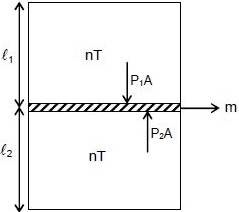
- (A) \(\frac{{RT}}{{ng}}\left[ {\frac{{{l_1} - 3{l_2}}}{{{l_1}{l_2}}}} \right]\)
- (B) \(\frac{{RT}}{g}\left[ {\frac{{2{l_1} + {l_2}}}{{{l_1}{l_2}}}} \right]\)
- (C) \(\frac{{nRT}}{{ng}}\left[ {\frac{1}{{{l_2}}} + \frac{1}{{{l_1}}}} \right]\)
- (D) \(\frac{{nRT}}{g}\left[ {\frac{{{l_1} - {l_2}}}{{{l_1}{l_2}}}} \right]\)
Show answer and solution
Correct Answer: (D)
\(\mathrm{P}_{2} \mathrm{A}-\mathrm{P}_{1} \mathrm{A}=\mathrm{mg}\)\(m=\frac{1}{g}\left(\frac{P_{1} A \ell_{1}}{\ell_{1}}-\frac{P_{2} A \ell_{2}}{\ell_{2}}\right)\)
\(\mathrm{m}=\frac{1}{\mathrm{g}}\left(\frac{\mathrm{nRT}}{\ell_{1}}-\frac{\mathrm{nRT}}{\ell_{2}}\right)\)
\(m=\frac{n R T}{g}\left(\frac{1}{\ell_{1}}-\frac{1}{\ell_{2}}\right)\)
-
- (A) \(\frac{{m{\bar v ^{ 2}}}}{{3{k_B}}}\)
- (B) \(\frac{{m{\bar v ^{ 2}}}}{{7{k_B}}}\)
- (C) \(\frac{{m{\bar v ^{ 2}}}}{{5{k_B}}}\)
- (D) \(\frac{{m{\bar v ^{ 2}}}}{{6{k_B}}}\)
Show answer and solution
Correct Answer: (A)
According to equipartion energy theorem\(\frac{1}{2} m\left(v_{m s}^{2}\right)=3 \times \frac{1}{2} k_{b} T\)
\(T=\frac{m \bar{V}_{r m s}^{-2}}{3 k}\)
-
- (A) \(2\times 10^{-7}\,s\)
- (B) \(4\times 10^{-8}\,s\)
- (C) \(0.5\times 10^{-8}\,s\)
- (D) \(3\times 10^{-6}\,s\)
Show answer and solution
Correct Answer: (B)
\({\text { The mean time between two collision } \propto \frac{P}{\sqrt{T}}} \)\({\qquad \frac{\Delta t_{1}}{\Delta t_{2}}=\frac{P_{1}}{P_{2}} \times \frac{\sqrt{T_{2}}}{\sqrt{T_{1}}}} \)
\({\Rightarrow \quad \frac{6 \times 10^{-8}}{\Delta t_{2}}=(\sqrt{\frac{3}{5}}) \times 2} \)
\({\Rightarrow \quad \Delta t_{2}=6 \times 10^{-8} \times \frac{1}{2} \sqrt{\frac{5}{3}} \approx 4 \times 10^{-8} \text { sec }}\)
- 359. An ideal gas occupies a volume of \(2\, m^3\) at a pressure of \(3\times10^6\, Pa\). The energy of the gas is 2019 Medium
- (A) \(9\times10^6\,J\)
- (B) \(6\times10^4\,J\)
- (C) \(10^8\,J\)
- (D) Insufficient information
Show answer and solution
Correct Answer: (D)
Cannot determine, degree of freedom must be given -
- (A) \(80\,m/s\)
- (B) \(100\sqrt {5}\,m/s\)
- (C) \(100\,m/s\)
- (D) \(80\sqrt {5}\,m/s\)
Show answer and solution
Correct Answer: (B)
\(V_{r m s}=\sqrt{\frac{3 R T}{M_{w}}}\)\(\Rightarrow v_{m s} \propto \sqrt{T}\)
\(\text { Now, } \frac{v}{200}=\sqrt{\frac{500}{400}} \Rightarrow \frac{v}{200}=\frac{\sqrt{5}}{2}\)
\(\Rightarrow \mathrm{v}=100 \sqrt{5} \mathrm{m} / \mathrm{s}\)
-
- (A) \({10^8}\,\frac{N}{{{m^2}}}\)
- (B) \({10^3}\,\frac{N}{{{m^2}}}\)
- (C) \({10^4}\,\frac{N}{{{m^2}}}\)
- (D) None of this
Show answer and solution
Correct Answer: (D)
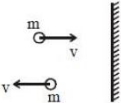
Pressure is defined as normal force per unit area.Force is calculated as change in \( momentum/time.\)
By this answer is \(2 \mathrm{N} / \mathrm{m}^{2}\)
None of the option matches so this question must be Bonus.
Detailed solution is as following:
\(Magnitude\, of\, change\, in\, momentum \,per\, collision\) \(=2\) \(mv\)
Pressure \(=\frac{\text { Force }}{\text { Area }}=\frac{N(2 m v)}{1}\)
\({=\frac{10^{22} \times 2 \times 10^{-26} \times 10^{4}}{1}} \)
\({=2 \mathrm{N} / \mathrm{m}^{2}}\)
-
- (A) \(\frac{1}{4}\frac{{{P_0}{V_0}}}{R}\)
- (B) \(\frac{1}{2}\frac{{{P_0}{V_0}}}{R}\)
- (C) \(\frac{5}{4}\frac{{{P_0}{V_0}}}{R}\)
- (D) \(\frac{3}{4}\frac{{{P_0}{V_0}}}{R}\)
Show answer and solution
Correct Answer: (D)
\(n=1\) mole\(P=P_{0}\left\{1-\frac{1}{2}\left(\frac{V_{0}}{V}\right)^{2}\right\} \quad ; \quad P V=n R T=R T\)
\(P=\frac{R T}{V}\)
\(\frac{R T}{V}=P_{0}\left\{1-\frac{V_{0}^{2}}{2 V^{2}}\right\}\)
\(T=\frac{P_{0} V}{R}\left\{1-\frac{V^{2}}{2 V^{2}}\right\}=\frac{P_{0}}{R}\left\{V-\frac{V_{0}^{2}}{2 V}\right\}\)
\(\Delta T \)\(=\frac{P_{0}}{R}\left\{\left(2 V_{0}-V_{0}\right)-\frac{V_{0}^{2}}{2}\left(\frac{1}{2 V_{0}}-\frac{1}{V_{0}}\right)\right\}\)
\(=\frac{P_{0}}{R}\left\{V_{0}-\frac{V_{0}^{2}}{2}\right\} \)
\( \Delta T \)\(=\frac{P_{0}}{R}\left\{\left(2 V_{0}-V_{0}\right)-\frac{V_{0}^{2}}{2}\left(\frac{1}{2 V_{0}}-\frac{1}{V_{0}}\right)\right\} \)
\(=\frac{P_{0}}{R}\left\{V_{0}-\frac{V_{0}^{2}(1-2)}{2 \times 2 V_{0}}\right\} \)
\(=\frac{P_{0}}{R}\left\{V_{0}-\frac{V_{0}}{4}\right\}=\frac{3}{4} \frac{P_{0} V_{0}}{R}\)
-
- (A) \({n_0}{\alpha ^{ - 3/4}}\)
- (B) \({n_0}{\alpha ^{ - 3}}\)
- (C) \({n_0}{\alpha ^{ 1/4}}\)
- (D) \(\sqrt {{n_0}} {\alpha ^{1/2}}\)
Show answer and solution
Correct Answer: (A)
Given number density of molecules of gas as a function of \(r\) is\(n(r)=n_{0} e^{-a r^{4}}\)
Total number of molecule \(=\int_{0}^{\infty} n(r) \mathrm{d} V=\int_{0}^{\infty} n_{0} e^{-\alpha x^{4}} 4 \pi r^{2} d r\)
Number of molecules is proportional to \(\mathrm{n}_{0} \alpha^{-3 / 4}\)
-
- (A) \(A\) has one vibrational mode and \(B\) has two
- (B) Both \(A\) and \(B\) have a vibrational mode each
- (C) \(A\) is rigid but \(B\) has a vibrational mode
- (D) \(A\) has a vibrational mode but \(B\) has none
Show answer and solution
Correct Answer: (D)
For \(A:\)\(\frac{C_{p}}{C_{v}}=\gamma=1+\frac{2}{f}=\frac{29}{22}\)
It gives \(f=6.3 \approx 6 \quad(3 \text { translational, } 2 \text { rotational and } 1\) vibrational)
For \(B:\)
\(\frac{C_{p}}{C_{v}}=\gamma=1+\frac{2}{f}=\frac{30}{21}\)
\(\Rightarrow \mathrm{f}=4.67\)
\(\Rightarrow \quad \approx 5 \quad(3 \text { translational, } 2\) rotational, no vibrational)
-
- (A) \(800\,K\)
- (B) \(10^4\,K\)
- (C) \(3\times10^5\,K\)
- (D) \(650\,K\)
Show answer and solution
Correct Answer: (B)
\(v_{m s}=\sqrt{\frac{3 R T}{m}} \quad v_{\text {escape }}=\sqrt{2 g R_{e}}\)\(\mathrm{v}_{\mathrm{rms}}=\mathrm{v}_{\text {escape }}\)
\(\frac{3 \mathrm{RT}}{\mathrm{m}}=2 \mathrm{gR}_{\mathrm{e}}\)
\(\frac{3 \times 1.38 \times 10^{-23} \times 6.02 \times 10^{26}}{2} \times 10 \times 10^{3}=10^{4} \mathrm{k}\)
-
- (A) \(\frac {3}{2}\,Q\)
- (B) \(\frac {5}{3}\,Q\)
- (C) \(\frac {7}{5}\,Q\)
- (D) \(\frac {2}{3}\,Q\)
Show answer and solution
Correct Answer: (C)
\(Q=C v \Delta T\)\(Q^{\prime}=C_{P} \Delta T\)
\(Q^{\prime}=\frac{C_{P}}{C_{V}} Q=\left(1+\frac{2}{5}\right) Q=\frac{7}{5} Q\)
-
- (A) \(40\)
- (B) \(30\)
- (C) \(35\)
- (D) \(25\)
Show answer and solution
Correct Answer: (C)
For a diatomic gas, \(\mathrm{C}_{\mathrm{p}}=\frac{7}{2} \mathrm{R}\)since gas undergoes isobaric process
\(\Rightarrow \Delta \mathrm{Q}=\mathrm{n} \frac{7}{2} \mathrm{R\Delta\,T}=\frac{7}{2}({nR\Delta\,T})=35 \mathrm{J}\)
-
- (A) \(40\)
- (B) \(80\)
- (C) \(100\)
- (D) \(20\)
Show answer and solution
Correct Answer: (A)
As temperature at point \(A\) and \(C\) is same.\(\therefore\) Internal energy change will be same.
\(\mathrm{Q}-\mathrm{W}=\mathrm{Q}^{\prime}-\mathrm{W}^{\prime}\)
\(60-30=Q^{\prime}-10\)
\(Q^{\prime}=40 \mathrm{J}\)
-
- (A) \(3/5\)
- (B) \(2/5\)
- (C) \(2/3\)
- (D) \(5/3\)
Show answer and solution
Correct Answer: (B)
Equation of adiabatic process\(TV^{2/f} =\) constant
\(\therefore \,\,\frac {2}{f}=\frac {2}{5}=x\)
-
- (A) \(120\)
- (B) \(100\)
- (C) \(140\)
- (D) \(130\)
Show answer and solution
Correct Answer: (D)
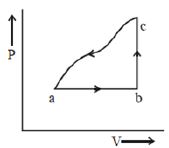
\(\Delta\,E\) \(\Delta\,W\) \(\Delta\,Q\) \(ab\) \(250\) \(bc\) \(0\) \(60\) \(ca\) \(-180\) \(\Delta\,E\) \(\Delta\,W\) \(\Delta\,Q\) \(ab\) \(120\) \(130\) \(250\) \(bc\) \(60\) \(0\) \(60\) \(ca\) \(-180\) -
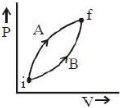
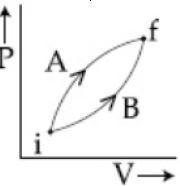
- (A) \(\Delta {Q_A}\, = \,\Delta {Q_B}\,;\,\Delta {U_A} = \Delta {U_B}\)
- (B) \(\Delta {Q_A}\, > \,\Delta {Q_B}\,;\,\Delta {U_A} = \Delta {U_B}\)
- (C) \(\Delta {Q_A}\, < \,\Delta {Q_B}\,;\,\Delta {U_A} < \Delta {U_B}\)
- (D) \(\Delta {Q_A}\, > \,\Delta {Q_B}\,;\,\Delta {U_A} > \Delta {U_B}\)
Show answer and solution
Correct Answer: (B)
Initial and final states for both the processes are same,\(\therefore \Delta \mathrm{U}_{\mathrm{A}}=\Delta \mathrm{U}_{\mathrm{B}}\)
Work done during process \(A\) is greater than in process \(B\). Because area is more
By First law of thermodynamics
\(\Delta Q=\Delta U+W\)
\(\Rightarrow \Delta \mathrm{Q}_{\mathrm{A}}>\Delta \mathrm{Q}_{\mathrm{B}}\)
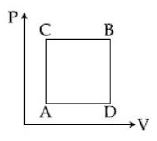
- 372. For the given cyclic process \(CAB\) as shown for a gas, the work done is ..... \(J\)
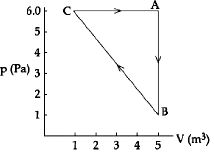 2019 Easy
- (A) \(30\)
- (B) \(10\)
- (C) \(1\)
- (D) \(5\)
Show answer and solution
Correct Answer: (B)
Work done \(=\) Area of loop
\(= \frac{1}{2} (4) (5)\)
\(= 10\, J\) -
- (A) \(2256\)
- (B) \(167\)
- (C) \(2089\)
- (D) \(1\)
Show answer and solution
Correct Answer: (C)
\(W = P\left( {dV} \right)\)\( = 0.01 \times {10^5}\left( {1671 - 1} \right) \times {10^{ - 6}} = 167\,J\)\(Q = \Delta U + W\)
\(\Delta U = Q - W = mL - 167\)\( = 2256 - 167 = 2089\,J\)
-
- (A) \(\frac{1}{2}\,R\Delta T\)
- (B) \(\frac{1}{2}\,KR\Delta T\)
- (C) \(\frac{3}{2}\,R\Delta T\)
- (D) \(\frac{{2K}}{3}\,\Delta T\)
Show answer and solution
Correct Answer: (A)
\({\mathrm{VT}=\mathrm{K}} \)\({\Rightarrow \quad \mathrm{V}\left(\frac{\mathrm{PV}}{\mathrm{nR}}\right)=\mathrm{k}} \)
\({\Rightarrow \quad \mathrm{PV}^{2}=\mathrm{K}} \)
\({\because \quad \mathrm{C}=\frac{\mathrm{R}}{1-\mathrm{x}}+\mathrm{C}_{\mathrm{v}} \text { (For polytropic process) }} \)
\({\mathrm{C}=\frac{\mathrm{R}}{1-2}+\frac{3 \mathrm{R}}{2}=\frac{\mathrm{R}}{2}} \)
\({\therefore \quad \Delta \mathrm{Q}=\mathrm{nC} \Delta \mathrm{T}}\)
-
- (A) \(\frac{{nR}}{{{C_v} - nR}}\)
- (B) \(\frac{{nR}}{{{C_v} + nR}}\)
- (C) \(\frac{{4nR}}{{{C_v} + nR}}\)
- (D) \(\frac{{4nR}}{{{C_v} - nR}}\)
Show answer and solution
Correct Answer: (B)
\(\mathrm{w}=\mathrm{n} \mathrm{R} \Delta \mathrm{T}\)\(\Delta \mathrm{H}=\left(\mathrm{C}_{\mathrm{v}}+\mathrm{n} \mathrm{R}\right) \Delta \mathrm{T}\)
\(\frac{\omega}{\Delta H}=\frac{n R}{C_{v}+n R}\)
-
- (A) \(a\, d\, c\, b\)
- (B) \(a\, d\, b\, c\)
- (C) \(d\, a\, c\, b\)
- (D) \(d\, a\, b\, c\)
Show answer and solution
Correct Answer: (D)
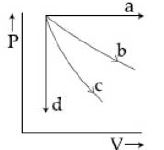
isochoric \(\rightarrow\) Process dIsobaric \(\rightarrow\) Process a
Adiabatic slope will be more than isothermal so
Isothermal \(\rightarrow\) Process b
Adiabatic\(\rightarrow\) Process \(c\)
Order \(\rightarrow\) d a b c
-
- (A) \({T_2} = {\left( {{T_1}{T_4}} \right)^{1/2}};\,{T_3} = {\left( {T_1^2{T_4}} \right)^{1/3}}\)
- (B) \({T_2} = {\left( {T_1^2{T_4}} \right)^{1/3}};\,{T_3} = {\left( {{T_1}T_4^2} \right)^{1/3}}\)
- (C) \({T_2} = {\left( {{T_1}T_4^2} \right)^{1/3}};\,{T_3} = {\left( {T_1^2{T_4}} \right)^{1/3}}\)
- (D) \({T_2} = {\left( {T_1^3{T_4}} \right)^{1/4}};\,{T_3} = {\left( {{T_1}T_4^3} \right)^{1/4}}\)
Show answer and solution
Correct Answer: (B)
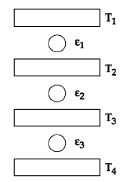
\(n_{1}=n_{2}=n_{3}\)\(\Rightarrow \quad 1-\frac{T_{2}}{T_{1}}=1-\frac{T_{3}}{T_{2}}=1-\frac{T_{4}}{T_{3}}\)
\(\Rightarrow \quad \frac{T_{2}}{T_{1}}=\frac{T_{3}}{T_{2}}=\frac{T_{4}}{T_{3}}\)
\(\Rightarrow \quad \mathrm{T}_{2} \mathrm{T}_{3}=\mathrm{T}_{1} \mathrm{T}_{4}\) and \(\frac{\mathrm{T}_{3}^{2}}{\mathrm{T}_{2}}=\mathrm{T}_{4}\)
Solve for \(\mathrm{T}_{2}\) and \(\mathrm{T}_{3}\)
-
- (A) \(600\)
- (B) \(400\)
- (C) \(300\)
- (D) \(500\)
Show answer and solution
Correct Answer: (D)
\(W_1 = W_2\)\(\Rightarrow \,\,\,600-T_2\,=\,T_2\,-\,400\)
\(\Rightarrow T_2\,=\,500\,K\)
-
- (A) \(15\)
- (B) \(30\)
- (C) \(25\)
- (D) \(20\)
Show answer and solution
Correct Answer: (D)
\(0.1 \times 400 \times \left( {500 - T} \right)\)\( = 0.5 \times 4200 \times \left( {T - 30} \right) + 800\left( {T - 30} \right)\)
\( \Rightarrow 40\left( {500 - T} \right) = \left( {T - 30} \right)\left( {2100 + 800} \right)\)
\( \Rightarrow 20000 - 40T = 2900\,T - 30 \times 2900\)
\( \Rightarrow 20000 + 30 \times 2900 = T\left( {2940} \right)\)
\(T = {30.4^ \circ }C\)
\(\frac{{\Delta T}}{T} \times 100 = \frac{{6.4}}{{30}} \times 100 \simeq 20\% \)
-
- (A) \(35\)
- (B) \(150\)
- (C) \(130\)
- (D) \(20\)
Show answer and solution
Correct Answer: (D)
Suppose \('m'\) gram of water evaporates then, heat required \(\Delta {Q_{req}} = m{L_v}\)Mass that converts into ice \(=(150-m)\)
So, heat released in this process
\(\Delta {Q_{rel}} = \left( {150 - m} \right){L_f}\)
Now,
\(\Delta {Q_{rel}} = \Delta {Q_{req}}\)
\(\left( {150 - m} \right){L_f} = m{L_v}.\)
\(M\left( {{L_f} - {L_v}} \right) = 150\,{L_f}\)
\(m = \frac{{150{L_f}}}{{{L_f} + {L_v}}}\,\,;\,\,m = 20\,g\)
-
- (A) \(25\)
- (B) \(60\)
- (C) \(40\)
- (D) \(35\)
Show answer and solution
Correct Answer: (A)
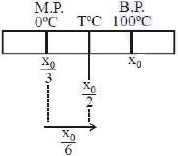
\(t = \frac{{{x_t} - {x_0}}}{{{x_{100}} - {x_0}}}{100^ \circ }C\)\(\frac{{\frac{{{x_0}}}{2} - \frac{{{x_0}}}{3}}}{{x - \frac{{{x_0}}}{3}}}{100^ \circ }C\)
\( = {25^ \circ }C\)
-
- (A) \(9F/\left( {\pi {r^2}YT} \right)\)
- (B) \(F/\left( {3\pi {r^2}YT} \right)\)
- (C) \(3F/\left( {\pi {r^2}YT} \right)\)
- (D) \(6F/\left( {\pi {r^2}YT} \right)\)
Show answer and solution
Correct Answer: (C)
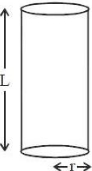
Lenght of cylinder remains unchangedSo \({\left( {\frac{F}{A}} \right)_{compressive}} = {\left( {\frac{F}{A}} \right)_{Themal}}\)
\(\frac{F}{{\pi {r^2}}} = Y\alpha T\,\,\,\,\,\,\left( {\alpha \,is\,liner\,coefficient\,of\,\exp ansion} \right)\)
\(\therefore \alpha = \frac{F}{{YT\pi {r^2}}}\)
\(\therefore \,The\,coefficient\,of\,volume\,expansion\,\gamma = 3\alpha \)
\(\therefore \gamma =3 \frac{F}{{YT\pi {r^2}}}\)
-
- (A) \(458\)
- (B) \(920\)
- (C) \(1232\)
- (D) \(654\)
Show answer and solution
Correct Answer: (B)
\(Heat\,loss = Heat\,gain\)\(192 \times S\left( {100 - 21.5} \right)\)
\( = \left( {128 \times 0.394 + 240 \times 4.2} \right)\left( {21.5 - 8.4} \right)\)
\(192 \times 78.5 \times S = 1058.432 \times 13.1\)
\(S = 0.91995\,J/g\,{K^{ - 1}}\)
\(S = 919.95\,J/kg\,{K^{ - 1}}\)
-
- (A) \(0.5\)
- (B) \(9\)
- (C) \(0.9\)
- (D) \(1.5\)
Show answer and solution
Correct Answer: (B)
\(\begin{array}{l}
Mg = \left( {\frac{{Ay}}{l}} \right)\,\Delta l\\
Mg = \left( {Ay} \right)\,\alpha \Delta T = 2\pi
\end{array}\)It is closest to \(9\)
-
- (A) \(50\)
- (B) \(100\)
- (C) \(60\)
- (D) \(40\)
Show answer and solution
Correct Answer: (D)
\(m \times 0.5 \times 20 + \left( {m - 20} \right) \times 80\)\( = 50 \times 1 \times 40\)
\( \Rightarrow 90\,m - 1600 = 2000\)
\( \Rightarrow 90\,m = 3600\)
\( \Rightarrow m = 40\,gm\)
-
- (A) \(230\)
- (B) \(270\)
- (C) \(200\)
- (D) \(250\)
Show answer and solution
Correct Answer: (A)
\(\Delta {\ell _1} = \Delta {\ell _2}\)\(\ell {\alpha _1}\Delta {T_1} = \ell {\alpha _2}\Delta {T_2}\)
\(\frac{{\alpha { _1}}}{{{\alpha _2}}} = \frac{{\Delta {T_1}}}{{\Delta {T_2}}}\,\,;\,\,\frac{4}{3} = \frac{{T - 30}}{{180 - 30}}\)
\(T = {203^ \circ }C\)
-
- (A) \(85\)
- (B) \(60\)
- (C) \(80\)
- (D) \(70\)
Show answer and solution
Correct Answer: (C)
\(100 \times {S_A} \times \left[ {100 - 90} \right] = 50 \times {S_B} \times \left( {90 - 75} \right)\)\(2{S_A} = 1.5\,{S_B}\)
\({S_A} = \frac{3}{4}{S_B}\)
\(Now,100 \times {S_A} \times \left[ {100 - T} \right] = 50 \times {S_B}\left( {T - 50} \right)\)
\(2 \times \left( {\frac{3}{4}} \right)\left( {100 - T} \right) = \left( {T - 50} \right)\)
\(300 - 3T = 2T - 100\)
\(400 = 5T\)
\(T = 80\)
-
- (A) \(\frac{{50{M_2}}}{{{M_1}}} - 5\)
- (B) \(\frac{{5{M_2}}}{{{M_1}}} - 5\)
- (C) \(\frac{{50{M_2}}}{{{M_1}}}\)
- (D) \(\frac{{5{M_1}}}{{{M_2}}} - 50\)
Show answer and solution
Correct Answer: (A)
\(Heat\,lost=Heat\,gain\)\( \Rightarrow \,{M_2} \times 1 \times 50 = {M_1} \times 0.5 \times 10 + {M_1}.{L_f}\)
\( \Rightarrow \,\,{L_f} = \frac{{500{M_2} - 5{M_1}}}{{{M_1}}}\)
\( = \frac{{500{M_2}}}{{{M_1}}} - 5\)
-
- (A) \(10^3\, Nm^{-2}\)
- (B) \(10^6\, Nm^{-2}\)
- (C) \(10^8\, Nm^{-2}\)
- (D) \(10^4\, Nm^{-2}\)
Show answer and solution
Correct Answer: (B)
\(Energy\,of\,catapult = \frac{1}{2} \times {\left( {\frac{{\Delta \ell }}{\ell }} \right)^2} \times Y \times A \times \ell \)\( = Kinetic\,energy\,of\,the\,ball = \frac{1}{2}\,m{V^2}\)
\(Therefore,\frac{1}{2} \times {\left( {\frac{{20}}{{42}}} \right)^2} \times Y \times \pi \times {3^2} \times {10^{ - 6}} \times 42 \times {10^{ - 2}}\)
\( = \frac{1}{2} \times 2 \times {10^{ - 2}} \times {\left( {20} \right)^2}\)
\(Y = 3 \times {10^{6\,}}\,N{m^2}\)
-
- (A) \(\frac{F}{{A\alpha \,\Delta T}}\)
- (B) \(\frac{F}{{A\alpha \,\left( {\Delta T - 273} \right)}}\)
- (C) \(\frac{F}{{2A\,\alpha \,\Delta T}}\)
- (D) \(\frac{2F}{{A\,\alpha \,\Delta T}}\)
Show answer and solution
Correct Answer: (A)
\(\Delta L = L \propto \Delta T\)\(Strain = \frac{{\Delta L}}{L} = \propto \Delta T\,\,;\,\,Y = \frac{F}{{A \propto \Delta T}}\)
-
- (A) \(6.2 \times {10^6}\,N{m^{ - 2}}\)
- (B) \(4.8 \times {10^6}\,N{m^{ - 2}}\)
- (C) \(5.2 \times {10^6}\,N{m^{ - 2}}\)
- (D) \(3.1 \times {10^6}\,N{m^{ - 2}}\)
Show answer and solution
Correct Answer: (D)
Tensile stress in wire will be\( = \frac{{Tensile\,force}}{{Cross\,section\,Area}}\)
\( = \frac{{mg}}{{\pi {R^2}}} = \frac{{4 \times 3.1\pi }}{{\pi \times 4 \times {{10}^{ - 6}}}}N{m^{ - 2}} = 3.1 \times {10^6}N{m^{ - 2}}\)
-
- (A) \(1.8\times 10^6\,N/m^2\)
- (B) \(0.2\times 10^6\,N/m^2\)
- (C) \(1.2\times 10^6\,N/m^2\)
- (D) None of these
Show answer and solution
Correct Answer: (D)
\(\ell = 1\,M\)\(A = {10^{ - 6}}{M^2}\)
\(stress = \frac{F}{A}\) \({Y_s} = 120 \times {10^9}\)
\(Stress = \frac{{Stress}}{Y}\)
\(\Delta \ell = \frac{{\ell \times F}}{{AY}}\)
\(\Delta {\ell _1} + \Delta {\ell _2} = \frac{{{\ell _1}F}}{{A{Y_1}}} + \frac{{{\ell _2}F}}{{A{Y_2}}} = 0.2 \times {10^{ - 3}}\)
\(\frac{F}{A} = \frac{{0.2 \times {{10}^{ - 3}}}}{{\frac{\ell }{{{Y_1}}} + \frac{\ell }{{{Y_2}}}}}\)
\( = \frac{{0.2 \times {{10}^{ - 3}}}}{{\frac{1}{{120 \times {{10}^9}}} + \frac{1}{{60 \times {{10}^9}}}}} = \frac{{0.2 \times {{10}^{ - 3}} \times {{10}^9} \times 120}}{{1 + 2}}\)
\( = \frac{{0.2 \times {{10}^6} \times 120}}{3} = 8 \times {10^6}\)

-
- (A) \(1\)
- (B) \(1.16\)
- (C) \(0.90\)
- (D) \(1.36\)
Show answer and solution
Correct Answer: (B)
\(\frac{{400}}{{\frac{\pi }{4}{d^2}}} = 379 \times {10^6}\)\({d^2} = \frac{{4 \times 400 \times {{10}^{ - 6}}}}{{\pi \times 379}} = 0.336 \times {10^{ - 6}} \times 4\)
\(d = 2\sqrt {0.336} \times {10^{ - 3}}M \simeq 1.16\,mm\)
-
- (A) \(1.3\)
- (B) \(1.5\)
- (C) \(1.7\)
- (D) \(1.9\)
Show answer and solution
Correct Answer: (C)
Given:\(\frac{{{Y_A}}}{{{Y_B}}} = \frac{7}{4}\,\,\,{L_A} = 2m\,\,\,{A_A} = \pi {R^2}\)
\({L_B} = 1.5\,m\,\,\,\,\,\,\,\,{A_B} = \pi {\left( {2mm} \right)^2}\)
\(\frac{F}{A} = Y\left( {\frac{\ell }{L}} \right)\)
\(given\,F\,and\,\ell \,are\,same \Rightarrow \frac{{AY}}{L}\,is\,same\)
\(\frac{{{A_A}{Y_A}}}{{{L_A}}} = \frac{{{A_B}{Y_B}}}{{{L_B}}}\)
\( \Rightarrow \frac{{\left( {\pi {R^2}} \right)\left( {\frac{7}{4}{Y_B}} \right)}}{2} = \frac{{\pi {{\left( {2\,mm} \right)}^2}.{Y_B}}}{{1.5}}\)
\(R = 1.74\,mm\)
-
- (A) \(4\,M\)
- (B) \(\frac {M}{2}\)
- (C) \(M\)
- (D) \(2\,M\)
Show answer and solution
Correct Answer: (D)
Height of liquid rise in capillary tube \(h = \frac{{2T\cos {\theta _c}}}{{\rho rg}}\)\( \Rightarrow h \propto \frac{1}{r}\)
When radius becomes double height become half
\(\therefore h' = \frac{h}{2}\)
\(Now,\,M = \pi {r^2}h \times \rho \,and\,M'\)
\( = \pi {\left( {2r} \right)^2}\left( {h/2} \right) \times \rho = 2M.\)
-
- (A) \(3/5\)
- (B) \(4/5\)
- (C) \(2/3\)
- (D) \(2/5\)
Show answer and solution
Correct Answer: (D)
\(h = \frac{{2{S_1}\cos \theta }}{{{r_1}{\rho _1}g}}\)\(h = \frac{{2{s_2}\cos {\theta _2}}}{{{r_2}{\rho _2}g}}\)
\( \Rightarrow \frac{{{r_1}}}{{{r_2}}} = \frac{2}{5}\)
-
- (A) \(46.3\)
- (B) \(65.4\)
- (C) \(30.1\)
- (D) \(87.5\)
Show answer and solution
Correct Answer: (D)
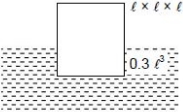
\(0.3\,{\ell ^3}\,{\rho _\omega } = {\ell ^3}\rho \)\(\rho = 300\frac{{kg}}{{{m^3}}}\)
\(m + {\ell ^3}\rho = {\ell ^3}{\rho _\omega }\)
\(M = {\ell ^3}\left( {{\rho _w} - \rho } \right) = {\left( 0.5 \right)^3}\left\{ {1000 - 300} \right\}\)
\( = 700 \times {\left( 0.5 \right)^3}\)
\( = 87.5\,kg\)
-
- (A) \(\frac{1}{4}\,\rho {v^2}\)
- (B) \(\frac{3}{4}\,\rho {v^2}\)
- (C) \(\frac{1}{2}\,\rho {v^2}\)
- (D) \(\rho {v^2}\)
Show answer and solution
Correct Answer: (B)
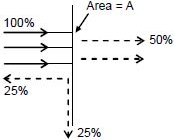
\(F = \frac{1}{4} \times \rho A{v^2} + \frac{1}{4}2\rho a{v^2}\)\( \Rightarrow \frac{F}{A} = \frac{3}{4}\rho A{v^2} = \rho \)
-
- (A) \(3\)
- (B) \(4\)
- (C) \(5\)
- (D) \(0\)
Show answer and solution
Correct Answer: (A)
In first case:\(\frac{{\frac{{mg}}{A}}}{{\left( {\frac{{\Delta {\ell _1}}}{\ell }} \right)}} = Y\,\,\,\,\, \Rightarrow \,\,\,\Delta {\ell _1} = \frac{{mg}}{{\left( {\frac{{YA}}{\ell }} \right)}}\)
In second case:
\(\frac{{\frac{{mg - B}}{A}}}{{\left( {\frac{{\Delta {\ell _1}}}{\ell }} \right)}} = Y\,\,\,\, \Rightarrow \,\,\Delta {\ell _2} = \frac{{mg - B}}{{\left( {\frac{{YA}}{\ell }} \right)}} = \frac{{\left( {\frac{{3mg}}{4}} \right)}}{{\left( {\frac{{YA}}{\ell }} \right)}}\)
\( \Rightarrow \,\,\Delta {\ell _2} = \frac{3}{4}\Delta {\ell _1} = 3\,mm\)
-
- (A) \(2.0\)
- (B) \(0.1\)
- (C) \(0.4\)
- (D) \(1.2\)
Show answer and solution
Correct Answer: (A)
\(y = \frac{{{w^2}{x^2}}}{{2g}} = \frac{{{{\left( {2 \times 2\pi } \right)}^2} \times {{\left( {0.05} \right)}^2}}}{{2g}}\)\( = 25 \times 8 \times {10^{ - 4}}\)
\( = 2\,cm\,\,\,\,\)
No questions on this page match these filters.