


Questions
12 questionsShowing 1–12 of 12 questions
-
- (A) \(40\)
- (B) \(30\)
- (C) \(35\)
- (D) \(25\)
Show answer and solution
Correct Answer: (C)
For a diatomic gas, \(\mathrm{C}_{\mathrm{p}}=\frac{7}{2} \mathrm{R}\)since gas undergoes isobaric process
\(\Rightarrow \Delta \mathrm{Q}=\mathrm{n} \frac{7}{2} \mathrm{R\Delta\,T}=\frac{7}{2}({nR\Delta\,T})=35 \mathrm{J}\)
-
- (A) \(40\)
- (B) \(80\)
- (C) \(100\)
- (D) \(20\)
Show answer and solution
Correct Answer: (A)
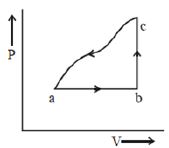
As temperature at point \(A\) and \(C\) is same.\(\therefore\) Internal energy change will be same.
\(\mathrm{Q}-\mathrm{W}=\mathrm{Q}^{\prime}-\mathrm{W}^{\prime}\)
\(60-30=Q^{\prime}-10\)
\(Q^{\prime}=40 \mathrm{J}\)
-
- (A) \(3/5\)
- (B) \(2/5\)
- (C) \(2/3\)
- (D) \(5/3\)
Show answer and solution
Correct Answer: (B)
Equation of adiabatic process\(TV^{2/f} =\) constant
\(\therefore \,\,\frac {2}{f}=\frac {2}{5}=x\)
-
- (A) \(120\)
- (B) \(100\)
- (C) \(140\)
- (D) \(130\)
Show answer and solution
Correct Answer: (D)
\(\Delta\,E\) \(\Delta\,W\) \(\Delta\,Q\) \(ab\) \(250\) \(bc\) \(0\) \(60\) \(ca\) \(-180\) \(\Delta\,E\) \(\Delta\,W\) \(\Delta\,Q\) \(ab\) \(120\) \(130\) \(250\) \(bc\) \(60\) \(0\) \(60\) \(ca\) \(-180\) -
- (A) \(\Delta {Q_A}\, = \,\Delta {Q_B}\,;\,\Delta {U_A} = \Delta {U_B}\)
- (B) \(\Delta {Q_A}\, > \,\Delta {Q_B}\,;\,\Delta {U_A} = \Delta {U_B}\)
- (C) \(\Delta {Q_A}\, < \,\Delta {Q_B}\,;\,\Delta {U_A} < \Delta {U_B}\)
- (D) \(\Delta {Q_A}\, > \,\Delta {Q_B}\,;\,\Delta {U_A} > \Delta {U_B}\)
Show answer and solution
Correct Answer: (B)
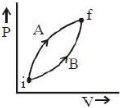
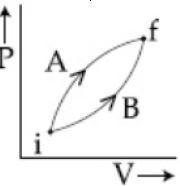
Initial and final states for both the processes are same,\(\therefore \Delta \mathrm{U}_{\mathrm{A}}=\Delta \mathrm{U}_{\mathrm{B}}\)
Work done during process \(A\) is greater than in process \(B\). Because area is more
By First law of thermodynamics
\(\Delta Q=\Delta U+W\)
\(\Rightarrow \Delta \mathrm{Q}_{\mathrm{A}}>\Delta \mathrm{Q}_{\mathrm{B}}\)
-
- (A) \(30\)
- (B) \(10\)
- (C) \(1\)
- (D) \(5\)
Show answer and solution
Correct Answer: (B)
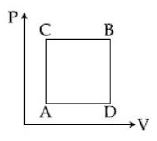
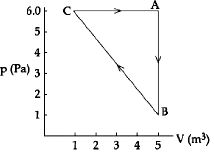
Work done \(=\) Area of loop
\(= \frac{1}{2} (4) (5)\)
\(= 10\, J\) -
- (A) \(2256\)
- (B) \(167\)
- (C) \(2089\)
- (D) \(1\)
Show answer and solution
Correct Answer: (C)
\(W = P\left( {dV} \right)\)\( = 0.01 \times {10^5}\left( {1671 - 1} \right) \times {10^{ - 6}} = 167\,J\)\(Q = \Delta U + W\)
\(\Delta U = Q - W = mL - 167\)\( = 2256 - 167 = 2089\,J\)
-
- (A) \(\frac{1}{2}\,R\Delta T\)
- (B) \(\frac{1}{2}\,KR\Delta T\)
- (C) \(\frac{3}{2}\,R\Delta T\)
- (D) \(\frac{{2K}}{3}\,\Delta T\)
Show answer and solution
Correct Answer: (A)
\({\mathrm{VT}=\mathrm{K}} \)\({\Rightarrow \quad \mathrm{V}\left(\frac{\mathrm{PV}}{\mathrm{nR}}\right)=\mathrm{k}} \)
\({\Rightarrow \quad \mathrm{PV}^{2}=\mathrm{K}} \)
\({\because \quad \mathrm{C}=\frac{\mathrm{R}}{1-\mathrm{x}}+\mathrm{C}_{\mathrm{v}} \text { (For polytropic process) }} \)
\({\mathrm{C}=\frac{\mathrm{R}}{1-2}+\frac{3 \mathrm{R}}{2}=\frac{\mathrm{R}}{2}} \)
\({\therefore \quad \Delta \mathrm{Q}=\mathrm{nC} \Delta \mathrm{T}}\)
-
- (A) \(\frac{{nR}}{{{C_v} - nR}}\)
- (B) \(\frac{{nR}}{{{C_v} + nR}}\)
- (C) \(\frac{{4nR}}{{{C_v} + nR}}\)
- (D) \(\frac{{4nR}}{{{C_v} - nR}}\)
Show answer and solution
Correct Answer: (B)
\(\mathrm{w}=\mathrm{n} \mathrm{R} \Delta \mathrm{T}\)\(\Delta \mathrm{H}=\left(\mathrm{C}_{\mathrm{v}}+\mathrm{n} \mathrm{R}\right) \Delta \mathrm{T}\)
\(\frac{\omega}{\Delta H}=\frac{n R}{C_{v}+n R}\)
-
- (A) \(a\, d\, c\, b\)
- (B) \(a\, d\, b\, c\)
- (C) \(d\, a\, c\, b\)
- (D) \(d\, a\, b\, c\)
Show answer and solution
Correct Answer: (D)
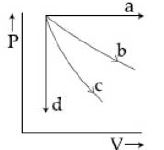
isochoric \(\rightarrow\) Process dIsobaric \(\rightarrow\) Process a
Adiabatic slope will be more than isothermal so
Isothermal \(\rightarrow\) Process b
Adiabatic\(\rightarrow\) Process \(c\)
Order \(\rightarrow\) d a b c
-
- (A) \({T_2} = {\left( {{T_1}{T_4}} \right)^{1/2}};\,{T_3} = {\left( {T_1^2{T_4}} \right)^{1/3}}\)
- (B) \({T_2} = {\left( {T_1^2{T_4}} \right)^{1/3}};\,{T_3} = {\left( {{T_1}T_4^2} \right)^{1/3}}\)
- (C) \({T_2} = {\left( {{T_1}T_4^2} \right)^{1/3}};\,{T_3} = {\left( {T_1^2{T_4}} \right)^{1/3}}\)
- (D) \({T_2} = {\left( {T_1^3{T_4}} \right)^{1/4}};\,{T_3} = {\left( {{T_1}T_4^3} \right)^{1/4}}\)
Show answer and solution
Correct Answer: (B)
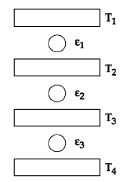
\(n_{1}=n_{2}=n_{3}\)\(\Rightarrow \quad 1-\frac{T_{2}}{T_{1}}=1-\frac{T_{3}}{T_{2}}=1-\frac{T_{4}}{T_{3}}\)
\(\Rightarrow \quad \frac{T_{2}}{T_{1}}=\frac{T_{3}}{T_{2}}=\frac{T_{4}}{T_{3}}\)
\(\Rightarrow \quad \mathrm{T}_{2} \mathrm{T}_{3}=\mathrm{T}_{1} \mathrm{T}_{4}\) and \(\frac{\mathrm{T}_{3}^{2}}{\mathrm{T}_{2}}=\mathrm{T}_{4}\)
Solve for \(\mathrm{T}_{2}\) and \(\mathrm{T}_{3}\)
-
- (A) \(600\)
- (B) \(400\)
- (C) \(300\)
- (D) \(500\)
Show answer and solution
Correct Answer: (D)
\(W_1 = W_2\)\(\Rightarrow \,\,\,600-T_2\,=\,T_2\,-\,400\)
\(\Rightarrow T_2\,=\,500\,K\)
No questions on this page match these filters.