


Questions
18 questionsShowing 1–18 of 18 questions
-
- (A) \(10^3\, J\)
- (B) \(10^5\, J\)
- (C) \(10^4\, J\)
- (D) \(10^6\, J\)
Show answer and solution
Correct Answer: (C)
\(\mathrm{E} =\frac{1}{2} \mathrm{M} \mathrm{V}_{m}^{2} \)\(=\frac{1}{2} \times 2 \times\left(\frac{3 \mathrm{P}}{\rho}\right) \)
\(=\frac{3 \times 4 \times 10^{4}}{8}=1.5 \times 10^{4} \mathrm{J}\)
-
- (A) \(17.4\)
- (B) \(15.7\)
- (C) \(19.7\)
- (D) \(21.6\)
Show answer and solution
Correct Answer: (A)
\(f_{\operatorname{mix}}=\frac{n_{1} f_{1}+n_{2} f_{2}}{n_{1}+n_{2}}=\frac{2 \times 3+3 \times 5}{5}=\frac{21}{5}\)\(C_{v}=\frac{f R}{5}=\frac{21}{5} \times \frac{R}{2}=17.4 \mathrm{J} / \mathrm{mol} \mathrm{K}\)
-
- (A) \(0.9\)
- (B) \(6\)
- (C) \(10\)
- (D) \(14\)
Show answer and solution
Correct Answer: (C)
\(\Delta Q = \frac{f}{2}nR\Delta T\)\( = \frac{5}{2}\left( {\frac{{15}}{{28}}} \right)(8.3)(1200 - 300) = 10000\,J\)
-
- (A) \(\sim 10^{10}\)
- (B) \(\sim 10^{11}\)
- (C) \(\sim 10^{12}\)
- (D) \(\sim 10^{13}\)
Show answer and solution
Correct Answer: (A)
\(v=\frac{V_{a v}}{\lambda}\)\(\lambda=\frac{\mathrm{RT}}{\sqrt{2} \pi \sigma^{2} \mathrm{N}_{\mathrm{A}} \mathrm{P}}\)
\(\sigma=2 \times 0.3 \times 10^{-9}\)
\(P=\frac{R T}{V}\)
\(\Rightarrow \quad=\frac{V}{\sqrt{2} \pi \sigma^{2} N_{A}}\)
\(V_{\mathrm{av}}=\sqrt{\frac{8}{3 \pi}} \times V_{\mathrm{rms}}\)
\(\begin{aligned} \therefore \quad \mathrm{v} =\frac{200 \times \sqrt{2} \pi \times \sigma^{2} \mathrm{N}_{\mathrm{A}}}{25 \times 10^{-3}} \times \sqrt{\frac{8}{3 \pi}} \\ =17.68 \times 10^{8} / \mathrm{sec} \\ =0.1768 \times 10^{10} / \mathrm{sec}-10^{10} \end{aligned}\)
-
- (A) \(350\)
- (B) \(700\)
- (C) \(748\)
- (D) \(374\)
Show answer and solution
Correct Answer: (C)
\(\Delta \mathrm{Q}=\mathrm{nC}_{\mathrm{v}} \Delta \mathrm{T}=\mathrm{n} \frac{\mathrm{3}}{2} \mathrm{R} \Delta \mathrm{T}\)\(=\left(\frac{67.2}{22.4}\right)\left(\frac{3}{2} \times 8.31\right)(20)\)
\( \approx 748 \mathrm{J}\)
-
- (A) \(15\,RT\)
- (B) \(12\,RT\)
- (C) \(4\,RT\)
- (D) \(20\,RT\)
Show answer and solution
Correct Answer: (A)
\(U_{\text {total }} =U_{O_{2}}+U_{A r}\)\(=\frac{3 \times 5 \times R T}{2}+\frac{5 \times 3 \times R T}{2}\)
\(=15 \mathrm{RT}\)
-
- (A) \(3.16\)
- (B) \(0.32\)
- (C) \(0.45\)
- (D) \(2.24\)
Show answer and solution
Correct Answer: (A)
\(\frac{\left(\mathrm{V}_{\mathrm{RMS}}\right)_{\mathrm{He}}}{\left(\mathrm{V}_{\mathrm{RMS}}\right)_{\mathrm{Ar}}} =\sqrt{\frac{\mathrm{M}_{\mathrm{Ar}}}{\mathrm{M}_{\mathrm{He}}}} \)\(=\sqrt{\frac{40}{4}}=\sqrt{10}=3.16\)
-
- (A) \(\frac{{RT}}{{ng}}\left[ {\frac{{{l_1} - 3{l_2}}}{{{l_1}{l_2}}}} \right]\)
- (B) \(\frac{{RT}}{g}\left[ {\frac{{2{l_1} + {l_2}}}{{{l_1}{l_2}}}} \right]\)
- (C) \(\frac{{nRT}}{{ng}}\left[ {\frac{1}{{{l_2}}} + \frac{1}{{{l_1}}}} \right]\)
- (D) \(\frac{{nRT}}{g}\left[ {\frac{{{l_1} - {l_2}}}{{{l_1}{l_2}}}} \right]\)
Show answer and solution
Correct Answer: (D)
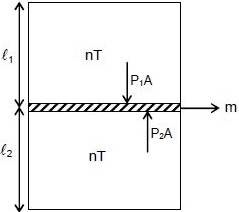
\(\mathrm{P}_{2} \mathrm{A}-\mathrm{P}_{1} \mathrm{A}=\mathrm{mg}\)\(m=\frac{1}{g}\left(\frac{P_{1} A \ell_{1}}{\ell_{1}}-\frac{P_{2} A \ell_{2}}{\ell_{2}}\right)\)
\(\mathrm{m}=\frac{1}{\mathrm{g}}\left(\frac{\mathrm{nRT}}{\ell_{1}}-\frac{\mathrm{nRT}}{\ell_{2}}\right)\)
\(m=\frac{n R T}{g}\left(\frac{1}{\ell_{1}}-\frac{1}{\ell_{2}}\right)\)
-
- (A) \(\frac{{m{\bar v ^{ 2}}}}{{3{k_B}}}\)
- (B) \(\frac{{m{\bar v ^{ 2}}}}{{7{k_B}}}\)
- (C) \(\frac{{m{\bar v ^{ 2}}}}{{5{k_B}}}\)
- (D) \(\frac{{m{\bar v ^{ 2}}}}{{6{k_B}}}\)
Show answer and solution
Correct Answer: (A)
According to equipartion energy theorem\(\frac{1}{2} m\left(v_{m s}^{2}\right)=3 \times \frac{1}{2} k_{b} T\)
\(T=\frac{m \bar{V}_{r m s}^{-2}}{3 k}\)
-
- (A) \(2\times 10^{-7}\,s\)
- (B) \(4\times 10^{-8}\,s\)
- (C) \(0.5\times 10^{-8}\,s\)
- (D) \(3\times 10^{-6}\,s\)
Show answer and solution
Correct Answer: (B)
\({\text { The mean time between two collision } \propto \frac{P}{\sqrt{T}}} \)\({\qquad \frac{\Delta t_{1}}{\Delta t_{2}}=\frac{P_{1}}{P_{2}} \times \frac{\sqrt{T_{2}}}{\sqrt{T_{1}}}} \)
\({\Rightarrow \quad \frac{6 \times 10^{-8}}{\Delta t_{2}}=(\sqrt{\frac{3}{5}}) \times 2} \)
\({\Rightarrow \quad \Delta t_{2}=6 \times 10^{-8} \times \frac{1}{2} \sqrt{\frac{5}{3}} \approx 4 \times 10^{-8} \text { sec }}\)
- 11. An ideal gas occupies a volume of \(2\, m^3\) at a pressure of \(3\times10^6\, Pa\). The energy of the gas is 2019 Medium
- (A) \(9\times10^6\,J\)
- (B) \(6\times10^4\,J\)
- (C) \(10^8\,J\)
- (D) Insufficient information
Show answer and solution
Correct Answer: (D)
Cannot determine, degree of freedom must be given -
- (A) \(80\,m/s\)
- (B) \(100\sqrt {5}\,m/s\)
- (C) \(100\,m/s\)
- (D) \(80\sqrt {5}\,m/s\)
Show answer and solution
Correct Answer: (B)
\(V_{r m s}=\sqrt{\frac{3 R T}{M_{w}}}\)\(\Rightarrow v_{m s} \propto \sqrt{T}\)
\(\text { Now, } \frac{v}{200}=\sqrt{\frac{500}{400}} \Rightarrow \frac{v}{200}=\frac{\sqrt{5}}{2}\)
\(\Rightarrow \mathrm{v}=100 \sqrt{5} \mathrm{m} / \mathrm{s}\)
-
- (A) \({10^8}\,\frac{N}{{{m^2}}}\)
- (B) \({10^3}\,\frac{N}{{{m^2}}}\)
- (C) \({10^4}\,\frac{N}{{{m^2}}}\)
- (D) None of this
Show answer and solution
Correct Answer: (D)
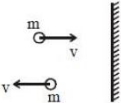
Pressure is defined as normal force per unit area.Force is calculated as change in \( momentum/time.\)
By this answer is \(2 \mathrm{N} / \mathrm{m}^{2}\)
None of the option matches so this question must be Bonus.
Detailed solution is as following:
\(Magnitude\, of\, change\, in\, momentum \,per\, collision\) \(=2\) \(mv\)
Pressure \(=\frac{\text { Force }}{\text { Area }}=\frac{N(2 m v)}{1}\)
\({=\frac{10^{22} \times 2 \times 10^{-26} \times 10^{4}}{1}} \)
\({=2 \mathrm{N} / \mathrm{m}^{2}}\)
-
- (A) \(\frac{1}{4}\frac{{{P_0}{V_0}}}{R}\)
- (B) \(\frac{1}{2}\frac{{{P_0}{V_0}}}{R}\)
- (C) \(\frac{5}{4}\frac{{{P_0}{V_0}}}{R}\)
- (D) \(\frac{3}{4}\frac{{{P_0}{V_0}}}{R}\)
Show answer and solution
Correct Answer: (D)
\(n=1\) mole\(P=P_{0}\left\{1-\frac{1}{2}\left(\frac{V_{0}}{V}\right)^{2}\right\} \quad ; \quad P V=n R T=R T\)
\(P=\frac{R T}{V}\)
\(\frac{R T}{V}=P_{0}\left\{1-\frac{V_{0}^{2}}{2 V^{2}}\right\}\)
\(T=\frac{P_{0} V}{R}\left\{1-\frac{V^{2}}{2 V^{2}}\right\}=\frac{P_{0}}{R}\left\{V-\frac{V_{0}^{2}}{2 V}\right\}\)
\(\Delta T \)\(=\frac{P_{0}}{R}\left\{\left(2 V_{0}-V_{0}\right)-\frac{V_{0}^{2}}{2}\left(\frac{1}{2 V_{0}}-\frac{1}{V_{0}}\right)\right\}\)
\(=\frac{P_{0}}{R}\left\{V_{0}-\frac{V_{0}^{2}}{2}\right\} \)
\( \Delta T \)\(=\frac{P_{0}}{R}\left\{\left(2 V_{0}-V_{0}\right)-\frac{V_{0}^{2}}{2}\left(\frac{1}{2 V_{0}}-\frac{1}{V_{0}}\right)\right\} \)
\(=\frac{P_{0}}{R}\left\{V_{0}-\frac{V_{0}^{2}(1-2)}{2 \times 2 V_{0}}\right\} \)
\(=\frac{P_{0}}{R}\left\{V_{0}-\frac{V_{0}}{4}\right\}=\frac{3}{4} \frac{P_{0} V_{0}}{R}\)
-
- (A) \({n_0}{\alpha ^{ - 3/4}}\)
- (B) \({n_0}{\alpha ^{ - 3}}\)
- (C) \({n_0}{\alpha ^{ 1/4}}\)
- (D) \(\sqrt {{n_0}} {\alpha ^{1/2}}\)
Show answer and solution
Correct Answer: (A)
Given number density of molecules of gas as a function of \(r\) is\(n(r)=n_{0} e^{-a r^{4}}\)
Total number of molecule \(=\int_{0}^{\infty} n(r) \mathrm{d} V=\int_{0}^{\infty} n_{0} e^{-\alpha x^{4}} 4 \pi r^{2} d r\)
Number of molecules is proportional to \(\mathrm{n}_{0} \alpha^{-3 / 4}\)
-
- (A) \(A\) has one vibrational mode and \(B\) has two
- (B) Both \(A\) and \(B\) have a vibrational mode each
- (C) \(A\) is rigid but \(B\) has a vibrational mode
- (D) \(A\) has a vibrational mode but \(B\) has none
Show answer and solution
Correct Answer: (D)
For \(A:\)\(\frac{C_{p}}{C_{v}}=\gamma=1+\frac{2}{f}=\frac{29}{22}\)
It gives \(f=6.3 \approx 6 \quad(3 \text { translational, } 2 \text { rotational and } 1\) vibrational)
For \(B:\)
\(\frac{C_{p}}{C_{v}}=\gamma=1+\frac{2}{f}=\frac{30}{21}\)
\(\Rightarrow \mathrm{f}=4.67\)
\(\Rightarrow \quad \approx 5 \quad(3 \text { translational, } 2\) rotational, no vibrational)
-
- (A) \(800\,K\)
- (B) \(10^4\,K\)
- (C) \(3\times10^5\,K\)
- (D) \(650\,K\)
Show answer and solution
Correct Answer: (B)
\(v_{m s}=\sqrt{\frac{3 R T}{m}} \quad v_{\text {escape }}=\sqrt{2 g R_{e}}\)\(\mathrm{v}_{\mathrm{rms}}=\mathrm{v}_{\text {escape }}\)
\(\frac{3 \mathrm{RT}}{\mathrm{m}}=2 \mathrm{gR}_{\mathrm{e}}\)
\(\frac{3 \times 1.38 \times 10^{-23} \times 6.02 \times 10^{26}}{2} \times 10 \times 10^{3}=10^{4} \mathrm{k}\)
-
- (A) \(\frac {3}{2}\,Q\)
- (B) \(\frac {5}{3}\,Q\)
- (C) \(\frac {7}{5}\,Q\)
- (D) \(\frac {2}{3}\,Q\)
Show answer and solution
Correct Answer: (C)
\(Q=C v \Delta T\)\(Q^{\prime}=C_{P} \Delta T\)
\(Q^{\prime}=\frac{C_{P}}{C_{V}} Q=\left(1+\frac{2}{5}\right) Q=\frac{7}{5} Q\)
No questions on this page match these filters.