


All JEE Mains 2019 Physics questions
31 chaptersShowing 101–150 of 468 questions
-
- (A) \(2a + \frac{{2b}}{{\sqrt 3 }}\)
- (B) \(2a + \frac{{2b}}{3}\)
- (C) \(\frac{{2\sqrt 3 }}{a} + 2b\)
- (D) \(2a + 2b\)
Show answer and solution
Correct Answer: (D)
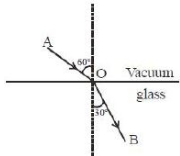
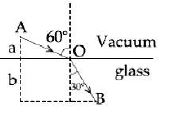
From Snell's law\(1 \sin 60^o=\mu \sin 30^o\)
\(\Rightarrow \mu=\sqrt{3}\)
Optical path \( = {\text{AO}} + \mu ({\text{OB}})\)
\( = \frac{{\text{a}}}{{\cos {{60}^o}}} + \sqrt 3 \frac{{\text{b}}}{{\cos {{30}^o}}}\)
\( = 2{\text{a}} + 2{\text{b}}\)
-
- (A) \(\sqrt 2 \)
- (B) \(\frac{4}{3}\)
- (C) \(\sqrt 3 \)
- (D) \(\frac{3}{2}\)
Show answer and solution
Correct Answer: (B)
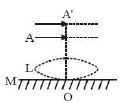
For image to form at object itself, says must retrace their path back to object. Hence must incident on mirror normally.case \(1\) : Object will be at focus of lens
\(\frac{1}{f}=(\mu-1)\left(\frac{1}{R}-\frac{1}{-R}\right)=\frac{1}{-18}\)
\(\Rightarrow {\mathrm{R}}=18\, \mathrm{cm}\)
case \(2\) : Retraction at \(1^{\text {st }}\) surface:
\(\frac{1}{-27}-\frac{1.5}{V_{1}}=\frac{1-1.5}{R}\) ..... \((i)\)
\(2^{\text {nd }}\) retraction:
\(\frac{1.5}{V_{1}}-\frac{\mu}{\infty}=\frac{1.5-u}{-R}\) ..... \((ii)\)
From \((i)\) and \((ii)\)
\(\mu=\frac{4}{3}\)
-
- (A) \(\theta > {\sin ^{ - 1}}\,\frac{{{\mu _1}}}{{{\mu _2}}}\)
- (B) \(\theta > {\sin ^{ - 1}}\,\sqrt {\frac{{\mu _2^2}}{{\mu _1^2}} - 1} \)
- (C) \(\theta < {\sin ^{ - 1}}\,\frac{{{\mu _1}}}{{{\mu _2}}}\)
- (D) \(\theta < {\sin ^{ - 1}}\,\sqrt {\frac{{\mu _2^2}}{{\mu _1^2}} - 1} \)
Show answer and solution
Correct Answer: (D)
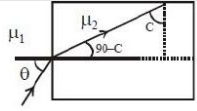
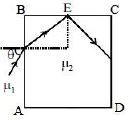
\(\sin \mathrm{c}=\frac{\mu_{1}}{\mu_{2}}\)\(\mu_{1} \sin \theta=\mu_{2} \sin \left(90^o-\mathrm{C}\right)\)
\(\sin \theta=\frac{\mu_{2} \sqrt{1-\frac{\mu_{1}^{2}}{\mu_{2}^{2}}}}{\mu_{1}}\)
\(\theta=\sin ^{-1} \sqrt{\frac{\mu_{1}^{2}-\mu_{2}^{2}}{\mu_{1}^{2}}}\)
For \(TIR\)
\(\theta<\sin ^{-1} \sqrt{\frac{\mathrm{u}_{2}^{2}}{\mu_{1}^{2}}-1}\)
-
- (A) \(2.26\times 10^{-3}\,m/s\) away from the lens
- (B) \(0.92\times 10^{-3}\,m/s\) away from the lens
- (C) \(3.22\times 10^{-3}\,m/s\) towards the lens
- (D) \(1.16\times 10^{-3}\,m/s\) towards the lens
Show answer and solution
Correct Answer: (D)
\(\frac{1}{V}-\frac{1}{-20}=\frac{1}{30}\)\( \Rightarrow \frac{1}{V} = \frac{1}{{0.30}} - \frac{1}{{20}} = \) \( + \frac{{200 - 3}}{{60}} = \frac{{197}}{{60}}\)
\( \Rightarrow \quad - \frac{{dV}}{{dt\,\,{V^2}}} + \frac{{du}}{{dt\,{u^2}}} = 0\)
\( \Rightarrow \frac{{dV}}{{dt}} = \frac{{{V^2}}}{{{u^2}}}\frac{{du}}{{dt}}\) \( = {\left( {\frac{3}{{197}}} \right)^2} \times ( - 5)\) \( = - 0.00116\,{\text{m}}/{\text{s}}\)
-
- (A) \(40\, cm\) from the convergent mirror, same size as the object
- (B) \(20\, cm\) from the convergent mirror, same size as the object
- (C) \(40\, cm\) from the convergent lens, twice the size of the object
- (D) None of these
Show answer and solution
Correct Answer: (D)
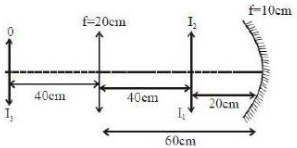
There will be \(3\) phenomenon\((i)\) Refraction from lens
\((ii)\) Reflection from mirror
\((iii)\) Refraction from lens
After these phenomena. Image will be on object and will have same size. None of the option depicts so this question is Bonus.
\(1^{\text {st }}\) refraction \(\mathrm{u}=-40\,\mathrm{cm} ; \mathrm{f}=+20\, \mathrm{cm}\)
\( \Rightarrow {\text{v}} = + 40\,{\text{cm}}\) (image \(I_1\)) and \(m_1\,=\,-\,1\) for reflction
\({\text{u}} = - 20\,{\mkern 1mu} {\text{cm}}\,;{\text{f}} = - 10\,{\mkern 1mu} {\text{cm}}\)
\( \Rightarrow v = - 20{\mkern 1mu} \,{\text{cm}}\) (image \(I_2\)) and \(m_2\,=\,-\,1\) \(2^{\text {nd }}\) refraction
\(\mathrm{u}=-40\, \mathrm{cm}\) ; \(\mathrm{f}=+20\, \mathrm{cm}\)
\( \Rightarrow v = + 40{\mkern 1mu} \,{\text{cm}}\) (image \(I_3\)) and \(m_3=-\,1\)
Total magnification \(=m_{1} \times m_{2} \times m_{3}=-1\) and final image is formed at distance \(40\,\mathrm{cm}\) from convergent lens and is of same size as the object.
-
- (A) Image disappears
- (B) Magnified image
- (C) Erect real image
- (D) No change
Show answer and solution
Correct Answer: (A)
If the water is filled focal length will decrease and image will disappear. -
- (A) \(57000\)
- (B) \(45000\)
- (C) \(66000\)
- (D) None of these
Show answer and solution
Correct Answer: (A)
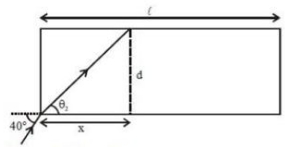
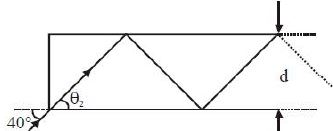
If we approximate the angle \(\theta_{2}\) as \(30^o\) initially then answer will be closer to \(57000\). but if we solve thoroughly, answer will be close to \(55000\) .So both the answers must be awarded. Detailed solution as following.
Exact solution
By Snell's law \(1.\sin {40^o} = (1.31)\sin {\theta _2}\)
\(\sin \theta_{2}=\frac{64}{1.31}=\frac{64}{131} \approx .49\)
Now \(\tan {\theta _2} = \frac{{64}}{{\sqrt {{{(131)}^2} - {{(64)}^2}} }}\) \( = \frac{{64}}{{\sqrt {13065} }} \approx \frac{{64}}{{114.3}} = \frac{{\text{d}}}{x}\)
Now number of reflections
\(=\frac{2 \times 64}{114.3 \times 20 \times 10^{-6}}=\frac{64 \times 10^{5}}{114.3}\)
\(=55991 \approx 55000\)
Approximate solution
By Snell's law \(1 . \sin 40^{\circ}=(1.31) \sin \theta_{2}\)
\({\sin \theta_{2}=\frac{0.64}{1.31}=\frac{64}{131} \approx 0.49}\)
If assume \( \Rightarrow {\theta _2} \approx {30^o}\)
\(\tan {30^o} = \frac{{\text{d}}}{{\text{x}}} \Rightarrow {\text{x}} = \sqrt 3 {\text{d}}\)
Now number of reflections
\(=\frac{\ell}{\sqrt{3} \mathrm{d}}=\frac{2}{\sqrt{3} \times 20 \times 10^{-6}}=\frac{10^{5}}{\sqrt{3}}\)
\(\approx 57735 \approx 57000\)
-
- (A) \(\frac{R}{{2\left( {{\mu _1} - {\mu _2}} \right)}}\)
- (B) \(\frac{2R}{{\left( {{\mu _1} - {\mu _2}} \right)}}\)
- (C) \(\frac{R}{{\left( {{\mu _1} - {\mu _2}} \right)}}\)
- (D) \(\frac{R}{{2 - \left( {{\mu _1} - {\mu _2}} \right)}}\)
Show answer and solution
Correct Answer: (C)
For \(1^{\text {st }}\) lens \(\frac{1}{{{f_1}}} = \left( {\frac{{{\mu _1} - 1}}{1}} \right)\) \(\left( {\frac{1}{\infty } - \frac{1}{{ - R}}} \right) = \frac{{{\mu _1} - 1}}{R}\)For \(2^{n d}\) lens \(\frac{1}{{{f_2}}} = \left( {\frac{{{\mu _2} - 1}}{1}} \right)\) \(\left( {\frac{1}{{ - R}} - 0} \right) = - \frac{{{\mu _2} - 1}}{R}\)
\(\frac{1}{f_{e q}}=\frac{1}{f_{1}}+\frac{1}{f_{2}}\)
\(\frac{1}{{{f_{eq}}}} = \frac{{{\mu _1} - 1}}{R} + \frac{{ - \left( {{\mu _2} - 1} \right)}}{R}\) \( \Rightarrow {f_{eq}} = \frac{R}{{{\mu _1} - {\mu _2}}}\)
-
- (A) \(1\)
- (B) \(2\)
- (C) \(4\)
- (D) \(3.1\)
Show answer and solution
Correct Answer: (D)
\({\frac{\mu_{2}}{\mathrm{v}}-\frac{\mu_{1}}{\mathrm{u}}=\frac{\mu_{2}-\mu_{1}}{\mathrm{R}}}\)\({\Rightarrow \quad \frac{1.34}{\mathrm{v}}-\frac{1}{-\infty}=\frac{0.34}{7.8}} \)
\( \Rightarrow {\text{v}} = \frac{{1.34 \times 7.8}}{{0.34}}\,\,{\text{nm}}\) \( = 3.074\,{\text{cm}}\)
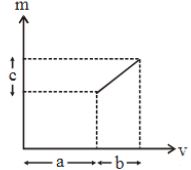
- 110. The graph shows how the magnification \(m\) produced by a thin lens varies with image distance \(v\). What is the focal length of the lens used?
 2019 Medium
- (A) \(\frac {b^2}{ac}\)
- (B) \(\frac {a}{c}\)
- (C) \(\frac {b^2c}{a}\)
- (D) \(\frac {b}{c}\)
Show answer and solution
Correct Answer: (D)
\(f\,=\,\frac {b}{c}\)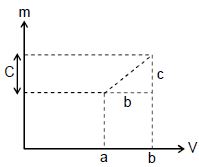
-
- (A) \(45\)
- (B) \(60\)
- (C) \(75\)
- (D) \(90\)
Show answer and solution
Correct Answer: (B)
\(\theta \,=\,60^o\)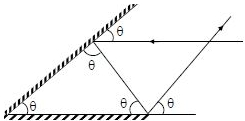
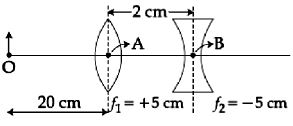
- 112. What is the position and nature of image formed by lens combination shown in figure? (\(f_1, f_2\) are focal lengths)
 2019 Hard
- (A) \(70\, cm\) from point \(B\) at left; virtual
- (B) \(40\, cm\) from point \(B\) at right; real
- (C) \(\frac{20}{3}\, cm\) from point \(B\) at right; real
- (D) \(70\, cm\) from point \(B\) at right ; real
Show answer and solution
Correct Answer: (D)
Image by convex lens:\(\frac{1}{v} - \frac{1}{u} = \frac{1}{f}\) ; \(\frac{1}{v} + \frac{1}{{20}} = \frac{1}{5}\)
\({v=\frac{20}{3}\, \mathrm{cm}}\)
Image by concave lens:
\(u=\left[\frac{20}{3}-2\right]=\frac{14}{3} \,\mathrm{cm}\)
\(\frac{1}{v}-\frac{1}{u}=\frac{1}{f}\) ; \(\frac{1}{v}-\frac{3}{14}=-\frac{1}{5}\)
\(v=70\, \mathrm{cm}\)
-
- (A) \(\frac{2}{{\ln \,2}}\)
- (B) \(ln\,2\)
- (C) \(\frac{1}{2}\,\ln\,2\)
- (D) \(2\,ln\,2\)
Show answer and solution
Correct Answer: (D)
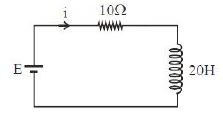
\(L I D I=I^{2} R\)\(L \times \frac{E}{10}\left(-e^{-t / 2}\right) \times \frac{-1}{2}=\frac{E}{10}\left(1-e^{-t / 2}\right) \times 10\)
\(e^{-1 / 2}=1-e^{-1 / 2} \quad ; \quad t=2 \ell n 2\)
-
- (A) \(RC\) circuit with \(R = 1\, k\,\Omega \) and \(C = 1\, \mu F\)
- (B) \(RL\) circuit with \(R = 1\, k\,\Omega \) and \(L = 10\, mH\)
- (C) \(RL\) circuit with \(R = 1\, k\,\Omega \) and \(L = 1\, mH\)
- (D) \(RC\) circuit with \(R = 1\, k\,\Omega \) and \(C = 10\, \mu F\)
Show answer and solution
Correct Answer: (D)
Given phase difference \(=\frac{\pi}{4}\) and \(\omega=100\) \(rad/s\)\(\Rightarrow\) Reactance \((X)=\) Resistance \((R)\) Now by checking option.
Option \((A)\)
\(\mathrm{R}=1000 \,\Omega\) and \(\mathrm{X}_{\mathrm{c}}=\frac{1}{10^{-6} \times 100}=10^{4} \,\Omega\)
Option \((B)\)
\(\mathrm{R}=10^{3} \,\Omega\) and \(\mathrm{X}_{\mathrm{L}}=10 \times 10^{-3} \times 100=1 \,\Omega\)
Option \((\mathrm{C})\)
\(\mathrm{R}=10^{3} \,\Omega\) and \(\mathrm{X}_{\mathrm{L}}=10^{-3} 100=10^{-1}\, \Omega\)
Option \((D)\)
\(\mathrm{R}=10^{3} \,\Omega\) and \(\mathrm{X}_{\mathrm{c}}=\frac{1}{10 \times 10^{-6} \times 100}=10^{3} \,\Omega\)
-
- (A) \(5.65\times 10^2\,J\)
- (B) \(2.26\times 10^3\,J\)
- (C) \(5.17\times 10^2\,J\)
- (D) \(3.39\times 10^3\,J\)
Show answer and solution
Correct Answer: (C)
\(E = Pt = \frac{{{E^2}}}{{{Z^2}}}Rt = \frac{{{{(24)}^2}}}{{{{60}^2} + {{(8.33\pi - 2\pi )}^2}}}(60)(60) = 518\,\,J\) -
- (A) \(2.2\)
- (B) \(3.3\)
- (C) \(5\)
- (D) \(7.2\)
Show answer and solution
Correct Answer: (B)
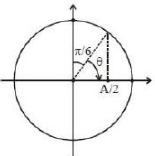
\(V(t)=220 \sin (100 \pi t)\) volt time taken,\(t=\frac{\theta}{\omega}=\frac{\frac{\pi}{3}}{100 \pi}=\frac{1}{300} \,\mathrm{sec}\)
\(=3.3 \,\mathrm{ms}\)
-
- (A) \(\frac{{EL}}{{7.3{R^2}}}\)
- (B) \(\frac{{EL}}{{2.7{R^2}}}\)
- (C) \(\frac{{7.3EL}}{{{R^2}}}\)
- (D) \(\frac{{2.7EL}}{{{R^2}}}\)
Show answer and solution
Correct Answer: (B)
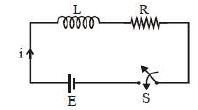
\(q=\int 1 d t\)\(\mathrm{q}=\int_{0}^{\mathrm{L} R} \frac{\mathrm{E}}{\mathrm{R}}\left[1-\mathrm{e}^{\frac{-\mathrm{Rt}}{\mathrm{L}}}\right] \mathrm{dt}\)
\(\mathrm{q}=\frac{\mathrm{EL}}{\mathrm{R}^{2}} \frac{1}{\mathrm{e}} \quad ; \quad \mathrm{q}=\frac{\mathrm{EL}}{2.7 \mathrm{R}^{2}}\)
-
- (A) \(60^o\)
- (B) \(30^o\)
- (C) \(90^o\)
- (D) None of these
Show answer and solution
Correct Answer: (D)
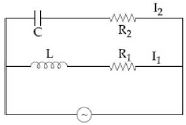
For the first branch:\( \tan \phi_{1} =\frac{-X_{c}}{R_{2}}=\frac{\frac{1}{\left(100 \times \frac{\sqrt{3}}{2} \times 10^{-6}\right)}}{20} \approx-10^{-3}\)
\(\Rightarrow \quad \phi_{1} \approx-90^{\circ}\)
For the second branch:
\(\tan \phi_{2}=\frac{X_{L}}{R}=\sqrt{3}\)
\(\Rightarrow \quad \phi_{2} \approx 60^{\circ}\)
Phase difference between current in branch \(1\) and \(2=150^{\circ} .\)
No option is correct.
-
- (A) \(5.5\)
- (B) \(7.5\)
- (C) \(3\)
- (D) \(6\)
Show answer and solution
Correct Answer: (D)
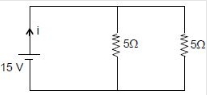
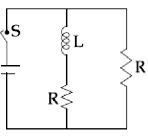
After long time, inductor will behave like resistance less wire,\(\mathrm{i}=\frac{15}{\mathrm{R}_{\mathrm{m}}}=\frac{15}{(5 / 2)}\)
\(=6 \,\mathrm{A}\)
-
- (A) \(2.0\times 10^{-5}\,Nm\)
- (B) \(4.0\times 10^{-6}\,Nm\)
- (C) \(1.6\times 10^{-5}\,Nm\)
- (D) \(7.9\times 10^{-6}\,Nm\)
Show answer and solution
Correct Answer: (A)
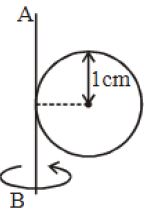
\(m = 5 \times {10^{ - 3}}kg,\,\,\,r = {10^{ - 2}}m\)\(\omega = 25 \times 2\pi \,rad/5\)
\( = 50\,\,\pi \,\,rad/\sec \)
\(\omega = \frac{\tau }{I}t\)
\(\tau = \frac{{I\omega }}{t} = \frac{{5m{r^2}}}{4} \times \frac{\omega }{t}\)
\( = \frac{{5 \times 5 \times {{10}^{ - 3}} \times {{10}^{ - 4}} \times 50\,\pi }}{{4 \times 5}}\)
\( = \frac{{25\pi }}{4} \times {10^{ - 6}} = 2 \times {10^{ - 5}}\)
-
- (A) \(MR^2\)
- (B) \(3MR^2\)
- (C) \(\frac{4}{5}\,M{R^2}\)
- (D) \(\frac{2}{3}\,M{R^2}\)
Show answer and solution
Correct Answer: (B)
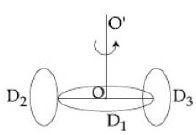
\(I = \frac{{M{R^2}}}{2} + 2\left( {\frac{{M{R^2}}}{4} + M{R^2}} \right)\)\( = \frac{{M{R^2}}}{2} + \frac{{M{R^2}}}{2} + 2M{R^2} = 3\,M{R^2}\)
-
- (A) \(MR^2\)
- (B) \(3MR^2\)
- (C) \(\frac{4}{5}\,M{R^2}\)
- (D) \(\frac{2}{3}\,M{R^2}\)
Show answer and solution
Correct Answer: (B)
\(I = \frac{{M{R^2}}}{2} + 2\left( {\frac{{M{R^2}}}{4} + M{R^2}} \right)\)\( = \frac{{M{R^2}}}{2} + \frac{{M{R^2}}}{2} + 2M{R^2} = 3\,M{R^2}\)
-
- (A) \(\frac{{a + b}}{3}\)
- (B) \(\sqrt {\frac{{{a^2} + {b^2} + ab}}{3}} \)
- (C) \(\frac{{a + b}}{2}\)
- (D) \(\sqrt {\frac{{{a^2} + {b^2} + ab}}{2}} \)
Show answer and solution
Correct Answer: (B)
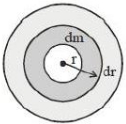
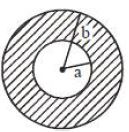
\(dI = \left( {dm} \right){r^2}\)\( = \left( {\sigma dA} \right){r^2}\)
\( = \left( {\frac{{{\sigma _0}}}{r}2\pi dr} \right){r^2} = \left( {{\sigma _0}2\pi 0{r^2}dr} \right)\)
\(I = \int {DI = \int\limits_a^b {{\sigma _0}2\pi {r^2}dr} } \)
\( = {\sigma _0}2\pi \left( {\frac{{{b^3} - {a^3}}}{3}} \right)\)
\(m = \int {dm = \int {\sigma dA} } \)
\( = {\sigma _0}2\pi \int\limits_a^b {dr} \)
-
- (A) \(\frac{{a + b}}{3}\)
- (B) \(\sqrt {\frac{{{a^2} + {b^2} + ab}}{3}} \)
- (C) \(\frac{{a + b}}{2}\)
- (D) \(\sqrt {\frac{{{a^2} + {b^2} + ab}}{2}} \)
Show answer and solution
Correct Answer: (B)
\(dI = \left( {dm} \right){r^2}\)\( = \left( {\sigma dA} \right){r^2}\)
\( = \left( {\frac{{{\sigma _0}}}{r}2\pi dr} \right){r^2} = \left( {{\sigma _0}2\pi 0{r^2}dr} \right)\)
\(I = \int {DI = \int\limits_a^b {{\sigma _0}2\pi {r^2}dr} } \)
\( = {\sigma _0}2\pi \left( {\frac{{{b^3} - {a^3}}}{3}} \right)\)
\(m = \int {dm = \int {\sigma dA} } \)
\( = {\sigma _0}2\pi \int\limits_a^b {dr} \)
-
- (A) \(\frac{{3F}}{{2mR}}\)
- (B) \(\frac{{F}}{{3mR}}\)
- (C) \(\frac{{F}}{{2mR}}\)
- (D) \(\frac{{2F}}{{3mR}}\)
Show answer and solution
Correct Answer: (D)
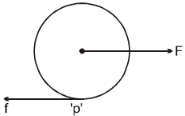
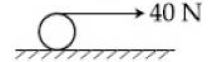
\(F -f = ma\)\(fR = \frac{1}{2}\,m{R^2}\alpha \)
\(a = \alpha R\)
\(\alpha=\frac{{2F}}{{3mR}}\)
-
- (A) \(\frac{{3F}}{{2mR}}\)
- (B) \(\frac{{F}}{{3mR}}\)
- (C) \(\frac{{F}}{{2mR}}\)
- (D) \(\frac{{2F}}{{3mR}}\)
Show answer and solution
Correct Answer: (D)
\(F -f = ma\)\(fR = \frac{1}{2}\,m{R^2}\alpha \)
\(a = \alpha R\)
\(\alpha=\frac{{2F}}{{3mR}}\)
-
- (A) \(2\)
- (B) \(8\)
- (C) \(6\)
- (D) \(3\)
Show answer and solution
Correct Answer: (C)
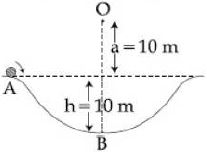
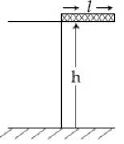
\(v = \sqrt {{5^2} + 2gh} = \sqrt {{5^2} + 2 \times 10 \times 10} = \sqrt {225} \)\( = 15\,m/s\)
\(h = rmv\, = 20 \times \left( {20 \times {{10}^{ - 3}}kg} \right) \times \left( {15} \right)\)
\( = 6\,kg\,{m^2}/\sec \)
-
- (A) \(20\)
- (B) \(30\)
- (C) \(40\)
- (D) \(10\)
Show answer and solution
Correct Answer: (C)
\(\begin{array}{l}
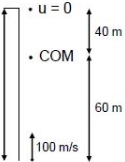
{Y_{cm}}from\,ground\, = \frac{{0.03 \times 100}}{{0.05}} = 60\,m\\
{V_{cm}} = \frac{{0.02 \times 100}}{{0.05}} = 40\,m/s\\
H = \frac{{V_{cm}^2}}{{2g}} = \frac{{40 \times 40}}{{20}} = 80\,m
\end{array}\)Height above building \(= 80 - 40 = 40\, m\)
-
- (A) \(20\)
- (B) \(30\)
- (C) \(40\)
- (D) \(10\)
Show answer and solution
Correct Answer: (C)
\(\begin{array}{l}
{Y_{cm}}from\,ground\, = \frac{{0.03 \times 100}}{{0.05}} = 60\,m\\
{V_{cm}} = \frac{{0.02 \times 100}}{{0.05}} = 40\,m/s\\
H = \frac{{V_{cm}^2}}{{2g}} = \frac{{40 \times 40}}{{20}} = 80\,m
\end{array}\)Height above building \(= 80 - 40 = 40\, m\)
-
- (A) \(0.5\)
- (B) \(0.6\)
- (C) \(0.02\)
- (D) \(0.28\)
Show answer and solution
Correct Answer: (A)
\(Angular \,impulse = change\, in\, angular\, momentum.\)\(\tau \,\Delta t = \Delta L\)
\(mg\frac{\ell }{2} \times 0.01 = \frac{{m{\ell ^2}}}{3}\omega \)
\(\omega = \frac{{3g \times 0.01}}{{2\ell }} = \frac{{3 \times 10 \times 0.01}}{{2 \times 0.3}} = \frac{1}{2} = 0.5\,rad/s\)
Time taken by rod to hit the ground
\(t\sqrt {\frac{{2h}}{g}} = \sqrt {\frac{{2 \times 5}}{{10}}} = 1\,\sec .\)
In this time angule rotate by rod
\(\theta = \omega t = 0.5 \times 1 = 0.5\,radian\)
-
- (A) \(\frac{g}{13l}\)
- (B) \(\frac{g}{3l}\)
- (C) \(\frac{g}{2l}\)
- (D) \(\frac{7g}{3l}\)
Show answer and solution
Correct Answer: (A)
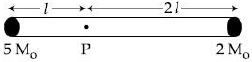
\(\alpha = \frac{\tau }{I}\)\( = \frac{{5{M_o}g\ell - 4{M_o}g\ell }}{{5{M_o}{\ell ^2} + 2{M_o}4{\ell ^2}}}\)
\( = \frac{{{M_o}g\ell }}{{13{M_o}{\ell ^2}}}\)
\( = \frac{g}{{13\,\ell }}\)
-
- (A) \(\sqrt \frac {30}{2}\)
- (B) \(\sqrt {30}\)
- (C) \(\sqrt \frac {20}{2}\)
- (D) \( \frac {\sqrt {30}}{2}\)
Show answer and solution
Correct Answer: (B)
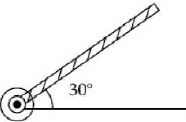
\(\begin{array}{l}
mg\frac{\ell }{2}\left( {\frac{1}{2}} \right) = \frac{1}{2}\left( {\frac{{m{\ell ^2}}}{3}} \right){\omega ^2}\\
\Rightarrow \,\,\,\omega = \sqrt {\frac{{3g}}{{2\ell }}} = \sqrt {30}
\end{array}\) -
- (A) \(1\)
- (B) \(\frac{4}{5}\)
- (C) \(\frac{2}{{\sqrt 5 }}\)
- (D) \(\frac{14}{15}\)
Show answer and solution
Correct Answer: (D)
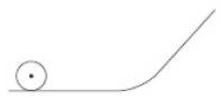
For solid sphere\(\frac{1}{2}m{v^2} + \frac{1}{2} \cdot \frac{1}{2}m{R^2} \cdot \frac{{{V^2}}}{{{R^2}}} = mg{h_{sph}}\)
For solid cylinder
\(\frac{1}{2}m{V^2} + \frac{1}{2} \cdot \frac{1}{2}m{R^2} \cdot \frac{{{V^2}}}{{{R^2}}} = mg{h_{cyl}}\)
\( \Rightarrow \frac{{{h_{sph}}}}{{{h_{cyl}}}} = \frac{{7/5}}{{3/2}} = \frac{{14}}{{15}}\)
-
- (A) \(285\)
- (B) \(185\)
- (C) \(65\)
- (D) \(140\)
Show answer and solution
Correct Answer: (D)
\({I_1} = \frac{{\left( {\frac{{7M}}{8}} \right){{\left( {ZR} \right)}^2}}}{2} = \frac{{7M \times 4{R^2}}}{{2 \times 8}} = \frac{{7M{R^2}}}{4}\)\({I_2} = \frac{2}{5}\frac{M}{8}{\left( {\frac{R}{2}} \right)^2} = \frac{{2M}}{{5 \times 8}}\frac{{{R^2}}}{4} = \frac{{M{R^2}}}{{80}}\)
\(\frac{{{I_1}}}{{{I_2}}} = \frac{{7M{R^2} \times 80}}{{4M{R^2}}} = 140\)
-
- (A) \(\frac {K}{I}\,\theta \)
- (B) \(\frac {K}{2I}\,\theta \)
- (C) \(\frac {K}{4I}\,\theta \)
- (D) \(\frac {2K}{I}\,\theta \)
Show answer and solution
Correct Answer: (D)
\(Kinetic\,energy\,KE = \frac{1}{2}I{\omega ^2} = K{\theta ^2}\)\( \Rightarrow {\omega ^2} = \frac{{2k{\theta ^2}}}{I} \Rightarrow \omega = \sqrt {\frac{{2k}}{I}} \theta \,\,\,\,\,\,\,\,\,\,\,...\left( A \right)\)
\(Differentiate\,\left( A \right)\,wrt\,time\, \to \)
\(\frac{{d\omega }}{{dt}} = \alpha = \sqrt {\frac{{2k}}{I}} \left( {\frac{{d\theta }}{{dt}}} \right)\)
\( \Rightarrow \alpha = \sqrt {\frac{{2k}}{I}} .\sqrt {\frac{{2k}}{I}} \,\theta \left\{ {by\,\left( 1 \right)} \right\}\)
\( \Rightarrow \alpha = \frac{{2k}}{I}\theta \)
-
- (A) \(20\)
- (B) \(16\)
- (C) \(12\)
- (D) \(10\)
Show answer and solution
Correct Answer: (B)
\(40 + f = m\left( {R\alpha } \right)\,\,\,\,\,\,\,\,...\left( i \right)\)\(40 \times R - f \times R = mR = {2^\alpha }\)
\(40 - f = mR\alpha \,\,\,\,\,\,\,\,\,\,\,\,\,\,...\left( {ii} \right)\)
From \((i)\) and \((ii)\)
\(\alpha = \frac{{40}}{{mR}} = 16\)
-
- (A) \(\frac{{M{R^2}}}{2}\)
- (B) \(\frac{{M{R^2}}}{3}\)
- (C) \(\frac{{M{R^2}}}{6}\)
- (D) \(\frac{{2M{R^2}}}{3}\)
Show answer and solution
Correct Answer: (D)
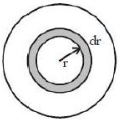
\({I_{Disc}} = \int\limits_0^R {\left( {dm} \right){r^2} \Rightarrow {I_{Disc}} = \int\limits_0^R {\left( {\sigma 2\pi rdr} \right){r^2}} } \)\({I_{Disc}} = \int\limits_0^R {\left( {k{r^2}2\pi rdr} \right)} {r^2}\,\,\,\,\,\,\,\,\,Mass\,of\,disc\)
\({I_{Disc}} = 2\pi k\int\limits_0^R {{r^2}dr\,\,\,\,\,\,\,\,\,\,\,\,\,\,\,\,\,\,\,M = } \int\limits_0^R {2\pi rdr\,k{r^2}} \)
\({I_{Disc}} = 2\pi k\left( {\frac{{{r^6}}}{6}} \right)_0^R\,\,\,\,\,\,\,\,\,\,\,\,\,\,\,\,\,M = 2\pi k\int\limits_0^R {{r^3}dr} \)
\({I_{Disc}} = 2\pi k\frac{{{R^6}}}{6}\,\,\,\,\,\,\,\,\,\,\,\,\,\,\,\,\,\,\,\,\,\,\,M = 2\pi k\left. {\frac{{{r^4}}}{4}} \right|_0^R\)
\({I_{Disc}} = \frac{{\pi k{R^6}}}{3} = \left( {\frac{{\pi k{R^4}}}{2}} \right)\frac{{{R^2}2}}{3}\,M = 2\pi k\left. {\frac{{{r^4}}}{4}} \right|_0^R\)
\({I_{Disc}} = \frac{{M2{R^2}}}{3}\,\,\,\,\,;\,\,\,\,\,\,\,\,{I_{Disc}} = \frac{2}{3}M{R^2}\)
-
- (A) \(\frac{{M{R^2}}}{2}\)
- (B) \(\frac{{M{R^2}}}{3}\)
- (C) \(\frac{{M{R^2}}}{6}\)
- (D) \(\frac{{2M{R^2}}}{3}\)
Show answer and solution
Correct Answer: (D)
\({I_{Disc}} = \int\limits_0^R {\left( {dm} \right){r^2} \Rightarrow {I_{Disc}} = \int\limits_0^R {\left( {\sigma 2\pi rdr} \right){r^2}} } \)\({I_{Disc}} = \int\limits_0^R {\left( {k{r^2}2\pi rdr} \right)} {r^2}\,\,\,\,\,\,\,\,\,Mass\,of\,disc\)
\({I_{Disc}} = 2\pi k\int\limits_0^R {{r^2}dr\,\,\,\,\,\,\,\,\,\,\,\,\,\,\,\,\,\,\,M = } \int\limits_0^R {2\pi rdr\,k{r^2}} \)
\({I_{Disc}} = 2\pi k\left( {\frac{{{r^6}}}{6}} \right)_0^R\,\,\,\,\,\,\,\,\,\,\,\,\,\,\,\,\,M = 2\pi k\int\limits_0^R {{r^3}dr} \)
\({I_{Disc}} = 2\pi k\frac{{{R^6}}}{6}\,\,\,\,\,\,\,\,\,\,\,\,\,\,\,\,\,\,\,\,\,\,\,M = 2\pi k\left. {\frac{{{r^4}}}{4}} \right|_0^R\)
\({I_{Disc}} = \frac{{\pi k{R^6}}}{3} = \left( {\frac{{\pi k{R^4}}}{2}} \right)\frac{{{R^2}2}}{3}\,M = 2\pi k\left. {\frac{{{r^4}}}{4}} \right|_0^R\)
\({I_{Disc}} = \frac{{M2{R^2}}}{3}\,\,\,\,\,;\,\,\,\,\,\,\,\,{I_{Disc}} = \frac{2}{3}M{R^2}\)
-
- (A) \(\frac{{M{\omega _0}}}{{M + 3m}}\)
- (B) \(\frac{{M{\omega _0}}}{{M + m}}\)
- (C) \(\frac{{M{\omega _0}}}{{M + 2m}}\)
- (D) \(\frac{{M{\omega _0}}}{{M + 6m}}\)
Show answer and solution
Correct Answer: (D)
Conservation of angualr momentum about rotation axes:\({L_i} = {L_f}\)
\(\left( {\frac{{M{\ell ^2}}}{{12}}} \right){\omega _0} = \left[ {\frac{{M{\ell ^2}}}{{12}} + 2\left( {m{{\left( {\frac{{{\ell ^2}}}{2}} \right)}^2}} \right)} \right]{\omega _f}\)
\( \Rightarrow \,{\omega _f} = \left( {\frac{M}{{M + 6m}}} \right){\omega _0}\)
-
- (A) \(\left( {\frac{{5a}}{3},\frac{{5b}}{3}} \right)\)
- (B) \(\left( {\frac{{2a}}{3},\frac{{2b}}{3}} \right)\)
- (C) \(\left( {\frac{{3a}}{4},\frac{{3b}}{4}} \right)\)
- (D) \(\left( {\frac{{5a}}{12},\frac{{5b}}{12}} \right)\)
Show answer and solution
Correct Answer: (D)
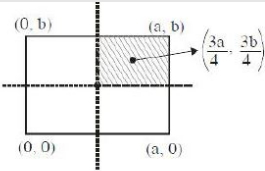
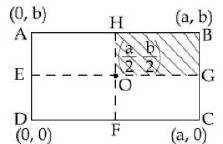
\(x = \frac{{M\frac{a}{2} - \frac{M}{4} \times \frac{{3a}}{4}}}{{M - \frac{M}{4}}}\)\( = \frac{{\frac{a}{2} - \frac{{3a}}{{16}} \times \frac{{3a}}{4}}}{{\frac{3}{4}}} = \frac{{\frac{{5a}}{{16}}}}{{\frac{3}{4}}} = \frac{{5a}}{{12}}\)
\(y = \frac{{M\frac{b}{2} - \frac{M}{4} \times \frac{{3b}}{4}}}{{M - \frac{M}{4}}} = \frac{{5b}}{{12}}\)

No questions on this page match these filters.