


Questions
20 questionsShowing 1–20 of 20 questions
-
- (A) \(0.16\)
- (B) \(1.60\)
- (C) \(0.24\)
- (D) \(0.32\)
Show answer and solution
Correct Answer: (D)
\(m = \frac{f}{{f - u}}\)\(5 = \frac{{ - 40}}{{ - 40 - u}}\,;\,u\, = \, - 32\,cm\)
-
- (A) \(13.4\)
- (B) \(8.8\)
- (C) \(6.7\)
- (D) \(11.7\)
Show answer and solution
Correct Answer: (B)
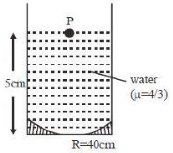
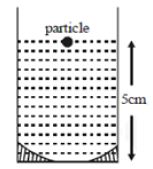
Light incident from particle \(P\) will be reflected at mirror.\({\text{u}} = - 5\,{\text{cm}},\) \({\text{f}} = {\text{m}} - \frac{{\text{R}}}{2}\) \( = - 20\,{\text{cm}}\)
\(\frac{1}{v} + \frac{1}{u} = \frac{1}{f}\) ; \(\boxed{{v_1} = + \frac{{20}}{3}\,\,cm}\)
This image will act as object for light getting refracted at water surface.
So, object distance \(d=5+\frac{20}{3}=\frac{35}{3} \,\mathrm{cm}\)
Below water surface.
After refraction, final image is at
\({d^\prime } = d\left( {\frac{{{\mu _2}}}{{{\mu _1}}}} \right)\) \( = \left( {\frac{{35}}{3}} \right)\left( {\frac{1}{{4/3}}} \right)\)
\(=\frac{35}{4}=8.75 \,\mathrm{cm}\)
\( \approx 8.8\, \mathrm{cm}\)
-
- (A) \(1.1\, cm\) away fro the lens
- (B) \(0\)
- (C) \(0.55\, cm\) towards the lens
- (D) \(0.55\, cm\) away from the lens
Show answer and solution
Correct Answer: (D)
If \(u=-10 \,\mathrm{cm}\)\(v=+10\, \mathrm{cm}\)
\(\Rightarrow \mathrm{f}=5\,\mathrm{cm}\)
Glass plate shift \(=\mathrm{t}\left(1-\frac{1}{\mu}\right)=1.5\left(1-\frac{2}{3}\right)=0.5\,\mathrm{cm}\)
So, new \(u=10-0.5=9.5\,\mathrm{cm}\)
\(\frac{1}{v}-\frac{1}{u}=\frac{1}{f}\)
\(\frac{1}{v}-\frac{1}{-9.5}=\frac{1}{5}\)
After solving we get,
\(v=\frac{47.5}{4.5}\). Hence, shift \(\frac{47.5}{4.5}-10=\left(\frac{2.5}{4.5}\right)=0.55\, \mathrm{cm}\)
-
- (A) \(20\)
- (B) \(10\)
- (C) \(30\)
- (D) \(40\)
Show answer and solution
Correct Answer: (B)
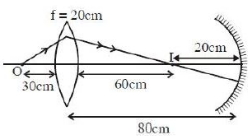
Image formed by lens\(\frac{1}{v}-\frac{1}{u}=\frac{1}{f}\) ; \(\frac{1}{v}+\frac{1}{30}=\frac{1}{20}\)
\(v=+60\, \mathrm{cm}\)
If image position does not change even when mirror is removed it means image formed by lens is formed at centre of curvature of spherical mirror.
Radius of curvature of mirror \(=80-60=20\,{cm}\)
\(\Rightarrow\) Focal length of mirror \(f=10\, \mathrm{cm}\) for virtual image, object is to be kept between focus and pole.
\(\Rightarrow\) Maximum distance of object from spherical mirror for which virtual image is formed, is \(10\,\mathrm{cm} .\)
-
- (A) \(5 : 3\)
- (B) \(2 : 1\)
- (C) \(4 : 3\)
- (D) \(3 : 1\)
Show answer and solution
Correct Answer: (D)
Magnification is \(2\)If image is real, \(x_{1}=\frac{3 f}{2}\)
If image is virtual, \(x_{2}=\frac{f}{2}\)
\(\frac{x_{1}}{x_{2}}=3: 1\)
-
- (A) \(90\)
- (B) \(30\)
- (C) \(60\)
- (D) \(45\)
Show answer and solution
Correct Answer: (C)
\(i=\theta\)\(r_{1}=r_{2}=\frac{A}{2}=30^{\circ}\)
by Snell's law
\(1 \times \sin i = \sqrt 3 \times \frac{1}{2} = \frac{{\sqrt 3 }}{2}\)
\(i=60\)
-
- (A) \(f_1\,-\,f_2\)
- (B) \(\frac{R}{{{\mu _2} - {\mu _1}}}\)
- (C) \(\frac{{2{f_1}{f_2}}}{{{f_1} + {f_2}}}\)
- (D) \({{f_1} + {f_2}}\)
Show answer and solution
Correct Answer: (B)
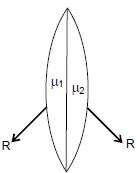
\(\frac{1}{f}=\frac{\left(\mu_{1}-1\right)}{R}+\frac{\left(1-\mu_{2}\right)}{R}\)\(\frac{1}{f}=\frac{\left(\mu_{1}-\mu_{2}\right)}{R}\)
\(\Rightarrow \quad \mathrm{f}=\frac{\mathrm{R}}{\mu_{1}-\mu_{2}}\)
-
- (A) \({\mu _1} +2{\mu _2} = 3\)
- (B) \({2\mu _1} + {\mu _2} = 1\)
- (C) \({3\mu _2} + {\mu _1} = 1\)
- (D) \({2\mu _2} + {\mu _1} = 1\)
Show answer and solution
Correct Answer: (A)
\(\frac{1}{{{f_1}}} = \left( {{\mu _1} - 1} \right)\left( {\frac{1}{R} - \frac{1}{\infty }} \right)\) ; \(\frac{1}{{{f_2}}} = \left( {{\mu _2} - 1} \right)\left( {\frac{1}{\infty } - \frac{1}{R}} \right)\)\(\frac{1}{{{f_1}}} = \frac{{(\mu - 1)}}{R}\) ; \(\frac{1}{{{f_2}}} = - \left( {\frac{{{\mu _2} - 1}}{R}} \right)\)
\(\mathrm{f}_{2}=2 \mathrm{f}_{1}\) ; \(\frac{1}{\mathrm{f}_{1}}=\frac{2}{\mathrm{f}_{2}}\)
\(\frac{\mu_{1}-1}{R}=\frac{-2\left(\mu_{2}-1\right)}{R}\)
\(\mu_{1}+2 \mu_{2}=3\)
-
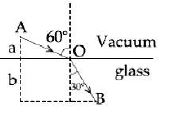
- (A) \(2a + \frac{{2b}}{{\sqrt 3 }}\)
- (B) \(2a + \frac{{2b}}{3}\)
- (C) \(\frac{{2\sqrt 3 }}{a} + 2b\)
- (D) \(2a + 2b\)
Show answer and solution
Correct Answer: (D)
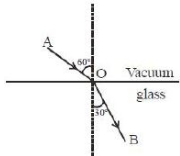
From Snell's law\(1 \sin 60^o=\mu \sin 30^o\)
\(\Rightarrow \mu=\sqrt{3}\)
Optical path \( = {\text{AO}} + \mu ({\text{OB}})\)
\( = \frac{{\text{a}}}{{\cos {{60}^o}}} + \sqrt 3 \frac{{\text{b}}}{{\cos {{30}^o}}}\)
\( = 2{\text{a}} + 2{\text{b}}\)
-
- (A) \(\sqrt 2 \)
- (B) \(\frac{4}{3}\)
- (C) \(\sqrt 3 \)
- (D) \(\frac{3}{2}\)
Show answer and solution
Correct Answer: (B)
For image to form at object itself, says must retrace their path back to object. Hence must incident on mirror normally.case \(1\) : Object will be at focus of lens
\(\frac{1}{f}=(\mu-1)\left(\frac{1}{R}-\frac{1}{-R}\right)=\frac{1}{-18}\)
\(\Rightarrow {\mathrm{R}}=18\, \mathrm{cm}\)
case \(2\) : Retraction at \(1^{\text {st }}\) surface:
\(\frac{1}{-27}-\frac{1.5}{V_{1}}=\frac{1-1.5}{R}\) ..... \((i)\)
\(2^{\text {nd }}\) retraction:
\(\frac{1.5}{V_{1}}-\frac{\mu}{\infty}=\frac{1.5-u}{-R}\) ..... \((ii)\)
From \((i)\) and \((ii)\)
\(\mu=\frac{4}{3}\)
-
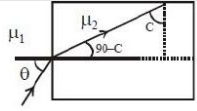
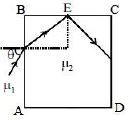
- (A) \(\theta > {\sin ^{ - 1}}\,\frac{{{\mu _1}}}{{{\mu _2}}}\)
- (B) \(\theta > {\sin ^{ - 1}}\,\sqrt {\frac{{\mu _2^2}}{{\mu _1^2}} - 1} \)
- (C) \(\theta < {\sin ^{ - 1}}\,\frac{{{\mu _1}}}{{{\mu _2}}}\)
- (D) \(\theta < {\sin ^{ - 1}}\,\sqrt {\frac{{\mu _2^2}}{{\mu _1^2}} - 1} \)
Show answer and solution
Correct Answer: (D)
\(\sin \mathrm{c}=\frac{\mu_{1}}{\mu_{2}}\)\(\mu_{1} \sin \theta=\mu_{2} \sin \left(90^o-\mathrm{C}\right)\)
\(\sin \theta=\frac{\mu_{2} \sqrt{1-\frac{\mu_{1}^{2}}{\mu_{2}^{2}}}}{\mu_{1}}\)
\(\theta=\sin ^{-1} \sqrt{\frac{\mu_{1}^{2}-\mu_{2}^{2}}{\mu_{1}^{2}}}\)
For \(TIR\)
\(\theta<\sin ^{-1} \sqrt{\frac{\mathrm{u}_{2}^{2}}{\mu_{1}^{2}}-1}\)
-
- (A) \(2.26\times 10^{-3}\,m/s\) away from the lens
- (B) \(0.92\times 10^{-3}\,m/s\) away from the lens
- (C) \(3.22\times 10^{-3}\,m/s\) towards the lens
- (D) \(1.16\times 10^{-3}\,m/s\) towards the lens
Show answer and solution
Correct Answer: (D)
\(\frac{1}{V}-\frac{1}{-20}=\frac{1}{30}\)\( \Rightarrow \frac{1}{V} = \frac{1}{{0.30}} - \frac{1}{{20}} = \) \( + \frac{{200 - 3}}{{60}} = \frac{{197}}{{60}}\)
\( \Rightarrow \quad - \frac{{dV}}{{dt\,\,{V^2}}} + \frac{{du}}{{dt\,{u^2}}} = 0\)
\( \Rightarrow \frac{{dV}}{{dt}} = \frac{{{V^2}}}{{{u^2}}}\frac{{du}}{{dt}}\) \( = {\left( {\frac{3}{{197}}} \right)^2} \times ( - 5)\) \( = - 0.00116\,{\text{m}}/{\text{s}}\)
-
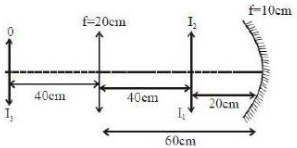
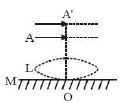
- (A) \(40\, cm\) from the convergent mirror, same size as the object
- (B) \(20\, cm\) from the convergent mirror, same size as the object
- (C) \(40\, cm\) from the convergent lens, twice the size of the object
- (D) None of these
Show answer and solution
Correct Answer: (D)
There will be \(3\) phenomenon\((i)\) Refraction from lens
\((ii)\) Reflection from mirror
\((iii)\) Refraction from lens
After these phenomena. Image will be on object and will have same size. None of the option depicts so this question is Bonus.
\(1^{\text {st }}\) refraction \(\mathrm{u}=-40\,\mathrm{cm} ; \mathrm{f}=+20\, \mathrm{cm}\)
\( \Rightarrow {\text{v}} = + 40\,{\text{cm}}\) (image \(I_1\)) and \(m_1\,=\,-\,1\) for reflction
\({\text{u}} = - 20\,{\mkern 1mu} {\text{cm}}\,;{\text{f}} = - 10\,{\mkern 1mu} {\text{cm}}\)
\( \Rightarrow v = - 20{\mkern 1mu} \,{\text{cm}}\) (image \(I_2\)) and \(m_2\,=\,-\,1\) \(2^{\text {nd }}\) refraction
\(\mathrm{u}=-40\, \mathrm{cm}\) ; \(\mathrm{f}=+20\, \mathrm{cm}\)
\( \Rightarrow v = + 40{\mkern 1mu} \,{\text{cm}}\) (image \(I_3\)) and \(m_3=-\,1\)
Total magnification \(=m_{1} \times m_{2} \times m_{3}=-1\) and final image is formed at distance \(40\,\mathrm{cm}\) from convergent lens and is of same size as the object.
-
- (A) Image disappears
- (B) Magnified image
- (C) Erect real image
- (D) No change
Show answer and solution
Correct Answer: (A)
If the water is filled focal length will decrease and image will disappear. -
- (A) \(57000\)
- (B) \(45000\)
- (C) \(66000\)
- (D) None of these
Show answer and solution
Correct Answer: (A)
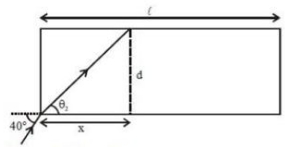
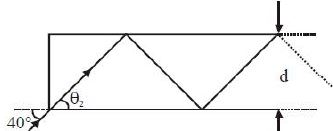
If we approximate the angle \(\theta_{2}\) as \(30^o\) initially then answer will be closer to \(57000\). but if we solve thoroughly, answer will be close to \(55000\) .So both the answers must be awarded. Detailed solution as following.
Exact solution
By Snell's law \(1.\sin {40^o} = (1.31)\sin {\theta _2}\)
\(\sin \theta_{2}=\frac{64}{1.31}=\frac{64}{131} \approx .49\)
Now \(\tan {\theta _2} = \frac{{64}}{{\sqrt {{{(131)}^2} - {{(64)}^2}} }}\) \( = \frac{{64}}{{\sqrt {13065} }} \approx \frac{{64}}{{114.3}} = \frac{{\text{d}}}{x}\)
Now number of reflections
\(=\frac{2 \times 64}{114.3 \times 20 \times 10^{-6}}=\frac{64 \times 10^{5}}{114.3}\)
\(=55991 \approx 55000\)
Approximate solution
By Snell's law \(1 . \sin 40^{\circ}=(1.31) \sin \theta_{2}\)
\({\sin \theta_{2}=\frac{0.64}{1.31}=\frac{64}{131} \approx 0.49}\)
If assume \( \Rightarrow {\theta _2} \approx {30^o}\)
\(\tan {30^o} = \frac{{\text{d}}}{{\text{x}}} \Rightarrow {\text{x}} = \sqrt 3 {\text{d}}\)
Now number of reflections
\(=\frac{\ell}{\sqrt{3} \mathrm{d}}=\frac{2}{\sqrt{3} \times 20 \times 10^{-6}}=\frac{10^{5}}{\sqrt{3}}\)
\(\approx 57735 \approx 57000\)
-
- (A) \(\frac{R}{{2\left( {{\mu _1} - {\mu _2}} \right)}}\)
- (B) \(\frac{2R}{{\left( {{\mu _1} - {\mu _2}} \right)}}\)
- (C) \(\frac{R}{{\left( {{\mu _1} - {\mu _2}} \right)}}\)
- (D) \(\frac{R}{{2 - \left( {{\mu _1} - {\mu _2}} \right)}}\)
Show answer and solution
Correct Answer: (C)
For \(1^{\text {st }}\) lens \(\frac{1}{{{f_1}}} = \left( {\frac{{{\mu _1} - 1}}{1}} \right)\) \(\left( {\frac{1}{\infty } - \frac{1}{{ - R}}} \right) = \frac{{{\mu _1} - 1}}{R}\)For \(2^{n d}\) lens \(\frac{1}{{{f_2}}} = \left( {\frac{{{\mu _2} - 1}}{1}} \right)\) \(\left( {\frac{1}{{ - R}} - 0} \right) = - \frac{{{\mu _2} - 1}}{R}\)
\(\frac{1}{f_{e q}}=\frac{1}{f_{1}}+\frac{1}{f_{2}}\)
\(\frac{1}{{{f_{eq}}}} = \frac{{{\mu _1} - 1}}{R} + \frac{{ - \left( {{\mu _2} - 1} \right)}}{R}\) \( \Rightarrow {f_{eq}} = \frac{R}{{{\mu _1} - {\mu _2}}}\)
-
- (A) \(1\)
- (B) \(2\)
- (C) \(4\)
- (D) \(3.1\)
Show answer and solution
Correct Answer: (D)
\({\frac{\mu_{2}}{\mathrm{v}}-\frac{\mu_{1}}{\mathrm{u}}=\frac{\mu_{2}-\mu_{1}}{\mathrm{R}}}\)\({\Rightarrow \quad \frac{1.34}{\mathrm{v}}-\frac{1}{-\infty}=\frac{0.34}{7.8}} \)
\( \Rightarrow {\text{v}} = \frac{{1.34 \times 7.8}}{{0.34}}\,\,{\text{nm}}\) \( = 3.074\,{\text{cm}}\)
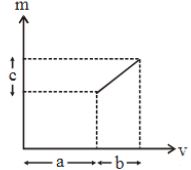
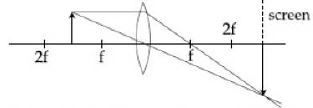
- 18. The graph shows how the magnification \(m\) produced by a thin lens varies with image distance \(v\). What is the focal length of the lens used?
 2019 Medium
- (A) \(\frac {b^2}{ac}\)
- (B) \(\frac {a}{c}\)
- (C) \(\frac {b^2c}{a}\)
- (D) \(\frac {b}{c}\)
Show answer and solution
Correct Answer: (D)
\(f\,=\,\frac {b}{c}\)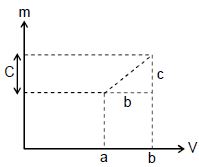
-
- (A) \(45\)
- (B) \(60\)
- (C) \(75\)
- (D) \(90\)
Show answer and solution
Correct Answer: (B)
\(\theta \,=\,60^o\)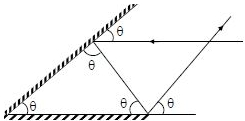
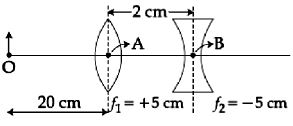
- 20. What is the position and nature of image formed by lens combination shown in figure? (\(f_1, f_2\) are focal lengths)
 2019 Hard
- (A) \(70\, cm\) from point \(B\) at left; virtual
- (B) \(40\, cm\) from point \(B\) at right; real
- (C) \(\frac{20}{3}\, cm\) from point \(B\) at right; real
- (D) \(70\, cm\) from point \(B\) at right ; real
Show answer and solution
Correct Answer: (D)
Image by convex lens:\(\frac{1}{v} - \frac{1}{u} = \frac{1}{f}\) ; \(\frac{1}{v} + \frac{1}{{20}} = \frac{1}{5}\)
\({v=\frac{20}{3}\, \mathrm{cm}}\)
Image by concave lens:
\(u=\left[\frac{20}{3}-2\right]=\frac{14}{3} \,\mathrm{cm}\)
\(\frac{1}{v}-\frac{1}{u}=\frac{1}{f}\) ; \(\frac{1}{v}-\frac{3}{14}=-\frac{1}{5}\)
\(v=70\, \mathrm{cm}\)

No questions on this page match these filters.