


Questions
13 questionsShowing 1–13 of 13 questions
-
- (A) \(1.5\times 10^{-3}\,V\)
- (B) \(1.1\times 10^{-3}\,V\)
- (C) \(2.5\times 10^{-3}\,V\)
- (D) \(0.3\times 10^{-3}\,V\)
Show answer and solution
Correct Answer: (B)
\( \therefore \quad \mathrm{Emf} =\mathrm{B} \ell \mathrm{v} \sin 45^{\circ} \)\(=\left(0.3 \times 10^{-4}\right) \times(10) \times 5 \times \frac{1}{\sqrt{2}} \)
\(=1.1 \times 10^{-3}\, \mathrm{V} \)
-
- (A) \(0.016\,s\)
- (B) \(0.324\,s\)
- (C) \(0.002\,s\)
- (D) \(0.103\,s\)
Show answer and solution
Correct Answer: (A)
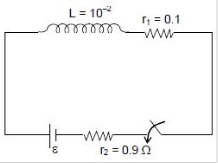
\(\mathrm{L}=10 \times 10^{-3} \,\mathrm{H}, \mathrm{r}_{1}=0.1\, \Omega\)\(i=\varepsilon\left\{1-e^{-t / 2}\right\}\)
\(i_{saturation}\) \(=\varepsilon\)
\(80 \%\) \(i_{saturastion}\) \(=0.8\, \mathrm{\varepsilon}\)
\(0.8 \varepsilon=\varepsilon\left\{1-e^{-t / 2}\right\}\)
\(0.8=1-\mathrm{e}^{-\mathrm{t/2} } \quad ; \quad \mathrm{e}^{-\mathrm{t/2} }=0.2\)
\(e^{t/L}=5\)
\(\mathrm{t}=\mathrm{L} \ln 5=10 \times 10^{-3} \times 1.6=16 \times 10^{-3}\)
-
- (A) \(14\)
- (B) \(7\)
- (C) \(21\)
- (D) \(140\)
Show answer and solution
Correct Answer: (D)
\({\text{B}}({\text{t}}) = 0.4\sin \left( {50\pi \times {{10}^{ - 2}}} \right)\)\( = 0.4\sin \left( {\frac{{50\pi }}{{100}}} \right) = 0.4\)
\(\Delta q = \frac{{ - \Delta {\text{Q}}}}{{\text{R}}} = \frac{{\Delta {\text{Q}}}}{{\text{R}}}\)
\( = \frac{{0.4 \times 3.5 \times {{10}^{ - 3}}}}{{10}}\)
\( = 140\,{\text{mc}}\)
-
- (A) decreases by a factor of \(9\)
- (B) increases by a factor of \(27\)
- (C) increases by a factor of \(3\)
- (D) decreases by a factor of \(9\sqrt 3 \)
Show answer and solution
Correct Answer: (C)
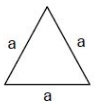
Total length \(L\) will remain constant\(\mathrm{L}=(3 \mathrm{a}) \mathrm{N} \quad(\mathrm{N}=\text { total tums })\)
And length of winding \(=(d) N=\ell\)
\((d=\text { diameter of wire })\)
Self inductance \(=\mu_{0} \mathrm{n}^{2} \mathrm{A} \ell\)
\(=\mu_{0} n^{2}\left(\frac{\sqrt{3} a^{2}}{4}\right) d N\)
\(\alpha a^{2} N \propto a\)
So self inductance will become \(3\) times.
-
- (A) \(20\)
- (B) \(40\)
- (C) \(45\)
- (D) \(25\)
Show answer and solution
Correct Answer: (C)
Given \(: V_{P}=2300\, \mathrm{V}, V_{s}=230\, \mathrm{V}, I_{P}=5\, \mathrm{A}\)\(\eta=90 \%=0.9\)
Efficiency \(\eta=0.9=\frac{P_{s}}{P_{p}} \Rightarrow P_{s}=0.9 P_{p}\)
\(\mathrm{V}_{\mathrm{s}} \mathrm{I}_{\mathrm{s}}=0.9 \times \mathrm{V}_{\mathrm{P}} \mathrm{I}_{\mathrm{P}} \quad(\because \mathrm{P}=\mathrm{VI})\)
\({I_s} = \frac{{0.9 \times 2300 \times 5}}{{230}} = 45{\mkern 1mu} {\text{A}}\)
-
- (A) \(12\)
- (B) \(6\)
- (C) \(1\)
- (D) \(2\)
Show answer and solution
Correct Answer: (A)
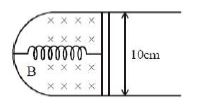
\(E = vB\)
\(V = Ed = dvB\)\(=2\times 10^{-2}\times 6\times 0.1=12\;mV\) -
- (A) \(50000\)
- (B) \(10000\)
- (C) \(1000\)
- (D) \(5000\)
Show answer and solution
Correct Answer: (D)
\(\mathrm{T}_{0}=2 \pi \sqrt{\frac{\mathrm{m}}{\mathrm{k}}}=\frac{2 \pi}{\sqrt{10}}\)\(\mathrm{A}=\mathrm{A}_{0} \mathrm{e}^{-1 / \gamma}\)
\(\therefore\) for \(\mathrm{A}=\frac{\mathrm{A}_{0}}{\mathrm{e}}, \mathrm{t}=\gamma\)
\(\mathrm{t}=\gamma=\frac{2 \mathrm{m}}{\mathrm{b}}=\frac{\frac{2 \mathrm{m}}{\mathrm{B}^{2} \ell^{2}}}{\frac{\mathrm{B}^{2} \ell^{2}}{\mathrm{R}}}=10^{4} \,\mathrm{s}\)
\(\therefore \) No of oscillation \(\frac{\mathrm{t}}{\mathrm{T}_{0}}=\frac{10^{4}}{2 \pi / \sqrt{10}} \approx 5000\)
-
- (A) \(440\, V\) and \(5\, A\)
- (B) \(440\, V\) and \(20\, A\)
- (C) \(220\, V\) and \(20\, A\)
- (D) \(220\, V\) and \(10\, A\)
Show answer and solution
Correct Answer: (A)
Given \(\mathrm{N}_{\mathrm{P}}=300, \mathrm{N}_{\mathrm{s}}=150, \mathrm{P}_{0}=2200 \,\mathrm{W}\) \(\mathrm{l}_{\mathrm{s}}=10\, \mathrm{A}\)\(\mathrm{P}_{0}=\mathrm{V}_{0} \mathrm{l}_{0} \)
\(\Rightarrow 2200=\mathrm{V}_{0} \times 10 \)
\(\Rightarrow \mathrm{V}_{0}=220\, \mathrm{V}\)
\(\because \frac{V_{i}}{V_{0}}=\frac{N_{p}}{N_{s}} \)
\(\Rightarrow V_{1}=2 \times 220=440\, \mathrm{V}\)
Also, \(\quad \mathrm{P}_{0}=\mathrm{V}_{\mathrm{i}} \mathrm{l}_{\mathrm{i}}\)
\(\Rightarrow \mathrm{I}_{\mathrm{i}}=\frac{2200}{440}=5\, \mathrm{A}\)
-
- (A) \(115\)
- (B) \(170\)
- (C) \(60\)
- (D) \(150\)
Show answer and solution
Correct Answer: (B)
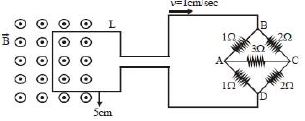
since it is a balanced wheatstone bridge, its equivalent resistance \(=\frac{4}{3}\, \Omega\)\(\varepsilon=\mathrm{B} \ell \mathrm{v}=5 \times 10^{-4}\, \mathrm{V}\)
So total resistance
\(\mathrm{R}=\frac{4}{3}+1.7 \approx 3\, \Omega\)
\(\therefore \quad \mathrm{i}=\frac{\varepsilon}{\mathrm{R}} \approx 166\, \mu \mathrm{A} \approx 170\, \mu \mathrm{A}\)
-
- (A) \(437.5\)
- (B) \(740\)
- (C) \(540\)
- (D) \(637.5\)
Show answer and solution
Correct Answer: (A)
\(\frac{L \Delta T}{\Delta t}=25\)\(\Rightarrow L=\frac{25 \times 1}{15}=\frac{5}{3}\)
\(\Delta U=\frac{1}{2} L\left(l_{f}^{2}-l_{1}^{2}\right)=\frac{1}{2} \times \frac{5}{3} \times\left(25^{2}-10^{2}\right)\)
\(\quad=\frac{5}{6} \times 525=437 .5\, \mathrm{J}\)
-
- (A) \(1/L\)
- (B) \(L\)
- (C) \(1/L^2\)
- (D) \(L^2\)
Show answer and solution
Correct Answer: (A)
\(\phi=\mathrm{NBA}=\mathrm{LI}\)\({\mathrm{N}} \mu_{0} \mathrm{n} \mathrm{I} \pi \mathrm{R}^{2}=\mathrm{LI}\)
\(\mathrm{N} \mu_{0} \frac{\mathrm{N}}{\ell} \mathrm{I} \pi \mathrm{R}^{2}=\mathrm{LI}\)
\(\mathrm{N}\) and \(\mathrm{R}\) constant
Self inductance \((L)\) \(\propto \frac{1}{\ell} \propto \frac{1}{\text { length }}\)
-
- (A) \(\frac{{{n_1}}}{{{n_2}}}\)
- (B) \(\frac{{{n_2}}}{{{n_1}}}.\frac{{{r_1}}}{{{r_2}}}\)
- (C) \(\frac{{{n_2}}}{{{n_1}}}.\frac{{r_2^2}}{{r_1^2}}\)
- (D) \(\frac{{{n_2}}}{{{n_1}}}\)
Show answer and solution
Correct Answer: (D)
\(\ \frac{M}{L} =\frac{\mu_{0} n n_{1} n_{2} n_{1}^{2} \ell}{\mu_{0} \pi n_{1}^{2} r_{1}^{2} \ell}\)\(=\frac{n_{2}}{n_{1}}\)
-
- (A) \(6.67 \times {10^{ - 3}}\,Wb\)
- (B) \(6.67 \times {10^{ - 4}}\,Wb\)
- (C) \(3.67 \times {10^{ - 4}}\,Wb\)
- (D) \(3.67 \times {10^{ - 3}}\,Wb\)
Show answer and solution
Correct Answer: (B)
Mutual induction\(\phi_{q}=M l_{p}\)
\(10^{-3}=\mathrm{M}(3)\)
\(\Rightarrow M=\frac{1}{3} \times 10^{-3}\)
\(\phi_{\mathrm{p}}=\mathrm{Ml}_{\mathrm{q}}\)
\(\Rightarrow \phi_{p}=6.67 \times 10^{-4}\, \mathrm{Wb}\)
No questions on this page match these filters.