


All JEE Mains 2019 Physics questions
31 chaptersShowing 301–350 of 468 questions
-
- (A) \(\sqrt {\frac{{qE}}{{2md}}} \)
- (B) \(\sqrt {\frac{{2qE}}{{md}}} \)
- (C) \(\sqrt {\frac{{qE}}{{md}}} \)
- (D) \(2\sqrt {\frac{{qE}}{{md}}} \)
Show answer and solution
Correct Answer: (B)
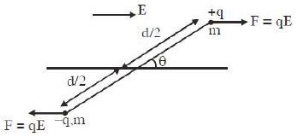
Moment of inertia\((I)=m\left(\frac{d}{2}\right)^{2} \times 2=\frac{m d^{2}}{2}\)
Now by \(\tau=I \alpha\)
\((q E)(d \sin \theta)=\frac{m d^{2}}{2} \cdot \alpha\)
\(\alpha=\left(\frac{2 \mathrm{qE}}{\mathrm{md}}\right) \sin \theta\) for small \(\theta\)
\({\Rightarrow \alpha=\left(\frac{2 \mathrm{qE}}{\mathrm{md}}\right) \theta}\)
\(\Rightarrow \) Angular frequency \(\omega = \sqrt {\frac{{2qE}}{{md}}} \)
-
- (A) \(a\,\log \,\left( {1 - \frac{Q}{{2\pi aA}}} \right)\)
- (B) \(\frac{a}{2}\,\log \,\left( {\frac{1}{{1 - \frac{Q}{{2\pi aA}}}}} \right)\)
- (C) \(a\,\log \,\left( {\frac{1}{{1 - \frac{Q}{{2\pi aA}}}}} \right)\)
- (D) \(\frac{a}{2}\,\log \left( {1 - \frac{1}{{2\pi aA}}} \right)\,\)
Show answer and solution
Correct Answer: (B)
\(Q = \int \rho 4\pi {r^2}dr = \int_0^R {\left( {\frac{A}{{{r^2}}}{e^{ - \frac{{2r}}{a}}}} \right)} \left( {4\pi {r^2}} \right)dr\)\( = 4\pi A\frac{a}{2}\left( {1 - {e^{\frac{{ - 2R}}{a}}}} \right)\)
\( \Rightarrow R = \frac{{ - a}}{2}\log \left( {1 - \frac{Q}{{2\pi Aa}}} \right)\)
-
- (A) \(3F\)
- (B) \(\frac{F}{3}\)
- (C) \(9F\)
- (D) \(27F\)
Show answer and solution
Correct Answer: (D)
\(\therefore F \propto \frac{1}{{{r^3}}}\)
Required force \(= 27\, F\). -
- (A) \(\sqrt 3 q\ell \,\frac{{\hat j - \hat i}}{{\sqrt 2 }}\)
- (B) \((q\ell )\,\frac{{\hat i + \hat j}}{{\sqrt 2 }}\)
- (C) \(2q\ell \,\hat j\)
- (D) \( - \sqrt 3 q\ell \,\hat j\)
Show answer and solution
Correct Answer: (D)
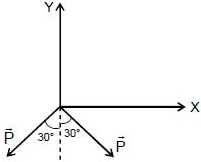
\(|\overrightarrow {\text{P}} | = {\text{qL}}\)\({\overrightarrow {\text{P}} _{{\text{net}}}} = 2{\text{P}}\cos {30^\circ }( - \widehat {\text{j}})\)
\( = {\text{P}}\sqrt 3 ( - \widehat {\text{j}})\)
\( = \sqrt 3 {\text{qL}}( - \widehat {\text{j}})\)
-
- (A) \(\frac{R}{{\sqrt 5 }}\)
- (B) \(\frac{R}{{\sqrt 2 }}\)
- (C) \(R\)
- (D) \(R\sqrt 2 \)
Show answer and solution
Correct Answer: (B)
Electric field \(E=\frac{k Q x}{\left(x^{2}+R^{2}\right)^{3 / 2}}\)For maxima \(\frac{d E}{d x}=0\)
After solving we get, \(\left(x \pm \frac{\mathrm{R}}{\sqrt{2}}\right)\)
-
- (A) \(E \propto \frac{1}{D}\)
- (B) \(E \propto \frac{1}{D^3}\)
- (C) \(E \propto \frac{1}{D^2}\)
- (D) \(E \propto \frac{1}{D^4}\)
Show answer and solution
Correct Answer: (D)
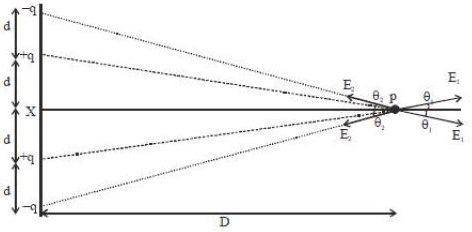
Electric field at \(\mathrm{p}=2 \mathrm{E}_{1} \cos \theta_{1}-2 \mathrm{E}_{2} \cos \theta_{2}\)\(=\frac{2 \mathrm{Kq}}{\left(\mathrm{d}^{2}+\mathrm{D}^{2}\right)} \times \frac{\mathrm{D}}{\left(\mathrm{d}^{2}+\mathrm{D}^{2}\right)^{1 / 2}}-\frac{2 \mathrm{Kq}}{\left[(2 \mathrm{d})^{2}+\mathrm{D}^{2}\right]} \times \frac{\mathrm{D}}{\left[(2 \mathrm{d})^{2}+\mathrm{D}^{2}\right]^{1 / 2}}\)
\(=2 \mathrm{KqD}\left[\left(\mathrm{d}^{2}+\mathrm{D}^{2}\right)^{-3 / 2}-\left(4 \mathrm{d}^{2}+\mathrm{D}^{2}\right)^{-3 / 2}\right]\)
\(=\frac{2 \mathrm{KqD}}{\mathrm{D}^{3}}\left[\left(1+\frac{\mathrm{d}^{2}}{\mathrm{D}^{2}}\right)^{-3 / 2}-\left(1+\frac{4 \mathrm{d}^{2}}{\mathrm{D}^{2}}\right)^{-3 / 2}\right]\)
Applying binomial approximation \(\because \mathrm{d}<<\mathrm{D}\)
\(=\frac{2 \mathrm{KqD}}{\mathrm{D}^{3}}\left[1-\frac{3}{2} \frac{\mathrm{d}^{2}}{\mathrm{D}^{2}}-\left(1-\frac{3 \times 4 \mathrm{d}^{2}}{2 \mathrm{D}^{2}}\right)\right]\)
\(=\frac{2 \mathrm{KqD}}{\mathrm{D}^{3}}\left[\frac{12}{2} \frac{\mathrm{d}^{2}}{\mathrm{D}^{2}}-\frac{3}{2} \frac{\mathrm{d}^{2}}{\mathrm{D}^{2}}\right]\)
\(=\frac{9 \mathrm{kqd}^{2}}{\mathrm{D}^{4}}\)
-
- (A) \(a = \frac{{3R}}{{{2^{1/4}}}}\)
- (B) \(a = {2^{ - 1/4}}R\)
- (C) \(a = {8^{ - 1/4}}R\)
- (D) \(a = R/\sqrt 3 \)
Show answer and solution
Correct Answer: (C)
\(E 4 \pi a^{2}=\frac{\int_{0}^{\theta} k r 4 \pi r^{2} d r}{e_{0}}\)\(E=\frac{k 4 \pi a^{4}}{4 \times 4 \pi \varepsilon_{0}}\)
\(2 \mathrm{Q}=\int_{0}^{\mathrm{R}} \mathrm{kr} 4 \pi \mathrm{r}^{2} \mathrm{dr}\)
\(\mathrm{k}=\frac{2 \mathrm{Q}}{\pi \mathrm{R}^{4}}\)
\(\mathrm{QE}=\frac{1}{4 \pi \varepsilon_{0}} \frac{\mathrm{QQ}}{(2 \mathrm{a})^{2}}\)
\(\mathrm{R}=\mathrm{a} 8^{1 / 4}\)
-
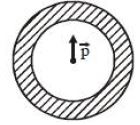
- (A) Surface charge density on the inner surface of the shell is zero everywhere
- (B) Electric field outside the shell is the same as that of a point charge at the centre of the shell
- (C) Surface charge density on the inner surface is uniform and equal to \(\frac{{\left( {Q/2} \right)}}{{4\pi {a^2}}}\)
- (D) Surface charge density on the outer surface depends on \(\left| {\vec P} \right|\)
Show answer and solution
Correct Answer: (B)
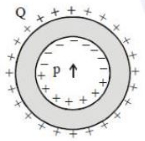
Total charge of dipole \(=0,\) so charge induced on outside surface \(=0\).But due to non uniform electric field of dipole, the charge induced on inner surface is non zero and non uniform.
So, for any observer outside the shell, the resultant electric field is due to Q uniformly distributed on outer surface only and it is equal to.
\(\boxed{E = \frac{{KQ}}{{{r^2}}}}\)
-
- (A) \({\tan ^{ - 1}}\left( {2.0} \right)\)
- (B) \({\tan ^{ - 1}}\left( {0.2} \right)\)
- (C) \({\tan ^{ - 1}}\left( {5.0} \right)\)
- (D) \({\tan ^{ - 1}}\left( {0.5} \right)\)
Show answer and solution
Correct Answer: (D)
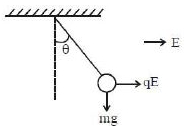
\(\tan \theta=\frac{\mathrm{qE}}{\mathrm{mg}}=\frac{5 \times 10^{-6} \times 2000}{2 \times 10^{-3} \times 10}\)\(\tan \theta=\frac{1}{2} \Rightarrow \theta=\tan ^{-1}(0.5)\)
-
- (A) \(-\frac Q2\)
- (B) \(+\frac Q2\)
- (C) \(+\frac Q4\)
- (D) \(-\frac Q4\)
Show answer and solution
Correct Answer: (D)
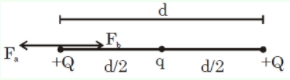
For equilibrium,\(\vec{F}_{a}+\vec{F}_{B}=0\)
\(\vec{F}_{a}=-\overrightarrow{F_{B}}\)
\(\frac{k Q Q}{d^{2}}=-\frac{k Q q}{(d / 2)^{2}}\)
\(\Rightarrow q=-\frac{Q}{4}\)
-
- (A) \((63\hat i - 27\hat j) \times {10^2}\)
- (B) \((-63\hat i + 27\hat j) \times {10^2}\)
- (C) \((81\hat i - 81\hat j) \times {10^2}\)
- (D) \((-81\hat i + 81\hat j) \times {10^2}\)
Show answer and solution
Correct Answer: (A)
\(\overrightarrow {\text{E}} = \frac{{{\text{k}}{{\text{q}}_1}}}{{{\text{r}}_1^3}}{\overrightarrow {\text{r}} _1} + \frac{{{\text{k}}{q_2}}}{{{\text{r}}_2^3}}{\overrightarrow {\text{r}} _2}\)\( = {\text{k}} \times {10^{ - 6}}\left[ {\frac{{\sqrt {10} }}{{10\sqrt {10} }}( - \widehat {\text{i}} + 3\widehat {\text{j}}) + \frac{{( - 25)}}{{125}}( - 4\widehat {\text{i}} + 3\widehat {\text{j}})} \right]\)
\( = \left( {9 \times {{10}^3}} \right)\left[ {\frac{1}{{10}}( - \widehat {\text{i}} + 3\widehat {\text{j}}) - \frac{1}{5}( - 4\widehat {\text{i}} + 3\widehat {\text{j}})} \right]\)
\( = \left( {9 \times {{10}^3}} \right)\left[ {\left( { - \frac{1}{{10}} + \frac{4}{5}} \right)\widehat {\text{i}} + \left( {\frac{3}{{10}} - \frac{3}{5}} \right)\widehat {\text{i}}} \right]\)
\( = 9000\left( {\frac{7}{{10}}\widehat {\text{i}} - \frac{3}{{10}}\widehat {\text{j}}} \right)\)
\( = (63\widehat {\text{i}} - 27\widehat {\text{j}})(100)\)
-
- (A) \(6\)
- (B) \(4\)
- (C) \(7\)
- (D) \(5\)
Show answer and solution
Correct Answer: (A)
For closed organ pipe, resonate frequency is odd multiple of fundamental frequency. \((2 n+1) f_{o} \leq 20,000\)\(\left(f_{o} \text { is fundamental frequency }=1.5 Khz \right)\)
\(n=6\)
-
- (A) \(\frac{g}{{30}}\)
- (B) \(\frac{g}{{10}}\)
- (C) \(\frac{g}{{5}}\)
- (D) \(\frac{g}{{20}}\)
Show answer and solution
Correct Answer: (C)
\(60=\sqrt{\frac{M g}{\mu}}\)\(60.5=\sqrt{\frac{M\left(g^{2}+a^{2}\right)^{1 / 2}}{\mu}} \Rightarrow \frac{60.5}{60}=\sqrt{\sqrt{\frac{g^{2}+a^{2}}{g^{2}}}}\)
\(\left(1+\frac{0.5}{60}\right)^{4}=\frac{g^{2}+a^{2}}{g^{2}}=1+\frac{2}{60}\)
\(\Rightarrow g^{2}+a^{2}=g^{2}+g^{2} \times \frac{2}{60}\)
\(a=g \sqrt{\frac{2}{60}}=\frac{g}{\sqrt{30}}=\frac{g}{5.47}\)
\(\simeq \frac{g}{5}\)
-
- (A) \(666\)
- (B) \(753\)
- (C) \(500\)
- (D) \(333\)
Show answer and solution
Correct Answer: (A)
\(f=\frac{2}{2 \ell} V_{s}=\frac{330}{0.5}=660 \mathrm{Hz}\)\( \therefore \quad f^{\prime}=f\left(\frac{v_{s}+v}{v_{s}}\right)=(660)\left(\frac{330+\frac{50}{18}}{330}\right)=660\left(1+\frac{50}{18 \times 330}\right)\)
\(=666 \mathrm{Hz}\)
-
- (A) \(\frac{{\sqrt 3 }}{2}\upsilon \)
- (B) \(\frac{{2\upsilon }}{{\sqrt 3 }}\)
- (C) \(\upsilon \)
- (D) \(\frac{\upsilon }{2}\)
Show answer and solution
Correct Answer: (D)
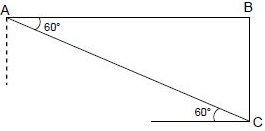
\(\mathrm{V}_{\mathrm{P}} \rightarrow\) Speed of plane\(\vee \rightarrow\) Speed of sound
\(\vee \cos 60^{\circ}=V_{P}\)
\(V_{P}=\frac{V}{2}\)
-
- (A) \(\pi \)
- (B) \(\frac{\pi }{2}\)
- (C) \(-\frac{\pi }{2}\)
- (D) \(0\)
Show answer and solution
Correct Answer: (A)
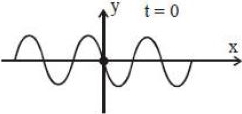
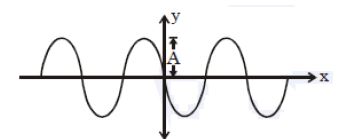
\(y=A \sin (k x-w t+\phi)\)at \(x=0, t=0\) and slope is negative
\(\Rightarrow \phi=\pi\)
-
- (A) \(322\)
- (B) \(341\)
- (C) \(335\)
- (D) \(328\)
Show answer and solution
Correct Answer: (D)
\(\lambda_{1}=4(11+\mathrm{e}) =\frac{\mathrm{v}}{512}\)\(\lambda_{2}=4(27+e)=\frac{V}{256}\)
\(\frac{11+e}{27+e}=\frac{1}{2}\)
\(\Rightarrow \quad 22+2 e=27+e\)
\(\Rightarrow \quad e=5\)
-
- (A) \(30\)
- (B) \(10\)
- (C) \(40\)
- (D) \(20\)
Show answer and solution
Correct Answer: (C)
Loudness of sound is given by\(\mathrm{dB}=10 \log \frac{I}{\mathrm{I}_{0}}\) (\(I\) is intensity of sound, \(I_0\) is reference intensity of sound)
\(120=10 \log \left(\frac{I}{I_{0}}\right)\)
\(\Rightarrow I=1 \mathrm{W} / \mathrm{m}^{2}\)
Also, \(\mathrm{I}=\frac{\mathrm{P}}{4 \pi \mathrm{r}^{2}}=\frac{2}{4 \pi \mathrm{r}^{2}}\)
\(\therefore r=\sqrt{\frac{2}{4 \pi}}=\sqrt{\frac{I}{2 \pi}} \mathrm{m}=0.399 \mathrm{m}\)
\(\approx 40 \mathrm{cm}\)
-
- (A) \(1143\)
- (B) \(857\)
- (C) \(750\)
- (D) \(807\)
Show answer and solution
Correct Answer: (C)
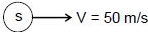
\(\mathrm{f}_{\mathrm{a}}=\frac{\mathrm{V}}{\mathrm{V}-\mathrm{V}_{\mathrm{s}}} \mathrm{f}_{\mathrm{o}}=1000 \mathrm{Hz}\)\(\mathrm{f}_{\mathrm{a}}^{\prime}=\frac{\mathrm{V}}{\mathrm{V}+\mathrm{V}_{\mathrm{s}}} \mathrm{f}_{\mathrm{o}}\)
\(\frac{f_{a}^{\prime}}{f_{a}}=\frac{V-V_{s}}{V+V_{s}}=\frac{350-50}{350+50}=\frac{300}{400}=\frac{3}{4}\)
\(\mathrm{f}_{\mathrm{a}}^{\prime}=\frac{3}{4} \times 1000=750 \mathrm{Hz}\)
-
- (A) \(16, 14\)
- (B) \(12, 16\)
- (C) \(8, 18\)
- (D) \(12, 18\)
Show answer and solution
Correct Answer: (D)
\( v= \frac{v+v_{0}}{v} v_{0}\)\(\Rightarrow v_{0}=\left(\frac{v}{v_{0}}-1\right) v\)
\(v_{0}=\left(\frac{530}{500}-1\right) 300=18 \mathrm{m} / \mathrm{s}\)
\(v_{0}=\left|\left(\frac{480}{500}-1\right) 300\right|=12 \mathrm{m} / \mathrm{s}\)
-
- (A) \(320\, m/s, 120\, Hz\)
- (B) \(180\, m/s, 80\, Hz\)
- (C) \(180\, m/s, 120\, Hz\)
- (D) \(320\, m/s, 80\, Hz\)
Show answer and solution
Correct Answer: (D)
We have:\(f=\frac{n v}{2 \ell}\)
\(240=\frac{3 \times v}{2 \times 2}\)
\(\Rightarrow \quad v=320 \mathrm{m} / \mathrm{s}\)
Fundamental frequency \(=\frac{v}{2 \ell}=80 \mathrm{Hz}\)
-
- (A) \(60\)
- (B) \(80\)
- (C) \(40\)
- (D) \(20\)
Show answer and solution
Correct Answer: (B)
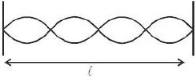
\(4^{\text {th }}\) harmonic\(4 \frac{\lambda}{2}=\ell \quad ; 2 \lambda=\ell\)
From equation \(\frac{2 \pi}{\lambda}=0.157\)
\(\lambda=40 ; \quad \ell=2 \lambda=80 \mathrm{m}\)
-
- (A) \(10\)
- (B) \(33.3\)
- (C) \(16.6\)
- (D) \(20.0\)
Show answer and solution
Correct Answer: (D)
\(\mathrm{f}=\frac{\mathrm{n}}{2 \ell} \sqrt{\frac{\mathrm{T}}{\mathrm{m}}}\)On solving, \(n=5\)
\(5\) loops are formed in \(1 \mathrm{m}\)
Separation between successive nodes \(=\frac{1}{5} \mathrm{m}=20 \mathrm{cm}\)
-
- (A) \(499\)
- (B) \(502\)
- (C) \(504\)
- (D) \(507\)
Show answer and solution
Correct Answer: (B)
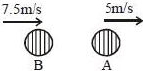
\(v =\) speed of sound in water \(=1500 m / s\)frequency received by \(A = f\)
\(=\left[\frac{ V - V _{ A }}{ V - V _{ B }}\right] f _{0}=\left[\frac{1500-5}{1500-7.5}\right] f _{0}\)
frequency received by \(B = f ^{\prime \prime}=\)
\(\left[\frac{ V + V _{ B }}{ V + V _{ A }}\right] f ^{\prime}=\left[\frac{1500+7.5}{1500+5}\right]\left[ \frac{1500-5}{1500-7.5}\right] f\)
\(f ^{\prime \prime}=\left(\frac{1500+7.5}{1500-7.5}\right)\left(\frac{1500-5}{1500+5}\right)(500)\)
\(=502\; Hz\)
-
- (A) \(18/17\)
- (B) \(19/18\)
- (C) \(20/19\)
- (D) \(21/20\)
Show answer and solution
Correct Answer: (B)
\(\mathrm{f}_{1}=\mathrm{f}_{0}\left(\frac{340}{340-34}\right) \quad ; \quad \mathrm{f}_{2}=\mathrm{f}_{0}\left(\frac{340}{340-17}\right)\)\(\frac{f_{1}}{f_{2}}=\frac{323}{306}=\frac{19}{18}\)
-
- (A) The wave is propagating along the positive \(x-\) axis with speed \(25\, ms^{-1}\).
- (B) The wave is propagating along the positive \(x-\) axis with speed \(100\, ms^{-1}\).
- (C) The wave is propagating along the negative \(x-\) axis with speed \(25\, ms^{-1}\).
- (D) The wave is propagating along the negative \(x-\) axis with speed \(100\, ms^{-1}\).
Show answer and solution
Correct Answer: (C)
\(y=10^{-3} \sin (50 t+2 x)\)Wave is travelling along negative \(X-axis\)
Wave speed \(=\frac{\omega}{\mathrm{k}}=\frac{50}{2}=25 \mathrm{m} / \mathrm{s}\)
-
- (A) \(332\)
- (B) \(338\)
- (C) \(384\)
- (D) \(379\)
Show answer and solution
Correct Answer: (C)
\(v=2 f(l_2-l_1)\)\(v=2 \times 480 \times(70-30) \times 10^{-2}\)
\(v=960 \times 40 \times 10^{-2}\)
\(\mathrm{v}=38400 \times 10^{-2} \mathrm{m} / \mathrm{s}\)
\(v=384 \mathrm{m} / \mathrm{s}\)
-
- (A) \(1 : 4\)
- (B) \(1 : 2\)
- (C) \(3 : 5\)
- (D) \(4 : 9\)
Show answer and solution
Correct Answer: (B)
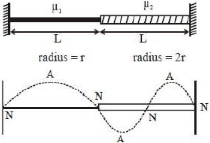
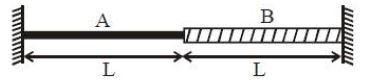
Let mass per unit length of wires are \(\mu_{1}\) and \(\mu_{2}\) respectively.\(\because\) Materials are same, so density \(\rho\) is same.
\(\mu_{1}=\frac{\rho \pi r^{2} L}{L}=\mu \text { and } \mu_{2}=\frac{\rho 4 \pi r^{2} L}{L}=4 \mu\)
Tension in both are same \(=\mathrm{T},\) let speed of wave in wires are \(V_{1}\) and \(V_{2}\)
\(V_{1}=\frac{V_{1}}{2 L}=\frac{V}{2 L} \& f_{02}=\frac{V_{2}}{2 L}=\frac{V}{4 L}\)
Frequency at which both resonate is \(L.C.M.\) of both frequencies i.e. \(\frac{\mathrm{V}}{2 \mathrm{L}}\)
Hence number of loops in wires are \(1\) and \(2\) respectively
So, ratio of number of antinodes is \(1:2\)
-
- (A) \(10\)
- (B) \(7.5\)
- (C) \(12.5\)
- (D) \(5\)
Show answer and solution
Correct Answer: (C)
\(y=0.03 \sin \left[450\left(t-\frac{9 x}{450}\right)\right]\)So, \(\mathrm{v}=\frac{450}{9}=50 \mathrm{m} / \mathrm{s}\)
Also, \(v=\sqrt{\frac{T}{\lambda}}\)
\(\Rightarrow 50=\sqrt{\frac{T}{5 \times 10^{-3}}}\)
\(\Rightarrow T=2500 \times 5 \times 10^{-3}=12.5 \mathrm{N}\)
-
- (A) \(12\)
- (B) \(11\)
- (C) \(15\)
- (D) \(4\)
Show answer and solution
Correct Answer: (D)
Speed of wave from wave equation\(v=-\frac{(\text { coeffecient of } t)}{(\text { coeffecient of } x)}\)
\(v=-\frac{1000}{(-3)}=\frac{1000}{3}\)
since speed of wave \(\propto \sqrt{T}\)
\(\mathrm{So}=\frac{1000}{\frac{3}{336}}=\sqrt{\frac{273}{\mathrm{T}}}\)
\(\Rightarrow T=277.41 \mathrm{K}\)
\(\mathrm{T}=4.41^{\circ} \mathrm{C}\)
-
- (A) \(2250\)
- (B) \(2060\)
- (C) \(2150\)
- (D) \(2300\)
Show answer and solution
Correct Answer: (A)
Doppler effect:
\(f=\left(\frac{v+u_{0}}{v-u_{s}}\right)\left(f_{0}\right)\)
\(2000=\left(\frac{340+(-20)}{340-(-20)}\right)\left(f_{0}\right)\)
\(\mathrm{f}_{\mathrm{o}}=2250 \mathrm{Hz}\) -
- (A) \(15.0\)
- (B) \(10.0\)
- (C) \(5.5\)
- (D) \(2.5\)
Show answer and solution
Correct Answer: (D)
\(f=660\,Hz,\) \(v=330\,m/s\)\(f_{1}=f\left(\frac{v-u}{v}\right) ; \quad f_{2}=f\left(\frac{v+u}{v}\right)\)
\(\mathrm{f}_{2}-\mathrm{f}_{1}=\frac{\mathrm{f}}{\mathrm{v}}[\mathrm{v}+\mathrm{u}-(\mathrm{v}-\mathrm{u})]\)
\(10=\mathrm{f}_{2}-\mathrm{f}_{1}=\frac{\mathrm{f}}{\mathrm{v}}[2 \mathrm{u}]\)
\(u=2.5 \mathrm{m} / \mathrm{s}\)

-
- (A) \(10\)
- (B) \(100\)
- (C) \(50\)
- (D) \(20\)
Show answer and solution
Correct Answer: (D)
\(A=A_{0} e^{-\gamma t}\)
\(A=\frac{A_{0}}{2}\) after \(10\) oscillations
\(\because\) After 2 seconds
\(\frac{A_{0}}{2}=A_{0} e^{-\gamma(2)} \quad ; \quad 2=e^{2 \gamma}\)
\( \ell n 2=2 \gamma \quad ; \quad \gamma=\frac{\ell n 2}{2}\)
\(\because A=A_{0} e^{-\gamma t}\)
\(\ell n \frac{\mathrm{A}_{0}}{\mathrm{A}}=\gamma \mathrm{t} ; \quad \ell \mathrm{n} 1000 \frac{\ell n 2}{2} \mathrm{t}\)
\(2\left(\frac{3 \ell n 10}{\ell n 2}\right)=t ; \quad \frac{6 \ell n 10}{\ell n 2}=t\)
\(t=19.931 \mathrm{sec}\)
\(t \approx 20 \mathrm{sec}\) -
- (A) \(10^{-3}\,K\)
- (B) \(10^{-4}\)
- (C) \(10^{-1}\,K\)
- (D) \(10^{-5}\,K\)
Show answer and solution
Correct Answer: (D)
By law of conservation of energy\(\frac{1}{2} \mathrm{kx}^{2}=\left(\mathrm{m}_{1} \mathrm{s}_{1}+\mathrm{m}_{2} \mathrm{s}_{2}\right) \Delta \mathrm{T}\)
\(\Delta T=\frac{16 \times 10^{-2}}{4384}=3.65 \times 10^{-5}\)
-
- (A) \(\frac{4\pi}{3}\)
- (B) \(\frac{3}{8}\pi\)
- (C) \(\frac{8\pi}{3}\)
- (D) \(\frac{7}{3}\pi\)
Show answer and solution
Correct Answer: (C)
\(\left|v_{4}\right|=\left|a_{4}\right|\)\(\Rightarrow \quad(w \sqrt{A^{2}-x^{2}})_{4}=\left(w^{2} x\right)_{4}\)
\(\Rightarrow \quad w \sqrt{25-16}=w^{2} \times 4\)
\(\Rightarrow \quad w=\frac{3}{4}\)
\(T=\frac{2 \pi}{w}=2 \pi \frac{4}{3}=\frac{8 \pi}{3}\)
-
- (A) \(\frac {A}{2}\)
- (B) \(\frac {A}{2\sqrt 2}\)
- (C) \(\frac {A}{\sqrt 2}\)
- (D) \(A\)
Show answer and solution
Correct Answer: (C)
\(\mathrm{PE}=\mathrm{KE}\)\(\Rightarrow \quad \frac{1}{2} m \omega^{2}\left(A^{2}-x^{2}\right)=\frac{1}{2} m \omega^{2} x^{2}\)
\(\Rightarrow \quad x=\frac{A}{\sqrt{2}}\)
-
- (A) \(m{y_0}a\omega _1^2\hat k\)
- (B) \(m\left( { - {x_0}b + {y_0}a} \right)\omega _1^2\hat k\)
- (C) \( - m\left( { - {x_0}b\omega _2^2 + {y_0}a\omega _1^2} \right)\hat k\)
- (D) Zero
Show answer and solution
Correct Answer: (A)
\(\overrightarrow{\mathrm{F}}=\mathrm{m} \overrightarrow{\mathrm{a}}=\mathrm{m}\left[-\mathrm{a} \omega_{1}^{2} \cos \omega, \mathrm{t} \hat{\mathrm{i}}-\mathrm{b} \omega_{2}^{2} \sin \omega_{2} \mathrm{t} \hat{\mathrm{j}}\right.\)\(\overrightarrow{\mathrm{f}}_{\mathrm{t}-0}=-\mathrm{ma} \omega_{1}^{2} \hat{\mathrm{i}}\)
\(\overrightarrow{\mathrm{r}}_{\mathrm{t}-0}=\left(\mathrm{x}_{0}+\mathrm{a}\right) \hat{\mathrm{i}}+\mathrm{y} \hat{\mathrm{j}}\)
\(\vec{\tau}=\overrightarrow{\mathrm{r}} \times \overrightarrow{\mathrm{F}}=\mathrm{my}_{0} \mathrm{a} \omega_{1}^{2} \hat{\mathrm{k}}\)
-
- (A) \(1/9\)
- (B) \(1\)
- (C) \(2\)
- (D) \(0.33\)
Show answer and solution
Correct Answer: (D)
\(\mathrm{K}=\frac{1}{2} \mathrm{mv}^{2} ; \mathrm{U}=\frac{1}{2} \mathrm{k} \mathrm{x}^{2}=\frac{1}{2} \mathrm{m}^{2} \mathrm{x}^{2}\)\(\begin{aligned} \therefore \quad \frac{\mathrm{k}}{\mathrm{U}}= \frac{\mathrm{v}^{2}}{\omega^{2} \mathrm{x}^{2}}=\left(\frac{\cos (\mathrm{wt})}{\sin (\mathrm{wt})}\right)^{2} \\ =\cot ^{2}\left(\frac{\pi}{90} \times 210\right) \\= \cot ^{2}\left(2 \pi+\frac{\pi}{3}\right) \\=\left(\frac{1}{\sqrt{3}}\right)^{2}=\frac{1}{3} \end{aligned}\)
-
- (A) \({K_2} = 2{K_1}\)
- (B) \({K_2} = \frac{{{K_1}}}{2}\)
- (C) \({K_2} = \frac{{{K_1}}}{4}\)
- (D) \({K_2} = {K_1}\)
Show answer and solution
Correct Answer: (A)
Maximum kinetic energy at lowest point \(B\) is given by\(\mathrm{K}=\mathrm{mg} \ell(1-\cos \theta)\)
where \(\theta=\) angular amp.
\(\mathrm{K}_{1}=\mathrm{mg} \ell(1-\cos \theta)\)
\(\mathrm{K}_{2}=\mathrm{mg}(2 \ell)(1-\cos \theta)\)
\(\mathrm{K}_{2}=2 \mathrm{K}_{1}\)
-
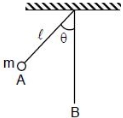
- (A) \(Mgl\,\left( {1 + \theta _0^2} \right)\)
- (B) \(Mgl\,\left( {1 - \theta _0^2} \right)\)
- (C) \(Mgl\)
- (D) \(Mgl\,\left( {1 + \frac{{\theta _0^2}}{2}} \right)\)
Show answer and solution
Correct Answer: (A)
Angular momentum conservation\(\mathrm{MV}_{0} \mathrm{L}=\mathrm{MV}_{1}(\mathrm{L}-\ell)\)
\(V_{1}=V_{0}\left(\frac{L}{L-\ell}\right)\)
\(\mathrm{w}_{\mathrm{g}}+\mathrm{w}_{\mathrm{p}}=\Delta \mathrm{KE}\)
\(-m g \ell+w_{p}=\frac{1}{2} m\left(V_{1}^{2}-V_{0}^{2}\right)\)
\(w_{p}=m g \ell+\frac{1}{2} m V_{0}^{2}\left(\left(\frac{L}{L-\ell}\right)^{2}-1\right)\)
\(=m g \ell+\frac{1}{2} m V_{0}^{2}\left(\left(1-\frac{L}{L-\ell}\right)^{-2}-1\right)\)
Now, \(\ell<<\mathrm{L}\)
By, Binomial approximation
\(=m g \ell+\frac{1}{2} m V_{0}^{2}\left(\left(1+\frac{L}{L-\ell}\right)^{-2}-1\right)\)
\(=m g \ell+\frac{1}{2} m V_{0}^{2}\left(\frac{2 \ell}{L}\right)\)
\(\mathrm{W}_{\mathrm{P}}=\mathrm{mg} \ell+\mathrm{mV}_{0}^{2} \frac{\ell}{\mathrm{L}}\)
Here, \(\mathrm{V}_{0}=\) maximum velocity \(=\omega \times \mathrm{A}=(\sqrt{\frac{\mathrm{g}}{\mathrm{L}}})\left(\theta_{0} \mathrm{L}\right)\)
\(\mathrm{So}, \mathrm{w}_{\mathrm{p}}=\mathrm{mg} \ell+\mathrm{m}\left(\theta_{0} \sqrt{\mathrm{gL}}\right)^{2} \frac{\ell}{\mathrm{L}}\)
\(=m g \ell\left(1+\theta_{0}^{2}\right)\)
-
- (A) \(0.77\)
- (B) \(0.57\)
- (C) \(0.37\)
- (D) \(0.17\)
Show answer and solution
Correct Answer: (C)
\(\mathrm{f}=\frac{1}{2 \pi} \sqrt{\frac{\mathrm{C}}{\left(\frac{\mathrm{ML}^{2}}{3}\right)}} \& 0.8 \mathrm{f}=\frac{1}{2 \pi} \sqrt{\frac{\mathrm{C}}{\left(\frac{\mathrm{ML}^{2}}{3}+\frac{\mathrm{mL}^{2}}{2}\right)}}\)
\(\Rightarrow \quad \frac{25}{16}=\frac{\frac{\mathrm{ML}^{2}}{3}+\frac{\mathrm{mL}^{2}}{2}}{\frac{\mathrm{ML}^{2}}{3}}\)
\(\Rightarrow \quad \frac{25}{16}=1+\frac{3 \mathrm{m}}{2 \mathrm{M}}\)
\(\Rightarrow \quad \frac{9}{16}=\frac{3 \mathrm{m}}{2 \mathrm{M}}\)
\(\Rightarrow \quad \frac{\mathrm{m}}{\mathrm{M}}=\frac{3}{8}=0.37\) - 342. A simple harmonic motion is represented by \(y\, = 5\,(\sin \,3\pi t\, + \,\sqrt 3 \,\cos \,3\pi t)\,cm\) The amplitude and time period of the motion are 2019 Medium
- (A) \(10\,\,cm\,,\,\frac{2}{3}\,s\)
- (B) \(10\,\,cm\,,\,\frac{3}{2}\,s\)
- (C) \(5\,\,cm\,,\,\frac{3}{2}\,s\)
- (D) \(5\,\,cm\,,\,\frac{2}{3}\,s\)
Show answer and solution
Correct Answer: (A)
\(y=5(\sin 3 \pi t+\sqrt{3} \cos 3 \pi t) \mathrm{cm}\)\(\Rightarrow \quad y=10 \sin (3 \pi t+\phi)\)
\(\Rightarrow A=10 \mathrm{cm}\)
\(\Rightarrow \quad T=\frac{2}{3} \sec\)
-
- (A) \(10^{-3} rad/s\)
- (B) \(1\,rad/s\)
- (C) \(10^{-1} rad/s\)
- (D) \(10^{-5} rad/s\)
Show answer and solution
Correct Answer: (A)
Angular frequency of pendulum\(\omega \propto \sqrt{\frac{g_{e f f}}{\ell}}\)
\(\therefore \quad \frac{\Delta \omega}{\omega}=\frac{1}{2} \frac{\Delta g_{e f f}}{g_{e f f}}\)
\(\Delta \omega=\frac{1}{2} \frac{\Delta g}{g} \times \omega\)
\([ \omega_{s}=\) angular frequency of support]
\(\frac{\Delta \omega}{\omega}=\frac{1}{2} \times \frac{\Delta g}{g}\)
\(=\frac{1}{2} \times \frac{2\left(\mathrm{A} \omega_{5}^{5}\right)}{10}\)
\(\Rightarrow \frac{\Delta \omega}{\omega}=\frac{1 \times 10^{-2}}{10}=10^{-3}\)
-
- (A) \(2T\sqrt {\frac {1}{10}}\)
- (B) \(2T\sqrt {\frac {1}{14}}\)
- (C) \(4T\sqrt {\frac {1}{15}}\)
- (D) \(4T\sqrt {\frac {1}{14}}\)
Show answer and solution
Correct Answer: (C)
For a simple pendulum \(\mathrm{T}=2 \pi \sqrt{\frac{\mathrm{L}}{\mathrm{g}_{\mathrm{err}}}}\)Situation \(1\): when pendulum is in air \(\rightarrow g_{\text {eff }}=g\)
Situation \(2\) :when pendulum is in liquid
\(\rightarrow g_{e f}=g\left(1-\frac{\rho_{\text {liquid }}}{\rho_{\text {body }}}\right)=g\left(1-\frac{1}{16}\right)=\frac{15 g}{16}\)
So, \(\frac{\mathrm{T}^{\prime}}{\mathrm{T}}=\frac{2 \pi \sqrt{\frac{\mathrm{L}}{15 \mathrm{g} / 16}}}{2 \pi \sqrt{\frac{\mathrm{L}}{\mathrm{g}}}}\)
\(\Rightarrow \mathrm{T}^{\prime}=\frac{4 \mathrm{T}}{\sqrt{15}}\)
-
- (A) \(n\)
- (B) \(\frac{1}{n^2}\)
- (C) \(n^2\)
- (D) \(\frac{1}{n}\)
Show answer and solution
Correct Answer: (D)
\(\begin{array}{l}
{k_1} = \frac{C}{{{\ell _1}}}\\
{k_2} = \frac{C}{{{\ell _2}}}\\
\frac{{{k_1}}}{{{k_2}}} = \frac{{C{\ell _2}}}{{{\ell _1}C}} = \frac{{{\ell _2}}}{{n{\ell _2}}} = \frac{1}{n}
\end{array}\) -
- (A) \(13\)
- (B) \(27\)
- (C) \(4\)
- (D) \(7\)
Show answer and solution
Correct Answer: (D)
\(A=A_{0} e^{-0.1 t}=\frac{A_{0}}{2}\)\(\ln 2=0.1 \mathrm{t}\)
\(t=10\, \mathrm{ln} 2=6.93 \approx 7 \mathrm{sec}\)
-
- (A) \(\sqrt 2 \,a\omega\)
- (B) \(a\omega \)
- (C) \(\sqrt 3 \,a\omega\)
- (D) \(2\,a\omega \)
Show answer and solution
Correct Answer: (A)
\(\mathrm{v}_{\mathrm{x}}=\frac{\mathrm{d} \mathrm{x}}{\mathrm{dt}}=-\mathrm{a} \omega \sin \omega \mathrm{t}\)\(\mathrm{v}_{\mathrm{y}}=\frac{\mathrm{dy}}{\mathrm{dt}}=\mathrm{a\omega} \cos \omega \mathrm{t}\)
\(\mathrm{v}_{\mathrm{z}}=\frac{\mathrm{d} z}{\mathrm{dt}}=\mathrm{a} \omega\)
\(\therefore \quad \mathrm{v}=\sqrt{\mathrm{v}_{\mathrm{x}}^{2}+\mathrm{v}_{\mathrm{y}}^{2}+\mathrm{v}_{\mathrm{z}}^{2}}=\mathrm{a} \omega \sqrt{2}\)
-
- (A) \(\frac{1}{{2\pi }}\sqrt {\frac{{3k}}{m}} \)
- (B) \(\frac{1}{{2\pi }}\sqrt {\frac{{2k}}{m}} \)
- (C) \(\frac{1}{{2\pi }}\sqrt {\frac{{6k}}{m}} \)
- (D) \(\frac{1}{{2\pi }}\sqrt {\frac{{k}}{m}} \)
Show answer and solution
Correct Answer: (C)
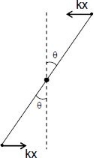
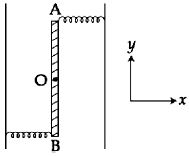
Torque on rod at displacement \(\theta\) from mean position \(\theta\) is very small. \(x=\frac{L}{2} \theta\)\(\tau=2 k x \frac{L}{2}=2 k \frac{L^{2}}{4} \theta=\frac{k L^{2}}{2} \theta\)
Now, \(\tau=1 \alpha\)
\(\frac{\mathrm{kL}^{2}}{2} \theta=\frac{\mathrm{mL}^{2}}{12} \alpha \quad ; \quad \alpha=\frac{6 \mathrm{k}}{\mathrm{m}} \theta\)
\(\tau=\frac{\omega}{2 \pi}=\frac{1}{2 \pi} \sqrt{\frac{6 k}{m}}\)
-
- (A) \(10^3\, J\)
- (B) \(10^5\, J\)
- (C) \(10^4\, J\)
- (D) \(10^6\, J\)
Show answer and solution
Correct Answer: (C)
\(\mathrm{E} =\frac{1}{2} \mathrm{M} \mathrm{V}_{m}^{2} \)\(=\frac{1}{2} \times 2 \times\left(\frac{3 \mathrm{P}}{\rho}\right) \)
\(=\frac{3 \times 4 \times 10^{4}}{8}=1.5 \times 10^{4} \mathrm{J}\)
-
- (A) \(17.4\)
- (B) \(15.7\)
- (C) \(19.7\)
- (D) \(21.6\)
Show answer and solution
Correct Answer: (A)
\(f_{\operatorname{mix}}=\frac{n_{1} f_{1}+n_{2} f_{2}}{n_{1}+n_{2}}=\frac{2 \times 3+3 \times 5}{5}=\frac{21}{5}\)\(C_{v}=\frac{f R}{5}=\frac{21}{5} \times \frac{R}{2}=17.4 \mathrm{J} / \mathrm{mol} \mathrm{K}\)
No questions on this page match these filters.