


All JEE Mains 2019 Physics questions
31 chaptersShowing 401–450 of 468 questions
-
- (A) \(27\)
- (B) \(1/27\)
- (C) \(9\)
- (D) \(1/9\)
Show answer and solution
Correct Answer: (C)
We have\({V_T} = \frac{2}{g}\frac{{{r^2}}}{\eta }\left( {{\rho _0} - {\rho _\ell }} \right)g\)
\( \Rightarrow {V_T} \propto {r^2}\)
Since mass of the sphere wll be same
\(\therefore \rho \frac{4}{3}\pi {R^3} = 27 \cdot \frac{4}{3}\pi {r^3}\rho \)
\( \Rightarrow r = \frac{R}{3}\)
\(\therefore \,\frac{{{V_1}}}{{{v_2}}} = \frac{{{R_2}}}{{{r^2}}} = 9\)
-
- (A) \(400\)
- (B) \(500\)
- (C) \(600\)
- (D) \(303\)
Show answer and solution
Correct Answer: (D)
\({P_1} = 5.05 \times {10^6}\,;\,{P_2} = 8.08 \times {10^6}\)\({P_2} - {P_1} = \rho g\left( {{d_2} - {d_1}} \right)\)
\({d_2} - {d_1} = \frac{{3.03 \times {{10}^6}}}{{{{10}^3} \times 10}} = 3.03 \times {10^2} = 303\)
-
- (A) \(0.5\)
- (B) \(0.7\)
- (C) \(0.6\)
- (D) \(0.8\)
Show answer and solution
Correct Answer: (C)
\(In\,{1^{st\,}}\,situation\)\({V_b}{\rho _b}g = {V_s}{\rho _w}g\)
\(\frac{{{V_s}}}{{{V_b}}} = \frac{{{\rho _b}}}{{{\rho _w}}} = \frac{4}{5}\) \(...\left( i \right)\)
Here \(V_b\) is volume of block
\(V_s\) is submerged volume of block
\({\rho _b}\) is density of block
\({\rho _w}\) id density of water \(\& \) Let \({\rho _0}\) is density of oil
Finally in equilibrium condition
\({V_b}{\rho _b}g = \frac{{{V_b}}}{2}{\rho _0}g + \frac{{{V_b}}}{2}{\rho _w}g\)
\(2{\rho _b} = {\rho _0} + {\rho _w}\)
\( \Rightarrow \frac{{{\rho _0}}}{{{\rho _w}}} = \frac{3}{5} = 0.6\)
-
- (A) \(6.0\)
- (B) \(4.8\)
- (C) \(9.6\)
- (D) \(2.9\)
Show answer and solution
Correct Answer: (B)
\(\frac{{dv}}{{dt}} = Av \Rightarrow \frac{{dv}}{{dt}} = A\sqrt {2gh} \)\( \Rightarrow \frac{{0.74}}{{60}} = \left( {3.14} \right){\left( {\frac{2}{{100}}} \right)^2}\sqrt {2\left( {9.8} \right)h} \)
\( \Rightarrow h = 4.92\,m\)
-
- (A) \(5.1\)
- (B) \(1.7\)
- (C) \(4\)
- (D) \(2.9\)
Show answer and solution
Correct Answer: (A)
\(\frac{{dv}}{{dt}} = \phi - a\sqrt {2gh} = 0\) \((for\,maximum\,height)\)\(h = \frac{{{\phi ^2}}}{{2g{a^2}}} = \frac{{{{10}^{ - 8}}}}{{2 \times 9.8 \times {{10}^{ - 8}}}} = 5.1\,cm\)
-
- (A) \(10^3\)
- (B) \(10^6\)
- (C) \(10^2\)
- (D) \(10^4\)
Show answer and solution
Correct Answer: (D)
Reynolds number\( = \frac{{\rho vd}}{\eta }\)Volume flow rate\( = v \times \pi {r^2}\)
\(v = \frac{{100 \times {{10}^{ - 3}}}}{{60}} \times \frac{1}{{\pi \times 25 \times {{10}^{ - 4}}}}\)
\(v = \frac{2}{{3\pi }}m/s\)
Reynolds number \( = \frac{{{{10}^3} \times 2 \times 10 \times {{10}^{ - 2}}}}{{{{10}^{ - 3}} \times 3\pi }} = 2 \times {10^4}\)
\(Order\,{10^4}\)
-
- (A) \(5\times 10^{-4}\,m^2\)
- (B) \(5\times 10^{-5}\,m^2\)
- (C) \(1\times 10^{-5}\,m^2\)
- (D) \(2\times 10^{-5}\,m^2\)
Show answer and solution
Correct Answer: (B)
\({10^{ - 4}}\, \times \,1\, = \sqrt {{{(1)}^2} + 2 \times 10 \times 0.15 \times } A\)\(A = \frac{{{{10}^{ - 4}}}}{2} = 5 \times {10^{ - 5}}\)
-
- (A) \(\frac{1}{{\sqrt {\gamma g} }}\ln \left( {1 + \sqrt {\frac{\gamma }{g}} {V_0}} \right)\)
- (B) \(\frac{1}{{\sqrt {\gamma g} }}{\tan ^{ - 1}}\left( {\sqrt {\frac{\gamma }{g}} {V_0}} \right)\)
- (C) \(\frac{1}{{\sqrt {\gamma g} }}{\sin ^{ - 1}}\left( {\sqrt {\frac{\gamma }{g}} {V_0}} \right)\)
- (D) \(\frac{1}{{\sqrt {2\gamma g} }}{\tan ^{ - 1}}\left( {\sqrt {\frac{2\gamma }{g}} {V_0}} \right)\)
Show answer and solution
Correct Answer: (B)
\(\begin{array}{l}
- \left( {g + \gamma {v^2}} \right) = \frac{{dv}}{{dt}}\\
- gdt = \frac{g}{\gamma }\left( {\frac{{dv}}{{\frac{g}{\gamma } + {v^2}}}} \right)\\
{\rm{integrating}}\,0\, \to \,t\,and\,{V_0} \to 0:
\end{array}\)\(\begin{array}{l}
- gt = - \sqrt {\frac{g}{\gamma }} {\tan ^{ - 1}}\left( {\frac{{{V_0}}}{{\sqrt {\frac{g}{\gamma }} }}} \right)\\
t = \frac{1}{{\sqrt {\gamma g} }}{\tan ^{ - 1}}\left( {\frac{{\sqrt \gamma }}{g}{V_0}} \right)
\end{array}\) -
- (A) \({v_4} - \frac{{{v_2}}}{2}\)
- (B) \({v_4} - \frac{{{v_2}}}{4}\)
- (C) \({v_4} - {v_2}\)
- (D) \({v_4} + {v_2}\)
Show answer and solution
Correct Answer: (C)
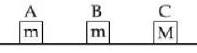
Applying linear momentum conservation\(\begin{array}{l}
{m_1}{v_1}\hat i + {m_2}{v_2}\hat i = {m_1}{v_3}\hat i + {m_2}{v_4}\hat i\\
{m_1}{v_1} + 0.5\,{m_1}{v_2} = {m_1}\left( {0.5{v_1}} \right) + 0.5\,{m_1}\,{v_4}\\
0.5\,{m_1}{v_1} = 0.5\,{m_1}\left( {{v_4} - {v_2}} \right)\\
{v_1} = {v_4} - {v_2}
\end{array}\) -
- (A) \(0.47\)
- (B) \(0.28\)
- (C) \(0.14\)
- (D) \(0.20\)
Show answer and solution
Correct Answer: (D)
\(\begin{array}{l}
\Rightarrow 0 = 50{V_1} - 20{V_2}\,and\,{V_1} + {V_2} = 0.7\\
\Rightarrow \,{V_1} = 0.2
\end{array}\)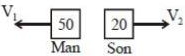
-
- (A) \(200\)
- (B) \(140\)
- (C) \(70\)
- (D) \(100\)
Show answer and solution
Correct Answer: (D)
\(T\,\,cos\,45^o = mg\)
\(T\,\,sin\,45^o = F\)
\(\Rightarrow F = mg = 100\,N.\)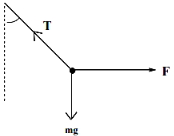
-
- (A) \(2\sqrt {\frac{k}{p}} \)
- (B) \(2\sqrt {\frac{p}{k}} \)
- (C) \(\sqrt {\frac{{2k}}{p}}\)
- (D) \(\sqrt {\frac{{2p}}{k}} \)
Show answer and solution
Correct Answer: (B)
\(\begin{array}{l}
\frac{{dp}}{{dt}} = F = kt\\
\int_p^{3p} {dP} = \int_0^T {kt\,dt} \\
2p = \frac{{K{T^2}}}{2}\,\,;\,\,\,T = 2\sqrt {\frac{p}{k}}
\end{array}\) -
- (A) \(\frac{E}{32}\)
- (B) \(\frac{E}{16}\)
- (C) \(\frac{E}{64}\)
- (D) \(\frac{E}{4}\)
Show answer and solution
Correct Answer: (B)
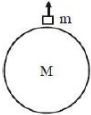
Minmun energy required \((E)=-(Potential\,energy\,of\,object\,at\,surface\,of\,earth)\)\(Now\,{M_{earth}} = 64{M_{moon}}\)
\(\rho \cdot \frac{4}{3}\pi R_e^3 = 64 \cdot \frac{4}{3}\pi R_m^3\) \( \Rightarrow {R_e} = 4{R_m}\)
\(Now\frac{{{E_{moon}}}}{{{E_{earth}}}} = \frac{{{M_{moon}}}}{{{M_{earth}}}} \cdot \frac{{{R_{earth}}}}{{{R_{moon}}}} = \frac{1}{{64}} \times \frac{4}{1}\)
\( \Rightarrow {E_{moon}} = \frac{E}{{16}}\)
-
- (A) \(2\,mv^2\)
- (B) \(mv^2\)
- (C) \(\frac{1}{2}\,m{v^2}\)
- (D) \(\frac{3}{2}\,m{v^2}\)
Show answer and solution
Correct Answer: (B)
\(Initially,\,kinetic\,energy = \frac{1}{2}m{v^2} = \frac{1}{2}m\frac{{G{M_e}}}{r}\)By conservation of \(M.E\).,
\(\frac{{ - G{M_e}m}}{r} + KE = 0\)
\(KE = \frac{{G{M_e}m}}{r} = m{v^2}\)
-
- (A) \(\sqrt {2gR} \)
- (B) \(\sqrt {gR} \)
- (C) \(\sqrt {\frac{{gR}}{2}} \)
- (D) \(\sqrt {gR} (\sqrt 2 - 1)\)
Show answer and solution
Correct Answer: (D)
\(\Delta V = {V_f} - {V_i}\)\( = \sqrt {\frac{{2gMe}}{{{R_e}}}} - \sqrt {\frac{{gMe}}{{{R_e}}}} \)
\( = \left( {\sqrt 2 - 1} \right)\sqrt {g{R_e}} \)
-
- (A) \(\frac{{GM}}{{3{a^2}}}\)
- (B) \(\frac{{2GM}}{{9{a^2}}}\)
- (C) \(\frac{{GM}}{{9{a^2}}}\)
- (D) \(\frac{{2GM}}{{3{a^2}}}\)
Show answer and solution
Correct Answer: (A)
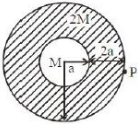
We use Gauss's Law for gravitation\(g.4\pi {r^2} = \left( {Mass\,enclosed} \right)4\pi G\)
\(g = \frac{{3M4\pi G}}{{4\pi {{\left( {3a} \right)}^2}}} = \frac{{GM}}{{3{a^2}}}\)
-
- (A) \(9\)
- (B) \(11\)
- (C) \(13\)
- (D) \(17\)
Show answer and solution
Correct Answer: (B)
\(\frac{{m{V^2}}}{r} = \frac{{GMm}}{{{r^2}}}\)\(V = \sqrt {\frac{{GM}}{r}} \)
\(n = \frac{{VT}}{{2\pi r}} = \sqrt {\frac{{GM}}{r}} \frac{T}{{2\pi r}}\)
\( = \left( {\sqrt {\frac{{GM}}{{{r^3}}}} } \right) \times \frac{T}{{2\pi }} = \sqrt {\frac{{6.67 \times {{10}^{ - 11}} \times 8 \times {{10}^{22}}}}{{{{\left( {202 \times {{10}^4}} \right)}^3}}}} \times \frac{T}{{2\pi }}\)
\( = \frac{{24 \times 3600}}{{2 \times 3.14}}\sqrt {\frac{{6.67 \times 8 \times {{10}^{11}}}}{{{{\left( {202} \right)}^3} \times {{10}^{12}}}}} \)
\( = \frac{{24 \times 3600}}{{2 \times 3.14 \times 1242.8}} = \frac{{24 \times 3600}}{{78.51}} \simeq 11\)
-
- (A) \(Gm\left[ {A\left( {\frac{1}{{a + L}} - \frac{1}{a}} \right) - BL} \right]\)
- (B) \(Gm\left[ {A\left( {\frac{1}{a} - \frac{1}{{a + L}}} \right) - BL} \right]\)
- (C) \(Gm\left[ {A\left( {\frac{1}{{a + L}} - \frac{1}{a}} \right) + BL} \right]\)
- (D) \(Gm\left[ {A\left( {\frac{1}{a} - \frac{1}{{a + L}}} \right) + BL} \right]\)
Show answer and solution
Correct Answer: (D)
\(Mass\,of\,element = dm = \left( {A + B{x^2}} \right)dx\)\(Field\,due\,to\,element\,at\,x = 0\)
\(dE = \frac{{G\left( {dm} \right)}}{{{X^2}}} = \left( {\frac{{GA}}{{{X^2}}} + GB} \right)dx\)
\(Total\,field\)
\(E = GA\int_a^{a + L} {\frac{1}{{{X^2}}}dx + GB\int_a^{a + L} {dx} } \)
\( = G\left[ {A\left( {\frac{1}{a} - \frac{1}{{a + L}}} \right) + BL} \right]\)
\(SO,\,force = ME\)
\( = Gm\left[ {A\left( {\frac{1}{a} - \frac{1}{{a + L}}} \right)+ BL} \right]\)

-
- (A) \(T/R^2\) is a constant
- (B) \(TR\) is constant
- (C) \(T^2/R^3\) is a constant
- (D) \(T/R\) is a constant
Show answer and solution
Correct Answer: (D)
For circular motion of particle:\(\frac{{m{V^2}}}{r} = mE\)
\( = m\left( {\frac{{GM}}{{{r^2}}}} \right)\)
where \(M = \int\limits_0^r {\left( {4\pi {x^2}dx} \right)} \left( {\frac{k}{{{x^2}}}} \right)\)
\( = 4\pi kr\)
\( \Rightarrow \frac{{m{V^2}}}{r} = m\left( {\frac{{G\left( {4\pi k} \right)}}{r}} \right)\)
\( \Rightarrow\,V =constant\)
\(T = \frac{{2\pi R}}{V}\)
\( \Rightarrow \) \(\frac{T}{R}=constant\)
-
- (A) \(1.35\sqrt {\frac{{GM}}{a}} \)
- (B) \(1.16\sqrt {\frac{{GM}}{a}} \)
- (C) \(1.41\sqrt {\frac{{GM}}{a}} \)
- (D) \(1.21\sqrt {\frac{{GM}}{a}} \)
Show answer and solution
Correct Answer: (B)
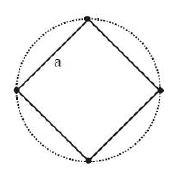
Net force on particle towards center of circle is\({F_c} = \frac{{G{M^2}}}{{2{a^2}}} + \frac{{G{M^2}}}{{{a^2}}}\sqrt 2 \)
\( = \frac{{G{M^2}}}{{{a^2}}}\left( {\frac{1}{2} + \sqrt 2 } \right)\)
This force will act as centripetal force.
Diatance of particle from center of circle is \(\frac{a}{{\sqrt 2 }}.\)
\(r = \frac{a}{{\sqrt 2 }},{F_c} = \frac{{m{v^2}}}{r}\)
\(\frac{{m{v^2}}}{{\frac{a}{{\sqrt 2 }}}} = \frac{{G{M^2}}}{{{a^2}}}\left( {\frac{1}{2} + \sqrt 2 } \right)\)
\({v^2} = \frac{{GM}}{a}\left( {\frac{1}{{2\sqrt 2 }} + 1} \right)\)
\({v^2} = \frac{{GM}}{a}\left( {1.35} \right)\,\,;\,\,v = 1.16\sqrt {\frac{{GM}}{a}} \)
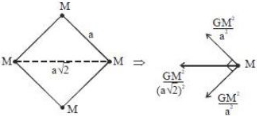
-
- (A) \(\frac{L}{m}\)
- (B) \(\frac{4L}{m}\)
- (C) \(\frac{L}{2m}\)
- (D) \(\frac{2L}{m}\)
Show answer and solution
Correct Answer: (C)
Based on Kepler’s law\(\frac{{dA}}{{dt}} = \frac{L}{{2m}}\)
-
- (A) \(1.6\times 10^3\,km\)
- (B) \(3.2\times 10^3\,km\)
- (C) \(6.4\times 10^3\,km\)
- (D) \(1.28\times 10^4\,km\)
Show answer and solution
Correct Answer: (B)
\({E_1} =-\frac{{GMm}}{{R + h}} - \left( { - \frac{{GMm}}{R}} \right)\)\({E_2} = \frac{1}{2}m{\left( {\sqrt {\frac{{GM}}{{R + h}}} } \right)^2} = \frac{{GMm}}{{2\left( {R + h} \right)}}\)
\({E_1} = {E_2}\,\,;\,\,h = \frac{R}{2}\)
-
- (A) \(\frac{{\sqrt 3 }}{2}\,s\)
- (B) \(\frac{2}{{\sqrt 3 }}\,s\)
- (C) \(\frac{3}{2}\,s\)
- (D) \(2\sqrt 3 \,s\)
Show answer and solution
Correct Answer: (D)
\(g = \frac{{GM}}{{{R^2}}}\)\(\frac{{{g_p}}}{{{g_e}}} = \frac{{{M_p}}}{{{M_e}}}{\left( {\frac{{{R_e}}}{{{R_p}}}} \right)^2} = 3{\left( {\frac{1}{3}} \right)^2} = \frac{1}{3}\)
\(Also,\,T \propto \frac{1}{{\sqrt g }}\)
\( \Rightarrow \frac{{{T_p}}}{{{T_e}}} = \sqrt {\frac{{{g_e}}}{{{g_p}}}} = \sqrt 3 \)
\( \Rightarrow {T_p} = 2\sqrt {3s} \)
-
- (A) \(\frac{R}{3}\)
- (B) \(\frac{R}{4}\)
- (C) \(\frac{R}{9}\)
- (D) \(\frac{R}{2}\)
Show answer and solution
Correct Answer: (D)
Since mass of the object remains same\(\therefore \) Weight of object will be proporational to \('g'\) \((acceleration\, due\, to\,gravity)\) Given ;
\(\frac{{{W_{earth}}}}{{{W_{planet}}}} = \frac{9}{4} = \frac{{{g_{earth}}}}{{{g_{planet}}}}\)
Also,
\({g_{surface}} = \frac{{GM}}{{{R^2}}}\) \((M is mass planet,
G is unversal gravitational constant, R is radius of planet)\)
\(\therefore \frac{9}{4} = \frac{{G{M_{earth}}R_{planet}^2}}{{G{M_{planet}}R_{earth}^2}} = \frac{{{M_{earth}}}}{{{M_{planet}}}} \times \frac{{R_{planet}^2}}{{R_{earth}^2}}\)
\( = 9\frac{{R_{planet}^2}}{{R_{earth}^2}}\)
\(\therefore {R_{planet}} = \frac{{{R_{earth}}}}{2} = \frac{R}{2}\)
-
- (A) \(6.4\times10^6\, m\)
- (B) \(9.0\times10^6\, m\)
- (C) \(2.6\times10^6\, m\)
- (D) \(1.6\times10^6\, m\)
Show answer and solution
Correct Answer: (C)
\(\frac{{GM}}{{{{\left( {R + h} \right)}^2}}} = \frac{{GM}}{{2{R^2}}}\)\(R + h = \sqrt 2 R\)
\(h = \left( {\sqrt 2 - 1} \right)R\)
\( \simeq 2.6 \times {10^6}m\)
-
- (A) \(\frac {1}{2}\)
- (B) \(1\)
- (C) \(2\)
- (D) \(\sqrt {\frac {1}{2}}\)
Show answer and solution
Correct Answer: (B)
\(K{E_A} = \frac{1}{2}m\left( {\frac{{GM}}{R}} \right)\)\(K{E_B} = \frac{1}{2}\left( {2m} \right)\left( {\frac{{GM}}{{2R}}} \right)\)
\( \Rightarrow \frac{{K{E_A}}}{{K{E_B}}} = 1\)
-
- (A) \(2.4\times10^4\, m/s\)
- (B) \(1.4\times10^5\, m/s\)
- (C) \(3.8\times10^4\, m/s\)
- (D) \(2.8\times10^5\, m/s\)
Show answer and solution
Correct Answer: (D)
\(\frac{1}{2}m{v^2} + \frac{{2\left( { - GMm} \right)}}{r} = 0\)\({V^2} = \frac{{4GM}}{r} = \frac{{4 \times 6.67 \times {{10}^{ - 11}} \times 3 \times {{10}^{31}}}}{{2 \times {{10}^{11}}}}\)
\(V = 20\sqrt 2 \times {10^4}\,m/s\)
\( = 2.828 \times {10^5}\,m/s\)
-
- (A) \( - \frac{{m{g^2}{t^2}}}{8}\)
- (B) \( \frac{{m{g^2}{t^2}}}{8}\)
- (C) \(0\)
- (D) \( \frac{{3m{g^2}{t^2}}}{8}\)
Show answer and solution
Correct Answer: (D)
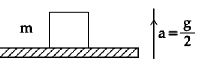
\(\begin{array}{l}
W = F\cos \theta \\
\,\,\,\,\,\, = m\left( {g + \frac{g}{2}} \right) \times \left[ {\frac{1}{2} \times \frac{g}{2} \times {t^2}} \right]
\end{array}\) -
- (A) \(\frac{{2F}}{{\sqrt {mk} }}\)
- (B) \(\frac{F}{{\pi \sqrt {mk} }}\)
- (C) \(\frac{{\pi F}}{{\sqrt {mk} }}\)
- (D) \(\frac{F}{{\sqrt {mk} }}\)
Show answer and solution
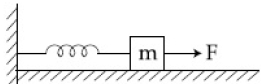
Correct Answer: (D)
When \(\,{v_{\max }}\) \(\Rightarrow \) acceleration \(= 0\)\( \Rightarrow \,x = \frac{F}{K}\)
Apply work energy theorem
\(\,{W_{sp}}\) + \(w_f\) = \(\Delta K.E\)
\(\begin{array}{l}
- \frac{1}{2}K{x^2} + F.x = \Delta K.E\,\,\,;\,\, - \frac{1}{2}K\frac{{{F^2}}}{{{K^2}}} + \frac{{{F^2}}}{K}\\
\,\,\,\,\,\,\,\,\,\,\,\,\,\,\,\,\,\,\,\,\,\,\,\,\,\,\,\,\,\,\, = \frac{1}{2}mu_{\max }^2\\
\frac{{{F^2}}}{{2K}} = \frac{1}{2}mu_{\max }^{2\,}\,\,\,;\,\,\,\frac{F}{{\sqrt {mK} }} = {V_{\max }}
\end{array}\)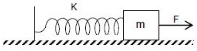
-
- (A) \(40\)
- (B) \(4\)
- (C) \(80\)
- (D) \(2\)
Show answer and solution
Correct Answer: (D)
\(\begin{array}{l}
v = \sqrt {2 \times 10} \times 100\\
\,\,\,\, = 20\sqrt 5 \\
COLM \to \,{v_p} = \frac{{1 \times 20\sqrt 5 }}{4}\\
COTME \to \\
\frac{1}{2} \times 4 \times {\left( {5\sqrt 5 } \right)^2} + \frac{1}{2}1.25 \times {10^6}{\left( {\frac{{30}}{k}} \right)^2}
\end{array}\)\(\begin{array}{l}
= - 4 \times 10 \times \left( {n - \frac{{30}}{k}} \right) + \frac{1}{2}k{n^2}\\
\Rightarrow \,\,250 + \frac{{900}}{{2 \times 1.25 \times {{10}^6}}}\\
\,\, = - 40x + \frac{{1200}}{k} + \frac{1}{2}k{x^2}\\
\Rightarrow \,x = 2\,cm
\end{array}\)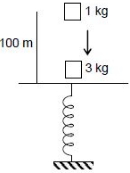
-
- (A) \(1.5\)
- (B) \(1.2\)
- (C) \(1.8\)
- (D) \(1\)
Show answer and solution
Correct Answer: (B)
By conseravtion of linear momentum;\(\begin{array}{l}
2{v_0} = 2\left( {\frac{{{v_0}}}{4}} \right) + mv \Rightarrow 2{v_0} = \frac{{{v_0}}}{2} + mv\,2\\
\Rightarrow \frac{{3{v_0}}}{2} = mv\,\,\,\,\,\,\,\,\,\,\,\,\,\,\,\,\,\,\,\,\,...\left( 1 \right)
\end{array}\)Since collision is elastic \( \to \)
\( \Rightarrow v - \frac{{{v_0}}}{4} = {v_0} \Rightarrow m = \frac{6}{5} = 1.2\,kg\)
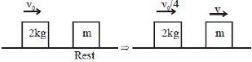
-
- (A) \(0.7\)
- (B) \(0.3\)
- (C) \(0.1\)
- (D) \(0.4\)
Show answer and solution
Correct Answer: (A)
\(\begin{array}{l}
2.5 \times {10^{ - 2}} \times 0.2 = \frac{1}{2} \times 20 \times {10^{ - 3}}\left\{ { - {V^2} + {1^2}} \right\}\\
5 \times {10^{ - 3}} = 10 \times {10^{ - 3}}\left( {1 - {V^2}} \right)\\
1 - {V^2} = \frac{1}{2}\,\,;\,\,{V^2} = \frac{1}{2}\,\,;\,\,V = \frac{1}{{\sqrt 2 }}\, = 0.7
\end{array}\) -
- (A) \(850\)
- (B) \(950\)
- (C) \(875\)
- (D) \(900\)
Show answer and solution
Correct Answer: (D)
\(\begin{array}{l}
x = 3{t^2} + 5\\
\Rightarrow v = 6t\\
\Rightarrow \,\Delta W = \Delta k\\
\,\,\,\,\,\,\,\,\, = \frac{1}{2}\left( 2 \right){\left( {30} \right)^2} - \frac{1}{2}2{\left( 0 \right)^2}\\
\,\,\,\,\,\,\,\,\, = 900\,J
\end{array}\) -
- (A) \(2.5\)
- (B) \(4\)
- (C) \(5\)
- (D) \(6.5\)
Show answer and solution
Correct Answer: (D)
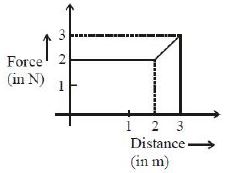
According to work energy theorem.Work done by force on the particle \(= Change\, in\, KE\)
\(work\, done = Area \,under F-x \,graph =\) \(\int {F.dx\, = } \)
\(\begin{array}{l}
2 \times 2 + \frac{{\left( {2 + 3} \right) \times 1}}{2}\\
W = K{E_{final}} - K{E_{initial}} = 6.5\\
K{E_{initial}} = 0\\
K{E_{final}} = 6.5\,J
\end{array}\)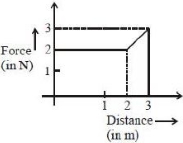
-
- (A) \(v/\left( {2\sqrt 2 } \right)\)
- (B) \({2\sqrt 2 }\,v\)
- (C) \(\sqrt {2\,} v\)
- (D) \(v/\sqrt 2 \)
Show answer and solution
Correct Answer: (B)
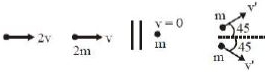
Linear momentum conservation\(m\) \(2v + 2m v = m \)\( \times \,0 + m\frac{{v'}}{{\sqrt 2 }} \times 2\)
\(v' = 2\sqrt 2 \,v.\)
-
- (A) \(9\, J\)
- (B) \(12\, K\)
- (C) \(10\, J\)
- (D) \(15\, J\)
Show answer and solution
Correct Answer: (D)
\(\begin{array}{l}
K.E.\, - 3 = \overrightarrow F .\overrightarrow d \\
K.E. = 3 + \left( {3\hat i - 12\hat j} \right) \times \left( {4\hat i} \right)\\
K.E. = 3 + 12 = 15\,J
\end{array}\) -
- (A) such that it escapes to infinity
- (B) in an elliptical orbit
- (C) in the same circular orbit of radius \(R\)
- (D) in a circular orbit of a different radius
Show answer and solution
Correct Answer: (B)
\(\begin{array}{l}
2m{v_x} = mv\\
\Rightarrow \,{v_x} = \frac{v}{2}\\
\,\,\,\,\,\,{v_y} = \frac{v}{2}\\
{v_{net}} = \sqrt {{v_{{x^2}}} + {v_{{y^2}}}} = \frac{v}{{\sqrt 2 }}
\end{array}\)So, path will be elliptical.

-
- (A) \(\frac{m}{2}\left( {\frac{{{\theta _0} + {\theta _1}}}{{{\theta _0} - {\theta _1}}}} \right)\)
- (B) \(m\left( {\frac{{{\theta _0} - {\theta _1}}}{{{\theta _0} + {\theta _1}}}} \right)\)
- (C) \(m\left( {\frac{{{\theta _0} + {\theta _1}}}{{{\theta _0} - {\theta _1}}}} \right)\)
- (D) \(\frac{m}{2}\left( {\frac{{{\theta _0} - {\theta _1}}}{{{\theta _0} + {\theta _1}}}} \right)\)
Show answer and solution
Correct Answer: (C)
Just before collision speed of \(m\)\(v = \sqrt {2gL\left( {1 - \cos {\theta _ \circ }} \right)} \)
Just after collision speed os \( M \)
\({v_1} = \sqrt {2gL\left( {1 - \cos {\theta _1}} \right)} \)
\(\begin{array}{l}
And\,{v_1} = \left( {\frac{{M - m}}{{M + m}}} \right)v\,\,;\,\,\frac{{{v_1}}}{v} = \frac{{M - m}}{{M + m}}\\
\,\,\,\,\,\,\,\,\,\,\,\,\,\,\,\sqrt {\frac{{1 - \cos {\theta _1}}}{{1 - \cos {\theta _0}}}} = \frac{{M - m}}{{M + m}}\\
\frac{{\sin \left( {{\theta _1}/2} \right)}}{{\sin \left( {{\theta _0}/2} \right)}} = \frac{{M - m}}{{M + m}}\,\,\,\,\,\left[ {1 - \cos 2\theta = 2{{\sin }^2}\theta } \right]\\
\frac{{{\theta _1}}}{{{\theta _0}}} = \frac{{M - m}}{{M + m}}
\end{array}\)\(\begin{array}{l}
M{\theta _1} + m{\theta _1} = M{\theta _0} - m{\theta _0}\\
M = m\left[ {\frac{{{\theta _1} + {\theta _0}}}{{{\theta _0} - {\theta _1}}}} \right]
\end{array}\) -
- (A) \(nMgL\)
- (B) \(\frac {MgL}{2n^2}\)
- (C) \(\frac {2MgL}{n^2}\)
- (D) \(\frac {MgL}{n^2}\)
Show answer and solution
Correct Answer: (B)
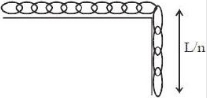
Mass of the hanging part \(=\) \(\frac{M}{n}\)\({h_{COM}} = \frac{L}{{2n}}\)
work done \(W = mg{h_{COM}} = \left( {\frac{M}{n}} \right)g\left( {\frac{L}{{2n}}} \right) = \frac{{MgL}}{{2{n^2}}}\)
-
- (A) \(\frac{{2{v^2}}}{{7g}}\)
- (B) \(\frac{{{v^2}}}{g}\)
- (C) \(\frac{{2{v^2}}}{{5g}}\)
- (D) \(\frac{{{v^2}}}{2g}\)
Show answer and solution
Correct Answer: (C)
Let mass attains height \('h'\) on wedge and at that time. both attain velocity \(v_f\)Conservation of momentum:
\(mv = (m + 4m)\)\(V_f\) \(...(A)\)
\(COE:\)
\(\frac{1}{2}m{v^2} = \frac{1}{2}\left( {m + 4m} \right)V_f^2 + mgh\,\,\,\,\,\,\,\,\,\,\,\,\,\,...\left( B \right)\)
From \((A)\) and \((B)\)
\(h = \frac{{2{V^2}}}{{5g}}\)
-
- (A) \(2\)
- (B) \(3.5\)
- (C) \(1.5\)
- (D) \(4\)
Show answer and solution
Correct Answer: (D)
\(\begin{array}{l}
\left( i \right)\,\,\,\,m{v_0} = - m{v_1} + m{v_2}\\
\left( {ii} \right)\,\,{v_0} = {v_1} + {v_2}\\
\,\,\,\,\,\,\,\,\,\frac{{2m{v_0}}}{{m + M}} = {v_2}\\
K{E_f} = \frac{1}{2}mv_1^2 = \frac{1}{2}m{\left( {\frac{{M - m}}{{M + m}}} \right)^2}v_0^2 = \frac{{36}}{{100}} \times \frac{1}{2}mv_0^2\\
\Rightarrow \,M = 4\,m.
\end{array}\)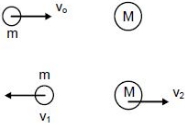
-
- (A) \(5\)
- (B) \(2\)
- (C) \(4\)
- (D) \(3\)
Show answer and solution
Correct Answer: (C)
Apply \(LMC\) (Linear Momentum Conservation)\(mv = (2m + M) v'\)
\(v' = \frac{{mv}}{{2m + M}}\)
Initial energy
\(\frac{1}{2}\) \(m{v^2}\)
Final energy
\(\frac{1}{2}\,\left( {2m + M} \right){\left( {\frac{{mv}}{{2m + M}}} \right)^2}\)
\(Initial\, kinetic\, energy - Final\, Kinetic\, energy =\) \(\frac{5}{6}\) of initial kinetic energy.
After solving, we get, \(\frac{M}{m} = 4.\)
-
- (A) \(3.2\, m/s\) and \(12.6\, m/s\)
- (B) \(6.5\, m/s\) and \(6.3\, m/s\)
- (C) \(6.5\, m/s\) and \(3.2\, m/s\)
- (D) \(3.2\, m/s\) and \(6.3\, m/s\)
Show answer and solution
Correct Answer: (B)
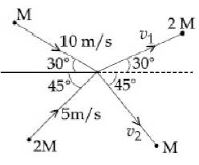
\(\begin{array}{l}
2MV,\cos {30^ \circ } + M{v_2}\cos {45^ \circ }\\
= 10\,M\,\cos {30^ \circ } + 10\cos {45^ \circ }\\
\Rightarrow {v_1}\sqrt 3 + \frac{{{v_2}}}{{\sqrt 2 }} = 5\sqrt 3 + 5\sqrt 2 \,\,\,\,\,\,\,\,\,\,\,...\left( i \right)\\
2MV,\,\sin {30^ \circ } - M{V_2}\sin {45^ \circ }\\
= - 10\,M\sin {30^ \circ } + 10\,M\,\sin {45^ \circ }
\end{array}\)\(\begin{array}{l}
V - \frac{{{V_2}}}{{\sqrt 2 }} = - 5 + 5\sqrt 2 \,\,\,\,\,\,\,\,\,\,\,\,\,\,\,\,\,\,\,\,\,\,\,\,...\left( {ii} \right)\\
{V_1} = \frac{{5\left( {\sqrt 3 - 1} \right) + 10\sqrt 2 }}{{\sqrt 3 + 1}} = \frac{{17.5}}{{2.7}} = 6.5\,m/s\\
{V_2} = 6.3\,m/s
\end{array}\) -
- (A) \(10.3\)
- (B) \(2.8\)
- (C) \(2.5\)
- (D) \(5.1\)
Show answer and solution
Correct Answer: (B)
\(\begin{array}{l}
at\,t = 1\\
\,{u_x} = 5,\,{u_y} = 5\sqrt 3 \\
{v_y} = 5\sqrt 3 - 10\,\,;\,\,\,{v_x} = 5\\
\tan \,\theta \, = - 2\left( {2 - \sqrt 3 } \right) \Rightarrow \theta = - {30^ \circ }\\
R = \frac{{{v^2}}}{{a \bot }} = \frac{{{{10}^2}}}{{\left( {10\,\cos \,{{30}^ \circ }} \right)}}
\end{array}\)\(\begin{array}{l}
\,\, = \frac{{10}}{{\sqrt 3 }} \times 2\, = \frac{{20}}{{\sqrt 3 }}m\\
\frac{{{5^2} + {{\left( {10 - 5\sqrt 3 } \right)}^2}}}{{10\,\cos \theta }} = \frac{{200 - 100\sqrt 3 }}{{10 \times 0.965}} = 2.8m
\end{array}\)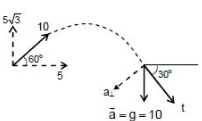
-
- (A) \(15\,m\)
- (B) \(20\sqrt 2 \,m\)
- (C) \(5\,m\)
- (D) \(10\sqrt 2 \,m\)
Show answer and solution
Correct Answer: (B)
\(\begin{array}{l}
\overrightarrow S = \left( {5\hat i + 4\hat j} \right)2 + \frac{1}{2}\left( {4\hat j + 4\hat j} \right)4\\
\,\,\,\, = \,10\hat i + 8\hat j + 8\hat i + 8\hat j\\
\overrightarrow {{r_2}} - \overrightarrow {{r_1}} = 18\hat i + 16\hat j\\
\overrightarrow {{r_2}} = 20\hat i + 20\hat j\\
\left| {\overrightarrow {{r_f}} } \right| = 20\sqrt 2
\end{array}\) -
- (A) \(18\)
- (B) \(14\)
- (C) \(26\)
- (D) \(20\)
Show answer and solution
Correct Answer: (D)
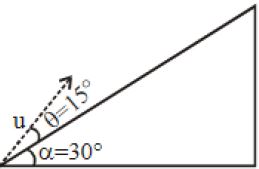
\(\begin{array}{l}
T = \frac{{2\,u\,\sin \theta }}{{g\,\cos \alpha }}\\
R\, = u\,\cos \theta \,T - \frac{1}{2}\,g\,\sin \,\alpha \,{T^2}\\
\,\,\,\,\, = \,\frac{{u\,\cos \,\theta \,2u\,\sin \,\theta }}{{g\,\cos \,\alpha }} - \frac{{g\,\sin \,\alpha }}{2}\frac{{4{u^2}{{\sin }^2}\theta }}{{{g^2}{{\cos }^2}\alpha }}\\
\,\,\,\,\, = \frac{{{u^2}{{\sin }^2}\theta }}{{g\,\cos \,\alpha }} - \frac{{{u^2}\sin \,\alpha }}{{g\,{{\cos }^2}\alpha }}\{ 1 - \cos 2\theta \}
\end{array}\)\(\begin{array}{l}
= \frac{{4 \times \frac{1}{2}}}{{10 \times \frac{{\sqrt 3 }}{2}}} - \frac{{{u^2}\sin \,\alpha }}{{g\,{{\cos }^2}\,\alpha }}\left\{ {1 - \frac{{\sqrt 3 }}{2}} \right\}\\
= \frac{4}{{10\sqrt 3 }} - \frac{8}{{30}}\left\{ {1 - \frac{{\sqrt 3 }}{2}} \right\}\\
= \frac{4}{{5\sqrt 3 }} - \frac{8}{{30}} = \frac{{8\sqrt 3 - 8}}{{30}} = \frac{{8\left( {\sqrt 3 - 1} \right)}}{{30}} = 20\,cm
\end{array}\) -
- (A) \(2R/g\)
- (B) \(R/4g\)
- (C) \(R/g\)
- (D) \(R/2g\)
Show answer and solution
Correct Answer: (A)
\(\begin{array}{l} Range\,will\,be\,same\,for\,time\,{t_1}\,and\,{t_2},\,so\,\\ angles\,of\,projrection\,will\,be\,'\theta '\,\& '{90^ \circ } - \theta '\\ {t_1} = \frac{{2u\,\sin \,\theta }}{g}{t_2} = \frac{{2u\,\sin \,\left( {{{90}^ \circ } - \theta } \right)}}{g}\,and\\ \,\,\,\,\,\,\,R = \,\frac{{{u^2}\sin \,2\theta }}{g}\\ {t_1}{t_2} = \frac{{4{u^2}\sin \theta \cos \theta }}{{{g^2}}} = \frac{2}{g}\left[ {\frac{{2{u^2}\sin \theta \cos \theta }}{g}} \right]\\ \,\,\,\,\,\,\,\,\,\,\,\,\,\,\,\,\,\,\,\,\,\,\,\,\,\,\,\,\,\,\,\,\,\,\,\,\,\,\,\,\,\,\, = \frac{{2R}}{g} \end{array}\)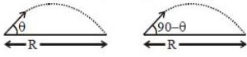
-
- (A) \(\frac{{\sqrt 3 g}}{{2r}}\)
- (B) \(\left( {g\sqrt 3 } \right)/r\)
- (C) \(2g / r\)
- (D) \(2g/\left( {r\sqrt 3 } \right)\)
Show answer and solution
Correct Answer: (D)
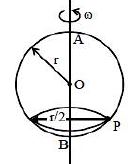
\(\begin{array}{l}
N\,\sin \,\theta = m\frac{r}{2}{\omega ^2}\,\,\,\,\,\,\,\,\,\,\,\,\,\,\,\,\,\,\,\,\,\,\,\,\,...\left( i \right)\\
N\,\cos \,\,\theta = mg\,\,\,\,\,\,\,\,\,\,\,\,\,\,\,\,\,\,\,\,\,\,\,\,\,\,\,\,\,\,...\left( {ii} \right)\\
\tan \,\,\theta \, - \frac{{r{\omega ^2}}}{{2g}}\\
\frac{r}{{2\frac{{\sqrt 3 \,r}}{2}}} = \frac{{r{\omega ^2}}}{{2g}}\,\,\,;\,\,{\omega ^2} = \frac{{2g}}{{\sqrt 3 \,r}}
\end{array}\)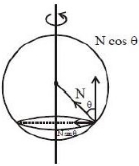
-
- (A) \(2.2\)
- (B) \(4.2\)
- (C) \(2.6\)
- (D) \(3.2\)
Show answer and solution
Correct Answer: (C)
\(\begin{array}{l}
if\,we\,take\,the\,position\,of\,ship\,'A'\,as\,\\
origin\,then\,positions\,velocity\,of\,both\\
ships\,can\,be\,given\,as:\\
{{\vec v}_A} = \left( {30\hat i + 50\hat j} \right)km/hr\\
{{\vec v}_B} = - 10\hat i\,km/hr\,\,;\,{{\vec r}_A} = 0\hat i + \hat j\\
{{\vec r}_B} = \left( {80\hat i + 150\hat j} \right)\,km\\
Time\,after\,which\,{\rm{distance}}\,between\\
them\,will\,be\,\min imum
\end{array}\)\(\begin{array}{l}
t = \frac{{{{\vec r}_{BA}} \cdot {{\vec v}_{BA}}}}{{\left| {{{\vec v}_{BA}}} \right|}}\,;\\
Where\,{{\vec r}_{BA}} = \left( {80\hat i + 150\hat j} \right)\,km\\
{{\vec v}_{BA}} = - 10\left( {30\hat i + 50\hat j} \right)\,\left( { - 40\hat i - 50\hat j} \right)km/hr\\
\therefore \,t = - \frac{{\left( {80\hat i + 150\hat j} \right)\,.\left( { - 40\hat i - 50\hat h} \right)}}{{{{\left| { - 40i - 50\hat h} \right|}^2}}}\\
\,\,\,\,\,\, = \,\frac{{3200 + 7500}}{{4100}}hr = \frac{{10700}}{{4100}}hr = 2.6\,hrs
\end{array}\)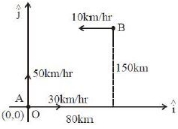
-
- (A) \(40\)
- (B) \(100\)
- (C) \(25\)
- (D) \(50\)
Show answer and solution
Correct Answer: (D)
\(\begin{array}{l}
\vec r = \left( {15{t^2}} \right)\hat i + \left( {4 - 20{t^2}} \right)\hat j\\
\vec v = \frac{{d\vec r}}{{dt}} = \left( {30t} \right)\hat i - \left( {40t} \right)\hat j\\
\vec a = \frac{{d\vec v}}{{dt}} = \left( {30} \right)\hat i - \left( {40} \right)\hat j\\
\left| {\vec a} \right| = 50
\end{array}\)
No questions on this page match these filters.