


Questions
11 questionsShowing 1–11 of 11 questions
-
- (A) \(\sqrt {\frac{{qE}}{{2md}}} \)
- (B) \(\sqrt {\frac{{2qE}}{{md}}} \)
- (C) \(\sqrt {\frac{{qE}}{{md}}} \)
- (D) \(2\sqrt {\frac{{qE}}{{md}}} \)
Show answer and solution
Correct Answer: (B)
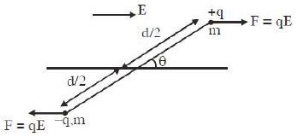
Moment of inertia\((I)=m\left(\frac{d}{2}\right)^{2} \times 2=\frac{m d^{2}}{2}\)
Now by \(\tau=I \alpha\)
\((q E)(d \sin \theta)=\frac{m d^{2}}{2} \cdot \alpha\)
\(\alpha=\left(\frac{2 \mathrm{qE}}{\mathrm{md}}\right) \sin \theta\) for small \(\theta\)
\({\Rightarrow \alpha=\left(\frac{2 \mathrm{qE}}{\mathrm{md}}\right) \theta}\)
\(\Rightarrow \) Angular frequency \(\omega = \sqrt {\frac{{2qE}}{{md}}} \)
-
- (A) \(a\,\log \,\left( {1 - \frac{Q}{{2\pi aA}}} \right)\)
- (B) \(\frac{a}{2}\,\log \,\left( {\frac{1}{{1 - \frac{Q}{{2\pi aA}}}}} \right)\)
- (C) \(a\,\log \,\left( {\frac{1}{{1 - \frac{Q}{{2\pi aA}}}}} \right)\)
- (D) \(\frac{a}{2}\,\log \left( {1 - \frac{1}{{2\pi aA}}} \right)\,\)
Show answer and solution
Correct Answer: (B)
\(Q = \int \rho 4\pi {r^2}dr = \int_0^R {\left( {\frac{A}{{{r^2}}}{e^{ - \frac{{2r}}{a}}}} \right)} \left( {4\pi {r^2}} \right)dr\)\( = 4\pi A\frac{a}{2}\left( {1 - {e^{\frac{{ - 2R}}{a}}}} \right)\)
\( \Rightarrow R = \frac{{ - a}}{2}\log \left( {1 - \frac{Q}{{2\pi Aa}}} \right)\)
-
- (A) \(3F\)
- (B) \(\frac{F}{3}\)
- (C) \(9F\)
- (D) \(27F\)
Show answer and solution
Correct Answer: (D)
\(\therefore F \propto \frac{1}{{{r^3}}}\)
Required force \(= 27\, F\). -
- (A) \(\sqrt 3 q\ell \,\frac{{\hat j - \hat i}}{{\sqrt 2 }}\)
- (B) \((q\ell )\,\frac{{\hat i + \hat j}}{{\sqrt 2 }}\)
- (C) \(2q\ell \,\hat j\)
- (D) \( - \sqrt 3 q\ell \,\hat j\)
Show answer and solution
Correct Answer: (D)
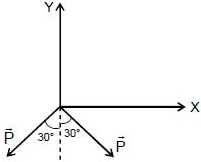
\(|\overrightarrow {\text{P}} | = {\text{qL}}\)\({\overrightarrow {\text{P}} _{{\text{net}}}} = 2{\text{P}}\cos {30^\circ }( - \widehat {\text{j}})\)
\( = {\text{P}}\sqrt 3 ( - \widehat {\text{j}})\)
\( = \sqrt 3 {\text{qL}}( - \widehat {\text{j}})\)
-
- (A) \(\frac{R}{{\sqrt 5 }}\)
- (B) \(\frac{R}{{\sqrt 2 }}\)
- (C) \(R\)
- (D) \(R\sqrt 2 \)
Show answer and solution
Correct Answer: (B)
Electric field \(E=\frac{k Q x}{\left(x^{2}+R^{2}\right)^{3 / 2}}\)For maxima \(\frac{d E}{d x}=0\)
After solving we get, \(\left(x \pm \frac{\mathrm{R}}{\sqrt{2}}\right)\)
-
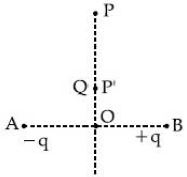
- (A) \(E \propto \frac{1}{D}\)
- (B) \(E \propto \frac{1}{D^3}\)
- (C) \(E \propto \frac{1}{D^2}\)
- (D) \(E \propto \frac{1}{D^4}\)
Show answer and solution
Correct Answer: (D)
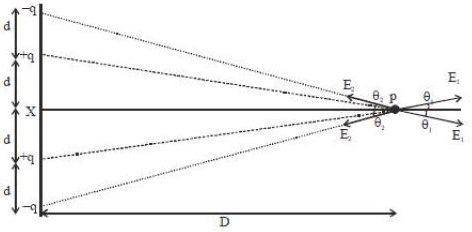
Electric field at \(\mathrm{p}=2 \mathrm{E}_{1} \cos \theta_{1}-2 \mathrm{E}_{2} \cos \theta_{2}\)\(=\frac{2 \mathrm{Kq}}{\left(\mathrm{d}^{2}+\mathrm{D}^{2}\right)} \times \frac{\mathrm{D}}{\left(\mathrm{d}^{2}+\mathrm{D}^{2}\right)^{1 / 2}}-\frac{2 \mathrm{Kq}}{\left[(2 \mathrm{d})^{2}+\mathrm{D}^{2}\right]} \times \frac{\mathrm{D}}{\left[(2 \mathrm{d})^{2}+\mathrm{D}^{2}\right]^{1 / 2}}\)
\(=2 \mathrm{KqD}\left[\left(\mathrm{d}^{2}+\mathrm{D}^{2}\right)^{-3 / 2}-\left(4 \mathrm{d}^{2}+\mathrm{D}^{2}\right)^{-3 / 2}\right]\)
\(=\frac{2 \mathrm{KqD}}{\mathrm{D}^{3}}\left[\left(1+\frac{\mathrm{d}^{2}}{\mathrm{D}^{2}}\right)^{-3 / 2}-\left(1+\frac{4 \mathrm{d}^{2}}{\mathrm{D}^{2}}\right)^{-3 / 2}\right]\)
Applying binomial approximation \(\because \mathrm{d}<<\mathrm{D}\)
\(=\frac{2 \mathrm{KqD}}{\mathrm{D}^{3}}\left[1-\frac{3}{2} \frac{\mathrm{d}^{2}}{\mathrm{D}^{2}}-\left(1-\frac{3 \times 4 \mathrm{d}^{2}}{2 \mathrm{D}^{2}}\right)\right]\)
\(=\frac{2 \mathrm{KqD}}{\mathrm{D}^{3}}\left[\frac{12}{2} \frac{\mathrm{d}^{2}}{\mathrm{D}^{2}}-\frac{3}{2} \frac{\mathrm{d}^{2}}{\mathrm{D}^{2}}\right]\)
\(=\frac{9 \mathrm{kqd}^{2}}{\mathrm{D}^{4}}\)
-
- (A) \(a = \frac{{3R}}{{{2^{1/4}}}}\)
- (B) \(a = {2^{ - 1/4}}R\)
- (C) \(a = {8^{ - 1/4}}R\)
- (D) \(a = R/\sqrt 3 \)
Show answer and solution
Correct Answer: (C)
\(E 4 \pi a^{2}=\frac{\int_{0}^{\theta} k r 4 \pi r^{2} d r}{e_{0}}\)\(E=\frac{k 4 \pi a^{4}}{4 \times 4 \pi \varepsilon_{0}}\)
\(2 \mathrm{Q}=\int_{0}^{\mathrm{R}} \mathrm{kr} 4 \pi \mathrm{r}^{2} \mathrm{dr}\)
\(\mathrm{k}=\frac{2 \mathrm{Q}}{\pi \mathrm{R}^{4}}\)
\(\mathrm{QE}=\frac{1}{4 \pi \varepsilon_{0}} \frac{\mathrm{QQ}}{(2 \mathrm{a})^{2}}\)
\(\mathrm{R}=\mathrm{a} 8^{1 / 4}\)
-
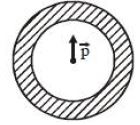
- (A) Surface charge density on the inner surface of the shell is zero everywhere
- (B) Electric field outside the shell is the same as that of a point charge at the centre of the shell
- (C) Surface charge density on the inner surface is uniform and equal to \(\frac{{\left( {Q/2} \right)}}{{4\pi {a^2}}}\)
- (D) Surface charge density on the outer surface depends on \(\left| {\vec P} \right|\)
Show answer and solution
Correct Answer: (B)
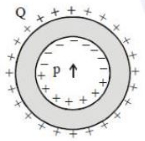
Total charge of dipole \(=0,\) so charge induced on outside surface \(=0\).But due to non uniform electric field of dipole, the charge induced on inner surface is non zero and non uniform.
So, for any observer outside the shell, the resultant electric field is due to Q uniformly distributed on outer surface only and it is equal to.
\(\boxed{E = \frac{{KQ}}{{{r^2}}}}\)
-
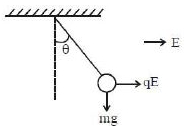
- (A) \({\tan ^{ - 1}}\left( {2.0} \right)\)
- (B) \({\tan ^{ - 1}}\left( {0.2} \right)\)
- (C) \({\tan ^{ - 1}}\left( {5.0} \right)\)
- (D) \({\tan ^{ - 1}}\left( {0.5} \right)\)
Show answer and solution
Correct Answer: (D)
\(\tan \theta=\frac{\mathrm{qE}}{\mathrm{mg}}=\frac{5 \times 10^{-6} \times 2000}{2 \times 10^{-3} \times 10}\)\(\tan \theta=\frac{1}{2} \Rightarrow \theta=\tan ^{-1}(0.5)\)
-
- (A) \(-\frac Q2\)
- (B) \(+\frac Q2\)
- (C) \(+\frac Q4\)
- (D) \(-\frac Q4\)
Show answer and solution
Correct Answer: (D)
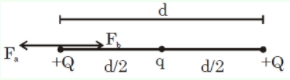
For equilibrium,\(\vec{F}_{a}+\vec{F}_{B}=0\)
\(\vec{F}_{a}=-\overrightarrow{F_{B}}\)
\(\frac{k Q Q}{d^{2}}=-\frac{k Q q}{(d / 2)^{2}}\)
\(\Rightarrow q=-\frac{Q}{4}\)
-
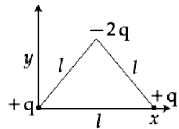
- (A) \((63\hat i - 27\hat j) \times {10^2}\)
- (B) \((-63\hat i + 27\hat j) \times {10^2}\)
- (C) \((81\hat i - 81\hat j) \times {10^2}\)
- (D) \((-81\hat i + 81\hat j) \times {10^2}\)
Show answer and solution
Correct Answer: (A)
\(\overrightarrow {\text{E}} = \frac{{{\text{k}}{{\text{q}}_1}}}{{{\text{r}}_1^3}}{\overrightarrow {\text{r}} _1} + \frac{{{\text{k}}{q_2}}}{{{\text{r}}_2^3}}{\overrightarrow {\text{r}} _2}\)\( = {\text{k}} \times {10^{ - 6}}\left[ {\frac{{\sqrt {10} }}{{10\sqrt {10} }}( - \widehat {\text{i}} + 3\widehat {\text{j}}) + \frac{{( - 25)}}{{125}}( - 4\widehat {\text{i}} + 3\widehat {\text{j}})} \right]\)
\( = \left( {9 \times {{10}^3}} \right)\left[ {\frac{1}{{10}}( - \widehat {\text{i}} + 3\widehat {\text{j}}) - \frac{1}{5}( - 4\widehat {\text{i}} + 3\widehat {\text{j}})} \right]\)
\( = \left( {9 \times {{10}^3}} \right)\left[ {\left( { - \frac{1}{{10}} + \frac{4}{5}} \right)\widehat {\text{i}} + \left( {\frac{3}{{10}} - \frac{3}{5}} \right)\widehat {\text{i}}} \right]\)
\( = 9000\left( {\frac{7}{{10}}\widehat {\text{i}} - \frac{3}{{10}}\widehat {\text{j}}} \right)\)
\( = (63\widehat {\text{i}} - 27\widehat {\text{j}})(100)\)
No questions on this page match these filters.