


enEnglishguગુજરાતી
JEE Mains · Physics · STD 12 - Atoms
- JEE Mains 2019
- Hard
- MCQ
A particle of mass \(m\) moves in a circular orbit in a central potential field \(U\left( r \right) = \frac{1}{2}k{r^2}\). If Bohr’s quantization conditions are applied, radii of possible orbits and energy levels vary with quantum number \(n\) as
Pick an option to check your answer.
Answer & Solution
Correct Answer
(A) \({r_n} \propto \sqrt n ,{E_n} \propto n\)
Step-by-step Solution
Detailed explanation
\(\mathrm{U}=\frac{1}{2} \mathrm{kr}^{2}\)
Force, \(F=-\frac{d U}{d r}=-k r\)
For circular motion \(\frac{\mathrm{mv}^{2}}{\mathrm{r}}=\mathrm{kr}\) .... \((i)\)
And \({ mvr }=\frac{n h}{2 \pi}\) .... \((ii)\)
\({ \Rightarrow {r^2} = \frac{{{\text{nh}}}}{{2\pi \sqrt {{\text{km}}} }}}\)
\({ \Rightarrow {\text{r}} \propto \sqrt {\text{n}} }\)
Total energy, \(E=k+U\)
\( = \frac{1}{2}m{v^2} + \frac{1}{2}k{r^2}\)
\( = \frac{1}{2}k{r^2} + \frac{1}{2}k{r^2}\) [From equation \((i)\)]
\(E = k{r^2}\)
\( \Rightarrow \,\,E\, \propto \,\,n\)
More questions from Physics
- A uniform rod \(A B\) of mass \(2 \mathrm{~kg}\) and Length \(30 \mathrm{~cm}\) at rest on a smooth horizontal surface. An impulse of force \(0.2\ \mathrm{Ns}\) is applied to end \(B.\) The time taken by the rod to turn through at right angles will be \(\frac{\pi}{\mathrm{x}}\ \mathrm{s}\), where X = _______.JEE Mains 2024 Hard
- If force \(\vec{F}=3 \hat{i}+4 \hat{j}-2 \hat{k}\) acts on a particle having position vector \(2 \hat{i}+\hat{j}+2 \hat{k}\) then, the torque about the origin will beJEE Mains 2022 Easy
- For a specific wavelength \(670 \; nm\) of light coming from a galaxy moving with velocity \(v\), the observed wavelength is \(670.7 \; nm\). The value of \(v\) is ............JEE Mains 2022 Medium
- In photoelectric effect an em-wave is incident on a metal surface and electrons are ejected from the surface. If the work function of the metal is 2.14 eV and stopping potential is 2 V , what is the wavelength of the em-wave ?
(Given hc \(=1242 \mathrm{eVnm}\) where h is the Planck's constant and c is the speed of light in vaccum.)JEE Mains 2025 Easy - The total length of a sonometer wire between fixed ends is \(110\, cm\). Two bridges are placed to divide the length of wire in ratio \(6 : 3 : 2\). The tension in the wire is \(400\, N\) and the mass per unit length is \(0.01\, kg/m\) . What is the minimum common frequency with Which three parts can vibrate ........... \(Hz\) ?JEE Mains 2014 Medium
- Different combination of \(3\) resistors of equal resistance \(R\) are shown in the figures.
The increasing order for power dissipation is: JEE Mains 2023 Medium
More PYQs from JEE Mains
- A conducting circular loop is placed in \(X - Y\) plane in presence of magnetic field \(\overrightarrow{ B }=\left(3 t ^{3} \hat{ j }+3 t ^{2} \hat{ k }\right)\) in SI unit. If the radius of the loop is \(1 m\), the induced emf in the loop, at time, \(t =2\,s\) is \(n \pi V\). The value of \(n\) is.JEE Mains 2022 Medium
- The distance of the Sun from earth is \(1.5 \times 10^{11} \,m\) and its angular diameter is \((2000) \,s\) when observed from the earth. The diameter of the Sun will be ...........JEE Mains 2022 Medium
- In an experiment, a small steel ball falls through a Iiquid at a constant speed of \(10\, cm/s\). If the steel ball is pulled upward with a force equal to twice its effective weight, how fast will it move upward ? ......... \(cm/s\)JEE Mains 2013 Hard
- Experimentally it is found that \(12.8\,eV\) energy is required to separate a hydrogen atom into a proton and an electron. So the orbital radius of the electron in a hydrogen atom is \(\frac{9}{ x } \times 10^{-10}\,m\). The value of the \(x\) is \(\left(1\,eV =1.6 \times 10^{-19}\,J , \frac{1}{4 \pi \epsilon_0}=9 \times 10^9\,Nm ^2 / C ^2\right.\) and electronic charge \(=1.6 \times 10^{-19}\,J\,C\) )JEE Mains 2023 Medium
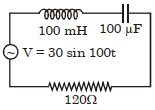
- Find the peak current and resonant frequency of the following circuit (as shown in figure).
 JEE Mains 2021 Hard