


JEE Mains · Physics · STD 11 - 1. units,dimensions and measurement
In \(SI\, units\), the dimensions of \(\sqrt {\frac{{{ \varepsilon _0}}}{{{\mu _0}}}} \) is
- A \(A{T^{ - 3}}M{L^{3/2}}\)
- B \({A^{ - 1}}TM{L^3}\)
- C \({A^2}{T^3}{M^{ - 1}}{L^{ - 2}}\)
- D \(A{T^2}{M^{ - 1}}{L^{ - 1}}\)
Answer & Solution
Correct Answer
(C) \({A^2}{T^3}{M^{ - 1}}{L^{ - 2}}\)
Step-by-step Solution
Detailed explanation
\begin{array}{l} Dimension\,of\,\sqrt {\frac{{{\varepsilon _0}}}{{{\mu _0}}}} \\ \left[ {{\varepsilon _0}} \right] = \left[ {{M^{ - 1}}{L^{ - 3}}{T^4}{A^2}} \right]\\ \left[ {{\mu _0}} \right] = \left[ {ML{T^{ - 2}}{A^{ - 2}}} \right]\\ Dimension\,of\,\,\sqrt…
See the Complete Solution
Get step-by-step explanations for this and 2.5 Lakh+ more JEE, NEET & CET questions.
- Unlock all solutions
- Practice the full chapter
- Track accuracy across PYQs
4.8 rated on Google Play · 14,000+ reviews
More questions from Physics
- Choose the correct relationship between Poisson ratio \((\sigma)\). bulk modulus \(( K )\) and modulus of rigidity \((\eta)\) of a given solid object:JEE Mains 2023 Medium
- A particular hydrogen like ion emits radiation of frequency \(2.92 \times 10^{15}\, {Hz}\) when it makes transition from \({n}=3\) to \({n}=1 .\) The frequency in \({Hz}\) of radiation emitted in transition from \({n}=2\) to \({n}=1\) will be : (in \(\,\times 10^{15}\))JEE Mains 2021 Medium
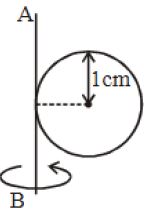
- \(5\,g\) and radius \(1\,cm\) is fixed to a thin stick \(AB\) of negligible mass as shown in the figure. The system is initially at rest. The constant torque, that will make the system rotate about \(AB\) at \(25\) rotations per second in \(5\,s\) is close to
 JEE Mains 2019 Medium
 - Two point charges \(q_1\,(\sqrt {10}\,\,\mu C)\) and \(q_2\,(-25\,\,\mu C)\) are placed on the \(x-\) axis at \(x = 1\,m\) and \(x = 4\,m\) respectively. The electric field (in \(V/m\) ) at a point \(y = 3\,m\) on \(y-\) axis is, [ take \({\mkern 1mu} {\mkern 1mu} \frac{1}{{4\pi {\varepsilon _0}}} = 9 \times {10^9}{\mkern 1mu} {\mkern 1mu} N{m^2}{C^{ - 2}}{\rm{ }}\) ]JEE Mains 2019 Hard
- A hydrogen atom in its ground state absorbs \(10.2\ eV\) of energy. The orbital angular momentum is increased by (Given Planck constant \(h = 6.6 \times {10^{ - 34}}J - sec\))JEE Mains 2022 Medium
- The electric fields of two plane electromagnetic plane waves in vacuum are given by \(\overrightarrow{\mathrm{E}}_{1}=\mathrm{E}_{0} \hat{\mathrm{j}} \cos (\omega \mathrm{t}-\mathrm{kx})\) and \(\overrightarrow{\mathrm{E}}_{2}=\mathrm{E}_{0} \hat{\mathrm{k}} \cos (\omega \mathrm{t}-\mathrm{ky})\) At \(t=0,\) a particle of charge \(q\) is at origin with a velocity \(\overrightarrow{\mathrm{v}}=0.8 \mathrm{c} \hat{\mathrm{j}}\) (\(c\) is the speed of light in vacuum). The instantaneous force experienced by the particle isJEE Mains 2020 Hard
More PYQs from JEE Mains
- The sum of the series \(1 + 2 \times 3 + 3 \times 5 + 4 \times 7 + .......\) upto \(11^{th}\) term isJEE Mains 2019 Hard
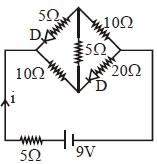
- The current \(i\) in the network is.....\(A\)
 JEE Mains 2020 Medium
 - A vessel contains \(14\,g\) of nitrogen gas at a temperature of \(27^{\circ}\,C\). The amount of heat to be transferred to the gap to double the r.m.s. speed of its molecules will be \(......J\) \(\left(\right.\) Take \(R =8.32\,J\,mol ^{-1} k ^{-1}\) )JEE Mains 2022 Medium
- Two fair dice are thrown. The numbers on them are taken as \(\lambda\) and \(\mu\), and a system of linear equations \(x+y+z=5\) ; \(x+2 y+3 z=\mu\) ; \(x+3 y+\lambda z=1\) is constructed. If \(\mathrm{p}\) is the probability that the system has a unique solution and \(\mathrm{q}\) is the probability that the system has no solution, then :JEE Mains 2021 Hard
- Given below are two statements: Statement \((I)\) : When currents vary with time, Newton's third law is valid only if momentum carried by the electromagnetic field is taken into account. Statement \((II)\) : Ampere's circuital law does not depend on Biot-Savart's law. In the light of the above statements, choose the correct answer from the options given below:JEE Mains 2024 Hard
- A water spray gun is attached to a hose of cross sectional area \(30\) cm\(^2\). The gun comprises of \(10\) perforations each of cross sectional area \(15\) mm\(^2\). If the water flows in the hose with the speed of \(50\) cm/s, calculate the speed at which the water flows out from each perforation. (Neglect any edge effects)JEE Mains 2026 Medium