


JEE Mains · Chemistry · STD 12 - 4. d and f- block elements
Consider the following reactions.
\( PbCl_{2}+K_{2}CrO_{4}\rightarrow A+2KCl \)
(Hot solution)
\( A+NaOH\rightleftharpoons B+Na_{2}CrO_{4} \)
\( PbSO_{4}+4CH_{3}COONH_{4}\rightarrow(NH_{4})_{2}SO_{4}+X \)
In the above reactions, A, B and X are respectively.
- A \( Na_{2}[Pb(OH)_{2}], PbCrO_{4} \) and \( (NH_{4})_{2}[Pb(CH_{3}COO)_{4}] \)
- B \( PbCrO_{4}, Na_{2}[Pb(OH)_{4}] \) and \( [Pb(NH_{3})_{4}]SO_{4} \)
- C \( Na_{2}[Pb(OH)_{2}], PbCrO_{4} \) and \( [Pb(NH_{3})_{4}]SO_{4} \)
- D \( PbCrO_{4}, Na_{2}[Pb(OH)_{4}] \) and \( (NH_{4})_{2}[Pb(CH_{3}COO)_{4}] \)
Answer & Solution
Correct Answer
(D) \( PbCrO_{4}, Na_{2}[Pb(OH)_{4}] \) and \( (NH_{4})_{2}[Pb(CH_{3}COO)_{4}] \)
Step-by-step Solution
Detailed explanation
The reactions are as follows: \( PbCl_{2}+K_{2}CrO_{4}\rightarrow PbCrO_{4}+2KCl \) (Hot solution) \( PbCrO_{4}+4NaOH \) (excess) \( (A) \rightarrow Na_{2}[Pb(OH)_{4}]+Na_{2}CrO_{4} \) \( PbSO_{4}+4CH_{3}COONH_{4} \rightarrow(NH_{4})_{2}[Pb(CH_{3}COO)_{4}]+(NH_{4})_{2}SO_{4} \)
See the Complete Solution
Get step-by-step explanations for this and 2.5 Lakh+ more JEE, NEET & CET questions.
- Unlock all solutions
- Practice the full chapter
- Track accuracy across PYQs
4.8 rated on Google Play · 14,000+ reviews
More questions from Chemistry
- Given below are two statements : Statement \(I :\) In 'Lassaigne's Test, when both nitrogen and sulphur are present in an organic compound, sodium thiocyanate is formed. Statement \(II :\) If both nitrogen and sulphur are present in an organic compound, then the excess of sodium used in sodium fusion will decompose the sodium thiocyanate formed to give \(NaCN\) and \(Na _{2} S\). In the light of the above statements, choose the most appropriate answer from the options given below...JEE Mains 2022 Medium
- For a reaction, \(A(g) \to A(l)\); \(\Delta H = - 3RT\). The correct statement for the reaction isJEE Mains 2017 Hard
- The incorrect decreasing order of atomic radius is _______.JEE Mains 2025 Easy
- Match List \(I\) with List \(II\).
Choose the correct answer from the options given below :-List \(I\) Isomeric pairs List \(II\) Type of isomers \(A\) Propanamine and \(N-\)Methylethanamine \(I\) Metamers \(B\) Hexan\(-2-\)one and Hexan\(-3-\)one \(II\) Positional isomers \(C\) Ethanamide and Hydroxyethanimine \(III\) Functional isomers \(D\) \(o-\)nitrophenol and \(p-\)nitrophenol \(IV\) Tautomers JEE Mains 2023 Hard - The standard Gibbs energy for the given cell reaction in \(kJ\,mol^{-1}\) at \(298\,K\) is \(Zn(s)\, + \,C{u^{2 + }}(aq)\, \to \,Z{n^{2 + }}(aq) + Cu\,(s)\,,\,{E^o} = 2\,V\) at \(298\,K\) [Faraday’s constant \(F = 96500\,C\,mol^{-1}\) ]JEE Mains 2019 Hard
- The interhalogen compound formed from the reaction of bromine with excess of fluorine is a.JEE Mains 2022 Easy
More PYQs from JEE Mains
- If \(\int \frac{d x}{\left(x^{2}+x+1\right)^{2}}=a \tan ^{-1}\left(\frac{2 x+1}{\sqrt{3}}\right)+b\left(\frac{2 x+1}{x^{2}+x+1}\right)+C\) \(x>0\) where \(C\) is the constant of integration, then the value of \(9(\sqrt{3} \mathrm{a}+\mathrm{b})\) is equal to ... .JEE Mains 2021 Medium
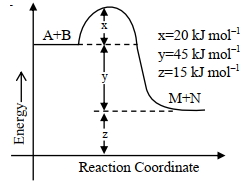
- According to the following figure, the magnitude of the enthalpy change of the reaction \(\mathrm{A}+\mathrm{B} \rightarrow \mathrm{M}+\mathrm{N} \text { in } \mathrm{kJ} \mathrm{mol}^{-1}\) is equal to ...... . (Integer answer)
 JEE Mains 2021 Medium
 - The de Broglie wavelength associated with an electron accelerated through a potential difference V is \(\lambda_e\) and the de Broglie wavelength associated with a proton accelerated through the same potential difference is \(\lambda_p\). If their corresponding masses are \(m_e\) and \(m_p\), respectively, then the ratio of their de Broglie wavelengths \(\left(\dfrac{\lambda_e}{\lambda_p}\right)\) is ______.JEE Mains 2026 Medium
- A refrigerator consumes an average \(35\, {W}\) power to operate between temperature \(-10^{\circ} {C}\) to \(25^{\circ} {C}\). If there is no loss of energy then how much average heat per second does it transfer? (in \({J} / {s}\))JEE Mains 2021 Medium
- The half life of a radioactive substance is \(5\) years. After \(x\) years a given sample of the radioactive substance gest reduced to \(6.25 \%\) of its initial value of \(x\) is ...............JEE Mains 2022 Medium
- The value of \(\lim _{n \rightarrow \infty} \sum_{k=1}^n \frac{n^3}{\left(n^2+k^2\right)\left(n^2+3 k^2\right)}\) is :JEE Mains 2024 Hard