


Questions
9 questionsShowing 1–9 of 9 questions
-
- (A) 2
- (B) 4
- (C) 5
- (D) 7
Show answer and solution
Correct Answer: (B)
The general formula of an alkane is \(C_n H_{2n+2}\).
The balanced chemical equation for the complete combustion of an alkane is:
\(C_n H_{2n+2} + \left(\dfrac{3n+1}{2}\right) O_2 \rightarrow n CO_2 + (n+1) H_2O\)
Given that \(8\) moles of oxygen are required for complete combustion:
\(\dfrac{3n+1}{2} = 8\)
\(3n + 1 = 16\)
\(n = 5\)
The molecular formula of the alkane \((Y)\) is \(C_5H_{12}\).
Since \((Y)\) yields only one monochlorinated product \((Z)\) upon reaction with \(Cl_2/h\nu\), all the hydrogen atoms in the alkane must be equivalent.
Among the isomers of \(C_5H_{12}\) (n-pentane, isopentane, and neopentane), only 2,2-dimethylpropane (neopentane) has all equivalent hydrogen atoms.
The structure of neopentane is \(C(CH_3)_4\).
In this structure, the central carbon is quaternary, and the four surrounding methyl carbons are primary carbon atoms.
Therefore, the total number of primary carbon atoms in \((Y)\) is \(4\).
Answer: \(4\) -
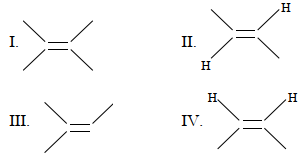
- (A) III > I > II > IV
- (B) III > II > I > IV
- (C) I > III > II > IV
- (D) I > III > IV > II
Show answer and solution
Correct Answer: (C)
Stability order :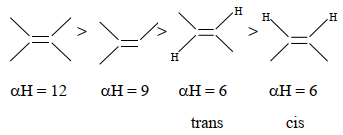
Trans is more stable than cis -
- (A) B and C only
- (B) B and D only
- (C) A and B only
- (D) A and C only
Show answer and solution
Correct Answer: (B)
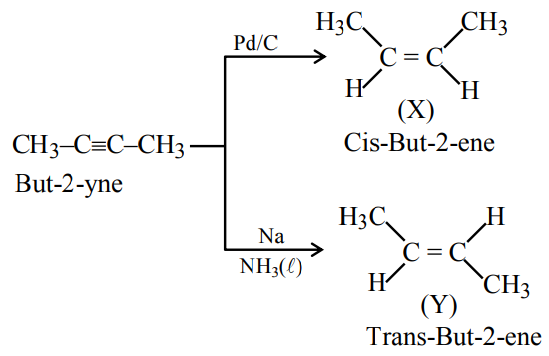
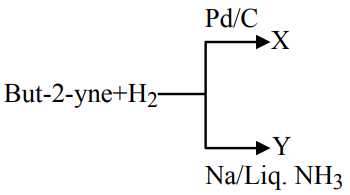
Dipole moment \(x \neq 0\)
-
- (A) \(90\)
- (B) \(118\)
- (C) \(160\)
- (D) \(125\)
Show answer and solution
Correct Answer: (B)
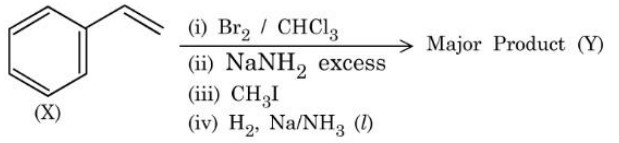
Addition of \(Br_2\) to styrene (X) yields 1,2-dibromoethylbenzene.
\(C_6H_5-CH=CH_2 \xrightarrow{Br_2/CHCl_3} C_6H_5-CH(Br)-CH_2(Br)\)
Reaction with excess \(NaNH_2\) causes double dehydrohalogenation followed by deprotonation of the terminal alkyne, forming sodium phenylacetylide.
\(C_6H_5-CH(Br)-CH_2(Br) \xrightarrow{NaNH_2 \text{ (excess)}} C_6H_5-C \equiv C^- Na^+\)
Nucleophilic substitution with \(CH_3I\) yields 1-phenylpropyne.
\(C_6H_5-C \equiv C^- Na^+ \xrightarrow{CH_3I} C_6H_5-C \equiv C-CH_3\)
Reduction with \(Na/NH_3(l)\) reduces the internal alkyne to a trans-alkene without affecting the benzene ring.
\(C_6H_5-C \equiv C-CH_3 \xrightarrow{Na/NH_3(l)} C_6H_5-CH=CH-CH_3\)
The major product (Y) is trans-1-phenylpropene, which has the molecular formula \(C_9H_{10}\).
Molar mass of \(C_9H_{10} = (9 \times 12) + (10 \times 1) = 108 + 10 = 118 \text{ g mol}^{-1}\).
Answer: \(118\) -
- (A) A and D only
- (B) B and C only
- (C) A and C only
- (D) B and D only
Show answer and solution
Correct Answer: (B)
In the given Friedel-Crafts alkylation reaction, \(1\)-chloropropane reacts with anhydrous \(\text{AlCl}_3\) to initially form a primary carbocation, the \(n\)-propyl carbocation (\(\text{CH}_3-\text{CH}_2-\text{CH}_2^+\)).
This primary carbocation is less stable and undergoes a \(1,2\)-hydride shift to form a more stable secondary carbocation, the iso-propyl carbocation (\(\text{CH}_3-\text{CH}^+-\text{CH}_3\)). Therefore, statement B is correct.
The iso-propyl carbocation then acts as an electrophile and attacks the benzene ring, yielding iso-propylbenzene (cumene) as the major product. Thus, statement A is incorrect.
Once an alkyl group is introduced to the benzene ring, it acts as an electron-donating group (via hyperconjugation and inductive effect), which activates the ring. This makes the newly formed alkylbenzene more reactive towards electrophilic aromatic substitution than the original benzene molecule, leading to polyalkylation. Hence, multiple substitution is a common and inevitable drawback. Therefore, statement C is correct.
Introducing an electron-donating substituent on benzene generally activates the ring and facilitates Friedel-Crafts alkylation (except for strong Lewis bases like \(-\text{NH}_2\) which complex with \(\text{AlCl}_3\)). Thus, statement D is incorrect.
Therefore, only statements B and C are correct.
Answer: B and C only -
- (A) Statement I is correct but Statement II is incorrect.
- (B) Both Statement I and Statement II are correct.
- (C) Statement I is incorrect but Statement II is correct.
- (D) Both Statement I and Statement II are incorrect.
Show answer and solution
Correct Answer: (C)
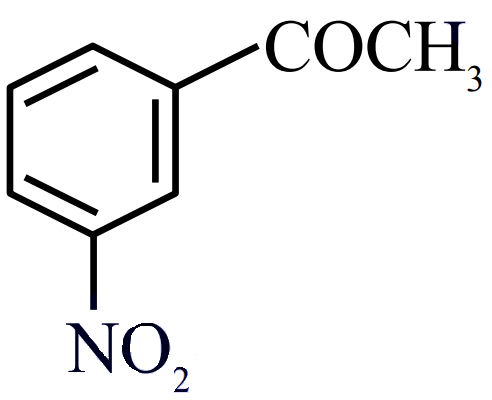
Nitrobenzene does not give Friedel-Craft acylation since it is a highly deactivated ring. -
- (A) C > A > B > D
- (B) C > A > D > B
- (C) B > D > A > C
- (D) A > B > C > D
Show answer and solution
Correct Answer: (A)
The stability of alkenes is directly proportional to the number of \(\alpha\)-hydrogen atoms due to hyperconjugation.
Let us count the number of \(\alpha\)-hydrogen atoms in each given alkene:
A. 2-Methylbut-2-ene: \((CH_3)_2C=CHCH_3\)
Number of \(\alpha\)-hydrogen atoms = \(3 + 3 + 3 = 9\)
B. cis-But-2-ene: \(CH_3CH=CHCH_3\)
Number of \(\alpha\)-hydrogen atoms = \(3 + 3 = 6\)
C. 2,3-Dimethylbut-2-ene: \((CH_3)_2C=C(CH_3)_2\)
Number of \(\alpha\)-hydrogen atoms = \(3 + 3 + 3 + 3 = 12\)
D. Prop-1-ene: \(CH_3CH=CH_2\)
Number of \(\alpha\)-hydrogen atoms = \(3\)
Since the stability of an alkene increases with the number of \(\alpha\)-hydrogen atoms, the correct stability order is C > A > B > D.
Answer: C > A > B > D -
- (A) A & E Only
- (B) A, B & D Only
- (C) C, D & E Only
- (D) A, C & E Only
Show answer and solution
Correct Answer: (D)
\(Ph - CH = CH _2 \xrightarrow[ HBr ]{( PhCOO )_2} Ph - CH _2- CH _2- Br\)
Anti Markovnikov addition
• Reaction follow radical addition in presence of peroxide
• In absence of peroxide follow carbocation mechanism
• Benzene also formed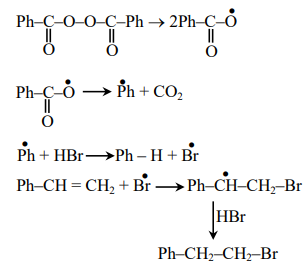
-
- (A) Hept-2-ene
- (B) Hept-1,3,5-triene
- (C) Heptane
- (D) Hept-2,4,6-triene
Show answer and solution
Correct Answer: (C)
Compound (X) undergoes isomerization on heating with anhydrous \(AlCl_3\) and HCl gas to give branched-chain alkanes. The formation of \(2,4\)-dimethylpentane (a \(7\)-carbon branched alkane) indicates that (X) is a \(7\)-carbon straight-chain alkane.
Aromatization of n-heptane at high temperature and pressure in the presence of oxides of V, Mo, or Cr supported over alumina gives toluene.
Cyclisation of n-heptane under similar conditions initially yields methylcyclohexane, which can further undergo dehydrogenation to form toluene.
Since all these reactions are characteristic of n-heptane, compound (X) is heptane.
Answer: Heptane

No questions on this page match these filters.