


Questions
20 questionsShowing 1–20 of 20 questions
-
- (A) 2
- (B) 3
- (C) 6
- (D) 8
Show answer and solution
Correct Answer: (C)
The central atom in \(XeO_6^{4-}\) is Xenon (Xe).
The number of valence electrons in Xe is \(8\).
Let the oxidation state of Xe in \(XeO_6^{4-}\) be \(x\).
\(x + 6(-2) = -4\)
\(x = +8\)
Since the oxidation state of Xe is \(+8\), all \(8\) of its valence electrons are involved in bonding with the \(6\) oxygen atoms. There are no non-bonding electrons left on the central atom.
Number of lone pairs on Xe \(= 0\)
Xe forms \(6\) \(\sigma\) bonds with the \(6\) oxygen atoms (and \(2\) \(\pi\) bonds to satisfy its \(+8\) oxidation state and minimize formal charge).
Number of \(\sigma\) bond-pairs \(= 6\)
Total number of \(\sigma\) bond-pairs and lone pairs around the central atom \(= 6 + 0 = 6\).
Answer: \(6\) -
- (A) 2
- (B) \(0\)
- (C) 1
- (D) 3
Show answer and solution
Correct Answer: (C)
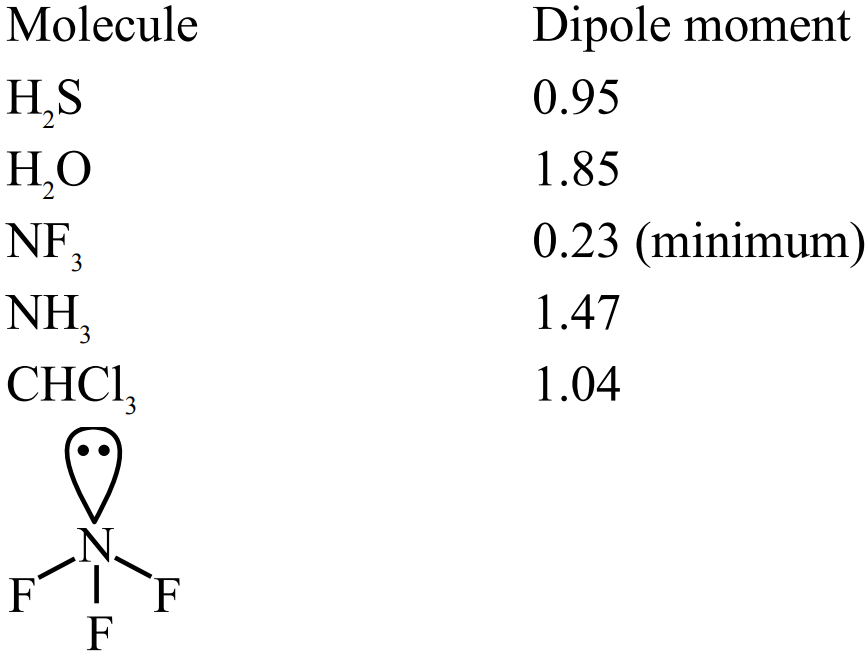
Number of lone pair on central atom = 1 -
- (A) bent, square planar
- (B) linear, square planar
- (C) bent, see-saw
- (D) linear, tetrahedral
Show answer and solution
Correct Answer: (A)
The autoionization of bromine trifluoride is given by the reaction:
\(2\text{BrF}_3 \rightleftharpoons \text{BrF}_2^{\oplus} + \text{BrF}_4^{\ominus}\)
For the cation \(\text{BrF}_2^{\oplus}\):
The central atom Br has \(7\) valence electrons. Due to the positive charge, it has \(7 - 1 = 6\) electrons available.
It forms \(2\) single bonds with F atoms, leaving \(4\) electrons, which constitute \(2\) lone pairs.
Steric number = \(2\) (bond pairs) + \(2\) (lone pairs) = \(4\).
The hybridization is \(sp^3\). With \(2\) bond pairs and \(2\) lone pairs, the shape is bent (or V-shaped).
For the anion \(\text{BrF}_4^{\ominus}\):
The central atom Br has \(7\) valence electrons. Due to the negative charge, it has \(7 + 1 = 8\) electrons available.
It forms \(4\) single bonds with F atoms, leaving \(4\) electrons, which constitute \(2\) lone pairs.
Steric number = \(4\) (bond pairs) + \(2\) (lone pairs) = \(6\).
The hybridization is \(sp^3d^2\). To minimize repulsion, the \(2\) lone pairs occupy opposite (trans) positions in the octahedral geometry, resulting in a square planar shape.
Thus, the shapes of the cation and anion are bent and square planar, respectively.
Answer: bent, square planar -
- (A) 1
- (B) 2
- (C) 3
- (D) 4
Show answer and solution
Correct Answer: (D)
The steric number \(H\) is calculated as \(H = \dfrac{1}{2}(V + M - C + A)\), where \(V\) is the number of valence electrons on the central atom, \(M\) is the number of monovalent atoms, \(C\) is the cationic charge, and \(A\) is the anionic charge.
For \(sp^3d\) hybridization, \(H = 5\).
BrF\(_5\): \(H = \dfrac{1}{2}(7 + 5) = 6\) (\(sp^3d^2\))
XeF\(_5^-\): \(H = \dfrac{1}{2}(8 + 5 + 1) = 7\) (\(sp^3d^3\))
BF\(_4^-\): \(H = \dfrac{1}{2}(3 + 4 + 1) = 4\) (\(sp^3\))
ICl\(_4^-\): \(H = \dfrac{1}{2}(7 + 4 + 1) = 6\) (\(sp^3d^2\))
XeF\(_4\): \(H = \dfrac{1}{2}(8 + 4) = 6\) (\(sp^3d^2\))
SF\(_4\): \(H = \dfrac{1}{2}(6 + 4) = 5\) (\(sp^3d\))
NH\(_4^+\): \(H = \dfrac{1}{2}(5 + 4 - 1) = 4\) (\(sp^3\))
ClF\(_3\): \(H = \dfrac{1}{2}(7 + 3) = 5\) (\(sp^3d\))
XeF\(_2\): \(H = \dfrac{1}{2}(8 + 2) = 5\) (\(sp^3d\))
ICl\(_2^-\): \(H = \dfrac{1}{2}(7 + 2 + 1) = 5\) (\(sp^3d\))
The species with \(sp^3d\) hybridization are SF\(_4\), ClF\(_3\), XeF\(_2\), and ICl\(_2^-\).
The number of such species is \(4\).
Answer: \(4\) -
- (A) A, C and D Only
- (B) A, B and C Only
- (C) A, D and E Only
- (D) A and D Only
Show answer and solution
Correct Answer: (D)
Manganate ion → \(MnO_{4}^{-2}\)
Permanganate ion → \(MnO_{4}^{-}\)
(A) Both are tetrahedral (\(d^{3}s\) Hybridisation)
(B) \(MnO_{4}^{-}\) (+7 oxidation state)
\(MnO_{4}^{2-}\) (+6 oxidation state)
(C) \(Mn^{2+} + S_{2}O_{8}^{2-} \to MnO_{4}^{-}\) (Permanganate ion)
(D) \(MnO_{4}^{-}\) → Diamagnetic
\(MnO_{4}^{2-}\) → Paramagnetic
(E) It is oxidising agent -
- (A) A, B, C, D & E
- (B) B & C only
- (C) B, C & D only
- (D) A, C & D only
Show answer and solution
Correct Answer: (B)
(A) Dipole moment: \( NF_{3} < NH_{3} \)
(B) \( BeH_{2} \) is '\( sp \)' hybridized, linear molecule with zero dipole moment.
(C) \( O_{2}^{-2} \Rightarrow \) bond order = 1;
\( F_{2} \Rightarrow \) bond order = 1
(D) Formal charge on central oxygen atom in \( O_{3} \) is +1.
(E) In \( NO_{2} \); nitrogen does not follow octet rule. -
- (A) Both Statement I and Statement II are true
- (B) Both Statement I and Statement II are false
- (C) Statement I is true but Statement II is false
- (D) Statement I is false but Statement II is true
Show answer and solution
Correct Answer: (A)
Statement I: The standard reduction potential \(E^{\circ}_{\text{Al}^{3+}/\text{Al}}\) is \(-1.66\) V, which is highly negative, indicating that aluminium has a strong tendency to lose electrons and is highly electropositive. The standard reduction potential \(E^{\circ}_{\text{Tl}^{3+}/\text{Tl}}\) is \(+1.26\) V, which is positive, indicating that thallium is less electropositive than aluminium. Thus, Statement I is true.
Statement II: Boron has a very small atomic size, resulting in a very high sum of its first three ionization enthalpies. This high energy requirement prevents boron from losing three electrons to form \(\text{B}^{3+}\) ions, so it forms only covalent compounds. In contrast, aluminium has a larger size and a significantly lower sum of its first three ionization enthalpies, allowing it to easily form \(\text{Al}^{3+}\) ions in its compounds. Thus, Statement II is true.
Both Statement I and Statement II are true.
Answer: Both Statement I and Statement II are true -
- (A) Both Statement I and Statement II are true
- (B) Both Statement I and Statement II are false
- (C) Statement I is true but Statement II is false
- (D) Statement I is false but Statement II is true
Show answer and solution
Correct Answer: (D)
Explanation:
1. Analysis of Statement I: Aluminium reacts with hot aqueous sodium hydroxide (\( \text{NaOH} \)) to form a soluble tetrahydroxoaluminate(III) complex, \( \text{[Al(OH)}_4\text{]}^- \), along with the evolution of hydrogen gas. The balanced chemical equation is:
\( 2\text{Al} + 2\text{NaOH} + 6\text{H}_2\text{O} \rightarrow 2\text{Na}^+[\text{Al(OH)}_4]^- + 3\text{H}_2 \)
Since it forms a monovalent complex ion \( \text{[Al(OH)}_4\text{]}^- \) and not the hexavalent \( \text{[Al(OH)}_6\text{]}^{3-} \), Statement I is false.
2. Analysis of Statement II (Geometry vs Shape): As correctly noted, terms like "square planar", "pyramidal", and "linear" describe the spatial arrangement of the atoms excluding lone pairs, which refers precisely to the molecular shape rather than the total electron-pair geometry:
- For \( \text{ICl}_4^- \): The central iodine atom has 7 valence electrons plus 1 from the negative charge, giving 8 electrons (4 bonding pairs and 2 lone pairs). Its hybridization is \( sp^3d^2 \); its electron geometry is octahedral, but its shape is square planar.
- For \( \text{ClO}_3^- \): The central chlorine atom has 7 valence electrons plus 1 from the negative charge, giving 8 electrons (3 \( \sigma \)-bonds and 1 lone pair). Its hybridization is \( sp^3 \); its electron geometry is tetrahedral, but its shape is trigonal pyramidal.
- For \( \text{IBr}_2^- \): The central iodine atom has 7 valence electrons plus 1 from the negative charge, giving 8 electrons (2 bonding pairs and 3 lone pairs). Its hybridization is \( sp^3d \); its electron geometry is trigonal bipyramidal, but its shape is linear.
Thus, Statement II correctly identifies the molecular shapes of these species, making Statement II true.
Hence, Option D is the correct choice. -
- (A) Both Statement I and Statement II are true
- (B) Both Statement I and Statement II are false
- (C) Statement I is true but Statement II is false
- (D) Statement I is false but Statement II is true
Show answer and solution
Correct Answer: (C)
In Statement I, the bond angle of \(F_2O\) is \(103^{\circ}\), \(H_2O\) is \(104.5^{\circ}\), and \(Cl_2O\) is \(110.9^{\circ}\). The increasing order of bond angle is \(F_2O < H_2O < Cl_2O\). In \(F_2O\), the high electronegativity of fluorine shifts the bond pairs towards fluorine, decreasing bond pair-bond pair repulsion and thus decreasing the bond angle. In \(Cl_2O\), steric hindrance between the large chlorine atoms increases the bond angle. Thus, Statement I is true.
In Statement II, \(SiF_4\) is a covalent compound (it is a gas at room temperature), whereas \(SnF_4\) and \(PbF_4\) are ionic solids. Thus, Statement II is false.
Answer: Statement I is true but Statement II is false -
- (A) Both Statement I and Statement II are true
- (B) Both Statement I and Statement II are false
- (C) Statement I is true but Statement II is false
- (D) Statement I is false but Statement II is true
Show answer and solution
Correct Answer: (D)
Statement I: Number of compounds in which sulphur does not follow the octet rule (from \(SO_2\), \(SO_3\), \(SF_4\), \(SF_6\) and \(H_2S\)).
\(SO_2\): The formal-charge-minimised structure \(O=S=O\) places \(10\) electrons around sulphur (expanded octet).
\(SO_3\): With three \(S=O\) double bonds, sulphur has \(12\) electrons around it (expanded octet).
\(SF_4\): \(4\) bond pairs \(+ 1\) lone pair \(= 10\) electrons around \(S\) (expanded octet).
\(SF_6\): \(6\) bond pairs \(= 12\) electrons around \(S\) (expanded octet).
\(H_2S\): \(2\) bond pairs \(+ 2\) lone pairs \(= 8\) electrons around \(S\) (obeys the octet rule).
Depending on whether formal-charge-minimised structures are used for \(SO_2\) and \(SO_3\), either \(2\) (\(SF_4, SF_6\)) or \(4\) (\(SO_2, SO_3, SF_4, SF_6\)) species violate the octet rule, but the number is never \(3\).
Hence, Statement I is false.
Statement II: Among the given sets, exactly one contains only molecules having one lone pair on the central atom.
Number of lone pairs on the central atom, \(\text{LP} = \dfrac{\text{valence electrons of central atom} - \text{number of bonded monovalent atoms}}{2}\):
\(H_2O\): \(\dfrac{6 - 2}{2} = 2\) lone pairs
\(ClF_3\): \(\dfrac{7 - 3}{2} = 2\) lone pairs
\(SF_4\): \(\dfrac{6 - 4}{2} = 1\) lone pair
\(NH_3\): \(\dfrac{5 - 3}{2} = 1\) lone pair
\(BrF_5\): \(\dfrac{7 - 5}{2} = 1\) lone pair
\(XeF_4\): \(\dfrac{8 - 4}{2} = 2\) lone pairs
Checking the sets:
\(\{H_2O\ (2),\ ClF_3\ (2),\ SF_4\ (1)\}\): not all have \(1\) lone pair.
\(\{NH_3\ (1),\ BrF_5\ (1),\ SF_4\ (1)\}\): all have exactly \(1\) lone pair.
\(\{BrF_5\ (1),\ ClF_3\ (2),\ XeF_4\ (2)\}\): not all have \(1\) lone pair.
\(\{XeF_4\ (2),\ ClF_3\ (2),\ H_2O\ (2)\}\): not all have \(1\) lone pair.
Exactly one set satisfies the condition, so Statement II is true.
Hence, Statement I is false but Statement II is true, which corresponds to option \((4)\). -
- (A) Both Statement I and Statement II are true
- (B) Both Statement I and Statement II are false
- (C) Statement I is true but Statement II is false
- (D) Statement I is false but Statement II is true
Show answer and solution
Correct Answer: (C)
The bond order of the given oxygen species can be calculated using molecular orbital theory:
For \(O_2\) (16 electrons), the configuration is Sigma 1s2, Sigma* 1s2, Sigma 2s2, Sigma* 2s2, Sigma 2pz2, (Pi 2px2, Pi 2py2), (Pi* 2px1, Pi* 2py1 .
Bond order = \(\dfrac{10 - 6}{2} = 2\). Number of unpaired electrons = \(2\).
For \(O_2^+\) (15 electrons), one electron is removed from a \(\pi^{*}\) orbital.
Bond order = \(\dfrac{10 - 5}{2} = 2.5\). Number of unpaired electrons = \(1\).
For \(O_2^-\) (17 electrons), one electron is added to a \(\pi^{*}\) orbital.
Bond order = \(\dfrac{10 - 7}{2} = 1.5\). Number of unpaired electrons = \(1\).
For \(O_2^{2-}\) (18 electrons), two electrons are added to the \(\pi^{*}\) orbitals.
Bond order = \(\dfrac{10 - 8}{2} = 1\). Number of unpaired electrons = \(0\).
Since bond length is inversely proportional to bond order, the correct sequence of bond lengths is \(O_2^+ < O_2 < O_2^- < O_2^{2-}\). Thus, Statement I is true.
The number of unpaired electrons for the species are \(2, 1, 1,\) and \(0\) respectively. The correct sequence is \(O_2 > O_2^+ = O_2^- > O_2^{2-}\). Thus, Statement II is false.
Answer: Statement I is true but Statement II is false -
- (A) Statement I is true but Statement II is false
- (B) Both Statement I and Statement II are false
- (C) Statement I is false but Statement II is true
- (D) Both Statement I and Statement II are true
Show answer and solution
Correct Answer: (C)
Statement-I:
\( SF_{4} \) (See-saw),
\( XeF_{4} \) (square planar),
\( [PtCl_{4}]^{2-} \) (square planar),
\( [NiCl_{4}]^{2-} \) (Tetrahedral),
\( [Ni(CN)_{4}]^{2-} \) (square planar),
\( SeF_{4} \) (See-saw),
\( NH_{4}^{+} \) (Tetrahedral).
Statement-II:
\( NO_{2} \) (seven electrons on N) ,
\( BeH_{2} \) (four electrons on Be) ,
\( BF_{3} \) (six electrons on B) ,
\( AlCl_{3} \) (six electrons on Al). -
- (A) Both Statement I and Statement II are false
- (B) Both Statement I and Statement II are true
- (C) Statement I is true but Statement II is false
- (D) Statement I is false but Statement II is true
Show answer and solution
Correct Answer: (A)
In \(BF _4^{-}, SiF _4\) and \(XeF _4\) all bond lengths are identicalMolecules B.O. \(O _2^{+}\) → 2.5 \(O_2^{-}\) → 1.5 \(O _2^{2-}\) → 1 \(F_2\) → 1 -
- (A) \(120^{\circ}\)
- (B) \(107^{\circ}\)
- (C) \(102^{\circ}\)
- (D) \(116^{\circ}\)
Show answer and solution
Correct Answer: (C)
\(N F _{ 3 }\)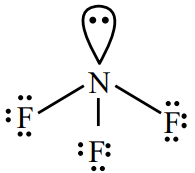 , hybridization : \(sp ^3\)
Number of lone pair in \(NF _3=10\)
Bond angle in \(NF _3 \approx 102^{\circ}\) -
- (A) A-II, B-I, C-III, D-IV
- (B) A-II, B-III, C-IV, D-I
- (C) A-II, B-III, C-I, D-IV
- (D) A-II, B-II, C-IV, D-I
Show answer and solution
Correct Answer: (B)
\(XeF_{2}\) & \(I_{3}^{-}\): 2 bond pair 3 lone pair; Linear
\(XeOF_{4}\) & \(BrF_{5}\): 5 bond pair 1 lone pair; Square pyramidal
\(XeO_{2}F_{2}\) & \(SF_{4}\): 4 bond pair 1 lone pair; See saw
\(XeO_{3}\) & \(NH_{3}\): 3 bond pair 1 lone pair; Pyramidal - 16. Pair of species among the following having same bond order as well as paramagnetic character will be - 2026 Hard
- (A) \(O_{2}^{+}, N_{2}^{2-}\)
- (B) \(O_{2}^{-}, N_{2}^{+}\)
- (C) \(O_{2}^{+}, N_{2}^{-}\)
- (D) \(O_{2}^{-}, N_{2}\)
Show answer and solution
Correct Answer: (C)
Species Bond order Magnetic Nature \(O _2^{+}\) 2.5 Paramagnetic \(O _2^{-}\) 1.5 Paramagnetic \(O _2^{+}\) 2.5 Paramagnetic \(N _2^{-}\) 2.5 Paramagnetic \(N _2^{2-}\) 2 Paramagnetic -
- (A) C Only
- (B) C and E Only
- (C) A and D Only
- (D) B and E Only
Show answer and solution
Correct Answer: (B)
In \(SF_4\), the central sulphur atom has \(6\) valence electrons. It forms \(4\) sigma bonds with fluorine atoms and has \(1\) lone pair. The steric number is \(5\), corresponding to \(sp^3d\) hybridization, and the shape is see-saw.
In \(BrF_4^{\ominus}\), the central bromine atom has \(8\) valence electrons (\(7 + 1\)). It forms \(4\) sigma bonds and has \(2\) lone pairs. The steric number is \(6\), corresponding to \(sp^3d^2\) hybridization, and the shape is square planar.
In \(CH_4\), the central carbon atom has \(4\) valence electrons. It forms \(4\) sigma bonds and has \(0\) lone pairs. The steric number is \(4\), corresponding to \(sp^3\) hybridization, and the shape is tetrahedral.
In \(IF_4^{\oplus}\), the central iodine atom has \(6\) valence electrons (\(7 - 1\)). It forms \(4\) sigma bonds and has \(1\) lone pair. The steric number is \(5\), corresponding to \(sp^3d\) hybridization, and the shape is see-saw.
In \(XeF_4\), the central xenon atom has \(8\) valence electrons. It forms \(4\) sigma bonds and has \(2\) lone pairs. The steric number is \(6\), corresponding to \(sp^3d^2\) hybridization, and the shape is square planar.
In \(XeO_2F_2\), the central xenon atom has \(8\) valence electrons. It forms \(4\) sigma bonds (\(2\) with oxygen, \(2\) with fluorine), \(2\) pi bonds, and has \(1\) lone pair. The steric number is \(5\), corresponding to \(sp^3d\) hybridization, and the shape is see-saw.
Therefore, \(IF_4^{\oplus}\) and \(XeO_2F_2\) are isostructural with \(SF_4\).
Answer: C and E Only - 18. The formal charges on the atoms marked as (1) to (4) in the Lewis representation of \(HNO_{3}\) molecule respectively are
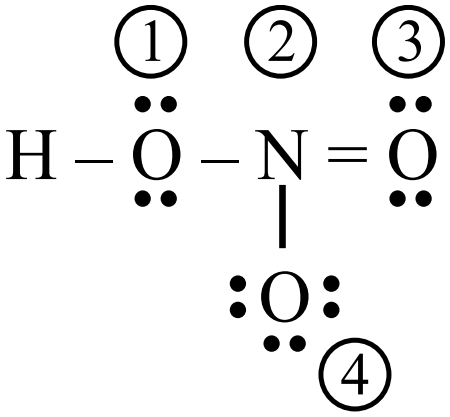 2026 Hard
- (A) +1, 0, 0, -1
- (B) 0, -1, 0, +1
- (C) 0, +1, 0, -1
- (D) 0, 0, -1, +1
Show answer and solution
Correct Answer: (C)
Consider the structure of \(HNO_{3}\)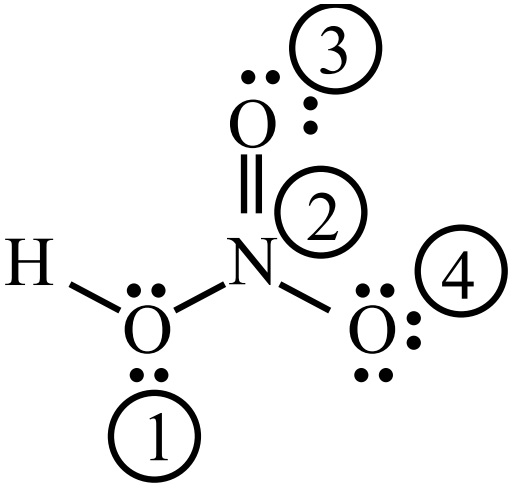
\(1 : 0\)
\(2 : (+1)\)
\(3 : 0\)
\(4 : (-1)\)
Formal charge = valence e's - non bonding e's - \(\left(\frac{\text { bonding electrons }}{2}\right)\) -
- (A) A, B and E
- (B) A and E
- (C) B, C and D
- (D) C and D
Show answer and solution
Correct Answer: (B)
Species with the same number of valence electrons and the same skeletal structure generally have similar Lewis dot structures (isoelectronic species).
For pair A: \(\text{SO}_3^{2-}\) has \(6 + 3(6) + 2 = 26\) valence electrons. \(\text{CO}_3^{2-}\) has \(4 + 3(6) + 2 = 24\) valence electrons. Since they have different numbers of valence electrons, they do not have similar Lewis dot structures (\(\text{SO}_3^{2-}\) has a lone pair on the central atom and is pyramidal, while \(\text{CO}_3^{2-}\) has no lone pair on the central atom and is trigonal planar).
For pair B: \(\text{O}_2^{2-}\) has \(2(6) + 2 = 14\) valence electrons. \(\text{F}_2\) has \(2(7) = 14\) valence electrons. Both have a single bond and three lone pairs on each atom, so they have similar Lewis dot structures.
For pair C: \(\text{CN}^-\) has \(4 + 5 + 1 = 10\) valence electrons. \(\text{CO}\) has \(4 + 6 = 10\) valence electrons. Both have a triple bond and one lone pair on each atom, so they have similar Lewis dot structures.
For pair D: \(\text{NH}_3\) has \(5 + 3(1) = 8\) valence electrons. \(\text{H}_3\text{O}^+\) has \(6 + 3(1) - 1 = 8\) valence electrons. Both have three single bonds and one lone pair on the central atom, so they have similar Lewis dot structures.
For pair E: \(\text{MnO}_4^{2-}\) has \(7 + 4(6) + 2 = 33\) valence electrons. \(\text{CrO}_4^{2-}\) has \(6 + 4(6) + 2 = 32\) valence electrons. Since they have different numbers of valence electrons (\(\text{MnO}_4^{2-}\) has an unpaired electron), they do not have similar Lewis dot structures.
Thus, pairs A and E do not have similar Lewis dot structures.
Answer: A and E -
- (A) B, C and E only
- (B) B and D only
- (C) A and D only
- (D) B, D and E only
Show answer and solution
Correct Answer: (A)
(A)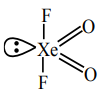
(B) Xe has 7 electron pair in its valence shell
(C) O-Xe-O Bond angle is close to \( 120^{\circ} \)
(D) F-Xe-F Bond angle is close to \( 180^{\circ} \)
(E) Xe has 14 valence electron in \( XeO_{2}F_{2}\)
No questions on this page match these filters.