


JEE Mains · Chemistry · STD 12 - D and f- block elements
- JEE Mains 2026
- Hard
- MCQ
Given below are two statements:
Statement I: The number of pairs among \([\text{Ti}^{4+}, \text{V}^{2+}]\), \([\text{V}^{2+}, \text{Mn}^{2+}]\), \([\text{Mn}^{2+}, \text{Fe}^{3+}]\) and \([\text{V}^{2+}, \text{Cr}^{2+}]\) in which both ions are coloured is \(3\).
Statement II: The number of pairs among \([\text{La}^{3+}, \text{Yb}^{2+}]\), \([\text{Lu}^{3+}, \text{Ce}^{4+}]\) and \([\text{Ac}^{3+}, \text{Lr}^{3+}]\) ions in which both are diamagnetic is \(3\).
In the light of the above statements, choose the correct from the options given below:
Pick an option to check your answer.
Answer & Solution
Correct Answer
(A) Both Statement I and Statement II are correct
Step-by-step Solution
Detailed explanation
For Statement I:
The electronic configurations of the given transition metal ions are:
\(\text{Ti}^{4+} : 3d^0\) (colourless due to absence of unpaired electrons)
\(\text{V}^{2+} : 3d^3\) (coloured)
\(\text{Mn}^{2+} : 3d^5\) (coloured)
\(\text{Fe}^{3+} : 3d^5\) (coloured)
\(\text{Cr}^{2+} : 3d^4\) (coloured)
The pairs in which both ions are coloured are \([\text{V}^{2+}, \text{Mn}^{2+}]\), \([\text{Mn}^{2+}, \text{Fe}^{3+}]\), and \([\text{V}^{2+}, \text{Cr}^{2+}]\). The pair \([\text{Ti}^{4+}, \text{V}^{2+}]\) contains \(\text{Ti}^{4+}\) which is colourless. Thus, there are exactly \(3\) pairs where both ions are coloured. Statement I is correct.
For Statement II:
The electronic configurations of the given f-block ions are:
\(\text{La}^{3+} : [\text{Xe}] 4f^0\) (diamagnetic)
\(\text{Yb}^{2+} : [\text{Xe}] 4f^{14}\) (diamagnetic)
\(\text{Lu}^{3+} : [\text{Xe}] 4f^{14}\) (diamagnetic)
\(\text{Ce}^{4+} : [\text{Xe}] 4f^0\) (diamagnetic)
\(\text{Ac}^{3+} : [\text{Rn}] 5f^0\) (diamagnetic)
\(\text{Lr}^{3+} : [\text{Rn}] 5f^{14}\) (diamagnetic)
All the given ions have either an \(f^0\) or \(f^{14}\) configuration, meaning they have no unpaired electrons and are diamagnetic. Therefore, in all \(3\) pairs, both ions are diamagnetic. Statement II is correct.
Both Statement I and Statement II are correct.
Answer: Both Statement I and Statement II are correct
More questions from Chemistry
- \([image]\) Maleic anhydride Maleic anhydride can be prepared by :
 JEE Mains 2021 Hard
- A \(KCl\) solution of conductivity \(0.14\, S m ^{-1}\) shows a resistance of \(4.19 \,\Omega\) in a conductivity cell. If the same cell is filled with an \(HCl\) solution, the resistance drops to \(1.03 \,\Omega\). The conductivity of the \(HCl\) solution is \(....... \,\times 10^{-2} \,S m ^{-1}\). (Round off to the Nearest Integer).JEE Mains 2021 Hard
- In an electrochemical reaction of lead, at standard temperature, if \(E _{\left( Pb ^{2+} / Pb \right)}^0= m\) Volt and \(E _{\left( Pb ^{4+} / Pb \right)}^0= n\) Volt, then the value of \(E _{\left( Pb ^{2+} / Pb ^{4+}\right)}^0\) is given by \(m-x n\). The value of \(x\) is \(...........\). (Nearest integer)JEE Mains 2023 Medium
- The structure of which of the following chloro species can be explained on the basis of \(dsp^2\) hybridization ?JEE Mains 2013 Hard
- 500 mL of 1.2 M KI solution is mixed with 500 mL of \(0.2~M~KMnO _4\) solution in basic medium. The liberated iodine was titrated with standard \(0.1~M~Na _2 S_2 O _3\) solution in the presence of starch indicator till the blue color disappeared. The volume (in L ) of \(Na _2 S_2 O _3\) consumed is __________. (Nearest integer)JEE Mains 2026 Easy
- The molecular geometry of \(S\,F _{6}\) is octahedral. What is the geometry of \(S\,F _{4}\) (including lone pair(s) of electrons, if any)?JEE Mains 2020 Medium
More PYQs from JEE Mains
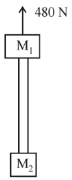
- Two blocks of mass \(M_1 = 20\,kg\) and \(M_2 = 12\,kg\) are connected by a metal rod of mass \(8\,kg.\) The system is pulled vertically up by applying a force of \(480\,N\) as shown. The tension at the mid-point of the rod is ........ \(N\)
 JEE Mains 2013 Hard
- Two identical electric point dipoles have dipole moments \(\overrightarrow{p}_{1}= p\hat i\) and \(\overrightarrow{p}_{2}=- p\hat i\) and are held on the \(x-\)axis at distance \('a'\) from each other. When released, they move along the \(x-\)axis with the direction of their dipole moments remaining unchanged. If the mass of each dipole is \('m',\) their speed when they arc infinitely far apart isJEE Mains 2020 Medium
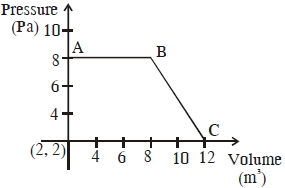
- The magnitude of work done by a gas that undergoes a reversible expansion along the path \(ABC\) shown in the figure is .............. \(\mathrm{Joule}\)
 JEE Mains 2020 Hard
- Ice and water are placed in a closed container at a pressure of 1 atm and temperature 273.15 K . If pressure of the system is increased 2 times, keeping temperature constant, then identify correct observation from following.JEE Mains 2025 Medium
- \(n-\) \(moles\) of an ideal gas with constant volume heat capacity \(C_v\) undergo an isobaric expansion by certain volume. The ratio of the work done in the process, to the heat supplied isJEE Mains 2019 Medium