


All JEE Mains 2026 Chemistry questions
26 chaptersShowing 301–350 of 432 questions
- 301. Number of moles and number of molecules in \(1.4187\) L of \(SO_2\) at STP respectively are: 2026 Medium
- (A) \(0.1266; 3.812 \times 10^{22}\)
- (B) \(0.0633; 3.812 \times 10^{22}\)
- (C) \(0.1266; 7.6238 \times 10^{22}\)
- (D) \(0.0633; 7.6238 \times 10^{22}\)
Show answer and solution
Correct Answer: (B)
Volume of \(SO_2\) at STP \(= 1.4187\) L
Molar volume of an ideal gas at STP is approximately \(22.414\) L.
Number of moles \(n = \dfrac{\text{Volume}}{\text{Molar Volume}} = \dfrac{1.4187}{22.414} = 0.0633\)
Number of molecules \(= n \times N_A\)
Number of molecules \(= 0.0633 \times 6.022 \times 10^{23} = 3.812 \times 10^{22}\)
Answer: \(0.0633; 3.812 \times 10^{22}\) - 302. One mole of an alkane (x) requires \(8\) mole oxygen for complete combustion. Sum of number of carbon and hydrogen atoms in the alkane (x) is _______. 2026 Medium
- (A) 15
- (B) 17
- (C) 19
- (D) 21
Show answer and solution
Correct Answer: (B)
The general formula of an alkane is \(C_n H_{2n+2}\).
The balanced chemical equation for the complete combustion of an alkane is:
\(C_n H_{2n+2} + \left(\dfrac{3n+1}{2}\right) O_2 \rightarrow n CO_2 + (n+1) H_2O\)
Given that \(1\) mole of the alkane requires \(8\) moles of oxygen for complete combustion, we equate the stoichiometric coefficient of \(O_2\) to \(8\):
\(\dfrac{3n+1}{2} = 8\)
\(3n + 1 = 16\)
\(3n = 15\)
\(n = 5\)
The molecular formula of the alkane is \(C_5H_{12}\).
The number of carbon atoms is \(5\) and the number of hydrogen atoms is \(12\).
Sum of the number of carbon and hydrogen atoms \(= 5 + 12 = 17\).
Answer: \(17\) - 303. The correct order of total number of atoms present in
(A) \(2\) moles of cyclohexane
(B) \(684\) g of sucrose
(C) \(90.8\) L of dihydrogen at STP
is: 2026 Medium- (A) \(C>A>B\)
- (B) \(C>B>A\)
- (C) \(B>C>A\)
- (D) \(B>A>C\)
Show answer and solution
Correct Answer: (D)
For (A):
Formula of cyclohexane is \(C_6H_{12}\).
Number of atoms per molecule = \(6 + 12 = 18\).
Total number of atoms in \(2\) moles = \(2 \times 18 \times N_A = 36 N_A\).
For (B):
Formula of sucrose is \(C_{12}H_{22}O_{11}\).
Molar mass of sucrose = \(342\) g/mol.
Number of moles = \(\dfrac{684}{342} = 2\) moles.
Number of atoms per molecule = \(12 + 22 + 11 = 45\).
Total number of atoms = \(2 \times 45 \times N_A = 90 N_A\).
For (C):
Formula of dihydrogen is \(H_2\).
Number of moles at STP = \(\dfrac{90.8}{22.7} = 4\) moles.
Number of atoms per molecule = \(2\).
Total number of atoms = \(4 \times 2 \times N_A = 8 N_A\).
Comparing the total number of atoms:
\(90 N_A > 36 N_A > 8 N_A\)
Therefore, the correct order is \(B > A > C\).
Answer: \(B>A>C\) -
- (A) \(2.1\) g
- (B) \(4.2\) g
- (C) \(21\) g
- (D) \(42\) g
Show answer and solution
Correct Answer: (D)
The balanced chemical equation for the reaction of iron with steam is:
\(3Fe + 4H_2O \rightarrow Fe_3O_4 + 4H_2\)
Molar mass of \(H_2O = 2 \times 1 + 16 = 18 \text{ g mol}^{-1}\)
Number of moles of steam (\(H_2O\)) given = \(\dfrac{18}{18} = 1 \text{ mol}\)
From the balanced equation, \(4 \text{ moles}\) of \(H_2O\) react with \(3 \text{ moles}\) of \(Fe\).
Therefore, \(1 \text{ mole}\) of \(H_2O\) will react with \(\dfrac{3}{4} \text{ moles}\) of \(Fe\).
Mass of iron reacted = Moles of \(Fe \times\) Molar mass of \(Fe\)
Mass of iron = \(\dfrac{3}{4} \times 56 = 3 \times 14 = 42 \text{ g}\)
Answer: \(42\) g -
- (A) \(5.68\)
- (B) \(11.44\)
- (C) \(22.74\)
- (D) \(17.05\)
Show answer and solution
Correct Answer: (B)
Ratio of mass percentage of C : H = \(12 : 1\)
Ratio of moles of C : H = \(\dfrac{12}{12} : \dfrac{1}{1} = 1 : 1\)
The empirical formula is \(CH\). Since the hydrocarbon has two carbon atoms, its molecular formula is \(C_2H_2\).
Molar mass of \(C_2H_2 = 2 \times 12 + 2 \times 1 = 26\) g mol\(^{-1}\)
Moles of \(C_2H_2\) in \(3.38\) g = \(\dfrac{3.38}{26} = 0.13\) mol
The combustion reaction is:
\(C_2H_2 + \dfrac{5}{2}O_2 \rightarrow 2CO_2 + H_2O\)
From the stoichiometry, \(1\) mole of \(C_2H_2\) produces \(2\) moles of \(CO_2\).
Moles of \(CO_2\) produced = \(2 \times 0.13 = 0.26\) mol
Molar mass of \(CO_2 = 12 + 2 \times 16 = 44\) g mol\(^{-1}\)
Weight of \(CO_2\) formed = \(0.26 \times 44 = 11.44\) g
Answer: \(11.44\) -
- (A) \(0.825\)
- (B) \(0.032\)
- (C) \(0.867\)
- (D) \(0.967\)
Show answer and solution
Correct Answer: (D)
\(10\%\) w/w aqueous urea solution means \(10\) g of urea is present in \(100\) g of solution.
Mass of urea \(= 10\) g
Mass of water \(= 100 - 10 = 90\) g
Molar mass of urea (\(\text{NH}_2\text{CONH}_2\)) \(= 14 + 2 + 12 + 16 + 14 + 2 = 60\) g mol\(^{-1}\)
Molar mass of water (\(\text{H}_2\text{O}\)) \(= 18\) g mol\(^{-1}\)
Moles of urea, \(n_{\text{urea}} = \dfrac{10}{60} = \dfrac{1}{6}\) mol
Moles of water, \(n_{\text{water}} = \dfrac{90}{18} = 5\) mol
Total moles \(= 5 + \dfrac{1}{6} = \dfrac{31}{6}\) mol
Mole fraction of water, \(x_{\text{water}} = \dfrac{n_{\text{water}}}{n_{\text{water}} + n_{\text{urea}}} = \dfrac{5}{\dfrac{31}{6}} = \dfrac{30}{31} \approx 0.967\)
Answer: \(0.967\) -
- (A) \(5.824\text{ L}\)
- (B) \(7.428\text{ L}\)
- (C) \(6.892\text{ L}\)
- (D) \(8.375\text{ L}\)
Show answer and solution
Correct Answer: (C)
Mass of \(H_2SO_4\) solution \(= 50 \times 1.3 = 65\text{ g}\)
Mass of pure \(H_2SO_4 = 65 \times \dfrac{50}{100} = 32.5\text{ g}\)
Moles of \(H_2SO_4 = \dfrac{32.5}{98} \approx 0.3316\text{ mol}\)
Moles of \(Zn = \dfrac{20}{65} \approx 0.3077\text{ mol}\)
The balanced chemical equation is:
\(Zn + H_2SO_4 \rightarrow ZnSO_4 + H_2\)
Since the moles of \(Zn\) are less than the moles of \(H_2SO_4\), \(Zn\) is the limiting reagent.
Moles of \(H_2\) produced \(=\) Moles of \(Zn = \dfrac{20}{65}\text{ mol}\)
Volume of \(H_2\) gas at STP \(= \dfrac{20}{65} \times 22.4\text{ L} = 6.892\text{ L}\)
Answer: \(6.892\text{ L}\) -
- (A) A and B only
- (B) B and C only
- (C) C and D only
- (D) A, C and E only
Show answer and solution
Correct Answer: (D)
Number of atoms is calculated as the product of the number of moles, atomicity, and Avogadro's number (\(N_A\)).
For A: Moles of O\(_2\) = \(\dfrac{2}{32} = \dfrac{1}{16}\) mol. Atomicity of O\(_2\) is \(2\).
Number of atoms = \(\dfrac{1}{16} \times 2 \times N_A = \dfrac{1}{8} N_A\)
For B: Moles of SO\(_2\) = \(\dfrac{4}{64} = \dfrac{1}{16}\) mol. Atomicity of SO\(_2\) is \(3\).
Number of atoms = \(\dfrac{1}{16} \times 3 \times N_A = \dfrac{3}{16} N_A\)
For C: Moles of O\(_2\) at STP = \(\dfrac{1400}{22400} = \dfrac{1}{16}\) mol. Atomicity of O\(_2\) is \(2\).
Number of atoms = \(\dfrac{1}{16} \times 2 \times N_A = \dfrac{1}{8} N_A\)
For D: Moles of He at STP = \(\dfrac{0.05}{22.4} = \dfrac{1}{448}\) mol. Atomicity of He is \(1\).
Number of atoms = \(\dfrac{1}{448} \times 1 \times N_A = \dfrac{1}{448} N_A\)
For E: Moles of H\(_2\) = \(0.0625 = \dfrac{1}{16}\) mol. Atomicity of H\(_2\) is \(2\).
Number of atoms = \(\dfrac{1}{16} \times 2 \times N_A = \dfrac{1}{8} N_A\)
Comparing the number of atoms, A, C, and E contain the same number of atoms.
Answer: A, C and E only -
- (A) 182.5
- (B) 1825
- (C) 365
- (D) 91.25
Show answer and solution
Correct Answer: (B)
\(Ba ( OH )_{2( aq )}+2 HCl _{( aq )} \rightarrow BaCl _{2( aq )}+2 H _2 O _{(\ell)}\)
2.5 mmole \(\quad\)5mmole
wt of \(HCl =5 \times 36.5\) (milligram)
= 182.5 (milligram)
Hence \(x =1825\). -
- (A) 2
- (B) 4
- (C) 5
- (D) 7
Show answer and solution
Correct Answer: (B)
The general formula of an alkane is \(C_n H_{2n+2}\).
The balanced chemical equation for the complete combustion of an alkane is:
\(C_n H_{2n+2} + \left(\dfrac{3n+1}{2}\right) O_2 \rightarrow n CO_2 + (n+1) H_2O\)
Given that \(8\) moles of oxygen are required for complete combustion:
\(\dfrac{3n+1}{2} = 8\)
\(3n + 1 = 16\)
\(n = 5\)
The molecular formula of the alkane \((Y)\) is \(C_5H_{12}\).
Since \((Y)\) yields only one monochlorinated product \((Z)\) upon reaction with \(Cl_2/h\nu\), all the hydrogen atoms in the alkane must be equivalent.
Among the isomers of \(C_5H_{12}\) (n-pentane, isopentane, and neopentane), only 2,2-dimethylpropane (neopentane) has all equivalent hydrogen atoms.
The structure of neopentane is \(C(CH_3)_4\).
In this structure, the central carbon is quaternary, and the four surrounding methyl carbons are primary carbon atoms.
Therefore, the total number of primary carbon atoms in \((Y)\) is \(4\).
Answer: \(4\) - 311. Arrange the following alkenes in decreasing order of stability.
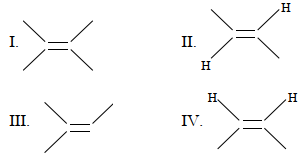
Choose the correct answer from the options given below : 2026 Hard- (A) III > I > II > IV
- (B) III > II > I > IV
- (C) I > III > II > IV
- (D) I > III > IV > II
Show answer and solution
Correct Answer: (C)
Stability order :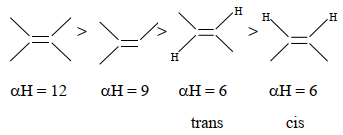
Trans is more stable than cis -
- (A) B and C only
- (B) B and D only
- (C) A and B only
- (D) A and C only
Show answer and solution
Correct Answer: (B)
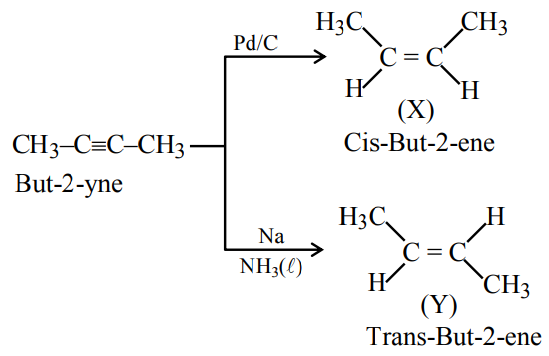
Dipole moment \(x \neq 0\)
-
- (A) \(90\)
- (B) \(118\)
- (C) \(160\)
- (D) \(125\)
Show answer and solution
Correct Answer: (B)
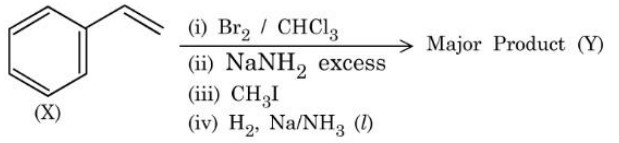
Addition of \(Br_2\) to styrene (X) yields 1,2-dibromoethylbenzene.
\(C_6H_5-CH=CH_2 \xrightarrow{Br_2/CHCl_3} C_6H_5-CH(Br)-CH_2(Br)\)
Reaction with excess \(NaNH_2\) causes double dehydrohalogenation followed by deprotonation of the terminal alkyne, forming sodium phenylacetylide.
\(C_6H_5-CH(Br)-CH_2(Br) \xrightarrow{NaNH_2 \text{ (excess)}} C_6H_5-C \equiv C^- Na^+\)
Nucleophilic substitution with \(CH_3I\) yields 1-phenylpropyne.
\(C_6H_5-C \equiv C^- Na^+ \xrightarrow{CH_3I} C_6H_5-C \equiv C-CH_3\)
Reduction with \(Na/NH_3(l)\) reduces the internal alkyne to a trans-alkene without affecting the benzene ring.
\(C_6H_5-C \equiv C-CH_3 \xrightarrow{Na/NH_3(l)} C_6H_5-CH=CH-CH_3\)
The major product (Y) is trans-1-phenylpropene, which has the molecular formula \(C_9H_{10}\).
Molar mass of \(C_9H_{10} = (9 \times 12) + (10 \times 1) = 108 + 10 = 118 \text{ g mol}^{-1}\).
Answer: \(118\) -
- (A) A and D only
- (B) B and C only
- (C) A and C only
- (D) B and D only
Show answer and solution
Correct Answer: (B)
In the given Friedel-Crafts alkylation reaction, \(1\)-chloropropane reacts with anhydrous \(\text{AlCl}_3\) to initially form a primary carbocation, the \(n\)-propyl carbocation (\(\text{CH}_3-\text{CH}_2-\text{CH}_2^+\)).
This primary carbocation is less stable and undergoes a \(1,2\)-hydride shift to form a more stable secondary carbocation, the iso-propyl carbocation (\(\text{CH}_3-\text{CH}^+-\text{CH}_3\)). Therefore, statement B is correct.
The iso-propyl carbocation then acts as an electrophile and attacks the benzene ring, yielding iso-propylbenzene (cumene) as the major product. Thus, statement A is incorrect.
Once an alkyl group is introduced to the benzene ring, it acts as an electron-donating group (via hyperconjugation and inductive effect), which activates the ring. This makes the newly formed alkylbenzene more reactive towards electrophilic aromatic substitution than the original benzene molecule, leading to polyalkylation. Hence, multiple substitution is a common and inevitable drawback. Therefore, statement C is correct.
Introducing an electron-donating substituent on benzene generally activates the ring and facilitates Friedel-Crafts alkylation (except for strong Lewis bases like \(-\text{NH}_2\) which complex with \(\text{AlCl}_3\)). Thus, statement D is incorrect.
Therefore, only statements B and C are correct.
Answer: B and C only -
- (A) Statement I is correct but Statement II is incorrect.
- (B) Both Statement I and Statement II are correct.
- (C) Statement I is incorrect but Statement II is correct.
- (D) Both Statement I and Statement II are incorrect.
Show answer and solution
Correct Answer: (C)
Nitrobenzene does not give Friedel-Craft acylation since it is a highly deactivated ring. -
- (A) C > A > B > D
- (B) C > A > D > B
- (C) B > D > A > C
- (D) A > B > C > D
Show answer and solution
Correct Answer: (A)
The stability of alkenes is directly proportional to the number of \(\alpha\)-hydrogen atoms due to hyperconjugation.
Let us count the number of \(\alpha\)-hydrogen atoms in each given alkene:
A. 2-Methylbut-2-ene: \((CH_3)_2C=CHCH_3\)
Number of \(\alpha\)-hydrogen atoms = \(3 + 3 + 3 = 9\)
B. cis-But-2-ene: \(CH_3CH=CHCH_3\)
Number of \(\alpha\)-hydrogen atoms = \(3 + 3 = 6\)
C. 2,3-Dimethylbut-2-ene: \((CH_3)_2C=C(CH_3)_2\)
Number of \(\alpha\)-hydrogen atoms = \(3 + 3 + 3 + 3 = 12\)
D. Prop-1-ene: \(CH_3CH=CH_2\)
Number of \(\alpha\)-hydrogen atoms = \(3\)
Since the stability of an alkene increases with the number of \(\alpha\)-hydrogen atoms, the correct stability order is C > A > B > D.
Answer: C > A > B > D -
- (A) A & E Only
- (B) A, B & D Only
- (C) C, D & E Only
- (D) A, C & E Only
Show answer and solution
Correct Answer: (D)
\(Ph - CH = CH _2 \xrightarrow[ HBr ]{( PhCOO )_2} Ph - CH _2- CH _2- Br\)
Anti Markovnikov addition
• Reaction follow radical addition in presence of peroxide
• In absence of peroxide follow carbocation mechanism
• Benzene also formed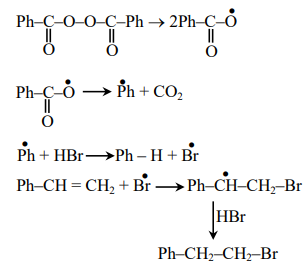
-
- (A) Hept-2-ene
- (B) Hept-1,3,5-triene
- (C) Heptane
- (D) Hept-2,4,6-triene
Show answer and solution
Correct Answer: (C)
Compound (X) undergoes isomerization on heating with anhydrous \(AlCl_3\) and HCl gas to give branched-chain alkanes. The formation of \(2,4\)-dimethylpentane (a \(7\)-carbon branched alkane) indicates that (X) is a \(7\)-carbon straight-chain alkane.
Aromatization of n-heptane at high temperature and pressure in the presence of oxides of V, Mo, or Cr supported over alumina gives toluene.
Cyclisation of n-heptane under similar conditions initially yields methylcyclohexane, which can further undergo dehydrogenation to form toluene.
Since all these reactions are characteristic of n-heptane, compound (X) is heptane.
Answer: Heptane -
- (A) Both Statement I and Statement II are true
- (B) Both Statement I and Statement II are false
- (C) Statement I is true but Statement II is false
- (D) Statement I is false but Statement II is true
Show answer and solution
Correct Answer: (C)
In fractional distillation, the temperature of the fractionating column decreases from bottom to top. As the vapours of the mixture rise, they cool and undergo condensation.
The component with the higher boiling point condenses at a higher temperature, meaning it condenses earlier (lower down the column) than the component with the lower boiling point. Thus, Statement I is true.
As the vapours rise up the fractionating column, the higher boiling component continuously condenses and falls back as liquid, while the lower boiling (more volatile) component remains in the vapour phase and continues to rise. Therefore, the vapours rising up the column become richer in the lower boiling component, not the high boiling component. Thus, Statement II is false.
Hence, Statement I is true but Statement II is false.
Answer: Statement I is true but Statement II is false - 320. Identify the correct IUPAC name of hydrocarbon (\(x\)) containing three primary carbon atoms and with molar mass \(72\text{ g mol}^{-1}\). 2026 Medium
- (A) 1,1-Dimethylcyclopropane
- (B) 2,2-Dimethylpropane
- (C) 2-Methylbutane
- (D) n-pentane
Show answer and solution
Correct Answer: (C)
Let the hydrocarbon be an alkane with general formula \(C_nH_{2n+2}\).
Molar mass \(= 14n + 2 = 72 \Rightarrow 14n = 70 \Rightarrow n = 5\)
The molecular formula is \(C_5H_{12}\).
The structural isomers of \(C_5H_{12}\) are:
n-pentane: \(CH_3-CH_2-CH_2-CH_2-CH_3\) (2 primary carbons)
2-methylbutane: \(CH_3-CH(CH_3)-CH_2-CH_3\) (3 primary carbons)
2,2-dimethylpropane: \(C(CH_3)_4\) (4 primary carbons)
The hydrocarbon with exactly three primary carbon atoms is 2-methylbutane.
Answer: 2-Methylbutane - 321. In IUPAC nomenclature, the correct order of decreasing priority of functional group is : 2026 Medium
- (A) \(-CONH_2, >C=O, -CHO, -NH_2, -C\equiv C-\)
- (B) \(-CONH_2, -COOCH_3, -CHO, -NH_2, -OH\)
- (C) \(-CONH_2, -CHO, >C=O, -NH_2, -C\equiv C-\)
- (D) \(-CONH_2, -CHO, -CN, -NH_2, -C\equiv C-\)
Show answer and solution
Correct Answer: (C)
The correct order of decreasing priority for functional groups in IUPAC nomenclature is:
Carboxylic acids (\(-COOH\)) \(>\) Sulphonic acids (\(-SO_3H\)) \(>\) Esters (\(-COOR\)) \(>\) Acid halides (\(-COX\)) \(>\) Amides (\(-CONH_2\)) \(>\) Nitriles (\(-CN\)) \(>\) Aldehydes (\(-CHO\)) \(>\) Ketones (\(>C=O\)) \(>\) Alcohols (\(-OH\)) \(>\) Thiols (\(-SH\)) \(>\) Amines (\(-NH_2\)) \(>\) Alkynes (\(-C\equiv C-\)).
Checking the given options:
Option (A) is incorrect because \(-CHO\) has a higher priority than \(>C=O\).
Option (B) is incorrect because \(-COOCH_3\) has a higher priority than \(-CONH_2\).
Option (C) correctly follows the priority order: \(-CONH_2 > -CHO > >C=O > -NH_2 > -C\equiv C-\).
Option (D) is incorrect because \(-CN\) has a higher priority than \(-CHO\).
Answer: \(-CONH_2, -CHO, >C=O, -NH_2, -C\equiv C-\) -
- (A) 431
- (B) 432
- (C) 433
- (D) 435
Show answer and solution
Correct Answer: (D)
Mass of the organic compound (X) can be calculated as:
\(\text{Mass of X} = \text{Moles} \times \text{Molar mass}\)
\(\text{Mass of X} = 2.0 \times 10^{-3} \text{ mol} \times 76 \text{ g mol}^{-1} = 0.152 \text{ g}\)
In the Carius method for sulphur estimation, the mass of sulphur in the given mass of \(\text{BaSO}_4\) is:
\(\text{Mass of S} = \dfrac{32}{233} \times \text{Mass of BaSO}_4\)
\(\text{Mass of S} = \dfrac{32}{233} \times 0.4813 \text{ g} \approx 0.0661 \text{ g}\)
The percentage of sulphur in the organic compound is given by:
\(\text{\% of S} = \dfrac{\text{Mass of S}}{\text{Mass of X}} \times 100\)
\(\text{\% of S} = \dfrac{0.0661}{0.152} \times 100 \approx 43.487 \text{ \%}\)
To express this in the requested format:
\(43.487 \text{ \%} = 434.87 \times 10^{-1} \text{ \%}\)
Rounding to the nearest integer, we get \(435\).
Answer: \(435\) -
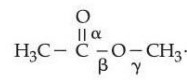
- (A) \(\alpha > \beta > \gamma\)
- (B) \(\alpha < \beta < \gamma\)
- (C) \(\alpha = \beta = \gamma\)
- (D) \(\alpha < \beta = \gamma\)
Show answer and solution
Correct Answer: (B)
In methyl acetate, the \(\alpha\) bond is a \(C=O\) double bond, which is the shortest among the three.
The \(\beta\) bond is a \(C-O\) single bond adjacent to a carbonyl group. Due to resonance (\(CH_3-C(=O)-O-CH_3 \leftrightarrow CH_3-C(-O^-)=O^+-CH_3\)), the \(\beta\) bond acquires partial double bond character, making it shorter than a pure single bond.
The \(\gamma\) bond is a pure \(C-O\) single bond between an \(sp^3\) hybridized carbon and oxygen, with no resonance involvement. Thus, it is the longest bond.
Therefore, the correct order of bond lengths is \(\alpha < \beta < \gamma\).
Answer: \(\alpha < \beta < \gamma\) - 324. The correct increasing order of C-H(A), C-O(B), C=O(C) and \(C \equiv N(D)\) bonds in terms of covalent bond length is: 2026 Easy
- (A) A < B < C < D
- (B) A < D < C < B
- (C) D < C < B < A
- (D) D < C < A < B
Show answer and solution
Correct Answer: (B)
Explanation:
Let us determine the correct order of bond lengths step-by-step by analyzing the two primary factors involved: bond order and atomic size.
1. Effect of Bond Order:
For a given pair of atoms, bond length decreases as the bond order increases because more shared electrons pull the nuclei closer together. Therefore, a triple bond is shorter than a double bond, which is shorter than a single bond: \(\text{Triple} < \text{Double} < \text{Single}\). This explains why the carbonyl double bond \(C=O(C)\) is shorter than the ether single bond \(C-O(B)\).
2. Effect of Atomic Size (The C-H Exception):
When comparing bonds with different atoms, the size of the atoms is crucial. Hydrogen belongs to the first period and has the smallest atomic radius because it possesses only a single \(1s\) orbital shell. Because the hydrogen atom is exceptionally small, the \(C-H(A)\) single bond is uniquely compressed, measuring only around \(107\text{ pm}\). This is shorter than the \(C \equiv N(D)\) triple bond (\(116\text{ pm}\)), where both carbon and nitrogen are larger second-period atoms.
3. Summary of Bond Length Values:
- \(C-H(A)\): \(107\text{ pm}\)
- \(C \equiv N(D)\): \(116\text{ pm}\)
- \(C=O(C)\): \(121\text{ pm}\)
- \(C-O(B)\): \(143\text{ pm}\)
Arranging these values from shortest to longest gives: A < D < C < B.
Hence, Option B is the correct choice. -
- (A) \(6\)
- (B) \(4\)
- (C) \(3\)
- (D) \(5\)
Show answer and solution
Correct Answer: (B)
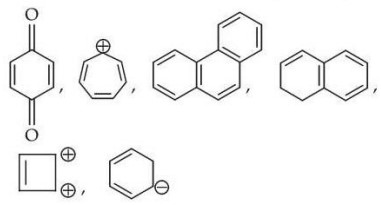
A species is aromatic if it is cyclic, planar, fully conjugated (continuous cyclic overlap of \(p\)-orbitals) and contains \((4n + 2)\,\pi\) electrons (Huckel's rule). Let us analyse each species.
\(1,4\)-Benzoquinone:
The six-membered ring has only \(4\pi\) electrons (from the two \(C=C\) bonds); the two \(C=O\) groups are cross-conjugated and do not contribute to a continuous \((4n + 2)\,\pi\) ring system. Hence, it is non-aromatic.
Tropylium cation:
A planar, cyclic, fully conjugated seven-membered system with three \(C=C\) bonds and a positive charge (empty \(p\)-orbital). It has \(6\,\pi\) electrons, satisfying Huckel's rule with \(n = 1\). It is aromatic.
Phenanthrene:
A fused tricyclic, planar, fully conjugated hydrocarbon with \(14\,\pi\) electrons. It obeys Huckel's rule with \(n = 3\). It is aromatic.
\(1,2\)-Dihydronaphthalene:
It contains an intact benzene ring fused to a partially saturated six-membered ring. Because of the benzene ring, the molecule as a whole is classified as aromatic.
Cyclobutadiene dication:
A planar, four-membered ring with one \(C=C\) bond and two positive charges (two empty \(p\)-orbitals), giving \(2\,\pi\) electrons. It satisfies Huckel's rule with \(n = 0\). It is aromatic.
Cyclohexadienyl anion (as drawn with a \(-CH_2-\) group):
The \(sp^3\) \(-CH_2-\) carbon breaks the continuous cyclic conjugation, so the ring is not fully conjugated. Hence, it is non-aromatic.
Counting the aromatic species: tropylium cation, phenanthrene, \(1,2\)-dihydronaphthalene and cyclobutadiene dication give a total of \(4\) aromatic species.
Hence, the correct option is \((2)\ 4\). - 326. According to Lewis theory, the total number of \(\sigma\) bond-pairs and lone pair of electrons around the central atom of \(XeO_6^{4-}\) ion is _____. 2026 Medium
- (A) 2
- (B) 3
- (C) 6
- (D) 8
Show answer and solution
Correct Answer: (C)
The central atom in \(XeO_6^{4-}\) is Xenon (Xe).
The number of valence electrons in Xe is \(8\).
Let the oxidation state of Xe in \(XeO_6^{4-}\) be \(x\).
\(x + 6(-2) = -4\)
\(x = +8\)
Since the oxidation state of Xe is \(+8\), all \(8\) of its valence electrons are involved in bonding with the \(6\) oxygen atoms. There are no non-bonding electrons left on the central atom.
Number of lone pairs on Xe \(= 0\)
Xe forms \(6\) \(\sigma\) bonds with the \(6\) oxygen atoms (and \(2\) \(\pi\) bonds to satisfy its \(+8\) oxidation state and minimize formal charge).
Number of \(\sigma\) bond-pairs \(= 6\)
Total number of \(\sigma\) bond-pairs and lone pairs around the central atom \(= 6 + 0 = 6\).
Answer: \(6\) -
- (A) 2
- (B) \(0\)
- (C) 1
- (D) 3
Show answer and solution
Correct Answer: (C)
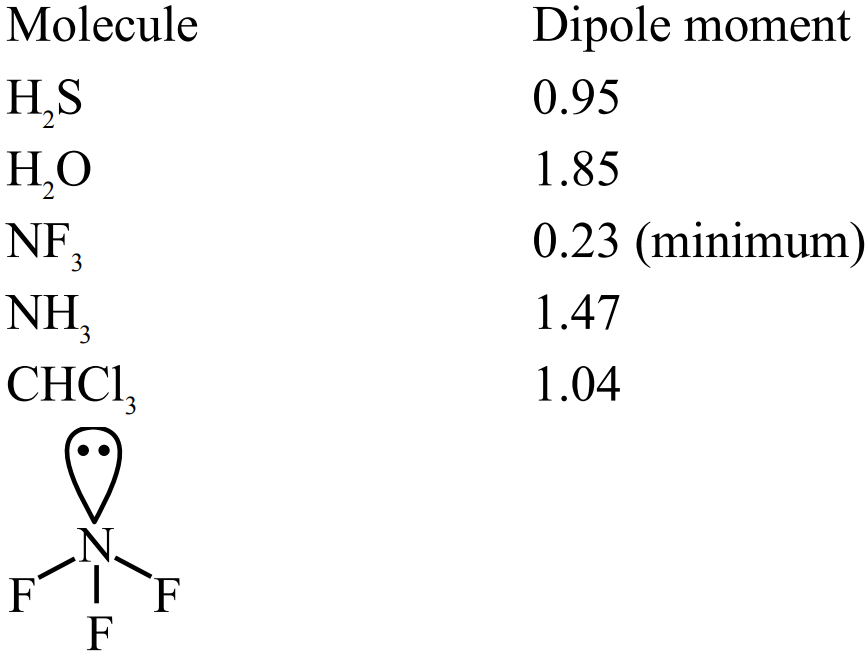
Number of lone pair on central atom = 1 -
- (A) bent, square planar
- (B) linear, square planar
- (C) bent, see-saw
- (D) linear, tetrahedral
Show answer and solution
Correct Answer: (A)
The autoionization of bromine trifluoride is given by the reaction:
\(2\text{BrF}_3 \rightleftharpoons \text{BrF}_2^{\oplus} + \text{BrF}_4^{\ominus}\)
For the cation \(\text{BrF}_2^{\oplus}\):
The central atom Br has \(7\) valence electrons. Due to the positive charge, it has \(7 - 1 = 6\) electrons available.
It forms \(2\) single bonds with F atoms, leaving \(4\) electrons, which constitute \(2\) lone pairs.
Steric number = \(2\) (bond pairs) + \(2\) (lone pairs) = \(4\).
The hybridization is \(sp^3\). With \(2\) bond pairs and \(2\) lone pairs, the shape is bent (or V-shaped).
For the anion \(\text{BrF}_4^{\ominus}\):
The central atom Br has \(7\) valence electrons. Due to the negative charge, it has \(7 + 1 = 8\) electrons available.
It forms \(4\) single bonds with F atoms, leaving \(4\) electrons, which constitute \(2\) lone pairs.
Steric number = \(4\) (bond pairs) + \(2\) (lone pairs) = \(6\).
The hybridization is \(sp^3d^2\). To minimize repulsion, the \(2\) lone pairs occupy opposite (trans) positions in the octahedral geometry, resulting in a square planar shape.
Thus, the shapes of the cation and anion are bent and square planar, respectively.
Answer: bent, square planar -
- (A) 1
- (B) 2
- (C) 3
- (D) 4
Show answer and solution
Correct Answer: (D)
The steric number \(H\) is calculated as \(H = \dfrac{1}{2}(V + M - C + A)\), where \(V\) is the number of valence electrons on the central atom, \(M\) is the number of monovalent atoms, \(C\) is the cationic charge, and \(A\) is the anionic charge.
For \(sp^3d\) hybridization, \(H = 5\).
BrF\(_5\): \(H = \dfrac{1}{2}(7 + 5) = 6\) (\(sp^3d^2\))
XeF\(_5^-\): \(H = \dfrac{1}{2}(8 + 5 + 1) = 7\) (\(sp^3d^3\))
BF\(_4^-\): \(H = \dfrac{1}{2}(3 + 4 + 1) = 4\) (\(sp^3\))
ICl\(_4^-\): \(H = \dfrac{1}{2}(7 + 4 + 1) = 6\) (\(sp^3d^2\))
XeF\(_4\): \(H = \dfrac{1}{2}(8 + 4) = 6\) (\(sp^3d^2\))
SF\(_4\): \(H = \dfrac{1}{2}(6 + 4) = 5\) (\(sp^3d\))
NH\(_4^+\): \(H = \dfrac{1}{2}(5 + 4 - 1) = 4\) (\(sp^3\))
ClF\(_3\): \(H = \dfrac{1}{2}(7 + 3) = 5\) (\(sp^3d\))
XeF\(_2\): \(H = \dfrac{1}{2}(8 + 2) = 5\) (\(sp^3d\))
ICl\(_2^-\): \(H = \dfrac{1}{2}(7 + 2 + 1) = 5\) (\(sp^3d\))
The species with \(sp^3d\) hybridization are SF\(_4\), ClF\(_3\), XeF\(_2\), and ICl\(_2^-\).
The number of such species is \(4\).
Answer: \(4\) -
- (A) A, C and D Only
- (B) A, B and C Only
- (C) A, D and E Only
- (D) A and D Only
Show answer and solution
Correct Answer: (D)
Manganate ion → \(MnO_{4}^{-2}\)
Permanganate ion → \(MnO_{4}^{-}\)
(A) Both are tetrahedral (\(d^{3}s\) Hybridisation)
(B) \(MnO_{4}^{-}\) (+7 oxidation state)
\(MnO_{4}^{2-}\) (+6 oxidation state)
(C) \(Mn^{2+} + S_{2}O_{8}^{2-} \to MnO_{4}^{-}\) (Permanganate ion)
(D) \(MnO_{4}^{-}\) → Diamagnetic
\(MnO_{4}^{2-}\) → Paramagnetic
(E) It is oxidising agent -
- (A) A, B, C, D & E
- (B) B & C only
- (C) B, C & D only
- (D) A, C & D only
Show answer and solution
Correct Answer: (B)
(A) Dipole moment: \( NF_{3} < NH_{3} \)
(B) \( BeH_{2} \) is '\( sp \)' hybridized, linear molecule with zero dipole moment.
(C) \( O_{2}^{-2} \Rightarrow \) bond order = 1;
\( F_{2} \Rightarrow \) bond order = 1
(D) Formal charge on central oxygen atom in \( O_{3} \) is +1.
(E) In \( NO_{2} \); nitrogen does not follow octet rule. -
- (A) Both Statement I and Statement II are true
- (B) Both Statement I and Statement II are false
- (C) Statement I is true but Statement II is false
- (D) Statement I is false but Statement II is true
Show answer and solution
Correct Answer: (A)
Statement I: The standard reduction potential \(E^{\circ}_{\text{Al}^{3+}/\text{Al}}\) is \(-1.66\) V, which is highly negative, indicating that aluminium has a strong tendency to lose electrons and is highly electropositive. The standard reduction potential \(E^{\circ}_{\text{Tl}^{3+}/\text{Tl}}\) is \(+1.26\) V, which is positive, indicating that thallium is less electropositive than aluminium. Thus, Statement I is true.
Statement II: Boron has a very small atomic size, resulting in a very high sum of its first three ionization enthalpies. This high energy requirement prevents boron from losing three electrons to form \(\text{B}^{3+}\) ions, so it forms only covalent compounds. In contrast, aluminium has a larger size and a significantly lower sum of its first three ionization enthalpies, allowing it to easily form \(\text{Al}^{3+}\) ions in its compounds. Thus, Statement II is true.
Both Statement I and Statement II are true.
Answer: Both Statement I and Statement II are true -
- (A) Both Statement I and Statement II are true
- (B) Both Statement I and Statement II are false
- (C) Statement I is true but Statement II is false
- (D) Statement I is false but Statement II is true
Show answer and solution
Correct Answer: (D)
Explanation:
1. Analysis of Statement I: Aluminium reacts with hot aqueous sodium hydroxide (\( \text{NaOH} \)) to form a soluble tetrahydroxoaluminate(III) complex, \( \text{[Al(OH)}_4\text{]}^- \), along with the evolution of hydrogen gas. The balanced chemical equation is:
\( 2\text{Al} + 2\text{NaOH} + 6\text{H}_2\text{O} \rightarrow 2\text{Na}^+[\text{Al(OH)}_4]^- + 3\text{H}_2 \)
Since it forms a monovalent complex ion \( \text{[Al(OH)}_4\text{]}^- \) and not the hexavalent \( \text{[Al(OH)}_6\text{]}^{3-} \), Statement I is false.
2. Analysis of Statement II (Geometry vs Shape): As correctly noted, terms like "square planar", "pyramidal", and "linear" describe the spatial arrangement of the atoms excluding lone pairs, which refers precisely to the molecular shape rather than the total electron-pair geometry:
- For \( \text{ICl}_4^- \): The central iodine atom has 7 valence electrons plus 1 from the negative charge, giving 8 electrons (4 bonding pairs and 2 lone pairs). Its hybridization is \( sp^3d^2 \); its electron geometry is octahedral, but its shape is square planar.
- For \( \text{ClO}_3^- \): The central chlorine atom has 7 valence electrons plus 1 from the negative charge, giving 8 electrons (3 \( \sigma \)-bonds and 1 lone pair). Its hybridization is \( sp^3 \); its electron geometry is tetrahedral, but its shape is trigonal pyramidal.
- For \( \text{IBr}_2^- \): The central iodine atom has 7 valence electrons plus 1 from the negative charge, giving 8 electrons (2 bonding pairs and 3 lone pairs). Its hybridization is \( sp^3d \); its electron geometry is trigonal bipyramidal, but its shape is linear.
Thus, Statement II correctly identifies the molecular shapes of these species, making Statement II true.
Hence, Option D is the correct choice. -
- (A) Both Statement I and Statement II are true
- (B) Both Statement I and Statement II are false
- (C) Statement I is true but Statement II is false
- (D) Statement I is false but Statement II is true
Show answer and solution
Correct Answer: (C)
In Statement I, the bond angle of \(F_2O\) is \(103^{\circ}\), \(H_2O\) is \(104.5^{\circ}\), and \(Cl_2O\) is \(110.9^{\circ}\). The increasing order of bond angle is \(F_2O < H_2O < Cl_2O\). In \(F_2O\), the high electronegativity of fluorine shifts the bond pairs towards fluorine, decreasing bond pair-bond pair repulsion and thus decreasing the bond angle. In \(Cl_2O\), steric hindrance between the large chlorine atoms increases the bond angle. Thus, Statement I is true.
In Statement II, \(SiF_4\) is a covalent compound (it is a gas at room temperature), whereas \(SnF_4\) and \(PbF_4\) are ionic solids. Thus, Statement II is false.
Answer: Statement I is true but Statement II is false -
- (A) Both Statement I and Statement II are true
- (B) Both Statement I and Statement II are false
- (C) Statement I is true but Statement II is false
- (D) Statement I is false but Statement II is true
Show answer and solution
Correct Answer: (D)
Statement I: Number of compounds in which sulphur does not follow the octet rule (from \(SO_2\), \(SO_3\), \(SF_4\), \(SF_6\) and \(H_2S\)).
\(SO_2\): The formal-charge-minimised structure \(O=S=O\) places \(10\) electrons around sulphur (expanded octet).
\(SO_3\): With three \(S=O\) double bonds, sulphur has \(12\) electrons around it (expanded octet).
\(SF_4\): \(4\) bond pairs \(+ 1\) lone pair \(= 10\) electrons around \(S\) (expanded octet).
\(SF_6\): \(6\) bond pairs \(= 12\) electrons around \(S\) (expanded octet).
\(H_2S\): \(2\) bond pairs \(+ 2\) lone pairs \(= 8\) electrons around \(S\) (obeys the octet rule).
Depending on whether formal-charge-minimised structures are used for \(SO_2\) and \(SO_3\), either \(2\) (\(SF_4, SF_6\)) or \(4\) (\(SO_2, SO_3, SF_4, SF_6\)) species violate the octet rule, but the number is never \(3\).
Hence, Statement I is false.
Statement II: Among the given sets, exactly one contains only molecules having one lone pair on the central atom.
Number of lone pairs on the central atom, \(\text{LP} = \dfrac{\text{valence electrons of central atom} - \text{number of bonded monovalent atoms}}{2}\):
\(H_2O\): \(\dfrac{6 - 2}{2} = 2\) lone pairs
\(ClF_3\): \(\dfrac{7 - 3}{2} = 2\) lone pairs
\(SF_4\): \(\dfrac{6 - 4}{2} = 1\) lone pair
\(NH_3\): \(\dfrac{5 - 3}{2} = 1\) lone pair
\(BrF_5\): \(\dfrac{7 - 5}{2} = 1\) lone pair
\(XeF_4\): \(\dfrac{8 - 4}{2} = 2\) lone pairs
Checking the sets:
\(\{H_2O\ (2),\ ClF_3\ (2),\ SF_4\ (1)\}\): not all have \(1\) lone pair.
\(\{NH_3\ (1),\ BrF_5\ (1),\ SF_4\ (1)\}\): all have exactly \(1\) lone pair.
\(\{BrF_5\ (1),\ ClF_3\ (2),\ XeF_4\ (2)\}\): not all have \(1\) lone pair.
\(\{XeF_4\ (2),\ ClF_3\ (2),\ H_2O\ (2)\}\): not all have \(1\) lone pair.
Exactly one set satisfies the condition, so Statement II is true.
Hence, Statement I is false but Statement II is true, which corresponds to option \((4)\). -
- (A) Both Statement I and Statement II are true
- (B) Both Statement I and Statement II are false
- (C) Statement I is true but Statement II is false
- (D) Statement I is false but Statement II is true
Show answer and solution
Correct Answer: (C)
The bond order of the given oxygen species can be calculated using molecular orbital theory:
For \(O_2\) (16 electrons), the configuration is Sigma 1s2, Sigma* 1s2, Sigma 2s2, Sigma* 2s2, Sigma 2pz2, (Pi 2px2, Pi 2py2), (Pi* 2px1, Pi* 2py1 .
Bond order = \(\dfrac{10 - 6}{2} = 2\). Number of unpaired electrons = \(2\).
For \(O_2^+\) (15 electrons), one electron is removed from a \(\pi^{*}\) orbital.
Bond order = \(\dfrac{10 - 5}{2} = 2.5\). Number of unpaired electrons = \(1\).
For \(O_2^-\) (17 electrons), one electron is added to a \(\pi^{*}\) orbital.
Bond order = \(\dfrac{10 - 7}{2} = 1.5\). Number of unpaired electrons = \(1\).
For \(O_2^{2-}\) (18 electrons), two electrons are added to the \(\pi^{*}\) orbitals.
Bond order = \(\dfrac{10 - 8}{2} = 1\). Number of unpaired electrons = \(0\).
Since bond length is inversely proportional to bond order, the correct sequence of bond lengths is \(O_2^+ < O_2 < O_2^- < O_2^{2-}\). Thus, Statement I is true.
The number of unpaired electrons for the species are \(2, 1, 1,\) and \(0\) respectively. The correct sequence is \(O_2 > O_2^+ = O_2^- > O_2^{2-}\). Thus, Statement II is false.
Answer: Statement I is true but Statement II is false -
- (A) Statement I is true but Statement II is false
- (B) Both Statement I and Statement II are false
- (C) Statement I is false but Statement II is true
- (D) Both Statement I and Statement II are true
Show answer and solution
Correct Answer: (C)
Statement-I:
\( SF_{4} \) (See-saw),
\( XeF_{4} \) (square planar),
\( [PtCl_{4}]^{2-} \) (square planar),
\( [NiCl_{4}]^{2-} \) (Tetrahedral),
\( [Ni(CN)_{4}]^{2-} \) (square planar),
\( SeF_{4} \) (See-saw),
\( NH_{4}^{+} \) (Tetrahedral).
Statement-II:
\( NO_{2} \) (seven electrons on N) ,
\( BeH_{2} \) (four electrons on Be) ,
\( BF_{3} \) (six electrons on B) ,
\( AlCl_{3} \) (six electrons on Al). -
- (A) Both Statement I and Statement II are false
- (B) Both Statement I and Statement II are true
- (C) Statement I is true but Statement II is false
- (D) Statement I is false but Statement II is true
Show answer and solution
Correct Answer: (A)
In \(BF _4^{-}, SiF _4\) and \(XeF _4\) all bond lengths are identicalMolecules B.O. \(O _2^{+}\) → 2.5 \(O_2^{-}\) → 1.5 \(O _2^{2-}\) → 1 \(F_2\) → 1 -
- (A) \(120^{\circ}\)
- (B) \(107^{\circ}\)
- (C) \(102^{\circ}\)
- (D) \(116^{\circ}\)
Show answer and solution
Correct Answer: (C)
\(N F _{ 3 }\)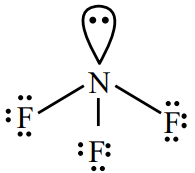 , hybridization : \(sp ^3\)
Number of lone pair in \(NF _3=10\)
Bond angle in \(NF _3 \approx 102^{\circ}\) -
- (A) A-II, B-I, C-III, D-IV
- (B) A-II, B-III, C-IV, D-I
- (C) A-II, B-III, C-I, D-IV
- (D) A-II, B-II, C-IV, D-I
Show answer and solution
Correct Answer: (B)
\(XeF_{2}\) & \(I_{3}^{-}\): 2 bond pair 3 lone pair; Linear
\(XeOF_{4}\) & \(BrF_{5}\): 5 bond pair 1 lone pair; Square pyramidal
\(XeO_{2}F_{2}\) & \(SF_{4}\): 4 bond pair 1 lone pair; See saw
\(XeO_{3}\) & \(NH_{3}\): 3 bond pair 1 lone pair; Pyramidal - 341. Pair of species among the following having same bond order as well as paramagnetic character will be - 2026 Hard
- (A) \(O_{2}^{+}, N_{2}^{2-}\)
- (B) \(O_{2}^{-}, N_{2}^{+}\)
- (C) \(O_{2}^{+}, N_{2}^{-}\)
- (D) \(O_{2}^{-}, N_{2}\)
Show answer and solution
Correct Answer: (C)
Species Bond order Magnetic Nature \(O _2^{+}\) 2.5 Paramagnetic \(O _2^{-}\) 1.5 Paramagnetic \(O _2^{+}\) 2.5 Paramagnetic \(N _2^{-}\) 2.5 Paramagnetic \(N _2^{2-}\) 2 Paramagnetic -
- (A) C Only
- (B) C and E Only
- (C) A and D Only
- (D) B and E Only
Show answer and solution
Correct Answer: (B)
In \(SF_4\), the central sulphur atom has \(6\) valence electrons. It forms \(4\) sigma bonds with fluorine atoms and has \(1\) lone pair. The steric number is \(5\), corresponding to \(sp^3d\) hybridization, and the shape is see-saw.
In \(BrF_4^{\ominus}\), the central bromine atom has \(8\) valence electrons (\(7 + 1\)). It forms \(4\) sigma bonds and has \(2\) lone pairs. The steric number is \(6\), corresponding to \(sp^3d^2\) hybridization, and the shape is square planar.
In \(CH_4\), the central carbon atom has \(4\) valence electrons. It forms \(4\) sigma bonds and has \(0\) lone pairs. The steric number is \(4\), corresponding to \(sp^3\) hybridization, and the shape is tetrahedral.
In \(IF_4^{\oplus}\), the central iodine atom has \(6\) valence electrons (\(7 - 1\)). It forms \(4\) sigma bonds and has \(1\) lone pair. The steric number is \(5\), corresponding to \(sp^3d\) hybridization, and the shape is see-saw.
In \(XeF_4\), the central xenon atom has \(8\) valence electrons. It forms \(4\) sigma bonds and has \(2\) lone pairs. The steric number is \(6\), corresponding to \(sp^3d^2\) hybridization, and the shape is square planar.
In \(XeO_2F_2\), the central xenon atom has \(8\) valence electrons. It forms \(4\) sigma bonds (\(2\) with oxygen, \(2\) with fluorine), \(2\) pi bonds, and has \(1\) lone pair. The steric number is \(5\), corresponding to \(sp^3d\) hybridization, and the shape is see-saw.
Therefore, \(IF_4^{\oplus}\) and \(XeO_2F_2\) are isostructural with \(SF_4\).
Answer: C and E Only - 343. The formal charges on the atoms marked as (1) to (4) in the Lewis representation of \(HNO_{3}\) molecule respectively are
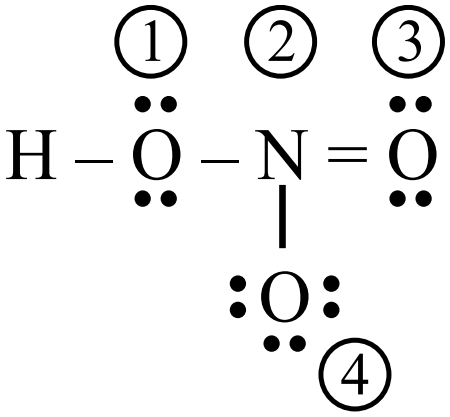 2026 Hard
- (A) +1, 0, 0, -1
- (B) 0, -1, 0, +1
- (C) 0, +1, 0, -1
- (D) 0, 0, -1, +1
Show answer and solution
Correct Answer: (C)
Consider the structure of \(HNO_{3}\)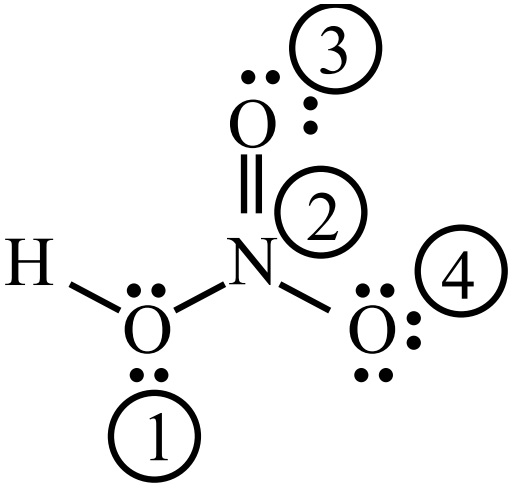
\(1 : 0\)
\(2 : (+1)\)
\(3 : 0\)
\(4 : (-1)\)
Formal charge = valence e's - non bonding e's - \(\left(\frac{\text { bonding electrons }}{2}\right)\) -
- (A) A, B and E
- (B) A and E
- (C) B, C and D
- (D) C and D
Show answer and solution
Correct Answer: (B)
Species with the same number of valence electrons and the same skeletal structure generally have similar Lewis dot structures (isoelectronic species).
For pair A: \(\text{SO}_3^{2-}\) has \(6 + 3(6) + 2 = 26\) valence electrons. \(\text{CO}_3^{2-}\) has \(4 + 3(6) + 2 = 24\) valence electrons. Since they have different numbers of valence electrons, they do not have similar Lewis dot structures (\(\text{SO}_3^{2-}\) has a lone pair on the central atom and is pyramidal, while \(\text{CO}_3^{2-}\) has no lone pair on the central atom and is trigonal planar).
For pair B: \(\text{O}_2^{2-}\) has \(2(6) + 2 = 14\) valence electrons. \(\text{F}_2\) has \(2(7) = 14\) valence electrons. Both have a single bond and three lone pairs on each atom, so they have similar Lewis dot structures.
For pair C: \(\text{CN}^-\) has \(4 + 5 + 1 = 10\) valence electrons. \(\text{CO}\) has \(4 + 6 = 10\) valence electrons. Both have a triple bond and one lone pair on each atom, so they have similar Lewis dot structures.
For pair D: \(\text{NH}_3\) has \(5 + 3(1) = 8\) valence electrons. \(\text{H}_3\text{O}^+\) has \(6 + 3(1) - 1 = 8\) valence electrons. Both have three single bonds and one lone pair on the central atom, so they have similar Lewis dot structures.
For pair E: \(\text{MnO}_4^{2-}\) has \(7 + 4(6) + 2 = 33\) valence electrons. \(\text{CrO}_4^{2-}\) has \(6 + 4(6) + 2 = 32\) valence electrons. Since they have different numbers of valence electrons (\(\text{MnO}_4^{2-}\) has an unpaired electron), they do not have similar Lewis dot structures.
Thus, pairs A and E do not have similar Lewis dot structures.
Answer: A and E -
- (A) B, C and E only
- (B) B and D only
- (C) A and D only
- (D) B, D and E only
Show answer and solution
Correct Answer: (A)
(A)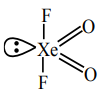
(B) Xe has 7 electron pair in its valence shell
(C) O-Xe-O Bond angle is close to \( 120^{\circ} \)
(D) F-Xe-F Bond angle is close to \( 180^{\circ} \)
(E) Xe has 14 valence electron in \( XeO_{2}F_{2}\) -
- (A) 7 and 5
- (B) 5 and 6
- (C) 5 and 7
- (D) 6 and 7
Show answer and solution
Correct Answer: (C)
Least metallic \(= F\), valence electrons \(= 7\)
Most metallic \(= P\), valence electrons \(= 5\) -
- (A) 5
- (B) 2
- (C) 3
- (D) 4
Show answer and solution
Correct Answer: (D)
Step-by-step Solution:
Total energy required to convert 1 mole of \( \text{Li(g)} \) to \( \text{Li}^{2+}(\text{g}) \) is the sum of the first and second ionization enthalpies:
\( E_{\text{total}} = IE_1 + IE_2 \)
= \( 520 + 7297 = 7817\text{ kJ mol}^{-1} \)
Given mass of lithium = \( 3.5\text{ mg} = 3.5 \times 10^{-3}\text{ g} \)
Molar mass of Lithium = \( 7\text{ g mol}^{-1} \)
Number of moles of lithium (\( n \)):
\( n = \frac{3.5 \times 10^{-3}\text{ g}}{7\text{ g mol}^{-1}} = 5 \times 10^{-4}\text{ mol} \)
Total energy required for \( 5 \times 10^{-4}\text{ mol} \) of Lithium:
\( \text{Energy (in kJ)} = 5 \times 10^{-4}\text{ mol} \times 7817\text{ kJ mol}^{-1} = 3.9085\text{ kJ} \)
Converting the energy into Joules (\( \text{J} \)) to match the options:
\( \text{Energy (in J)} = 3.9085 \times 10^3\text{ J} = 3908.5\text{ J} \)
Rounding off to the nearest integer, we get \( 3909 \).
Correct Option: D (3909) -
- (A) Statement-I is false but Statement-II is true
- (B) Both Statement-I and Statement-II are true.
- (C) Both Statement-I and Statement-II are false.
- (D) Statement-I is true but Statement-II is false.
Show answer and solution
Correct Answer: (B)
\(\xrightarrow[Z_{\text {eff }} \uparrow I . E . \uparrow]{\begin{array}{l}C<O<N<F \\ 2 p^2 2 p^4 2 p^3 2 p^5\end{array}}\)
Statement-I is correct
\(S > Se > Te > Po > O\)
\(
\left|\Delta_{eg} H\right| \quad \begin{array}{lllll}
200 & 195 & 190 & 174 & 141(in kJ / mol)
\end{array}
\)
Statement-II is correct. -
- (A) Both Statement I and Statement II are true
- (B) Both Statement I and Statement II are false
- (C) Statement I is false but Statement II is true
- (D) Statement I is true but Statement II is false
Show answer and solution
Correct Answer: (D)
Metallic character of s-block elements is greater than p-block elements.
Anionic radius is greater than atomic radius but cationic radius is always less than atomic radius for any element. -
- (A) Both Statement I and Statement II are true
- (B) Both Statement I and Statement II are false
- (C) Statement I is true but Statement II is false
- (D) Statement I is false but Statement II is true
Show answer and solution
Correct Answer: (D)
The first ionisation enthalpy generally increases across a period from left to right due to an increase in effective nuclear charge. For the third period elements \(\text{Na}\), \(\text{Mg}\), \(\text{Cl}\), and \(\text{Ar}\), the correct order of first ionisation enthalpy is \(\text{Ar} > \text{Cl} > \text{Mg} > \text{Na}\). Thus, Statement I is false.
The electronic configuration of \(\text{Ca}\) is \([\text{Ar}] 4s^2\). After the removal of two electrons, \(\text{Ca}^{2+}\) attains the highly stable noble gas configuration of Argon \([\text{Ar}]\). Removing a third electron requires breaking this stable noble gas core, which requires a very large amount of energy. Therefore, the third ionisation enthalpy of \(\text{Ca}\) is exceptionally high compared to \(\text{Al}\), \(\text{Fe}\), and \(\text{B}\). Thus, Statement II is true.
Answer: Statement I is false but Statement II is true
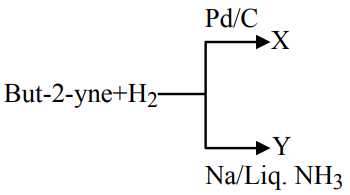

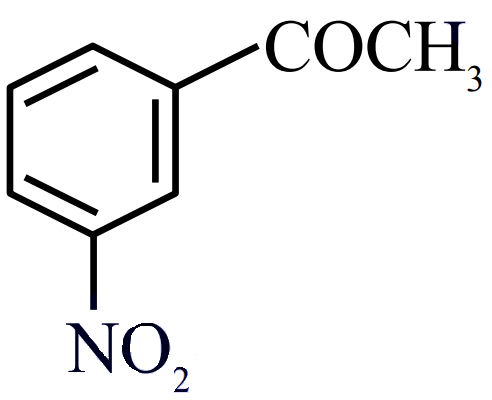
No questions on this page match these filters.