


Questions
16 questionsShowing 1–16 of 16 questions
-
- (A) \((2.7 \times 10^{-5})^3\)
- (B) \(6 \times 10^{-2}\)
- (C) \(\sqrt{2.7 \times 10^{-5}}\)
- (D) \(3 \times 10^{-2}\)
Show answer and solution
Correct Answer: (D)
For the reaction \(A_2(g) + B_2(g) \rightleftharpoons C(g)\), the equilibrium constant is \(K_1 = 2.7 \times 10^{-5}\).
When a reaction is multiplied by a factor \(n\), the new equilibrium constant becomes \(K^n\).
The given reaction is multiplied by \(\dfrac{1}{3}\) to obtain the reaction \(\dfrac{1}{3}A_2(g) + \dfrac{1}{3}B_2(g) \rightleftharpoons \dfrac{1}{3}C(g)\).
The new equilibrium constant \(K_2\) is given by:
\(K_2 = (K_1)^{1/3}\)
\(K_2 = (2.7 \times 10^{-5})^{1/3}\)
\(K_2 = (27 \times 10^{-6})^{1/3}\)
\(K_2 = 3 \times 10^{-2}\)
Answer: \(3 \times 10^{-2}\) -
- (A) 2.67, 2.67, 2.67
- (B) 1.21, 2.24, 1.56
- (C) 1.66, 1.66, 1.66
- (D) 2.56, 1.62, 2.24
Show answer and solution
Correct Answer: (A)
\(\underset {t = t_{eq}}{} ~\underset {2 ~mole}{P_2(g)} +~\underset {2 ~mole}{Q_2(g)} \rightleftharpoons ~\underset {2 ~mole}{2PQ(g)}\)
\(K _{ eq }=\frac{2^2}{2.2}=1\)
Now 1 mole of each \(P_2\) and \(Q_2\) is added
So reaction will move in forward direction
\(\underset {t = t'_{eq}}{} ~\underset {3 ~-~x}{P_2(g)} +~\underset {3 ~-~x}{Q_2(g)} \rightleftharpoons ~\underset {2 ~+~2x}{2PQ(g)}\)
\(K_{c}=1=\frac{(2+2x)^{2}}{(3-x)(3-x)}\)
\(\frac{2+2x}{3-x}=1\)
\(2+2x=3-x\)
\(x=\frac{1}{3}\)
At new equilibrium
Moles of \(P_{2}=\frac{8}{3}=2.67\)
Moles of \(Q_{2}=\frac{8}{3}=2.67\)
Moles of \(PQ=\frac{8}{3}=2.67\) -
- (A) \(2.5\times 10^{-3}\)
- (B) \(2.5\times 10^{3}\)
- (C) \(1.0\times 10^{-5}\)
- (D) \(5\times 10^{-3}\)
Show answer and solution
Correct Answer: (C)
The given reactions are:
\(2xy \rightleftharpoons x_2 + y_2 \quad K_1 = 2.5 \times 10^5\)
\(xy + \dfrac{1}{2}z_2 \rightleftharpoons xyz \quad K_2 = 5 \times 10^{-3}\)
We need to find the equilibrium constant \(K_3\) for the reaction:
\(\dfrac{1}{2}x_2 + \dfrac{1}{2}y_2 + \dfrac{1}{2}z_2 \rightleftharpoons xyz\)
Reversing the first reaction and multiplying it by \(\dfrac{1}{2}\), we get:
\(\dfrac{1}{2}x_2 + \dfrac{1}{2}y_2 \rightleftharpoons xy\)
The equilibrium constant for this modified reaction is:
\(K' = \left(\dfrac{1}{K_1}\right)^{\dfrac{1}{2}} = \dfrac{1}{\sqrt{K_1}}\)
Adding this modified reaction to the second reaction:
\(\dfrac{1}{2}x_2 + \dfrac{1}{2}y_2 \rightleftharpoons xy \quad (K')\)
\(xy + \dfrac{1}{2}z_2 \rightleftharpoons xyz \quad (K_2)\)
---------------------------------------------------
\(\dfrac{1}{2}x_2 + \dfrac{1}{2}y_2 + \dfrac{1}{2}z_2 \rightleftharpoons xyz\)
The equilibrium constant \(K_3\) for the overall reaction is the product of the equilibrium constants of the added reactions:
\(K_3 = K' \times K_2 = \dfrac{K_2}{\sqrt{K_1}}\)
Substituting the given values:
\(K_3 = \dfrac{5 \times 10^{-3}}{\sqrt{2.5 \times 10^5}}\)
\(K_3 = \dfrac{5 \times 10^{-3}}{\sqrt{25 \times 10^4}}\)
\(K_3 = \dfrac{5 \times 10^{-3}}{5 \times 10^2}\)
\(K_3 = 1.0 \times 10^{-5}\)
Answer: \(1.0\times 10^{-5}\) -
- (A) (i) 3, 1; (ii) 3, 1
- (B) (i) 4, 1; (ii) 4, 1
- (C) (i) 1, 3; (ii) 2, 1
- (D) (i) 1, 2; (ii) 2, 1
Show answer and solution
Correct Answer: (D)
For reaction (i): \(K _{ p }> K _{ c }\)
\(\Delta n _{ g }>0\)
\(y-x>0\)
\(85.87=2.586(0.0821 \times 400)^{y \times}\)
Solving \(y-x \simeq 1\)
For reaction (ii) : \(K _{ p }< K _{ c }\)
\( y-x<0\). -
- (A) 100
- (B) 125
- (C) 150
- (D) 200
Show answer and solution
Correct Answer: (B)
\(NH _{3(g)} \rightleftharpoons \frac{1}{2} N_{2(g)}+\frac{3}{2} H _{2(g)}\)
\(t=0\)\(\quad\)1mole\(\quad\quad\)—\(\quad\quad\)—
\(t = t _{ eq }\)\(\quad\)\(1-\alpha\)\(\quad\)\(\alpha / 2\)\(\quad\)\(3 \alpha / 2\)
\(k _{ p }=\frac{\left(\frac{\alpha}{2}\right)^{1 / 2}\left(\frac{3 \alpha}{2}\right)^{3 / 2}}{(1-\alpha)}\left[\frac{ P _{ T }}{1+\alpha}\right]^1\)\(\quad\)\(\left[\because P _{ T }=\sqrt{3} atm\right]\)
\(9=\frac{\left(\frac{\alpha}{2}\right)^{1 / 2}\left(\frac{3 \alpha}{2}\right)^{3 / 2}}{(1-\alpha)} \times \frac{(3)^{1 / 2}}{1+\alpha}\)
\(9=\frac{9\left(\frac{\alpha}{2}\right)^2}{1-\alpha^2}\)
\(1-\alpha^2=\frac{\alpha^2}{4}\)
\(\frac{5 \alpha^2}{4}=1\)
\(\alpha^2=0.8\)
\(\alpha=(0.8)^{1 / 2}\)
\(\alpha=\left[\frac{1}{0.8}\right]^{-1 / 2}\)
\(\begin{array}{l}\alpha=\left[125 \times 10^{-2}\right]^{-1 / 2} \\ x=125\end{array}\) -
- (A) 2472
- (B) 2473
- (C) 2474
- (D) 2475
Show answer and solution
Correct Answer: (C)
Let the initial moles of \(N_2O_5\) be \(2\).
The given reaction is:
\(2N_2O_5(g) \rightleftharpoons 2N_2O_4(g) + O_2(g)\)
Since \(N_2O_5\) is \(50\%\) dissociated (degree of dissociation \(\alpha = 0.5\)), the moles at equilibrium are:
Moles of \(N_2O_5 = 2(1 - 0.5) = 1\)
Moles of \(N_2O_4 = 2(0.5) = 1\)
Moles of \(O_2 = 0.5\)
Total moles at equilibrium \(= 1 + 1 + 0.5 = 2.5\)
Given the total pressure \(P = 2\) atm, the partial pressures of the gases are:
\(P_{N_2O_5} = \dfrac{1}{2.5} \times 2 = 0.8\) atm
\(P_{N_2O_4} = \dfrac{1}{2.5} \times 2 = 0.8\) atm
\(P_{O_2} = \dfrac{0.5}{2.5} \times 2 = 0.4\) atm
The equilibrium constant \(K_p\) is:
\(K_p = \dfrac{(P_{N_2O_4})^2 \cdot P_{O_2}}{(P_{N_2O_5})^2} = \dfrac{(0.8)^2 \times 0.4}{(0.8)^2} = 0.4\)
The standard free energy change \(\Delta G^\circ\) is given by:
\(\Delta G^\circ = -RT \ln K_p\)
Using the given values:
\(\ln(0.4) = 2.303 \log(0.4) = 2.303 (\log 4 - \log 10)\)
\(\ln(0.4) = 2.303 (2 \log 2 - 1) = 2.303 (2 \times 0.30 - 1) = 2.303 (-0.4) = -0.9212\)
Now, substituting the values into the \(\Delta G^\circ\) equation (\(T = 50^\circ C + 273 = 323\) K):
\(\Delta G^\circ = -8.314 \times 323 \times (-0.9212)\)
\(\Delta G^\circ = 2473.81\) J mol\(^{-1}\)
The magnitude of the standard free energy change to the nearest integer is \(2474\) J mol\(^{-1}\).
Answer: \(2474\) -
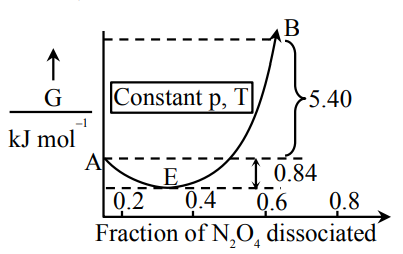
- (A) D and E only
- (B) C and E only
- (C) A and D only
- (D) B and C only
Show answer and solution
Correct Answer: (A)

(A) \( \Delta_{r}G^{\circ} = G^{\circ}_{B} - G^{\circ}_{A} = +ve \)
(B) \( \Delta_{r}G^{\circ} = +ve \). \( N_{2}O_{4} \) will partially dissociate into \( NO_{2} \).
(C) For reverse reaction, It is partially completed as there is equilibrium at E.
(D) For 1 mole \( N_{2}O_{4} \) ; \( \Delta_{r}G^{\circ} = -0.84 \, kJ \, mol^{-1} \).
(E) For 2 mole \( NO_{2} \) ; \( \Delta G^{\circ} = -5.4 - 0.84 = -6.24 \, kJ \, mol^{-1} \). -
- (A) 8
- (B) 10
- (C) 12
- (D) 14
Show answer and solution
Correct Answer: (A)
The given equilibrium reaction is:
\(\text{X}_2\text{Y}_4(g) \rightleftharpoons 2\text{XY}_2(g)\)
Initial moles: \(1\)
Degree of dissociation, \(\alpha = 0.75\)
Moles of \(\text{X}_2\text{Y}_4\) at equilibrium \(= 1 - \alpha = 1 - 0.75 = 0.25\)
Moles of \(\text{XY}_2\) at equilibrium \(= 2\alpha = 2 \times 0.75 = 1.5\)
Total moles at equilibrium \(= 0.25 + 1.5 = 1.75\)
Given total pressure, \(P = 1\) atm.
Partial pressure of \(\text{X}_2\text{Y}_4\), \(P_{\text{X}_2\text{Y}_4} = \dfrac{0.25}{1.75} \times 1 = \dfrac{1}{7}\) atm
Partial pressure of \(\text{XY}_2\), \(P_{\text{XY}_2} = \dfrac{1.5}{1.75} \times 1 = \dfrac{6}{7}\) atm
The equilibrium constant \(K_p\) is given by:
\(K_p = \dfrac{(P_{\text{XY}_2})^2}{P_{\text{X}_2\text{Y}_4}} = \dfrac{(\dfrac{6}{7})^2}{\dfrac{1}{7}} = \dfrac{36}{7}\)
The standard Gibbs free energy change is:
\(\Delta_r G^{\ominus} = -RT \ln K_p = -2.3 RT \log K_p\)
Calculating \(\log K_p\):
\(\log \left(\dfrac{36}{7}\right) = \log 36 - \log 7 = \log (2^2 \times 3^2) - \log 7\)
\(\log \left(\dfrac{36}{7}\right) = 2 \log 2 + 2 \log 3 - \log 7\)
\(\log \left(\dfrac{36}{7}\right) = 2(0.3) + 2(0.48) - 0.84 = 0.6 + 0.96 - 0.84 = 0.72\)
Substituting the values into the \(\Delta_r G^{\ominus}\) equation:
\(\Delta_r G^{\ominus} = -2.3 \times 8.3 \times 600 \times 0.72\)
\(\Delta_r G^{\ominus} = -8246.88 \text{ J mol}^{-1} = -8.24688 \text{ kJ mol}^{-1}\)
The magnitude of \(\Delta_r G^{\ominus}\) is \(8.24688 \text{ kJ mol}^{-1}\).
Rounding to the nearest integer, we get \(8\).
Answer: \(8\) -
- (A) 0.367, 0.275
- (B) 0.53, 0.4
- (C) 0.742, 0.557
- (D) 0.557, 0.418
Show answer and solution
Correct Answer: (D)
\(\begin{array}{ccc} A & \rightleftharpoons & B \\ 0.5 M & & 0.375 M \end{array} \quad\) (At equilibrium)
\(K_{eq} = \frac{[B]_{eq}}{[A]_{eq}} = \frac{0.375}{0.5} = 0.75\)
Now 0.1 mole of A is added so reaction will move in forward direction.
\(A \rightleftharpoons B\)
\(0.6 - x\) \(0.375 + x\)
\(K_{eq} = 0.75 = \frac{0.375 + x}{0.6 - x}\)
\(0.45 - 0.75x = 0.375 + x\)
\(1.75x = 0.075\)
\(x = \frac{0.075}{1.75} = \frac{3}{70} = 0.043\)
Moles of \(A =0.043=0.557\)
Moles of \(B =0.418\) -
- (A) \(3.28, 2.624\)
- (B) \(2.624, 3.28\)
- (C) \(3.28, 0.656\)
- (D) \(0.656, 6.56\)
Show answer and solution
Correct Answer: (A)
The given reaction is \(A(g) \rightleftharpoons B(g)\).
Let the initial moles of \(A\) be \(1\) and at equilibrium, let \(x\) moles of \(A\) dissociate.
Moles at equilibrium:
\(n_A = 1 - x\)
\(n_B = x\)
Since \(\Delta n_g = 0\), the equilibrium constant \(K_c\) can be written in terms of moles:
\(K_c = \dfrac{n_B}{n_A} = \dfrac{x}{1 - x} = 4.0\)
\(x = 4 - 4x \Rightarrow 5x = 4 \Rightarrow x = 0.8\)
At equilibrium, the moles of the gases are:
\(n_{He} = 1\)
\(n_B = 0.8\)
Using the ideal gas equation \(P = \dfrac{nRT}{V}\), the partial pressures are calculated as follows:
Partial pressure of He:
\(P_{He} = \dfrac{1 \times 0.082 \times 400}{10} = 3.28\) atm
Partial pressure of \(B(g)\):
\(P_B = \dfrac{0.8 \times 0.082 \times 400}{10} = 2.624\) atm
Answer: \(3.28, 2.624\) -
- (A) 2
- (B) 4
- (C) 6
- (D) 8
Show answer and solution
Correct Answer: (B)
For the first equilibrium:
\(\text{CaCO}_3(s) \rightleftharpoons \text{CaO}(s) + \text{CO}_2(g)\)
\(K_{p_1} = P_{\text{CO}_2} = 0.08 \text{ atm}\)
For the second equilibrium:
\(\text{C}(s) + \text{CO}_2(g) \rightleftharpoons 2\text{CO}(g)\)
\(K_{p_2} = \dfrac{(P_{\text{CO}})^2}{P_{\text{CO}_2}} = 2 \text{ atm}\)
Substituting the value of \(P_{\text{CO}_2}\):
\(\dfrac{(P_{\text{CO}})^2}{0.08} = 2\)
\((P_{\text{CO}})^2 = 0.16\)
\(P_{\text{CO}} = 0.4 \text{ atm} = 4 \times 10^{-1} \text{ atm}\)
Answer: \(4\) -
- (A) 100
- (B) 10
- (C) 1
- (D) 0.1
Show answer and solution
Correct Answer: (A)
\(H _2 X \rightleftharpoons H ^{+}+ HX ^{-}\),
\(0.1-x \quad x+y \quad x-y\)
\(2.5 \times 10^{-8}=\frac{(x+y)(x-y)}{0.1-x}\)
\(HX ^{-} \rightleftharpoons H ^{+}+ X ^{2-}\)
\(x-y \quad x+y \quad y\)
\(1 \times 10^{-13}=\frac{( x + y )( y )}{ x - y }\)
Approximate : \(K _{ a _1} \gg K_{ a _2} \Rightarrow\) So \(x \gg y\).
\(x + y \approx x , x - y \approx x\)
\(10^{-13}=\frac{x \cdot y}{x}\)
\(y=10^{-13}\)
\(\left[ X ^{2-}\right]=10^{-13}\)
\(\left[ X ^{2-}\right]=100 \times 10^{-15}\) -
- (A) \(\dfrac{x^2}{a^2 + x^2} \times p\)
- (B) \(\dfrac{x^2}{a^2 - x^2} \times p\)
- (C) \(\dfrac{a + x^2}{x^2} \times p\)
- (D) \(\dfrac{a^2 - x^2}{x^2} \times p\)
Show answer and solution
Correct Answer: (B)
The reaction is \(A(g) \rightleftharpoons B(g) + C(g)\)
Initial moles: \(a\) for \(A\), \(0\) for \(B\), \(0\) for \(C\)
Moles at equilibrium: \((a - x)\) for \(A\), \(x\) for \(B\), \(x\) for \(C\)
Total moles at equilibrium \(= (a - x) + x + x = a + x\)
Partial pressures at equilibrium:
\(p_A = \dfrac{a - x}{a + x} p\)
\(p_B = \dfrac{x}{a + x} p\)
\(p_C = \dfrac{x}{a + x} p\)
The equilibrium constant \(K_p\) is given by:
\(K_p = \dfrac{p_B \cdot p_C}{p_A}\)
\(K_p = \dfrac{\left(\dfrac{x}{a + x} p\right) \left(\dfrac{x}{a + x} p\right)}{\dfrac{a - x}{a + x} p}\)
\(K_p = \dfrac{x^2}{(a + x)(a - x)} p\)
\(K_p = \dfrac{x^2}{a^2 - x^2} p\)
Answer: \(\dfrac{x^2}{a^2 - x^2} \times p\) -
- (A) 215
- (B) 220
- (C) 225
- (D) 230
Show answer and solution
Correct Answer: (D)
According to the van 't Hoff equation:
\(\log_{10} K_p = -\dfrac{\Delta H^\circ}{2.303 R} \left(\dfrac{1}{T}\right) + \dfrac{\Delta S^\circ}{2.303 R}\)
This represents a linear equation \(y = mx + c\), where \(y = \log_{10} K_p\) and \(x = \dfrac{1}{T}\). The slope \(m\) of the line is given by:
\(m = -\dfrac{\Delta H^\circ}{2.303 R}\)
From the given data table, we can calculate the slope \(m\) using any two points, for example \((0.05, 3.5)\) and \((0.06, 2.5)\):
\(m = \dfrac{y_2 - y_1}{x_2 - x_1} = \dfrac{2.5 - 3.5}{0.06 - 0.05} = \dfrac{-1.0}{0.01} = -100\)
Equating the calculated slope to the theoretical slope:
\(-\dfrac{\Delta H^\circ}{2.303 R} = -100\)
\(\dfrac{\Delta H^\circ}{R} = 100 \times 2.303 = 230.3\)
The magnitude of \(\dfrac{\Delta H^\circ}{R}\) is \(230.3\). Rounding to the nearest integer, we get \(230\).
Answer: \(230\) -
- (A) 60
- (B) 70
- (C) 80
- (D) 90
Show answer and solution
Correct Answer: (B)
\(A _2+ B _2 \xrightarrow{500 K} 2 AB \log K =2.2\)
\(\Delta H ^{\circ}=(2 \times 32)-(6+ x )=(58- x ) kJ\)
\(\Delta S ^{\circ}=(2 \times 222)-(146+280)=18\) Joule
\(\Delta G ^{\circ}=- RT \ln K\)
\(\Delta G ^{\circ}=-\frac{8.314 \times 500 \times 2.2 \times 2.303}{1000}\)
\(\Delta G ^{\circ}=-21.06\)
\(58-x-500\left(\frac{18}{1000}\right)=-21.06\)
\(x =70.06 KJ / mol\) -
- (A) 12
- (B) 15
- (C) 18
- (D) 20
Show answer and solution
Correct Answer: (B)
\(X _2(g)+ Y _2(g) \rightleftharpoons 2 Z ( g )\)
\(K_C=\frac{(9)^2}{3 \times 3}=9\)
Now 10 moles of \(Z\) are added then reaction will move in backward direction.
\(X _2(g)+ Y _2(g) \rightleftharpoons 2 Z ( g )\)
\(3+X \quad 3+X \quad 19-2 X\)
\(K_c=\frac{(19-2 X)^2}{(3+X)(3+X)}=9\)
\(\frac{19-2 X}{3+X}=3\)
\(19-2 X=9+3 X\)
\(\begin{array}{l}10=5 X \\ X=2\end{array}\)
At equilibrium ⇒ moles of \(Z=19-2 \times 2\)
\(=15\) moles
No questions on this page match these filters.