


Questions
13 questionsShowing 1–13 of 13 questions
-
- (A) Haloform test
- (B) Lucas test
- (C) Silver mirror test
- (D) Benedict test
Show answer and solution
Correct Answer: (A)
The optically active alkyl bromide \(\text{C}_4\text{H}_9\text{Br}\) is \(2\)-bromobutane, \(\text{CH}_3\text{CH}(\text{Br})\text{CH}_2\text{CH}_3\).
Reaction with ethanolic \(\text{KOH}\) undergoes dehydrohalogenation to form but-\(2\)-ene as the major product [A] (Zaitsev's rule).
But-\(2\)-ene [A] reacts with \(\text{Br}_2\) to form \(2,3\)-dibromobutane [B], \(\text{CH}_3\text{CH}(\text{Br})\text{CH}(\text{Br})\text{CH}_3\).
Compound [B] undergoes double dehydrohalogenation with ethanolic \(\text{KOH}\) and \(\text{NaNH}_2\) to give but-\(2\)-yne [C], \(\text{CH}_3\text{C}\equiv\text{CCH}_3\).
Hydration of but-\(2\)-yne [C] with \(\text{HgSO}_4\) and dilute \(\text{H}_2\text{SO}_4\) yields butan-\(2\)-one [D], \(\text{CH}_3\text{COCH}_2\text{CH}_3\).
Since compound [D] is a methyl ketone, its functional group is confirmed by the haloform test.
Answer: Haloform test -
- (A) A, C and E only
- (B) B, C and D only
- (C) A, D and E only
- (D) B, C and E only
Show answer and solution
Correct Answer: (D)
Chlorocylohexane is more polar due to - I effect of - Cl,
Whereas chlorobenzene has \(- I >+ M\), so it is less polar & also has partial double bond character. -
- (A) 2
- (B) 3
- (C) 4
- (D) 5
Show answer and solution
Correct Answer: (B)
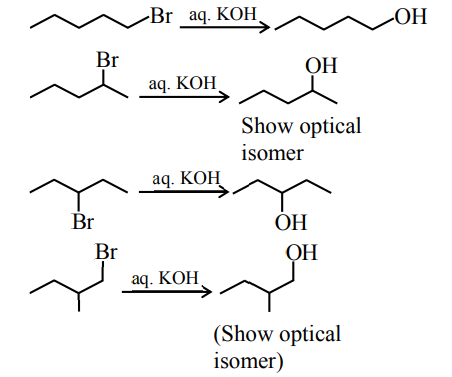
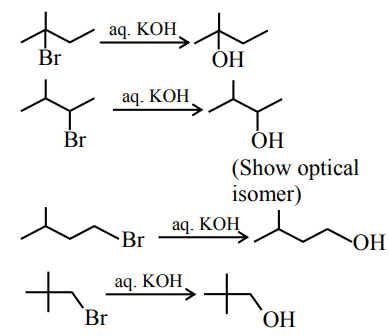
Explanation:
Let us analyze all the structural isomers and their respective substitution products step-by-step to find the ones that exhibit optical isomerism:
1. Understanding the Reaction:
Reaction of alkyl halides with aqueous KOH is a nucleophilic substitution reaction where the bromine atom \((-\text{Br})\) is replaced by a hydroxyl group \((-\text{OH})\) to form an alcohol without any skeletal rearrangement.
2. Identifying all 8 Structural Isomers and their Products:
There are a total of 8 structural isomers for the molecular formula \(C_5H_{11}Br\). Let us check the alcohol products formed by each:
- 1-Bromopentane \(\rightarrow\) Pentan-1-ol (Achiral)
- 2-Bromopentane \(\rightarrow\) Pentan-2-ol (Chiral, contains a stereocenter at C-2) → Product 1
- 3-Bromopentane \(\rightarrow\) Pentan-3-ol (Achiral)
- 1-Bromo-2-methylbutane \(\rightarrow\) 2-Methylbutan-1-ol (Chiral, contains a stereocenter at C-2) → Product 2
- 2-Bromo-2-methylbutane \(\rightarrow\) 2-Methylbutan-2-ol (Achiral)
- 2-Bromo-3-methylbutane \(\rightarrow\) 3-Methylbutan-2-ol (Chiral, contains a stereocenter at C-2) → Product 3
- 1-Bromo-3-methylbutane \(\rightarrow\) 3-Methylbutan-1-ol (Achiral)
- 1-Bromo-2,2-dimethylpropane \(\rightarrow\) 2,2-Dimethylpropan-1-ol (Achiral)
3. Conclusion:
Out of the 8 distinct structural products formed, exactly 3 products contain an asymmetric chiral carbon atom bonded to four different groups, meaning only 3 products can exhibit optical isomerism. Therefore, Option B is absolutely correct.
Hence, Option B is the correct choice. -
- (A) A, B and C Only
- (B) B and D Only
- (C) A and E Only
- (D) D and E Only
Show answer and solution
Correct Answer: (C)
Statement A is correct. Alcoholic KOH provides alkoxide ions which are stronger bases than hydroxide ions. Furthermore, alcohol is a less polar solvent than water, which decreases the solvation of the base, making it more effective for elimination reactions over substitution.
Statement B is incorrect. The reactivity towards the \(S_N^1\) mechanism depends on the stability of the intermediate carbocation. The carbocation \(C_6H_5-\overset{+}{C}H-C_6H_5\) is more stable than \(C_6H_5-\overset{+}{C}H_2\) due to extended resonance stabilization from two phenyl rings. Thus, \(C_6H_5-CHCl-C_6H_5\) is more reactive than \(C_6H_5-CH_2-Cl\).
Statement C is incorrect. Aryl halides are much less reactive towards nucleophilic substitution than alkyl halides due to the partial double bond character of the C-X bond arising from resonance, as well as the \(sp^2\) hybridization of the carbon atom.
Statement D is incorrect. Allyl chloride (\(CH_2=CH-CH_2-Cl\)) contains a carbon-carbon double bond, making it a haloalkene, not a haloalkyne.
Statement E is correct. Alkyl chlorides (\(R-Cl\)) can be easily prepared from alcohols (\(R-OH\)) using \(SOCl_2\). However, phenols (\(Ar-OH\)) do not react with \(SOCl_2\) to give aryl chlorides because the C-O bond in phenol has a partial double bond character due to resonance, making it difficult to cleave.
Therefore, only statements A and E are correct.
Answer: A and E Only -
- (A) Both Statement I and Statement II are true
- (B) Both Statement I and Statement II are false
- (C) Statement I is true but Statement II is false
- (D) Statement I is false but Statement II is true
Show answer and solution
Correct Answer: (C)
Statement I:
When \(3\)-phenylpropene reacts with \(HBr\), protonation of the alkene occurs to form a secondary carbocation.
\(C_6H_5-CH_2-CH=CH_2 + H^+ \rightarrow C_6H_5-CH_2-CH^+-CH_3\)
This secondary carbocation undergoes a \(1,2\)-hydride shift to form a more stable, resonance-stabilized benzylic carbocation.
\(C_6H_5-CH_2-CH^+-CH_3 \rightarrow C_6H_5-CH^+-CH_2-CH_3\)
The bromide ion then attacks this benzylic carbocation to form the major product, \(1\)-bromo-\(1\)-phenylpropane.
\(C_6H_5-CH^+-CH_2-CH_3 + Br^- \rightarrow C_6H_5-CH(Br)-CH_2-CH_3\)
The carbon atom bonded to the bromine is attached to four different groups: a phenyl group (\(-C_6H_5\)), an ethyl group (\(-CH_2CH_3\)), a hydrogen atom (\(-H\)), and a bromine atom (\(-Br\)). Thus, it is a chiral carbon. The product is a secondary alkyl bromide. Therefore, Statement I is true.
Statement II:
The Sandmeyer reaction involves treating a diazonium salt with \(Cu(I)\) salts (\(CuCl\), \(CuBr\), \(CuCN\)) to prepare aryl chlorides, aryl bromides, and aryl cyanides, respectively.
The Gattermann reaction involves treating a diazonium salt with copper powder (\(Cu\)) and halogen acids (\(HCl\), \(HBr\)) to prepare aryl chlorides and aryl bromides. Aryl cyanides are not prepared using the Gattermann reaction. Therefore, Statement II is false.
Conclusion: Statement I is true but Statement II is false.
Answer: Statement I is true but Statement II is false -
- (A) Statement I is false but Statement II is true
- (B) Both Statement I and Statement II are true
- (C) Both Statement I and Statement II are false
- (D) Statement I is true but Statement II is false
Show answer and solution
Correct Answer: (D)
Statement - I :
C - Cl bond is strong in vinyl chloride because of double bond character.
Statement - II :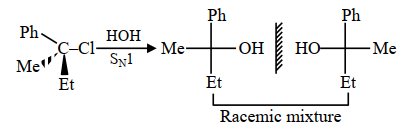
Racemic mixture is optically inactive, which can not rotate PPL. -
- (A) Both Statement I and Statement II are true
- (B) Both Statement I and Statement II are false
- (C) Statement I is true but Statement II is false
- (D) Statement I is false but Statement II is true
Show answer and solution
Correct Answer: (A)
The rate of \(S_N1\) reaction depends on the stability of the carbocation intermediate formed during the rate-determining step.
Benzyl chloride undergoes ionization to form a benzyl carbocation (\(C_6H_5CH_2^+\)), whereas ethyl chloride forms an ethyl carbocation (\(CH_3CH_2^+\)). The benzyl carbocation is highly stabilized by the delocalization of the positive charge over the benzene ring through resonance. On the other hand, the ethyl carbocation is stabilized only by hyperconjugation involving three \(\alpha\)-hydrogens.
Since resonance provides significantly greater stabilization than hyperconjugation, the benzyl carbocation is much more stable than the ethyl carbocation. Consequently, benzyl chloride reacts faster in the \(S_N1\) mechanism than ethyl chloride. Thus, Statement I is true.
Statement II correctly explains that the ethyl carbocation intermediate is less stabilized by hyperconjugation compared to the resonance stabilization of the benzyl carbocation. Thus, Statement II is also true.
Both Statement I and Statement II are true.
Answer: Both Statement I and Statement II are true -
- (A) Both Statement I and Statement II are true
- (B) Both Statement I and Statement II are false
- (C) Statement I is true but Statement II is false
- (D) Statement I is false but Statement II is true
Show answer and solution
Correct Answer: (A)
Statement I is true because as the size of the alkyl group increases, the molecular mass and surface area increase. This leads to an increase in the magnitude of van der Waals forces, which in turn increases the boiling point. Thus, the correct order of boiling points is \(\text{CH}_3\text{CH}_2\text{CH}_2\text{I} > \text{CH}_3\text{CH}_2\text{I} > \text{CH}_3\text{I}\).
Statement II is true because para-dichlorobenzene is more symmetrical than ortho-dichlorobenzene, allowing it to pack more efficiently in the crystal lattice, which results in a higher melting point. However, ortho-dichlorobenzene has a higher dipole moment than para-dichlorobenzene (which has a dipole moment of zero). The stronger dipole-dipole interactions in ortho-dichlorobenzene lead to a higher boiling point compared to para-dichlorobenzene.
Both Statement I and Statement II are true.
Answer: Both Statement I and Statement II are true -
- (A) A-IV, B-I, C-III, D-II
- (B) A-III, B-IV, C-I, D-II
- (C) A-III, B-IV, C-II, D-I
- (D) A-I, B-II, C-IV, D-III
Show answer and solution
Correct Answer: (C)
Explanation:
Let us match the given chloro derivatives with their respective structural formulas:
1. Vinyl Chloride: In vinylic halides, the halogen atom is directly bonded to the \( sp^2 \) hybridized carbon atom of a carbon-carbon double bond. Therefore, Vinyl chloride corresponds to \( \text{CH}_2 = \text{CHCl} \) (A-III).
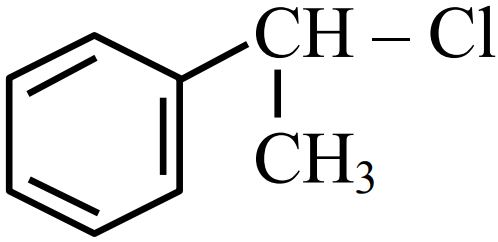
2. Benzylic chloride: In benzylic halides, the halogen atom is bonded to an \( sp^3 \) hybridized carbon atom attached next to an aromatic ring. Therefore, structure IV \( \text{C}_6\text{H}_5 - \text{CH(Cl)} - \text{CH}_3 \) represents a benzylic chloride derivative (B-IV).
3. Alkyl chloride: In alkyl halides, the halogen atom is bonded to a saturated alkyl chain. Isopropyl chloride \( \text{CH}_3 - \text{CH(Cl)} - \text{CH}_3 \) is a standard alkyl chloride (C-II).
4. Allyl chloride: In allylic halides, the halogen atom is bonded to an \( sp^3 \) hybridized carbon atom next to a carbon-carbon double bond. Therefore, Allyl chloride corresponds to \( \text{CH}_2 = \text{CH} - \text{CH}_2\text{Cl} \) (D-I).
Hence, the correct matching is A-III, B-IV, C-II, D-I, which corresponds to Option C. -
- (A) A-I, B-IV, C-III, D-II
- (B) A-III, B-I, C-IV, D-II
- (C) A-IV, B-II, C-I, D-III
- (D) A-I, B-III, C-II, D-IV
Show answer and solution
Correct Answer: (B)
Finkelstein reaction involves the conversion of alkyl chlorides or bromides to alkyl iodides using \(NaI\) in dry acetone. Thus, A matches with III.
Swarts reaction is used for the synthesis of alkyl fluorides by heating an alkyl chloride or bromide in the presence of a metallic fluoride such as \(SbF_3\), \(AgF\), \(Hg_2F_2\), or \(CoF_2\). Thus, B matches with I.
Sandmeyer's reaction involves the conversion of aryl diazonium salts to aryl halides using cuprous halides like \(Cu_2Cl_2\) or \(Cu_2Br_2\). Thus, C matches with IV.
Fittig reaction involves the coupling of two aryl halide molecules in the presence of sodium (\(Na\)) and dry ether to form a diaryl compound. Thus, D matches with II.
The correct matching is A-III, B-I, C-IV, D-II.
Answer: A-III, B-I, C-IV, D-II -
- (A) 20
- (B) 30
- (C) 40
- (D) 50
Show answer and solution
Correct Answer: (B)
The reaction of Grignard reagent with water yields an alkane:
\(RMgI + H_2O \rightarrow RH + Mg(OH)I\)
Given that \(1 \text{ g}\) of the gas \(RH\) occupies \(1.4 \text{ dm}^3\) at STP, we can find its molar mass. Using the standard molar volume at STP (\(22.4 \text{ dm}^3\)):
\(\text{Molar mass of } RH = \dfrac{22.4 \text{ dm}^3 \text{ mol}^{-1}}{1.4 \text{ dm}^3 \text{ g}^{-1}} = 16 \text{ g mol}^{-1}\)
The alkane with a molar mass of \(16 \text{ g mol}^{-1}\) is methane (\(CH_4\)).
Methane reacts with iodine in the presence of an oxidizing agent like \(HIO_3\) (which prevents the backward reaction by consuming the formed \(HI\)) to give methyl iodide:
\(CH_4 + I_2 \xrightarrow{HIO_3} CH_3I + HI\)
Thus, compound (X) is methyl iodide (\(CH_3I\)).
Compound (X) undergoes the Wurtz reaction when treated with sodium and dry ether to form a higher alkane:
\(2CH_3I + 2Na \xrightarrow{\text{dry ether}} CH_3-CH_3 + 2NaI\)
Compound (Y) is ethane (\(C_2H_6\)).
The molar mass of ethane (\(C_2H_6\)) is:
\(2 \times 12 + 6 \times 1 = 30 \text{ g mol}^{-1}\)
Answer: \(30\) -
- (A) \(I^{-}>C_{6}H_{5}O^{-}>F^{-}>C_{2}H_{5}O^{-}\)
- (B) \(I^{-}>C_{2}H_{5}O^{-}>C_{6}H_{5}O^{-}>F^{-}\)
- (C) \(I^{-}>C_{2}H_{5}O^{-}>F^{-}>C_{6}H_{5}O^{-}\)
- (D) \(I^{-}>F^{-}>C_{6}H_{5}O^{-}>C_{2}H_{5}O^{-}\)
Show answer and solution
Correct Answer: (B)
Order of nucleophilicity:
\(I ^{\ominus}> C _2 H _5 O ^{\ominus}> PhO ^{\ominus}> F ^{\ominus}\) -
- (A) 60
- (B) 66
- (C) 70
- (D) 75
Show answer and solution
Correct Answer: (B)
\(C _6 H _{10} \xrightarrow{ Br _2} C _6 H _{10} Br _2\)
Molecular mass of \(C _6 H _{10} Br _2\) is :
\(12 \times 6+10+160\)
\(72+10+160=242\)
\(\%\) of \(Br =\frac{160}{242} \times 100\)
\(\%\) of \(Br =66.11 \% \approx 66 \%\)
No questions on this page match these filters.