


Questions
19 questionsShowing 1–19 of 19 questions
-
- (A) 7 and 5
- (B) 5 and 6
- (C) 5 and 7
- (D) 6 and 7
Show answer and solution
Correct Answer: (C)
Least metallic \(= F\), valence electrons \(= 7\)
Most metallic \(= P\), valence electrons \(= 5\) -
- (A) 5
- (B) 2
- (C) 3
- (D) 4
Show answer and solution
Correct Answer: (D)
Step-by-step Solution:
Total energy required to convert 1 mole of \( \text{Li(g)} \) to \( \text{Li}^{2+}(\text{g}) \) is the sum of the first and second ionization enthalpies:
\( E_{\text{total}} = IE_1 + IE_2 \)
= \( 520 + 7297 = 7817\text{ kJ mol}^{-1} \)
Given mass of lithium = \( 3.5\text{ mg} = 3.5 \times 10^{-3}\text{ g} \)
Molar mass of Lithium = \( 7\text{ g mol}^{-1} \)
Number of moles of lithium (\( n \)):
\( n = \frac{3.5 \times 10^{-3}\text{ g}}{7\text{ g mol}^{-1}} = 5 \times 10^{-4}\text{ mol} \)
Total energy required for \( 5 \times 10^{-4}\text{ mol} \) of Lithium:
\( \text{Energy (in kJ)} = 5 \times 10^{-4}\text{ mol} \times 7817\text{ kJ mol}^{-1} = 3.9085\text{ kJ} \)
Converting the energy into Joules (\( \text{J} \)) to match the options:
\( \text{Energy (in J)} = 3.9085 \times 10^3\text{ J} = 3908.5\text{ J} \)
Rounding off to the nearest integer, we get \( 3909 \).
Correct Option: D (3909) -
- (A) Statement-I is false but Statement-II is true
- (B) Both Statement-I and Statement-II are true.
- (C) Both Statement-I and Statement-II are false.
- (D) Statement-I is true but Statement-II is false.
Show answer and solution
Correct Answer: (B)
\(\xrightarrow[Z_{\text {eff }} \uparrow I . E . \uparrow]{\begin{array}{l}C<O<N<F \\ 2 p^2 2 p^4 2 p^3 2 p^5\end{array}}\)
Statement-I is correct
\(S > Se > Te > Po > O\)
\(
\left|\Delta_{eg} H\right| \quad \begin{array}{lllll}
200 & 195 & 190 & 174 & 141(in kJ / mol)
\end{array}
\)
Statement-II is correct. -
- (A) Both Statement I and Statement II are true
- (B) Both Statement I and Statement II are false
- (C) Statement I is false but Statement II is true
- (D) Statement I is true but Statement II is false
Show answer and solution
Correct Answer: (D)
Metallic character of s-block elements is greater than p-block elements.
Anionic radius is greater than atomic radius but cationic radius is always less than atomic radius for any element. -
- (A) Both Statement I and Statement II are true
- (B) Both Statement I and Statement II are false
- (C) Statement I is true but Statement II is false
- (D) Statement I is false but Statement II is true
Show answer and solution
Correct Answer: (D)
The first ionisation enthalpy generally increases across a period from left to right due to an increase in effective nuclear charge. For the third period elements \(\text{Na}\), \(\text{Mg}\), \(\text{Cl}\), and \(\text{Ar}\), the correct order of first ionisation enthalpy is \(\text{Ar} > \text{Cl} > \text{Mg} > \text{Na}\). Thus, Statement I is false.
The electronic configuration of \(\text{Ca}\) is \([\text{Ar}] 4s^2\). After the removal of two electrons, \(\text{Ca}^{2+}\) attains the highly stable noble gas configuration of Argon \([\text{Ar}]\). Removing a third electron requires breaking this stable noble gas core, which requires a very large amount of energy. Therefore, the third ionisation enthalpy of \(\text{Ca}\) is exceptionally high compared to \(\text{Al}\), \(\text{Fe}\), and \(\text{B}\). Thus, Statement II is true.
Answer: Statement I is false but Statement II is true -
- (A) Both Statement I and Statement II are false
- (B) Statement I is false but Statement II is true
- (C) Statement I is true but Statement II is false
- (D) Both Statement I and Statement II are true
Show answer and solution
Correct Answer: (B)
Correct order of size is \(Mg > Al > Mg ^{2+}> Al ^{3+}\)
Atomic size depends mainly upon \(Z _{\text {effective }}\) and shell number.
Generally on moving down the group electron affinity decreases and on moving across the period electron affinity increase.
In the periodic table Cl has maximum electron affinity. Halogen has higher electron affinity than Chalcogen.
\(Cl > Br > S > O\) -
- (A) Both Statement I and Statement II are true
- (B) Both Statement I and Statement II are false
- (C) Statement I is true but Statement II is false
- (D) Statement I is false but Statement II is true
Show answer and solution
Correct Answer: (A)
Electronegativity increases across a period from left to right. Nitrogen, oxygen, and fluorine belong to group 15, 16, and 17 respectively in the second period. Thus, the correct order of electronegativity is \(F > O > N\). Statement I is true.
In \(OF_2\), fluorine is more electronegative than oxygen and always exhibits an oxidation state of \(-1\). Let the oxidation state of oxygen be \(x\). Then \(x + 2(-1) = 0 \Rightarrow x = +2\).
In \(Na_2O\), sodium is an alkali metal and exhibits an oxidation state of \(+1\). Let the oxidation state of oxygen be \(y\). Then \(2(+1) + y = 0 \Rightarrow y = -2\).
Statement II is also true.
Both Statement I and Statement II are true.
Answer: Both Statement I and Statement II are true -
- (A) Both Statement I and Statement II are true
- (B) Both Statement I and Statement II are false
- (C) Statement I is true but Statement II is false
- (D) Statement I is false but Statement II is true
Show answer and solution
Correct Answer: (A)
Statement I:
\(Al_2O_3\) and \(Cr_2O_3\) are both amphoteric oxides.
\(Cl_2O_7\) and \(Mn_2O_7\) are both acidic oxides.
\(Na_2O\) and \(V_2O_3\) are both basic oxides.
\(CO\) and \(N_2O\) are both neutral oxides.
All \(4\) pairs contain oxides of the same nature. Hence, Statement I is true.
Statement II:
\(Na_2O\) is a strongly basic oxide.
\(Al_2O_3\) is an amphoteric oxide.
\(CO\) is a neutral oxide.
\(Cl_2O_7\) is a strongly acidic oxide.
Thus, the most basic oxide is \(Na_2O\) and the most acidic oxide is \(Cl_2O_7\). Hence, Statement II is true.
Both Statement I and Statement II are true.
Answer: Both Statement I and Statement II are true -
- (A) Both statement I and statement II are true
- (B) Both statement I and statement II are false
- (C) Statement I is false but statement II is true
- (D) Statement I is true but statement II is false
Show answer and solution
Correct Answer: (A)
\( Na^{+}:-1s^{2} 2s^{2} 2p^{6} \) (fully filled electronic configuration)
\( Mg^{+}:-1s^{2} 2s^{2} 2p^{6} 3s^{1} \)
\( IE_{2} \) of \( Na > IE_{2} \) of Mg
Size of \( O^{2-} > F^{-} \) -
- (A) Both Statement I and Statement II are true
- (B) Both Statement I and Statement II are false
- (C) Statement I is true but Statement II is false
- (D) Statement I is false but Statement II is true
Show answer and solution
Correct Answer: (B)
Statement I: The second ionization enthalpy of Ga is higher than that of Al. This is due to the poor shielding effect of the ten \(3d\) electrons in Ga, which increases the effective nuclear charge and holds the valence electrons more tightly. The correct order of second ionization enthalpy is \(B > Ga > Al\). Thus, Statement I is false.
Statement II: The first ionization enthalpy generally decreases down the group. However, Pb has a slightly higher ionization enthalpy than Sn due to the poor shielding of \(4f\) and \(5d\) electrons (lanthanoid contraction). The correct order of first ionization enthalpy for Group 14 elements is \(Sn < Pb < Ge < Si < C\). Thus, Statement II is false.
Both Statement I and Statement II are false.
Answer: Both Statement I and Statement II are false -
- (A) lowest and lowest
- (B) highest and lowest
- (C) lowest and highest
- (D) highest and highest
Show answer and solution
Correct Answer: (C)
In a period, as we move from left to right, the atomic size decreases and the effective nuclear charge increases.
Due to the large atomic size and low effective nuclear charge, the element at the extreme left (alkali metal) has the lowest first ionisation enthalpy in the period.
As we move to the extreme right (excluding noble gases), the elements (halogens) have the smallest atomic size and highest effective nuclear charge in the period. They require only one electron to complete their octet. Thus, they have the highest negative electron gain enthalpy.
Therefore, the first ionisation enthalpy of the extreme left element is the lowest, and the negative electron gain enthalpy of the extreme right element is the highest.
Answer: lowest and highest - 12. In period 4 of the periodic table, the elements with highest and lowest atomic radii are respectively: 2026 Medium
- (A) Na & Cl
- (B) K & Se
- (C) K & Br
- (D) Rb & Br
Show answer and solution
Correct Answer: (C)
In a period moving from left to right atomic size decreases. -
- (A) A-II, B-III, C-IV, D-I
- (B) A-IV, B-III, C-II, D-I
- (C) A-III, B-II, C-IV, D-I
- (D) A-III, B-II, C-I, D-IV
Show answer and solution
Correct Answer: (A)
Given \(n=2\), the electronic configurations correspond to elements of the second period.
A. \(ns^2 \Rightarrow 2s^2\) is Beryllium (Be).
B. \(ns^2np^1 \Rightarrow 2s^2 2p^1\) is Boron (B).
C. \(ns^2np^3 \Rightarrow 2s^2 2p^3\) is Nitrogen (N).
D. \(ns^2np^6 \Rightarrow 2s^2 2p^6\) is Neon (Ne).
The first ionization energy generally increases across a period from left to right. However, Beryllium has a higher ionization energy than Boron due to the stable fully-filled \(2s\) subshell. Nitrogen has a high ionization energy due to its stable half-filled \(2p\) subshell. Neon, being a noble gas, has the highest ionization energy.
The order of first ionization energy is B \(<\) Be \(<\) N \(<\) Ne.
Arranging the given values in increasing order: \(800 < 899 < 1402 < 2080\) kJ mol\(^{-1}\).
Thus, the matching is:
A. Be \(\rightarrow 899\) (II)
B. B \(\rightarrow 800\) (III)
C. N \(\rightarrow 1402\) (IV)
D. Ne \(\rightarrow 2080\) (I)
This corresponds to A-II, B-III, C-IV, D-I.
Answer: A-II, B-III, C-IV, D-I -
- (A) \(-906\) kJ/mol
- (B) \(-856\) kJ/mol
- (C) \(+1450\) kJ/mol
- (D) \(+590\) kJ/mol
Show answer and solution
Correct Answer: (C)
Ionization enthalpy is the energy required to remove an electron from an isolated gaseous atom or ion. It is always an endothermic process, so its value is always positive.
The second ionization enthalpy is the energy required to remove an electron from a unipositive ion. Since the effective nuclear charge increases after the removal of the first electron, the remaining electrons are held more tightly by the nucleus. Thus, the second ionization enthalpy is always greater than the first ionization enthalpy (\(IE_{2} > IE_{1}\)).
Given the first ionization enthalpy of Mg is \(+737\) kJ/mol, the second ionization enthalpy must be positive and greater than \(+737\) kJ/mol.
Among the given options, only \(+1450\) kJ/mol satisfies these conditions.
Answer: \(+1450\) kJ/mol -
- (A) \(F < N < C < O\)
- (B) \(C < O < N < F\)
- (C) \(C < N < F < O\)
- (D) \(C < F < N < O\)
Show answer and solution
Correct Answer: (C)
To compare second ionization potential configuration of mono-cation is observed.\(C ^{+}\) \(N ^{+}\) \(O ^{+}\) \(F ^{+}\) [He]\(2 s^2 sp ^1\) [He]\(2 s^2 sp ^2\) [He]\(2 s^2 sp ^3\)Half - filled stable. [He]\(2 s^2 sp ^4\)
\(2^{nd}\) IE order:
\(O > F > N > C\) - 16. The correct set that contains all kinds (basic, acidic, amphoteric and neutral) of oxides is: 2026 Medium
- (A) \(Na_2 O, K_2 O, Al_2 O_3\) and \(As_2 O_3\)
- (B) \(Al_2 O_3, As_2 O_3, CO\) and \(NO\)
- (C) \(K_2 O, Cl_2 O_7, As_2 O_3\) and \(NO\)
- (D) \(Na_2 O, N_2 O, Al_2 O_3\) and \(CO\)
Show answer and solution
Correct Answer: (C)
\(K_2O\) is a metallic oxide and is basic in nature.
\(Cl_2O_7\) is a non-metallic oxide with a high oxidation state and is acidic in nature.
\(As_2O_3\) is a metalloid oxide and is amphoteric in nature.
\(NO\) is a neutral oxide.
Thus, the set \(K_2O, Cl_2O_7, As_2O_3\) and \(NO\) contains all kinds of oxides.
Answer: \(K_2 O, Cl_2 O_7, As_2 O_3\) and \(NO\) - 17. The correct trend in the first ionization enthalpies of the elements in the \(3^{rd}\) period of periodic table is: 2026 Hard
- (A) \(Al < Si < S < P < Cl\)
- (B) \(Al < S < P < Si < Cl\)
- (C) \(Si < S < Al < P < Cl\)
- (D) \(S < Si < Al < P < Cl\)
Show answer and solution
Correct Answer: (A)
In general on moving from left to right in a period ionization energy increases as \(Z_{eff}\) increases.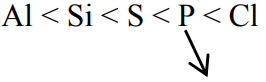
(Ionisation energy of phosphorus is more because of half filled stable configuration) -
- (A) \((r_A + r_B), 2(r_A + r_B)\)
- (B) \(\dfrac{1}{2}(r_A + r_B), (r_A + r_B)\)
- (C) \((r_A + r_B), (r_A + r_B)\)
- (D) \(2(r_A + r_B), \dfrac{1}{2}(r_A + r_B)\)
Show answer and solution
Correct Answer: (A)
The covalent bond length of the AB molecule is the internuclear distance between atom A and atom B.
Bond length = \(r_A + r_B\)
The total length of the AB molecule is the distance between the outermost boundaries of the two atoms along the internuclear axis.
Total length = Radius of A + Bond length + Radius of B
Total length = \(r_A + (r_A + r_B) + r_B = 2(r_A + r_B)\)
Answer: \((r_A + r_B), 2(r_A + r_B)\) -
- (A) A, B and D only
- (B) A, B, C and D
- (C) A and B only
- (D) B and C only
Show answer and solution
Correct Answer: (A)
→ On moving left to right in a period IE increases and from top to bottom in a group IE decreases.
\( F>P>S>B \) (IE order)
→ On moving left to right in a period metallic and basic character decreases.
\( K>Mg>Al>B \) (Metallic character order)
On moving top to bottom in a group metallic and basic character increases.
\( K_{2}O>Na_{2}O>MgO>Al_{2}O_{3} \)
→ EA: Group 17 > Group 16 > Group 15
\( Cl>F>S>P \)
No questions on this page match these filters.