


Questions
21 questionsShowing 1–21 of 21 questions
-
- (A) 5
- (B) 8
- (C) 4
- (D) 7
Show answer and solution
Correct Answer: (D)
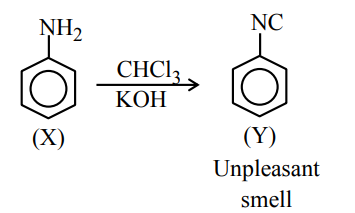
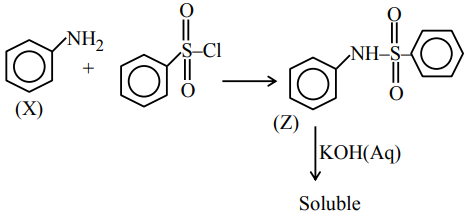
Number of different H atom in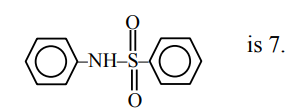
-
- (A) Benzoic acid, benzamide, aniline
- (B) Toluic acid, methylbenzamide, 2-methylaniline
- (C) Benzoic acid, 4-methylbenzamide, 4-methylaniline.
- (D) Phenylethanoic acid, phenylethanamide, benzamine
Show answer and solution
Correct Answer: (A)
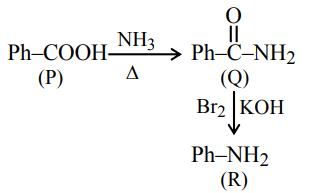
Explanation:
1. Step 1: Formation of Compound (Q)
When a carboxylic acid is treated with aqueous ammonia (\( \text{NH}_3 \)) and heated, it undergoes amidation to form an amide. Here, benzoic acid (\( \text{C}_6\text{H}_5\text{COOH} \), compound P) reacts with ammonia under hot conditions to yield benzamide (\( \text{C}_6\text{H}_5\text{CONH}_2 \), compound Q):
\( \text{C}_6\text{H}_5\text{COOH} + \text{NH}_3 \xrightarrow{\Delta} \text{C}_6\text{H}_5\text{CONH}_2 + \text{H}_2\text{O} \)
2. Step 2: Formation of Compound (R)
When benzamide (Q) is heated with bromine (\( \text{Br}_2 \)) and potassium hydroxide (\( \text{KOH} \)), it undergoes the Hofmann bromamide degradation reaction. This reaction degrades the amide to a primary amine containing one less carbon atom than the parent amide. Thus, benzamide converts into aniline (\( \text{C}_6\text{H}_5\text{NH}_2 ), compound R):
\text{C}_6\text{H}_5\text{CONH}_2 + \text{Br}_2 + 4\text{KOH} \xrightarrow{\Delta} \text{C}_6\text{H}_5\text{NH}_2 + \text{K}_2\text{CO}_3 + 2\text{KBr} + 2\text{H}_2\text{O} \)
3. Molecular Formula Verification:
The molecular formula of aniline (\( \text{C}_6\text{H}_5\text{NH}_2 \)) is gathered as \( \text{C}_6\text{H}_7\text{N} \), which completely matches the molecular formula of the product.
Hence, Option A is the correct choice. -
- (A) \(C < B < A < D\)
- (B) \(D < C < B < A\)
- (C) \(C < D < B < A\)
- (D) \(D < B < A < C\)
Show answer and solution
Correct Answer: (C)
Boiling point depends on the strength of intermolecular forces.
\(n\text{-C}_4\text{H}_{10}\) (C) is a nonpolar alkane with only weak van der Waals forces, resulting in the lowest boiling point.
\(n\text{-C}_4\text{H}_9\text{OH}\) (A) is an alcohol that forms strong intermolecular hydrogen bonds due to the high electronegativity of oxygen, giving it the highest boiling point.
Both \(n\text{-C}_4\text{H}_9\text{NH}_2\) (B) and \(\text{C}_2\text{H}_5\text{NHC}_2\text{H}_5\) (D) are amines and form hydrogen bonds, which are weaker than those in alcohols because nitrogen is less electronegative than oxygen.
Between the primary amine (B) and the secondary amine (D), the primary amine has two \(\text{N-H}\) bonds available for hydrogen bonding and less steric hindrance, leading to stronger intermolecular forces and a higher boiling point than the secondary amine.
The increasing order of boiling points is \(C < D < B < A\).
Answer: \(C < D < B < A\) - 4. Benzyl isocyanide can be obtained from
Choose the correct answer from the options given below: 2026 Medium- (A) A and B Only
- (B) A and C Only
- (C) B and D Only
- (D) D and E Only
Show answer and solution
Correct Answer: (A)
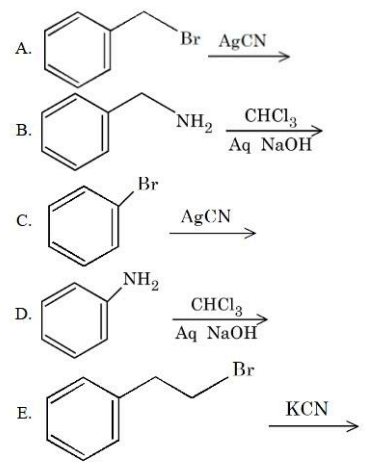
Reaction A: \(C_6H_5CH_2Br + AgCN \rightarrow C_6H_5CH_2NC + AgBr\)
\(AgCN\) is predominantly covalent, so the nucleophilic attack occurs through the nitrogen atom, forming benzyl isocyanide.
Reaction B: \(C_6H_5CH_2NH_2 + CHCl_3 + 3NaOH \rightarrow C_6H_5CH_2NC + 3NaCl + 3H_2O\)
This is the carbylamine reaction. Primary amines react with chloroform and alkali to form isocyanides. Benzyl amine gives benzyl isocyanide.
Reaction C: \(C_6H_5Br + AgCN \rightarrow\) No reaction
Aryl halides are generally unreactive towards nucleophilic substitution under normal conditions due to the partial double bond character of the C-Br bond.
Reaction D: \(C_6H_5NH_2 + CHCl_3 + 3NaOH \rightarrow C_6H_5NC + 3NaCl + 3H_2O\)
Aniline undergoes the carbylamine reaction to form phenyl isocyanide, not benzyl isocyanide.
Reaction E: \(C_6H_5CH_2CH_2Br + KCN \rightarrow C_6H_5CH_2CH_2CN + KBr\)
\(KCN\) is predominantly ionic, so the nucleophilic attack occurs through the carbon atom, forming a cyanide (nitrile) rather than an isocyanide.
Thus, benzyl isocyanide is obtained from reactions A and B only.
Answer: A and B Only - 5.
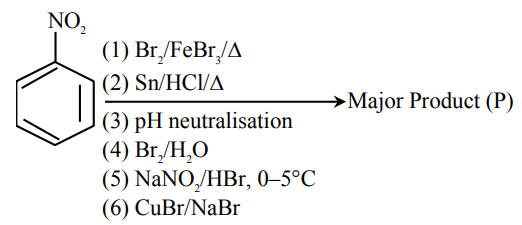
Consider the above sequence of reactions. The number of bromine atom(s) in the final product (P) will be: 2026 Medium- (A) 1
- (B) 6
- (C) 5
- (D) 3
Show answer and solution
Correct Answer: (C)
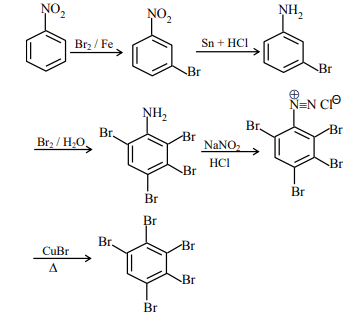
Number of Br atom in major product \(( P )=5\) -
- (A) Benzene
- (B) Phenol
- (C) Propanol
- (D) Chlorobenzene
Show answer and solution
Correct Answer: (A)
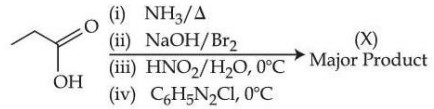
The starting material is propanoic acid (\(CH_3CH_2COOH\)).
In step (i), propanoic acid reacts with \(NH_3\) upon heating to form propanamide.
\(CH_3CH_2COOH \xrightarrow{NH_3, \Delta} CH_3CH_2CONH_2\)
In step (ii), propanamide undergoes Hoffmann bromamide degradation with \(NaOH\) and \(Br_2\) to form ethylamine.
\(CH_3CH_2CONH_2 \xrightarrow{NaOH, Br_2} CH_3CH_2NH_2\)
In step (iii), ethylamine reacts with nitrous acid (\(HNO_2\)) to form an unstable diazonium salt, which hydrolyzes to give ethanol.
\(CH_3CH_2NH_2 \xrightarrow{HNO_2, H_2O} CH_3CH_2OH\)
In step (iv), ethanol reacts with benzenediazonium chloride (\(C_6H_5N_2Cl\)). Ethanol reduces the diazonium salt to benzene, while getting oxidized to ethanal.
\(CH_3CH_2OH + C_6H_5N_2Cl \rightarrow C_6H_6 + CH_3CHO + N_2 + HCl\)
The final major product (X) is benzene.
Answer: Benzene - 7. Consider the following reaction sequence
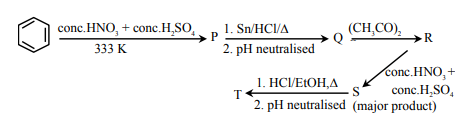
The percentage of nitrogen in product 'T' formed is __________ %. (Nearest integer) 2026 Medium- (A) 10
- (B) 20
- (C) 30
- (D) 40
Show answer and solution
Correct Answer: (B)
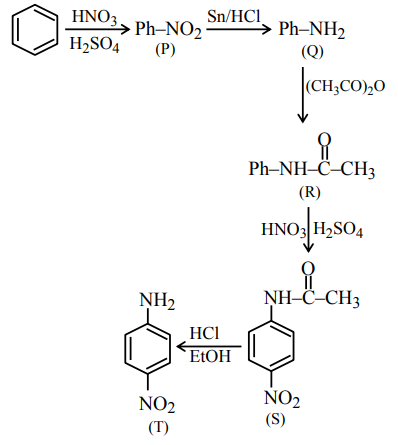
Mol. wt \(=6 \times 12+(6 \times 1)+(2 \times 14)+(2 \times 16)\)
\(=138\)
\(\% N=\frac{28}{138} \times 100=20.29 \%\) -
- (A) 1
- (B) 2
- (C) 3
- (D) 4
Show answer and solution
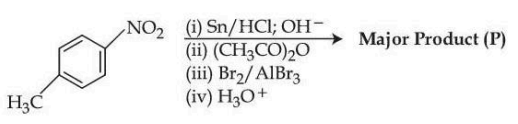
Correct Answer: (A)
The given reactant is p-nitrotoluene.
Step (i): Reduction with Sn/HCl followed by \(OH^-\) converts the \(-NO_2\) group to an \(-NH_2\) group, yielding p-toluidine.
Step (ii): Reaction with acetic anhydride, \((CH_3CO)_2O\), protects the amino group by forming N-(4-methylphenyl)acetamide.
Step (iii): Bromination with \(Br_2/AlBr_3\) directs the incoming bromine to the ortho position relative to the strongly activating \(-NHCOCH_3\) group (the para position is blocked by the methyl group). This yields 2-bromo-4-methylacetanilide.
Step (iv): Acid hydrolysis with \(H_3O^+\) removes the acetyl group, yielding 2-bromo-4-methylaniline as the major product (P).
The molecular formula of product P (2-bromo-4-methylaniline) is \(C_7H_8NBr\).
Molar mass of P = \((7 \times 12) + (8 \times 1) + 14 + 80 = 186 \text{ g mol}^{-1}\).
In Carius analysis, the bromine in the organic compound is quantitatively converted to silver bromide (AgBr).
Molar mass of AgBr = \(108 + 80 = 188 \text{ g mol}^{-1}\).
Since one molecule of P contains one bromine atom, 1 mole of P produces 1 mole of AgBr.
Moles of P in \(1.0 \text{ g} = \dfrac{1.0}{186} \text{ mol}\).
Moles of AgBr produced = \(\dfrac{1.0}{186} \text{ mol}\).
Mass of AgBr produced = \(\dfrac{1.0}{186} \times 188 \text{ g} \approx 1.01 \text{ g}\).
Rounding to the nearest integer, the mass of the AgBr precipitate is 1 g.
Answer: \(1\) -
- (A) 301
- (B) 146
- (C) 228
- (D) 208
Show answer and solution
Correct Answer: (C)
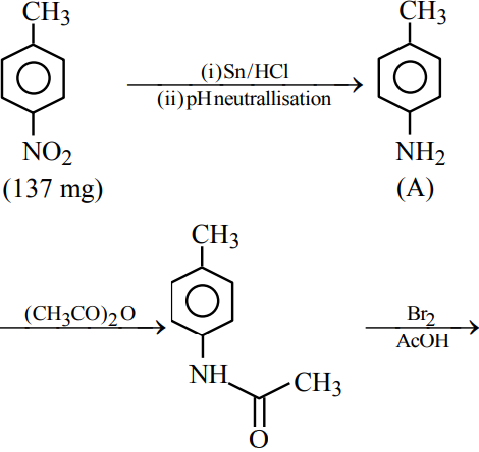
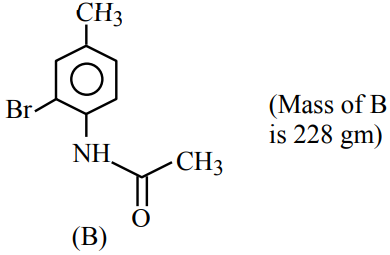
Mole \(=\frac{137 \times 10^{-3}}{137}=0.001 mole\)
Mole of product \(=0.001\) mole
Mass of product \(=0.001 \times 228 gm\)
\(=0.228 gm =228 mg\) -
- (A) 18
- (B) 21
- (C) 24
- (D) 28
Show answer and solution
Correct Answer: (B)
The given starting material is diazoaminobenzene (\(C_6H_5-N=N-NH-C_6H_5\)).
When diazoaminobenzene is treated with an acid catalyst (HCl) and excess aniline, and warmed to \(40-45^\circ \text{C}\), it undergoes a rearrangement reaction (or dissociation followed by coupling) to form \(p\)-aminoazobenzene.
The reaction sequence is as follows:
1. Diazoaminobenzene reacts with HCl to form benzenediazonium chloride and aniline.
2. The benzenediazonium ion then couples with the excess aniline at the para position to yield \(p\)-aminoazobenzene.
3. Cooling and adding acetic acid helps in precipitating the free base, \(p\)-aminoazobenzene, which is a yellow dye (often called Aniline Yellow).
The structure of the yellow product (X), \(p\)-aminoazobenzene, is \(C_6H_5-N=N-C_6H_4-NH_2\).
The molecular formula of \(p\)-aminoazobenzene is \(C_{12}H_{11}N_3\).
Let's calculate its molar mass:
Molar mass \(= (12 \times 12) + (11 \times 1) + (3 \times 14)\)
Molar mass \(= 144 + 11 + 42 = 197 \text{ g mol}^{-1}\)
The mass of nitrogen in one mole of the compound is \(3 \times 14 = 42 \text{ g}\).
The percentage of nitrogen in the product is:
\(\% \text{ N} = \dfrac{42}{197} \times 100 \approx 21.32\%\)
Rounding to the nearest integer, we get \(21\).
Answer: \(21\) -
- (A) Both Statement I and Statement II are false
- (B) Statement I is true but Statement II is false
- (C) Both Statement I and Statement II are true
- (D) Statement I is false but Statement II is true
Show answer and solution
Correct Answer: (C)
Statement-I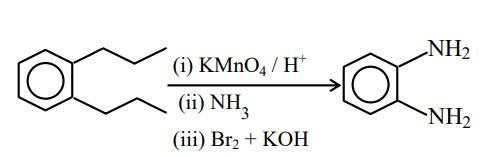
Statement-II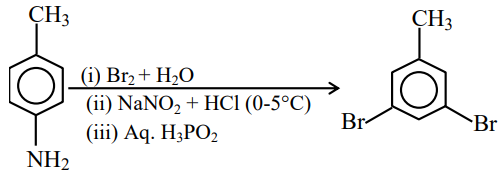
Both statement (I) and (II) are true. -
- (A) Both Statement I and Statement II are true
- (B) Both Statement I and Statement II are false
- (C) Statement I is true but Statement II is false
- (D) Statement I is false but Statement II is true
Show answer and solution
Correct Answer: (D)
Statement I describes the Hoffmann bromamide degradation reaction. When benzamide (\(C_6H_5CONH_2\)) is heated with bromine in an ethanolic solution of sodium hydroxide, it produces aniline (\(C_6H_5NH_2\)), not benzylamine. Thus, Statement I is false.
Statement II describes the nitration of aniline. Direct nitration of aniline with \(HNO_3/H_2SO_4\) yields a mixture of \(p\)-nitroaniline (\(51\%\)), \(m\)-nitroaniline (\(47\%\)), and \(o\)-nitroaniline (\(2\%\)). The significant formation of the meta derivative is due to the protonation of aniline in the strongly acidic medium to form the anilinium ion, which is meta-directing. Since \(47\% > 2\%\), \(m\)-nitroaniline is produced in a higher amount than \(o\)-nitroaniline. Thus, Statement II is true.
Answer: Statement I is false but Statement II is true -
- (A) Both Statement I and Statement II are false
- (B) Both Statement I and Statement II are true
- (C) Statement I is true but Statement II is false
- (D) Statement I is false but Statement II is true
Show answer and solution
Correct Answer: (D)
Statement I: False
\(R - NC \xrightarrow{ H _3 O ^{+}} R - NH _2+ HCOOH\)
Statement II: True
\(R - CN \xrightarrow{ H _3 O ^{+}} RCOOH \xrightarrow{ SOCl _2} RCOCl\)
\(\xrightarrow{ NH _3} RCONH _2 \xrightarrow{ NaOCl / OH ^{-}} RNH _2\)
\(\xrightarrow{ CHCl _3+ KOH } R - NC\) - 14. Identify the incorrect statements.
Choose the correct answer from the options given below: 2026 Hard- (A) A and D Only
- (B) A and C Only
- (C) B and C Only
- (D) A and B Only
Show answer and solution
Correct Answer: (C)
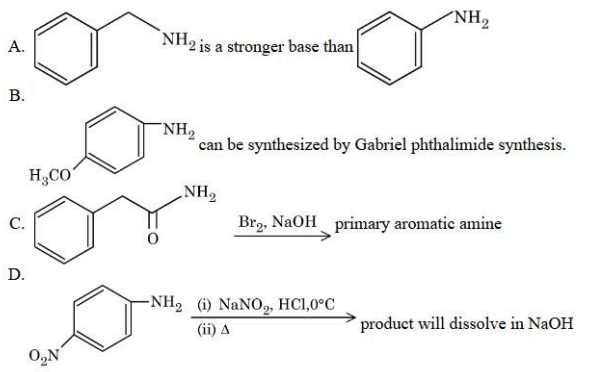
Statement A: In benzylamine (\(C_6H_5CH_2NH_2\)), the lone pair of electrons on the nitrogen atom is localized and not involved in resonance. In aniline (\(C_6H_5NH_2\)), the lone pair is delocalized over the benzene ring. Hence, benzylamine is a stronger base than aniline. Statement A is correct.
Statement B: Gabriel phthalimide synthesis involves the nucleophilic substitution (\(S_N2\)) of an alkyl halide by the phthalimide anion. Aryl halides do not undergo nucleophilic substitution easily due to the partial double bond character of the C-X bond. Therefore, primary aromatic amines (like p-methoxyaniline) cannot be synthesized by this method. Statement B is incorrect.
Statement C: The reaction of 2-phenylacetamide (\(C_6H_5CH_2CONH_2\)) with \(Br_2\) and \(NaOH\) is the Hoffmann bromamide degradation, which yields benzylamine (\(C_6H_5CH_2NH_2\)). Benzylamine is a primary aliphatic (aralkyl) amine, not a primary aromatic amine (where the \(-NH_2\) group must be directly attached to the benzene ring). Statement C is incorrect.
Statement D: p-Nitroaniline undergoes diazotization with \(NaNO_2\) and \(HCl\) at \(0^\circ C\) to form p-nitrobenzenediazonium chloride. Heating this aqueous solution (\(\Delta\)) yields p-nitrophenol. Since p-nitrophenol is acidic, it dissolves in aqueous \(NaOH\) to form a soluble sodium salt. Statement D is correct.
The incorrect statements are B and C.
Answer: B and C Only -
- (A) 1-Bromo-4-nitrobenzene
- (B) 1, 3, 5-Tribromo-2-nitrobenzene
- (C) 4-Bromo-1-nitrobenzene
- (D) 1, 3, 5-Tribromobenzene
Show answer and solution
Correct Answer: (B)
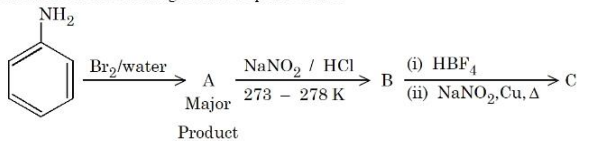
Aniline on reaction with bromine water gives 2,4,6-tribromoaniline (A) as the major product due to the strong activating nature of the \(-\text{NH}_2\) group.
Reaction of (A) with \(\text{NaNO}_2/\text{HCl}\) at \(273-278\text{ K}\) (diazotization) yields 2,4,6-tribromobenzenediazonium chloride (B).
Treatment of (B) with \(\text{HBF}_4\) forms 2,4,6-tribromobenzenediazonium fluoroborate. Heating this intermediate with \(\text{NaNO}_2\) and \(\text{Cu}\) replaces the diazonium group with a nitro group, forming 2,4,6-tribromonitrobenzene (C).
To assign the IUPAC name, we number the ring to give the lowest locant set to the substituents. The set (1, 2, 3, 5) is lower than (1, 2, 4, 6). Therefore, the nitro group is at position 2, and the bromo groups are at positions 1, 3, and 5. The correct IUPAC name is 1,3,5-tribromo-2-nitrobenzene.
Answer: 1, 3, 5-Tribromo-2-nitrobenzene -
- (A) A > B > C > D
- (B) C > D > B > A
- (C) A > C > D > B
- (D) C > A > D > B
Show answer and solution
Correct Answer: (C)
Correct order of stability
\(\underset {+M} {A} > C > \underset {-M} {D} > \underset {-M} {B} \)
EDG increases stability
EWG decreases stability -
- (A) 8
- (B) 10
- (C) 12
- (D) 15
Show answer and solution
Correct Answer: (B)
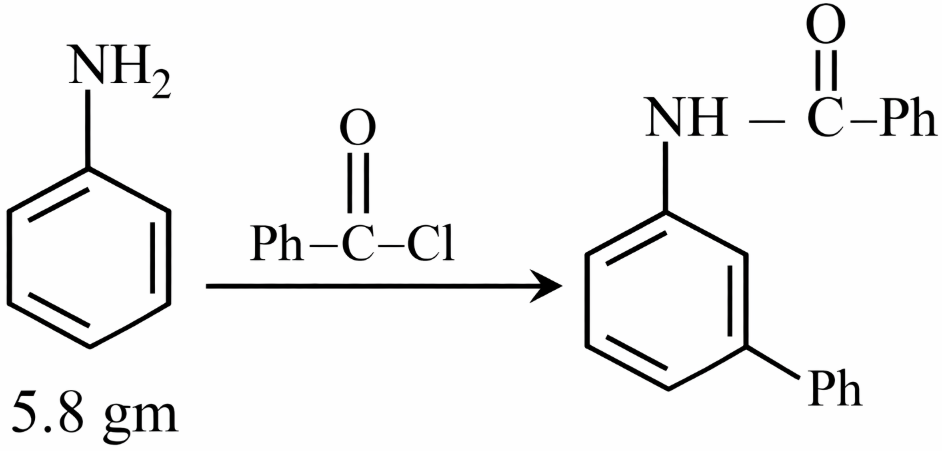
\(n=\frac{5.8}{93}\)
\(n=0.0623\)
\(n =0.0623 \times \frac{82}{100}\)
\(mass =0.051 \times 197\)
\(mass =10.047\) -
- (A) \(5\)
- (B) \(4\)
- (C) \(3\)
- (D) \(6\)
Show answer and solution
Correct Answer: (C)
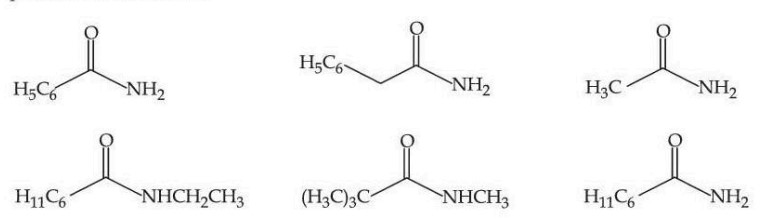
The reaction of an amide with \(\text{Br}_2/\text{KOH}\) (alcoholic) is the Hoffmann bromamide degradation reaction. This reaction is specific to primary amides (\(R-\text{CONH}_2\)) and produces primary amines (\(R-\text{NH}_2\)) with one less carbon atom.
Among the given compounds, the primary amides are:
1. Benzamide (\(\text{C}_6\text{H}_5\text{CONH}_2\))
2. 2-Phenylacetamide (\(\text{C}_6\text{H}_5\text{CH}_2\text{CONH}_2\))
3. Acetamide (\(\text{CH}_3\text{CONH}_2\))
4. Cyclohexanecarboxamide (\(\text{C}_6\text{H}_{11}\text{CONH}_2\))
The other two compounds (N-ethylcyclohexanecarboxamide and N-methylpivalamide) are secondary amides and do not undergo this reaction.
The primary amines formed from the degradation of the four primary amides are:
1. Aniline (\(\text{C}_6\text{H}_5\text{NH}_2\))
2. Benzylamine (\(\text{C}_6\text{H}_5\text{CH}_2\text{NH}_2\))
3. Methylamine (\(\text{CH}_3\text{NH}_2\))
4. Cyclohexylamine (\(\text{C}_6\text{H}_{11}\text{NH}_2\))
The Gabriel phthalimide synthesis is used for the preparation of aliphatic primary amines. It cannot be used to prepare aromatic primary amines (like aniline) because aryl halides do not undergo nucleophilic substitution with the phthalimide anion.
Therefore, aniline cannot be prepared by Gabriel phthalimide synthesis. The remaining three amines (benzylamine, methylamine, and cyclohexylamine) are aliphatic primary amines and can be prepared by this method.
Thus, there are \(3\) compounds that satisfy both conditions.
Answer: \(3\) -
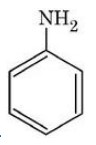
- (A) aniline
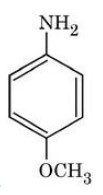
- (B) \(4\)-methoxyaniline
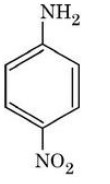
- (C) \(4\)-nitroaniline
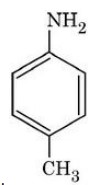
- (D) \(4\)-methylaniline (p-toluidine)
Show answer and solution
Correct Answer: (C)
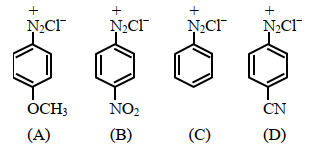
The strength of a conjugate acid is inversely proportional to the basic strength of its corresponding base. Thus, the weakest base will form the strongest conjugate acid.
The basicity of anilines depends on the availability of the lone pair on the nitrogen atom. Electron-withdrawing groups decrease basicity by withdrawing electron density, while electron-donating groups increase basicity.
In \(4\)-nitroaniline, the \(-\text{NO}_2\) group is a strong electron-withdrawing group due to its \(-R\) and \(-I\) effects. This strongly delocalizes the lone pair of electrons on the nitrogen atom, making \(4\)-nitroaniline the weakest base among the given options.
In contrast, \(-\text{OCH}_3\) (\(+R\) effect) and \(-\text{CH}_3\) (\(+I\) and hyperconjugation) are electron-donating groups that increase basicity, making \(4\)-methoxyaniline and \(4\)-methylaniline stronger bases than aniline.
Since \(4\)-nitroaniline is the weakest base, its conjugate acid is the strongest.
Answer: \(4\)-nitroaniline - (A) aniline
-
- (A) 4
- (B) 2
- (C) 8
- (D) 5
Show answer and solution
Correct Answer: (A)
\(2^{\circ}\) Amines are insoluble with hinsberg reagent.
\(Ph - NH - CH _3, Me - NH - Me\),
\(Ph - NH - CH _2- CH _2- CH _3, Ph - NH - Ph\) -
- (A) A, C and E only
- (B) B, C and D only
- (C) C and E only
- (D) C, D and E only
Show answer and solution
Correct Answer: (C)
The balanced chemical equation for Hoffmann bromamide degradation is:
\(\text{R-CONH}_2 + \text{Br}_2 + 4\text{NaOH} \rightarrow \text{R-NH}_2 + \text{Na}_2\text{CO}_3 + 2\text{NaBr} + 2\text{H}_2\text{O}\)
Statement A is false because \(1\) mole of \(\text{Br}_2\) and \(4\) moles of \(\text{NaOH}\) are consumed per mole of amide.
Statement B is false because primary alkyl amides readily undergo this reaction.
Statement C is true as the primary product of this reaction is a primary amine.
Statement D is false because the reaction is strictly given by primary amides (\(\text{R-CONH}_2\)), not secondary amides.
Statement E is true as the by-products formed are \(\text{Na}_2\text{CO}_3\), \(\text{NaBr}\), and \(\text{H}_2\text{O}\).
Therefore, only statements C and E are true.
Answer: C and E only

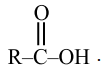
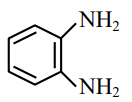 can be synthesized from
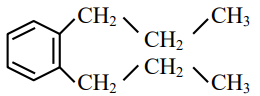 using simpler reagents in the order i) Acidic \(KMnO _4\), ii) Ammonia, iii) Bromine and alkali
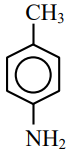 can be converted into
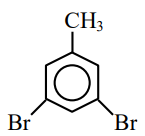 using reagents in the order (i) Bromine- \(H _2 O\) (ii) \(NaNO _2 / HCl \left(0-5^{\circ} C \right)\) (iii) aq. \(H _3 PO _2\).
No questions on this page match these filters.