


Questions
32 questionsShowing 1–32 of 32 questions
-
- (A) 11
- (B) 44
- (C) 22
- (D) 33
Show answer and solution
Correct Answer: (D)
Molar mass of \(CrCl_3 \cdot 6H_2O = 52 + 3 \times 35.5 + 6 \times 18 = 266.5 \text{ g mol}^{-1}\)
Moles of complex reacted \(= \dfrac{5.33}{266.5} = 0.02 \text{ mol}\)
Since the complex is a \(1:3\) electrolyte, it dissociates to give one complex cation and three chloride anions. Its formula is \([Cr(H_2O)_6]Cl_3\).
When passed through a cation exchanger, the complex cation is exchanged, and the chloride ions pass into the eluted solution.
Molar mass of \(AgCl = 108 + 35.5 = 143.5 \text{ g mol}^{-1}\)
Moles of \(AgCl\) formed \(= \dfrac{8.61}{143.5} = 0.06 \text{ mol}\)
The ratio of moles of complex reacted to moles of \(AgCl\) formed is:
\(\text{Ratio} = \dfrac{0.02}{0.06} = \dfrac{1}{3} = 0.3333...\)
This can be written as \(33.33 \times 10^{-2}\).
Rounding to the nearest integer, we get \(33\).
Answer: \(33\) -
- (A) 3
- (B) 1
- (C) 6
- (D) 10
Show answer and solution
Correct Answer: (A)
\(\begin{array}{lc}{\left[ Cr \left( H _2 O \right)_5 Cl \right] Cl _2 \cdot H _2 O + AgNO _3} & \rightarrow 2 AgCl \\ 2.75 / 266.5 & - \\ =0.0103 \text { moles } & 0.02063 \text { mole }\end{array}\)
Mass of \(AgCl =0.02063 \times 143.5=2.96 gm\) -
- (A) 5
- (B) 25
- (C) 35
- (D) 55
Show answer and solution
Correct Answer: (A)
The formula of tetraaquadichloridochromium (III) chloride is \([Cr(H_2O)_4Cl_2]Cl\).
In this complex, there is one ionizable chloride ion present outside the coordination sphere.
The dissociation reaction is:
\([Cr(H_2O)_4Cl_2]Cl \rightarrow [Cr(H_2O)_4Cl_2]^+ + Cl^-\)
Number of moles of the complex \(= M \times V = 0.05 \times \dfrac{100}{1000} = 0.005\) moles.
Since one mole of the complex yields one mole of chloride ions, the number of moles of \(Cl^-\) ions produced is \(0.005\) moles.
When excess \(AgNO_3\) is added, the chloride ions precipitate as \(AgCl\):
\(Ag^+ + Cl^- \rightarrow AgCl \downarrow\)
Number of moles of \(AgCl\) precipitated \(= 0.005 = 5 \times 10^{-3}\) moles.
The value is \(5\).
Answer: \(5\) -
- (A) 0.2 mol of 'Z' is formed
- (B) Y' is \( BaSO_{4} \) and 'Z' is AgBr
- (C) 0.4 mol of 'Z' is formed
- (D) 0.1 mol of 'Y' is formed
Show answer and solution
Correct Answer: (A)
0.4 mol \( [Co(NH_{3})_{5}SO_{4}]Br \) + 0.4 mol \( [Co(NH_{3})_{5}Br]SO_{4} \) are present in 4 lit. solution.
2 lit. of mixture will contain 0.2 mol of each complex.
2 lit. mixture on reaction with excess \( AgNO_{3} \), 0.2 mole AgBr will be formed (Y).
2 lit. mixture on reaction with excess \( BaCl_{2} \), 0.2 mole \( BaSO_{4} \) will be formed (Z). -
- (A) \(2, 2, 2\) and \((A)>(C)>(B)\)
- (B) \(0, 2, 0\) and \((A)>(C)>(B)\)
- (C) \(2, 2, 0\) and \((B)>(C)>(A)\)
- (D) \(2, 2, 2\) and \((C)>(A)>(B)\)
Show answer and solution
Correct Answer: (A)
The oxidation state of \(Ni\) in all three complexes is \(+2\). The electronic configuration of \(Ni^{2+}\) is \([Ar] 3d^{8}\).
In \([Ni(en)_3]^{2+}\) (A), the coordination number is \(6\) (octahedral geometry). The \(d^{8}\) configuration in an octahedral field is \(t_{2g}^{6} e_{g}^{2}\), which has \(2\) unpaired electrons.
In \([NiCl_4]^{2-}\) (B), the coordination number is \(4\) with weak field \(Cl^{-}\) ligands (tetrahedral geometry). The \(d^{8}\) configuration in a tetrahedral field is \(e^{4} t_{2}^{4}\), which has \(2\) unpaired electrons.
In \([Ni(NH_3)_6]^{2+}\) (C), the coordination number is \(6\) (octahedral geometry). The \(d^{8}\) configuration in an octahedral field is \(t_{2g}^{6} e_{g}^{2}\), which has \(2\) unpaired electrons.
Thus, the number of unpaired electrons in (A), (B), and (C) are \(2, 2,\) and \(2\) respectively.
The frequency of absorption of light is directly proportional to the crystal field splitting energy (\(\Delta\)).
According to the spectrochemical series, the field strength of the ligands follows the order: \(en > NH_3 > Cl^{-}\).
Furthermore, the crystal field splitting energy for octahedral complexes is significantly greater than that for tetrahedral complexes (\(\Delta_o = \dfrac{9}{4}\Delta_t\)).
Therefore, the order of crystal field splitting energy, and hence the frequency of absorption, is \([Ni(en)_3]^{2+} > [Ni(NH_3)_6]^{2+} > [NiCl_4]^{2-}\), which corresponds to \((A) > (C) > (B)\).
Answer: \(2, 2, 2\) and \((A)>(C)>(B)\) -
- (A) Statement I is false but Statement II is true
- (B) Both Statement I and Statement II are true
- (C) Both Statement I and Statement II are false
- (D) Statement I is true but Statement II is false
Show answer and solution
Correct Answer: (D)
\( [Cu(NH_{3})_{4}]^{2+} \rightarrow d^{9}, dsp ^2\) one unpaired electron
\( [Ni(en)_{3}]^{2+} \rightarrow d^{8}, sp ^3 d^2\) two unpaired electrons
\( [Ni(NH_{3})_{6}]^{2+} \rightarrow d^{8} ,sp ^3 d^2\) two unpaired electrons
\( [Mn(H_{2}O)_{6}]^{2+} \rightarrow d^{5}, sp ^3 d^2\) five unpaired electrons
\( [Ni(CO)_{4}] \) (diamagnetic),
\( [Ni(CN)_{4}]^{2-} \) (paramagnetic),
\( [NiCl_{4}]^{-2} \) (diamagnetic). -
- (A) Both Statement I and Statement II are true
- (B) Both Statement I and Statement II are false
- (C) Statement I is true but Statement II is false
- (D) Statement I is false but Statement II is true
Show answer and solution
Correct Answer: (A)
Statement I:
The third ionization energy (\(IE_3\)) corresponds to the removal of the third valence electron. Let us look at the electronic configurations of the divalent cations for the given metals:
\(Sc^{2+}\): \([Ar] 3d^{1}\)
\(Mn^{2+}\): \([Ar] 3d^{5}\)
\(Cu^{2+}\): \([Ar] 3d^{9}\)
\(Zn^{2+}\): \([Ar] 3d^{10}\)
For \(Sc\), removing the third electron involves taking it from the \(3d^{1}\) state, which results in a highly stable noble gas core (\([Ar]\)). Hence, \(Sc\) has the lowest \(IE_3\).
For \(Zn\), the third electron must be removed from a completely filled, highly stable \(3d^{10}\) subshell. Combined with its high effective nuclear charge (\(Z_{eff}\)) across the 3d series, \(Zn\) requires the highest energy for the removal of the third electron.
Thus, Statement I is true.
Statement II:
The Crystal Field Stabilization Energy (CFSE) depends on the magnitude of the crystal field splitting energy (\(\Delta_o\)), which in turn depends on the oxidation state of the central metal ion and the strength of the ligand.
1. Oxidation state: A higher oxidation state on the central metal ion leads to a larger \(\Delta_o\). Therefore, the splitting for \(Co^{3+}\) complexes is significantly greater than for \(Co^{2+}\) complexes. This makes the CFSE of \([Co(H_2O)_6]^{3+}\) greater than that of \([Co(H_2O)_6]^{2+}\).
2. Nature of the ligand: Ethylenediamine (\(en\)) is a strong field bidentate ligand, whereas \(H_2O\) is a weak field ligand. According to the spectrochemical series, \(en\) causes a much larger splitting than \(H_2O\). Thus, the \(\Delta_o\) and CFSE for \([Co(en)_3]^{3+}\) are greater than those for \([Co(H_2O)_6]^{3+}\).
The overall order of CFSE is:
\([Co(H_2O)_6]^{2+} < [Co(H_2O)_6]^{3+} < [Co(en)_3]^{3+}\)
Thus, Statement II is true.
Since both statements are correct, the correct option is (1).
Answer: Both Statement I and Statement II are true -
- (A) Both Statement I and Statement II are false
- (B) Statement I is true but Statement II is false
- (C) Statement I is false but Statement II is true
- (D) Both Statement I and Statement II are true
Show answer and solution
Correct Answer: (B)
Statement 1 (True)
Strength of ligand: \(Cl^{-}>Br^{-}\)
\(\Delta_{t}:[CoCl_{4}]^{2}>[CoBr_{4}]^{2-}\)
\(E_{absorbed}:[CoCl_{4}]^{2-}>[CoBr_{4}]^{2-}\)
Statement 2 (False)
Strength of ligand : \(I ^{-}< Cl ^{-}\)
\(\Delta_{t}:[CoI_{4}]^{2-}<[CoCl_{4}]^{2-}\) -
- (A) Both Statement I and Statement II are true
- (B) Both Statement I and Statement II are false
- (C) Statement I is true but Statement II is false
- (D) Statement I is false but Statement II is true
Show answer and solution
Correct Answer: (A)
\(\left[ Mn \left( H _2 O \right)_6\right]^{2+} \Rightarrow\) CFSE value is zero because of \(d ^5\) configuraiton with WFL in coordination number 6 \(\left[ Cr \left( H _2 O \right)_6\right]^{2+}\).
\(\left[ Cr \left( H _2 O \right)_6\right]^{2+} \Rightarrow\) CFSE value is \(-0.6 \Delta_0\) because of \(d ^4\) configuraiton with WFL in coordination number 6.
For : \(K _3\left[ Fe ( CN )_6\right], \mu=\sqrt{1(1+2)}=\sqrt{3}\) B.M.
For : \(Na _4\left[ Fe ( CN )_6\right], \mu=\sqrt{0}\) B.M. -
- (A) Both Statement I and Statement II are correct
- (B) Both Statement I and Statement II are incorrect
- (C) Statement I is correct but Statement II is incorrect
- (D) Statement I is incorrect but Statement II is correct
Show answer and solution
Correct Answer: (A)
In an octahedral crystal field, the five degenerate d-orbitals split into two sets: a lower energy \(t_{2g}\) set and a higher energy \(e_g\) set.
The energy of the \(t_{2g}\) orbitals is lowered by \(0.4\Delta_o\) (stabilization of \(-0.4\Delta_o\)) and the energy of the \(e_g\) orbitals is raised by \(0.6\Delta_o\) (destabilization of \(+0.6\Delta_o\)) relative to the barycenter. Hence, Statement I is correct.
In the free atomic or ionic state, all five d-orbitals of a transition metal are degenerate (have the same energy). When ligands approach the central metal ion to form a complex, the spherically symmetrical field is disrupted, which destroys the degeneracy of the d-orbitals and causes them to split. Hence, Statement II is correct.
Both Statement I and Statement II are correct.
Answer: Both Statement I and Statement II are correct -
- (A) Both statement - I and statement - II are false
- (B) Statement I is false but statement - II is true
- (C) Both statement - I and statement - II are true
- (D) Statement - I is true but statement - II is false
Show answer and solution
Correct Answer: (C)
In \( K_{3}[Co(CO_{3})_{3}] \Rightarrow sp^{3}d^{2} \) hybridized, octahedral
\( \Rightarrow 4 \) unpaired electron
\( \Rightarrow 4.9~B.M. \)
\( [Ni(CN)_{4}]^{2-} \)\( \Rightarrow \) \( dsp^{2} \) hybridized, square planar
\( \Rightarrow 0 \) unpaired electron
\( \Rightarrow 0~B.M. \)
\( [MnBr_{4}]^{2-} \)\( \Rightarrow \) \( sp^{3} \) hybridized, tetrahedral
\( \Rightarrow 5 \) unpaired electron
\( \Rightarrow 5.9~B.M. \)
\( [CoF_{6}]^{3-} \)\(\Rightarrow sp ^3 d^2\) hybridized, octahedral
\( \Rightarrow 4 \) unpaired electron
\( \Rightarrow 4.9~B.M. \) -
- (A) Both statement - I and statement - II are true
- (B) Both statement - I and statement - II are false
- (C) Statement - I is true but statement - II is false
- (D) Statement - I is false but statement - II is true
Show answer and solution
Correct Answer: (A)
Paramagnetic species :
\(\left[ CoF _6\right]^3,\left[ TiF _6\right]^3,\left[ Fe ( CN )_6\right]^3\)
Diamagnetic species : \(V _2 O _5\)
In \(K _4\left[ Fe ( CN )_6\right] \Rightarrow\) No. of unpaired electron \(=0\)
\(K _3\left[ Fe ( CN )_6\right] \Rightarrow\) No. of unpaired electron \(=1\)
\(\left[ Fe \left( H _2 O \right)_6\right] SO _4 \cdot H _2 O \Rightarrow\) No. of unpaired electron \(=4\)
\(\left[ Fe \left( H _2 O \right)_6\right] Cl _3 \Rightarrow\) No. of unpaired electron \(=5\) -
- (A) C & D only
- (B) A, B & D only
- (C) A, C & E only
- (D) A, B, C, D & E
Show answer and solution
Correct Answer: (B)
(A) \( Co^{3+}:-3d^{6} \),
\( NH_{3} \Rightarrow S.F.L \)
Hybridisation \( \Rightarrow d^{2}sp^{3} \), Inner orbital complex.
(B) \( Mn^{3+}:-3d^{4} \),
\( Cl^{-} \Rightarrow W.F.L\)
Hybridisation \( \Rightarrow sp^{3}d^{2} \), Outer orbital complex.
(C) \( Co^{3+}:-3d^{6} \),
\( F^{-} \Rightarrow W.F.L \)
Hybridisation \(\Rightarrow sp^{3}d^{2} \), Outer orbital complex.
(D) \( Fe^{3+}:-3d^{5} \),
\( F^{-} \Rightarrow W.F.L \)
Hybridisation \( \Rightarrow sp^{3}d^{2} \), Outer orbital complex.
(E) \( Ni^{2+}:-3d^{8} \),
\( CN^{-} \Rightarrow S.F.L \).
Hybridisation \(\Rightarrow dsp^{2} \), Inner orbital complex. -
- (A) A, B, C, D and E
- (B) B, C and D only
- (C) A, C and D only
- (D) A, C and E only
Show answer and solution
Correct Answer: (C)
Statement A is correct. The oxalate ion (\(C_2O_4^{2-}\)) is a bidentate ligand and forms chelate rings with the central metal ion. Due to the chelate effect, \([Fe(C_2O_4)_3]^{3-}\) is more stable than complexes formed by monodentate ligands like \([Fe(OH)_6]^{3-}\) and \([Fe(SCN)_6]^{3-}\).
Statement B is incorrect. Ethylenediamine (en) is a bidentate ligand and forms chelate rings, whereas \(NH_3\) is a monodentate ligand. Therefore, \([Cu(en)_2]^{2+}\) is more stable than \([Cu(NH_3)_4]^{2+}\) due to the chelate effect.
Statement C is correct. In \(K_4[Fe(CN)_6]\), the oxidation state of Fe is \(+2\), which corresponds to a \(3d^6\) configuration. Since \(CN^-\) is a strong field ligand, it causes the pairing of electrons in the \(3d\) orbitals, leaving two inner \(3d\) orbitals empty. Thus, the hybridization is \(d^2sp^3\).
Statement D is correct. The \(NO_2^-\) ligand is an ambidentate ligand, meaning it can coordinate to the metal center through either the nitrogen atom or the oxygen atom. Therefore, \([Fe(NO_2)_3Cl_3]^{3-}\) can exhibit linkage isomerism.
Statement E is incorrect. Both \(NO_2^-\) and \(SCN^-\) are ambidentate ligands. \(NO_2^-\) can bind through N or O, and \(SCN^-\) can bind through S or N.
Therefore, the correct statements are A, C, and D.
Answer: A, C and D only -
- (A) A-I, B-II, C-III, D-IV
- (B) A-II, B-III, C-IV, D-I
- (C) A-III, B-IV, C-I, D-II
- (D) A-IV, B-I, C-II, D-III
Show answer and solution
Correct Answer: (D)
The crystal field splitting energy \(\Delta_0\) depends on the strength of the ligand.
According to the spectrochemical series, the order of ligand strength is \(F^- < H_2O < en < CN^-\).
Thus, the order of \(\Delta_0\) for the given complexes is \([CrF_6]^{3-} < [Cr(H_2O)_6]^{3+} < [Cr(en)_3]^{3+} < [Cr(CN)_6]^{3-}\).
Matching with the given values:
\([CrF_6]^{3-}\) has the minimum \(\Delta_0 = 15,060\) cm\(^{-1}\) (B \(\rightarrow\) I).
\([Cr(H_2O)_6]^{3+}\) has \(\Delta_0 = 17,400\) cm\(^{-1}\) (C \(\rightarrow\) II).
\([Cr(en)_3]^{3+}\) has \(\Delta_0 = 22,300\) cm\(^{-1}\) (D \(\rightarrow\) III).
\([Cr(CN)_6]^{3-}\) has the maximum \(\Delta_0 = 26,600\) cm\(^{-1}\) (A \(\rightarrow\) IV).
This corresponds to A-IV, B-I, C-II, D-III.
Answer: A-IV, B-I, C-II, D-III -
- (A) A-I, B-III, C-IV, D-II
- (B) A-II, B-I, C-III, D-IV
- (C) A-IV, B-II, C-I, D-III
- (D) A-III, B-I, C-IV, D-II
Show answer and solution
Correct Answer: (D)
The spin-only magnetic moment is given by the formula \(\mu = \sqrt{n(n+2)}\) BM, where \(n\) is the number of unpaired electrons.
A. \([Cr(H_2O)_6]^{2+}\): Chromium is in the \(+2\) oxidation state. The electronic configuration of \(Cr^{2+}\) is \([Ar] 3d^4\). Since \(H_2O\) is a weak field ligand, no pairing occurs. The number of unpaired electrons is \(n = 4\).
\(\mu = \sqrt{4(4+2)} = \sqrt{24} \approx 4.90\) BM. (A \(\rightarrow\) III)
B. \([Co(H_2O)_6]^{2+}\): Cobalt is in the \(+2\) oxidation state. The electronic configuration of \(Co^{2+}\) is \([Ar] 3d^7\). With \(H_2O\) as a weak field ligand, the configuration is \(t_{2g}^5 e_g^2\). The number of unpaired electrons is \(n = 3\).
\(\mu = \sqrt{3(3+2)} = \sqrt{15} \approx 3.87\) BM. (B \(\rightarrow\) I)
C. \([Cu(H_2O)_6]^{2+}\): Copper is in the \(+2\) oxidation state. The electronic configuration of \(Cu^{2+}\) is \([Ar] 3d^9\). The number of unpaired electrons is \(n = 1\).
\(\mu = \sqrt{1(1+2)} = \sqrt{3} \approx 1.73\) BM. (C \(\rightarrow\) IV)
D. \([Mn(H_2O)_6]^{2+}\): Manganese is in the \(+2\) oxidation state. The electronic configuration of \(Mn^{2+}\) is \([Ar] 3d^5\). With \(H_2O\) as a weak field ligand, the configuration is \(t_{2g}^3 e_g^2\). The number of unpaired electrons is \(n = 5\).
\(\mu = \sqrt{5(5+2)} = \sqrt{35} \approx 5.92\) BM. (D \(\rightarrow\) II)
The correct matching is A-III, B-I, C-IV, D-II.
Answer: A-III, B-I, C-IV, D-II -
- (A) A-III, B-IV, C-II, D-I
- (B) A-III, B-I, C-IV, D-II
- (C) A-III, B-IV, C-I, D-II
- (D) A-II, B-I, C-IV, D-III
Show answer and solution
Correct Answer: (C)
In a tetrahedral crystal field, the d-orbitals split into a lower energy \(e\) set and a higher energy \(t_2\) set. The energy of an electron in the \(e\) orbital is \(-0.6 \Delta_t\) and in the \(t_2\) orbital is \(+0.4 \Delta_t\). Since \(\Delta_t\) is generally small, tetrahedral complexes form high-spin configurations.
The Crystal Field Stabilization Energy (CFSE) is given by:
\(\text{CFSE} = (-0.6 n_e + 0.4 n_{t_2}) \Delta_t\)
For \(d^2\): The configuration is \(e^2 t_2^0\).
\(\text{CFSE} = 2 \times (-0.6) + 0 = -1.2 \Delta_t\) (A \(\rightarrow\) III)
For \(d^4\): The configuration is \(e^2 t_2^2\).
\(\text{CFSE} = 2 \times (-0.6) + 2 \times (0.4) = -1.2 + 0.8 = -0.4 \Delta_t\) (B \(\rightarrow\) IV)
For \(d^6\): The configuration is \(e^3 t_2^3\).
\(\text{CFSE} = 3 \times (-0.6) + 3 \times (0.4) = -1.8 + 1.2 = -0.6 \Delta_t\) (C \(\rightarrow\) I)
For \(d^8\): The configuration is \(e^4 t_2^4\).
\(\text{CFSE} = 4 \times (-0.6) + 4 \times (0.4) = -2.4 + 1.6 = -0.8 \Delta_t\) (D \(\rightarrow\) II)
Therefore, the correct match is A-III, B-IV, C-I, D-II.
Answer: A-III, B-IV, C-I, D-II -
- (A) A and B only
- (B) A, B and D only
- (C) C and D only
- (D) C, D and E only
Show answer and solution
Correct Answer: (B)
\(\left[ Ni \left( PPh _3\right)_2 Cl _2\right]\)
Given : Paramagnetic complex hence it must be tetrahedral so
Crystal field splitting :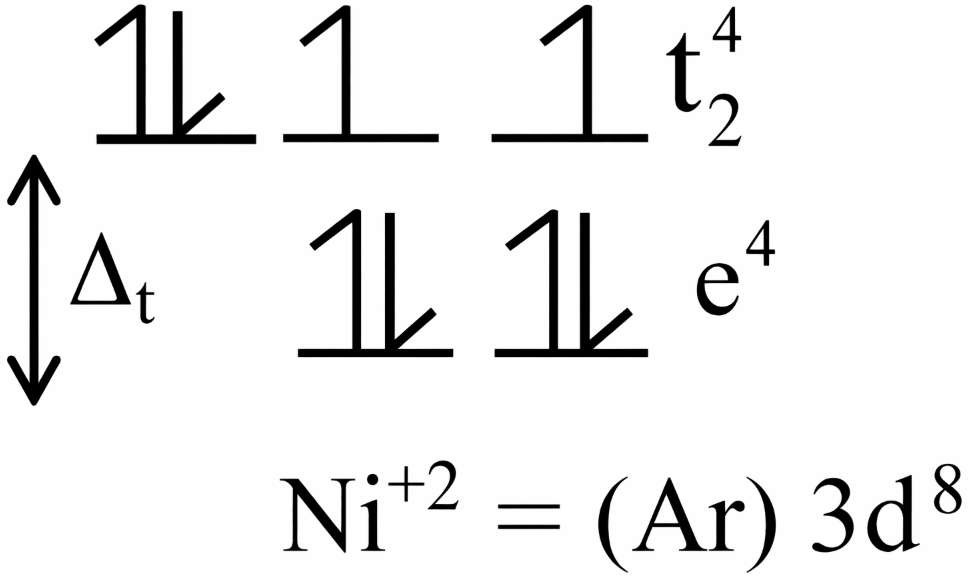
(A) Tetrahedral complex not show geometrical isomerism.
(B) Complex is Blue colour
(C) Calculated spin only magnetic moment of the complex is \(2.84 B . M\).
(D) \({C.F.S.E }=-0.6 \Delta_t(4)+0.4 \Delta_t(4)\)
\(=-0.8 \Delta_t\left(\text { not }-0.8 \Delta_0\right)\)
(E) \(Ni ( CO )_4\) also tetrahedral
Hence only A, B, D correct. -
- (A) 6
- (B) 12
- (C) 24
- (D) 48
Show answer and solution
Correct Answer: (A)
To determine the magnetic nature of the given complexes, we analyze the oxidation state, electronic configuration, and the nature of the ligands for each central metal atom/ion:
1. \([\text{MnBr}_4]^{2-}\): Mn\(^{2+}\) has a \(3d^5\) configuration. Br\(^-\) is a weak field ligand. The complex is tetrahedral with \(5\) unpaired electrons. (Paramagnetic)
2. \([\text{NiCl}_4]^{2-}\): Ni\(^{2+}\) has a \(3d^8\) configuration. Cl\(^-\) is a weak field ligand. The complex is tetrahedral with \(2\) unpaired electrons. (Paramagnetic)
3. \([\text{Ni(CN)}_4]^{2-}\): Ni\(^{2+}\) has a \(3d^8\) configuration. CN\(^-\) is a strong field ligand. The complex is square planar (\(dsp^2\)) with all electrons paired. (Diamagnetic)
4. \([\text{Ni(CO)}_4]\): Ni\(^0\) has a \(3d^8 4s^2\) configuration, which becomes \(3d^{10}\) in the presence of the strong field ligand CO. The complex is tetrahedral with all electrons paired. (Diamagnetic)
5. \([\text{CoF}_6]^{3-}\): Co\(^{3+}\) has a \(3d^6\) configuration. F\(^-\) is a weak field ligand. The complex is octahedral and high spin (\(t_{2g}^4 e_g^2\)) with \(4\) unpaired electrons. (Paramagnetic)
6. \([\text{Fe(CN)}_6]^{4-}\): Fe\(^{2+}\) has a \(3d^6\) configuration. CN\(^-\) is a strong field ligand. The complex is octahedral and low spin (\(t_{2g}^6 e_g^0\)) with all electrons paired. (Diamagnetic)
7. \([\text{Mn(CN)}_6]^{3-}\): Mn\(^{3+}\) has a \(3d^4\) configuration. CN\(^-\) is a strong field ligand. The complex is octahedral and low spin (\(t_{2g}^4 e_g^0\)) with \(2\) unpaired electrons. (Paramagnetic)
8. \([\text{Ti(CN)}_6]^{3-}\): Ti\(^{3+}\) has a \(3d^1\) configuration. The complex is octahedral (\(t_{2g}^1 e_g^0\)) with \(1\) unpaired electron. (Paramagnetic)
9. \([\text{Cu(H}_2\text{O)}_6]^{2+}\): Cu\(^{2+}\) has a \(3d^9\) configuration. The complex is octahedral (\(t_{2g}^6 e_g^3\)) with \(1\) unpaired electron. (Paramagnetic)
10. \([\text{Co(C}_2\text{O}_4\text{)}_3]^{3-}\): Co\(^{3+}\) has a \(3d^6\) configuration. Oxalate (\(\text{C}_2\text{O}_4^{2-}\)) acts as a strong field ligand for Co\(^{3+}\). The complex is octahedral and low spin (\(t_{2g}^6 e_g^0\)) with all electrons paired. (Diamagnetic)
Therefore, the paramagnetic complexes are \([\text{MnBr}_4]^{2-}\), \([\text{NiCl}_4]^{2-}\), \([\text{CoF}_6]^{3-}\), \([\text{Mn(CN)}_6]^{3-}\), \([\text{Ti(CN)}_6]^{3-}\), and \([\text{Cu(H}_2\text{O)}_6]^{2+}\).
The total number of paramagnetic complexes is \(6\).
Answer: \(6\) -
- (A) A = B < C < D
- (B) A = B < D < C
- (C) C = D < B < A
- (D) C < B < D < A
Show answer and solution
Correct Answer: (D)
\(Mn^{2+}~3d^{5}~n=5\)
\(Cu ^{2+}~3 d^9~t _{2 g}^{2,2,2}~e _{ g }^{2,1} n =1\)
\(Ni ^{2+}~3 d^8\) square planar \(n =0\)
\(Ni ^{2+}~3 d^8\) tetrahedral \(e ^{2,2}~t _2^{2,1,1}~n =2\) -
- (A) \(\left[ Ni ( CN )_4\right]^{2-}\) and \(\left[ NiCl _4\right]^{2-}\) are diamagnetic and \(Ni ( CO )_4\) is paramagnetic.
- (B) \(Ni ( CO )_4\) and \(\left[ NiCl _4\right]^{2-}\) are diamagnetic and \(\left[ Ni ( CN )_4\right]^{2-}\) is paramagnetic.
- (C) \(Ni ( CO )_4\) and \(\left[ Ni ( CN )_4\right]^{2-}\) are diamagnetic and \(\left[ NiCl _4\right]^{2-}\) is paramagnetic.
- (D) \(Ni ( CO )_4\) is diamagnetic and \(\left[ NiCl _4\right]^{2-}\) and \(\left[ Ni ( CN )_4\right]^{2-}\) are paramagnetic.
Show answer and solution
Correct Answer: (C)
\(\left[ Ni ( CN )_4\right]^{2-} \rightarrow 3 d^8 \rightarrow\) diamagnetic \(\rightarrow dsp ^2\)
\(\left[ Ni ( CO )_4\right] \rightarrow 3 d^{10} \rightarrow\) diamagnetic \(\rightarrow sp ^3\)
\(\left[ NiCl _4\right]^{2-} \rightarrow 3 d^8 \rightarrow e ^{2,2} t _2^{2,1,1} \rightarrow sp ^3 \rightarrow\) paramagnetic. -
- (A) A and B Only
- (B) A, C and D Only
- (C) B and C Only
- (D) A and D Only
Show answer and solution
Correct Answer: (B)
Statement A is correct. The metal-carbon bond in metal carbonyls possesses both \(\sigma\) and \(\pi\) character due to synergic bonding.
Statement B is incorrect. The synergic bonding interaction between the metal and the CO ligand strengthens the metal-carbon bond.
Statement C is correct. The metal-carbon \(\sigma\) bond is formed by the donation of a lone pair of electrons from the carbonyl carbon into a vacant orbital of the metal.
Statement D is correct. The metal-carbon \(\pi\) bond is formed by the back-donation of electrons from a filled d-orbital of the metal into the vacant antibonding \(\pi^{*}\) orbital of the CO ligand.
Therefore, statements A, C, and D are correct.
Answer: A, C and D Only -
- (A) 1
- (B) 2
- (C) 3
- (D) 4
Show answer and solution
Correct Answer: (B)
Pairing energy neglected w.r.t. \(\Delta_0\)
\(\left[ Co ( ox )_3\right]^{3-}: Co ^{+3}: d ^6 ; t _2 g^{2,2,2} eg ^{0,0}\)
\(CFSE =6 \times\left(-0.4 \Delta_0\right)=-2.4 \Delta_0\)
\(\left[ Cr \left( ox _3\right)\right]^{3-}: Cr ^{+3}: d ^3 ; t _2 g^{1,1,1} eg ^{0,0}\)
\(CFSE =3 \times\left(-0.4 \Delta_0\right)=-1.2 \Delta_0\)
\(\frac{( CFSE )_{ Co ^{+3}}}{( CFSE )_{ Cr ^{+3}}}=2\) -
- (A) 4
- (B) 6
- (C) 8
- (D) 10
Show answer and solution
Correct Answer: (B)
\(Sc ^{+3}\) 18 \(Cr ^{+2}\) 22 \(Mn ^{+3}\) 22 \(Co ^{+3}\) 24 \(Fe ^{+3}\) 23
\(Cr ^{2+}\) and \(Mn ^{3+}\) are isoelectronic
\(n =2\)
Complex is : \(\left[ Co ( en )_2 NH _3 Cl \right] Cl _2\)
\(\Rightarrow Co ^{3+} \quad 3 d^6 \quad t _{2 g}^{2,2,2} \quad e _{ g }^{0,0}\) -
- (A) C and E only
- (B) A, D and B only
- (C) B, C and E only
- (D) C and D only
Show answer and solution
Correct Answer: (C)
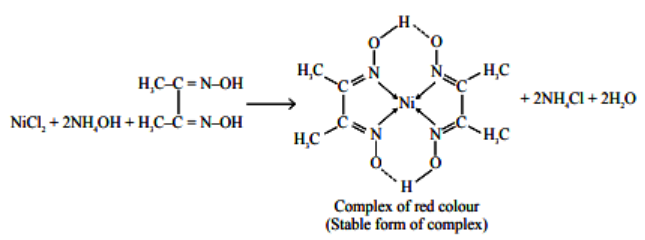
In the above complex, Ni is present in +2 oxidation number.
A) It is rosy red ppt
B) It is precipitated in basic medium
C) \(Ni ^{+2}: 3 d^8\)
Hybridisation : \(dsp ^2\)
Unpaired \(e ^{-}=0\)
Geometry : Square planar
D) \(N - Ni - N\) Bond angle is close to \(90^{\circ}\)
E) 2 five membered metal containing rings are formed. -
- (A) 15
- (B) 25
- (C) 35
- (D) 45
Show answer and solution
Correct Answer: (A)
In an octahedral complex, the d-orbitals split into \(t_{2g}\) and \(e_g\) levels.
For \(d^3\): Configuration is \(t_{2g}^3 e_g^0\). Number of unpaired electrons = \(3\).
For \(d^4\) (low spin): Configuration is \(t_{2g}^4 e_g^0\). Number of unpaired electrons = \(2\).
For \(d^5\) (high spin): Configuration is \(t_{2g}^3 e_g^2\). Number of unpaired electrons = \(5\).
For \(d^6\) (high spin): Configuration is \(t_{2g}^4 e_g^2\). Number of unpaired electrons = \(4\).
For \(d^7\) (low spin): Configuration is \(t_{2g}^6 e_g^1\). Number of unpaired electrons = \(1\).
Total number of unpaired electrons = \(3 + 2 + 5 + 4 + 1 = 15\).
Answer: \(15\) -
- (A) III < I < II < IV < V
- (B) III < I < IV < V < II
- (C) III < IV < I < II < V
- (D) III < I < IV < II < V
Show answer and solution
Correct Answer: (D)
Wavelength of light absorbed increases as C.F.S.E of complex decreases.
\([Co(CN)_{6}]^{3-}\) has maximum CFSE
\([CoF_{6}]^{3-}\) has least CFSE
Ligand field strength\(\uparrow\) ; C.F.S.E\(\uparrow\)
Correct wavelength order :
V > II > IV > I > III -
- (A) 0
- (B) 2
- (C) 4
- (D) 6
Show answer and solution
Correct Answer: (B)
In \( [Ni(CO)_{4}] \) \( Ni^{0}: 3d^{8} 4s^{2} \)
Hybridisation state :\( sp^{3} \)
Unpaired electron = 0
In \( [NiCl_{4}]^{2-} \),: \( Ni^{2+}: 3d^{8} \)
Hybridisation state \( sp^{3} \)
Unpaired electron = 2
In \( [PtCl_{4}]^{2-} \), \( Pt^{2+}: 5d^{8} \)
Hybridisation state : \( dsp^{2} \)
Unpaired electron = 0
In \( [Ni(CN)_{4}]^{2-} \), \( Ni^{2+}: 3d^{8} \)
Hybridisation state : \( dsp^{2} \)
Unpaired electron = 0
In \( [Pt(NH_{3})_{2}Cl_{2}] \), \( Pt^{2+}: 5d^{8} \)
Hybridisation state :\( dsp^{2} \)
Unpaired electron = 0 -
- (A) B, C and D Only
- (B) B, D and E Only
- (C) A, C and D Only
- (D) C, D and E Only
Show answer and solution
Correct Answer: (B)
Coordination isomerism arises from the interchange of ligands between cationic and anionic entities of different metal ions present in a complex.
A. \([Ag(NH_3)_2][Ag(CN)_2]\): Both the complex cation and anion contain the same metal ion (\(Ag^+\)). Interchanging one ligand produces a neutral molecule \([Ag(NH_3)(CN)]\), and interchanging both ligands yields the identical compound. Thus, it does not show coordination isomerism.
B. \([Co(NH_3)_6][Cr(CN)_6]\): The complex contains different metal ions (\(Co^{3+}\) and \(Cr^{3+}\)). Interchange of ligands gives the coordination isomer \([Cr(NH_3)_6][Co(CN)_6]\). Thus, it shows coordination isomerism.
C. \([Co(NH_3)_6][Co(CN)_6]\): Both the complex cation and anion contain the same metal ion (\(Co^{3+}\)). According to the strict definition requiring different metal ions, this is generally excluded from being a primary example of coordination isomerism in standard contexts.
D. \([Fe(NH_3)_6][Co(CN)_6]\): The complex contains different metal ions (\(Fe^{3+}\) and \(Co^{3+}\)). Interchange of ligands gives the coordination isomer \([Co(NH_3)_6][Fe(CN)_6]\). Thus, it shows coordination isomerism.
E. \([Co(NH_3)_6][Fe(CN)_6]\): This is the coordination isomer of complex D. Since it contains different metal ions, it also shows coordination isomerism by interchanging ligands to form \([Fe(NH_3)_6][Co(CN)_6]\).
Since complexes D and E are coordination isomers of each other, they must both be included together. Therefore, the complexes that show coordination isomerism are B, D, and E.
Answer: B, D and E Only -
- (A) A, B, C and D
- (B) B, C and D only
- (C) A, C and D only
- (D) A, B and D only
Show answer and solution
Correct Answer: (D)
In \([\text{NiCl}_4]^{2-}\), Ni is in \(+2\) oxidation state with a \(3d^8\) configuration. Since \(\text{Cl}^-\) is a weak field ligand, no pairing of electrons takes place. The hybridisation is \(sp^3\), the geometry is tetrahedral, and the presence of two unpaired electrons makes it paramagnetic. Thus, statement A is correct.
In \([\text{Ni(NH}_3)_6]^{2+}\), Ni is in \(+2\) oxidation state with a \(3d^8\) configuration. In an octahedral field, a \(d^8\) ion cannot form inner orbital complexes. It undergoes \(sp^3d^2\) hybridisation, forming an octahedral geometry. It has two unpaired electrons, making it paramagnetic. Thus, statement B is correct.
In \([\text{Ni(CO)}_4]\), Ni is in \(0\) oxidation state with a \(3d^8 4s^2\) configuration. Since \(\text{CO}\) is a strong field ligand, the \(4s\) electrons are forced to pair up in the \(3d\) orbitals, resulting in a \(3d^{10}\) configuration. The hybridisation is \(sp^3\), the geometry is tetrahedral, and since there are no unpaired electrons, it is diamagnetic. Statement C incorrectly lists it as paramagnetic.
In \([\text{Ni(CN)}_4]^{2-}\), Ni is in \(+2\) oxidation state with a \(3d^8\) configuration. Since \(\text{CN}^-\) is a strong field ligand, it causes the pairing of \(3d\) electrons, leaving one \(3d\) orbital empty. The hybridisation is \(dsp^2\), the geometry is square planar, and the absence of unpaired electrons makes it diamagnetic. Thus, statement D is correct.
Therefore, only statements A, B, and D are correct.
Answer: A, B and D only -
- (A) Only A, B and D
- (B) Only A and B
- (C) Only B and D
- (D) Only B, C and D
Show answer and solution
Correct Answer: (A)
In a tetrahedral complex, due to the crystal field created by ligands, the five d-orbitals split into two sets.
Ligands approach the central metal ion from in between the axes. The \(d_{xy}\), \(d_{yz}\), and \(d_{xz}\) orbitals (which form the \(t_2\) set) lie in between the axes, experience more repulsion from the ligands, and therefore have higher energy.
The \(d_{x^2-y^2}\) and \(d_{z^2}\) orbitals (which form the \(e\) set) lie along the axes, experience less repulsion, and therefore have lower energy.
Therefore, the order of energy is \(d_{xy} = d_{yz} = d_{xz} > d_{x^2-y^2} = d_{z^2}\).
Evaluating the given statements:
A. \(d_{xy} = d_{xz} > d_{x^2-y^2}\) is correct.
B. \(d_{xy} = d_{yz} > d_{z^2}\) is correct.
C. \(d_{x^2-y^2} > d_{z^2} > d_{xz}\) is incorrect.
D. \(d_{x^2-y^2} = d_{z^2} < d_{xz}\) is correct.
Hence, statements A, B, and D are correct.
Answer: Only A, B and D -
- (A) 4
- (B) 5
- (C) 6
- (D) 7
Show answer and solution
Correct Answer: (C)
Here
\(X =3\) (Two cis + one trans isomers \()\)
\(Y=1\) (trans isomer)
\(Z =2\) (Fac- mer isomer)
\(X+Y+Z=3+1+2=6\)
No questions on this page match these filters.