


Questions
7 questionsShowing 1–7 of 7 questions
-
- (A) Both Statement I and Statement II are true
- (B) Both Statement I and Statement II are false
- (C) Statement I is true but Statement II is false
- (D) Statement I is false but Statement II is true
Show answer and solution
Correct Answer: (C)
In fractional distillation, the temperature of the fractionating column decreases from bottom to top. As the vapours of the mixture rise, they cool and undergo condensation.
The component with the higher boiling point condenses at a higher temperature, meaning it condenses earlier (lower down the column) than the component with the lower boiling point. Thus, Statement I is true.
As the vapours rise up the fractionating column, the higher boiling component continuously condenses and falls back as liquid, while the lower boiling (more volatile) component remains in the vapour phase and continues to rise. Therefore, the vapours rising up the column become richer in the lower boiling component, not the high boiling component. Thus, Statement II is false.
Hence, Statement I is true but Statement II is false.
Answer: Statement I is true but Statement II is false -
- (A) 1,1-Dimethylcyclopropane
- (B) 2,2-Dimethylpropane
- (C) 2-Methylbutane
- (D) n-pentane
Show answer and solution
Correct Answer: (C)
Let the hydrocarbon be an alkane with general formula \(C_nH_{2n+2}\).
Molar mass \(= 14n + 2 = 72 \Rightarrow 14n = 70 \Rightarrow n = 5\)
The molecular formula is \(C_5H_{12}\).
The structural isomers of \(C_5H_{12}\) are:
n-pentane: \(CH_3-CH_2-CH_2-CH_2-CH_3\) (2 primary carbons)
2-methylbutane: \(CH_3-CH(CH_3)-CH_2-CH_3\) (3 primary carbons)
2,2-dimethylpropane: \(C(CH_3)_4\) (4 primary carbons)
The hydrocarbon with exactly three primary carbon atoms is 2-methylbutane.
Answer: 2-Methylbutane - 3. In IUPAC nomenclature, the correct order of decreasing priority of functional group is : 2026 Medium
- (A) \(-CONH_2, >C=O, -CHO, -NH_2, -C\equiv C-\)
- (B) \(-CONH_2, -COOCH_3, -CHO, -NH_2, -OH\)
- (C) \(-CONH_2, -CHO, >C=O, -NH_2, -C\equiv C-\)
- (D) \(-CONH_2, -CHO, -CN, -NH_2, -C\equiv C-\)
Show answer and solution
Correct Answer: (C)
The correct order of decreasing priority for functional groups in IUPAC nomenclature is:
Carboxylic acids (\(-COOH\)) \(>\) Sulphonic acids (\(-SO_3H\)) \(>\) Esters (\(-COOR\)) \(>\) Acid halides (\(-COX\)) \(>\) Amides (\(-CONH_2\)) \(>\) Nitriles (\(-CN\)) \(>\) Aldehydes (\(-CHO\)) \(>\) Ketones (\(>C=O\)) \(>\) Alcohols (\(-OH\)) \(>\) Thiols (\(-SH\)) \(>\) Amines (\(-NH_2\)) \(>\) Alkynes (\(-C\equiv C-\)).
Checking the given options:
Option (A) is incorrect because \(-CHO\) has a higher priority than \(>C=O\).
Option (B) is incorrect because \(-COOCH_3\) has a higher priority than \(-CONH_2\).
Option (C) correctly follows the priority order: \(-CONH_2 > -CHO > >C=O > -NH_2 > -C\equiv C-\).
Option (D) is incorrect because \(-CN\) has a higher priority than \(-CHO\).
Answer: \(-CONH_2, -CHO, >C=O, -NH_2, -C\equiv C-\) -
- (A) 431
- (B) 432
- (C) 433
- (D) 435
Show answer and solution
Correct Answer: (D)
Mass of the organic compound (X) can be calculated as:
\(\text{Mass of X} = \text{Moles} \times \text{Molar mass}\)
\(\text{Mass of X} = 2.0 \times 10^{-3} \text{ mol} \times 76 \text{ g mol}^{-1} = 0.152 \text{ g}\)
In the Carius method for sulphur estimation, the mass of sulphur in the given mass of \(\text{BaSO}_4\) is:
\(\text{Mass of S} = \dfrac{32}{233} \times \text{Mass of BaSO}_4\)
\(\text{Mass of S} = \dfrac{32}{233} \times 0.4813 \text{ g} \approx 0.0661 \text{ g}\)
The percentage of sulphur in the organic compound is given by:
\(\text{\% of S} = \dfrac{\text{Mass of S}}{\text{Mass of X}} \times 100\)
\(\text{\% of S} = \dfrac{0.0661}{0.152} \times 100 \approx 43.487 \text{ \%}\)
To express this in the requested format:
\(43.487 \text{ \%} = 434.87 \times 10^{-1} \text{ \%}\)
Rounding to the nearest integer, we get \(435\).
Answer: \(435\) -
- (A) \(\alpha > \beta > \gamma\)
- (B) \(\alpha < \beta < \gamma\)
- (C) \(\alpha = \beta = \gamma\)
- (D) \(\alpha < \beta = \gamma\)
Show answer and solution
Correct Answer: (B)
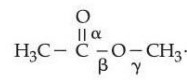
In methyl acetate, the \(\alpha\) bond is a \(C=O\) double bond, which is the shortest among the three.
The \(\beta\) bond is a \(C-O\) single bond adjacent to a carbonyl group. Due to resonance (\(CH_3-C(=O)-O-CH_3 \leftrightarrow CH_3-C(-O^-)=O^+-CH_3\)), the \(\beta\) bond acquires partial double bond character, making it shorter than a pure single bond.
The \(\gamma\) bond is a pure \(C-O\) single bond between an \(sp^3\) hybridized carbon and oxygen, with no resonance involvement. Thus, it is the longest bond.
Therefore, the correct order of bond lengths is \(\alpha < \beta < \gamma\).
Answer: \(\alpha < \beta < \gamma\) -
- (A) A < B < C < D
- (B) A < D < C < B
- (C) D < C < B < A
- (D) D < C < A < B
Show answer and solution
Correct Answer: (B)
Explanation:
Let us determine the correct order of bond lengths step-by-step by analyzing the two primary factors involved: bond order and atomic size.
1. Effect of Bond Order:
For a given pair of atoms, bond length decreases as the bond order increases because more shared electrons pull the nuclei closer together. Therefore, a triple bond is shorter than a double bond, which is shorter than a single bond: \(\text{Triple} < \text{Double} < \text{Single}\). This explains why the carbonyl double bond \(C=O(C)\) is shorter than the ether single bond \(C-O(B)\).
2. Effect of Atomic Size (The C-H Exception):
When comparing bonds with different atoms, the size of the atoms is crucial. Hydrogen belongs to the first period and has the smallest atomic radius because it possesses only a single \(1s\) orbital shell. Because the hydrogen atom is exceptionally small, the \(C-H(A)\) single bond is uniquely compressed, measuring only around \(107\text{ pm}\). This is shorter than the \(C \equiv N(D)\) triple bond (\(116\text{ pm}\)), where both carbon and nitrogen are larger second-period atoms.
3. Summary of Bond Length Values:
- \(C-H(A)\): \(107\text{ pm}\)
- \(C \equiv N(D)\): \(116\text{ pm}\)
- \(C=O(C)\): \(121\text{ pm}\)
- \(C-O(B)\): \(143\text{ pm}\)
Arranging these values from shortest to longest gives: A < D < C < B.
Hence, Option B is the correct choice. -
- (A) \(6\)
- (B) \(4\)
- (C) \(3\)
- (D) \(5\)
Show answer and solution
Correct Answer: (B)
A species is aromatic if it is cyclic, planar, fully conjugated (continuous cyclic overlap of \(p\)-orbitals) and contains \((4n + 2)\,\pi\) electrons (Huckel's rule). Let us analyse each species.
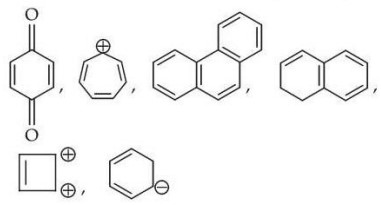
\(1,4\)-Benzoquinone:
The six-membered ring has only \(4\pi\) electrons (from the two \(C=C\) bonds); the two \(C=O\) groups are cross-conjugated and do not contribute to a continuous \((4n + 2)\,\pi\) ring system. Hence, it is non-aromatic.
Tropylium cation:
A planar, cyclic, fully conjugated seven-membered system with three \(C=C\) bonds and a positive charge (empty \(p\)-orbital). It has \(6\,\pi\) electrons, satisfying Huckel's rule with \(n = 1\). It is aromatic.
Phenanthrene:
A fused tricyclic, planar, fully conjugated hydrocarbon with \(14\,\pi\) electrons. It obeys Huckel's rule with \(n = 3\). It is aromatic.
\(1,2\)-Dihydronaphthalene:
It contains an intact benzene ring fused to a partially saturated six-membered ring. Because of the benzene ring, the molecule as a whole is classified as aromatic.
Cyclobutadiene dication:
A planar, four-membered ring with one \(C=C\) bond and two positive charges (two empty \(p\)-orbitals), giving \(2\,\pi\) electrons. It satisfies Huckel's rule with \(n = 0\). It is aromatic.
Cyclohexadienyl anion (as drawn with a \(-CH_2-\) group):
The \(sp^3\) \(-CH_2-\) carbon breaks the continuous cyclic conjugation, so the ring is not fully conjugated. Hence, it is non-aromatic.
Counting the aromatic species: tropylium cation, phenanthrene, \(1,2\)-dihydronaphthalene and cyclobutadiene dication give a total of \(4\) aromatic species.
Hence, the correct option is \((2)\ 4\).
No questions on this page match these filters.