


Questions
22 questionsShowing 1–22 of 22 questions
-
- (A) 73%
- (B) 71%
- (C) 76%
- (D) 68%
Show answer and solution
Correct Answer: (A)
\(\begin{array}{l}\quad { C _{ x } H _{ z }}+ O _2 \rightarrow CO _2+ H _2 O \\ t =0 \quad 0.25 gm \\ t _{ eq }\quad-\quad 0.18 gm \quad 0.15 gm \end{array}\)
Mass of ' H ' \(=\frac{0.15}{18} \times 2=0.016 \simeq 0.017 gm\).
Mass of ' O ' \(=0.25-0.05-0.017=0.1833 gm\)
Mass \(\%\) of ' O ' \(=\frac{0.1833}{0.25} \times 100=73.32 \%\). -
- (A) 2%
- (B) 6%
- (C) 1%
- (D) 4%
Show answer and solution
Correct Answer: (D)
\(\begin{array}{cl} C _{ x } H _{ y } Br _{ z } & \rightarrow \quad CO _2 \\ 1 g & 1.32 g\end{array}\)
\(\% C=\frac{1.32 \times 12}{44 \times 1} \times 100=36 \%\)
\(\begin{array}{clc} C _{ x } H _{ y } Br _{ z } & \rightarrow & AgBr \\ 0.53 g & & 0.75 g\end{array}\)
\(\% Br =\frac{0.75 \times 80}{188 \times 0.53} \times 100=60.2 \%\)
\(\% H =100-(36+60.2)\)
\(\% H \simeq 4 \%\) -
- (A) 4
- (B) 5
- (C) 6
- (D) 7
Show answer and solution
Correct Answer: (B)
Mass of \(AgBr\) formed = \(3.36\) g
Molar mass of \(AgBr = 108 + 80 = 188\) g mol\(^{-1}\)
Moles of \(AgBr\) formed = \(\dfrac{3.36}{188} \approx 0.01787\) mol
Since \(1\) mole of \(AgBr\) contains \(1\) mole of \(Br\), moles of \(Br\) in the compound = \(0.01787\) mol.
Mass of \(Br = 0.01787 \times 80 = 1.43\) g
Percentage of \(Br\) in compound \((X) = \dfrac{1.43}{2.0} \times 100 = 71.5\%\)
Given percentage of \(C = 26.7\%\)
Percentage of \(H = 100\% - (71.5\% + 26.7\%) = 1.8\%\)
Now, we find the molar ratio of the elements in the compound:
Moles of \(C = \dfrac{26.7}{12} = 2.225\)
Moles of \(H = \dfrac{1.8}{1} = 1.8\)
Moles of \(Br = \dfrac{71.5}{80} = 0.893\)
Dividing by the smallest value (\(0.893\)) to get the simplest ratio:
\(C : H : Br = \dfrac{2.225}{0.893} : \dfrac{1.8}{0.893} : \dfrac{0.893}{0.893}\)
\(C : H : Br \approx 2.5 : 2 : 1\)
Multiplying by \(2\) to obtain whole numbers, we get the ratio \(5 : 4 : 2\).
The empirical formula of the compound is \(C_5H_4Br_2\).
The total number of carbon atoms in the empirical formula is \(5\).
Answer: \(5\) -
- (A) \(Ca^{2+}\) and \(SO_4^{2-}\)
- (B) \(Ba^{2+}\) and \(PO_4^{3-}\)
- (C) \(Mn^{2+}\) and \(PO_4^{3-}\)
- (D) \(Ba^{2+}\) and \(SO_4^{2-}\)
Show answer and solution
Correct Answer: (B)
An apple green colour in the flame test indicates the presence of \(Ba^{2+}\) ion.
The group precipitate of \(Ba^{2+}\) is \(BaCO_3\), which dissolves in acetic acid to form barium acetate. Upon treatment with \(K_2CrO_4\), it gives a yellow precipitate of barium chromate (\(BaCrO_4\)), confirming the presence of \(Ba^{2+}\).
When the sodium carbonate extract is heated with conc. \(HNO_3\) and ammonium molybdate, the formation of a canary yellow precipitate indicates the presence of phosphate (\(PO_4^{3-}\)) ion. The canary yellow precipitate is ammonium phosphomolybdate, \((NH_4)_3PO_4 \cdot 12MoO_3\).
Therefore, the cation is \(Ba^{2+}\) and the anion is \(PO_4^{3-}\).
Answer: \(Ba^{2+}\) and \(PO_4^{3-}\) -
- (A) 42.10%
- (B) 63.15%
- (C) 21.05%
- (D) 48.24%
Show answer and solution
Correct Answer: (C)
\(\% S=\frac{32}{233} \times \frac{0.4813}{0.314} \times 100\)
\(=21.052 \%\) -
- (A) 50
- (B) 30
- (C) 20
- (D) 40
Show answer and solution
Correct Answer: (A)
% of \(P = \frac{n_{Mg_{2}P_{2}O_{7}} \times 2 \times 31}{w_{(unknown~compound)}} \times 100\)
\(= \frac{(\frac{1.79}{222} \times 2 \times 31)}{1} \times 100\)
\(= 49.99\% \approx 50\%\) -
- (A) \(273\)
- (B) \(27\)
- (C) \(2730\)
- (D) \(227\)
Show answer and solution
Correct Answer: (A)
Mass of carbon in the compound is calculated from the mass of \(CO_2\) produced:
Mass of C \(= \dfrac{12}{44} \times \text{mass of } CO_2 = \dfrac{12}{44} \times 0.25 = \dfrac{3}{44}\) g
Given that the percentage of carbon in the compound is \(25\%\):
\(\% \text{ of C} = \dfrac{\text{Mass of C}}{\text{Total mass } X} \times 100\)
\(25 = \dfrac{\dfrac{3}{44}}{X} \times 100\)
\(X = \dfrac{3}{44} \times \dfrac{100}{25} = \dfrac{3}{44} \times 4 = \dfrac{3}{11}\) g
\(X \approx 0.2727\) g
Verifying this using the percentage of hydrogen:
Mass of H \(= \dfrac{2}{18} \times \text{mass of } H_2O = \dfrac{2}{18} \times 0.12 = \dfrac{1}{75}\) g
\(\% \text{ of H} = \dfrac{\dfrac{1}{75}}{X} \times 100 = 4.89\)
\(X = \dfrac{100}{75 \times 4.89} \approx 0.2727\) g
Thus, \(X = 272.7 \times 10^{-3}\) g.
Rounding to the nearest integer, the required value is \(273\).
Answer: \(273\) -
- (A) Both Statement I and Statement II are true
- (B) Both Statement I and Statement II are false
- (C) Statement I is true but Statement II is false
- (D) Statement I is false but Statement II is true
Show answer and solution
Correct Answer: (D)
Statement I: \(1,2,3\)-Trihydroxypropane (glycerol) has a very high boiling point (around \(290^{\circ}\text{C}\)) and it decomposes at its boiling point under normal atmospheric pressure. Therefore, it cannot be separated from water by simple distillation. Instead, it is separated by distillation under reduced pressure (vacuum distillation). Hence, Statement I is false.
Statement II: An azeotropic mixture is a constant boiling mixture in which the liquid and vapour phases have the exact same composition. Because there is no change in composition upon boiling, the components of an azeotropic mixture cannot be separated by fractional distillation. Hence, Statement II is true.
Therefore, Statement I is false but Statement II is true.
Answer: Statement I is false but Statement II is true -
- (A) Both Statement I and Statement II are true
- (B) Both Statement I and Statement II are false
- (C) Statement I is true but Statement II is false
- (D) Statement I is false but Statement II is true
Show answer and solution
Correct Answer: (A)
Statement I : Sugar (\(\text{C}_{12}\text{H}_{22}\text{O}_{11}\)) is soluble in alcohol, whereas sodium chloride (\(\text{NaCl}\)) is insoluble in alcohol. Therefore, a mixture of sugar and salt can be separated based on their differential solubility in alcohol. This statement is true.
Statement II : Steam distillation is used to separate and purify organic compounds that are steam volatile and immiscible (insoluble) in water. Rose essence (essential oil) from rose petals possesses these properties, making steam distillation the appropriate method for its extraction. This statement is also true.
Therefore, both Statement I and Statement II are true.
Answer: Both Statement I and Statement II are true -
- (A) Both Statement I and Statement II are true
- (B) Both Statement I and Statement II are false
- (C) Statement I is true but Statement II is false
- (D) Statement I is false but Statement II is true
Show answer and solution
Correct Answer: (D)
Statement I is false because Kolbe's electrolysis of sodium acetate produces ethane, not methane. The reaction is: \(2\text{CH}_3\text{COONa} + 2\text{H}_2\text{O} \xrightarrow{\text{Electrolysis}} \text{CH}_3-\text{CH}_3 + 2\text{CO}_2 + \text{H}_2 + 2\text{NaOH}\). Decarboxylation of sodium ethanoate and the reaction of \(\text{CH}_3\text{MgBr}\) with water do produce methane.
Statement II is true because the simplest unsaturated hydrocarbon is ethene (\(\text{C}_2\text{H}_4\)), which upon hydrogenation yields ethane, meaning methane cannot be prepared from unsaturated hydrocarbons. Additionally, the Wurtz reaction involves the coupling of two alkyl halide molecules to form an alkane with at least two carbon atoms (\(2\text{RX} + 2\text{Na} \rightarrow \text{R}-\text{R} + 2\text{NaX}\)), so methane cannot be prepared by this method.
Therefore, Statement I is false but Statement II is true.
Answer: Statement I is false but Statement II is true -
- (A) Statement-I is false but Statement-II is true
- (B) Statement-I is true but Statement-II is false
- (C) Both Statement-I and Statement-II are true
- (D) Both Statement-I and Statement-II are false
Show answer and solution
Correct Answer: (D)
Theory based. -
- (A) 41
- (B) 42
- (C) 43
- (D) 44
Show answer and solution
Correct Answer: (A)
Mass of the organic compound, \(W = 0.2\) g
Mass of \(\text{BaSO}_4\) formed, \(m = 0.6\) g
Molar mass of \(\text{BaSO}_4 = 233 \text{ g mol}^{-1}\)
Molar mass of \(\text{S} = 32 \text{ g mol}^{-1}\)
The percentage of sulphur in the organic compound is given by the formula:
\(\% \text{S} = \dfrac{32}{233} \times \dfrac{m}{W} \times 100\)
Substituting the given values:
\(\% \text{S} = \dfrac{32}{233} \times \dfrac{0.6}{0.2} \times 100\)
\(\% \text{S} = \dfrac{32}{233} \times 3 \times 100\)
\(\% \text{S} = \dfrac{9600}{233} \approx 41.20\%\)
Rounding off to the nearest integer, the percentage of sulphur is \(41\).
Answer: \(41\) -
- (A) 53.58%
- (B) 87.65%
- (C) 37.57%
- (D) 34.79%
Show answer and solution
Correct Answer: (A)
Organic compound 0.2425 gm
AgCl obtained: 0.5253 gm
In carius method for estimation of halogen amount of AgCl obtained is 0.5253 gm from 0.2425 gm of organic compound.
Hence percentage of Cl .
Percentage of \( Cl = \frac{35.5}{143.5} \times \frac{0.5253}{0.2425} \times 100 = 53.58\% \) -
- (A) 4.55%
- (B) 10.30%
- (C) 21.97%
- (D) 16.48%
Show answer and solution
Correct Answer: (C)
\( \frac{n_{BaSO_{4}} \times 32}{W_{(unknown comp.)}} \times 100 \)
\( = \frac{1.2 \times 32}{233} \times \frac{100}{0.75} = 21.97\% \) -
- (A) 10
- (B) 15
- (C) 20
- (D) 25
Show answer and solution
Correct Answer: (B)
\(P_{ N _2}=(715-15) mm =\frac{700}{760} atm\)
\(V _{ N _2}=70 ml =\frac{70}{1000} l\)
\(n _{ N _2}=\frac{ PV }{ RT }=\frac{\left(\frac{700}{760}\right) \times\left(\frac{70}{1000}\right)}{0.0821 \times 300}\)
\(W _{ N _2}=\frac{700}{760} \times \frac{\frac{70}{1000}}{0.0821 \times 300} \times 28\)
\(\% N=\frac{ W _{ N _2}}{0.5} \times 100=\frac{700}{760} \times \frac{\frac{70 / 1000}{0.0821 \times 300} \times 28}{0.5} \times 100\)
\(=14.65 \% \approx 15\) -
- (A) A-III, B-IV, C-II, D-I
- (B) A-III, B-IV, C-I, D-II
- (C) A-IV, B-I, C-II, D-III
- (D) A-IV, B-III, C-II, D-I
Show answer and solution
Correct Answer: (C)
(A)-IV, (B)-I, (C)-II, (D)-III -
- (A) A-IV, B-II, C-I, D-III
- (B) A-IV, B-II, C-III, D-I
- (C) A-II, B-IV, C-I, D-III
- (D) A-II, B-IV, C-III, D-I
Show answer and solution
Correct Answer: (D)
Diethyl amine is a secondary amine and ethyl amine is a primary amine. Primary amines give the carbylamine test with \(CHCl_3\) and \(KOH\) on heating, while secondary amines do not. Thus, A matches with II.
Acetaldehyde is an aldehyde and acetone is a ketone. Aldehydes reduce ammoniacal silver nitrate (Tollens' reagent) to form a silver mirror, while ketones do not. Thus, B matches with IV.
Phenol reacts with neutral \(FeCl_3\) to form a violet-colored complex, whereas ethanol does not react. Thus, C matches with III.
Cinnamic acid contains a carbon-carbon double bond which decolorizes bromine water, whereas benzoic acid does not react with bromine water. Thus, D matches with I.
The correct matching is A-II, B-IV, C-III, D-I.
Answer: A-II, B-IV, C-III, D-I -
- (A) A-II, B-III, C-I, D-IV
- (B) A-II, B-IV, C-I, D-III
- (C) A-II, B-IV, C-III, D-I
- (D) A-IV, B-III, C-II, D-I
Show answer and solution
Correct Answer: (B)
Simple distillation is used to separate two liquids with a large difference in boiling points.
Fractional distillation is used to separate two liquids with close boiling points.
Steam distillation is used to separate steam volatile compounds.
Distillation under reduced pressure is used to separate liquids that decompose at their boiling points.
Therefore, the correct match is A-II, B-IV, C-I, D-III.
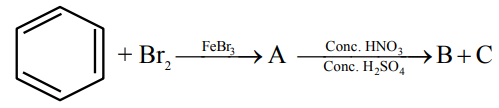
Answer: A-II, B-IV, C-I, D-III - 19. Method used for separation of mixture of products (B and C) obtained in the following reaction is:
 2026 Hard
- (A) Simple distillation
- (B) Sublimation
- (C) Steam distillation
- (D) Fractional distillation
Show answer and solution
Correct Answer: (D)
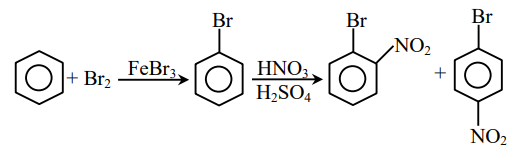
B & C separate by
Fractional Distillation method
Due to their different boiling point. -
- (A) \(0.42\)
- (B) \(0.82\)
- (C) \(0.62\)
- (D) \(0.12\)
Show answer and solution
Correct Answer: (D)
\(2\)-methylpropene reacts with dilute \(H_2SO_4\) to undergo hydration, forming tert-butyl alcohol as the major product (X).
The reaction is:
\(CH_2=C(CH_3)_2 \xrightarrow{\text{dil. } H_2SO_4} (CH_3)_3C-OH\)
Product (X) is an alcohol, which is significantly more polar than the starting alkene due to the presence of the \(-OH\) group. In normal phase chromatography, the stationary phase (such as silica gel) is highly polar. The polar \(-OH\) group forms strong hydrogen bonds with the stationary phase, causing the alcohol to be adsorbed more strongly than the non-polar alkene.
Consequently, the alcohol travels a shorter distance along the chromatography plate, resulting in a lower \(R_f\) value compared to the alkene.
Since the \(R_f\) value of \(2\)-methylpropene is \(0.42\), the \(R_f\) value of product (X) must be less than \(0.42\). Among the given choices, only \(0.12\) satisfies this condition.
Answer: \(0.12\) -
- (A) 40
- (B) 43
- (C) 45
- (D) 48
Show answer and solution
Correct Answer: (B)
Iodine gives violet colour
\(\%\) of \(I =\frac{\text { Atomic weight of } I }{\text { Molecular weight of } AgI } \times \frac{ m }{ W } \times 100\)
\(=\frac{127}{235} \times \frac{0.12}{0.15} \times 100\)
\(\%\) of \(I =43.23 \% \approx 43 \%\) -
- (A) 21
- (B) 0.42
- (C) 42
- (D) 0.21
Show answer and solution
Correct Answer: (C)
eq. of \(H_{2}SO_{4}\) = eq. of Ammonia
\(\Rightarrow \frac{15 \times 1 \times 2}{1000}\) = moles of ammonia \(\times 1\)
\(\Rightarrow\) Moles of ammonia = moles of 'N'
\(\Rightarrow\) Weight of nitrogen = \(\frac{15 \times 1 \times 2}{1000} \times 14 = 0.42\)
% weight of 'N' = \(\frac{0.42}{1} \times 100 = 42\)%
No questions on this page match these filters.