


Questions
16 questionsShowing 1–16 of 16 questions
-
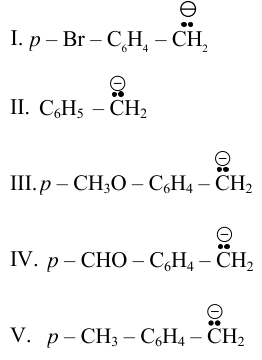
- (A) I > II > IV > V > III
- (B) I > IV > II > V > III
- (C) IV > I > II > V > III
- (D) IV > II > I > III > V
Show answer and solution
Correct Answer: (C)
Electron withdrawing groups increases stability of carbanion and electron donating groups decreases stability of carbanion. - 2. Consider the following compounds
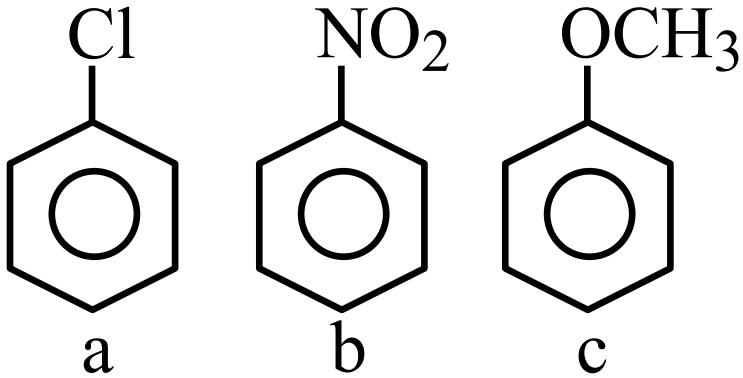
Arrange these compounds in the increasing order of reactivity with nitrating mixture. 2026 Hard- (A) \(c < a < b\)
- (B) \(b < c < a\)
- (C) \(c < b < a\)
- (D) \(b < a < c\)
Show answer and solution
Correct Answer: (D)
In Ph-OMe, -OMe is an electron donor group (+M).
\(Ph-NO_{2}\), \(-NO_{2}\) is strong withdrawing group (-M).
Ph-Cl, -Cl is a electron withdrawing group. -
- (A) \(x>y>z\)
- (B) \(y>z>x\)
- (C) \(z>x>y\)
- (D) \(x>z>y\)
Show answer and solution
Correct Answer: (C)
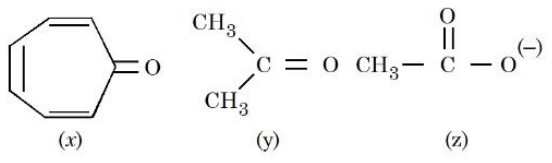
In acetone \((y)\), the carbon-oxygen bond is a localized double bond with a bond order of approximately \(2\).
In the acetate ion \((z)\), there are two equivalent resonance structures that delocalize the negative charge equally over both oxygen atoms. This results in a carbon-oxygen bond order of exactly \(1.5\).
In tropone \((x)\), the carbon-oxygen double bond is conjugated with the \(\pi\) system of the seven-membered ring. Polarization of the \(C=O\) bond leads to a resonance structure with a single \(C-O^{-}\) bond and a positive charge on the ring, forming an aromatic tropylium cation. This aromatic stabilization gives the \(C=O\) bond significant single-bond character. However, because this resonance structure involves charge separation, its contribution is less than that of the neutral structure. Thus, the bond order in tropone is between \(1.5\) and \(2\).
Since bond length is inversely proportional to bond order, the carbon-oxygen bond length is longest for the acetate ion (bond order \(1.5\)), followed by tropone (bond order between \(1.5\) and \(2\)), and shortest for acetone (bond order \(2\)).
Therefore, the correct order of carbon-oxygen bond length is \(z > x > y\).
Answer: \(z>x>y\) -
- (A) 11
- (B) 12
- (C) 13
- (D) 14
Show answer and solution
Correct Answer: (D)
The hydrocarbon with molecular formula \(C_5H_{10}\) has a degree of unsaturation of \(1\). Since its isomers do not decolourise \(KMnO_4\) solution, they do not contain any carbon-carbon double bonds. Thus, they must be cycloalkanes.
The possible structural isomers of cyclic \(C_5H_{10}\) and the number of their monochloro structural isomers are as follows:
1. Cyclopentane:
All carbon atoms are equivalent. Chlorination gives \(1\) monochloro product (chlorocyclopentane).
2. Methylcyclobutane:
There are \(4\) different types of hydrogen atoms (on the methyl group, on \(C_1\), on \(C_2/C_4\), and on \(C_3\)). Chlorination gives \(4\) monochloro products.
3. Ethylcyclopropane:
There are \(4\) different types of hydrogen atoms (on the \(CH_3\) of ethyl, on the \(CH_2\) of ethyl, on \(C_1\) of the ring, and on \(C_2/C_3\) of the ring). Chlorination gives \(4\) monochloro products.
4. 1,1-Dimethylcyclopropane:
There are \(2\) different types of hydrogen atoms (on the two equivalent methyl groups, and on the two equivalent \(CH_2\) groups of the ring). Chlorination gives \(2\) monochloro products.
5. 1,2-Dimethylcyclopropane:
There are \(3\) different types of hydrogen atoms (on the two equivalent methyl groups, on the two equivalent \(CH\) groups of the ring, and on the \(CH_2\) group of the ring). Chlorination gives \(3\) monochloro products.
Since each of these cycloalkanes has a different carbon skeleton, their monochloro derivatives will all be distinct structural isomers.
Total number of monochloro compounds (structural isomers only) = \(1 + 4 + 4 + 2 + 3 = 14\).
Answer: \(14\) -
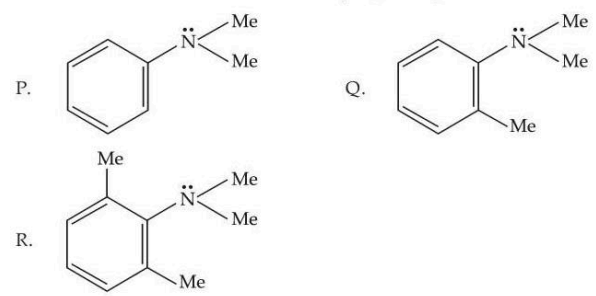
- (A) \(P > Q > R\)
- (B) \(R > P > Q\)
- (C) \(R > Q > P\)
- (D) \(P > R > Q\)
Show answer and solution
Correct Answer: (A)
The reaction of the given aromatic compounds with benzenediazonium chloride (\(Ph-N_2^+ Cl^-\)) is an azo coupling reaction, which is a type of electrophilic aromatic substitution.
The electrophile, the diazonium ion (\(Ph-N_2^+\)), is a weak electrophile and requires a strongly activated aromatic ring to undergo coupling. The reactivity of the ring depends on its electron density, which is enhanced by the \(+M\) (mesomeric) effect of the \(-NMe_2\) group.
1. In molecule P (N,N-dimethylaniline), the \(-NMe_2\) group is coplanar with the benzene ring. The lone pair on the nitrogen atom is fully delocalized into the ring, providing a strong \(+M\) effect and making the ring highly electron-rich and reactive.
2. In molecule Q, there is one methyl group at the ortho position to the \(-NMe_2\) group. This causes steric hindrance, forcing the \(-NMe_2\) group slightly out of the plane of the benzene ring. This phenomenon is known as Steric Inhibition of Resonance (SIR). As a result, the delocalization of the nitrogen lone pair into the ring is reduced, decreasing the \(+M\) effect and making it less reactive than P.
3. In molecule R, there are two methyl groups at the ortho positions. This causes severe steric repulsion, forcing the \(-NMe_2\) group almost completely out of the plane of the ring. The \(+M\) effect is minimized because the lone pair can no longer effectively overlap with the \(\pi\)-system of the ring. Consequently, the ring is the least activated among the three.
Therefore, the electron density on the aromatic ring and the reactivity towards electrophilic substitution follow the order: P \(>\) Q \(>\) R.
Answer: \(P > Q > R\) - 6. CORRECT order of stability for the following is
\( CH_{2}=CH^{-}, CH_{3}-CH_{2}^{-}, CH\equiv C^{-} \) 2026 Hard- (A) \( CH_{3}-CH_{2}^{-}>CH_{2}=CH^{-}>CH\equiv C^{-} \)
- (B) \( CH_{2}=CH^{-}>CH\equiv C^{-}>CH_{3}-CH_{2}^{-} \)
- (C) \( CH\equiv C^{-}>CH_{2}=CH^{-}>CH_{3}-CH_{2}^{-} \)
- (D) \( CH\equiv C^{-}>CH_{3}-CH_{2}^{-}>CH_{2}=CH^{-} \)
Show answer and solution
Correct Answer: (C)
\(CH _2= C \overline{ H }~CH _3= C _2~CH \equiv \overline{ C }\)
Stability \( \propto \) %S
Order of stability:
\( CH\equiv\overline{C}>CH_{2}=\overline{CH}>CH_{3}-C\overline{H}_{2} \) -
- (A) A, D & E only
- (B) B, D & E only
- (C) A, C & D only
- (D) B & D only
Show answer and solution
Correct Answer: (D)
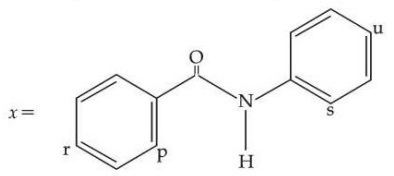
Statement B & D are not true - 8. For the given molecule, "\(x\)", the preferred site for the attack of the electrophile is :
 2026 Medium
- (A) Predominantly at "r"
- (B) "r" and "u"
- (C) "p" and "s"
- (D) Predominantly at "u"
Show answer and solution
Correct Answer: (D)
The given molecule, benzanilide, contains two phenyl rings with different reactivities towards electrophilic aromatic substitution.
The left phenyl ring is attached to the carbonyl carbon of the amide group (\(-C(=O)NHPh\)). The carbonyl group is electron-withdrawing due to its \(-M\) and \(-I\) effects, which deactivates this ring towards electrophilic attack.
The right phenyl ring is attached to the nitrogen atom of the amide group (\(-NHC(=O)Ph\)). The nitrogen atom possesses a lone pair of electrons that can delocalize into the ring via resonance (\(+M\) effect). This electron donation activates the right ring, making it significantly more reactive than the left ring.
The \(-NHC(=O)Ph\) group is an ortho/para directing group. The possible sites for electrophilic attack on the activated ring are the ortho position ('s') and the para position ('u').
Due to the large steric bulk of the \(-NHC(=O)Ph\) group, the ortho position ('s') experiences significant steric hindrance. Therefore, the electrophile will preferentially attack the less hindered para position.
Thus, the preferred site for the attack of the electrophile is predominantly at 'u'.
Answer: Predominantly at "u" -
- (A) Statement I is true but Statement II is false
- (B) Both Statement I and Statement II are true
- (C) Both Statement I and Statement II are false
- (D) Statement I is false but Statement II is true
Show answer and solution
Correct Answer: (A)
S-1 : \(\left( CH _3\right)_3 C ^{+}>\stackrel{+}{ C } H _3\); due to hyperconjugation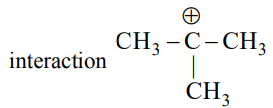
S-2 : False -
- (A) Both Statement I and Statement II are correct
- (B) Both Statement I and Statement II are incorrect
- (C) Statement I is correct but Statement II is incorrect
- (D) Statement I is incorrect but Statement II is correct
Show answer and solution
Correct Answer: (C)
Statement I is correct because alkyl groups exert a +I effect (electron-donating inductive effect). This increases the electron density on the negatively charged carbon atom, destabilizing the carbanion. Thus, as the number of alkyl groups increases, the stability of the carbanion decreases. The order of stability is \(\text{CH}_3^- > \text{CH}_3\text{CH}_2^- > (\text{CH}_3)_2\text{CH}^- > (\text{CH}_3)_3\text{C}^-\).
Statement II is incorrect because allyl and benzyl carbanions are highly stabilized by the resonance effect, where the negative charge is delocalized over the adjacent \(\pi\) bonds or the benzene ring, rather than by the inductive effect.
Answer: Statement I is correct but Statement II is incorrect -
- (A) B and D Only
- (B) C and A Only
- (C) A and D Only
- (D) B and C Only
Show answer and solution
Correct Answer: (D)
Presence of \(NO_{2}\) group in Benzene ring deactivate ring towards electrophilic substitution reaction due to -M effective & activate ring towards nucleophilic substitution. - 12. Increasing order of electron withdrawing power of following functional groups is:
a. \(-CN\)
b. \(-COOH\)
c. \(-NO_2\)
d. \(-I\) 2026 Easy- (A) \(c < b < d < a\)
- (B) \(c < a < b < d\)
- (C) \(d < b < a < c\)
- (D) \(a < b < c < d\)
Show answer and solution
Correct Answer: (C)
The electron withdrawing power (\(-I\) effect) of various functional groups follows the standard experimental order:
\(-NO_2 > -CN > -COOH > -F > -Cl > -Br > -I\)
Based on this series, the increasing order of electron withdrawing power for the given groups is:
\(-I < -COOH < -CN < -NO_2\)
This corresponds to the sequence \(d < b < a < c\).
Answer: \(d < b < a < c\) -
- (A) A-III, B-I, C-II, D-IV
- (B) A-III, B-IV, C-II, D-I
- (C) A-III, B-IV, C-I, D-II
- (D) A-I, B-III, C-IV, D-II
Show answer and solution
Correct Answer: (C)
Williamson synthesis involves the reaction of an alkyl halide with a sodium alkoxide to form an ether, which proceeds via a nucleophilic substitution (\(S_N2\)) mechanism. Thus, A matches with III.
Friedel-Crafts reaction involves the alkylation or acylation of an aromatic ring in the presence of a Lewis acid catalyst, which proceeds via an electrophilic substitution mechanism. Thus, B matches with IV.
Bromination of vinyl benzene (styrene) involves the addition of bromine across the carbon-carbon double bond, which proceeds via an electrophilic addition mechanism. Thus, C matches with I.
Chlorination of toluene in the presence of sunlight (or UV light) involves the substitution of hydrogen atoms in the methyl group by chlorine, which proceeds via a free radical substitution mechanism. Thus, D matches with II.
The correct matching is A-III, B-IV, C-I, D-II.
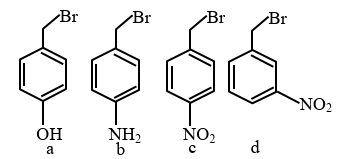
Answer: A-III, B-IV, C-I, D-II - 14. The correct order of reactivity of the following benzyl halides towards reaction with KCN is:
 2026 Medium
- (A) a > b > c > d
- (B) b > a > d > c
- (C) b > a > c > d
- (D) a > b > d > c
Show answer and solution
Correct Answer: (B)
This is \(S_{N}1\) reaction.
Rate of \(S_{N}1\) reaction \(\propto\) stability of carbocation. -
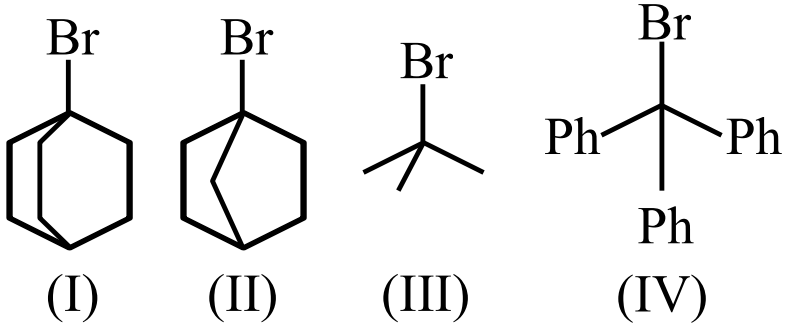
- (A) \(IV < III < II < I\)
- (B) \(III < I < II < IV\)
- (C) \(II < I < III < IV\)
- (D) \(I < II < III < IV\)
Show answer and solution
Correct Answer: (C)
Rate of \(S_{N}1\propto\) Stability of \(C^{\oplus}\) fromed
(I) and (II) are unstable due to Bredt's rule, (I) has more +I effect.
\((II) < (I) < (III) < (IV)\). -
- (A) \(PhO^{-} > ^{-}OH > CH_{3}COO^{-} > ClO_{4}^{-}\)
- (B) \(ClO_{4}^{-} > CH_{3}COO^{-} > ^{-}OH > PhO^{-}\)
- (C) \(CH_{3}COO^{-} > PhO^{-} > ^{-}OH > ClO_{4}^{-}\)
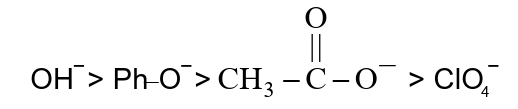
- (D) \({ }^{-} OH > PhO ^{-}> CH _3 COO ^{-}> ClO _4^{-}\)
Show answer and solution
Correct Answer: (D)
Stability order of anion: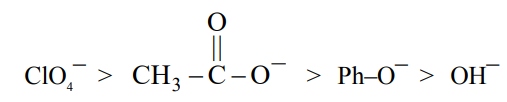 and nucleophlicity order reverse of stability of anion.
No questions on this page match these filters.