


Questions
10 questionsShowing 1–10 of 10 questions
-
- (A) 1312
- (B) 1086
- (C) 1402
- (D) 801
Show answer and solution
Correct Answer: (C)
Element E is N, the species is \(NH_{4}^{+}\), among B, C, N and O, N has highest first ionization energy. -
- (A) B, C and D Only
- (B) C, D and E Only
- (C) A, C and E Only
- (D) A and E Only
Show answer and solution
Correct Answer: (D)
Statement A is correct. Nitrogen in oxidation states from \(+1\) to \(+4\) tends to disproportionate in acidic medium. For example, \(3HNO_2 \rightarrow HNO_3 + H_2O + 2NO\).
Statement B is incorrect. Nitrogen does not have d-orbitals in its valence shell, so it cannot form \(d\pi - p\pi\) multiple bonds. It forms \(p\pi - p\pi\) multiple bonds.
Statement C is incorrect. The N-N single bond is weaker than the P-P single bond due to high interelectronic repulsion between the non-bonding electrons, which arises from the small N-N bond length.
Statement D is incorrect. Density increases down the group in group 15. Nitrogen is a gas and has the lowest density in its group, while bismuth has the highest.
Statement E is correct. Nitrogen has only four valence orbitals (one 2s and three 2p orbitals) available for bonding. Therefore, its maximum covalency is restricted to four.
Thus, only statements A and E are correct.
Answer: A and E Only -
- (A) N & As
- (B) As & Bi
- (C) Bi & N
- (D) As & Sb
Show answer and solution
Correct Answer: (A)
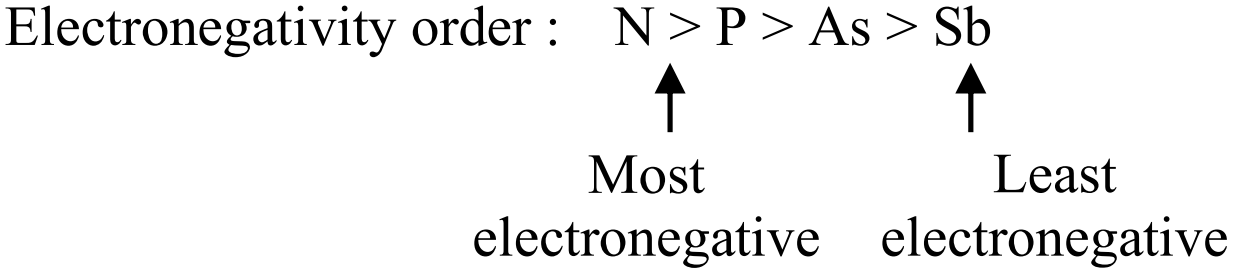
Element EN N 3.0 P 2.1 As 2.0 Sb 1.9 Bi 1.9
X = Nitrogen (N)
Y = Arsenic (As) -
- (A) A and B only
- (B) B and C only
- (C) A, B, C and D
- (D) A, C and D Only
Show answer and solution
Correct Answer: (C)
Statement A: The reducing nature of group 15 hydrides depends on the E-H bond strength. As the size of the central atom increases down the group, the E-H bond dissociation enthalpy decreases. Hence, the reducing character increases from NH\(_3\) to BiH\(_3\). This statement is correct.
Statement B: The basic character or the tendency to donate a lone pair of electrons depends on the electron density on the central atom. As the size of the central atom increases down the group, the electron density decreases. Thus, the basicity decreases from NH\(_3\) to BiH\(_3\). This statement is correct.
Statement C: Due to the decrease in E-H bond dissociation enthalpy down the group, the thermal stability of the hydrides decreases from NH\(_3\) to BiH\(_3\). This statement is correct.
Statement D: The H-E-H bond angle decreases down the group because the electronegativity of the central atom decreases and the size increases, causing the bond pairs to move further away from the central atom. This decreases the bond pair-bond pair repulsion. The bond angles are NH\(_3\) (\(107.8^{\circ}\)), PH\(_3\) (\(93.6^{\circ}\)), AsH\(_3\) (\(91.8^{\circ}\)), and SbH\(_3\) (\(91.3^{\circ}\)). This statement is correct.
All statements A, B, C, and D are correct.
Answer: A, B, C and D -
- (A) Both Statement-I and Statement-II are true.
- (B) Statement-I is true but Statement-II is false.
- (C) Both Statement-I and Statement-II are false.
- (D) Statement-I is false but Statement-II is true.
Show answer and solution
Correct Answer: (B)
\(X = N \quad X _2 O _3= N _2 O _3(\text { Acidic })\)
\(Y = Sb \quad Y _2 O _3= Sb _2 O _3(\text { Amphoteric })\)
Statement-I is true.
\(BCl_{3} + 3H_{2}O \rightarrow B(OH)_{3} + 3HCl\).
Statement-II is false. -
- (A) Statement I is true but Statement II is false
- (B) Both Statement I and Statement II are true
- (C) Statement I is false but Statement II is true
- (D) Both Statement I and Statement II are false
Show answer and solution
Correct Answer: (A)
Statement I :
Bond energy order is \(Cl _2> Br _2> F _2> I _2\)
Bond energy increases with increase in bond order.
Statement-II
Correct order of covalent character
According to the Fajan's rule, higher the charge on cation, greater is the covalent character.
\(PbCl _2< PbCl _4\)
\(UF _6> UF _4\),
\(SnCl _4> SnCl _2\) -
- (A) Both Statement I and Statement II are true
- (B) Both Statement I and Statement II are false
- (C) Statement I is true but Statement II is false
- (D) Statement I is false but Statement II is true
Show answer and solution
Correct Answer: (A)
Statement I: The electronic configuration of oxygen is \(1s^{2} 2s^{2} 2p^{4}\). Due to the absence of d-orbitals, its maximum covalency is limited to four (using one 2s and three 2p orbitals). Its covalency is generally two, but it can exceed two and go up to four in certain compounds. In \(SO_2\), oxygen is more electronegative than sulphur, so its oxidation state is \(-2\). In \(OF_2\), fluorine is more electronegative than oxygen, so the oxidation state of oxygen is \(+2\). Thus, Statement I is true.
Statement II: Oxygen differs from the rest of the group 16 elements due to its small atomic size, high electronegativity, and the absence of d-orbitals in its valence shell. This leads to its anomalous behaviour, such as the ability to form strong hydrogen bonds and \(p\pi-p\pi\) multiple bonds. Thus, Statement II is true.
Both Statement I and Statement II are true.
Answer: Both Statement I and Statement II are true -
- (A) Both Statement I and Statement II are true.
- (B) Statement I is false but Statement II is true.
- (C) Both Statement I and Statement II are false.
- (D) Statement I is true but Statement II is false.
Show answer and solution
Correct Answer: (C)
\(HF < HCl < HBr < HI\) (bond length order)
\(F < Cl < Br < I\) (radius order)
\(PH _3< AsH _3< NH _3< SbH _3< BiH _3\) (Boiling point order)
Maximum possible covalency of phosphorous is 6 -
- (A) Both Statement I and Statement II are true
- (B) Statement I is true but Statement II is false
- (C) Both Statement I and Statement II are false
- (D) Statement I is false but Statement II is true
Show answer and solution
Correct Answer: (A)
Correct order of
(i) Boiling point: \(HF > HI > HBr > HCl\)
(ii) Melting point: \(HI > HF > HBr > HCl\) -
- (A) A, B & C only
- (B) A & D only
- (C) A, B, C & D
- (D) B & C only
Show answer and solution
Correct Answer: (A)
Stability: \( NH_{3}>PH_{3}>AsH_{3}>SbH_{3}>BiH_{3} \)
Basicity: \( NH_{3}>PH_{3}>AsH_{3}>SbH_{3}>BiH_{3} \)
Reducing character : \(NH _3< PH _3< AsH _3< SbH _3< BiH _3\)
Boiling point: \(PH _3< AsH _3< NH _3< SbH _3< BiH _3\)
No questions on this page match these filters.